Reflection 1197
-Model of care in chronic disease: inclusion of a theory of
nursing
Luciana Gomes Furtado1, Maria Miriam Lima da Nóbrega2
1 Doctoral student in Nursing on the Postgraduate Nursing Program (PPGENF) at the Federal University of Paraíba (UFPB). Professor in the São Vicente de Paula Faculty of Nursing. Nurse at the Lauro Wanderley University Hospital of the UFPB. Paraíba, Brazil. E-mail: [email protected]
2 Ph.D. in Nursing.Associate Professor of the Department of Public Health Nursing and Psychiatry.Professor atPPGENF/ UFPB. Researcher for the National Council for Scientiic and Technological Development (CNPq). Paraíba, Brazil. E-mail: [email protected]
aBstract: In implementing the Chronic Care Model, the nurse has been indicated as key. The present study gives a theoretical relection which aims to relect on the integration of a theory of nursing into the Chronic Care Model. This relection originates from a thesis project, in the context of a University Hospital which is a benchmark in the attendance of patients with diabetes, in specialized and hospital care. This proposal relates four elements of the model for organizing the nursing care for this clientele, associated with Horta’s Basic Human Needs Theory. It is considered that using the Chronic Care Model, associated with Horta’s Basic Human Needs Theory, can advance nursing practice with this clientele, evidencing the practice’s elements and, consequently, evidencing the visibility of the nurse’s competences and practice activities in care for the chronic illnesses.
descriPtors: Nursing. Nursing theory. Chronic illness. Diabetes mellitus.
Modelo de cuidados na doenÇa crÔnica: inserÇÃo de uMa
teoria de enferMageM
resuMo: Na efetivação do Modelo de Cuidados na Doença Crônica, o enfermeiro tem sido apontado como a chave para a sua implementação. O presente estudo apresenta uma relexão teórica que objetiva reletir sobre a inserção de uma teoria de enfermagem no Modelo de Cuidados na Doença Crônica. Tal relexão emerge de um projeto de tese, no contexto de um hospital universitário, referência para o atendimento a pacientes com diabetes na atenção especializada e hospitalar. Nessa proposta, são relacionados quatro elementos do modelo para a organização do cuidado de enfermagem a essa clientela, associados com a Teoria das Necessidades Humanas Básicas, de Horta. Considera-se que utilizar esta associação poderá favorecer a prática de enfermagem a essa clientela, evidenciando os elementos da prática e, consequentemente, a visibilidade das competências e das atividades da prática do enfermeiro na atenção às doenças crônicas.
descritores: Enfermagem. Teoria de enfermagem. Doença crônica. Diabetes mellitus.
Modelo de atenciÓn en la enferMedad crÓnica:
la inclusiÓn de una teorÍa de enferMerÍa
resuMen: En la realización del Modelo de cuidados de enfermedades crónicas, la enfermera ha sido considerada como la clave para su implementación. Por lo tanto, este estudio presenta una relexión teórica que tiene como objetivo relexionar sobre la inserción de una teoría de enfermería en el Modelo de cuidados de enfermedades crónicas. Esta relexión surge de un proyecto de tesis en el contexto de un hospital universitario que es un referente para el cuidado de la diabetes en el hospital y la atención especializada. En esta propuesta, se relacionan con los cuatro elementos del modelo de organización de la atención de enfermería a estos clientes asociados con la Teoría de las Necesidades humanas básicas Horta. Se considera que el uso de esta asociación puede favorecer la práctica de la enfermería a esta clientela destacando los elementos de la práctica y por lo tanto la visibilidad de las actividades y competencias de la práctica de enfermería en la atención de las enfermedades crónicas.
introduction
At the beginning of this century, the chronic illnesses appear, in both the Brazilian and world setting, as responsible for the massive increase in the proiles of mortality and functional disabilities, caused by innumerable factors, including urban-ization, economic globalurban-ization, political and social measures and issues of social injustice – as well as the aging of the population.1
This situation led to the need to change the management of chronic illness, based on new mod-els of care, such as the Modelo de Atenção Crônica or
Modelo de Cuidados na Doença Crônica. These trans-lations were presented in the literature to refer to the Chronic Care Model(CCM); the Innovative Care for Chronic Conditions,(ICCC); the Pyramid Model of Risk; and Dahlgren and Whitehead’s Social Determination of Health Model.1-2
Among these models, the Chronic Care Model – the CCM – stands out. It was developed by Dr E. Wagner and collaborators at the MacColl Institute for Healthcare Innovation (Innovation de Seattle), in Seattle in the United States of America (USA), and is considered the most appropriate model for caring for the chronic illnesses, due to having been validated for, and being used in, more than ten countries.3 One should also note the fact that this model has a design which is basic but comprehensive, so as to organize care for the chronic illnesses and comply with the requirement to be based on scientiically-substantiated data, with a populational perspective, and centered on the service users.4
The CCM was devised to be a multidimen-sional solution for a complex problem, relying on a team of motivated professionals including the nurse, who takes on a fundamental role because of being in the front line of practice in terms of pro-viding the patient with information and education; establishing relationships with the clients, caregiv-ers and communities; providing continuity of care; using technology to optimize the provision of care; as well as supporting adherence to therapies in the long-term and promoting collaborative practice.1
In this perspective of the complexity of chronic illnesses, greater emphasis is placed on educational actions for self-care, the team of professionals necessarily presenting knowledges (physiopathology, nutrition, physical activity and speciic care), skills (knowing how to listen, communicate, lead, evaluate and work in a team) and attitudes (empathy, welcoming, motivating,
lexibility, creativity and initiative) directed to the organization and planning of such practices.5
In the light of the possibility of applying it in any chronic condition, this model was selected for re-designing the nursing care for the clientele with diabetes attended in specialized care, due to this being a priority in the health systems, as well as being a benchmark in the place of work of one of the authors.
As a result, this study aims to relect on the implications of the integration of a theory of nurs-ing in the Chronic Care Model, applied to the care for people with diabetes, attended in the outpa-tient endocrinology sector of a teaching hospital, so as to contribute with greater effectiveness to nursing care for this speciic clientele.
This article’s relections resulted from the thesis project of an ongoing doctorate course, whose object of investigation is the construction of a terminological subset of the International Classiication for Nursing Practice (ICNP®) for clients with diabetes mellitus in specialist care, as a facilitating instrument for the systematization of the nursing care directed at these people. First of all, the article presents the issue of the Chronic Care Model, where its development originated, its components, evaluation and its application; next, the role of nursing, with its activities and compe-tences; and, inally, a proposal for the integration of a theory of nursing in the Chronic Care Model.
the chronic care Model
The CCM was developed through a wide review of the international literature on the man-agement of the chronic illnesses, as a response to the situations of health involving a high prevalence of chronic conditions and the failure of the health care systems in the USA. Its authors believe that, based on this model, people can be better-attended and can live more healthily – and that in parallel, the health care costs can be reduced with the radi-cal change in the model of health care.2
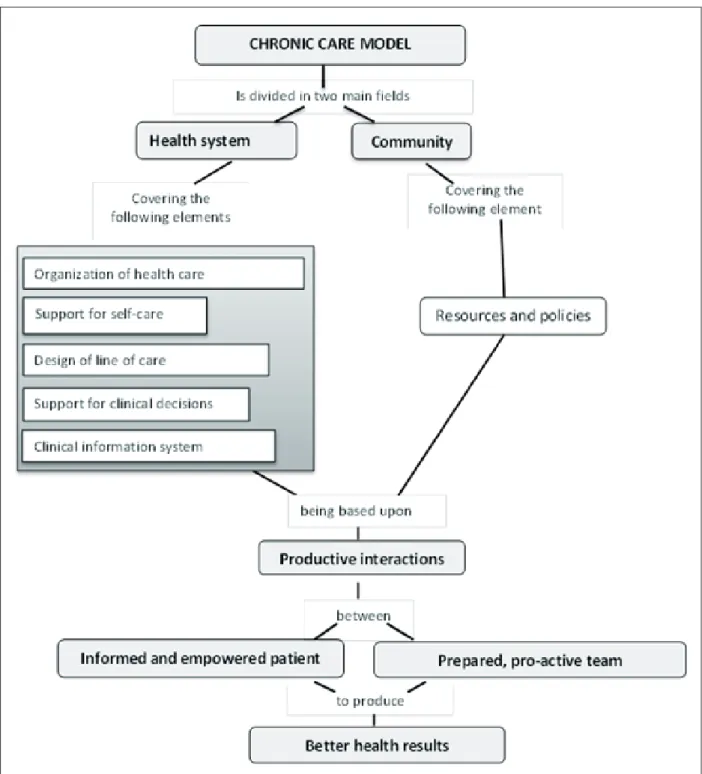
inter-relations allowing the development of people
who are informed and active, and of a health team which is prepared and pro-active to produce better health and functional results for the population.6
figure 1 – chronic care Model, adapted2
In order to implement the CCM, whether in its totality or partially, it is necessary to know what the use of each element requires, taking into account the changes which are required for each one. In ‘Organization of Health Care’, the changes aim to create a culture, organization and mecha-nisms which promote safe, high quality care; in
population and the service users, so as to facilitate more effective and eficient health care; in ‘Sup-port for self-care’, it is to prepare and empower the people for them to manage their own health and the care provided; while in ‘Resources and policies’, it is to mobilize these resources to meet the service users’ needs.2
In relation to the evaluation of the CCM, there is evidence in the international literature regarding its positive effects in the care for the chronic conditions, whether in joint evaluation, or in the evaluation of its elements separately. In spite of having been developed, applied and evaluated in the USA, the original proposal of the CCM has been adapted in various countries and situations and has generated a series of derived models in both developing and developed countries.2,4
This model finds a better environment for being implemented in public and universal systems of health care. In Brazil, these are used, partially, as part of innovative experiments in care for chronic illnesses in the Uniied Health System (Sistema Único de Saúde - SUS) in some munici-palities, accepted by the Ministry of Health in the Strategic Action Plan for Facing the Chronic Non-Transmissible Disease (NTD) 2011-2022, and also serve as the basis for the development of a new model applicable to the Brazilian public health system, termed the Model for Care for Chronic Conditions (MACC).2
the role of the nurse in the
chronic care Model
Nurses have been seen as leaders in chronic care, speciically in the participation in the CCM, which essentially presents productive interactions between the team and the patient. Research has evidenced that when this professional takes on the central role in her relationships with the diabetic patient, the latter’s glycated hemoglobin levels re-duce signiicantly, he comes to need the hospital less, and the rate of mortality and incidence of ad-verse events (myocardial infarction, angina, kidney disease) reduces, as a result of improving healthy behaviors through planned nursing consultations.7
It is believed that these positive results are due to the fact of there being a much better com-munication process between the nurse and the patient and to the nature of the former’s education and role, given that this professional uses strate-gies, such as the addressing of more comprehen-sive issues, not being restricted only to: treatment and diet; leadership of the client in discussing behavioral change; and the integration of shared care for the management of the diabetes.7
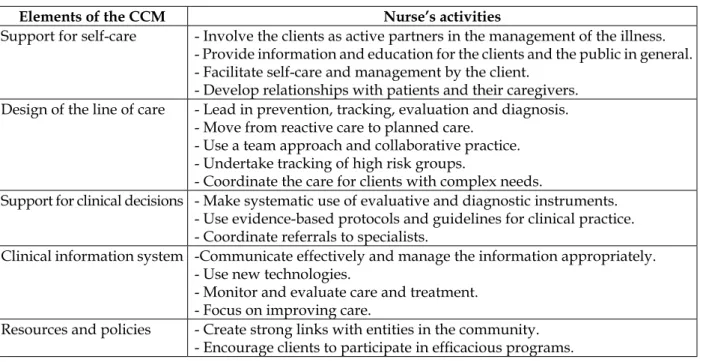
Table 1 shows the nurse’s activities in work-ing with the CCM, speciically for each of the model’s elements, as described by the Interna-tional Council of Nurses (ICN), which indicates the nurses as key elements for implementing it, due to their participating in a patient-centered care team.
table 1 – the chronic care Model and the nurses’ activities
elements of the ccM nurse’s activities
Support for self-care - Involve the clients as active partners in the management of the illness. - Provide information and education for the clients and the public in general. - Facilitate self-care and management by the client.
- Develop relationships with patients and their caregivers. Design of the line of care - Lead in prevention, tracking, evaluation and diagnosis.
- Move from reactive care to planned care. - Use a team approach and collaborative practice. - Undertake tracking of high risk groups.
- Coordinate the care for clients with complex needs.
Support for clinical decisions - Make systematic use of evaluative and diagnostic instruments. - Use evidence-based protocols and guidelines for clinical practice. - Coordinate referrals to specialists.
Clinical information system -Communicate effectively and manage the information appropriately. - Use new technologies.
- Monitor and evaluate care and treatment. - Focus on improving care.
Organization of health care - Commit to supporting the strategic development of the infrastructure of planned care.
- Adopt appropriate leadership roles in organizations and between organi
-zations.
- Develop agreements for the coordination of care. - Use and manage resources cost-effectively.
- Contribute to the undertaking of policies, planning and the management of services.
Source: ICN1.
For this, it is crucial for these professionals to acquire speciic competences to prevent and manage chronic illness, and thus to contribute with all their potential. These competences are to be found in an ICN publication, termed Nursing Care Continuum Framework and Competencies. Among the nine, the following stand out: partici-pating in activities related to improving access to the range of effective health services; respecting the client’s right to information, choice and self-determination in nursing and health care; dem-onstrating professional integrity, good character, and ethical conduct in response to the marketing strategies from the industry in prescribing drugs and other products, among others.1 In spite of the ICN indicating the activities and competences for the nurse to employ in practice, the lack of a theoretical nursing model for guiding care in this area is evidenced.
ProPosal for integrating a
nursing theory in the chronic
care Model
The proposal was perceived when the project was structured for the construction of a terminologi-cal subset of the ICNP® for people with diabetes mellitus under specialized care, for the Lauro Wan-derley University Hospital (HULW/UFPB), which stands out as a benchmark in care for the diabetic patient. It is intended that this subset should con-stitute an easily-accessible reference instrument for care, to improve the documentation of nursing care and promote the safety and quality of the health care in the above-mentioned clinical sector. The theoretical frameworks selected for the study were the CCM and the Basic Human Needs Theory.
The choice of the Basic Human Needs Theory is explained by the fact that it is the theoretical model upon which is based the HULW/UFPB’s Systematization of Nursing Care (SNC) project, as well as because of the understanding that, for appropriate and individualized nursing care, it is necessary to adopt a nursing process, based on a
speciic theory, which should be known to all the professionals of the institution in which the care is undertaken.
In this regard, the care proposal, in this study, was organized including four elements of the CCM (Figure 2), namely: support for the person with diabetes for self-care; structuring of the line of care for the person with diabetes, a clinical information system regarding the person with diabetes, and support for the clinical decision regarding the person with diabetes.
The selection by means of these four ele-ments brought into consideration the recommen-dations proposed in a recent evaluation of the CCM, in which the evidence suggested that the practices should be redesigned, in accordance with the various chronic illnesses, taking into account the speciic characteristics of each place of care.8
Thus, in order for the management of the care for the person with diabetes in the HULW/ UFPB endocrinology outpatient unit to have nurs-ing care planned in accordance with the basic human needs, allowing the achieving of positive results in the productive interactions between nurse and client, some changes were proposed in the selected elements of the CCM. These changes aimed to support the nursing process, understood as a theoretical-methodological instrument which guides the planning of the nursing care.
needs and in making him independent of this as-sistance, when possible, by teaching self-care – as well as recovering, maintaining and promoting health in collaboration with other professionals.9 Also taken into consideration, in this correlation, was the context present in the above-mentioned
endocrinology sector, where the nursing consulta-tion is not systematized, with the health educaconsulta-tion being worked on in separate stages (medication, diet, physical exercise, care for the feet), in sequen-tial consultations (verbal information) without any basis in a model or theory of nursing.
figure 2 – Management model for the person with diabetes in the specialized care at the hulW/ufPB
This being the case, it is believed that by undertaking these changes, based on the Theory of Human Needs, it will be possible to raise the awareness of people with diabetes regarding their need to make changes in their lifestyles,
resolution of problems, healthy coping, and the reduction of risks.
The second element refers to the Clinical information system regarding the person with diabetes. In this aspect, it is fundamental that the information from the clinical records should be organized and systematized, so as to make it possible to integrate it into the health information systems, making it possible to document the nurs-ing practice regardnurs-ing the stages of the nursnurs-ing process. This documentation takes place in the nursing consultation, in the stages of the nursing history, the nursing diagnosis, the care plan or nursing instructions (implementation of the care plan) and the progression of the nursing (report-ing of the successive changes which occur in the patient being assisted).
So as to support this organized and system-atized information from the nursing documenta-tion, it is necessary to use a nursing information system. In the present research, the ICNP® was chosen,10 due to being a terminology which rep-resents nursing worldwide, providing data for the representation of nursing practice in the health information systems.
In the current context, in the HULW/UFPB, no nursing information system is used for docu-menting the nurses’ practice in the consultations with the people with diabetes. This fact does not allow the representation of the nursing practice in a systematized way, thus compromising the vis-ibility of the nurses’ work in the context of the care given to the people with diabetes, and the com-munication of the nurses from the various sectors of the hospital involved in attending this clientele. The third element refers to the ‘Support for the clinical decision regarding the person with diabetes’, which should be directed by applying the nursing process, particularly when the nurse develops clinical reasoning, to identify the nursing diagnoses, and therapeutic reasoning, when she deines the planning and implements the nursing instructions. The objective is to promote individu-alized and holistic care based on identifying the needs of the person with diabetes, grounded in scientiic knowledge.
In this way, so as to ensure greater reliability and focusing in the nurse’s decision-making in the care for this speciic clientele, it is hoped that the ICNP®’s terminological subset for people with diabetes may be used in the specialized care, as a care benchmark. In this subset, the statements of the diagnoses, outcomes and nursing
interven-tions shall be based on Horta’s Basic Human Needs Theory,9 supporting the implementation of the nursing process in its various stages. It is reafirmed that the subsets or catalogs constitute a set of formulations of diagnoses, outcomes and nursing interventions for a group of clients or se-lected health priority, which must be supported in their structuring in a theoretical framework. The ICN proposed the development of these subsets, based on the ICNP®, as a strategy to strengthen the expansion of the use of this classiication on a worldwide scale, thus contributing to the uniica-tion of the language of nursing and, consequently, to the increase in the profession’s visibility in the different clinical settings.10
The fourth element, covered by the structur-ing of the line of care for the person with diabetes, is directed for there to be integration between the three levels of health care, which ensures the movement of referral and counter-referral among the patients who are referred via the Family Health Strategy to the endocrinology outpatient unit and to the internal medicine unit (endocrinology sec-tor), both of the HULW/UFPB, so that these clients may be better managed, and the complications arising from this illness be minimized.
In the light of the above, it is believed that the implications of the integration of a nursing theory in the CCM could bring positive results, as this would make effective care possible with the chronic ill-nesses, emphasizing the individualization of care11 in line with the needs of the person with diabetes.
Reiterating the data above, linked to the fact that the CCM is used by all the members of the health team, its application by the nurses, based on a speciic theory, could foster new knowledges in the improvement of the profession in the attention to chronic care, as the theories of nursing were con-ceptualized with the aim of organizing and system-atizing the issues which permeate the professional activities and generate knowledges which support them and support the practice itself.12
final considerations
In this process of restructuring the process of nursing care, it is relevant to consider the role of the nurse, who needs to relect on the need to improve his or her practice in chronic care, with tools which guide nursing practice in a safe, or-ganized and competent way, in which emphasis is placed on the use of the nursing process, based on a theoretical model, appropriate through the systematization of the nursing care.
Thus, based on the proposal presented, it is considered that using the CCM associated with Horta’s Basic Human Needs Theory can advance nursing practice for this clientele and evidence the elements of the practice (nursing diagnoses, outcomes and interventions) and, consequently, evidence the visibility of the nurse’s competences and practice activities in care for the chronic illnesses.
references
1. Conselho Internacional de Enfermeiros. Servir a
comunidade e garantir qualidade: os enfermeiros na
vanguarda dos cuidados na doença crônica. Portugal (PT): Ordem dos Enfermeiros; 2010.
2. Mendes EV. O cuidado das condições crônicas
na atenção primária à saúde: o imperativo da consolidação da estratégia da saúde da família.
Brasília (DF): Organização Pan-Americana da
Saúde; 2012.
3. Organização Pan-americana da Saúde. Linhas
de cuidado: hipertensão e diabetes. Brasília (DF):
Organização Pan-Americana da Saúde; 2010.
4. Barceló A, Luciani S, Agurto I, Ordunez P, Tasca R, Sued O. Melhoria dos cuidados crônicos por meio
das redes de atenção à saúde. Washington, DC (US):
OPAS; 2012.
5. Santos L, Torres HC. Práticas educativas em
Diabetes Mellitus: compreendendo as competências
dos proissionais da saúde. Texto Contexto Enferm
[online]. 2012 [acesso 2013 Mai 30]; 21(3):574-80.
Disponível em: http://www.scielo.br/pdf/tce/
v21n3/v21n3a12.pdf
6. Mendes EV. As redes de atenção à saúde. Ciênc
Saúde Coletiva [online]. 2010 [acesso 2012 Abr
05]; 15(5):2297-305. Disponível em: http://dx.doi. org/10.1590/S1413-81232010000500005
7. Bodenheimer T, MacGregor K, Stothart N. Nurses as leaders in chronic care: their role is pivotal in improving care for chronic diseases. BMJ [online]. 2005 [accessed 2012 Apr 06]; (330):612-3. Available
at: http://www.ncbi.nlm.nih.gov/pmc/articles/
PMC554894/
8. Coleman K, Austin B, Brach C, Wagner EH.
Evidence on the Chronic Care Model in the new
millenium. Health Affairs [online]. 2009 [accessed 2012 April 06]; 28(1):75-85. Available at: http:// content.healthaffairs.org/content/28/1/75.long 9. Horta WA. Processo de enfermagem. Rio de Janeiro
(RJ): Guanabara Koogan, 2011.
10. Coenen A, Kim TY. Development of terminology subsets using ICNP®. Int J Med Inform [online]. 2010 [accessed 2012 April 25]; 79(7):530-8. Available at: http://dx.doi.org.ez15.periodicos.capes.gov. br/10.1016/j.ijmedinf.2010.03.005
11. Wagner EH, Austin B, Davis C, Hindmarsh M, Schaefer J, Bonomi A. Improving chronic illness care: translating evidence into action. Health Affairs [online]. 2001 [accessed 2012 April 06]; 20(6):64-78. Available at: http://content.healthaffairs.org/ content/20/6/64.long
12. Rosa LM, Sebold LF, Arzuaga MA, Santos VEP, Ra-dünz,V. Referenciais de enfermagem e produção do
conhecimento cientíico. Rev Enferm UERJ [online].
2010 [acesso 2012 Abr 06]; 18(1):120-5. Disponível
em: http://www.facenf.uerj.br/v18n1/v18n1a21.pdf
Correspondence: Luciana Gomes Furtado
Rua Maria Eunice Guimarães Fernandes, 178 ap.902 58038-480 – Manaíra, João Pessoa, PB, Brazil. Email: [email protected]