ABSTRACT
BACKGROUND AND OBJECTIVES: Pain is a common symptom in people living with acquired immunodeiciency syndrome, being widely underreported and not treated. For this reason, there is the need for studies discussing the subject in the attempt to explain factors involved in this process and to look for adequate and efective therapies. So, this study aimed at relating pain level in people living with human immunodeiciency virus to socio-demographic and clinical variables.
METHODS: his was a descriptive and cross-sectional study with 261 individuals living with the human immunodeiciency virus. Visual analog scale for pain intensity and semi-structured interview for anamnesis were applied.
RESULTS: A total of 47.5% of individuals was found reporting mild pain/no pain; 24.1% with moderate pain and 28.4% with severe pain. here has been signiicant relationship between pain and gender (p=0.02), health status (p=0.001), health perception with regard to feeling ill or not (p=0.001) and infection stage (p=0.005). Pain was characterized as shooting (69%), piercing (55%) and burning (41%), with signiicant relationship with regard to pain intensity (p<0.001) and time (p<0.001). When the logistic regression model was applied, the fact of being a fe-male has represented a risk of 7.256 (p<0.001) for moderate pain and of 5.329 (p<0.004) for severe pain. With regard to age, age groups between 21 and 30 years (0.073; p<0.046), 41 and 50 years (0.068; p<0.023) and 51 and 60 years (0.063; p<0,030) were protection factors for the presence of moderate pain. With regard to health status, this variable was a risk factor for the pres-ence of moderate pain (8.13; p<0.038) and severe pain (11.73; p<0.005).
Pain level associated to socio-demographic and clinical variables
in people living with human immunodeficiency virus and acquired
immunodeficiency syndrome
Nível de dor associado a variáveis sócio-demográficas e clínicas em pessoas que vivem com o
vírus da imunodeficiência humana e a síndrome da imunodeficiência adquirida
Joelma Gomes da Silva1, Dimas Anaximandro da Rocha Morgan1, João Carlos Alchieri2, Humberto Jefferson de Medeiros1, Maria
Irany Knackfuss1
1. Universidade do Estado do Rio Grande do Norte, Mossoró, RN, Brasil. 2. Universidade Federal do Rio Grande do Norte, Natal, RN, Brasil.
Submitted in July 07, 2016.
Accepted for publication in January 31, 2017. Conlict of interests: none – Sponsoring sources: none.
Correspondence to:
Rua Nossa Senhora Perpétuo do Socorro, 1302 - Santa Delmira 59615-050, Mossoró, RN, Brasil.
E-mail: [email protected]
© Sociedade Brasileira para o Estudo da Dor
CONCLUSION: Pain was a prevalent symptom among people living with human immunodeiciency virus.
Keywords: Acquired immunodeiciency syndrome, Human im-munodeiciency virus, Pain.
RESUMO
JUSTIFICATIVA E OBJETIVOS: A dor é um sintoma comum em pessoas que vivem com a síndrome da imunodeiciência ad-quirida, sendo bastante subnotiicada e não tratada. Por esse mo-tivo, existe a necessidade de estudos que discutam a temática na tentativa de esclarecer os fatores envolvidos nesse processo e bus-car tratamentos adequados e eicazes. Dentro dessa perspectiva, o objetivo deste estudo foi relacionar o nível de dor em pessoas que vivem com o vírus da imunodeiciência humana, com variáveis sócio-demográicas e clínicas.
MÉTODOS: Pesquisa descritiva com caráter transversal, com 261 indivíduos vivendo com o vírus da imunodeiciência hu-mana. Foi aplicada a escala analógica visual para a intensidade da dor e entrevista semiestruturada como anamnese.
RESULTADOS: Foi encontrado um total de 47,5% indivíduos referindo dor leve/sem dor; 24,1% com dor moderada e 28,4% com dor intensa. Foi encontrada relação signiicativa entre a dor e o sexo (p=0,02), estado de saúde (p=0,001), percepção da saúde, quanto a se sentir doente ou não (p=0,001) e o estágio da infecção (p=0,005). A dor foi caracterizada em lancinante (69%), perfu-rante (55%) e em queimação (41%), sendo encontrada relação signiicativa entre essas variáveis (p<0,001). Foi possível encontrar também uma associação signiicativa com relação a intensidade da dor (p<0,001) e o tempo (p<0,001). Quando aplicado o modelo de regressão logística, o fato de ser mulher representou um risco de 7,256 (p<0,001) para a dor moderada e de 5,329 (p<0,004) para dor intensa. Com relação a idade, as faixas etárias de 21 a 30 anos (0,073; p<0,046), 41 a 50 anos (0,068; p<0,023) e 51 a 60 anos (0,063; p<0,030), apresentaram-se como fator de proteção para a presença de dor moderada. Com relação ao estado de saúde, esta variável apresentou-se como fator de risco para a presença de dor moderada (8,13; p<0,038) e intensa (11,73; p<0,005).
CONCLUSÃO: A dor foi um sintoma prevalente entre as pes-soas que vivem com o vírus da imunodeiciência humana. Descritores: Dor, Síndrome da imunodeiciência adquirida, Vírus da imunodeiciência humana.
INTRODUCTION
Pain is a complex multidimension physical and psychic ex-perience triggered by some primary stimulus and being in-luenced by sociocultural, family and gender context. So, the same stimulus might induce totally diferent painful respons-es in diferent individuals1,2.
his context may be also inluenced by a baseline disease, as it is the case of people living with human immunodeiciency virus (HIV) or with already installed acquired immunodei-ciency syndrome (AIDS), and this might happen due to three primary reasons: HIV symptom; other opportunistic disease or infection; adverse efect of antiretroviral therapy (ARVT). Pain is also a symptom which may be present in all stages of the disease in up to 90% of cases3.
Estimates reveal that approximately 80% of world population have inadequate access to moderate to severe pain manage-ment and that millions of people living with HIV/AIDS suf-fer of untreated severe pain4. It is also worth highlighting that HIV/AIDS is a major global health challenge, counting on 34.2 million people infected with HIV worldwide5. In Brazil, in 2012, 39185 cases of AIDS were notiied6.
So, one should take into consideration the presence not only of infectious complications but also of painful syndromes7. his study aimed at relating the level of pain of HIV/AIDS patients to socio-demographic and clinical variables.
METHODS
Descriptive, cross-sectional research carried out from Octo-ber 2013 to May 2015, in Hospital Rafael Fernandes, city of Mossoró, Rio Grande do Norte, Brazil.
To make up the sample, subjects attending the service for medical follow up and who voluntarily accepted to participate in the study were probabilistically and randomly selected. To determine the necessary number of HIV/AIDS individuals, sample size for inite populations calculation was applied, ac-cording to the following formula:
ʀ = Z 2.p.q.N
e2.(N – 1) + Z2.p.q
Where:
N= Population Size, in this study population is made up of 709 elements.
Z = Chosen conidence level 95% equal to 1.96.
p = proportion in which the phenomenon is observed. Value was p = 0.50.
According to Mattar8, if there are no previous estimates for p, 0.50 is admitted, thus obtaining the largest possible sample size. q = (1-p) proportion of non-occurrence of the phenomenon. e = sample error expressed in the variable unit. Sample error is maximum diference admitted by investigator between real population average. In this research, maximum error of 0.05 was admitted.
Transcribing values described for the formula, the following sample calculation is obtained:
ʀ = 1.96
2 . 0.5 . 0.5 . 709
0.052 . (709 – 1) + 1.962 . 0.5 . 0.5
ʀ = 680,92
1.77 + 0.96
ʀ = 680.92 2.73
ʀ = 249.4
A total of 249 questionnaires was needed to consider the sam-ple signiicant, thus being included 261 peosam-ple living with HIV/AIDS with minimum diagnostic time of six months; ages varied from 20 to 64 years; of both genders dwellers of Mossoró and neighbor cities, being excluded all individuals with cognitive abnormalities or unable to answer the ques-tionnaires.
Pain was evaluated with the visual analog scale (VAS) vali-dated in 19839.
his scale is considered a one-dimension tool, for evaluating just one aspect of pain, which is intensity; however, this is done in a minimally intrusive way. So, it classiies pain in mild (1-2), moderate (3-7) and severe (8-10).
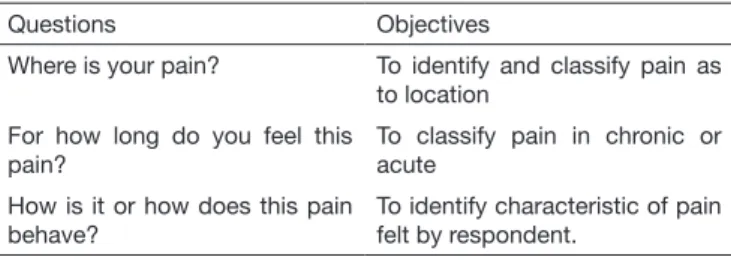
A semi-structured interview to evaluate other pain dimen-sions was developed to complement VAS pain investigation (Table 1).
Table 1. Semi-structured interview to evaluate pain dimensions
Questions Objectives
Where is your pain? To identify and classify pain as to location
For how long do you feel this pain?
To classify pain in chronic or acute
How is it or how does this pain behave?
To identify characteristic of pain felt by respondent.
With regard to other clinical variables associated to HIV/ AIDS a direct investigation was carried out asking individuals about their perception of their health, how they considered their health status, whether they felt ill or not, and the stage of their infection, mode and year when they were infected and year of the irst test.
his study was approved by the Ethics Committee, Univer-sidade do Estado do Rio Grande do Norte, opinion 421.293 in 2013.
Statistical analysis
be-ing expressed in mean±standard deviation, minimum and maxi-mum values, as well as simple frequency and percentage. To observe relationship between socio-demographic factors and pain levels in HIV/AIDS patients, odds ratio (OR), 95% conidence intervals and signiicance determined by Chi-square and Fisher Exact tests were used. he latter, in turn, was used whenever values with expected frequency below ive were found.
Logistic regression model was developed to study multiple ef-fects which might be involved with pain. When needed, vari-ables were translated into dummies. Values of p<0.05 were considered signiicant.
RESULTS
Table 2 shows results obtained by evaluated socio-demo-graphic indicators, showing association among studied vari-ables, with regard to the outcome of this study: pain. With regard to pain intensity (Table 2), there has been a to-tal of 47.5% individuals (n=124) referring mild or no pain, 24.1% individuals (n=63) with moderate pain and 28.4% (n=74) with severe pain.
With regard to age, there has been concentration of cases be-tween 41 and 50 years (34.9%), being also very close to the number of the group between 31 and 40 years of age (32.6%). Predominant education level was complete basic education
(49%); most people were single (36.8%), followed by people living as married (26.8%) and infection stage of most partici-pants of the study was AIDS (87%).
When pain was correlated to involved socio-demographic variables, it was possible to ind signiicant relationship only between pain and gender (p=0.02).
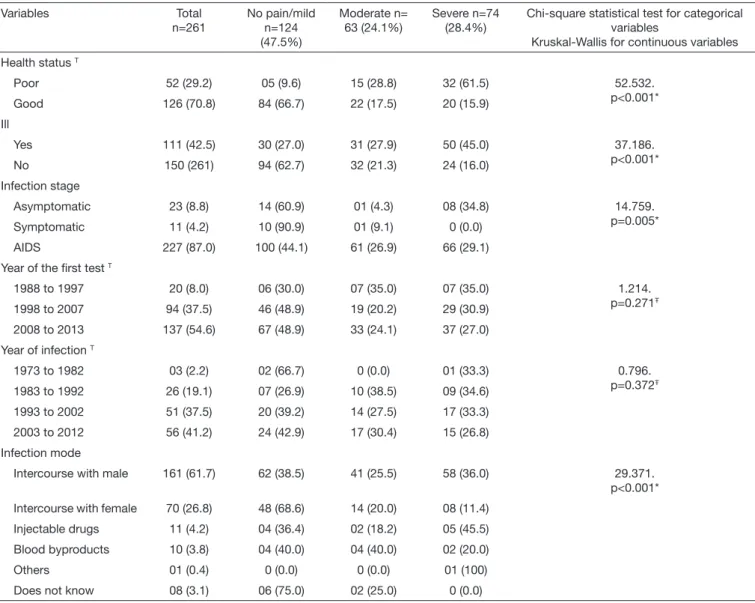
Table 3 shows results with regard to clinical aspects, being found signiicant associations between pain intensity and health status (p=0.001), health perception, as to feeling ill or not (p=0.001), and infection stage (p=0.005).
In our study, among those evaluating their health as poor, 61.5% have referred severe pain versus 28.8% referring mod-erate pain and 9.6% referring mild or no pain. Conversely, most people classifying their health as good belonged to the mild or no pain group (66.7%), having 17.5% referred mod-erate pain and 15.9% severe pain. With regard to considering themselves ill or not, those answering yes corresponded to 45% of those referring severe pain, 27.9% moderate pain and 27% mild or no pain.
With regard to infection mode, our study points to a signifi-cant correlation with the presence of pain, with higher con-centration among people acquiring HIV/AIDS by means of sexual intercourse with males. This fact might be explained because most participants of this study were females, thus showing a strong correlation between gender and presence of pain.
Table 2. Frequency values (%) of socio-demographic variables associated to pain level of evaluated patients
Variables Total n=261
No pain/mild n=124 (47,5%)
Moderate n= 63 (24,1%)
Severe n=74 (28,4%)
p value
Chi-square for categorical variables Kruskal-Wallis for continuous variables
Gender
Male 130 (49.8) 76 (58.5) 26 (20.0) 28 (21.5) 12.61. p=0.02* Female 131 (50.2) 48 (36.6) 37 (28.2) 46 (35.1)
Age (years)
21 to 30 32 (12.3) 19 (59.4) 08 (25.0) 05 (15.6) 2.369 p=0.124Ŧ
31 to 40 85 (32.6) 40 (47.1) 21 (24.7) 24 (28.2)
41 to 50 91 (34.9) 41 (45.1) 23 (25.3) 27 (29.7)
51 to 60 45 (17.2) 22 (48.9) 07 (15.6) 16 (35.6)
> 60 08 (3.1) 02 (25.0) 04 (50.0) 02 (25.0)
Education
None 67 (25.7) 25 (37.3) 16 (23.9) 26 (38.8) 8.059. p=0.234 Basic 128 (49.0) 69 (53.9) 27 (21.1) 32 (25.0)
High school 54 (20.7) 24 (44.4) 16 (29.6) 14 (25.9)
College 12 (4.6) 06 (50.0) 04 (33.3) 02 (16.7)
Marital Status
Single 96 (36.8) 42 (43.8) 20 (20.8) 34 (35.4) 11.918. p=0.291 Married 38 (14.6) 19 (50.0) 07 (18.4) 12 (31.6)
Stable relationship 70 (26.8) 38 (54.3) 18 (25.7) 14 (20.0)
Separate 24 (9.2) 09 (37.5) 07 (29.2) 08 (33.3)
Divorced 12 (4.6) 05 (41.7) 06 (50.0) 01 (8.3)
Widow(er) 21 (8.0) 11 (52.4) 05 (23.8) 05 (23.8)
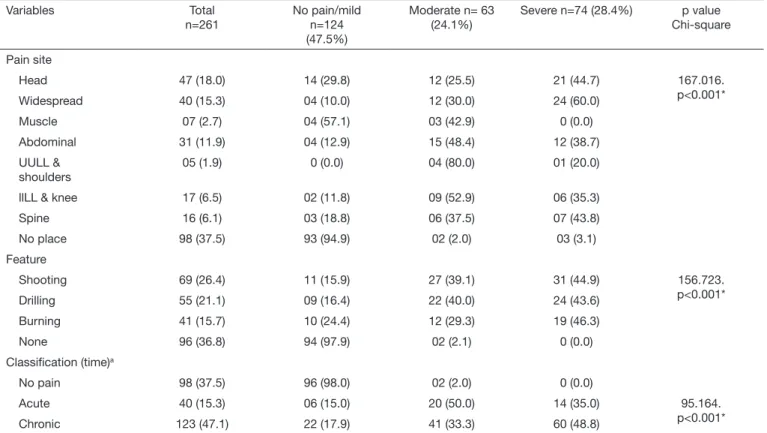
Still evaluating pain symptom and for this being a multidi-mensional variable, it may receive more than one classiica-tion. In our study, in addition to intensity, pain was classiied with regard to feature, site and duration (Table 4).
As to site, it was possible to ind signiicant association (p<0.001) with intensity according to the classiication of mild, moderate and severe. From total participants, 18% have referred headache and from this total, 44.7% have referred severe pain. Next was widespread pain where individuals re-ferring pain throughout the body were classiied, representing 15.3% of total, with higher concentration in the severe pain group (60%). Muscle (2.7%) and abdominal (11.9%) pains were also reported, and included all those referring stomach, bowel and kidneys pain, among other organs; upper limbs and shoulder (1.9%), lower limbs and knee (6.5%) and spine (6.1%). hese groups were determined according to partici-pants’ answers.
With regard to characteristic, it was possible to ind signii-cant association with regard to pain intensity (p<0.001),
be-ing especially characterized as shootbe-ing (69%), drillbe-ing (55%) and burning (41%).
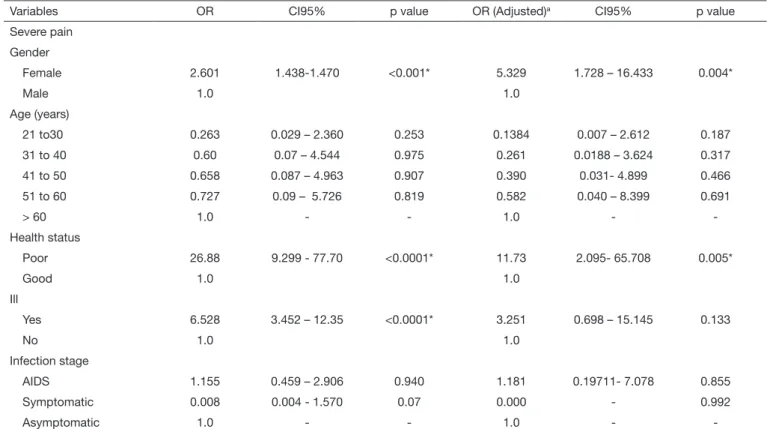
With regard to time, there has been signiicant association (p<0.001) with 15.3% with acute and 47.1% chronic pain. Table 5 illustrates multinominal logistic regression model with variables with value of p<0.2. At this moment, the risk for moderate and severe pain was identiied, taking as refer-ence the no pain/mild pain group.
With regard to gender, females had a risk of 7.256 (p<0.001) for moderate pain and of 5.329 (p<0.004) for severe pain.
With regard to age, it was possible to notice that groups from 21 to 30 years (0.073; p<0.046), 41 to 50 years (0.068; p<0.023) and 51 to 60 years (0.063; p<0.030) were protec-tion factors for the presence of moderate pain using as refer-ence the group above 60 years of age.
With regard to health status, this variable was risk factor for moderate (8.13; p<0.038) and severe (11.73; p<0.005) pain. Since classiication as good or poor was given by respondents
Table 3. Frequency values (%), clinical aspects and pain intensity of studied patients
Variables Total
n=261
No pain/mild n=124 (47.5%)
Moderate n= 63 (24.1%)
Severe n=74 (28.4%)
Chi-square statistical test for categorical variables
Kruskal-Wallis for continuous variables
Health status T
Poor 52 (29.2) 05 (9.6) 15 (28.8) 32 (61.5) 52.532. p<0.001* Good 126 (70.8) 84 (66.7) 22 (17.5) 20 (15.9)
Ill
Yes 111 (42.5) 30 (27.0) 31 (27.9) 50 (45.0) 37.186. p<0.001* No 150 (261) 94 (62.7) 32 (21.3) 24 (16.0)
Infection stage
Asymptomatic 23 (8.8) 14 (60.9) 01 (4.3) 08 (34.8) 14.759. p=0.005* Symptomatic 11 (4.2) 10 (90.9) 01 (9.1) 0 (0.0)
AIDS 227 (87.0) 100 (44.1) 61 (26.9) 66 (29.1)
Year of the irst test T
1988 to 1997 20 (8.0) 06 (30.0) 07 (35.0) 07 (35.0) 1.214. p=0.271Ŧ
1998 to 2007 94 (37.5) 46 (48.9) 19 (20.2) 29 (30.9)
2008 to 2013 137 (54.6) 67 (48.9) 33 (24.1) 37 (27.0)
Year of infection T
1973 to 1982 03 (2.2) 02 (66.7) 0 (0.0) 01 (33.3) 0.796. p=0.372Ŧ
1983 to 1992 26 (19.1) 07 (26.9) 10 (38.5) 09 (34.6)
1993 to 2002 51 (37.5) 20 (39.2) 14 (27.5) 17 (33.3)
2003 to 2012 56 (41.2) 24 (42.9) 17 (30.4) 15 (26.8)
Infection mode
Intercourse with male 161 (61.7) 62 (38.5) 41 (25.5) 58 (36.0) 29.371. p<0.001*
Intercourse with female 70 (26.8) 48 (68.6) 14 (20.0) 08 (11.4)
Injectable drugs 11 (4.2) 04 (36.4) 02 (18.2) 05 (45.5)
Blood byproducts 10 (3.8) 04 (40.0) 04 (40.0) 02 (20.0)
Others 01 (0.4) 0 (0.0) 0 (0.0) 01 (100)
Does not know 08 (3.1) 06 (75.0) 02 (25.0) 0 (0.0)
Table 4. Pain classiication with regard to site, feature and time
Variables Total
n=261
No pain/mild n=124 (47.5%)
Moderate n= 63 (24.1%)
Severe n=74 (28.4%) p value Chi-square
Pain site
Head 47 (18.0) 14 (29.8) 12 (25.5) 21 (44.7) 167.016.
p<0.001* Widespread 40 (15.3) 04 (10.0) 12 (30.0) 24 (60.0)
Muscle 07 (2.7) 04 (57.1) 03 (42.9) 0 (0.0)
Abdominal 31 (11.9) 04 (12.9) 15 (48.4) 12 (38.7)
UULL & shoulders
05 (1.9) 0 (0.0) 04 (80.0) 01 (20.0)
llLL & knee 17 (6.5) 02 (11.8) 09 (52.9) 06 (35.3)
Spine 16 (6.1) 03 (18.8) 06 (37.5) 07 (43.8)
No place 98 (37.5) 93 (94.9) 02 (2.0) 03 (3.1)
Feature
Shooting 69 (26.4) 11 (15.9) 27 (39.1) 31 (44.9) 156.723.
p<0.001* Drilling 55 (21.1) 09 (16.4) 22 (40.0) 24 (43.6)
Burning 41 (15.7) 10 (24.4) 12 (29.3) 19 (46.3)
None 96 (36.8) 94 (97.9) 02 (2.1) 0 (0.0)
Classiication (time)a
No pain 98 (37.5) 96 (98.0) 02 (2.0) 0 (0.0)
Acute 40 (15.3) 06 (15.0) 20 (50.0) 14 (35.0) 95.164.
p<0.001* Chronic 123 (47.1) 22 (17.9) 41 (33.3) 60 (48.8)
* Statistical signiicance (p<0.05); Chi-square for trend; UULL = upper limbs; llLL = lower limbs.
Table 5. Multinominal logistic regression model for socio-demographic and variables and clinical aspects of pain for people living with HIV/AIDS
Variables OR CI95% p value OR (Adjusted)a CI95% p value
Moderate pain
Gender
Female 2.253 1.21-4.18 0.012* 7.256 2.267-23.224 <0.001*
Male 1.0 1.0
Age (years)
21 to 30 0.211 0.032-1.39 0.159 0.073 0.005-0.958 0.046*
31 to 40 0.263 0.044-1.55 0.186 0.125 0.012-1.314 0.083
41 to 50 0.280 0.048-1.65 0.196 0.068 0.006-0.685 0.023*
51 to 60 0.159 0.024-1.06 0.063 0.063 0.005-0.765 0.030*
> 60 1.0 - - 1.0 -
-Health status
Poor 11.45 3.75-34.95 <0.001* 8.13 1.128-58.617 0.038*
Good 1.0 1.0
Ill
Yes 3.03 1.59-5.77 0.001 1.352 0.243-7.4971 0.730
No 1.0 1
Infection stage
AIDS 8.54 1.09-66.57 0.015* 5.04 - 1.0
Symptomatic 1.4 0.078-25.1 1.0 1.759 - 1.0
Asymptomatic 1.0 - - 1.0 -
and corresponded to their perception of their health, this fact is directly linked to symptoms load and perception in face of all this presentation.
DISCUSSION
Our results point to pain as common symptom in people living with HIV/AIDS, being present in any stage of infec-tion, in agreement with other studies10,11. Still confirming our results, another study12 after evaluating 302 ambulatory HIV/AIDS patients in Uganda, has found a total of 53% of individuals reporting mild pain, 20% moderate pain and 27% severe pain.
However, some authors have disagreed from our study when evaluating 156 individuals of whom 48.7% have reported pain, being that 51.3% had moderate to severe pain11. When pain was correlated to socio-demographic variables, and in line with the literature, it was possible to find sig-nificant relationship with gender, which has already been reported by other authors, being females with higher preva-lence of painful symptoms, being this fact associated to females’ anatomo-functional characteristics, as well as to modulation of some nervous system impulses, hormonal and psychological problems13,14.
Our results point to a higher number of females with mod-erate (28.2%) and severe (35.1%) pain. Conversely, most
males had no pain or mild pain (58.5%). In this same line of thought, some authors have found strong association be-tween pain and female gender15.
Confirming our results, a study with 354 Cuban participants (73 females, 281 males) has shown that pain significantly interfered with females as compared to males16. This was also true in a study by Norval17 with 103 adult HIV/AIDS patients, where it was possible to detect high prevalence of pain, being that females have referred more pain as com-pared to males, which strengthens even more our results, in spite of the different number of individuals in these studies. However, in disagreement with our study, other studies with populations living with HIV/AIDS, have not found significant differences between gender and the presence of pain12,18,19.
With regard to health status, it is classified as good or poor and the perception of feeling ill or not. So, these two vari-ables are intrinsically connected because they correspond to the individual perception of their health. Some studies have made this correlation between health perception and pain, finding an inversely proportional relationship between these variables20,21, which confirms our results.
Health perception is directly related to patients’ state of mind, how they position themselves in face of a chronic, permanent and full of stigmata disease, being reflected in the way patients decide to face potential challenges of the
Table 5. Multinominal logistic regression model for socio-demographic and variables and clinical aspects of pain for people living with HIV/AIDS – continuation
Variables OR CI95% p value OR (Adjusted)a CI95% p value
Severe pain
Gender
Female 2.601 1.438-1.470 <0.001* 5.329 1.728 – 16.433 0.004*
Male 1.0 1.0
Age (years)
21 to30 0.263 0.029 – 2.360 0.253 0.1384 0.007 – 2.612 0.187
31 to 40 0.60 0.07 – 4.544 0.975 0.261 0.0188 – 3.624 0.317
41 to 50 0.658 0.087 – 4.963 0.907 0.390 0.031- 4.899 0.466
51 to 60 0.727 0.09 – 5.726 0.819 0.582 0.040 – 8.399 0.691
> 60 1.0 - - 1.0 -
-Health status
Poor 26.88 9.299 - 77.70 <0.0001* 11.73 2.095- 65.708 0.005*
Good 1.0 1.0
Ill
Yes 6.528 3.452 – 12.35 <0.0001* 3.251 0.698 – 15.145 0.133
No 1.0 1.0
Infection stage
AIDS 1.155 0.459 – 2.906 0.940 1.181 0.19711- 7.078 0.855
Symptomatic 0.008 0.004 - 1.570 0.07 0.000 - 0.992
Asymptomatic 1.0 - - 1.0 -
-aOR (CI95%): odds ratio and 95% conidence interval adjusted by all variables listed in tables 1 and 2, by means of multinominal logistic regression; reference
disease and how they will cope with the treatment. So, a study with 953 people living with HIV/AIDS has stated that pain is directly related to health self-evaluation after finding significant relationship between pain and health status self-evaluation22.
With regard to infection stage, our study is in agreement with the literature because it is known that pain predomi-nance may vary depending on disease stage, care and treat-ment. This was proved by Bravin10 who has found in his prospective study 38% of ambulatory patients with HIV reporting significant pain, versus 50% of AIDS patients with the same symptoms; while just 25% of patients in early stages of infection have referred pain.
In agreement with our results, different studies have found significant relationship between pain, immune status and advanced disease stage, advanced infection stage and the ap-pearance of a larger number of symptoms and comorbidi-ties, reporting pain as a significantly common symptom in people living with HIV/AIDS (PVHA)12,18,23,24.
Conversely, however, a study with 79 PVHA, although hav-ing found pain as early symptom, has found weak and nega-tive correlation between pain and disease stage, without sta-tistical significance19.
With regard to mode of infection, our study points to a significant correlation with pain, with higher concentra-tion among those acquiring HIV/AIDS through sexual in-tercourse with males. This fact might be explained because most participants of this study were females and, as ob-served, there is strong correlation between gender and pain. With regard to other pain classifications, and in agreement with our results, other studies have also found the head as primary site of pain10,18,24. Similarly, other studies have found more common diagnoses: headache (46%), joint pain (31%) and muscle pain (27%)25; 40.9% had lower limbs pain, 44.4% neuropathic pain affecting feet, 31.8% ab-dominal pain, 31.8% head and neck, while just 4.5% had widespread pain19.
Differently from our results, another study has reported that pain was especially referred in abdomen and mouth (33%), followed by muscle pain (32%), joint or bone pain (20%)26, or even lower limbs (66%) followed by mouth pain (50.5%), headache (42.3%), throat ache (39.8%), chest pain (17.5%)17; joint (52.36%) and abdominal (50.37%) pain22. Another study with 157 participants has identified chest pain as primary pain site, followed by headache27. However, even with variations as to pain site prevalence among patients, our results, in general, are in line with the literature with regard to major pain sites referred by people living with HIV/AIDS.
It is important to stress that pain site might be associated to rheumatologic problems, which are very common among people with HIV/AIDS, as adverse effect of antiretroviral therapy and also due to opportunistic diseases19,25.
So, the association of pain site and intensity could be ex-plained by the infection stage, being associated to the pres-ence of comorbidities and the use of antiretroviral drugs,
which may induce nervous injuries being responsible for peripheral neuropathy pain, which may vary from mild to severe in addition to being incapacitating23,28.
With regard to characteristic there has been significant as-sociation with pain intensity (p<0.001), being primarily characterized as shooting (69%), drilling (55%) and burn-ing (41%), in agreement with other studies which have also established this classification29,30.
Understanding quality is critical for the establishment of some treatment goals. So, in a documental study as from medical charts of a reference hospital, it was possible to classify pain as radiating 33.3%), pulsing (20.0%), burn-ing (6.7%), jumpburn-ing (6.7%), pressburn-ing (6.7%), allodynia (6.7%), colic-type (6.7%) and widespread (6.7%)31.
With regard to time, it calls the attention the number of people with severe chronic pain (48.8%), since this pain is associated to a multifactorial character, but may also be re-lated to the association of mixed pathogenic mechanisms32.34. In case of people living with HIV/AIDS, this fact might be directly linked to disease stage, as well as to immune status, because there are estimates that approximately one million terminal patients suffer pain due to lack of treatment, being mostly classified as chronic pain1,3,35.
A study has found frequent pain reports in the two weeks previous to the study in 27 patients, 2% of the sample, be-ing that 22% have stated that pain persisted for more than three months, being then classified as chronic pain4.
Literature, however, is in disagreement with these results when reporting correlation of pain with early disease symp-tom, being that in our study correlation was weak and nega-tive with regard to stage, not being statistically significant19. Logistic regression analysis has shown relative risk of be-ing female and havbe-ing pain. These data strengthen previous discussions with regard to the association of female gender and pain.
Some studies have shown fragility of females with HIV/ AIDS to present pain, be it due to the burden of the dis-ease, which is considered higher for females, to cultural and economic disparities and education level, as well as to physi-ology, emotional and psychological states and gynecologic problems. These factors add to the fact that females are at risk for persistent, widespread and more severe pain. Among most common symptoms referred by females there are ra-diculopathies and headache36-38.
However, some studies disagree with this statement, as from relative risk measurement, not finding association between being female and the presence of pain12,18,39.
Our results also point to the fact that being younger is a pro-tection factor for pain in PVHA, which might be partially explained by the brittleness syndrome affecting the elderly40, as well as by the difficulty of diagnosing AIDS in the elderly primarily due to differential diagnosis41,42.
Another study18, after regression analysis, has found the variable age as risk of 1.03 (p<0.016) for the presence of pain. It is worth mentioning that there has been no division by age groups.
On the other hand, some authors report that younger adults are more prone to some symptoms related to HIV/AIDS, more specifically to headache45. However, the same authors have concluded that effects related to age as risk factor could be mistaken with those related to race. Another study has not found risk relationship between age and the appearance of symptoms such as pain44.
With regard to health status being a risk factor, this was be-cause classification was made as from individual perception, which is directly linked to symptoms load and perception with regard to the disease. A study has reported that the number of symptoms had 1.30 (p<0.03) risk for the pres-ence of severe pain12.
Similarly, other studies state that health self-evaluation is a risk factor for the presence of pain22,46.
CONCLUSION
In light of our results, it was possible to observe association between pain and some socio-demographic and clinic fac-tors in people living with HIV/AIDS.
REFERENCES
1. International HIV& AIDS charity. Pain in people with HIV. 2013. Disponível em: http://www.avert.org/aids-pain.htm. Acesso em: 08/07/2015.
2. Grünenthal F. Estudio EPIDOR: estudio epidemiológico del dolor en España. Socie-dade Espanhola de Reumatologia. Madrid: Edipharma; 2003.
3. Oliveira RM, da Silva LM, Pereira ML, Moura MA. [Pain management in patients with AIDS: analysis of the management structure of a reference hospital]. Rev Esc Enferm USP. 2013;47(2):456-63. Portuguese.
4. Robbins NM, Chaiklang K, Supparatpinyo K. Undertreatment of pain in HIV + adults in hailand. J Pain Symptom Manage. 2013;45(6):1061-72.
5. UNAIDS. UNAIDS report on the global AIDS epidemic 2012 “UNAIDS / JC2417E. Disponível em: http://www.unaids.org.br/sobre_aids/sobre_aids.asp. Aces-so em: 04 de março de 2015.
6. Brasil. Boletim Epidemiológico - AIDS/DST. (Ano VIII - nº 1 - 27ª a 52ª - semanas epidemiológicas - julho a dezembro de 2010; Ano VIII - nº 1 - 01ª a 26ª – semanas epidemiológicas - janeiro a junho de 2011). Ministério da Saúde. Ano VIII nº 01. 2012. Disponível em: http://www.aids.gov.br/pagina/publicacoes?page=1. Acesso em: 20/06/2013.
7. Aires EM, Bammann RH. Pain in hospitalized HIV-positive patients: clinical and therapeutical issues. Braz J Infect Dis. 2005;9(3):201-8.
8. Mattar F N. Pesquisa de marketing: metodologia, planejamento. 6a ed. São Paulo: Atlas; 2005.
9. Price DD, McGrath PA, Raii A, Buckingham B. he validation of visual ana-logue scales as ratio scale measures for chronic and experimental pain. Pain. 1983;17(1):45-56.
10. Bravin F. HIV+ e a dor crônica. Disponível em: http://drfranciscobravim.site. med.br/index.asp?PageName=HIV-2B-20e-20a- 20Dor-20Cr-F4nica. Acesso em 21/06/2015.
11. Merlin JS, Cen L, Praestgaard A, Turner M, Obando A, Alpert C, et al. Pain and physical and psychological symptoms in ambulatory HIV patients in the current tre-atment era. J Pain Symptom Manage. 2012;43(3):638-45
12. Namisango E, Harding R, Atuhaire L, Ddungu H, Katabira E, Muwanika FR, et al. Pain among ambulatory HIV/AIDS patients: multicenter study of prevalence, inten-sity, associated factors, and efect. J Pain. 2012;13(7):704-13.
13. Sarlani E, Greenspan JD. Gender diferences in temporal summation of mechanically evoked pain. Pain. 2002;97(1-2):163-9.
14. Quiton RL, Greenspan JD. Sex diferences in endogenous pain modulation by distrac-ting and painful conditioning stimulation. Pain. 2007;132(Suppl 1):S134-49. 15. Cipriano A, Almeida DB, Vall J. Peril do paciente com dor crônica
atendi-do em um ambulatório de atendi-dor de uma grande cidade atendi-do sul atendi-do Brasil. Rev Dor. 2011;12(4):297-300.
16. Calvetti PU, Giovelli GR, da Rosa CT, Gauer GJ, Moraes JF. Qualidade de vida em mulheres portadoras de HIV/Aids. Aletheia. 2012;(38-39):25-38.
17. Norval DA. Symptoms and sites of pain experienced by AIDS patients. S Afr Med J. 2004;94(6):450-4.
18. Aouizerat BE, Miaskowski CA, Gay C, Portillo CJ, Coggins T, Davis H, et al. Risk factors and symptoms associated with pain in HIV-infected adults. J Assoc Nurses AIDS Care. 2010;21(2):125-33.
19. Wahab KW, Salami AK. pain as a symptom in patients living with HIV/AIDS Seen at the outpatient clinic of a Nigerian Tertiary Hospital. J Int Assoc Physicians AIDS Care (Chic). 2011;10(1):35-9.
20. Siqueira FV, Facchini LA, Hallal PC. Epidemiology of physiotherapy utilization among adults and elderly. Rev Saude Publica. 2005;39(4):663-8.
21. Siqueira FV, Facchini LA, Piccini RX, Tomasi E, humé E, Silveira DS, et al. Ativi-dade física em adultos e idosos residentes em áreas de abrangência de uniAtivi-dades básicas de saúde de municípios das regiões Sul e Nordeste do Brasil. Cad Saúde Pública. 2008;24(1):39-54.
22. daCosta DiBonaventura M, Gupta S, Cho M, Mrus J. he association of HIV/AIDS treatment side efects with health status, work productivity, and resource use. AIDS Care. 2012;24(6):744-55.
23. Parker R, Stein DJ, Jelsma J. Pain in people living with HIV/AIDS: a systematic review. J Int AIDS Soc. 2014;17:18719.
24. Nair SN, Mary TR, Prarthana S, Harrison P. Prevalence of pain in patients with HIV/AIDS: a cross-sectional survey in a South Indian State. Indian J Palliat Care. 2009;15(1):67-70.
25. Hewitt DJ, McDonald M, Portenoy RK, Rosenfeld B, Passik S, Breitbart W. Pain syndromes and etiologies in ambulatory AIDS patients. Pain. 1997;70(2-3):117-23. 26. Larue F, Fontaine A, Colleau SM. Underestimation and undertreatment of pain in
HIV disease: multicentre study. BMJ. 1997;314(7073):23-8.
27. Ebirim LN, Otokwala JG. Inadequate pain relief in ambulatory patients with human im-munodeiciency virus disease in Port Harcourt. HIV/AIDS (Auckl). 2013;5:199-203. 28. Krashin DL, Merrill JO, Trescot AM. Opioids in the management of HIV-related
pain. Pain Physician. 2012;15(3 Suppl):E157-68.
29. Oliveira RM, Silva LM, Pereira ML, Gomes JM, Figueiredo SV, Almeida PC. Dor e analgesia em pacientes com síndrome da imunodeiciência adquirida. Rev Dor. 2012;13(4):332-7.
30. Fonseca JF, Britto MN. Terapias complementares como técnicas adjuvantes no contro-le da dor oncológica. Rev Saúde e Pesquisa. 2009;2(3):387-95.
31. Oliveira RM, da Silva LM, Pereira ML, Moura MA. [Pain management in patients with AIDS: analysis of the management structure of a reference hospital]. Rev Esc Enferm USP. 2013;47(2):456-63. Portuguese.
32. Castro LJ, Saramago P, Romão J, Paiva MD. A Dor Crónica em Portugal. Pain Propo-sal. 2011;24(12):1-12.
33. D’arcy Y. Compact clinical guide to acute pain management: an evidence-based ap-proach for nurses. New York: Springer Publishing Company; 2011.
34. Vellucci R. Heterogeneity of chronic pain. Clin Drug Investig. 2012;32(Suppl 1):3-10. 35. Alves Neto O, et al. Dor: princípios e prática. Porto Alegre: Artmed; 2008. 1438p. 36. PEPFAR: President’s Emergency Plan for AIDS Relief. Fact Sheet. Washington, DC:
Oice of the Global AIDS Coordinator; 2005.
37. Breitbart W, Passik SD, Reddy KS. Pain: clinical updates. IASP. 2006;4:1-8. 38. IASP. Task Force for Global Year Against Pain in Women. October 2007–2008: Fact
Sheet. Coller B. 2007. Pesquisado em: http://www.iasp-pain.org/GlobalYear/Pai-ninWomen. Acesso em: 20/06/2013
39. Cervia LD, Mcgowan JP, Weseley AJ. Clinical and demographic variables related to pain in HIV‐infected individuals treated with efective, combination antiretroviral therapy (cART). Pain Med. 2010;11(4):498-503.
40. Fhon JR, Diniz MA, Leonardo KC, Kusumota L, Haas VJ, Rodrigues RA. Síndro-me de fragilidade relacionada à incapacidade funcional no idoso. Acta Paul Enferm. 2012;25(4):589-94.
41. Azambuja KF. Peril do paciente HIV+ com mais de 60 anos no Estado do Rio de Janeiro. Disponível em: <http://www.aidscongress.net/7 congresso>. Acesso em: 28/08/ 2015. 42. Serra A, Sardinha AH, Pereira AN, Lima SC. Percepção de vida dos idosos
porta-dores do HIV/AIDS atendidos em centro de referência estadual. Saúde em Debate. 2013;37(97):294-304.
43. Humphreys J. A middle range theory of symptom management. In: Smith MJ, Liehr PR, eds. Middle range theory for nursing. New York: Springer Publishing Company; 2008. 145-58p.
44. Lee KA, Gay C, Portillo CJ, Coggins T, Davis H, Pullinger CR, et al. Symptom expe-rience in HIV-infected adults: a function of demographic and clinical characteristics. J Pain Symptom Manage. 2009;38(6):882-93.
45. Zingmond DS, Kilbourne AM, Justice AC, Wenger NS, Rodriguez-Barradas M, Ra-beneck L, et al. Diferences in symptom expression in older HIV-positive patients: the Veterans Aging Cohort 3 Site Study and HIV cost and service utilization study experience. J Acquir Immune Deic Syndr. 2003;33(Suppl 2):S84-92.