2013 July-Aug;21(4):920-7 www.eerp.usp.br/rlae
Corresponding Author: Luiza Jane Eyre de Souza Vieira Universidade de Fortaleza Av. Washington Soares, 1321 Bairro: Edson Queiroz
CEP: 60811-905, Fortaleza, CE, Brasil E-mail: [email protected]
Factors associated to the imposition of types of violence against women
informed in sentry services
Luiza Jane Eyre de Souza Vieira
1Renata Carneiro Ferreira
2Gracyelle Alves Remigio Moreira
3Ana Paula Soares Gondim
4Maria Alix Leite Araujo
5Raimunda Magalhães da Silva
51 PhD, Full Professor, Universidade de Fortaleza, Fortaleza, CE, Brazil. 2 MSc, Professor, Faculdade de Ensino Superior do Ceará, Fortaleza, CE, Brazil. 3 Doctoral student, Universidade Estadual do Ceará, Fortaleza, CE, Brazil.
4 PhD, Adjunct Professor, Centro de Ciências da Saúde, Universidade Federal do Ceará, Fortaleza, CE, Brazil. 5 PhD, Full Professor, Universidade de Fortaleza, Fortaleza, CE, Brazil.
Objective: to identify the prevalence and the factors associated to the imposition of the different
types of violence against women informed in sentry services. Method: transversal study
accomplished through 939 notification forms of cases of violence against women, referring to the
three years from 2006 to 2008 in Fortaleza, Ceará. Univariate and multiple analyses by logistic
regression were realized. Result: the results showed a positive association between the imposition
of types of violence against women with a schooling varying from illiterate to basic education and
the aggression which had occurred other times. Conclusion: this knowledge contributes to the
delineation of specific actions that aim at facing this problem, as well as generates subsidies for
adequate attendance proposals and guidance for the victims who call on health services.
Introduction
The violence against women is a phenomenon
that relects the inequalities of the genders in
society(1), establishing itself as public health problem
for the magnitude of its prevalence(2), seriousness and
recurrence, as well as for the negative consequences in
the life quality of the victims.
World-wide studies disclose high prevalence and
variability (15% to 71%) of the problem(3-4). In Brazil,
the mortality statistics show that every two hours there
is a homicide of a woman(5), representing the last degree
of an aggression scale that many times begins with the
psychological violence. The literature even presents
the close partners or former partners as the main
perpetrators of this violence(6-7).
Among the deinitions what violence against women is, the study is guided by the deinition from the Belém
de Pará Convention, adopted by the American States
Organization in 1994, which deines it as any action or
conduct based on gender, which causes death, damage
or physical, sexual or psychological suffering to the
woman, both in the public and in the private scope(8).
According to Law nº 11,340/2006, the types of
violence against women appear in physical, psychological,
sexual, patrimonial and moral forms(9). However, studies
warn about the interrelation of the different types of
violence, coniguring those cases into complex events
where these forms interlace, reverberating in the gravity
of the situations(6-7).
Understanding the phenomenon, the authors
defend the inluence of social factors in the occurrence
of those violence cases(10). Low schooling, poverty, lower
income of the women or unemployment, as well as the
use of alcohol and illicit drugs between the partners
seems to exacerbate the magnitude of the problem.
The violence against women has been a frequent
issue in the routine of the health services, which play
a basic role in diagnosis, registration, notiication and
treatment of the cases(11), beyond presenting themselves
as propitious places for the effectuation of necessary
strategies in the light of this problem.
The reference services for sentry violence were
instituted with the intention to contribute to the visibility of
the phenomenon through the potential that those present
in order to generate qualitatively high information. This
produced knowledge is essential for the implementation
of prevention strategies and control of the problem, for
the evaluation of the implemented actions and for the
planning of the resources and services(11).
The sentry services are responsible for the notiication of cases of violence against speciic groups according to Law Nº 10,778 that makes the notiication of violence
against women in the public and private health services
obligatory(12). It is important to add that Decree nº 104
of 25 January 2011 orders the domestic violence, sexual
and/or other types of violence as 45º event of obligatory
notiication throughout the national territory(13).
The increasing publication on the subject is
recognized, however the prevalence, the typological
diversity that enters the health services relects the
complexity of the problem and demands further
investigation. While the international organizations alert
the governments about the value of the human rights
and the reduction of the social inequalities, the integral
health of women still remains threatened by the force,
power and disrespect of the condition as citizen(8-9).
Considering that the professional nurse passes the
hierarchic levels of attention regarding the health of
women, the study contributes to the social practice of this
category, as the understanding of the phenomenon favors
the delineation of strategies and speciic actions, aiming at
the prevention and the confrontation of the violence against
this group, as well as fomenting the health promotion.
The study adopts as constructive analytical theories
the legal requirements that rule the subject, considering
the speciications of the violence against women(8-9,12-13).
In this meaning, to understand the factors that
can contribute to the imposition of the types of violence
against women, as well as sociodemographic and
behavioral characteristics of women in violent situations,
characteristics of the aggressions and the aggressors,
may well contribute to qualify the assistance, beyond
providing a contextual care on the part of the nurses.
Furthermore, facing violence is complex and is
associated to the lack of visibility of the problem for
different entities, especially for the health services.
In this context, the study has as objective to
identify the prevalence and the related factors to the
imposition of the different types of violence against the
woman informed in sentry services.
Methods
Transversal study that used as data source the
notiication forms of women who were violence victims
in Fortaleza, Ceará, referring to the period 2006 to
2008. Fortaleza, capital of the state Ceará, similar to
other Brazilian metropolises(2), concentrates a signiicant
Rev. Latino-Am. Enfermagem 2013 July-Aug.;21(4):920-7.
Putting the reader in the picture, at the time of the
study, the administration of violence against women in
Fortaleza was offered by four sentry services. The study
reached three of these services, enclosing 75% of the
notiications in the selected three years, which means,
960 cases.
For the accomplishment of the analysis, the study
took as base the notiications regarding women of
equal or superior age to 12 years who were residents in
Fortaleza. From the 960 present cases, 21 were excluded:
16 for aggression against women younger than 12 years
and ive for not identifying the type of violence, resulting
in 939 analyzed forms. For the accomplishment of the
data collection, one of the authors entered previously in
contact with the managers of these services, presented
the objectives of the research and scheduled appointment
dates and times to carry it out.
This stage was accomplished manually, form by
form, in the period from July to October 2009. Important
is to state that the collection of these data was made
in a reserved room, under surveillance of employees
of the respective services, considering the secrecy that
involves attendances of this nature.
The typologies of violence adopted in the study
followed the ones mentioned in the notiication form(15).
In this form, the occurrence data was considered that
are related to physical and psychological/moral violence,
recklessness/abandonment, sexual violence, torture
and patrimonial violence. It is worth to point out that
the form as well includes the human traficking and the
child labor, that for demanding other epistemological
concepts were not targets of this investigation.
The dependent 0 variable was the registration of
two or more types of violence against women and as
independent variables, sociodemographic data (conjugal
situation, age group, schooling, skin color, occupation,
sexual orientation, pregnancy, any kind of deiciency);
aggression data (place of occurrence, if it occurred other
times, number of involved people); aggressor data (gender,
type of relation with the victim, suspicion of alcohol use).
The variables were described in accordance with the
nomenclature referred to in the notiication form(15).
The chi-squared (χ2) test was used to analyze the
fact of women suffering two or more types of violence
in relation to the independent variables. P<0.05 was
established for statistic signiicance. The choice of
the variables for the construction of the multivariate
logistic regression model was based on the method of
automatic selection (Stepwise). The relation strength
between the independent and the dependent variables
was expressed in esteemed values of Odds ratio (OR)
gross and adjusted, with Reliability Interval (IC) of 95%.
The data were organized in the SPSS program (SPSS
Incorporation, Chicago, United States), version 16.0;
and analyzed through the STATA software (Stata Corp LP,
College Station, TX 77845, USA), version 11.0.
The research obeyed the norms of Resolution nº
196/96, of the National Health Authority that regulates
research with human beings and was approved by the
Committee for Ethics in Research of the University of
Fortaleza under concurring opinion nº 123/2009.
Results
Among the 939 analyzed forms, the frequency of
violence imposition against women was 73.9% (694).
Only one single type of violence was experienced by
245 women (26.1%), subdivided into psychological/
moral violence (85.7%), physical violence (74.9%),
recklessness/abandonment (18.2%), sexual violence
(13.3%), patrimonial violence (4.0%) and torture (2.7%).
The average age of the analyzed women who were
violence victims was 33.26 years (DP=11.05). The
average age among the women who were victims of two
or more types of violence was 33.32 years (DP=10.57)
and in the group of one single type of violence it was
33.08 years (DP=12.30).
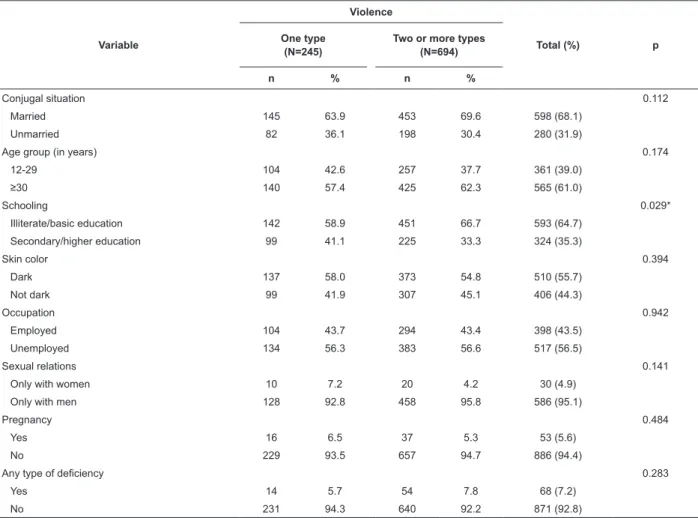
Married women of 30 or more years of age; who
have a schooling from illiterate to basic education; dark
skin; unemployed; having sexual relations only with
men; not pregnant and with no deiciency were the most
frequent victims (Table 1).
In Table 1 is to observe that the variable schooling
presented statistic signiicance (p=0.029) with the fact
of these women being victims of two or more types of
violence, whereas conjugal situation, age group, skin color,
occupation, sexual relations, pregnancy and any type of
deiciency did not present any signiicance (p>0.05).
In the group of women who suffered two or more
types of violence, the frequency of the place of the
aggression was highest in the residence (89.9%); the
violence was recurrent (91.4%); with the involvement of
one aggressor (88.2%); of masculine gender (97.5%);
close partner of the victim (73.8%); with suspicion of
alcohol consumption (66.5%). Among the women who
suffered a single type of violence, also the residence
predominated (81.6%); the aggression occurred several
times (80.5%); with one involved aggressor (89.5%); of
masculine gender (96.6%); close partner of the victim
Variable
Violence
Total (%) p
One type (N=245)
Two or more types (N=694)
n % n %
Conjugal situation 0.112
Married 145 63.9 453 69.6 598 (68.1)
Unmarried 82 36.1 198 30.4 280 (31.9)
Age group (in years) 0.174
12-29 104 42.6 257 37.7 361 (39.0)
≥30 140 57.4 425 62.3 565 (61.0)
Schooling 0.029*
Illiterate/basic education 142 58.9 451 66.7 593 (64.7)
Secondary/higher education 99 41.1 225 33.3 324 (35.3)
Skin color 0.394
Dark 137 58.0 373 54.8 510 (55.7)
Not dark 99 41.9 307 45.1 406 (44.3)
Occupation 0.942
Employed 104 43.7 294 43.4 398 (43.5)
Unemployed 134 56.3 383 56.6 517 (56.5)
Sexual relations 0.141
Only with women 10 7.2 20 4.2 30 (4.9)
Only with men 128 92.8 458 95.8 586 (95.1)
Pregnancy 0.484
Yes 16 6.5 37 5.3 53 (5.6)
No 229 93.5 657 94.7 886 (94.4)
Any type of deiciency 0.283
Yes 14 5.7 54 7.8 68 (7.2)
No 231 94.3 640 92.2 871 (92.8)
Variable
Violence
Total (%) p
One type (N=245)
Two or more types (N=694)
n % n %
Place of the occurrence <0.001*
Residence 191 81.6 605 89.9 796 (87.8)
Other place 43 18.4 68 10.1 111 (12.2)
Recurrent occurrence <0.001*
Yes 186 80.5 613 91.4 799 (88.6)
No 45 19.5 58 8.6 103 (11.4)
Number of involved people 0.573
One 214 89.5 605 88.2 819 (88.5)
Two or more 25 10.5 81 11.8 106 (11.5)
Gender of the aggressor 0.480
Female 08 3.4 17 2.5 25 (2.8)
Male 227 96.6 655 97.5 882 (97.2)
Table 1 - Sociodemographic characteristics in relation to the imposition of types of violence against women. Fortaleza,
CE, Brazil, 2006 to 2008
Table 2 - Characteristics of the aggression and the aggressor in relation to the imposition of different types of violence
against women. Fortaleza, CE, Brazil, 2006 to 2008
* Pearson chi-squared test; signiicant when p<0.05
In table 2, the majority of the variables showed
statistical signiicance (p<0,05) in the Univariate analysis,
with exception of the number of involved people and the
gender of the aggressor.
Rev. Latino-Am. Enfermagem 2013 July-Aug.;21(4):920-7.
Table 2 - (continuation)
Table 3 - Factors associated to women who suffer two or more types of violence. Fortaleza, CE, Brazil, 2006 to 2008
* Pearson chi-squared test; signiicant when p<0.05
Variable
Violence
Total (%) p
One type (N=245)
Two or more types (N=694)
n % n %
Relation with the victim 0.019*
Close partner 154 65.8 501 73.8 655 (71.7)
Other relation 80 34.2 178 26.2 258 (28.3)
Suspicion of alcohol use 0.024*
Yes 116 57.7 401 66.5 517 (64.3)
No 85 42.3 202 33.5 287 (35.7)
The non-adjusted analysis showed a positive
association between women who suffer two or more types
of violence with the schooling (OR=1.39;
IC95%=1.01-1.91); occurrence place (OR=2.00; IC95%=1.28-3.08);
recurrent aggression (OR=2.55; IC95%=1.63-3.97);
relation of the aggressor with the victim (OR=1.46;
IC95%=1.04-2.03) and suspicion of alcohol use by the
aggressor (OR=1.45; IC95%=1.03-2.04) (Table 3).
In the multiple logistic regression model is to
observe that there were positive associations of
women who suffer two or more types of violence, the
schooling varying from illiterate to basic education
(OR = 1.43; IC95% = 1.05-1.96) and recurrent aggression
(OR=2.41; IC95%=1.57-3.71) (Table 3).
Variable n %
Suffering two or more types of violence
Not adjusted Adjusted
OR (IC95%) p OR (IC95%) p
Conjugal situation
Married 598 75.7 1.29 (0.92-1.79) 0.112
Unmarried 280 70.7
Age group (in years)
12-29 361 71.1
≥30 565 75.2 1.22 (0.90-1.67) 0.174
Schooling
Illiterate/basic education 593 76.0 1.39 (1.01-1.91) 0.029* 1.43 (1.05-1.96) 0.022* Secondary/high education 324 69.4
Skin color
Dark 510 73.1
Not dark 406 75.6 0.87 (0.64-1.19) 0.394
Occupation
Employed 398 73.8
Unemployed 517 74.0 1.01 (0.74-1.37) 0.942
Sexual relations
Only with women 30 66.6
Only with men 586 78.1 1.78 (0.72-4.12) 0.141
Pregnancy
Yes 53 69.8
No 886 74.1 1.24 (0.63-2.33) 0.484
Any type of deiciency
Yes 68 79.4 1.39 (0.74-2.76) 0.283
No 871 73.4
Place of occurrence
Residence 796 76.0 2.00 (1.28-3,08) <0.001*
Other place 111 61.2
Variable n %
Suffering two or more types of violence
Not adjusted Adjusted
OR (IC95%) p OR (IC95%) p
Recurrent occorrence
Yes 799 76.7 2.55 (1.63-3.97) <0.001* 2.41 (1.57-3.71) <0.001*
No 103 56.3
Number of involved people
One 819 73.8
Two or more 106 76.4 1.14 (0.70-1.92) 0.573
Gender of the aggressor
Female 25 68.0
Male 882 74.2 1.35 (0.49-3.37) 0.480
Relation with the victim
Close partner 655 76.4 1.46 (1.04-2.03) 0.019*
Other relation 258 68.9
Suspicion of alcohol use
Yes 517 77.5 1.45 (1.03-2.04) 0.024*
No 287 70.3
Table 3 - (continuation)
* Pearson chi-squared test; signiicant when p<0.05
Discussion
This study presents as differentiation the
identiication of the factors associated to the imposition
of types of violence against women, investigations that
had chosen this speciic topic as research object being
scarce in Brazilian literature.
The indings showed a greater prevalence of
women being victims of two or more types of violence,
indicating that these overlap and hardly occur isolated.
Other inquiries had found similar results, emphasizing
the interlacement of the physical, sexual and
psychological aggressions, stating that the imposition
of several types of violence seems to be associated to
the higher seriousness of the cases and the demand for
specialized services(6-7,16).
The residence constitutes a privileged place for
the occurrence of these cases, reafirming what is
disclosed in literature(17-18) – that more than 90% of
the aggressions against women happen in the domestic
environment. The home is the most frequently chosen
place due to the fact that the aggressions are facilitated
through occurring in privacy, protected from the
interference of other people(18). In this form, the private
ambit that circumscribes the phenomenon restrains the
disruption and the visibility of the casuistry.
The biggest occurrence of the violence perpetrated
by the close partner of the victim, as found in this
research, expresses subordination and domination, in
which exist unequal distribution of privileges, rights and
duties, establishing asymmetries of power based on
the gender differences(19). The aggressions perpetrated
by the partner or former partner are recognized as
one of the most frequent forms of violence against
women(7,17,20). A study accomplished in the eastern region of India with 1,718 women certiied a higher
risk of violence on the part of the husband than any
another person(3).
Another relevant inding of this research that
reiterates literature(4,7) shows the association of the
alcohol use by the aggressor with the situations of
violence against women. Inquiries recognize the
ingestion of alcohol as an important factor of domestic
violence, which may be explained by the disinhibiting
effect on the behavior of the aggressors, as a way of
minimizing the responsibility for the violent behavior,
or even, the combination of the alcohol use with the
practice of violence may act as a denouncing factor of
the impulsive personality(21).
The authors(22) also demonstrated, in a research
of qualitative approach, the deriving upheavals of the
alcohol consumption in the families, emphasizing the
high levels of interpersonal conlicts which emerge in
several forms of domestic violence. However, the alcohol
is not mainly responsible for the aggressions, acting as
facilitator of previously determined situations(17).
The unadjusted bivariate analysis showed an
association between women being victim of two or more
types of violence with the variables: schooling, place
of occurrence, recurrent aggression, relation of the
aggressor with the victim and suspicion of alcohol use
Rev. Latino-Am. Enfermagem 2013 July-Aug.;21(4):920-7.
only the low schooling, varying from illiterate to basic
education, and the fact of the recurrent aggression
remain positively associated to the outcome.
The low educational level of the women who
are violence victims is shown in studies in other
countries(3,23) and in Brazil(16-17,24). In countries of
Southern Asia, the higher schooling levels have
become a factor of protection against violence forms(3).
A Brazilian research, accomplished through forms
of medical attendance and reports of legal medical
institutions, showed that most of the victims had not
concluded the basic education(17).
However, women of all educational levels face
situations of violence(7). What differentiates the behavior
of these women is, that the smartest ones had greater
personal autonomy, diminishing the tolerance towards
aggressions(4). And when becoming victims, almost always call on medical doctors’ ofices and particular law irms. In this manner, an underrepresentation in
the registrations can occur, associating the situations of
violence against women to poverty(7), since the majority
of the inquiries is accomplished in public services.
The manifestations of violence against women
present themselves in this study as directly associated
to the fact of the aggressions being recurrent,
indicating that the problem reveals itself in an intense
and repetitive form in the lives of the victims. The
authors(19,25) show that the women, many times, waive the formal denunciation for being inancially or
emotionally dependent on the aggressor, just as well
from fear or embarrassment of the exposition of the
case. This episode contributes to violence acquiring a
routine character.
Inquiries demonstrate that most of the aggressions
against women do not constitute a single event, but in
several episodes can last for decades(10,19). This context
collaborates with the level of gravity of the situations
of violence, reverberating negatively in the physical,
mental and social health of the victimized women. And
the consequences of this problem are clearly perceived
in the ambit of the health services, either for the
costs that they represent or for the complexity of the
attendance that they demand.
Conclusion
The results of this research showed as factors
associated to the imposition of different types of
violence against women the low schooling and the
recurrence of the aggression.
It is important to point out that the study in
question is one on demand of sentry services, and
the achieved indings cannot be generalized for the
population of female victims in general, considering
that a part of these victims at least calls on attendance.
However, this knowledge contributes to delineate
speciic actions that aim at the confrontation of this
casuistry, as well as it generates subsidies for adequate
proposal of attendance, guiding the victims that call on
the health services, contributing to the visibility of the
violence against women.
References
1. Ilha MM, Leal SMC, Soares JSF. Mulheres internadas por agressão em um hospital de pronto socorro: (in)visibilidade da violência. Rev Gaúcha Enferm. 2010;31(2):328-34.
2. Silva MA, Falbo GH Neto, Figueiroa JN, Cabral JE Filho. [Violência contra a mulher: prevalência e fatores associados em pacientes de um serviço público de saúde no Nordeste brasileiro]. Cad Saúde Pública. 2010;26(2):264-72. Inglês.
3. Babu BV, Kar SK. Domestic violence against women in eastern India: a population-based study on prevalence and related issues. BMC Public Health. 2009;9:129. doi:10.1186/1471-2458-9-129
4. Vieira EM, Perdona GSC, Santos MA. Fatores associados à violência física por parceiro íntimo em usuárias de serviços de saúde. Rev Saúde Pública. 2011;45(4):730-7. 5. Reichenheim ME, Souza ER, Moraes CL, Jorge MHPM, Silva CMFP, Minayo MCS. Violence and injuries in Brazil: the effect, progress made, and challenges ahead. Lancet. 2011;377(9781):1962-75.
6. Schraiber LB, D’Oliveira AFPL, Couto MT, Hanada H, Kiss LB, Durand JG, et al. Violência contra mulheres entre usuárias de serviços públicos de saúde da Grande São Paulo. Rev Saúde Pública. 2007;41(3):359-67. 7. Gadoni-Costa LM, Zucatti APN, Dell’Aglio DD. Violência contra a mulher: levantamento dos casos atendidos no setor de psicologia de uma delegacia para a mulher. Estudos Psicologia. 2011;28(2):219-27.
8. Decreto nº 1.973, de 1 de agosto de 1996 (BR). Promulga a convenção interamericana para prevenir, punir e erradicar a violência contra a mulher, concluída
em Belém do Pará, em 9 de junho de 1994. 1996.
[acesso 9 abr 2012]. Disponível em: http://www. jusbrasil.com.br/legislacao/112212/decreto-1973-96 9. Lei nº 11.340, de 07 de agosto de 2006 (BR). Cria
mecanismos para coibir a violência doméstica e familiar
Received: June 25th 2012 Accepted: Apr. 22nd 2013
10. Moura LBA, Gandolfi L, Vasconcelos AMN, Pratesi R. Violências contra mulheres por parceiro íntimo em área urbana economicamente vulnerável, Brasília, DF. Rev Saúde Pública. 2009;43(6):944-53.
11. Gawryszewski VP, Silva MMA, Malta DC, Mascarenhas MDM, Costa VC, Matos SG, et al. A proposta da rede
de serviços sentinela como estratégia da vigilância
de violências e acidentes. Ciência Saúde Coletiva. 2007;11(Sup):1269-78.
12. Lei nº 10.778, de 24 de novembro de 2003 (BR). Estabelece a notificação compulsória, no território nacional, do caso de violência contra a mulher que for atendida em serviços de saúde públicos ou privados. 2003. [acesso 14 mai 2012]. Disponível em: http:// www.abenfomg.com.br/site/arquivos/outros/09_LEI_ DE_NOTIFICACAO_VIOLENCIA.PDF
13. Portaria nº 104, de 25 de janeiro de 2011 (BR). Define as terminologias adotadas em legislação nacional, a relação de doenças, agravos e eventos em saúde pública de notificação compulsória em todo território
nacional e estabelece fluxos, critérios, responsabilidades
e atribuições aos profissionais de saúde. 2011. [acesso 20 jun 2012]. Disponível em: http://portal.saude.gov. br/portal/arquivos/pdf/portaria_104_26_2011_dnc.pdf 14. Diniz K. Em Fortaleza, violência contra a mulher
é epidemia crônica. Grupo UN 15 dez 2011. [acesso
20 junho de 2012]. Disponível em: http://www. grupoun.net/em-fortaleza-violencia-contra-a-mulher-e-epidemia-cronica/
15. Ministério da Saúde (MS). Sistema de informação
de agravos de notificação (SINAN), ficha de notificação/
investigação individual, violência doméstica, sexual e/ou
outras violências. Brasília – 2008. 2008. [acesso 13 mar 2012]. Disponível em: http://saude.gov.br/svs
16. Kronbauer JFD, Meneghel SN. Perfil da violência de
gênero perpetrada por companheiro. Rev Saúde Pública 2005;39(5):695-701.
17. Garcia MV, Ribeiro LA, Jorge MT, Pereira GR, Resende AP. Caracterização dos casos de violência contra a mulher atendidos em três serviços na cidade
de Uberlândia, Minas Gerais, Brasil. Cad Saúde Pública.
2008;24(11):2551-63.
18. Leôncio KL, Baldo PL, João VM, Biffi RG. O perfil de
mulheres vitimizadas e de seus agressores. Rev Enferm UERJ. 2008;16(3):307-12.
19. Deeke LP, Boing AF, Oliveira WF, Coelho EBS. A
Dinâmica da Violência Doméstica: uma análise a partir
dos discursos da mulher agredida e de seu parceiro. Saúde Soc. 2009;18(2):248-58.
20. Lettiere A, Nakano AMS. Violência doméstica:
as possibilidades e os limites de enfrentamento. Rev. Latino-Am. Enfermagem. 2011;19(6):1421-8.
21. Rovinski SLR. Dano psíquico em mulheres vítimas de violência. Rio de Janeiro: Lumen; 2004. 271 p.
22. Reinaldo AMS, Pillon SC. Repercussões do alcoolismo nas relações familiares: estudo de caso. Rev. Latino-Am. Enfermagem. 2008;16(esp):529-34.
23. Oyunbileg S, Sumberzul N, Udval N, Wang JD, Janes CR. Prevalence and Risk Factors of Domestic Violence among Mongolian Women. J Women’s Health. 2009;18(11):1873-80.
24. D’Oliveira AFPL, Schraiber LB, França-Junior I, Ludermir AB, Portella AP, Diniz CS, et al. Fatores associados à violência por parceiro íntimo em mulheres brasileiras. Rev Saúde Pública. 2009;43(2):299-310. 25. Lima VLA, Souza ML, Monticelli M, Oliveira MFV, Souza CBM, Costa CAL, et al. Violência contra
mulheres amazônicas. Rev. Latino-Am. Enfermagem.
2009;17(6):968-73.
Erratum
Issue v21n4, page 920
For
Maria Alix Leite Araujo4
Raimunda Magalhães da Silva5
Read
Maria Alix Leite Araujo5
Raimunda Magalhães da Silva5
For
4 PhD, Adjunct Professor, Centro de Ciências da Saúde, Universidade Federal do Ceará, Fortaleza, CE, Brazil.
5 PhD, Full Professor, Centro de Ciências da Saúde, Universidade Federal do Ceará, Fortaleza, CE, Brazil.
Read
4 PhD, Adjunct Professor, Centro de Ciências da Saúde, Universidade Federal do Ceará, Fortaleza, CE, Brazil.