THE WORK OF SPEECH THERAPISTS UNDER
SUPPORT CENTERS FOR FAMILY HEALTH (NASF) –
SPECIFICITIES OF PRIMARY CARE
O trabalho do fonoaudiólogo no núcleo de apoio à saúde da família
(NASF) – especificidades do trabalho em equipe na atenção básica
Carla Soleman (1), Cleide Lavieri Martins (1)
(1) Faculdade de Saúde Pública da Universidade de São
Paulo FSP/USP, São Paulo, SP, Brasil.
Source of support: CNPQ (Master Scholarships 2010-10 months).
Conlict of interest: non-existent
some regulations of the original Order has been
modiied over that period, with the most recent
determinations regarding the regulation of NASF are in the MS / GM No. 2.488, of 21st, October 2011,
which updates the National Primary Care Policy ¹,
and Ordinance No. 3.124, of 28th, December 2012,
which redeines the binding parameters of the NASF Primary Care Teams ².
The NASF are made up of a team, in which professionals from diferent areas of knowledge, among them Speech Therapy, work in an integrated way and together with the professionals of the Family Health teams, sharing and supporting
health practices in the territories under the
respon-sibility teams, assisting them in health promotion and disease prevention, diagnosis, the deinition
INTRODUCTION
In order to support the insertion of the Family Health Strategy (FHS) in the Network services and expand the scope, resolution, territorial, regional
-ization and actions of Primary Health Care (PHC) in Brazil , 2008, the Ministry of Health created the Centers of Support for Family Health (NASF). Due to the experiences lived since then signaled the dii
-culties of a new care model still in experimentation,
ABSTRACT
Purpose: to understand the work of the speech therapist in the Support Center for Family Health,
identifying incorporated technologies to the traditional professional work process. Methods: these
people are speech therapist of São Paulo / SP Support Center for Family Health team. Through online questionnaire, were raised information about the training and work processes of speech therapist as a supporter in these teams. The quantitative data were analyzed using a Descriptive Statistics and qualitative according to the precepts of Thematic Category Analysis, under the theoretical reference Health Work. Results: the work process was characterized from the elements that compose it, and
the object of work consists on the Family Health team and the population described, with support and instruments consist on technological tools recommended by the Health Ministry. The conformation team is varied and work organization start on matricial meetings. Their practices involve actions to support assistance, technical and pedagogical actions support, articulations actions of Network and work management actions and the speech therapists have a new knowledge and strategies through the shared work. Conclusion: on the Primary Care, the performance possibilities can be speciic or
shared, the knowledge core or in general , the focus depends on the characteristics of territory and availability. The training does not guarantee the necessary skills, with incorporation of new practices from the experiences in service.
KEYWORDS: Family Health; Speech, Language and Hearing Sciences; Primary Health Care;
prepare the speech therapist to understand and act in these circumstances, to be more focused on individual assistance.
The institution of the Family Health Support
Centers came to consolidate this space on speech
therapist actions within Primary Health Care, and is characterized as the main ield of work within that level of care. It is recognized in NASF the opportunity for the speech therapist acts in family and social context, contributing for transformation of health care, working in an interdisciplinary approach in the
formulation of therapeutic projects that consider the people and their needs.
Due to peculiarities of Primary Care and NASF work , note that the speech therapy as well as other professions, inds it diicult to enter and work in the
logic proposed, given the basic training does not
include many concepts and tools already cited here as essential to the organization of work in this service. Traditionally trained and active for specialties, speech therapists usually work in rehabilitation with speciic techniques for individualized treatments, making it diicult to view and work as support staf. For many professionals, interaction with a multi
-disciplinary team, or with families and community leaders, as well as more targeted actions for the
intersectoral coordination and collective involve
learning about a new way of acting.
This article presents some of results obtained in the survey conducted for the master’s thesis “The work of speech therapist in the Centers of Support for Family Health (NASF) – comprising practices from the composition of work process” (Soleman) ³, the School of Public Health University of São Paulo, and aims to understand the work of the speech therapist in the Support Center for Family Health, identifying technologies incorporated into the tradi
-tional work of this professional process.
METHODS
The research project was reviewed and approved by the Ethics Committee Research of Public Health School of São Paulo University (the research protocol No. 2241), and also by Ethics Committee Research of the Municipal Secretary Health of São
Paulo (Opinion No. 99/11).
This is a descriptive study, in which the quanti -tative and quali-tative approaches to the collection
and analysis of data were used.
The universe of this study consists of speech
therapist professional members of NASF teams in São Paulo / SP. According to the Coordination of
Primary Municipal Health Department, in the period of data collected, in 2012, the county had 87 NASF
teams, including 70 contracted speech therapist
of therapy, recovery and rehabilitation, so that the ESF is resolute in as many situations that are within the competence of Primary Care. With increasing capacity of basic care, it is expected that the secondary and tertiary levels are less ordered and consequently more resolute ¹.
The NASF is part of Primary Care, but do not
constitute as independent services and are in free
access to individual therapy or collective, that is, do not constitute as system gateway to the users, but as the rear for Family Health teams. Should act from demands identiied in working with these teams, and integrated to the Health Care Network and its services¹. Must be committed also to the
promotion of changes in attitude and actions of ESF
professionals and its own NASF team, including the intersectoral and interdisciplinary performance
shares, in addition to the humanization of services, continuing education, social participation, promoting
wholeness and territorial organization of health
services.
Through the expansion of the clinic, assisting in increasing the capacity of analysis and intervention
on health problems and needs, both in clinical
terms as health, the NASF seek to contribute to a
comprehensive care to SUS users and overcome the fragmented logic of health for construction
of attention and networks care, involved with the Family Health teams. The organization of work processes, always focused on the territory under its responsibility, should be structured discussion prior
-itizing cases, shared care with knowledge exchange
and mutual responsibilities, training generating
experience for all professionals, joint construction projects therapeutic interventions in the territory and the health of collectivity ¹.
According to the guidelines of the Ministry of Health, direct interventions of NASF professionals front of users and families must be carried out only in situations where the Family Health team has already exhausted its possibilities and always from the discussions of cases between these teams. The organization of these and other NASF of work
processes depends on a number of technological
tools such as Matricial Support, the Expanded Clinical, Therapeutic Project Singular (TPS), the Health Project in the Territory (PST) and the Pact Support. However, this is an innovative model, diferent from training of most health professionals model, and requires a willingness to change, is common to ind teams that play the hegemonic model. Acting on a new care model requires a humanized professional approach, an expanded look at the reality of population with rather compli
-cated living conditions, requires interdisciplinary
cases of Speech Therapists, prevent and promote the health of communication” (R5) “Supporting the ESF in activities developed by the teams and attend people in their needs with respect to areas of speech therapy activities.” (R9)
“Like other NASF professionals, ofer support
to amily health teams, discuss cases based on the matricial, create PTSs together. In
addition to developing speciic actions with
care on Language areas , Listening, Oral Motricity and etc.” (R36)
On the means and instruments of work, the speech therapists were asked about knowledge and use in their work processes of technological tools
recommended in the guiding documents of NASF.
The Support of Family Health Teams is the
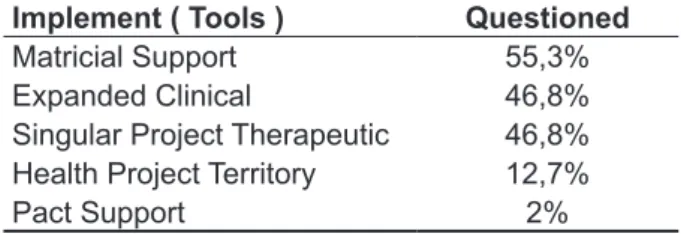
means by which the NASF professionals act on the objects of their work. As regards the instruments used in the organization of team work processes, which can be observed that the most professional minimally uses some of the technological tools recommended by the Ministry of Health, however not known the background. For many professionals, the irst contact in practice with such tools occurred only after it enters the NASF. The Table 1 shows the proportion of professionals who reported knowledge
and use in their practice the organization of
techno-logical tools in NASF work. were allocated. Out of this we obtained the email
contact 68 speech therapists, means by which they were invited to participate of this work. Were received 47 answered questionnaires, in others words, 69.1% of the 68 sent.
Participants were informed about the objectives and the methodological procedures of the study
and all participants signed a consent form in this research, according to the rules and guidelines of
the National Health Council Resolution 196/96.
Data collected occurred through online
question-naire, self applied type, in others words, answered directly by the object research, without intervention by the researcher. The questionnaire consists of 20 questions, some multiple choice and essay other, was built on the study objectives through a research support software, OpenQLQT4.
For the quantitative analysis of descriptive statistics procedures were used, and the quali
-tative data were grouped according argument and similarity of answers and the analysis was done according to the precepts of Category Analysis Theme5, under the theoretical framework of the
Working in Health.
RESULTS
The speech therapist graduates time of study objective varies from two to twenty-two years, eight years the average time. Among the respondents, 51% graduated in Public Health, and 66% were longer than two years of experience working in NASF team, time considered signiicant for under
-standing and relection on the work processes in a
team.
The speech therapist work process as a supporter in NASF team was characterized from the elements that compose it, being: object work ,
means and instruments, organization and division
of work6, and the identiication of operational deter
-minants that guide their practices.
From the analysis of responses of interviewees
about their role on the team NASF concluded
that for these professionals work object consists
of the Health Teams Family and the registered population of the territory. Follows the transcript
of excerpts of answers which highlights the speech therapist’s work object in NASF:
“[...]sensitization of family health teams in relation to speech therapist ; planning, implementation and evaluation of actions promotion, prevention and rehabilitation in community health [...]” (R3)
“Matricial, qualifying referrals, guide, share knowledge, contribute to greater solving
Table 1 – Knowledge of speech therapist on technological tools recommended for operation in the Support Center for Family Health, São Paulo, 2012
Implement ( Tools ) Questioned
Matricial Support 55,3%
Expanded Clinical 46,8%
Singular Project Therapeutic 46,8%
Health Project Territory 12,7%
Pact Support 2%
Still on the instruments, some speech therapists
mentioned speciic actions and forms of intervention as the means and instruments used by them and their teams for NASF organization of work processes, such as working in a multidisciplinary
team, Continuing Education, discussions cases, shared interventions, intersectoral coordination, actions in therapeutic or educational groups and
transdisciplinarity. Although not called technological
tools, such actions are part of the organization of
six people, ive or six diferent categories. In this case being considered only the categories directly connected to the assistance, without taking into
account NASF team of engineers and
adminis-trative, auxiliary present in all teams.
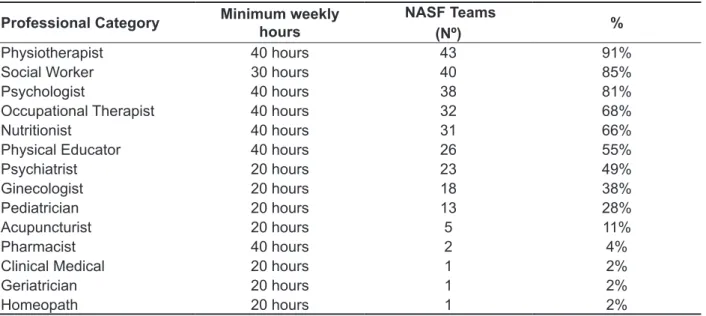
The diferent professional categories that make
up the teams NASF of persons questioned are
presented in Table 2, which allows us a preview of the categories that are more present in the work
processes of these speech therapists.
As regards the organization and division of work, it is necessary to separately show some important variables that characterize the multiplicity in the
organization of NASF teams studied.
As the composition of teams, the average number
was eight professionals per team, with weekly working hours ranging from 20, 30 or 40 hours, as required by law for each professional category. The
team that had the highest number of people consists
of 15 professionals from 11 diferent categories, and teams with fews professionals composed of
Table 2 – Composition of Support Center Teams for Health to professional categories, São Paulo, 2012
Professional Category Minimum weekly
hours
NASF Teams
(Nº) %
Physiotherapist 40 hours 43 91%
Social Worker 30 hours 40 85%
Psychologist 40 hours 38 81%
Occupational Therapist 40 hours 32 68%
Nutritionist 40 hours 31 66%
Physical Educator 40 hours 26 55%
Psychiatrist 20 hours 23 49%
Ginecologist 20 hours 18 38%
Pediatrician 20 hours 13 28%
Acupuncturist 20 hours 5 11%
Pharmacist 40 hours 2 4%
Clinical Medical 20 hours 1 2%
Geriatrician 20 hours 1 2%
Homeopath 20 hours 1 2%
The number of Basic Health Units in each
NASF team presents among the averaged 2.8 units
persons questioned, ranging one from six UBS by
team NASF. Each NASF team supports on average
fourteen Family Health teams, and variation found at least eight and a maximum of twenty teams.
The work organization shared between NASF and Family Health teams occurs in meeting spaces commonly called by the professionals of “matricial meetings”. Regarding to the share of cases, is that meeting space, where primarily, demands of support not only to the audiologist are brought, but for the whole NASF team.
There was great variation found where they are organized and the periodicity of matricial meetings. The most common was the occurrence of weekly meetings, lasting an hour with each Family Health team, followed by biweekly meeting, also with an hour long. The other most common conformations
also involve weekly or fortnightly, but with two hours for each Health Team family.
Professionals from NASF teams are divided to enter these meetings and this division can
occur in diferent ways. The most common logic
among persons questioned is NASF references
to certain Family Health team. Such references can be composed by pairs, threesomes or even a
NASF professional depending on the number of components and the number of supported teams.
References are responsible for discussing with the Family Health team all demands, regardless of
professional categories present. Another form of organization at the least common, even though it appears in the responses, is the division of NASF professionals in mini team thematic (mental health
and rehabilitation), in which professionals only
Health teams. They consist of matricial meetings, in other word, meetings directed to the case discus
-sions, in which the technical knowledge of NASF professionals will help in expanding the Family Health teams look for the diferent cases and training for professionals with issues in speech therapist generally related to the cases discussed or topics
of interest of various categories of ESF (doctors,
nurses, community health workers) and also the
NASF. Such capabilities can occur in formal spaces
speciically targeted to them, as in team meetings, technical meetings, but mostly occur during shared actions, where knowledge exchange happen in care
practices.
The network of joint actions are all those
aimed at bringing together the diferent services that assist population to the territory, whether health or other sectors. The Intersectoral action of persons
questioned consist of institutional visits at schools,
kindergartens, Psychosocial Care Centers (CAPS),
Social Centers and Cooperative (CECCO), Mental
Health Forum, Integrated Center for Rehabilitation (NIR), Integrated Center for Hearing Health (NISA) Coexistence of Children centers (CCA), Green and Healthy Environments Project (PAVS), various equipment of the territory as ONGs, neighborhood associations, and others. These actions can occur discussion of case patients followed for more than
one service, educational interventions, interventions
shared individual or collective, that would assist that community.
The work management actions are aimed
at planning and evaluation of work processes both individual and shared with NASF and ESF teams. Constitutes NASF meeting ,where all team members can discuss, plan and organize their work processes; the technical meeting of Basic Health Unit (UBS), in which are placed important questions about the UBS operation, which may be related to work together as well as the general meeting of UBS;
meetings of the Managing Council; Committee on Medical records; Internal Commission for Accident Prevention (CIPA); administrative actions, such as
planning an intervention, illing production records,
reporting, creating materials for service or groups
difusion.
The main speciic demand in speech therapy
and its consequences
Regarding to the speciic demand for NASF speech therapist, there are very few applicants, such as the questioned of this study indicate that the principal demand children with problems in the development of oral and written language. The afections of written language, involving diiculties in learning and reading and writing disorders were In most teams, the low to arrival speech thera
-pists language demands, as well as other demands,
for NASF support , determines that cases have
already received attention from team reference, including technical professionals, then are taken to discussion on matricial meetings. When the case
requires intervention of another NASF professional
that is not present on discussion, in other word, not
compose the reference of that team, the discussion
is brought to the meeting space that takes place between all NASF professional weekly.
In addition to the complaint brought by the Family Health teams to intervention of NASF,
some cases reach through the intersectoral joints
made by NASF team in some other health care or other sectors, instituting a reverse low, however legitimate, to which NASF the team usually follows
to bring demands for matricial meetings, so that the reference teams to appropriate cases and share the
construction of Singular Project Therapeutic.
The Support Act – Speech Therapists actions to the demands that come by the Family Health Teams
From the feedback about the composition of the weekly schedule of speech therapists were identiied diferent actions that were grouped and classiied according to the objectives of each.
The care support actions are those involving
the direct speech therapist action with service users,
and consist on consultation / individual attendance
speciic of the speech therapist, consultation / individual attendance shared with other team NASF members and / or ESF, visit / speciic home
consultation of speech therapist, visit / shared
home consultation with other professionals NASF
team and / or the ESF, groups of corporal practices
or mental health in which speech therapists can apply knowledge of its core know stimulating good life practices healthy; educational groups to promote health shared with NASF team members and / or ESF (group of pregnant women, children / child care, children, the elderly, hypertension and diabetes, with guidance on breastfeeding, comple
-mentary feeding introduction, harmful oral habits,
development of speech and language, oral health,
hearing health, disease prevention, smoking, elderly people in social group); groups / speciic therapeutic workshops in speech therapists, which may or may
not count on the support of other professionals (oral
and written language, articulation disorders, voice, storytelling, memory, motor orofacial); recreational workshops; steering groups for parents shared with
team members NASF and / or ESF.
The technical and pedagogical support
and situations presented. However, with regard to shared actions, speciically joint calls and actions in the territory, identiied some important obstacles.
Although the speech therapists perform actions
shared both with the ESF professionals and with
NASF professionals, it became evident that there
is still diicult to understand and conigure their work within an interdisciplinary team, being able to think its integrated action to the other profes
-sionals. Shared actions are not part of history of this profession and the training does not include yet the practice, which is being built by professionals inserted in this context.
In relation to the stock share with NASF team
professionals, respondents point out that this is
due to own demand of the teams by more than one category of NASF and takes place in shared
consultations and visits as in therapeutic groups or collective actions. Report that it is easier to plan
activities shared between the very NASF team due to the ainity between professionals, similar work
processes, and believe these important actions not
only by the exchanges and mutual learning, but also for the sense of security to be able to rely on a the same team colleague to add looks about any case or situation. Table 3 presents the professional NASF categories that share actions with speech therapists.
In relation to the actions share with NASF team
professionals, persons questioned point out that
this is due to own demand of teams by more than one category of NASF and takes place in shared
consultations and visits as in therapeutic groups or collective actions. Report that it is easier to plan
activities shared between the NASF team due to the ainity between professionals, similar work
processes, and believe these important action not
only by exchanges and mutual learning, but also for sense of security to be able to rely on the same team colleague to add looks about any case or situation. Table 3 presents the NASF professional categories that share actions with speech therapists.
reported by 76.6% of questioned as the main demand is for speech therapy, followed by bouts of oral language, which include the delayed development
of speech and phonetic / phonological disorders,
which were reported by 72.3% of questioned as the main demand for speech therapy practice. These demands come through the Family Health teams, especially by formal referrals from schools or just complaints of education professionals brought by
the mother.
This demand is received by professionals in NASF meeting between ESF and NASF and
various actions are cited as possible interventions,
depending on the history that accompanies each case. They are executed from shared or speciic
queries to evaluate the child, even home visits in
order to better understand the family context, and even visits to schools to the real child’s school situation knowledge. After diagnosis, the cases can be followed individually or in groups / therapeutic workshops, usually with a space for participation and guidance for parents and family in co-respon
-sibility order, and depending on the prognosis and course of disease, may or may not be referred to other levels of care within health care network. Other actions cited, still aiming to work the most frequent demands, are training for family health teams favoring the expansion of looking at these
cases, and also training in schools so that education
professionals acquire more tools to deal with the diiculties presented by his students.
The shared work
Regarding for discussion of cases, in which the request is formally the NASF support, it was
concluded that the teams have sought to organize
them to contemplate objectives for which they are
intended. Guaranteed is the team meeting space
with the participation of reference professionals and
supporters for the formulation of therapeutic projects and planning of actions from the problematic cases
Table 3– Main actions shared between speech therapists and professionals from the Centers of Family Health Support, São Paulo 2012
Professional Category % Actions
Psychologist 27,6% Evaluation and Monitoring
Physiotherapist 23,4% Consultations and home visits
Occupational Therapist 21,2% Evaluation and Monitoring
Nutritionist 17% Promotion and Prevention
Physical Educator 8,5% Groups
Table 4– Main actions shared between speech therapists and professionals of Family Health Strategy, São Paulo, 2012
Professional Category % Actions
Nurse 76,5% Consultations and home visits
Community Health Agent 51% Home Visits and Groups
Nursing Assistants 17% Home Visits and Groups
Dentist or Oral Health Technical 12,7% Promotion and Prevention
Doctor 6,3% Consult
Regarding to the actions shared between speech therapy NASF and professionals in the ESF, there was a great diference in frequency sharing with speciic professions of the ESF, mainly due
the unavailability agenda within the work dynamic, with strong criticism by persons questioned on
participation or non-participation of doctors in these
activities. Table 4 shows such a distribution.
DISCUSSION
According to Mendes-Gonçalves6, the object of
health work are the human health needs, so focus on which worker’s action from being recognized
and print on that object a project of transformation,
a purpose. The object of health professional work will be what he learns to invest emotionally, in other word, that which takes as investiment object 7.
The actions that speech therapists of NASF cite on responses by supporting teams of Family Health Strategy demonstrate the investment of energy in teams, in order to construct new knowledge that will come out of Speech therapists knowledge core to move into ield knowledge of the whole team, and
also direct investments in meeting the health needs of population assisted, either through clinical care,
collective or joint actions in other network services.
Silva et al.8 point out that the performance of these
professionals in education and continuing education
of Primary Care teams should be achieved through
changes made during the care and from the
knowledge of the health needs identiied in the territory.
The form or working tool is a thing or a complex of things the worker inserts between himself and the object of work and serves you to direct your activity
on this object6. The instruments are enhanced by
experiences of subjects that expand the possibilities of intervention on the object. Through the support, the NASF professionals modify work processes of Family Health teams and intervene in the health needs of population served by these teams.
The Matrix Support was the main tool that the respondents as organizer of work processes. However, in some responses was evident not
professional familiarity with the work speciics in the NASF. It is possible that the professionals who
did not report the proposed tools have not under-stood the question that the instruments referred to.
However, it is valid to point out that the lack of these tools, which are basis for work in NASF, signals the unpreparedness of many professionals inserted in the service and relects beforehand the diiculties in the work processes of these teams.
Corroborating the inding on the methods and tools in NASF, in a study about the psychiatrist in Primary Health Care, in the current context of SUS9,
the object of work matches the Support to Health Teams Family, as refers to the mental health of individuals, and the Matrix Support as an instrument
/ tool.
About the organization and division of work in NASF, we note the diferent compositions in teams determining the diferent processes, modes of
operation and results.
Considering the irst ive professional categories
that appear in NASF team of speech therapists
questioned, there is emphasis on issues of physical therapists rehabilitation irst, Physiotherapist presence in more than 90% of the teams, occupa
-tional therapist and nutritionist close to 70% and mental health soon after by the strong presence of psychologists and again occupational therapists. In the city of Belo Horizonte / MG, similar indings were found as 28% of NASF professionals that munici
-pality were physiotherapists and is still among the top ive categories and occupational therapists and
speech therapists10.
According to the determinations and NASF guidelines, the number of professionals and
spaces and planning work. This availability inter
-feres not only in time and frequency of meetings, but more on content and progress of discussions. There is no set rule in NASF guidelines on how teams should be divided to make the meeting spaces with the Health Family teams. What is recommended that cases are studied and discussed primarily among professionals in the Health Family teams for that priorities are listed and subsequently discussed with NASF for diferent looks can be placed on the
situation at hand and from then occurs planning and the revaluation of natural therapeutic projects. Silva et al. 8 emphasize that meetings are essential to
discussion of cases and planning of actions.
The name given to these meetings between NASF and ESF teams “matricial meetings” can cause misunderstanding that there is a speciic
space and determined to the matricial occur.
However, among respondents there is a clear
understanding that the matricial is a logic of
organi-zation of work, a constant process that permeates every action shared between professionals from both teams, and this term only a jargon used by professionals to facilitate the identiication of that space. Matrix support is a technological tool that
provides care support and pedagogical technical support to the reference teams, promoting the
sharing of knowledge and expanding the resolution
of problemas11. The aim, when the matrix support
team (the NASF) meets the reference team, is that
the matrix support to assist the reference team at
for-formulation / reformulation and implementation of a unique treatment plan for an individual subject
or collective, which requires a health intervention beyond the reference team’s ability. This process
contributes to the organization of a continuous line
of care, breaking with the fragmentation of care, which afect the integrity of attention12.
In a study about the speech therapist assign -ments in NASF in municipalities in the metropolitan region of Recife13 was veriied that reality all teams
realize the construction of Therapeutic Project Single from case discussion spaces between NASF and ESF teams. In Belo Horizonte / MG, the organization of work also part of meetings and the demands stem from the Health Family teams irst, being re-discussed between the NASF team
according to the needs of each caso10.
As could be seen from actions described by the respondents of this study, speech therapy in demand pervades all life cycles of subjects, from pregnancy to the guidelines of the importance of stimulating the auditory system of the baby, the facial growth through breastfeeding until senility when the physical decline afects basic skills such as communication and the natural process of power. To on local needs. However, some teams in compo
-sition responds only to the minimum criteria of total workload, speciied in guiding documents without considering the realities found in the diferent terri
-tories in which NASF teams with minimal profes
-sionals are divided in many areas to support a large number Family Health teams. The greater number of units in which professionals are references, the less time to plan and develop actions shared with the family health teams, considering that staying in each place is limited and time that is lost with displacement between the units is great. This
question has a negative impact on the professional
work processes that make up the NASF team, so that a direct efect on their ability to compose the Family Health teams, because it depends on being close, nexus need.
Silva et al.8 approach in their work the theme of
care co-responsibility, pointing out that the demands are worked in an interdisciplinary way, from the deinition of a set treatment plan, in order to avoid increasing the burden faced by Attention Basic teams. For implementation of collective work, teams need to have such availability.
The study showed diiculties in work organi
-zation also on the number of Health Family teams assisted. At the time of this study data collection current regulations advocated a maximum number of 15 Health Family teams for each NASF team, which had not been corrected by the manager in most NASF teams whose number reached 20 assisted teams. This reality relects a serious problem identiied in the implementation of NASF that has been corrected by the Ministry during this process, since today is the determination that each NASF 1 support from ive to nine Health Family teams2, while the irst determinations about
the NASF organization stipulated the number of a
minimum of eight and a maximum of twenty teams. The question of the large number of Health Units and Health Family teamsunder the responsibility of a single, restricted NASF team was also identiied as a key challenge of this proposal in an article on the work of Psychology in NASF10. The authors
argue that due to great demand and displacements,
many of ESF teams are without proper support and a signiicant number of cases is without assistance.
Based on the guiding documents for the NASF
work, teams organize meetings between NASF and
ESF according to needs and preferences of each
In Primary Care, the speech therapist has many possibilities for action, also in rehabilitation
morbidities or abnormal developmental processes,
but mainly in promoting speech and general health and prevention of diseases in all life cycles, and capacity building of Health Family teams. The focus of the speech therapist’s performance, as well as all the professionals involved, will depend on the
epidemiological and population characteristics of
territory where it operates.
The proile of speech therapy demand in a
municipal public service of Southern Brazil16 region,
was male children and school range, which is
similar to other studies of área17, in which patients
are directed mostly by complaints abnormal speech.
In response to this demand, there is investment
and plan actions, especially the prevention and promotion of health speech at the Basic Health Units, schools and day care centers belonging to the
areas covered in continuing education programs to
teachers and Primary Care16 health professionals.
Such propositions corroborate the role of NASF
speech therapy front of the most prevalent demands of territory that are the work focused on collective
actions of promotion and prevention, and even inter-sector collaboration, aiming to reduce this demand in the medium and long term.
Deeds shared between NASF professionals the most contact with Psychology involves a greater proximity between this skill and Speech Therapy,
due to the great demand for mental health, an area
in which the speech therapist is also included, the demand for schools by both professionals, and still increased availability due to the fact they have a workload of 40 hours per week. In a study on the work of psychology in NASF in Belo Horizonte, the authors claim that action takes place mainly
in a shared manner and refer in its various routine
conditions that require work of speech therapist10.
Have contact with the Physiotherapy is attributed to
the great demand for rehabilitation of neurological
cases and deiciencies, especially at home. In the case of Occupational Therapy, joint actions are due to the high number of kids with demand, with learning complaints and behavior, lack of limits or family dynamics. The shares with Nutrition mainly involve promotion of breastfeeding, paciier use
and bottle in the food introduction; reeducation food
groups with guidance on chewing and swallowing. In the case of Physical Education, there is a great mutual aid between categories in groups, involving recreational activities and learning, body care,
communication etc.
The sharing actions with Health Family teams involves not only the purpose of the action, but mainly professional availability. While the purpose of deal with this range of demands, there are several
speech therapy fronts in NASF.
The speech therapist’s actions in support of service are not always focused on situations in which the demand involves some speciic question of its core knowledge. Assuming that transdisciplinarity is
a principle of NASF, the possibilities of intervention
in Primary Care go far beyond this professional
is directed to do in their studies as through the
matricial and joint actions with diferent categories professionals, the audiologist will incorporate other
concepts to their practices and building the actions according to the needs presented.
Generally, the population’s health needs are very complex and can not be met based only on technologies used by a particular specialty, but require creative eforts and inter and transdisci
-plinary sets. Cunha and Campos11 bring a challenge
to the proposal of the matrix support this change in relation to knowledge, a constant search for the deinition and assertion of rigid boundaries between the diferent disciplinary clippings, for a balance that allows the expansion of the work object and the objective of work, the disease for subjects under care, increasing the capacity of professionals to deal with real people, and the limits of knowledge
and interventions.
In a study that sought to understand what the common ield of actuation of the ESF professionals,
including NASF14, the authors realized that this
common ield incorporates many theoretical and practical accumulation of Public Health, in particular
the development of educational and health
surveil-lance but also that from other ields are produced diferent indings, such as the clinical and rehabili -tation, and contributions of various sectors. Although
the common ield represents an ideal opportunity for realization of interprofessional , this also inlu -ences private spaces of the professions so that
when the team builds the possibility of exchanges,
mutual aid, increasing the understanding of health,
sickness, and intervention, professional acting so in its restricted area also modiica14. Azevedo and
Kind10 draw attention to the share of work in NASF,
revealing that there is indeed a dialogue between professionals and disciplines, resulting in diferent knowledge, opinions and / or perspectives that add
up to better understand and treat the user .
In a study about the practice of
speech-language pathologist in the NASF of Paraíba15,
stood out practices geared at nuclear knowledge of categories, which leads to the fragmentation of assistance weakening comprehensive care to the
user and the development of more activities related
as clinical-school, clinics and private services, but
the Primary Care is the only one in which the range of possibilities of intervention is so wide.
The basic training of speech therapist not
guarantee such amplitude of intervention
capac-ities, since until recently was focused on traditional therapeutic care, the individuality of patient and disorder that is presented. The speech therapist of NASF who responded to this study developed the ability to address the demand for a much broader sense, from the incorporation of new practices and knowledge acquired in the course of experiences and work experiences in NASF.
The scientiic literature shows many diiculties in training of professionals to work on a new model of care. Universities insist on training focused mainly
on technical aspects of profession, over stimulus
to work with diferent areas of professionals, and health services throughout the country rarely have
continuing education programs and education permanent18-20.
Emphasized that appropriate investment in training of all professional categories to act in
Primary Care qualiies health actions, increasing the solvability of this level of attention, bringing greater quality of life for population and interfering directly in remaining levels because it is a health system Network.
Faced complexity that involves Primary Health Care, and speciic work processes that characterize
the NASF, and considering historical questions of
hegemonic model, the still insuicient training of
health professionals involved in this service and the
limited production knowledge about speech thera
-pist’s work processes in this new playing ield, it is necessary to invest in knowledge production that bring beneits to these new forms of health work
organization.
Other works that problematized some issues raised in this study are very important for construction of knowledge back to work ield of Primary Care and NASF, and for speech therapy continues to evolving in the ield of Public Health.
ACKNOWLEDGEMENT
We thank all speech therapists cooperating participating in the study, the coordinators of NASF teams, the coordinators and the Health Department of Municipality of São Paulo.
sharing an assistance to nurse of team is to expand the clinical look of this, such action also occurs due to nurses have a great link with community and
there is still the fact that their schedules are more
malleable, and greater lexibility to conduct educa
-tional and shared actions. Sharing activities with doctors happens on a smaller scale due mainly to unavailability of agenda of this person to certain actions, however, many doctors have demand for specialist orientation in other areas of knowledge
and are able to arrange for consultations or other
shared actions, in order to expand the clinical
consultant.
In a study about the speech of speech active
in NASF teams municipalities of Paraíba on their
práticas15, all 12 respondents reported diiculties in sharing the shares with the professionals of the FHS, especially doctors and nurses. The study shows that the work is permeated by alleged power relations and the existence of conlicts between team members, as well as fragile due to staf turnover in the reference staf.
On the relationship of NASF teams with profes
-sionals of Health Family teams, Silva et al. 8
emphasize the importance of avoiding hierarchy, specialness and fragmentation, seeking a dialogical relationship between professionals, horizontally, which allows, from knowledge of each, the built of new knowledge composed of speciic cases and territory, carried over by the various specialties in a dynamic way, towards transdisciplinarity.
FINAL CONSIDERATIONS
From this study it was possible to know the speciics of speech therapists work in NASF, the
characteristics of its operations and contribution
of this professional in construction of Unity Health System, enhancing actions of Primary Attention through the Matrix Support.
5. Bardin L. Análise de conteúdo. 3ª ed. Lisboa.
Editora 70, 2008.
6. Mendes-Gonçalves RB. Práticas de Saúde: processos de trabalho e necessidades. São Paulo:
Centro de Formação dos Trabalhadores em Saúde
da Secretaria Municipal da Saúde de São Paulo
(Cadernos CEFOR Série textos, 1); 1992.
7. Cunha GT, Campos GWS. Método Paidéia para
co-gestão de coletivos organizados para o trabalho. ORG & DEMO.2010;11(1):31-46.
8. Silva ATC, Aguiar ME, Wink K, Rodrigues KGW,
Sato ME, Grisi SJFE et al. Núcleos de Apoio à
Saúde da Família: desaios e potencialidades na visão dos proissionais da Atenção Primária do
Município de São Paulo, Brasil. Cad. Saúde Pública. 2012;28(11):2076-84.
9. Vannucchi AMC, Carneiro Junior N. Modelos
tecnoassistenciais e atuação do psiquiatra no
campo da atenção primária à saúde no contexto atual do Sistema Único de Saúde, Brasil. Physis
Revista de Saúde Coletiva. 2012; 22(3):963-82.
10. Azevedo NS,Kind L. Psicologia nos Núcleos de Apoio à Saúde da Família em Belo Horizonte. Psicologia: ciência e proissão. 2013;33(3):520–35. 11. Cunha GT, Campos GWS. Apoio matricial e
atenção primária em saúde. Saúde e Sociedade. 2011;20:961-70.
12. Molini-Avejonas DR, Mendes VLF, Amato CAH.
Fonoaudiologia e Núcleos de Apoio à Saúde da
REFERENCES
1. Brasil. Ministério da Saúde. Portaria nº 2.488, de 21 de outubro de 2011. Aprova a Política Nacional de Atenção Básica, estabelecendo a revisão de diretrizes e normas para a organização da Atenção Básica, para a Estratégia Saúde da Família (ESF) e o Programa de Agentes Comunitários de Saúde
(PACS). Brasília (DF): Diário Oicial da República
Federativa do Brasil;2011.
2. Brasil. Ministério da Saúde. Portaria nº 3.124, de
28 de dezembro de 2012. Redeine os parâmetros
de vinculação dos Núcleos de Apoio à Saúde da Família (NASF) Modalidades 1 e 2 às Equipes Saúde da Família e/ou Equipes de Atenção Básica
para populações especíicas, cria a Modalidade
NASF 3, e dá outras providências. Brasília (DF):
Diário Oicial da República Federativa do Brasil;
2012.
3. Soleman C. O trabalho do Fonoaudiólogo no Núcleo de Apoio à Saúde da Família (NASF): compreendendo as práticas a partir da composição dos processos de trabalho [dissertação]. São Paulo (SP): Faculdade de Saúde Pública da Universidade de São Paulo; 2012.
4. Open QLQT, versão 1.4 [software na internet].
São Paulo: Faculdade de Saúde Pública da USP. [s.d.]; acesso em 25 fev. 2011. Disponível em: http://
www.qlqt.ipdsc.com.br.
RESUMO
Objetivo: compreender o trabalho do fonoaudiólogo no Núcleo de Apoio à Saúde da Família, identii
-cando tecnologias incorporadas ao processo de trabalho tradicional desse proissional. Métodos: os sujeitos são fonoaudiólogos das equipes de São Paulo/SP do Núcleo de Apoio à Saúde da Família. Por meio de questionário on-line, foram levantadas informações acerca da formação e dos processos de trabalho do fonoaudiólogo como apoiador nessas equipes. Os dados quantitativos foram ana-lisados por meio da Estatística Descritiva e os qualitativos de acordo com os preceitos da Análise
Categorial Temática, sob o referencial teórico do Trabalho em Saúde. Resultados: o processo de trabalho foi caracterizado a partir dos elementos que o compõem, sendo que o objeto do trabalho con-siste nas equipes de Saúde da Família e na população adscrita, o meio é o Apoio e os instrumentos consistem nas ferramentas tecnológicas preconizadas pelo Ministério da Saúde. A conformação das equipes é variada e a organização do trabalho parte das reuniões de matriciamento. Suas práticas envolvem ações de apoio à assistência, ações de apoio técnico-pedagógico, ações de articulação de Rede e ações de gestão do trabalho e os fonoaudiólogos se apropriam de novos conhecimentos e estratégias por meio do trabalho compartilhado. Conclusão: na Atenção Básica, as possibilidades de
atuação podem ser especíicas ou compartilhadas, do núcleo de conhecimento ou de âmbito geral, e o enfoque dependerá das características do território e da disponibilidade dos proissionais. A forma -ção não garante as competências necessárias, havendo a incorpora-ção de novas práticas a partir das
vivências experimentadas em serviço.
17. Barros PML, Oliveira PN. Peril dos pacientes
atendidos no setor de Fonoaudiologia de um
serviço público de RECIFE – PE. Rev CEFAC.
2010;12(1):128-33.
18. Andrade LMB, Quandt FL, Campos DA, Delziovo
CR, Coelho EBS, Moretti-Pires RO. Análise da implantação dos Núcleos de Apoio à Saúde da
Família no interior de Santa Catarina. Sau. &Transf.
Soc. 2012;3(1):18-31.
19. Moretti-Pires RO, Campos DA. Equipe
multiproissional em Saúde da Família: do
documental ao empírico no interior da Amazônia. Rev bras educ med 2010;34(3):379-89.
20. Helena ETS, Nemes MIB, Eluf-Neto J. Avaliação
da assistência a pessoas com hipertensão arterial em Unidades de Estratégia Saúde da Família. Saude Soc. 2010;19(3):614-26.
Família: conceitos e referências. Rev Soc Bras Fonoaudiol. 2010;15(3):465-74.
13. Fernandes TL, Nascimento CMB, Sousa FOS.
Análise das atribuições dos fonoaudiólogos do NASF em municípios da região metropolitana do Recife. Rev CEFAC. 2013;15(1):153-9.
14. Ellery AEL, Pontes RJS, Loiola FA. Campo comum de atuação dos proissionais da Estratégia Saúde
da Família no Brasil: um cenário em construção.
Physis Rev. de Saúde Coletiva.2013;23(2):415-37. 15. Costa LS, Alcântara LM, Alves RS, Lopes AMC, Silva AO, Sá LD.A prática do fonoaudiólogo nos
Núcleos de Apoio à Saúde da Família em municípios paraibanos. CoDAS.2013;25(4):381-7.
16. Diniz RD, Bordin R. Demanda em Fonoaudiologia em um serviço público municipal da região Sul do Brasil. RevSocBrasFonoaudiol. 2011;16(2):126-31.
Received on: October 01, 2014 Accepted on: December 19, 2014
Mailing address: Carla Soleman
Avenida Francisco das Chagas Oliveira, 2520,
apto 43, bloco A – Higienópolis São José do Rio Preto – SP – Brasil
CEP: 15085-485
E-mails: [email protected]