ANALYSIS THE CONCEPTIONS OF INFORMATION,
EDUCATION AND HEALTH COMMUNICATIONS AMONG
THE COORDINATORS OF VOICE CAMPAIGNS IN THE
FEDERAL DISTRICT OF BRAZIL
Informação, educação e comunicação em saúde: análise das concepções
dos coordenadores das campanhas de voz no distrito federal
Rodrigo Dornelas(1), Maria Fatima de Sousa(2), Ana Valéria Machado Mendonça(3)
(1) Federal University of Sergipe – UFS, Lagarto, Sergipe,
Brazil.
(2) UnB, Brasília, Federal District, Brazil. (3) UnB, Brasília, Federal District, Brazil.
Financial support: CAPES. Conlict of interest: non-existent
factors may potentiate or even hamper the estab-lishment of educational practices that will effec-tively contribute to the transformation of people’s health. Important among these factors is the biomedical training of professionals in the area, the low insertion in public health services, especially primary care ones, and the incipient construction of knowledge that will relate Speech Therapy to the
Collective Health ield. Thus, it can be seen that the
conceptions involving the educational actions of speech therapists are based on this still hegemonic
context, in which health is understood as absence of
disease1, with important implications for the educa-tional actions that are developed.
Few studies have been designed in such a way as to discuss the conceptions and practices
INTRODUCTION
After completing 30 years since its regulation,
Speech Therapy has attempted to expand its actions to the Collective Health ield, implementing health
practices directed at the population, and mainly emphasizing prevention and promotion within the
ield of Health Education.
However, educational actions are known not to reach their objectives in all cases since various
ABSTRACT
Purpose: to understand and discuss the conceptions of information, education and health communication (IEC) of speech therapists who coordinated and developed the Voice Campaigns in Brasilia, in the years 2009 and 2010. Methods: the study used a qualitative approach in which semi-structured questions were used to collect data. The data analysis followed the steps of content analysis and the discussion was based on information, education and health communication theories. Results: it showed that, health Information is seen only as the description of the vocal tract functions and not as data that could be helpful triggers for planning and implementing effective action for the Voice campaigns; the Health Education is seen as a transference of information and not as a collective process with regards to the needed care for vocal and well-being; and Communication in health is limited to press media and not as a strategy for construction of a communication based on the population’s knowledge about the subject. Conclusion: the IEC technologies can be observed in the campaigns studied, but the conceptions involved in this process are still far from a consensus.
The dificulty in talking about information, education and health communication relects a fragility of
the voice campaigns.
should be part of programmed activities following
a strategic planning, with expected short- medium-
and long-term results that will produce changes in the scenario of public health3.
Information, Education and Health Communication (IEC): A potentiating instrument in health actions
About 15 years ago, in September 1996, the 10th National Health Conference was held in Brazil. The
conquests of the Uniied Health system (SUS) had
not yet reached the desired levels of participation of various segments of society. Thus, the participating delegates discussed a proposal that would contem-plate IEC actions directed at the the requirements inherent in a new paradigm of health care4. It was
at that time that public authorities started to relect
about the importance of action related to IEC5.
Information within the health context has been
associated with the organization of data systems in order to support decision making policies for the intervention in a given reality. Thus, the role of infor-mation in health has been understood as a subsidy for this intervention, while at the same time contrib-uting to the understanding that the health reality
it relects should inluence decisions and modify perceptions. Information is deined as knowledge
enriched with meaning and its relevance resides in the treatment received both in its components and in its main concepts6.
Health information represents an essential premise for the organization of a campaign or activity whose purpose is to trigger questions about the care to be taken with health7, since access to
information expands the capacity of instrumental -ization of the subjects in decision processes, i.e., in the construction of the Quality of Communication and Health Information8.
Education resides in the relexion of the reality of
the learner, who will later take up again this reality with subsidies that will permit him to transform it. Education should contribute to the formation of citizens, and should not simply be understood as a means of acquiring knowledge, but rather as a means of transforming the reality of the subject who is being educated9.
Thus, it should be emphasized that the process of Health Education, in order to be transformative, should be based on accurate listening and then perform an intervention. In addition to being a fundamental skill in health education10, the ability to listen is understood as a means of providing
moments of relection and actions permitting a
conscious learning on the part of the persons, without controlling their lives11.
of information, education and communication in health adopted in campaigns promoted by Speech Therapy, and it is from this perspective that the
present study intends to start a relection about the
practices implemented in the Voice Campaigns, which are currently considered to be among the major actions promoted, mobilizing large part of the speech therapy community. Thus, the objective of the present article is to understand and discuss the conceptions of information, education and health communication of the speech therapists who developed and coordinated the voice campaigns in Brasília in 2009 and 2010.
Scenario: the voice campaigns
The actions of the voice campaigns promoted by speech therapists are organized by regional operators at various locations. The Brazilian Society of Speech Therapy (SBFa) stimulates the partici-pation of professionals, awarding a prize to the best campaign of the subsequent year chosen at the annual congress of Speech Therapy. Although the SBFa does not establish the strategy to be used in the campaigns, certain criteria must be followed for the campaign to compete for the prize of recognition
of the actions executed. One of these criteria is to
use the topic established since 2005, ‘Be a Friend of your Voice”, and all the printed and digital material
should contain the symbol of the campaign next to
the logo of SBFa
(http://www.sbfa.org.br/campan-hadavoz/index.htm).
In the Federal District, the objective of the Voice Campaign is “to urge the population to participate in health education actions directed at vocal awareness and its implications in communication,
health, culture, and quality of life”2. Thus, the
persons responsible for the campaign discuss the
actions to be executed and the structure needed for
this purpose.
The person responsible for the campaign directs its course under the guidance of the requisites proposed by the SBFa and according to the regional demand in which the actions will be inserted, and will have the necessary autonomy for the articulation
and development of contextualized work.
the actions of the campaigns held in the Federal
District, who had participated in the deinition of the
information targeted, of the materials to be used and of the methodology of the activities. Thus, 7 subjects were interviewed and formed the sample of the present study.
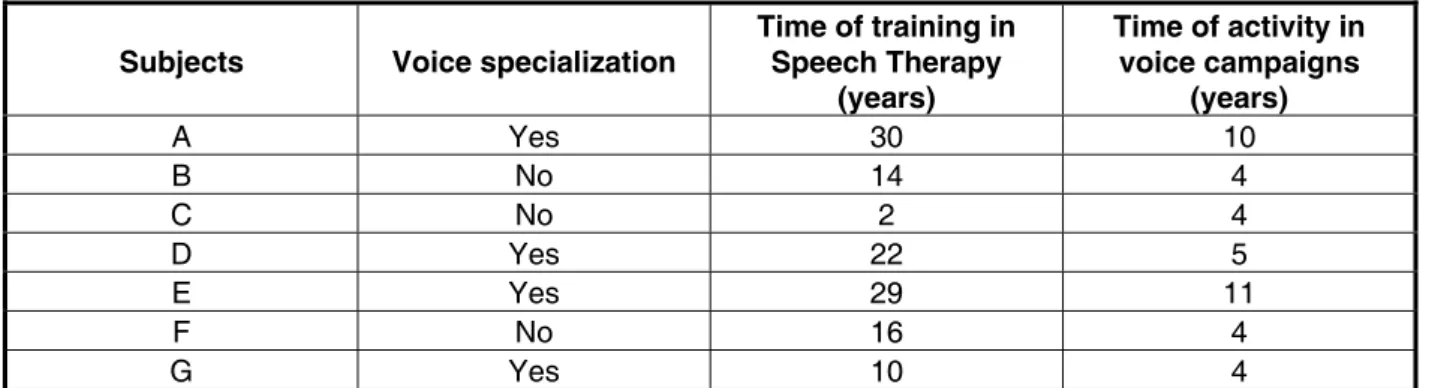
All participants were female Speech Therapists aged 25 to 53 years. Figure 1 illustrates the charac-terization of the sample.
Most subjects had been working in the voice
campaign for less than ive years, with this time
coinciding, in general, with one third of the time since their graduation. All have the title of specialist, 4 of them in the voice area.
For the sake of anonymity, the participants
were identiied as S1, S2, S3, S4, S5, S6 and S7. Identiication was performed at random by drawing
lots and regardless of the data presented in Figure
1, where the subjects are identiied as A,B,C,D,E,F
and G.
The interviews were scheduled by telephone contact and held individually. After the subject gave written informed consent, data collection was started.
A semistructured script of questions dealing with the voice Campaign was used. The interviews
were recorded, identiied with the initials of the inter -viewees, and transcribed.
The steps of Content Analysis were followed for data analysis: organization, coding, categorization, inferences and interpretation of the data. The initial categorization corresponded to the items previ-ously established in the interview script. Among
the communications, written text materials are
the most traditional in content analysis, permitting manipulation by the investigator in the search for replies to the research questions. In this respect, other studies have pointed out that content analysis is one of the classical procedures for the analysis of
text material14. The transcriptions of the interviews Relationships are implemented by means of
communication, a signiicant element that favors the exchange of information, discussion and knowledge.
Communication in health is a primordial factor for the success of Health Promotion. The importance of the attitudes of health professionals should be considered as an ally in the valuing of the common
sense and empirical experience of the populations, with a consequent beneit in terms of the incorpo -ration of technical public utility knowledge, without impairment of the cultural patrimony underlying the identity and the health of these groups12.
Considering these assumptions, the IEC policies adopted by the Health Ministry postulate that IEC actions, when dissociated, lead to murky pathways,
even considering these distinct ields of action in
health4. Indeed, it is in the junction of these ields that the work with the population materializes in terms of access to information in a strategy of
communi-cation aiming at educommuni-cation in a horizon of exercise
of citizenship, contributing to pursuit of quality of life by means of the participation of the population in the construction of knowledge13.
METHODS
The present study was approved by the Research Ethics Committee of the institution of origin (protocol no. 046/11) and all subjects gave written informed consent to participate. The study followed the rules of Resolution 196/96 of the CNS.
The design of the study was qualitative and the investigation was conducted in Brasília, Federal District, with the coordinators of the voice campaigns of 2009 and 2010.
Based on the objectives of the study, the participants were chosen intentionally according to their role in the voice campaign as the persons
responsible for the organization and execution of
Figure 1 – Characterization of the participants in the study
Subjects Voice specialization Time of training in Speech Therapy (years)
Time of activity in voice campaigns
(years)
the transmission of information from the perspective that the listener has no previous knowledge about voice or about the objectives listed for the Campaign.
Health information as a synonym of guidance
S3“[...] toguide the population with respect to the
care to be taken in order to have adequate health.”
S4 e S6 “[...] to explain what the vocal tract is,
etc... and the problems that can affect it”
S8 “[...] to show what the voice is in itself and
what problems can affect it.”
S1“[...] the functioning of the vocal folds, all the
physiology.”
S5“[...] how it happens and what it harms.”
S6 “[...] what are the damages, what are the
habits that impair our voice, our vocal health, what measures should be taken, and who the voice professionals are.”
S2“[...] the care you should have regarding your
voice, especially your habits (pause) , you know,... smoking, alcohol intake.”
Mechanisms used so that the information will reach the target public
It can be seen here that health information is perceived as a vehicle, i.e., the possibility that a given content will reach the individuals.
S1 “[...] in lealeting, art students walked up to
the persons, delivered the lealet and explained
what it was about.”
S3“[...] their own information lectures.”
S7“[...] workshops.”
S8“[...] lectures”
S4 “[...] mainly of the media, through radio
interviews.”
S5“[...]TV interviews.”
Health Education
Regarding Health Education, the following question was asked: “What do you understand by Health Education?”, with three response categories being observed, as presented below.
Guiding the population
It was perceived that, from the perspective of the interviewees, educating is directly linked to the idea of providing guidance about the best behaviors to be adopted by the population in order to be healthy,
as can be observed in the excerpts below:
S5“[...] for me, it is when you provide guidance
to the persons and the persons learn because of your guidance.”
S8“[...], it is not much directed at the population,
I do not educate a population, I think I provide guidance to a population.”
were organized into topics according to the semi-structured script applied, and then categorized by topic according to the frequency of their detection during the transcriptions.
The categories were named after the systematic organization of the transcribed content into topics related to the objective of the research, ie.: objective of the voice campaign, health information, health education, and health communication. Categories delineating the different viewpoints about a given
topic were identiied for each theme. The excerpts
presented are parts of the interviews that permitted the assignment to their respective categories, with literal transcription of the speech of the interviewee.
The discussion of the data was based on the recent theoretical framework of IEC5.
RESULTS
In order to clarify the objectives of the Voice Campaign in the perspective of the participants, the following question was asked as the triggering theme: “In your opinion, what is the objective of the voice campaign?”. Three distinct categories of responses were obtained and are presented below. We emphasize that the objective proposed by the SBFa is to promote actions that will raise the awareness of society regarding the importance of vocal health in its different dimensions15.
To disseminate Speech Therapy
This category demonstrates the strength of professional class corporativism in the actions organized in favor of population health.
S1“[...] to disseminate Speech Therapy.”
S4 “[...] to inform the population about the
existence of Speech Therapy.”
S5“[...] to disseminate the importance of speech
therapists and of their activity in this area.”
S6“[...] because the speech therapist works with
the voice.”
To raise awareness in the subject
S2“[...] people do not have this awareness
S3 “[...] to raise the awareness of people
regarding voice health and the care to be taken in order not to harm one’s voice
Normal functioning and physiological changes of the voice
Health Information
campaign. There is a visible concern about the path needed for the message to reach the participants. However, the construction of the message and
its contextualization is not stated by the persons
responsible, as can be observed in the speech
excerpts of the interviewees presented below:
S1 and S4“[...] Use of the media to disseminate the actions of the campaign
S2“[...] I think communication occurs in a general
manner in terms of lealeting, audiovisual material,
posters, banners.”
S3“[...] within the hospital itself you can provide
some written material.”
S7 “[...] to be transmitting this information to
everybody, to the population in general.” “[...] this being theway I provide health information.”
S5 “[...] In view of your knowledge, é você
estar disponibilizando a ter, um contato, a ter um interlocutor junto com aquela outra pessoa, então
mesmo q seja através da mídia, de panletos, mas
de você estabelecer alguma comunicação.”, you are willing to have a contact, to be an interlocutor with another person, to establish some communication
even if it is through the media, or through lealets.
S6 “[...] to communicate with people and make
them understand the need for the care to be taken with the voice.”
Bidirectional Communication
This category demonstrates the possibility of constructing the process of communication in a
contextualized form in the voice campaign.
S6“[...] I think that communication may be your
role, since you are part of this process, [...] you have
to be ready to exchange ideas and to listen to the
patient. You tell him that he cannot drink milk and he tells you “but I only have milk at home, I have a cow, and I can only drink milk and eat cheese.” Then I tell him: “too bad, I’ll see what you can try to do to minimize the situation and get where you should. It’s
an exchange, it’s much closer.”
DISCUSSION
If the objective intended by the organizers of the voice Campaign is to disseminate Speech
Therapy, what is the eficacy regarding voice care
for the population who looks for this space in order to learn about voice? This question may be under-scored by adding that Speech Therapy is not the only science responsible for voice care, but that
there are reports of positive experience with voice
care on the part of interdisciplinary teams16. Even though the voice campaign is elaborated by a class entity, it is necessary to inform the population about all the possibilities related to the voice, a
S7“[...] providing guidance about health care in
a general manner.”
Informing
It can be seen that the interviewees tend to consider information and education as synonyms,
according to the excerpts presented below:
S2“[...] informing people about health promotion
and prevention.” “[...] Information was transmitted.”
S1 “[...] and, with this education, to add this
knowledge to your daily life and, because you received this information, to start taking better care of your voice.”
S4 “[...] thus, the person is informed and starts
to have different habits, he/she has been educated, acquired knowledge, and has been really educated about taking care of his/her voice.”
S6“[...] It is the same thing as health information,
informing the population about the ills that can affect health.”
S7 “[...] – It is very important information about
the fact that hoarseness is not normal.”
S4 “[...] the same information that was
trans-mitted with respect to health information.”
S6 “[...] in the case of our focus, it is to bring to
the population the concepts they should know within the health area.”
S6“[...] the population is not informed about this,
so you will share some of your knowledge.”
The aspects raised regarding Health Education
also suggest a modiication of the attitude of the person responsible for the execution of the actions
of the campaign.
S3“[...] it should not be that idea that only health
professionals have knowledge.”
S5 “[...] some more practical task in order to try
to determine habits, and then try to modify some habits.”
Health Communication
Finally, regarding Health Communication, 2 response categories were observed, as shown below.
Unidirectional Communication
The category deals, among other questions, with the role of the health professional, in this case, the
person responsible for the execution of the actions
of the voice campaign. In this category, the hierarchy between the layman who looks for information about voice and the holder of the information, who
is responsible for the execution of the actions of the
voice campaign, is observed in most statements.
The relex of the hierarchy is in the manner how
information is necessary for a theoretical basis of the campaign for the construction of educational and communication material.
At present, in the discussions about health infor-mation, the major concern is about the integration
of information systems so that speciic strategies may be mapped, clariied and proposed for a
given/place/population. Thus, the integration of
the systems beneits the population with related strategies contextualized according to local reality,
supporting the performance of health professionals. Before this discussion of system integration, in order to achieve the objectives proposed, the voice campaign promoted by speech therapists should
beneit from health information. Using the data
made available by competent organs will permit the campaign to reach a larger number of individuals interested in the topic and with the need to share knowledge about it. Thus, public power is placed as a partner in making available these data and, if there are no population data covering the voice campaign, studies will be necessary in order to elaborate data banks prioritizing the vocal aspects of the population.
The mediatic path of information is the main aspect listed in this category. The role of health information, of subsidizing the construction of
knowledge or even of supporting the identiication
of the target population with the aspects listed as
priorities by the persons responsible, is modiied
when the priority is the path traced for information18 and not health information aiming at the potentiation of health communication and education.
Methodologically, Health Education focuses on the relationship between user/patient/client and the health professional. This relationship is directly linked to the educational process. The place occupied by the actors has been the theme
of various articles, since the “secret” of the eficacy
of this relationship resides in the positioning that the health professional reserves for himself10. In this respect, this is considered to be one of the
most important factors that inluence this process of
construction of learning.
The person responsible for the voice campaign is seen as a guide, as the person who guides the population towards the right path. The term “guiding” differs from Health Education, which implies a
qualiied listening before any intended action. The
creator of the campaigns must develop skills for
qualiied listening to the narratives of the population,
which implies remembering that the narration of a fact may modify the way to face it and to act in a given situation19. Thus, in order to be transformative, the process of Health Education must be based on careful listening followed by proper intervention10. topic of the campaign. Having the dissemination
of Speech Therapy as the objective interferes with the process of construction of actions and distorts the purposes of an educational health campaign. If the goal is to promote a profession, the problemati-zation regarding the voice and its care becomes a coadjuvant; thus the actions will focus on a dispute for the professional territory, on the dissemination of the actions that only Speech Therapy can perform
for the population regarding the voice, excluding the
important role of other professionals. The narrow view focusing on professional performance at the
expense of the voice care intended to be presented in a campaign modiies the actions, convictions, objectives and the expected results.
Raising the awareness of a population, one of the categories that arose in relation to the objective of the voice campaign, is a recurrent practice in mass interventions. The term “raising awareness” appears in different spaces as a priority in work with the population and also serves as a synonym of
modiication of negative behavior and/or attitudes,
and is present in the objective proposed by the SBFfor the voice campaign15.
The discussion of the liberating dialogue17 involves the constant capacity for transformation, in which man plays the role of a subject with a critical,
relexive and historical attitude and knowledge is understood as uninished, progressive and
continuous. In this respect, reality is understood as
a process that can be modiied by awareness as
the theory and practice of liberation17. The theory of awareness emphasizes that, by believing in himself, man can dominate the instruments for action at his disposal, i.e., by means of his practices, man becomes an important transforming agent of his social, cultural and historical universe. Based on these concepts, the relevance of awareness becomes evident for human beings in view of the possibility of intervention in the solution of problems that tend to affect society, as is the case for awareness regarding the practice of voice care. However, awareness should not be seen simply as the responsibility of the population, but rather its process should be constructed and elaborated collectively and should go beyond simple instru-mentalization without questioning the determinants involved in the health-sickness-care processes.
The subjects were asked to state how they understand Health Information and it could be seen
that they had dificulty in synthesizing their thoughts
about it.
The dificulty in discussing health information
demonstrated by the interviewees reveals the fragility of the issue when the theme is elucidated
will cause the proposed action to be effective To this end, it is necessary to construct knowledge in a
collective manner, paying attention to the context in
which the population is inserted.
CONCLUSION
IEC technologies are present in the voice campaign in Brasília, but the conception held by
those responsible for the elaboration and execution
of the actions is far from consensual, as observed in
the interviews. The dificulty in talking about IEC in health is relected on the theoretical fragility under
-lying the voice campaign. The conceptual dificulty is relected on the objective that guides the campaign
in the conception of the organizers. Distinct objec-tives of the campaign are presented, so that their focus is lost, now presented as a demonstration of the professional performance of speech therapists. In this case, the role of health campaigns as tools instrumentalizing the population is weakened, since in this situation the questions related to the voice become secondary.
In general, Health Information is seen as the description of the functioning of the vocal tract and not as the data needed to trigger the planning and
execution of effective actions for the campaign;
Health Education is considered to be a transfer of information and not as a collective process of construction of knowledge about voice and about the care needed for vocal well-being, and Health Communication is limited to the media, i.e., radio and TV interviews, rather than being seen as a strategy of construction of communication based on the knowledge of the population about the topic, with interventions also being made in community radios and in groups regionally recognized by the population.
According to data presented at the 19th Brazilian Congress of Speech Therapy, the voice campaign of the Federal District was one the most compre-hensive in Brazil. The campaign must be optimized, with a clear objective that the population should
be the most important beneiciary of the proposed
actions. The persons responsible for the campaigns should perform a theoretical articulation in order to contemplate the objectives of a health campaign based on the systematic approach made possible by the IEC theory.
Health education is deined as informing the
population about a given situation. Within this
context, health education is understood as a
meeting between two sides (health professional and
user) supported by dialogue and by the exchange of experiences, involving educational intentions, and
not limited to information, guidance and actions with emphasis only on the technique20
.
One of the greatest challenges of those who
work with health education is to overcome the limits of merely informative communication. Educating is more than transmitting information. It is training: transmitting ideas, visions of the world, values, and attitudes. This assumes that learning is a two-way path, in a critical and problematizing conception whereby both teacher and student are learners, in
a process of permanent exchanges and of political
transformation of reality21.
There are possibilities of practical activities directed at daily life and of a shift in the hierarchy relationship between the holder of knowledge and the so-called “lay” population. Health Education
occurs with exchanges starting from the validation
or recognition of the knowledge of the population about the subject approached, in this case the voice.
It can be seen that the process of communication in health is understood as a process of transmission of a message, i.e., the way the message reaches the interlocutor, in this case the population.
The process used is based on the develop-mental model of communication introduced in Brazil in 1950. This model conceives communication as the molding of attitudes and behaviors, considers communication to be unidirectional and linear, as a passage of a message from one pole to the other22.
This model impairs the contemplation of contextual
aspects according to the aspects in which the actions of the campaign are performed. Problematizing how the message will reach the population is necessary, but it is essential to construct this message with the population. The public reached by the voice
campaign is plural, with a signiicant heterogeneity
that requires to be considered by the actions estab-lished. In this way, the message to be constructed must be plural and should contemplate those who seek information about care with their voice.
REFERENCES
1. Cardoso AS, Nascimento MC. Comunicação no Programa Saúde da Família: o agente de saúde como elo integrador entre a equipe e a comunidade. Ciênc. Saúde coletiva. 2012;15(1):1509-20.
2. Associação Proissional dos Fonoaudiólogos
do Distrito Federal: Diretrizes da Campanha de voz no Distrito Federal, 2009. Disponível em: http://vozdebrasilia.blogspot.com. Acesso em: 14 mar.2009.
3. Saraceni V, Leal MC, Hartz ZMA. Avaliação
de campanhas de saúde com ênfase na síilis
Congênita: uma revisão sistemática. Rev. Bras. Saúde Matern. Infant. 2005;5(3):263-73.
4. Brasil. Ministério da Saúde. Conselho Nacional de Saúde: Anais da X Conferência Nacional de Saúde, 1996. Disponível em: http://conselho.saude. gov.br/biblioteca/Relatorios/relatorio_10.pdf Acesso em 10 nov. 2011.
5. Brasil. Ministério da Saúde: Informação, Educação e Comunicação para o SUS, 1996. Disponível em: http://bvsms.saude.gov.br/bvs/ publicacoes/cd08_11.pdf Acesso em 05 ago.2010. 6. Nascimento EMR, Costa MC, Mota ELA, Paim JS.
Estudo de fatores de risco para óbitos de menores de
um ano mediante compartilhamento de bancos de dados. Cad. Saúde Pública. 2008;24(11):2593-602.
7. Viacava F, Dachs N, Travassos C. Os
inquéritos domiciliares e o Sistema Nacional de Informações em Saúde. Ciência & Saúde Coletiva. 2006;11(4):863-9.
8. Silva AX, Cruz EA, Melo V. A importância estratégica da informação em saúde para o
exercício do controle social. Ciência & Saúde
Coletiva. 2007;12(3):683-8.
9. Pinafo E, Nunes EFPA, Gonzalez AD, Garanhani ML. Relações entre concepções e práticas de educação em saúde na visão de uma equipe de saúde da família. Trab. educ. saúde. 2011;9(2):201-21 .
10. Boehs AE, Monticelli M, Wosny AM, Heidemann IBS, Grisotti M. A interface necessária entre enfermagem, educação em saúde e o conceito de
cultura. Texto Contexto Enferm. 2007;16(2):307-14.
11. Pereira AV, Vieira ALS, Filho AA. Grupos de educação em saúde: aprendizagem permanente com pessoas soropositivas para o HIV. Trab. Educ. Saúde. 2011;9(1).
12. Rozemberg B. O saber local e os dilemas
relacionados à validação e aplicabilidade do
conhecimento cientíico em áreas rurais. Cad.
Saúde Pública. 2007;23(1):97-S05.
13. São Paulo. Prefeitura de Osasco. Secretaria
de políticas públicas: Ações e estratégias de IEC
implantadas no município de Osasco, 2010.
RESUMO
Objetivo: compreender e discutir as concepções de informação, educação e comunicação (IEC) em
saúde dos fonoaudiólogos que coordenaram e desenvolveram as campanhas de voz em Brasília, nos
anos 2009 e 2010. Métodos: pesquisa qualitativa que utilizou roteiro de perguntas semiestruturado que tratava da organização da campanha da voz em Brasília. As entrevistas foram realizadas com
os organizadores das campanhas da voz nos anos de 2009 e 2010, totalizando 08 entrevistas. O
material das entrevistas foram gravados e posteriormente transcritos, para a análise foram seguidas
as etapas da Análise de Conteúdo (AC). A discussão foi efetuada com base no referencial teórico de
informação, educação e comunicação em saúde. Resultados: a Informação em Saúde é vista como a descrição do funcionamento do aparelho fonador e não como dados disparadores necessários
para o planejamento e execução de ações eicazes para a campanha; a Educação em Saúde, como
repasse de informações e não como um processo de construção coletivo a respeito dos cuidados necessários para o bem estar vocal; e, a Comunicação em saúde, limita-se aos espaços da mídia e não como estratégia de construção de comunicação partindo do conhecimento da população a res-peito do assunto. Conclusão: o conceito IEC está presente na campanha de voz em Brasília, porém
a concepção que a cerca por parte dos responsáveis pela execução e elaboração das ações está longe de um consenso. A diiculdade em falar sobre informação, educação e comunicação em saúde relete na fragilidade teórica em que a campanha de voz está ancorada.
avaliação da informação cientíica em saúde na imprensa (Index of Scientiic Quality). Rev. Bras. Ginecol. Obstet. 2009;31(12):592-7.
19. Teixeira MLO, Ferreira MA. Cuidado
compartilhado: uma perspectiva de cuidar do idoso
fundamentada na educação em saúde. Texto contexto – enferm. 2009;18(4):750-8.
20. Renovato RD, Bagnato MHS. Práticas educativas em saúde e a constituição de sujeitos
ativos. Texto contexto – enferm. Florianópolis.
2010;19(3):554-62.
21. Rangel-S ML. Dengue: educação, comunicação e mobilização na perspectiva do controle – propostas inovadoras. Interface. 2008;12(25):433-41.
22. Oliveira AMF. Informação, educação e comunicação em saúde: é suiciente atuar em rede? Os desaios éticos da formação do proissional de saúde na pós – modernidade. Actas de Saúde
Coletiva. 2009:3(1):14-27. 14. Mozzato AR, Grzybovski D. Análise de conteúdo
como técnica de análise de dados qualitativos no
campo da administração: potencial e desaios.
RAC. 2011;15(4):731-47.
15. Sociedade Brasileira de Fonoaudiologia: Manual de sugestões e condutas para realização da Campanha da Voz, 2011. Disponível em: http://
www.sbfa.org.br/campanhadavoz/index.htm.
Acesso em 10 jan.2012.
16. Nemr K, Amar A, Abrahão M, Leite GCA, Köhle
J, Santos AO et al. Análise comparativa entre avaliação fonoaudiológica perceptivo-auditiva,
análise acústica e laringoscopias indiretas para
avaliação vocal em população com queixa vocal. Revista Bras Otorrinolaringol. 2005;71(1):13-7.
17. Freire P. Conscientização: teoria e prática da libertação – uma introdução ao pensamento de Paulo Freire. 3ª ed. São Paulo. Editora Moraes; 1980.
18. Oliveira MS, Paiva LHC, Costa JV, Neto AMP.
Adaptação para o português de questionário de
Received on: May 22, 2012 Accepted on: November 24, 2012
Mailing address: Rodrigo Dornelas
SQN 314 Bloco B Ap 107 Asa Norte Brasília – DF
CEP: 70767020