BRAZILIAN TRANSLATION AND ADAPTATION
OF THE QUESTIONNAIRE D’ALIMENTATION
Tradução e adaptação brasileira do Questionnaire D’alimentation
Maribel Hilasaca-Mamani (1), Taís de Souza Barbosa (1), Jocelyne Feine (2),
Rívea Inês Ferreira (3),Rosana Cristina Boni (1), Paula Midori Castelo (4)
(1) Universidade Estadual de Campinas, Piracicaba, São
Paulo, Brasil
(2) McGill University, Montreal, Quebec, Canada
(3) Universidade Cidade de São Paulo, São Paulo, São Paulo,
Brasil
(4) Universidade Federal de São Paulo, Diadema, São Paulo,
degree of malocclusion, as well as the masticatory muscles functioning, may inluence the quality of an individual’s masticatory function3,4. Moreover, eating behavior may inluence the amount of food taken per mouthful, then altering the rate of digestion and
absorption5.
With the aim of evaluating quality of masticatory function, the majority of studies found in the liter
-ature used objective evaluation methods, such as measurements of performance and eiciency6,7. It is believed that one type of method does not exclude the other, and an overall evaluation of the subject is desirable, particularly when it concerns the evalu
-ation of individuals who are undergoing dental and/ or orofacial treatment or who present feeding and/ or swallowing disorders, as a way of verifying the
INTRODUCTION
Mastication is an essential part of the digestive process, because this is when food is fragmented into smaller particles and mixed with saliva, making it possible to swallow and digest1. During the masti -cation process, contraction of various muscle groups occurs, generating pressure between the tooth cusps, which breaks down the food2. The condition of the dentition, such as the number of teeth present and in contact, the size of functional areas, and the
ABSTRACT
Purpose: to translate the French language instrument “Questionnaire D’Alimentation” to Brazilian
Portuguese and culturally adapt it for adolescents. Methods: the translation was based on a protocol
that consisted of translation to Brazilian Portuguese (by a professor with a Literary Arts degree and a Doctor of Dental Surgery, both luent in French and Brazilian Portuguese); back-translation into French; revision by a Committee of specialists (two translators, one native and one sworn translator, and two university professors, one being a Doctor of Dental Surgery and a Speech Therapist) and cultural equivalence (pre-test). The version used in the pre-test consisted of 26 questions with ive
possible responses (5-Likert), distributed in ive domains (Food-Mastication, Habits, Meats, Fruits and
Vegetables). The pre-test and test-retest was performed with a sample of 20 adolescents (10 boys/10 girls) from public schools of Piracicaba (Brazil). At this stage, the alternative “I did not understand” was added to each question in order to identify those that were not understood. Test-retest reliability was assessed for each domain using intra-class correlation coeicients (ICCs). Results: in the pre-test,
an excellent comprehension of the instrument was observed; in test-retest, ICCs ranged from 0.45 to 0.81 (moderate to excellent agreement). Conclusion: the Portuguese version of the Questionnaire D’Alimentation has shown to be easy to understand by Brazilian adolescents and useful in the
evaluation of the masticatory function and feeding or swallowing disorders that may afect food intake.
adolescents, thereby obtaining a questionnaire that can be used to evaluate the quality of masticatory function in Brazilian Portuguese language.
METHODS
This study was approved by the Research Ethics Committee of the Piracicaba Dental School, University of Campinas (UNICAMP), Protocol Number 108/2012. Those responsible for the subjects signed the Informed Consent. It is important to point out that before the translation processes began, the authors of Questionnaire D’Alimentation
were contacted (JF).
The Questionnaire D’Alimentation consists of
38 questions, and the domains “Food-Mastication”, “Habits”, “Meats”, “Fruits” and “Vegetables” comprise 29 questions speciically related to the frequency of and diiculty with mastication of foods of diferent types of consistency, in the two weeks preceding the subject’s evaluation. The remaining nine questions relate to diet speciicities (for example, appetite, allergies, relux, nausea, and other). Each question ofers ive possible response
indicators (5-Likert), according to the content of
the question, whether it is about the intensity of the diiculty, (domain “Food-Mastication”) or about the frequency of consuming a certain food (other domains). In addition, the domains “Meats”, “Fruits” and “Vegetables” also present an alternative to be checked (not applicable - N/A) if the subject does not usually eat these foods.
Translation and cross-cultural adaptation of the
Questionnaire D’Alimentation were performed in
the following steps, proposed by Guillemin, et al.16: initial translation, back-translation, revision by a committee of specialists, and cultural adaptation
(Figure 1). Previous studies aimed to evaluate masticatory
ability by means of questionnaires related to his/ her masticatory capacity, food preference and
consistency8-10. Some have used the Visual Analog Scale (VAS) to make a more generalized evalu
-ation, in which the subject attributes a visual score that varies from 0 to 10 to questions such as “How well do you chew?”, or “Do you feel any discomfort when you chew?”6,8,11. A simple evaluation has also been found, such as “Are you satisied with your chewing capacity?”, with dichotomous YES/
NO responses12. A questionnaire (Questionnaire
D’Alimentation) was developed for French speaking
subjects who wore partial/complete dentures living
in Montreal, Quebec13,14. This questionnaire consists of 38 questions, with 29 questions being speciically related to the frequency of and diiculty chewing diferent types of foods during the two weeks before the evaluation.
Diiculty with mastication is the most probable mechanism by which poor dental health conditions or feeding/swallowing disorders may afect food intake, particularly foods with greater consistency, thereby leading to inadequate intake and having
a negative impact on nutritional status. A previous
study has shown that the higher the number of teeth afected by caries, the greater the chance of dissat
-isfaction with mastication12. It was also observed that subjects who have masticatory problems also present a higher DMFT (number of decayed, missing and illed teeth), fewer functional teeth, and orthodontic treatment need, both in adults and children9,12,15. To measure chewing ability in relation to diet, it is important to gain an understanding of how the subject prepares and chooses their foods.
To our knowledge, there are very few instru
-ments with the aim of evaluating chewing ability speciically. Thus, the aim of the present study was to translate and cross-culturally adapt the instrument
Revision by a Committee of Specialists and Cultural Adaptation
The versions V1 and V2 in Brazilian Portuguese and the Versions V3 and V4 in French, as well as the original instrument, were submitted to a Reviser Committee formed by two French language professors (one being native and the other a certiied translator), a Speech Therapist – University Professor (RCB) and a Doctor of Dental Surgery - University Professor (PMC). This stage consisted of the following aspects17:
• Semantic equivalence: This refers to the meaning of words; words that do not have a literal trans
-lation with a similar meaning were translated into terms in Brazilian Portuguese that had an equivalent meaning;
• Idiomatic equivalence: The formulation of collo
-quial expressions equivalent to those in the
original language;
• Cultural equivalence of each question: experiences undergone within the cultural context of the society.
In this stage, the cultural adaptation was performed, based on the target population of the research; that is, Brazilian adolescents who were not denture wearers. Therefore, three questions related to denture wearing were excluded from the domain “Habits” (questions 19, 23 and 24). Thus version V5 in Brazilian Portuguese was obtained.
Cultural Equivalence of the Instrument
Finally, to evaluate the cultural equivalence of the instrument, the version V5 in Brazilian Portuguese (Quality of Masticatory Function Questionnaire - QMFQ) was self-applied by 20
adolescents18 from public schools of Piracicaba (SP, Brazil), 13 (n=12) and 14 years of age (n=8), of both genders (10♂/10♀), selected by means of a draw from all authorizations received, under the supervision of two researchers (MHM and TSB). In version V5 the option “I didn’t understand” was added as an alternative response to all questions, as a way of identifying questions that had not been adequately understood. The percentage of “I didn’t understand” responses had to be lower than 15% so that the instrument could be considered culturally
adapted19. If the established limit was exceeded, the instrument would have to be submitted to a new cultural adaptation process, until the item “I didn’t understand” had not been chosen in any question by 85% or more of the adolescents.
For assessment of test-retest reliability, the same volunteers were invited to ill out a second copy of the questionnaire one week later for Intraclass Correlation Coeicient (ICC) determination using
Initial Translation
The version in French (original questionnaire) was initially translated to Brazilian Portuguese by a Professor with a degree in Literary Arts, as well as a Doctor of Dental Surgery and University Professor (RIF), both luent in French and Brazilian Portuguese, and aware of the aim of this study, emphasizing conceptual translation rather than
literal translation (versions in Brazilian Portuguese V1 and V2).
Back-translation
The versions in Brazilian Portuguese V1 and V2 went through back-translation into French, done by two native French teachers, who did not participate in the irst stage of translation, and who had no access to the original instrument, thus obtaining the translations in French V3 and V4. The purpose of back-translation is to compare the back transla
-tioned version with the original instrument.
Original Version
Final Version V5
Back-Translation V4 Back-Translation
V3
Pre-test (n=20) V5 in Brazilian Portuguese
Revision by Committee
Translation V2 Translation V1
Figure 1 – Stages of the processes of translation and cultural adaptation of the instrument
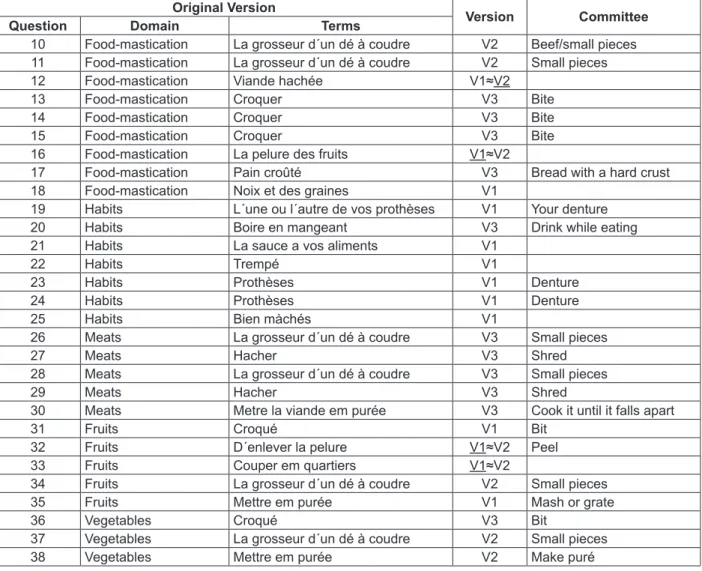
original instrument were submitted to a Reviewing Committee. Figure 2 presents the questions in the original version and their translations, as well as a synopsis of the decision making process relative to speciication of the irst and second version in Portuguese (V1 and V2) made by the committee. For some questions, the translations made by both translators were identical, or practically identical; for others, one or other version was prioritized; moreover, in other questions, the option taken was to combine the two versions, generating a version of consensus, with the purpose of obtaining greater clarity of the item.
RESULTS
Initial Translation and back-translation
Each version in Brazilian Portuguese (V1 and V2) was independently re-translated into French
(back-translation) by two native French teachers,
who were not aware of the purpose of the work, thereby giving rise to the origin of versions V3 and V4 in French.
Revision by a Committee of Specialists
The versions V1 and V2 in Brazilian Portuguese and the versions V3 and V4 in French, as well as the
Original Version
Version Committee
Question Domain Terms
10 Food-mastication La grosseur d´un dé à coudre V2 Beef/small pieces 11 Food-mastication La grosseur d´un dé à coudre V2 Small pieces 12 Food-mastication Viande hachée V1≈V2
13 Food-mastication Croquer V3 Bite 14 Food-mastication Croquer V3 Bite 15 Food-mastication Croquer V3 Bite 16 Food-mastication La pelure des fruits V1≈V2
17 Food-mastication Pain croûté V3 Bread with a hard crust 18 Food-mastication Noix et des graines V1
19 Habits L´une ou l´autre de vos prothèses V1 Your denture
20 Habits Boire en mangeant V3 Drink while eating
21 Habits La sauce a vos aliments V1
22 Habits Trempé V1
23 Habits Prothèses V1 Denture
24 Habits Prothèses V1 Denture
25 Habits Bien màchés V1
26 Meats La grosseur d´un dé à coudre V3 Small pieces
27 Meats Hacher V3 Shred
28 Meats La grosseur d´un dé à coudre V3 Small pieces
29 Meats Hacher V3 Shred
30 Meats Metre la viande em purée V3 Cook it until it falls apart
31 Fruits Croqué V1 Bit
32 Fruits D´enlever la pelure V1≈V2 Peel 33 Fruits Couper em quartiers V1≈V2
34 Fruits La grosseur d´un dé à coudre V2 Small pieces 35 Fruits Mettre em purée V1 Mash or grate
36 Vegetables Croqué V3 Bit
37 Vegetables La grosseur d´un dé à coudre V2 Small pieces 38 Vegetables Mettre em purée V2 Make puré
V1, choice of the irst translator’s version; V2, choice of the second translator’s version; V3, choice of a modiied version; V1≈V2,
similarity between the two versions with speciicity for the irst translator; V1≈V2, similarity between the two versions with speciicity for
the second translator.
of the diiculty (extreme, very, moderate, hardly, no diiculty) and frequency (never, rarely, sometimes, frequently, always, not applicable). For the irst item, the option was to choose the modiied version (V3). For the frequency scale, the option was for the V1; however, the term “à l´occasion”, which was translated as ”occasionally”, was changed to “sometimes” by the Committee, which is the word
more routinely used.
After conclusion of the process of translation and revision by the Committee, three questions related to denture wearing were excluded from the domain “Habits” (questions 19, 23 and 24).
Cultural Equivalence of the Instrument
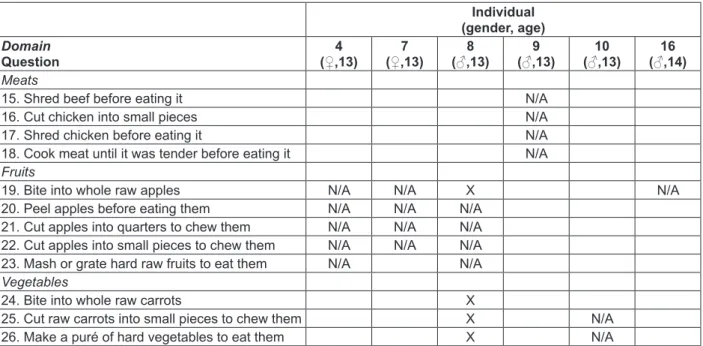
The use of the “Quality of Masticatory Function Questionnaire” was considered easy, fast and the questions were well understood by the subjects, since the alternative “I didn’t understand” was not checked by any of the participants. On the other hand, of the 20 adolescents who participated in pre-test, six checked the alternative response N/A (not applicable) to at least one question in the domains “Meats”, “Fruits” or “Vegetables” (Figure 3). Of these six participants, only one handed in the questionnaire with the responses left blank, being one question with reference to the domain “Fruits” (19: Bite into whole raw apples) and three questions of the domain “Vegetables”.
The test-retest reliability of the questionnaire was assessed for each domain, and the ICCs found were: 0.79 (Food-mastication), 0.45 (Habits), 0.62 (Meats), 0.74 (Fruits) and 0.81 (Vegetables), showing moderate to excellent agreement (p<0.01)20. The inal version of the instrument is shown in Figure 4. At this stage, replacements were made of terms
presented in V1 and V2 by synonyms, so that the terms would be better understood by the target population. Questions that sought to specify the size of the food (meats, fruits and vegetables) were those that generated the greatest diiculty. For example, the literal translation of the expression “la grosseur d´un dé à coudre” would be “the thickness of a thumb”. The second translator had also suggested the term “inch”, which is commonly used by the Brazilian adult population. However, the target population (adolescents) may not know the size of an “inch” and so the Committee suggested the use of the expression “small pieces”.
In questions 13, 14, 15, 31, and 36 the term “croquer” was used, which was translated as “grind” in V1 and as “chew” in V2. The Committee therefore suggested the use of “bite”, because this would
linguistically be more accept and easier to
under-stand, since “chew” would be translated into French as “mastiquer”.
Question 17 asks whether the subject has diicult with chewing “pain croûté”. This expression was translated by both translators as “toasted bread”; whereas for the Committee this translation was not acceptable, and it was replaced by “bread with a hard crust”. The term “hacher” (questions 27 and 29) was translated as ”chop” (V1) and ”mince” (V2), and it was afterwards changed by the Committee, which proposed the term ”shred” (the meat). Question 30 also generated doubts because of the expression “metre la viande em purée”, and it was translated as “Boiling the meat till it was tender”.
Individual (gender, age)
Domain
Question
4
(♀,13) (♀,13)7 (♂,13)8 (♂,13)9 (♂,13)10 (♂,14)16 Meats
15. Shred beef before eating it N/A
16. Cut chicken into small pieces N/A
17. Shred chicken before eating it N/A
18. Cook meat until it was tender before eating it N/A
Fruits
19. Bite into whole raw apples N/A N/A X N/A
20. Peel apples before eating them N/A N/A N/A
21. Cut apples into quarters to chew them N/A N/A N/A
22. Cut apples into small pieces to chew them N/A N/A N/A
23. Mash or grate hard raw fruits to eat them N/A N/A
Vegetables
24. Bite into whole raw carrots X
25. Cut raw carrots into small pieces to chew them X N/A
26. Make a puré of hard vegetables to eat them X N/A
Figure 3 – Pre-Test Synopsis: Description of the questions with alternative responses “not applicable” (N/A) or left blank (X) checked by six subjects
Este questionário visa avaliar sua escolha por alimentos em função de sua capacidade de mastigar nas duas últimas semanas.
ALIMENTAÇÃO-MASTIGAÇÃO
Extrema Muita Moderada Pouca Nenhuma
diiculdade 1. Você tem diiculdade para mastigar carne de vaca cortada em
pedaços pequenos?
□ (Assinale aqui se você não come carne de vaca)
□ □ □ □ □
2. Você tem diiculdade para mastigar frango cortado em pedaços pequenos?
□ (Assinale aqui se você não come frango)
□ □ □ □ □
3. Você tem diiculdade para mastigar carne moída?
□ (Assinale aqui se você não come carne moída) □ □ □ □ □
4. Você tem diiculdade para morder legumes duros, crus, inteiros
(exemplo: cenouras)? □ □ □ □ □
5. Você tem diiculdade para morder frutas duras, cruas, inteiras
(exemplo: maçãs)? □ □ □ □ □
6. Você tem diiculdade para morder frutas duras, cruas, cortadas
em quatro (exemplo: maçãs)? □ □ □ □ □
7. Você tem diiculdade para comer a casca de frutas duras, cruas? □ □ □ □ □ 8. Você tem diiculdade de mastigar pão com casca dura? □ □ □ □ □
9. Você tem diiculdade de mastigar nozes e grãos? □ □ □ □ □
HÁBITOS
Nas duas últimas semanas:
Nunca Raramente Às vezes Frequentemente Sempre
10. Você teve que beber enquanto comia para engolir
Nunca Raramente Às vezes Frequentemente Sempre
11. Você adicionou molho aos seus alimentos para
engolir melhor? □ □ □ □ □
12. Você molhou os alimentos em líquidos para masti
-gar e engolir melhor? □ □ □ □ □
13. Em geral, os alimentos que você engole são bem
mastigados? □ □ □ □ □
CARNES
Nas duas últimas semanas:
Nota: Se você não comeu carne, assinale a alternativa N/A (não aplicável).
Nunca Raramente Às vezes Frequentemente Sempre N/A
14. Foi necessário cortar a carne de vaca em
pedaços pequenos? □ □ □ □ □ □
15. Foi necessário desiar a carne de vaca
antes de comê-la? □ □ □ □ □ □
16. Foi necessário cortar o frango em pedaços
pequenos? □ □ □ □ □ □
17. Foi necessário desiar o frango antes de
comê-lo? □ □ □ □ □ □
18. Foi necessário cozinhar a carne até des
-manchar antes de comê-la? □ □ □ □ □ □
FRUTAS
Nas duas últimas semanas:
Nota: Se você não comeu essa fruta, assinale a alternativa N/A (não aplicável).
Nunca Raramente Às vezes Frequentemente Sempre N/A
19. Você mordeu maçãs cruas, inteiras? □ □ □ □ □ □
20. Foi necessário descascar as maçãs antes
de comê-las? □ □ □ □ □ □
21. Foi necessário cortar as maçãs em quatro
para mastigá-las? □ □ □ □ □ □
22. Foi necessário cortar as maçãs em pedaços
pequenos para mastigá-las? □ □ □ □ □ □
23. Foi necessário amassar ou ralar as frutas
duras cruas para comê-las? □ □ □ □ □ □
LEGUMES
Nas duas últimas semanas:
Nota: Se você não comeu esse legume, assinale a alternativa N/A (não aplicável).
Nunca Raramente Às vezes Frequentemente Sempre N/A
24. Você mordeu cenouras cruas inteiras? □ □ □ □ □ □
25. Foi necessário cortar as cenouras cruas em
pedaços pequenos para mastigá-las? □ □ □ □ □ □
26. Foi necessário fazer purê com os legumes
duros para comê-los? □ □ □ □ □ □
OBRIGADO POR SUA COLABORAÇÃO!
The English-version of this questionnaire is available at: Muller K, Morais J, Feine J. Nutritional and anthropometric analysis of eden
-tulous patients wearing implant overdentures or conventional dentures. Braz Dent J. 2008;19:145-50.
DISCUSSION
An instrument may only be considered valid
if it is capable of accurately capturing a certain
concept21. Furthermore, in the culture for which it
is being adapted, a translated instrument must be
capable of obtaining the same efect as the original instrument has in the context in which it was created. The lack of cultural equivalence compromises the validity of the information collected, making it impossible to use the instrument to study a concept
correctly22. This is why there are standardized instructions that are intended to minimize the loss of the original instrument characteristics that could result from the change in language16,22-24. Therefore, the methodology of the present study followed the
protocol suggested by Guillemim, et al.16, by which mistakes and misinterpretations in the initial transla
-tions are revealed. During these stages, semantic equivalence was appreciated, and not the literal interpretation, between the terms, since the literal interpretation is not always shown to be more advantageous to express concepts or situations of the new population one wishes to study16,24-26.
In this process, using and comparing more than one version is relevant. In addition to making it possible to choose items to incorporate, or to allow the junction of items arising from diferent versions, this strategy allows to carefully examine the sequence of the procedures, including the translations themselves, their re-translation and the appreciation that follows. The importance of a general criticism made by the committee of specialists must also be pointed out; among the members of the committee there must be individuals who are specialists in the disease investigated, in the measure used and in the concept explored, and they should preferably be
bilingual16.
The diferences between deinitions, beliefs and behaviors demand that the use of an instrument drawn up in other cultural contexts should, in addition
to reliable translation, be preceded by cross-cultural
adaptation to the country in which it will be applied, in order to keep the same concepts as those of the
original27. At the stage of cross-cultural adaptation, the number and characteristics of volunteers involved in pre-test were chosen in agreement with methodological criteria used for cultural adaptation of questionnaires16,18.
Originally it was proposed that this instrument should be self-applied, being necessary for the respondent to read the instructions carefully before answering the questions; therefore, future studies will be able to show whether there is equivalence. In this study, it was considered feasible for researchers to provide initial instructions to the subjects, with the aim to ensure that the rules for illing out the questionnaire were understood by the studied sample. For responses left blank or for alternative response N/A, the missing value may be replaced by the mean/median scores for each domain or for each subject28,29.
The process of translation and cultural adaptation of health-related questionnaires must keep a conceptual basis and follow standardized methodologies, since diferences in subject’s habits and culture may lead to misunderstandings, thereby altering the psychometric properties of the instrument. Therefore, in order to fully achieve
cultural adaptation, it is also necessary to conduct a
study of equivalence measurement, evaluating the reliability and validity of this new version in diferent populations and conditions (e.g. subjects with dental caries and/or periodontal disease, patients presenting feeding and/or swallowing disorders, denture users, patients undergoing orthognathic or bariatric surgery, and others).
CONCLUSION
The Portuguese version of the Questionnaire D’Alimentation has shown to be easy to understand
by Brazilian adolescents and useful in the evalu
-ation of the masticatory function and feeding or swallowing disorders that may afect food intake.
ACKNOWLEDGEMENTS
The authors would like to thank Prof. Fábio Nunes da Silva for his help in the translation process.
comparisons of implant–supported mandibular prostheses: psychometric evaluation. J Dent Res.
1994;73:1096-104.
9. Hassan AH, Amin Hel-S. Association of orthodontic treatment needs and oral health-related quality of life in young adults. Am J Orthod Dentofacial Orthop.
2010;137:42-7.
10. Souza JF, Grechi TH, Anselmo-Lima WT, Trawitzki LV, Valera FC. Mastication and deglutition changes in children with tonsillar hypertrophy. Braz J Otorhinolaryngol. 2013;79:424-8.
11. Prado MMS, Borges TF, Prado CJ, Gomes VL, Neves FD. Masticatoy function of subjects rehabilitated with conventional complete denture. Pesq Bras Odontoped Clin Integr. 2006;6:259-66. 12. Peres KG, Latorre MRDO, Peres MA, Traebert J, Panizzi M. Impact of dental caries and dental luorosis on 12-year-old schoolchildren’s self-perception of appearance and chewing. Cad
Saúde Pública. 2003;19:323-30.
13. Muller K.The mandibular implant overdenture versus the mandibular conventional denture:impact on the nutritional status [dissertation] Montreal (Quebec, Canada): Faculty of Dentistry; McGill
University; 1999.
14. Muller K, Morais J, Feine J. Nutritional and anthropometric analysis of edentulous patients
REFERENCES
1. Pereira LJ, Gavião MB, Engelen L, Van der Bilt A. Mastication and swallowing: inluence of luid addition to foods. J Appl Oral Sci. 2007;15:55-60. 2. Felicio CM, Melchior MO, Silva MAMR, Celeghini RMS. Masticatory performance in adults related to
temporomandibular disorder and dental occlusion. Pró-Fono R Atual Cient. 2007;19:151-8.
3. Ettinger RL.Changing dietary patterns with changing dentition: how do people cope? Spec
Care Dentist. 1998;18:33-9.
4. Marquezin MC, Kobayashi FY, Montes AB, Gavião MB, Castelo PM. Assessment of masticatory performance, bite force, orthodontic treatment need and orofacial dysfunction in children and adolescents. Arch Oral Biol. 2013;58:286-92. 5. Sun L, Ranawana DV, Tan WJ, Quek YC, Henry CJ. The impact of eating methods on eating rate and glycemic response in healthy adults. Physiol Behav.
2014;139C:505-10.
6. Katsuhiko K, Takahiro O, Garrett NR, Minoru T. Assessment of masticatory performance – methodologies and their application. Prosthodont
Res Pract. 2004;3:33-45.
7. Magalhães IB, Pereira LJ, Marques LS, Gameiro GH. The inluence of malocclusion on masticatory performance. A systematic review. Angle Orthod.
2010;80:981-7.
RESUMO
Objetivo: traduzir o instrumento em língua francesa “Questionnaire D’Alimentation” para o português
brasileiro e realizar a adaptação transcultural em adolescentes brasileiros. Métodos: a tradução foi
realizada com base em protocolo que consistiu na tradução para o português brasileiro (por um professor formado em Letras e uma Cirurgiã Dentista luentes em francês), tradução reversa para o francês (realizada por dois professores de francês), revisão por Comitê de especialistas (duas tradutoras, uma nativa e uma juramentada, e duas professoras universitárias, sendo uma Cirurgiã Dentista e uma Fonoaudióloga) e equivalência cultural (pré-teste). A versão utilizada no pré- teste consistiu de 26 questões com cinco respostas possíveis (5-Likert), distribuídas em cinco domínios (Alimentação- mastigação, Hábitos, Carnes, Frutas e Legumes). O pré-teste e teste-reteste foram realizados com uma amostra de 20 adolescentes (10 meninos/10 meninas) de escolas públicas de Piracicaba (Brasil). Nesta fase, a alternativa “não entendi” foi incluída a cada questão, a im de iden
-tiicar aquelas não compreendidas. A coniabilidade teste-reteste foi avaliada para cada domínio utili
-zando os coeicientes de correlação intra-classe (CCI). Resultados: no pré-teste, foi observada uma
excelente compreensão do instrumento; no teste-reteste, os CCIs variaram entre 0,45-0,81 (mode
-rada a excelente concordância). Conclusão: a versão em Português do Questionnaire D’Alimentation
mostrou ser de fácil compreensão por parte dos adolescentes brasileiros e útil na avaliação da função mastigatória e dos distúrbios de alimentação e deglutição que podem alterar a ingestão de alimentos.
screening of violence against pregnant women. Rev
Saude Publ. 2000;34:610-6.
23. da Mota Falcão D, Ciconelli RM, Ferraz
MB.Translation and cultural adaptation of quality of life questionnaires:an evaluation of methodology. J Rheumatol. 2003;30:379-85.
24. Herdman M, Fox-Rushby J, Badia X. “Equivalence” and the translation and adaptation of Health-Related Quality of Life Questionnaires. Qual Life Res. 1997;6:237-47.
25. Reichenheim ME, Moraes CL.Pillars for
assessing validity in epidemiological studies. Rev Bras Epidemiol. 1998;1:131-48.
26. Tesch FC, Oliveira BH, Leão A. Semantic equivalence of the Brazilian version of the Early Childhood Oral Health Impact Scale. Cad Saude
Publica. 2008;24:1897-909.
27. Barbosa TS, Gavião MB.Quality of life and oral health in children - Part II: Brazilian version of the Child Perceptions Questionnaire 11-14. Cien Saude
Colet. 2011;16:3267-76.
28. Shrive FM, Stuart H, Quan H, Ghali WA.Dealing with missing data in a multi-question depression scale:a comparison of imputation methods. BMC Med Res Methodol. 2006;6,57.
29. Eekhout I, de Boer RM, Twisk JW, de Vet HC, Heymans MW. Missing data: a systematic review of how they are reported and handled. Epidemiology.
2012;23:729-32.
15. Cushing AM, Sheiham A, Maizels J. Developing socio-dental indicators the social impact of dental disease. Community Dent Health. 1986;3:3-17.
16. Guillemin F, Bombardier C, Beaton D.
Cross-cultural adaptation of health-related quality of life measures: literature review and proposed guidelines. J Clin Epidemiol. 1993;46:1417-32.
17. Beaton DE, Bombardier C, Guillemin F,
Ferraz MB.Guidelines for the process of cross-cultural adaptation of self-report measures. Spine.
2000;25:3186-91.
18. Yusuf H, Gherunpong S, Sheiham A, Tsakos G. Validation of an English version of the Child-OIDP index, an oral health-related quality of life measure for children. Health Qual Life Outcomes. 2006;4:38.
19. Ciconelli RM, Ferraz MB, Santos W, Meinão I,
Quaresma MR. Brazilian-Portuguese version of the SF-36. A reliable and valid quality of life outcome
measure. Rev Bras Reumatol. 1999;39:143-50.
20. Fleiss JL. Reliability of Measurement. In: Fleiss JL. The design and analysis of clinical experiments. New York: Wiley; 1986. pp. 1-32.
21. Barbosa TS, Serra MD, Gavião MBD.Quality
of life and oral health in children - Part I: Brazilian version of the Child Perceptions Questionnaire
8-10. Cien Saude Colet. 2011;16:4077-85.
22. Reichenheim ME, Moraes CL, Hasselmann MH. Semantic equivalence of the Portuguese version of the Abuse Assessment Screen tool used for the
http://dx.doi.org/10.1590/1982-021620151764715
Received on: April 13, 2015 Accepted on: September 11, 2015
Mailing address: Paula Midori Castelo
Depto. Ciências Biológicas - Universidade Federal de São Paulo (UNIFESP)
R. São Nicolau, 210 – 1. Andar Diadema – SP – Brasil
CEP: 09913-030