INFLUENCE OF DIFFERENT DIETS OF
CORCYRA CEPHALONICA
ON LIFE
HISTORY OF A REDUVIID PREDATOR
RHYNOCORIS MARGINATUS
(FAB.)
SHAHAYARAJ* K., SATHIAMOORTHI P.
ABSTRACT
Rhynocoris marginatus (Fab.) a predator of nearly 25 insect pests, accepting the larvae of Corcyra cephalonica Stainton as an alternative laboratory host. Influence of different diets (wheat, jower, sorghum and rice) of C. cephalonica larvae on the life history of R. marginatus was studied under laboratory conditions. Developmental period and the adult longevity were minimum and maximum respectively when R. marginatus reared on C. cephalonica larvae from jower medium. This category has minimum pre-oviposition period (62.6 ± 5 days) and maximum number of batches of eggs laid, total number of eggs laid/female and hatchability. Life table studies indicated that the net reproductive rate, mean length of a generation and corrected generation time were maximum in the above mentioned category. The geometric studies revealed that heaviour (192.12 mg / adult) and shorter total body length were noticed in wheat and jower media reared C. cephalonica fed predators respectively.
INTRODUCTION
Rhynocoris marginaturs (Fab.) is an alate, entomosuccivorous, polyphagus, polymorphic, crepuscular, multivoltine assassin bug, predominantly found in the scrup jungles, semi-arid zones, tropical rain forests and agroecosystems of South India [1,2]. Joseph [3] used Corcyra larvae as feed for the reduviids by releasing them on filter paper in glass jar. These larvae were also used by previous researchers for rearing reduviids [4 – 6]. The development and laboratory biological control potential of R. marginatus on different host was studied by many authors [1,6,7 –11]. Sahayaraj [12] evaluated the biological control potential of R. marginatus on Helicoverpa armigera Hubner and Spodoptera litura (Fab.) under field conditions. He found that R. marginatus reduce the pest population and increased the groundnut production.
The relative importance of different preys on the postembryonic development of R. marginatus was studied [13]. Life history and life table of this predator on S. litura [14, 15] and Corcyra cephalonica Stainton [16, 17] were documented. Egg production, nymphal development, longevity and size of insect may be greatly influenced by the quality of the available food. Further, the quality of ingested food influences the development and reproduction. Influence of food on the development of many insect pest and predators were available in plenty. Such a kind of information was not available for this reduviid. Further the life table is the most useful numerical aid in studying population biology [18] and used for the determination of age distribution and mortality rate in natural population. Such studies facilitate the assessment of various ingredients of food, which are responsible for maintenance of population in nature as well as in the laboratory. The present study was undertaken to evaluate the impact of different rearing medium of the host C. cephalonica on the biology, fecundity and life table of R. marginatus.
MATERIALS AND METHODS
Rearing of Corcyra cephalonica larvae
Cereals such as wheat, jower, sorghum and rice were used in this study. These cereals were ground into small pieces of uniform size separately. One kilogram of crushed wheat was taken in a plastic
trough having three litre capacity. It was fortified with crushed groundnut (200 g), yeast (5 g), streptomycin (15 mg) and multivitamin (500 mg). Newly hatched one day old 500 C. cephalonica larvae were released into the food stuffs, and it was maintained at 30 ± 1°C temperature, 70 ± 10%
relative humidity and 11 L : 13 D hrs photoperiod. Similar procedure was followed for other cereals [19]. Ten replication was maintained for each cereal.
Reduviid Predator
Predator R. marginatus adults were collected from Melapattam Agroecosystem, Tirunelveli District, Tamil Nadu, India. Adults were maintained in the laboratory conditions on C. cephalonica larvae reared on wheat medium. The egg batches laid in the laboratory were incubated and the newly hatched first instar nymphs were used for this study. The predators were divided into four categories such as (i) C. cephalonica reared on jower medium fed group (JFC), (ii) C. cephalonica reared on rice medium fed group (RFC), (iii) C. cephalonica of sorghum medium fed group (SFC) and (iv) C. cephalonica of wheat medium fed group (WFC). Each set of predators were fed with head crushed fourth and fifth instar C. cephalonica larvae. Five newly eclosed first instar predators were introduced into the plastic container (650 ml capacity) and totally hundred nymphs were taken for each category and reared on each type of prey separately. Totally 400 nymphs were maintained for the four categories. All the nymphs were fed with their respective prey in ad libitum.
Biology and Bionomics
The number of prey consumed by predator was counted daily to calculate the number of larvae consumed per predator per stadia. Observations on moulting, developmental periods, adult emergence and weight of the newly emerged adults were recorded. The sex ratio of the laboratory emerged adult was calculated using the formula [20] : Sex ratio = No. of females emerged / No. of females + No. of males emerged
maintained in each category. The preoviposition period, number of batches of eggs, average number of eggs per batch and total number of eggs laid per female and hatchability were recorded from the adults emerged from each groups. The adult longevity and post-oviposition period were also recorded.
Life table studies
On the basis of the observed data of fecundity the life table was constructed according to the methods of BIRCH [21] elaborated by SOUTHWOOD [18]. Life table statistics like net reproductive rate (NRR – R0), mean length of generation (Tc), innate capacity for increase in number (rc), corrected rm, corrected generation time (T), finite rate of increase in numbers (λ), rate of weekly multiplication (RWM), doubling
time (DT) and number of individuals expected in F2 generation (Ro2) were determined.
Statistical Analysis
Analysis of variance (ANOVA) was used to determine the difference between first nymphal instars and second, third, fourth and fifth nymphal instars separately. Duncan's multiple range test (DMRT) was used to separate the treatment means [22]. Chi-square was used to determine the statistical significance in sex ratio of adult predators.
RESULT AND DISCUSSION
Juvenile developmental time
The shortest total stadial period was observed in the nymphal instars from JFC (38.5 ± 0.3) days followed by SFC (40.1 ± 0.7 days), RFC (41.0 ± 0.7) and WFC (42.0 ± 0.8 day) respectively (Table. 1). However, they were statistically insignificant. The short total developmental period recorded in JFC group might be a result of the better nutrition obtained by the predator with minimum expenditure of energy during predation on fever (19.37 preys/predator) prey individuals. The total developmental period of R. marginatus was 38.82 [10], 89.05 days [14] when reared on S. litura larva and 100.97 days [16] on C. cephalonica. The total average developmental time of R. marginatus nymphs in our experiment was about 40 days which is 0.4 times lower value when we compared to the observation of GEORGE (16) for R. marginatus nymphs fed on C. cephalonica in solitary rearing. The differences are probably due to the differences in experimental setups and food types. For example AMBROSE et al. [13] found that the type of prey had a significant influence on the development time of R. marginatus. This study indicates that group rearing was necessary for shortening the nymphal development. Among the five stadium, the sortest stadium was the first except in JFC and the longest was the fifth stadium (Table.1). Researchers [4, 23, 24] reported that in reduviids the shortest and longest stadia were the second and fifth instars respectively.
Table 1. Corcyra rearing media on the juvenile developmental period (in days) of R. marginatus
Life Stages Rearing media
Wheat Jower Sorghum Rice
First instar 7.0 ± 0.2 7.6 ± 0.3 6.9 ± 0.2 7.2 ± 0.3
Second instar 7.0 ± 0.3 7.4 ± 0.4 7.4 ± 0.3 7.3 ± 0.4
Third instar 7.8 ± 0.4 9.2 ± 0.3 7.9 ± 0.3 7.2 ± 0.7
Fourth instar 9.2 ± 0.4 7.9 ± 0.4 9.4 ± 0.3 8.4 ± 0.3
Fifth instar 13.2 ± 0.5 12.4 ± 0.7 12.6 ± 0.4 11.2 ± 0.3 Total days 42.0 ± 0.8a 38.5 ± 0.3b 40.1 ± 0.7bc 41.0 ± 0.7cd
Values in the row with same letters are not significantly different at P = 0.05 using the DMRT
Sex Ratio
Male biased sex ratio was observed in both WFC (0.46) and JFC (0.36), whereas in other two medium it was female biased sex ratio (0.59 and 0.61 for SFC and RFC respectively). Ambrose [25] stated that the
Adult Longevity
The male and female of test individuals of JFC had the longest adult longevity (176.4 ± 6.15 and 186.4 ± 4.1 days for female and male respectively). There was significant difference observed between the longevity of male and female (P < 0.05). Whereas the shortest adult longevity was recorded on WFC (147.9 ± 6.5 and 135.7 ± 6.7 days for male and female respectively) and was not statistically significant. In other reduviids like Coranus soosaii [26] and Acanthaspis pedestris Stal [27] the adult longevity was maximum in the crowded individuals. The female reduviids usually lived longer than the males [2].
Reproduction
Pre-oviposition, oviposition and post-oviposition periods
The preoviposition period of R. marginatus varied with prey rearing media. Among the four media, the shortest pre-oviposition period was observed in JFC (62.7 ± 15 days) followed by RFC (70.8 ± 1.3 days), WFC (73.3 ± 1.6 days) and SFC (68.0 ± 1.2 days). A contradict result was observed by many researchers [5, 28]. In an average the pre-oviposition period was 68.7 days which is longer than 41.4 and 38.1 days for R. marginatus fed on S. litura [14] and C. cephalonica [16] respectively. Further studies are necessary to confirm the results of the above said authors. As observed for the pre-oviposition, the
oviposition period was also minimum and maximum in JFC (44.7 days) and SFC (71.6 days) respectively. The variations in the reproductive period among the four categories was due to the variation in the nymphal duration.
Fecundity
As observed in pre-oviposition, the fecundity was also maximum in JFC group (360.9 ± 13.5) followed by WFC (223.6 ± 5.5) and the minimum was observed in SFC (208.3 ± 3.9) and RFC (208.4 ± 4.4). A diet consists solely by Corcyra reared on wheat thus seem to meet the optimal requirements of R. marginatus egg-laying female. The low egg production found by George [16] for females fed with C. cephalonica (100.97 egg/female) larvae corresponds well with the 148.74 eggs [14] for females fed with S. litura. More number of batches of eggs were recorded in JFC (6.49 ± 1.84) followed by wheat (5.00 ± 1.06). The maximum fecundity of JFC group might be due to the maximum weight of female predator. EVANS [29] reported that the mean fecundity of a predator was decreased upon the predator density. The reason for the differences in preoviposition and total number of eggs laid per female may be due to the different types of diet provided to the C. cephalonica. It may also be due to differences in the experimental setup, in that the female R. marginatus was present along with a male throught its life-time [16] and in the present examination the females were together with many males.
Table 2. Influence of different diets of Corcyra cephalonica on the fecundity and hatchability of Rhynocoris marginatus (X ± SE)
Parameters C. cephalonica larval diets
Wheat (n = 20)
Jower (n = 15)
Sorghum (n=15)
Rice (n = 28) Preoviposition period
(in days)
73.3a ± 1.6 62.7b ± 1.5 68.0c ± 1.2 70.8ad ± 1.3
No. of batches of eggs laid/female
5.00a ± 1.6 6.49b ± 1.84 4.495ac ± 0.68 94.22acd 0.760
Total no. of eggs laid/female 223.6a ± 5.5 360.9b ± 13.5 208.3c ± 3.9 208.4± 4.4 Average no. of egg/batch 43.88a ± 3.18 56.052b ± 1.31 48.49ac ± 3.83 49.01acd ± 1.77 Maximum no. of egg/batch 66.25a ± 2.53 75.75b ± 5.39 77.25bc ± 3.43 78.00bcd ± 4.22 Minimum no. of egg/batch 1 8.75a ± 3.90 30.00b ± 2.78 20.00ac ± 3.69 16.25acd ± 1.44
Hatching percentage 82.51a 82.88ab 74.33abc 79.92abcd Post oviposition period
(in days)
23.0a ± 1.5 18.5b ± 1.0 16.2c ± 1.1 20.7ab ± 0.8
Hatchability
The maximum number nymphs emerged from the R. marginatus fed with C. cephalonica reared on jower (82.88%) and wheat (82.51%). The minimum numbers of nymphs were emerged from the sorghum (74.33%) category (Table 2).
Predatory rate
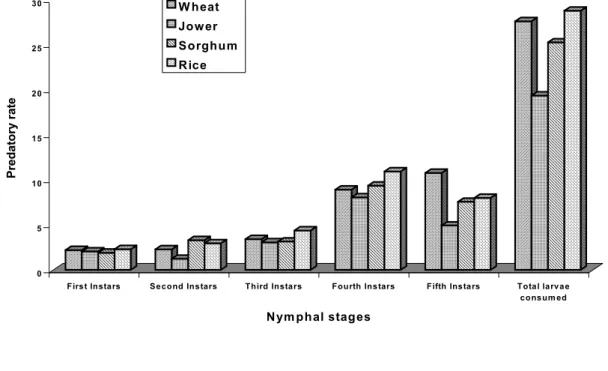
The predatory rate of R. marginatus was maximum and minimum in RFC group (28.79) and JFC group (19.37) respectively. The figure 1 shows that the predatory rate was gradually increased from the first instar to the fourth instar and decreased in fifth instar except WFC group as observed in Rhynocoris fuscipes Fab [30]. Further they stated that the conversion ratio of R. fuscipes was comparatively higher in the younger instar than in adults. LAKKUNDI
[4] reported that the feeding rate was higher in immature stages than their adults.
Biometrics (Weight)
It is well known fact that the type of food may have a substantial effect on the growth of the organisms. In addition to differences in chemical composition, preys differ in their capacity as phagostimulants. The heaviest female was observed on JFC group followed by WFC group (242.1 and 231.8 mg/female respectively). The lightest female was noted in SFC group (229.3) (Fig. 2). This results shows that the predatory rate of JFC group was very low when compared with other group (Fig. 1). Previous studies showed that type of the prey has on great influence on the development and weight of the reduviids [13, 31]. Further studies are essential to know the impact of prey type on the weight of the predators.
0 5 1 0 1 5 2 0 2 5 3 0
Predatory rate
Firs t Insta rs S e c ond Ins tars Third Insta rs Fourth Ins tars Fifth Ins ta rs Tota l la rv a e
c ons um ed
N ym phal stages
Figure 1. Influence of different diets of C orcyra larvae on the predatory rate (num ber of
prey/predetor/stadia) of R . m arginatus nym phs
W heat
Jow er
Sorghum
0 50 100 150 200 250
Weight (in mg)
Wheat Jower Sorghum Rice
Feed category
Figure 2. Influence of different diets of Corcyra larvae on the adult weight (in mg)
of R. marginatus
Male Female
Life table
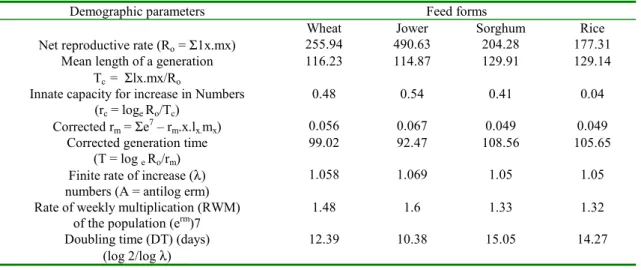
The data on the life table parameters of predator R. marginatus presented in the table 3 revealed that the highest and lowest survival and the female birth was noted in JFC and RFC respectively. In all the four media, the schedules of survival for female (Ix) were gradually decreased when the predator grew older. The net reproductive rate (NRR) was highest in JFC (490.63) followed by WFC (255.94), SFC (204.8) and RFC (177.31). Studies have indicated that the fertility of predator can vary based on the type of the
host larvae provided. In Acanthaspis pedestris Stal it was recorded as 19.36 [5] were as in R. marginatus the net reproductive rate was 48.2 eggs/female, S. litura [14] and 33.4 days on C. cephalonica [20] respectively. Similarly in Rhynocoris fuscipes (Fab.) the NRR was 32.88, 25.05 and 18.15 eggs/female on S. litura, Earias vitella Fab. and C. cephalonica respectively [32] The intrinsic rate of natural increase was the main focus of life table studies of R. marginatus and it was higher on JFC and more or less similar in other three groups (Table 3)
Table 3. Influence of cereals on the life table parameters of Rhynocoris marginatus
Demographic parameters Feed forms
Wheat Jower Sorghum Rice
Net reproductive rate (Ro = Σ1x.mx) 255.94 490.63 204.28 177.31 Mean length of a generation
Tc = Σlx.mx/Ro
116.23 114.87 129.91 129.14
Innate capacity for increase in Numbers (rc = loge Ro/Tc)
0.48 0.54 0.41 0.04
Corrected rm = Σe7 – rm.x.lx.mx) 0.056 0.067 0.049 0.049 Corrected generation time
(T = log e Ro/rm)
99.02 92.47 108.56 105.65
Finite rate of increase (λ) numbers (A = antilog erm)
1.058 1.069 1.05 1.05
Rate of weekly multiplication (RWM) of the population (erm)7
1.48 1.6 1.33 1.32
Doubling time (DT) (days) (log 2/log λ)
The mean length of generation was shorter on JFC (114.87) followed by WFC (116.23) and more or less similar in both SFC and RFC. Doubling time was maximum and minimum on SFC and JFC medium and minimum on SFC and JFC medium respectively. Increased mean length of generation and decreased multiplication were noted on R. marginatus. Similar trend was also noted in R. fuscipes [32], Acanthaspis siva Distant [33] and Cydnocoris gilvus Burm [34]. The mean length of generation (Tc) of R. marginatus on JFC, SFC, WFC and RFC categories were not higher than the corrected generation time, thus the species had not the capacity to multiply very faster.
CONCLUSIONS
The present study provided information fundamental to development of models to stimulate and predict population dynamics the high egg out put by females and maximum and minimum longevity and development, respectively of adults in JFC group of R. marginatus noted in our study seem to be a reflection of the superior nutritional quality of the
Corcyra. Shorter juvenile developmental time, preoviposition period and increased weight of adults maximum total number of eggs laid per female, hatching percent, average number of eggs laid per female and number of batches of eggs laid were observed in JFC. Similarly higher weekly multiplication of the predator population in JFC group might make the Corcyra reared of ideal condidate for the mass rearing of this reduviid for use in biological control programmes. Finally, this kind of models will be an useful tools for establishment of optimal biological and integrated strategies.
Acknowledgement
The authors are grateful to Rev. Fr. Dr. A. Lourdasamy, S.J. Principal and Prof. M. Thomas Punithan, HOD, Department of Zoology, St. Xavier's college, Palayamkottai for facilities and encouragements. Financial assistance by CSIR (ref.no. 37(1046)/EMRII) is acknowledged by the senior author.
REFERENCES
[1] SAHAYARAJ, K. 1994a. Capturing success by reduviid predators Rhyncoris kumarii and Rhynocoris marginatus on different age groups of Spodoptera litura, a polyphagous pest (Heteroptera: Reduviidae). Journal of Ecobiology 6(3): 221 – 224.
[2] AMBROSE, D. P. 1999. Assassin Bugs. Oxford & IBH Publishing Co. Pvt. Ltd., New Delhi. pp.228.
[3] JOSE, M. T. 1959. Biology binomics and economic importance of some reduviids collected from Delhi. Indian Journal of Entomology21 : 46 – 58.
[4] LAKKUUNDI, N. S. 1989. Assessment of reduviids for their predation and possibilities of their utilization in biological control; Ph.D., thesis, Indian Agricultural Research Institute, New Delhi.
[5] SAHAYARAJ, K. 1991. Bioecology, ecophysiology and ethology of chosen predatory hemipterans and the potential in Biological control (Insecta: Heteroptea : Reduviidae); Ph.D., thesis, Madurai Kamaraj University, Madurai, India.
[6] SAHAYARAJ, K. 1998. Laboratory rearing of predaceous bugs with special reference to reduviis (Insecta: Hemitera: Reduviidae). Zoo’s Print 13(5) : 17 – 18.
[7] IMMS, A. D. 1965. A general textbook of Entomology. The English Language Book Society and Methuen Company Limited, London.
[8] NAYAR, K. K., ANANTHAKRISHNAN, T. N. and DAVID, B.V. 1976. General and Applied Entomology; (New Delhi: Tata Mc-Graw Hill Publishing Company. pp. 169 – 170.
[9] VENNISON, S. J. and AMBROSE, D. P. 1988. Two new species of Acanthapis (Heteroptrea : Reduviidae : Acanthaspidinae) from southern India Journal of Bombay. Natural History Society85 : 383 – 390.
[11] SAHAYARAJ, K. 1995. Bioefficiacy and prey size suitability Rhynocoris marginatus Fabricius to Helocooverpa armigera Hubner of groundnut (Insecta: Heteroptrea: Reduviidae). Fresenis Environment Bulletin4 : 270 – 278.
[12] SAHAYARAJ, K. 1999. Field evaluation of Rhynocoris marginatus (Fab.) against two groundnut desoliators. International Arachis Newletter. 19 : 41 – 42.
[13] AMBROSE, D. P., SAJU, T. AND SAHAYARAJ, K. 1999. Prey influence on the development, reproduction and sex ratio of assassin bug Rhynocoris marginatus (Fab.). Environment and Ecology 8(1) : 280 – 287.
[14] GEORGE, P. J. E. 1999. Development, life table and intrinsic rate of natural increase of three morphs of Rhynocoris marginatus (Fab.) on cotton leaf worm Spodoptera litura Fab. Entomon 24(4) : 339 – 343.
[15] SAHAYARAJ, K. and GABRIEL PAULRAJ, M. 2001. Rearing and life table of reduviid predator Rhynocoris marginatus Fab. (Heteroptera : Reduviidae) on Spodoptera litura Fab. (Lepidoptera : Noctuidae) larvae. Journal of Applied Entomology 125 : 1 – 5.
[16] GEORGE, P. J. E. 2000. Life tables and intrinsic rate of natural increase of the three morphs of Rhynocoris marginatus (Fab.) on Corcyra cephalonica Stainton. Journal of Experimental Zoology 3(1) : 59 – 63.
[17] SAHAYARAJ, K. 2002. Small-scale laboratory rearing of a reduviid predator, Rhynocoris marginatus Fab. (Hemiptera : Reduviidae) on Corcyra cephalonica Stainton larvae by larval card method. Journal of Central European Agriculture 3(4) : (in press).
[18] SOUTHWOOD, J. R. E. 1978. Ecological methods with particular reference to study of insect population. Chapman and Hall, London. P. 391.
[19] SAHAYARAJ, K., SATHYAMOORTHY, P. and RAJAMANICKAM, K. 2001. Rearing media on Corcyra cephalonica Stainton biology and life table. Shashpa 8(2) : 125 – 130.
[20] ENKEGAARD, A. SARDAR, M. A. and BRODSGAARD, H. F. 1997. The predatory mite Hypoaspis miles: biological and demographic
characteristics on two prey species, the mushroom sciarid fly, Lycoriella Solani, and the mould mite, Tyrophagus putrescential. Entomologia Experimentalis et Applicata 82 : 135 – 146.
[21] BIRCH, S. 1948. The intrinsic rate of natural increase in an insect populations. Journal of Animal Ecology 17 : 15 – 26.
[22] DANIEL, W. W. 1987. Biostatistics : A foundation for analysis in the health science. New York: John Wiley & Sons.
[23] AMBROSE, D. P. 1983. Bioecology of an alate assassin bug, Acanthapis quinquespinoas (L) Fab. (Heteroptera: Reduviidae). In Proc. Symp. Ins. Ecol. and Resource manage, S. C. Goel (Ed.) Muzaffarnagar, India. pp. 107 –115. [24] KUMARASWAMI, N. S. 1991. Bioecology and
ethology of chosen predatory bugs and their potential in biological control. Ph.D. thesis, Madurai Kamaraj University, Madurai, India. [25] AMBROSE, D. P. 1987. Assassin bugs of Tamil
Nadu and their role in biological control (Insecta: Heteroptera: Reduviidae). In Advances in biological control research in India, J. K. Joseph and U.C. Abdurahiman (Ed.) (Calicut: M/S Printex Ltd.) pp. 16 – 28.
[26] AMBROSE, D. P. and JENOBA, T. 1988. Effect of crowding on the development and size of Coranus soosaii. Environment and Ecology 6 : 843 – 848.
[27] AMBROSE, D. P. RANI, M. R. S. and VENNISON, S. J. 1988. Effect of crowing on the camouflaging behaviour, size, development, oviposition pattern and hatchability of offspring of Acanthaspis pedestris Stal a potential predator of insect pests (Heteroptera: reduviidae) : Monitore Zoology 22 : 111 - 120. [28] AMBROSE, D. P. and LINVINGSTONE, D. 1987.
Biology of a new harpactorine assassin bug Rhynocoris kumarii (Hemiptera : Reduviidae) in south India. Journal Soil BiologyandEcology 7 : 48 – 58.
[30] AMBROSE, D. P. and KUMARASWAMI, N. S. 1993. Food requirement of Rhynocoris fuscipes Fab. (Hereoptera, Reduviidae). Journal of Biological Control7(2) : 102 –1 04
[31] AMBROSE, D. P. and SUBBURASU, P. A. 1988. Prey Influence on the Development, Reproduction and size of Assassin bug Acanthapis pedestris. EnvironmentandEcology 6(4) : 948 – 955.
[32] GEORGE, P. J. E. 2000. Reproductive performance of a harpactorine reduviid Rhynocoris fuscipes (Fab.) on three
lepidopteran insect pests. Insect Scienceandits Application 20(4) : 269 – 273.
[33] GEORGE, P. J. E., SEENIVASAGAN, R. AND
KANNAN, S. 1998. Influence of prey on the development and reproduction of Acanthaspis siva Distant. Entomon 23 : 69 – 75.
[34] VENKATESAN, S., SEENIVASAGAN, R. and KARUPPASAMY, G. 1997. Influence of prey species on feeding response, development and reproduction of the reduviid Cydnocoris gilvus Burm. Entomon22 : 21 – 27.
Shahayaraj K., [email protected] * correspondence author, Sathiamoorthi P.,