Braz Dent J 18(3) 2007
Hardness of composite resins 231
Braz Dent J (2007) 18(3): 231-234
Correspondence: Dr. Álvaro Della Bona, Faculdade de Odontologia, Universidade de Passo Fundo, Caixa Postal 611/613, BR 285, Km171, Campus I, 99001-970 Passo Fundo, RS, Brasil. Tel: +55-54-3311-5142. Fax: +55-54-3316-8403. e-mail: [email protected]
ISSN 0103-6440
Influence of Shade and Irradiation Time
on the Hardness of Composite Resins
Álvaro DELLA BONA1
Vinícius ROSA2
Dileta CECCHETTI3
1School of Dentistry of University of Passo Fundo, Passo Fundo, RS, Brazil 2University of São Paulo, São Paulo, SP, Brazil
3Institute of Biological Sciences, University of Passo Fundo, Passo Fundo, RS, Brazil
This study tested the following hypotheses: 1. increasing light irradiation time (IT) produces greater values of superficial hardness on different depths (0 and 3 mm); and 2. a dark shade composite (A3) needs longer IT than a light shade composite (A1) to produce similar hardness. Disk-shaped specimens (n=24 per shade) were fabricated using a 3-mm-thick increment of composite resin (Z100). Specimens were randomly assigned to 3 groups (n=8) according to the IT (400 mW/cm2) at the upper (U) surface: A1-10 and A3-10: 10 s; A1-20 and A3-20: 20 s; A1-40 and A3-40: 40 s. Specimens were stored in black lightproof containers at 37oC for 24 h before indentation in a hardness tester. Three Vickers indentations were performed on the U and lower (L) surfaces of each specimen. The indent diagonals were measured and the hardness value calculated. The results were analyzed statistically by ANOVA and Tukey’s test (α=0.05). Statistically significant differences were found between U and L surfaces of each composite shade-IT combination (p=0.0001) and among the ITs of same shade-surface combination (p=0.0001), except between groups A1-20U and A1-40U, confirming the study hypothesis 1 and partially rejecting the hypothesis 2.
Key Words: resin composite, shade, hardness, irradiation time.
INTRODUCTION
Composite resin has been described as an es-thetic restorative material with excellent physical and mechanical properties (1). Most composites are light-activated materials, meaning that they go through poly-merization in the presence of light (1). As light passes through the bulk of the composite resin, it is absorbed, dispersed and attenuated, decreasing the irradiance and curing effectiveness (3), consequently, the surface layer close to the light source is better polymerized than the layers far from it. Therefore, thick composite increments result in either partially or non-polymerized layers, which can compromise the quality of the resto-rations with decreased mechanical properties, low color stability and risk of pulp aggression by the non-polymer-ized monomers (1,2).
The conventional quartz tungsten halogen light
unit consists of a tungsten filament in an iodine or bromine gas filled bulb that produces a powerful white light with the irradiance of 400-800 mW/cm2 (4). As the
ideal wavelength to excite a-1,2-diketone is about 468 nm (1), thus the white light emitted from this type of curing unit must be filtered at the output to a range of blue light (400-500 nm) (5,6). Despite their popularity, quartz tungsten halogen units present several shortcom-ings, such as the restricted depth of cure, heat genera-tion and relatively long irradiagenera-tion time (7,8).
The irradiance is related to aspects as depth of polymerization, monomer conversion, gap formation, shrinkage, infiltration and adhesion (9). The irradiance of light emission depends on the power (Watts) of the curing unit as well as the time (seconds) and the surface area (cm2) where the light is spread over (9). The energy
Braz Dent J 18(3) 2007
232 A. Della Bona et al.
of light cured resin composite (1,8,10). The degree of polymerization of these materials is basically propor-tional to the material thickness and irradiation time (1), which depend on some variables, such as type of material, composite shade, distance and quality of light source. For an adequate polymerization of a 2-mm-thick composite increment is recommended an energy density between 21 and 24 J/cm2 (11), therefore, to light
cure a 2-mm-thick composite increment is required a minimum irradiance of 400 mW/cm2 for 40-60 s
(12-14) and 280 mW/cm2 for 60 s to light cure a 1-mm-thick
composite increment (12).The surface near the light source can be considered well polymerized for 20 s at an irradiance as low as 200 mW/cm2 because there is no
interference with light transmission (1,14). The amount of light exposure time indicated by the composite manufacturer must be extended whenever the irradi-ance is reduced due to distirradi-ance or any other factor.
The addition of components, such as titanium dioxide (TiO2) and aluminum dioxide (AlO2) in the
organic matrix is a common process to produce differ-ent shades of composite resin. It has been reported that the concentration of pigments difficult considerably the light transmittance through the bulk of composite resins due to the intensification of the optical density and, consequently, there is a decrease in the depth of poly-merization (15).
Hardness is a measure of a material’s resistance to localized plastic deformation (16). However, the term hardness may also refer to resistance to bending, scratching, abrasion or cutting, and gives an idea of relative easiness of finishing and polishing. The usual protocol to measure hardness uses indentation meth-ods. A composite resin may be considered well cured when the hardness of the opposing surface is equivalent to at least 80-90% of the top surface hardness (14).
The purpose of this study was to evaluate the influence of shade and irradiation time on the hardness of composite resins, testing the following hypotheses: 1. increasing irradiation time produces greater hardness on different depths (0 and 3 mm), and 2. a dark shade composite (A3) needs longer irradiation time than a light shade composite (A1) to produce a similar hardness.
MATERIAL AND METHODS
Forty-eight disk-shaped specimens (5 mm diam-eter x 3 mm thick) were fabricated using A1 and A3
shades of a composite resin (Z100, 3M/ESPE, St. Paul, MN, USA). Eight specimens from each shade (n=8) were irradiated for either 10 s, or 20 s or 40 s using a quartz tungsten halogen unit (Ultra Lux 200; Dabi Atlante, Ribeirão Preto, SP, Brazil) calibrated at 400 mW/cm2, as checked with a curing radiometer (Model
100 radiometer; Demetron Research Corp., Danbury, CT, USA). The curing unit tip was kept 1 mm from the specimen upper (U) surface by means of a transparent glass blade. After the irradiation time, specimens were storage during 24 h inside black containers at 37°C.
Three Vickers indentations (load: 0.1 kg; dwell time: 15 s) were performed in both U and lower (L) surfaces of each specimen, using a hardness tester (Duramin; Struers A/S, Rodovre, Denmark) according to the ISO6507-3:1998 specifications (16). The length of the two indentation diagonals (2a) were measured, averaged and divided by 2 to obtain “a” (mm), which is the average half diagonal of the indentation. H was calculated using H= 0.5 P/a2, where “P” is the applied
load (kg).
The results were analyzed statistically by ANOVA and Tukey’s test (α=0.05).
RESULTS
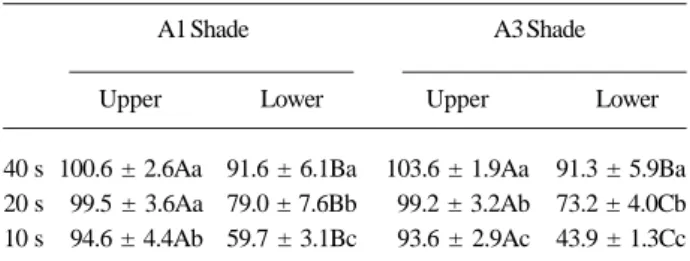
Hardness means (±SD) (kg/mm2) and the
statis-tical grouping are summarized in Table 1.
The A1U10 group showed significantly lower mean hardness than the other two groups (A1U20 and A1U40) for the U surface of this composite resin shade (A1) (≤0.05). At the L surface of A1 shade a signifi-cantly higher mean hardness was found at 40 s irradia-tion time (A1L40) than for the A1L10 and A1L20
Table 1. Hardness means (±SD) (kg/mm2) and statistical groupings of all experimental groups.
A1 Shade A3 Shade
Upper Lower Upper Lower
40 s 100.6 ± 2.6Aa 91.6 ± 6.1Ba 103.6 ± 1.9Aa 91.3 ± 5.9Ba 20 s 99.5 ± 3.6Aa 79.0 ± 7.6Bb 99.2 ± 3.2Ab 73.2 ± 4.0Cb 10 s 94.6 ± 4.4Ab 59.7 ± 3.1Bc 93.6 ± 2.9Ac 43.9 ± 1.3Cc
Braz Dent J 18(3) 2007
Hardness of composite resins 233
groups, which means that values were also statistically different (p≤0.05).
Both surfaces (U and L) of A3 shade composite revealed significantly greater mean hardness values at 40 s curing time, followed by the 20-s and the 10-s curing time groups (p≤0.05).
Statistically significant differences were found between U and L surfaces of each composite shade-IT combination (p=0.0001) and among the irradiation times of same shade-surface combination (p=0.0001), except between A1U20 and A1U40 groups.
DISCUSSION
The polymerization of light-cured composite resins starts and is sustained when the rate of delivery photons from the source of light is sufficient to maintain the photo-absorbing compound, camphoroquinone, in its excited or triplet state. In this state, camphoroquinone overreacts with an amine-reducing agent in order to form free radicals (12). Thus, it must be emphasized that, in addition to the type of restorative material, the light-curing unit plays a very important role on the polymerization process. It is responsible for both the wavelength of the emitted light and the irradiance. As mentioned, a wavelength of 468 nm results in maximum absorption coefficient of the camphoroquinone to change into an excited state (1). The irradiation time is also correlated to the light unit but controlled by the operator. Therefore, the depth of poly-merization depends on several factors inherent to the composite resin such as its chemistry, shade and translu-cency, catalyst concentration and sort and size of filler. The latter has a fundamental role on the light scattering, which,
per se, consists of a limiting factor in the depth of
polymerization (3). The light scattering is greater when the filler particle size is about one-half of the wavelength of activating light. It may become a problem once the manu-facturers produce finer particle size in commercial com-posite resins (3). Other factors that may determine the depth of polymerization remain on the irradiance, irradia-tion time, emission spectra of the light source, thickness of composite increment, distance from the light source tip to the composite resin and others (10,17).
Insufficiently polymerized composite resin may present quite a lot of problems such as follows: poor color stability, greater stain uptake, risk of pulp aggression by non-polymerized monomers and portions of the material with different values of Young’s modulus (1,17). It has
been reported that loading well-polymerized composite layers that are placed on poorly polymerized layers can lead the composite restoration to bend inward and dis-place, causing marginal fracture, open margins and cusp deflection (17).
The results of this study showed that the superficial hardness of a composite resin is indeed influenced by the irradiation time. As expected, for both shades, increasing the irradiation time, significantly increased the mean hard-ness values (p<0.05) (Table 1), except between A1U20 and A1U40 groups, confirming the first study hypothesis. This was observed for both surfaces, although it was more evident in the L surfaces than in the U surfaces. Despite the statistically different mean values, a short irradiation time of 10 s was able to produce a high hardness value on the U surface, which is in agreement with other studies (12,17). It is feasible to consider the irradiation attenuation during photopolymerization as a factor responsible for the modest hardness values measured in the lower surface. This study showed that a 10-s irradiation time produced similar mean hardness value in the U surface than a 40-s irradiation time in the L surface. Therefore, only the 40-s irradiation time was found to be effective to properly polymerize the L surface. The 10-s and 20-s irradiation times resulted in mean values lower than 80% of the mean value for the corresponding U surface. Therefore, these irradiation times are considered inadequate to produce a sufficient degree of polymerization in a 3-mm-thick incre-ment of the composite studied.
Significant differences were found for the mean hardness values recorded at U surfaces among the tested irradiation times. However, the greatest difference was less than 10% (A3 shade - from 103.6 kg/mm2 at 40 s to
93.6 kg/mm2 at 10 s).
Braz Dent J 18(3) 2007
234 A. Della Bona et al.
Indeed, the depth of cure is strongly associated to material opacity (20).
Considering the shades A1 and A3 at same irradia-tion time and same type of surface (U or L), there was no significant difference between the mean hardness values (Table 1), except for the 10-s and 20-s irradiation times in the L surface, which rejected the second study hypothesis for the U surface.
Considering the irradiation time, only the groups exposed to a 40-s curing time were able to produce adequate mean hardness values for both U and L surfaces of same specimens (p=0.74) (Table 1). Yet, significant differences were found between U and L surfaces of same specimens (p=0.0001). Therefore, to achieve an adequate hardness throughout a 3-mm thick increment of compos-ite resin the clinician should light cure it for 40 s.
Future studies should investigate the effect of translucency, rather than shade, on the depth of cure and hardness of composite resins.
RESUMO
Esse estudo testou as hipóteses de que: 1. maior tempo de fotopolimerização (TF) produz maior dureza superficial em diferentes profundidades (0 e 3 mm) de resina composta (RC); 2. a cor escura (A3) de RC exige maior TF do que a RC clara (A1) para obter o mesmo grau de D. Foram fabricados 24 corpos-de-prova para cada cor de RC em único incremento de 3 mm (Z100), dividindo-os em 3 grupos (n=8), de acordo com os TF (400 mW/ cm2) na superfície superior (S): A1-10 e A3-10: 10 s; A1-20 e A3-20: 20 s; A1-40 e A3-40: 40 s. Os corpos-de-prova foram armazenados sem luz, a 37oC por 24 h, antes de aferir o grau de dureza nas superfícies S e inferior (I) com um durômetro. Foram realizadas 3 penetrações Vickers em cada superfície (S e I) dos corpos-de-prova (n=24). As diagonais das penetrações foram medidas e os valores de dureza calculados. ANOVA e Tukey foram usados nas análises estatísticas (α=0,05). Ocorreram diferenças significativas entre S e I para cada combinação de cor-TF (p=0,0001) e entre os cor-TF de mesma combinação cor-superfície (p=0,0001), exceto entre A1S20 e A1S40, confirmando a hipótese 1, mas rejeitando parcialmente a hipótese 2.
ACKNOWLEDGEMENTS
The authors thank Mr. Gilmar L. Diefenthaeler, from the De-partment of Mechanical Engineering of the University of Passo Fundo, for the assistance during the hardness tests.
REFERENCES
1. Rueggeberg FA, Caughman WF, Curtis JW Jr. Effect of light intensity and exposure duration on cure of resin composite. Oper Dent 1994;19:26-32.
2. Barnett F. Pulpal response to restorative procedures and mate-rials. Curr Opin Dent 1992;2:93-98.
3. Ruyter IE, Oysaed H. Compressive creep of light cured resin based restorative materials. Acta Odontol Scand 1982;40:179-192.
4. Meyer GR, Ernest CP, Willershausen B. Decrease in power output of new light-emitting diode (LED) curing devices with increasing distance to filling surface. J Adhes Dent 2002;4:197-204.
5. Yap AUJ, Siow KS. Soft-start polymerization: influence on effectiveness of cure and post-gel shrinkage. Oper Dent 2001;26:260-266.
6. Lindberg A, Peutzfeldt A, van Djiken JWV. Effect of power density of curing unit, exposure duration and light guide distance on composite depth of cure. Clin Oral Invest 2005;9:71-76.
7. Lindberg A, Peutzfeldt A, van Dijken JWV. Curing depths of a universal hybrid and a flowable resin composite cured with quartz tungsten halogen and light-emitting diode units. Acta Odontol Scand 2004;62:97-101.
8. Nomoto R, Uchida K, Hirasawa T. Effects of light intensity on polymerization of light-cured composite resins. Dent Mater J 1994;13:298-205.
9. Abate PF, Zahra VN, Macchi RL. Effect of photopolymerization variables on composite hardness. J Prosthet Dent 2001;86:632-635.
10. Musanje L, Darvell BW. Polymerization of resin composite restorative materials: exposure reciprocity. Dent Mater 2003;19:531-541.
11. Lohbauer U, Rahiotis C, Kramer N, Petschelt A, Eliades G. The effect of different light-curing units on fatigue behavior and degree of conversion of a resin composite. Dent Mater 2005;21:608-615.
12. Caughman WF, Rueggeberg FA. Clinical guidelines for photocuring restorative resin. J Am Dent Assoc 1995;126:1280-1286.
13. Caughman WF, Rueggeberg FA. Shedding new light on compos-ite polymerization. Oper Dent 2002;27:636-638.
14. Yap AUJ, Seneviratne C. Influence of light energy density on effectiveness of composite cure. Oper Dent 2001;26:460-466.
15. Swartz ML, Phillips RW, Rhodes B. Visible light-activated resins - depth of cure. J Am Dent Assoc 1983;106:634-637. 16. International Standards Organization. ISO Standard 6507-3:1998 Metallic materials. Vickers hardness test. Geneva: ISO/TS; Available from: http://www.iso.ch/iso/en/prods-ser-vices/ISOstore/store.html. Latest access April 9, 2006. 17. Shortall AC, Wilson HJ, Harrington E. Depth of cure of
radiation-activated composite restoratives - influence of shade and opacity. J Oral Rehab 1995;22:337-342.
18. Kanca J. The effect of thickness and shade on the polymeriza-tion of light activated posterior composite resins. Quintes-sence Int 1986;17:809-811.
19. Calheiros FC, Kawano Y, Stansbury JW, Braga RR. Influence of radiant exposure on contraction stress, degree of conversion and mechanical properties of resin composites. Dent Mater 2006;22:799-803.
20. Shortall AC. How light source and product shade influence cure depth for a contemporary composite. J Oral Rehabil 2005;32:906-911.