Home or community-based pulmonary rehabilitation
for individuals with chronic obstructive pulmonary
disease: a systematic review and meta-analysis
Reabilitação pulmonar domiciliar ou comunitária
para indivíduos com doença pulmonar obstrutiva
crônica: revisão sistemática e meta-análise
Rehabilitación pulmonar domiciliaria o comunitaria
para individuos con enfermedad pulmonar
obstructiva crónica: revisión sistemática y
metaanálisis
Leonardo Fratti Neves 1 Manoela Heinrichs dos Reis 2 Tonantzin Ribeiro Gonçalves 1
Abstract
Chronic obstructive pulmonary disease (COPD) is a leading cause of mor-bidity and mortality worldwide, and outpatient pulmonary rehabilita-tion (OPR) has shown positive results. The aim of this study was to inves-tigate the effects of home or community-based pulmonary rehabilitation (HCPR) in individuals with COPD. This systematic review and meta-anal-ysis of randomized clinical trials compared HCPR to controls and HCPR to OPR according to functional capacity, dyspnea, and quality of life in individuals with COPD. 3,172 citations were identified in databases, and 23 were included in this review. HCPR proved superior to controls based on functional capacity in the 6-Minute Walk Test and Incremental Shuttle Walk Test, and based on dyspnea and quality of life in the Saint George’s Respiratory Questionnaire and the Chronic Respiratory Questionnaire. When HCPR and OPR were compared, there were no effect differences in functional capacity or quality of life. Improvement was greater in patients with more bronchial obstruction measured by FEV1. HCPR improves func-tional capacity and quality of life and decreases the sensation of dyspnea. Its benefits in functional capacity and quality of life are comparable to those obtained with OPR in individuals with COPD.
Rehabilitation; Biomedical Technology; Chronic Obstructive Pulmonary Disease
Correspondence L. F. Neves
Rua Pe. Clemente Faller 45, São Leopoldo, RS 93020-330, Brasil. [email protected] 1 Universidade do Vale do
Rio dos Sinos, São Leopoldo, Brasil.
Introduction
Chronic obstructive pulmonary disease (COPD) is defined as a preventable and treatable disease state involving progressive airflow obstruction that is not fully reversible 1. A chronic inflamma-tory process occurs that can produce changes in the bronchi (chronic bronchitis), bronchioles (obstructive bronchiolitis), and/or pulmonary parenchyma (pulmonary emphysema), leading to air flow limitation, caused primarily by smok-ing. The consequences can be systemic 1,2. COPD is a leading cause of death worldwide – including Europe 3,4, the United States 5, and Brazil 6. COPD was the sixth leading cause of death in the world in 1990 and fourth in 2000, and is estimated to reach third place by 2020 3. Estimated odds of death following hospitalization due to an exacer-bation of COPD are 51% 7.
Treatment of COPD can include smoking cessation, psychosocial monitoring, medication, and physical rehabilitation 8. This set of inter-ventions, involving a multidisciplinary team, is called pulmonary rehabilitation (PR). According to the American Thoracic Society (ATS) and Eu-ropean Respiratory Society (ERS), PR includes physical training as well as educational and be-havioral changes intended to promote physical and psychological improvement in COPD 9.
COPD is a not fully reversible condition, since damage to pulmonary structures is permanent. Most studies on PR thus emphasize improve-ment of functional aspects and quality of life 10. One of the main interventions studied in reha-bilitation programs is thus physical exercise, with or without other program components. PR based on exercise involves aerobics, muscle-strength-ening exercises, and in some cases strengthmuscle-strength-ening of respiratory muscles 11. Evidence suggests that exercise-based programs are the most effective in improving COPD symptoms, making exercise the main intervention to promote patients’ indepen-dence and improve their quality of life 10,11.
The benefits of PR in treating COPD have been demonstrated in several studies that high-light an increase in functional capacity and en-durance as well as a decrease in dyspnea percep-tion 12. Despite limited evidence that PR is effec-tive for increasing survival in COPD patients 10, it can improve the feeling of dyspnea, quality of life, and exercise capacity and decrease the number of hospitalizations, all of which are predictors of mortality 12,13.
PR is traditionally performed as outpatient pulmonary rehabilitation (OPR). According to national and international guidelines, it is cost-effective and well documented in the literature 1,9,11,12. This study considered OPR as a PR
mo-dality in a specialized outpatient setting. In a meta-analysis on the effects of OPR compared to a control group, even though the latter used im-portant treatment modalities such as bronchodi-lators, pulmonary rehabilitation, which included physical rehabilitation, showed better results in quality of life and exercise capacity 14. Accord-ing to another systematic review, PR is effective when compared to control conditions for the same outcomes, even with different approaches in each physical exercise program 15. A variety of physical training methods can be used during PR, including strength training, interval training, upper body training, inspiratory and expiratory muscle training, and transcutaneous electrical stimulation, in addition to aerobic training gen-erally used in programs 9,16.
Some studies (including randomized clinical trials, RCTs) on the use of PR as home or com-munity-based pulmonary rehabilitation (HCPR) rather than in an outpatient clinical setting (OPR) show positive results in improving exercise ca-pacity and quality of life and a decreasing dys-pnea sensation 17,18,19,20. We defined HCPR as a PR program developed in a non-specialized com-munity health service, in a comcom-munity center, or at the patient’s home. Other RCTs that compared standard OPR to home or community-based PR show similar results and greater effectiveness of HCPR for some outcomes such as exercise capac-ity and sensation of dyspnea 20,21,22. Some sys-tematic reviews 23,24,25 compare OPR to controls (no exercise), but none compare OPR and HCPR. Those systematic reviews showed that HCPR im-proved functional capacity and quality of life and reduced dyspnea sensation, but they used less comprehensive search strategies.
Although some studies have addressed PR in home and community settings, the benefits of this rehabilitation modality are still not clear for all the target outcomes. A wide variety of proto-cols are also used in rehabilitation programs, and the influence of these factors on the results re-quires more in-depth study. A better understand-ing of these aspects could inform health policies. The current study thus aimed to assess the effec-tiveness of HCPR compared to OPR or a control group for improving the commonly assessed out-comes (functional capacity, dyspnea perception, and quality of life) in patients with COPD, using a systematic literature review with meta-analysis.
Method
in the Centre for Reviews and Dissemination, University of York (PROSPERO) under number CRD42014007295 28,29. There were some modi-fications between the protocol and the final study due to the lack of data in the selected studies concerning some outcomes that we planned to analyze. We also planned to assess publication bias through tests of funnel plot asymmetry, comparing intervention effects estimated from individual studies against a measure of study size for each outcome. Nev-ertheless, this test is underpowered to distin-guish chance from real asymmetry when the meta-analysis includes less than 10 studies 26, which happened in all but one of the meta-anal-yses performed in the present review. Addition-ally, we needed to adopt different strategies for subgroup analyses, since few studies could be pooled for some of the selected outcomes.
Eligibility criteria
RCTs were selected for this review. Studies whose results did not include a control group (no ex-ercise) or a comparison (OPR) or which did not use random drawing to refer patients to the groups were excluded. The review included stud-ies whose participants were patients with COPD stages two or higher according to the Global Initiative for Chronic Obstructive Lung Disease (GOLD) 8.
The selected studies involved HCPR – pul-monary rehabilitation at home or in a non-specialized community center/health service – compared to a control group and/or to a group that received OPR. The results needed to contain at least one of the following outcomes: perfor-mance in the Six-Minute Walk Test (6MWT), per-formance in the Incremental Shuttle Walk Test (ISWT), quality of life (Saint George’s Respiratory Questionnaire – SGRQ or Chronic Respiratory Questionnaire – CRQ), or sensation of dyspnea (Medical Research Council – MRC). Outcomes were assessed at baseline, immediately upon conclusion of rehabilitation programs, and in follow-up evaluations when informed by the au-thors. Intervention was defined as a minimum period of four weeks.
Search strategy
Article searches were conducted from January 2014 to May 2015, independently of language or date of publication, in the following electronic
tion, manual searches were made in the refer-ences of the studies found on this research topic. The search strategy included a combination of the following terms: “chronic obstructive pulmo-nary disease”, “physical exercise”, “physical reha-bilitation”, “home care services”, and “communi-ty health services”. These terms were associated with a highly sensitive search strategy for RCTs 26. The complete search strategy used in PubMed, reproduced in the other databases with minor adjustments, can be accessed in the Supple-mentary material (https://www.dropbox.com/s/ w21i0iz37pv3kuc/Material%20Suplementar%20 13.03.2016.docx?dl=0).
Searches for unpublished or in-progress studies were done in the clinical trials databases (WHO International Clinical Trials Registry Plat-form and ClinicalTrials.gov) as well as abstracts in the annals of important conferences in the area, such as the International Congress of Tu-berculosis and Lung Disease (http://nritldcon gress.ir/en/), the International Symposium on Respiratory Disease – IRSD (http://www.isrd. org/), and COPD Conferences (http://www.cop dconferences.org).
Selection of studies and data extraction
In the first phase, the titles and abstracts of all studies identified during the searches were inde-pendently assessed by two reviewers (L.F.N. and M.H.R.) using the EndNote X3 software (Thom-son Reuters. http://www.endnote.com). All ab-stracts and titles that did not contain sufficient information for assessment of inclusion and ex-clusion criteria were selected for evaluation of the full text.
In the second phase, two reviewers indepen-dently assessed the full texts and selected the studies according to predefined eligibility crite-ria. Disagreements between reviewers were solved by consensus, and if necessary a third re-viewer (T.R.G.) made the decision. Overall agree-ment among reviewers was excellent (kappa = 0.89).
original authors were contacted by e-mail for fur-ther information.
Assessment of bias risk
The methodological quality assessment consid-ered the following characteristics of the selected studies: random sequence generation, blind-ing of researchers, blindblind-ing of outcome evalua-tors, selective data reporting, intention-to-treat analysis, and adequate description of losses and exclusions. Criteria for assessing each item in the studies’ methodological quality followed the recommendations of the Cochrane Handbook of Systematic Reviews of Interventions26, and the tables with the contents of the bias risk assess-ment were made in the Review Manager 5.1 soft-ware (Cochrane’s Informatics & Knowledge Man-agement Department; http://tech.cochrane. org/revman).
Data analysis
The meta-analysis was performed using calcu-lation of the mean difference with random ef-fects model, 95% confidence intervals (95%CI), and effect measures obtained through the post-intervention values. The studies were analyzed separately, according to type of intervention vs. comparison: HCPR vs. control group, or HCPR vs. OPR. The target outcomes were performance in 6MWT, performance in ISWT, quality of life (SGRQ or CRQ), and sensation of dyspnea (MRC).
All the analyses used Review Manager 5.1, and the random effects model was used to ac-count for any potential heterogeneity following different interventions in diverse study settings. Statistical heterogeneity of treatment effect be-tween studies was assessed using Cochran’s Q test and the inconsistency test (I2), in which values below 40% do not pose a problem, val-ues between 30% and 60% mean moderate het-erogeneity, values between 50% and 90% mean substantial heterogeneity, and values between 75% and 100% mean considerable heterogene-ity 23. Heterogeneity, when found, was evaluated by the researchers, and the possible causes were explored through subgroup analyses. Finally, as-sessment of the quality of evidence generated by this systematic review was summarized for each outcome and type of comparison using the GRADE Profiler software (Cochrane’s Informatics & Knowledge Management Department; http:// tech.cochrane.org/gradepro).
Results
Description of studies
The initial search identified 3,172 studies, exclud-ing duplicates. Of these, 58 were considered po-tentially relevant and 23 studies 17,18,19,30,31,32,33, 34,35,36,37,38,39,40,41,42,43,44,45,46,47,48,49,50 met the eli-gibility criteria and were included in this review. One of the selected studies appeared in two dis-tinct publications 49,50 in which the same inter-vention was applied to the same patients but de-scribing different outcomes. Figure 1 shows the flow diagram for the study search and selection.
The 23 selected studies involved a total of 1,258 individuals of both sexes. Thirteen stud-ies were done in Europe 17,19,21,31,33,38,42,43,45,46, 48,49,50, six in Asia 30,36,39,40,44,47, two in Austral-asia 34,35, one in North America 41, and one in South America 32. Among the studies included in the review, 19 17,18,19,30,31,32,33,34,36,38,39,40,42,43, 44,46,47,48,49,50 compared HCPR to control group (n = total 893; n HCPR = 485), while four 35,37,41,45 compared HCPR to OPR (n total = 375; n HCPR = 178). No studies reported harmful effects related to HCPR during interventions.
As for HCPR, all studies used at least one aer-obic component (43.5% walking, 17.4% biking, 8.7% climbing stairs, and 30.4% a combination of these exercises), and most included strength training for upper and lower limbs and respira-tory muscles, as well as educational measures. Some studies used different ways to encourage patients to exercise, such as walking to the beat of music or exercises accompanying demo videos, but most simply advised patients to walk with or without a pedometer and to fill in exercise dia-ries. Table 1 shows the characteristics of studies, patients, and interventions.
Risk of bias
RCTs: randomized clinical trials.
a test of funnel plot in the quality of life outcome (assessed by the CRQ) comparing HCPR to con-trols (the only meta-analysis that included more than 10 studies, ensuring the minimum power to conduct the test), showed little evidence of asym-metry. (Supplementary material: https://www. dropbox.com/s/w21i0iz37pv3kuc/Material%20 Suplementar%2013.03.2016.docx?dl=0).
Effects of interventions
• Analysis1:HCPRvs.controlgroup
Table 1
Characteristics of studies, patients, and interventions included in the systematic review.
Study/Country/ Outcome
Comparison/Time intervention
Population Interventions and controls/comparison conditions
Akinci & Olgun 30/
Turkey/6MWT, SRGQ
Home PR vs. controls/3 months
COPD patients with GOLD stages III and IV
Intervention(n=16): Age: 71.8±7.8 years; FEV1 (%
predicted): 36.1±10.8
Controls(n=16): Age: 65.1±10.2 years; FEV1 (%
predicted): 39.2±11.0
Selection: Patients from an output clinic at the University
Hospital in Istanbul
Home PR: Unsupervised and at-home breathing (labial frenum and diaphragmatic breathing) as well as aerobic exercises for lower limbs
(30-minute walk) and upper limbs (arm exercises – 15 repetitions of each exercise in 1 minute). Upper limb exercises simulated activities such as stirring soup in a pot, pulling an anchor up, hitting a punching bag, paddling, waxing the car, laps of crawl and breaststroke swimming,
chopping firewood, doing air scissors movements with the arms, and playing drums. Exercises were taught in the first session, and in two other
sessions, adjustments and corrections were made as problems were observed in the reports patients completed afterwards. The exercises did not need to be done all at once, and there was a follow-up every 15 days in
the first month and once a month in the second and third months. Controls: Participants did not receive any orientation from the healthcare
team on the exercises and followed a standard treatment plan Behnke et al. 17/
Germany/CRQ
Home PR vs. controls/6 months
COPD patients with GOLD stages III and IV
Intervention(n=15): Age: 64.0±1.9 years; FEV1 (%
predicted): 34.1±7.4
Controls(n=15): Age: 68.0±2.2 years; FEV1 (%
predicted): 37.5±7.5
Selection: Patients in hospital after an
exacerbation
Home PR: 10 days training walking in hospital, plus 30 minutes/day of breathing exercises and medication. Afterwards patients participated in a supervised program for six months of walking integrated into daily activities
like going to the mall. Walks were 3 times a day, to 125% of the greatest distance traveled by each individual in the 6MWT. Patients recorded the distance traveled and the time spent on each walk. In the first three months,
patients were visited every two weeks to assess their health status, after which supervision was monthly, by telephone.
Controls: Same 10-day treatment as home-based PR, plus standard medication, 30 minutes of breathing exercises a day during hospitalization.
After discharge, patients were advised to exercise, but without specific guidelines
Cambach et al. 31/ Netherlands/6MWT, CRQ
Community PR vs. controls/3 months
COPD patients with GOLD stages II and III
Intervention(n=15):
Age: 62±5 years; FEV1 (%
predicted): 59±16
Controls(n=8): Age: 62±9 years; FEV1 (% predicted):
60±23
Selection: Recruited by general practitioner or pulmonary physician
Community PR: Breathing techniques and bronchial hygiene, upper and lower limb exercises, educational guidance, relaxation techniques (once a week for 45 minutes), and recreational activities. Sessions were supervised by physical therapists with groups of 3 to 4 patients, 3 times a week, lasting 90 minutes. Exercises were twice a week using a cycle Ergometer (60 to 75% of Wmax – time increasing from 3 to 12 min), rowing machine,
or climbing stairs (60% of maximum heart rate – increasing from 3 to 5 minutes). Recreational activities were swimming, skating, and bicycling for
45 minutes once a week to reach ≥ 60% of maximum heart rate for ≥ 30 minutes.
Controls: Only standard medication Dias et al. 32/Brazil/
ISWT
Home PR vs. controls/6 months
COPD patients with GOLD stages II and III
Intervention(n=12): Age: 66.5±5.8 years; FEV1 (%
predicted): 55.14±24.8
Controls(n=11): Age: 64.0±5.8 years; FEV1 (%
predicted): 60.0±20.1
Selection: Patients that underwent outpatient care, stable, without exacerbation
in the previous 30 days
Home PR: Patients received a booklet on COPD and quality of life and a series of exercises, including stretching, respiratory reeducation, and aerobic exercises for upper limbs (with individual load at 50% of assessment
load). Patients were instructed to walk for 40 minutes three times a week at 85% peak oxygen consumption. Patients were encouraged to walk on treadmill on the first day to adapt to the speed they would walk at home. Patients were instructed by individual tutors to minimize errors in
performing exercises and to correctly complete an exercise diary. Two weekly visits were carried out individually to monitor exercises (85% of
maximum heart rate in the incremental test).
Controls: Participants received a booklet on COPD and quality of life, and a series of exercises, including stretching and respiratory reeducation exercises three times a week, in addition to visits to the outpatient center
twice a week to review their exercise routine
Du Moulin et al. 33/ Germany/6MWT, CRQ
Home PR vs. controls/6 months
COPD patients with GOLD stages II and III
Intervention(n=10):
Age: 67±2.4 years; FEV1 (%
predicted): 58.6±3
Controls(n=10): Age: 72±2.3 years; FEV1 (%
predicted): 58.4±4
Selection: Patients from an output center in Hamburg
Patients received 3 weeks of outpatient PR, consisting of 20 hours of exercise, 11 hours of education, 5 hours of nutritional orientation, 10 hours of respiratory therapy, 5 hours of relaxation, 3 hours of psychological support, and 5 hours of support for smoking cessation. Exercises were done
on treadmill, cycle ergometer, and strength exercises for lower/upper limbs and trunk.
Home PR: Walk 125% of distance traveled in 6MWT by the end of outpatient PR, in no more than 15 minutes, 3 times a day. Alternatively,
patients could combine the three workouts in a single daily workout. Patients completed a training diary to be sent to the researchers every 4 weeks, when they received new diaries. Motivational phone calls were
made every 4 weeks.
Controls: Patients were encouraged to maintain their normal activities of daily living, but received no orientation on their physical activities Effing et al. 34/
Netherlands/ISWT, CRQ
Community PR vs. controls/12 months
COPD patients with GOLD stages II and IV
Intervention(n=71): Age: 62.5±2.1 years; FEV1 (%
predicted): 42.7±5.9
Controls(n=68): Age: 68.7±2.1 years; FEV1 (%
predicted): 46.3±4.4
Selection: Patients from an output clinic at Medisch
Spectrum Hospital, Netherlands
Both groups received self-monitoring COPD guides and attended small group sessions with information and guidelines for smoking cessation,
monitoring of symptoms, and breathing exercises.
Community PR: Patients received guidance on bicycling, walks, climbing stairs, and weight exercises for upper and lower limbs. Patients received a diary with illustrations of exercises and where they should record their activities, feelings, and fatigue levels. A physical therapist made weekly
visits to adjust the exercises according to the diaries. Controls: Patients received self-monitoring guides and usual medication
Elliott et al. 35/
Australia/6MWT, CRQ
Community PR vs. OPR/3 months
COPD patients with GOLD stages II and IV
Intervention(n=9): Age: 62.5±2.1 years; FEV1 (%
predicted): 49.6±14.2
Controls(n=22): Age: 68.7±2.1 years; FEV1 (%
predicted): 50.7±17.0
Selection: Inpatients and outpatients of the
Respiratory Medicine Department, Royal Perth Hospital and Sir Charles
Gairdner Hospital, with normal breathless
Community PR: Patients participated in community group exercises. The program varied according to the distance from the patient’s home, schedule, length of sessions, and physical performance. Depending on ability, patients had sessions of general exercises: running for over 60-year-olds or individual sessions conducted by professionals. Sessions lasted 1.5 hours twice a week and involved warmup and stretching, walks, general exercises, or circuits for lower limb strengthening with weights, cool-down, and stretching. Exercises focused on functional mobility and did not change
over time.
Outpatient PR: Conducted in an outpatient center, twice a week with sessions of 1.5 hours. The program included warmup and stretching, muscle strengthening circuit of 30 minutes (upper/lower limbs and abdominal exercises), 30 minutes of aerobic training (treadmill, walking in the hospital hallway, and cycle ergometer), cool-down, and stretching.
Sessions were done in groups of 10 to 12 patients and exercises were prescribed according to each patient’s initial assessment, in addition to
on-going review by physical therapists Ghanem et al. 36/
Egypt/6MWT, CRQ
Home PR vs. controls/2 months
COPD patients with GOLD stages II to IV
Intervention(n=25): Age: 59.96±11.59 years; FEV1 (%
predicted): 36.24±14.17
Controls(n=14): Age: 56.43±9.03 years; FEV1 (%
predicted): 29.0±10.91
Selection: Patients admitted to the Chest Department in
a tertiary hospital
Before discharge all patients attended talks on lifestyle, anatomy and physiology, disease pathology, pulmonary medication, oxygen therapy,
avoiding environmental irritants, and prevention and management of respiratory infections. They were interviewed and received a booklet on
exercising as a reminder for home.
Home PR: In addition to standard medication, they were also instructed to exercise, including resistance training (walking or cycling) and strengthening
of upper and lower limbs (6 to 10 repetitions – interval training and rest according to individual tolerance) for two months. After the series
of exercises, patients had to stretch ischiotibial muscles, quadriceps, shoulders, neck, and lumbar spine.
Controls: Patients received standard medication following discharge
Table 1 (continued)
Study/Country/ Outcome
Comparison/Time intervention
Population Interventions and controls/comparison conditions
Güell et al. 37/ Spain/6MWT, CRQ
Home PR vs. OPR/9 weeks of intervention plus 6 months
follow-up
COPD patients with GOLD stages III and IV
Intervention(n=23): Age: 66.0±5.8 years; FEV1 (%
predicted): 39.0±7.6
Controls(n=28): Age: 63.2±6.6 years; FEV1 (%
predicted): 37.5±7.1
Selection: Patients referred for pulmonary rehabilitation
at a Spanish hospital
All patients received standard medical treatment and attended two educational sessions on the disease for 2 weeks, and were instructed on
how to drain secretion and perform breathing exercises. Home PR: Breathing exercises three times a week, with two sets of 15 minutes with threshold. The load for inspiratory exercises amounted to 40% of maximum inspiratory pressure. They performed strength training for upper limbs and daily walks on the street, unsupervised, at 4 km/hour controlled by a pedometer. The first week included a 15-minute walk, from the second to fourth week a 30-minute walk, and 45 minutes from the fifth to the ninth week. Patients were instructed to walk up and down stairs for 5
minutes before and after walks.
Outpatient PR: Patients performed the same breathing exercises, plus upper limb strength training consisting of 30 minutes of weightlifting (starting at 0.5 kg on each arm, increasing to 1 kg each week until patient’s maximum tolerance). Training of lower limbs was a 30-minute exercise on a
cycle ergometer Hernández et al. 38/
Spain/ISWT, CRQ, MRC
Home PR vs. controls/3 months
COPD patients with GOLD stages II to IV
Intervention(n=20): Age: 64.3±8.3 years; FEV1 (%
predicted): 41.7±15.6
Controls(n=17): Age: 63.1±6.9 years; FEV1 (%
predicted): 40.0±16.4
Selection: Stable patients with optimal drug
management
Home PR: Walking at home or on flat ground near their homes for at least 20 meters. Marks were made at 0, 10, and 20 meters so that patients could
identify the points. They received a cassette with audible signals so that they matched the speed of the walk to the demarcated points. Intensity of training was individualized at a constant speed two levels below the maximum obtained in the shuttle test. Trainings were held six days a week, lasting an hour, for 12 weeks. Every two weeks, patients went to hospital to
assess clinical status and treatment adherence.
Controls: Patients received standard medication plus visits to hospital every two weeks for clinical assessment and treatment supervision
Ho et al. 39/Taiwan/
ISWT, SRGQ
Home PR vs. controls/4 months
COPD patients with GOLD stages II to IV
Intervention(n=20): Age: 73.1±11.2 years; FEV1 (%
predicted): 60.6±18.9
Controls(n=21): Age: 75.1±9.6 years; FEV1 (%
predicted): 61.2±26.3
Selection: Stable patients, without use of O2 or
exacerbations in previous month
Home PR: Patients received instructions on warmup and cool-down exercises, and training consisted of walking to the rhythm of a song. Initial
training was 80% VO2 max and increased gradually, based on distance of
shuttle test, done monthly. Intensity of training increased with speed of the music. Patients chose their favorite music, and the beat was adjusted to timing of their steps to travel a certain distance. Training lasted 30 minutes,
five times a week for 16 weeks. Patients also received a booklet on COPD self-care, benefits of exercises, and precautions when exercising. They were
encouraged to complete an exercise diary.
Controls: Patients also received the booklet on COPD self-care, benefits of exercises, and precautions when exercising. They were also encouraged to
exercise five times a week and keep an exercise diary Jang et al. 40/South
Korea/6MWT
Home PR vs. controls/2 months
COPD patients with GOLD stages II to IV
Intervention(n=18): Age: 64.5±2.6 years; FEV1 (%
predicted): 45.31±11.07
Controls(n=18): Age: 65.7±2.2 years; FEV1 (%
predicted): 39.2±11.0
Selection: Patients without exacerbations from the physiotherapy department of the Yeungnam University
Home PR: Patients received educational guidance about COPD, medication management and smoking cessation, and watched videos showing interviews of experiences of other people who underwent PR. They performed respiratory training, with exercises for inspiratory and expiratory muscles. Physical training was done with elastic bands to strengthen chest, shoulders, and upper limbs. In the walks they used pedometers to keep
heart rate frequency between 40% and 60%. They were instructed to perform relaxations and received counseling. The trainings were conducted
five times a week. Patients were given diaries to record their trainings, besides receiving weekly calls to encourage them to remain in the program.
Controls: Patients received the same educational measures, but did not do the exercises
Maltais et al. 41/ Canada/6MWT, SRGQ, CRQ
Home PR vs. OPR/3 months of intervention plus 12
months follow-up
COPD patients with GOLD stages II to IV
Intervention(n=126):
Age: 66±9 years; FEV1 (%
predicted): 43.0±13.0
Controls(n=126): Age: 66±9 years; FEV1 (%
predicted): 46.0±13.0
Selection: Patients from specialized pulmonary
centers, stable
Prior to randomization, patients attended a four-week program on education for self-care.
Home PR: For eight weeks, three times a week, patients were instructed to perform self-monitored aerobic exercises and muscle strengthening.
Patients received staff visits to verify their understanding of the exercises. Exercising used portable cycle ergometers on loan to patients
during training. Intensity target was 60% of the peak reached during the incremental test, to be maintained for 40 minutes. Patients were instructed to decrease the intensity of training in case of intense dyspnea.
They performed stretch exercises and received supplemental oxygen if necessary, as with outpatients. Training diaries were completed, and during
the intervention patients received weekly calls to reinforce the importance of exercises and to detect problems.
Outpatient PR: Patients attended three sessions per week for eight weeks of workouts on stationary bicycles for 25 to 30 minutes per session, to maintain 80% of the peak reached in the incremental test. In case they presented desaturation (SpO2 < 88%) or already used oxygen at home,
patients received supplemental oxygen. The researchers decreased the exercise intensity in case of severe dyspnea or very high heart rate. Strength exercises lasted 30 minutes, ranging from one to three sets of 10 repetitions. When the goal was reached, resistance was increased with
elastic bands, weights, or gym anklets.
Patients in both groups were encouraged to maintain their workout routine with their own equipment without supervision for a period of 12 months. Every two months, patients were contacted to verify their adherence to the
program Man et al. 18/England/
ISWT, SGRQ, CRQ
Community PR vs. controls/3 months
COPD patients with GOLD stages II to IV
Intervention(n=18): Age: 70.7±9.3 years; FEV1 (%
predicted): 41.7±18.9
Controls(n=16): Age: 69.6±9.2 years; FEV1 (%
predicted): 36.7±14.9
Selection: Patients admitted to King’s College
Hospital in London with primary diagnosis of acute
exacerbation of COPD
All patients were discharged 10 days after COPD exacerbation. Community PR: Patients received individual exercise programs in one of three centers in two districts of London and were encouraged to exercise
for three months, ≥ 20 minutes a day. Sessions lasted two hours and consisted of one hour of exercise (walking and cycling, upper and lower limb strengthening) and one hour of educational activities aimed at
self-care, nutrition, and healthy habits. Controls: Usual medication was maintained
Moore et al. 42/United
Kingdom/ISWT, CRQ
Community PR vs. controls/6 weeks
COPD patients with GOLD stages II to IV
Intervention(n=10): Age: 70.0±13.0 years; FEV1 (%
predicted): 40.0±10.8
Controls(n=10): Age: 70.5±16.13 years; FEV1 (%
predicted): 41.5±20.17
Selection: Patients from a PR waiting list
Community PR: Patients watched two videos. The first (19 minutes) featured information on benefits of exercise in COPD treatment and a COPD patient’s testimony on his experience and benefits of exercises. The
second (30 minutes) taught patients how to perform a series of exercises four times a week for six weeks. Patients received professional guidance on
how to perform the exercises and were advised to stop if they feel pain or any other discomfort and to seek the physical therapist or physician in an emergency. Exercises included warmup, strength and high intensity aerobic
workouts for upper and lower limbs, stretching, and cool down. Controls: Patients received an educational booklet and standard medication
Table 1 (continued)
Study/Country/ Outcome
Comparison/Time intervention
Population Interventions and controls/comparison conditions
Murphy et al. 43/ Ireland/ISWT, MRC
Home PR vs. controls/6 weeks
COPD patients with GOLD stages III and IV
Intervention(n=16):
Age: 67±9.7 years; FEV1 (%
predicted): 38.0±12.0
Controls(n=15): Age: 65±11 years; FEV1 (%
predicted): 42.0±12.0
Selection: 31 consecutive patients referred by hospital treatment program to COPD
home follow-up
Community PR: Home sessions supervised by physical therapist twice a week for six consecutive weeks, totaling 12 sessions. Sessions lasted 30 to 40 minutes. On the other days, patients exercised for 15 minutes, keeping a
diary. Aerobic exercises were walking up and down stairs, sitting down and getting up from a chair; elastic bands were used for strengthening upper limbs. Patients were supposed to exercise maintaining dyspnea level from 3
to 5 on the Borg scale.
Controls: Patients received medication without any change in lifestyle or physical activity
Oh 44/South Korea/6MWT, CRQ
Home PR vs. controls/2 months
COPD patients with GOLD stages II to IV
Intervention(n=15): Age: 64.8±7.84 years; FEV1 (%
predicted): 42.12±15.07
Controls(n=8): Age: 66.8±12.29 years; FEV1 (%
predicted): 44.91±17.75
Selection: Subjects were recruited from an outpatient
respiratory clinic at a large university hospital in Korea
Home PR: Patients received guidelines and a booklet on medication, energy-sparing techniques, bronchial hygiene, and nutrition. They performed inspiratory muscle training five times a day, five minutes each session, with the PFLEX equipment (Healthscan, USA) and increased the load whenever possible at their sole discretion. For physical training, different exercises like walking and climbing stairs (five times a day – 10 reps each time) were used. Muscle strengthening of upper and lower limbs was done with elastic tubes. They also had Jacobson’s relaxation technique sessions twice a day, when waking up and before sleeping, and received
phone calls twice a week.
Controls: Patients only received educational guidelines at the beginning of the study
Puente-Maestu et al. 45/Spain/CRQ
Home PR vs. OPR/2 months
COPD patients with GOLD stages III and IV
Intervention(n=20): Age: 65.5±4.7 years; FEV1 (%
predicted): 40.0±6.0
Controls(n=21): Age: 63.3±4.3 years; FEV1 (%
predicted): 41.0±6.0
Selection: Patients were referred to the authors by
their pulmonologists
Home PR: Patients received a pedometer and were instructed to walk 3 to 4 km on flat terrain, for one hour, four times a week, maintaining moderate dyspnea for at least 10 minutes in each workout. The pedometer was adjusted to the length of their step, and patients completed a diary with the number of steps per day. Patients attended the outpatient center once
a week to have their data assessed, and were encouraged to continue. There was no direct supervision of the walks.
Outpatient PR: Patients in this group walked on a treadmill, supervised by a physical therapist, at 3km/h, with a target of 70% VO2 max and increasing
the treadmill distance 2% each week if they tolerated it. Individuals trained four times a week, 60 minutes a day, and could divide the session into three
parts with 10-minute intervals
Resqueti et al.19/ Spain/CRQ, MRC
Home PR vs. controls/9 weeks of
intervention plus 6 months follow-up
COPD patients with GOLD stages III and IV
Intervention(n=19): Age: 66.9±5.8 years; FEV1 (%
predicted): 27.5±9.0
Controls(n=19): Age: 68.5±7.0 years; FEV1 (%
predicted): 29.6±8.0
Selection: Patients attending an outpatient
clinic at two Spanish Universities
Both groups participated in a nine-week program with an hour educational sessions and conventional physical therapy (30 minutes) for bronchial
hygiene, diaphragmatic breathing, and labial frenum. Home PR: Patients began in the second week of intervention with three sessions in the hospital. Each session included exercises on a stationary bike for five minutes at maximum working capacity of 30 watts, 2 minutes rest, and climbing stairs for 5-15 minutes, depending on patient’s tolerance.
Upper limb strengthening used 15-30-minute sessions, initially without weights, increasing gradually according to tolerance. Inspiratory muscle training for 15 minutes with fixed load of 30% maximum inspiratory force.
From second to ninth week, patients followed the program at home, five times a week for 1.30 hours, performing the exercises they had learned. Controls: Patients were encouraged to continue respiratory physical therapy
exercises and walking at home, unsupervised. They were asked to record their daily activities on a specific form
Román et al. 46/ Spain/6MWT, CRQ
Home PR vs. controls/9 months
COPD patients with GOLD stages II to IV
Intervention(n=20): Age: 64.9±6.39 years; FEV1 (%
predicted): 60.9±10.5
Controls(n=15): Age: 64.1±8.2 years; FEV1 (%
predicted): 59.9±9.8
Selection: Patients referred by family physicians from
seven centers in Spain
Prior to randomization patients were divided into three groups. Two received PR in primary care centers and one received no intervention (controls). After the initial period, the groups that performed PR in primary
care centers were divided into one group that received maintenance at home and the other that did not receive any further intervention. We compared the groups with PR in the primary care centers for three months
and that were then divided into home PR or no further intervention (control2), in order to have the same baseline parameters. The two groups underwent three months of community PR in primary health care
centers involving three weekly sessions, 60 minutes each. Educational sessions, respiratory physical therapy (15 minutes, including breathing and diaphragm control and exercises for the chest and abdomen) and low- intensity exercises for peripheral muscles (45 minutes of abdominal exercises with load for lower and upper limbs – 8 to 10 repetitions for each
exercise).
Home PR: Patients continued receiving professional visits once a week, for nine months, in order to keep the exercises learned in the outpatient
program.
Control2: Patients received routine care accompanied by a doctor and a nurse
Singh et al. 47/ India/6MWT, CRQ
Home PR vs. controls/1 month
COPD patients with GOLD stages III and IV
Intervention(n=20): Age: 59.37±6.4 years; FEV1 (%
predicted): 28±7.5
Controls(n=20): Age: 59.3±6.5 years FEV1 (% predicted): 26±7.1
Selection: Stable COPD patients
Home PR: Patients were instructed to do breathing exercises (labial frenum and diaphragmatic breathing), removal of secretions (controlled cough and postural bronchial drainage), lower limb exercises (walking on a flat surface twice a day at submaximal speed while retaining labial frenum), and energy-sparing techniques. Exercises lasted 30 minutes, to be done twice daily.
Patients received weekly visits to monitor their exercising. Controls: Patients maintained usual medication
van Wetering et al. 48/
Netherlands/SRQ, MRC
Home PR vs. controls/4 months
COPD patients with GOLD stages II to IV
Intervention(n=87): Age: 65.9±8.8 years; FEV1 (%
predicted): 58±17
Controls(n=87): Age: 67.2±8.9 years; FEV1 (%
predicted): 60±15
Selection: Patients under supervision by the department of respiratory medicine at two general hospitals in Netherlands
Home PR: For four months, patients visited physical therapist of their locality twice a week, who instructed them to do aerobic exercises (walks or cycle Ergometer) and four exercises for upper and lower limbs. The visits
lasted 30 minutes and patients were instructed to perform the exercises twice a day at their homes without the need of any special equipment. They received nutritional guidance from a nutritionist, counseling to stop
smoking and a book with educational information about the disease.
Controls: Patients received only standard pharmacological treatment, in addition to doctor’s advice to eat more and quit smoking
Table 1 (continued)
Study/Country/ Outcome
Comparison/Time intervention
Population Interventions and controls/comparison conditions
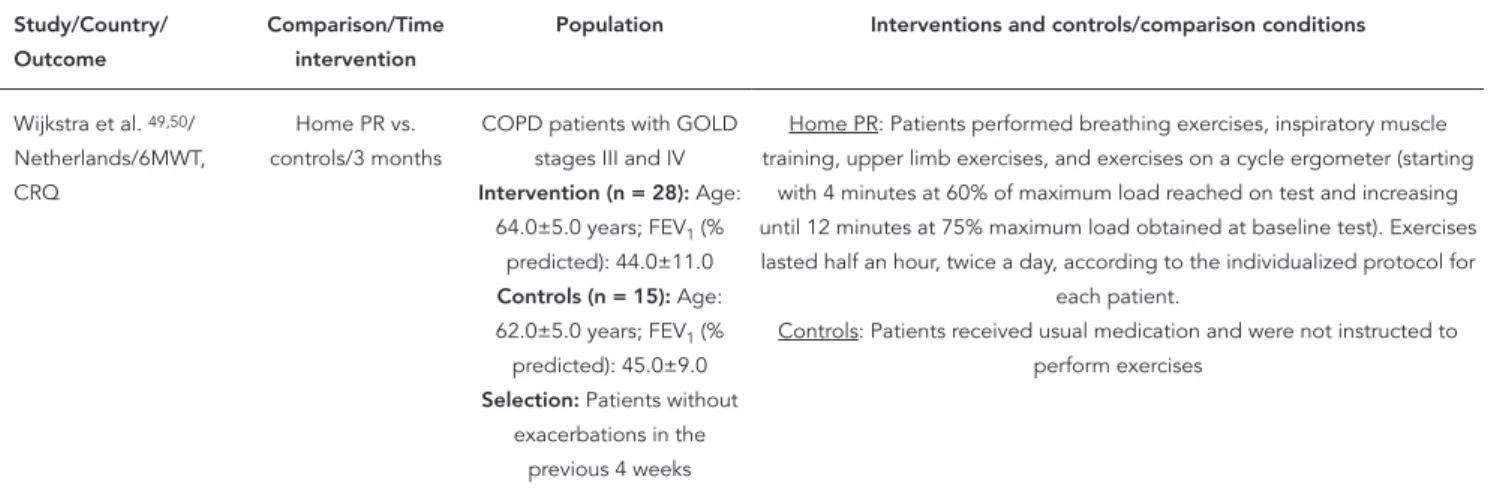
Wijkstra et al. 49,50/ Netherlands/6MWT, CRQ
Home PR vs. controls/3 months
COPD patients with GOLD stages III and IV
Intervention(n=28): Age: 64.0±5.0 years; FEV1 (%
predicted): 44.0±11.0
Controls(n=15): Age: 62.0±5.0 years; FEV1 (%
predicted): 45.0±9.0
Selection: Patients without exacerbations in the
previous 4 weeks
Home PR: Patients performed breathing exercises, inspiratory muscle training, upper limb exercises, and exercises on a cycle ergometer (starting
with 4 minutes at 60% of maximum load reached on test and increasing until 12 minutes at 75% maximum load obtained at baseline test). Exercises lasted half an hour, twice a day, according to the individualized protocol for
each patient.
Controls: Patients received usual medication and were not instructed to perform exercises
6MWT: Six-Minute Walk Test; COPD: chronic obstructive pulmonary disease; CRQ: Chronic Respiratory Questionnaire; FEV1: forced expiratory volume in
one second; GOLD: Global Initiative for Lung Disease; ISWT: Incremental Shuttle Walk Test; MRC: Medical Research Council; OPR: outpatient pulmonary rehabilitation; PR: pulmonary rehabilitation; SGRQ: Saint George’s Respiratory Questionnaire; SpO2: peripheral capillary oxygen saturation; VO2: maximum
rate of oxygen consumption; Wmax: maximum work rate. Note: data expressed as mean ± standard deviation.
Figure 2
Graph on risk of bias with percentages across all selected studies.
showed an effect size increase (54.38m, 95%CI: 29.53 to 79.23, I2 = 37%) in the studies including individuals with more severe COPD, stage III or IV according to the GOLD criteria 8 (FEV1 < 50% of predicted), while among the studies including individuals with less severe COPD (FEV1 > 50% of predicted), no effect was found (7.20m, 95%CI: -23.72 to 38.11, I2 = 55%). A reduction of hetero-geneity in both meta-analyses was seen (Figure 4). With regard to functional capacity measured by ISWT, significant improvement was also seen in the distance walked comparing patients who
performed HCPR to controls (78.84m, 95%CI: 43.04 to 104.64, I2 = 0%) (Figure 5). Finally, there was a significant decrease in sensation of dys-pnea assessed by MRC in HCPR compared to controls (-0.21, 95%CI: -0.42 to -0.00, I2 = 0%) (Figure 6).
as-Figure 4
Meta-analysis of functional capacity in the Six-Minute Walk Test (6MWT) comparing home or community-based pulmonary rehabilitation (HCPR) to controls.
95%CI: 95% confidence interval; FEV1: forced expiratory volume in one second; PR: pulmonary rehabilitation; SD: standard deviation.
sessed by CRQ, namely Fatigue (0.79, 95%CI: 0.51 to 1.07, I2 = 49%), Dyspnea (0.65, 95%CI: 0.21 to 1.09, I2 = 81%), Emotional Function (0.51, 95%CI: 0.20 to 0.83, I2 = 56%), and Mastery (0.73, 95%CI: 0.38 to 1.08, I2 = 63%) (Figure 7). Similarly, when compared to controls, patients who received HCPR also showed improvement in overall qual-ity of life assessed by SGRQ (-9.98, 95%CI: -17.23 to -2.74, I2 = 73%) and in the Activity (-12.34, 95%CI: -19.54 to -5.14, I2 = 57%) and Psychosocial Impact (-10.70, 95%CI: -18.89 to -2.52, I2 = 76%) domains, but no improvement was demonstrat-ed in the Symptoms domain (-3.24, 95%CI: -9.97 to 3.49, I2 = 53%) (Figure 8). High heterogeneity values were explored by separating the studies into subgroups according to the characteristics of the patients’ disease, risk of
methodologi-cal bias in studies, countries where the studies were performed, and intervention time. None of the analyses showed a substantial decrease in heterogeneities.
• Analysis2:HCPRvs.OPR
(a) Functional Capacity: Three studies 36,37,41 (n = 334) assessed functional capacity using the 6MWT. When considered jointly, the interven-tions did not differ significantly in the distance walked in the 6MWT (8.70m, 95%CI: -6.67 to 24.08, I2 = 0%) (Figure 9).
Dys-Figure 6
Meta-analysis of dyspnea perception in Medical Research Council (MRC) comparing home or community-based pulmonary rehabilitation (HCPR) to controls. 95%CI: 95% confidence interval; PR: pulmonary rehabilitation; SD: standard deviation.
95%CI: 95% confidence interval; PR: pulmonary rehabilitation; SD: standard deviation.
pnea (-0.14, 95%CI: 0.29 to -0.57, I2 = 0%), Fatigue (-0.18, 95%CI: -0.77 to 0.42, I2 = 59%), Emotional Function (-0.23, 95%CI: -0.99 to 0.53, I2 = 77%), or Mastery (-0.14, 95%CI: -0.95 to 0.68, I2 = 69%) (Figure 10). Likewise, high heterogeneity values were also explored using the previously specified criteria, and no substantial decrease in heteroge-neities was observed.
Assessment of quality of evidence
Assessment of the quality of evidence in this sys-tematic review was performed for each of the outcomes evaluated by the GRADE system. The GRADE system defines well-conducted RCTs as
Figure 7
Meta-analysis of quality of life in Chronic Respiratory Questionnaire (CRQ) comparing home or community-based pulmonary rehabilitation (HCPR) to controls.
95%CI: 95% confidence interval; PR: pulmonary rehabilitation; SD: standard deviation.
prevalent in assessing the quality of evidence for each outcome, since the method used to gener-ate random sequences in many studies was not clear (which does not mean that it was inappro-priate) and because double-blinding is not pos-sible in interventions such as PR. Still, sensitivity analysis, removing studies with lower method-ological quality of meta-analyses, did not signifi-cantly change the estimated effects between the outcomes or decrease the heterogeneities.
Discussion
Summary of the evidence
Figure 9
Meta-analysis of functional capacity in Six-Minute Walk Test (6MWT) comparing home or community-based pulmonary rehabilitation (HCPR) to outpatient pulmonary rehabilitation (OPR).
95%CI: 95% confidence interval; PR: pulmonary rehabilitation; SD: standard deviation.
Figure 10
Meta-analysis of quality of life in Chronic Respiratory Questionnaire (CRQ) comparing home or community-based pulmonary rehabilitation (HCPR) to outpatient pulmonary rehabilitation (OPR).
the HCPR group compared to the control group was 54.38 meters for patients with FEV1 < 50% of predicted; an improvement of 54 meters is known to be clinically significant 49. Moreover, studies show that the 6MWT is an excellent pre-dictor of hospitalization and mortality among COPD patients 52,53, i.e., the longer the distance walked in the test, the lower the odds of hospital-ization and death 52. The lack of effect for patients with FEV1 > 50% of predicted may have been due to the lower functional impairment in these in-dividuals, who would be expected to benefit less from the intervention.
Similarly, the average difference in the ISWT between the group that received HCPR and the control group was 73.85 meters, much higher than the 47.5-meter increase that is sufficient to show clinically significant improvement in this test 55. When HCPR and OPR were compared, it was not possible to identify differences between the average distances walked in the 6MWT. Sys-tematic reviews with meta-analysis comparing the effect of OPR to control groups found similar effect sizes as in the comparison between HCPR and controls, namely 77.7 meters (95%CI: 12.21 to 143.20) 13 and 48.0 meters (95%CI: 32.0 to 65.0) 56 in ISWT. These results show the strong poten-tial of home and community programs that use fewer devices and resources to produce similar gains in functional capacity when compared to standard outpatient programs.
Both the 6MWT and ISWT show good re-producibility and good sensitivity for assessing changes in functional capacity of patients with COPD after PR programs, with 6MWT as a sub-maximal test and ISWT as a sub-maximal test 57. This demonstrates that patients undergoing HCPR can benefit in different functional aspects of physical capacity. In addition, the tests are of easy to apply and low-cost and correlate well with the maximum oxygen consumption (VO2 max) 1,58, confirming the importance of the findings in this meta-analysis.
The current study also demonstrated that HCPR, when compared to a control group, de-creased the sensation of dyspnea, assessed by MRC. The index can help predict mortality risk in patients with COPD 8, and individuals with higher MRC indices have lower exercise capacity and lower quality of life 59, aspects also associ-ated with increased risk of mortality.
Quality of life in patients receiving HCPR compared to the control group showed im-provement, except in the symptoms section of
crease in the SGRQ score indicates a moderately effective change, while a 12-point decrease indi-cates highly efficient treatment 60.
Similarly, when evaluated by CRQ, all areas showed improvement in HCPR compared to the control group. Again, comparison of HCPR and OPR showed no differences in any of the CRQ do-mains, demonstrating that home or community-based programs can be as effective as outpatient pulmonary rehabilitation to improve quality of life for individuals with COPD.
These quality of life questionnaires seek to assess the degree of disability and not merely lung incapacity, since their domains tend to ad-dress the issue of disability related to psycho-social, emotional, and self-control factors and activities as well as the sensation of dyspnea and fatigue. Importantly, a 0.5-point change in CRQ may be clinically significant 14, and in me-ta-analyses comparing HCPR to control groups in all domains, the mean difference exceeded 0.5 points.
Quality of life questionnaires can be better at measuring the true impact of interventions in real life, compared to the results of other tests and measures 61. SGRQ is widely used to assess quality of life in these patients 8. However, CRQ, also widely used 62, has proven superior for eval-uating quality of life in patients with COPD who received PR 63,64.
As a whole, this study indicates that HCPR can improve functional capacity, quality of life, and sensation of dyspnea in COPD patients when compared to control interventions. This PR mo-dality’s results also resembled those of OPR, whose benefits are widely documented in the literature. Some studies have shown that HCPR is cost-effective, making it the most feasible ap-proach for extending to larger numbers of people and improving population access 65,66.
Strengths and limitations of the review
The various meta-analyses focused on out-comes with high clinical significance, extending the findings of systematic reviews on the topic with data up to 2012 23,24,25. No relevant evidence of heterogeneities was observed in at least three of the meta-analyses, while we explored the other heterogeneities that were detected. Altogether, these characteristics gave high methodological quality to this systematic review.
In light of the findings’ biological plausibil-ity, the absence of heterogeneity in the compari-sons of HCPR and control groups in ISWT and MRC and in the comparison of HCPR and OPR in 6MWT demonstrates that the results for these outcomes are reliable.
The heterogeneity in the 6MWT compar-ing HCPR to the control group was explored: one possible explanation for its increase is the percentage averages of predicted FEV1 in pa-tients. Subgroup analysis showed an important decrease in heterogeneity, mainly for the group with FEV1 < 50% of predicted. Maintenance of high heterogeneity in the analysis of studies with patients showing mean FEV1 > 50% of predicted may have occurred due to the small number of studies included or to other differences in reha-bilitation programs, since the studies included in this meta-analysis had low risk of methodologi-cal bias.
The observed heterogeneity in quality of life outcomes is somewhat expected, since quality of life concepts can change according to vari-ous study contexts and cultural characteristics, despite the validation of questionnaires for each country. In addition, such analyses always show heterogeneity between studies on the basis of their clinical and methodological diversity, even though the tests are unable to detect it; the ef-fect’s magnitude and direction should always be considered, regardless of the strength of evidence in assessing the estimates 26.
Although this review showed substantial heterogeneity in some analyses with regard to quality of life, HCPR clearly benefits COPD pa-tients, based on the direction and size of effects. Subgroup analyses sought to explain this hetero-geneity by considering differences in interven-tion times, methodological quality, and degree of patients’ commitment. However, none of the analyses revealed differences among subgroups in effect size or direction, making it impossible to explain the differences that were found. We thus assume that the heterogeneity is due to the large number of studies involved in some analyses, the variety of types of intervention, and the sociocul-tural diversity of subjects.
Various factors limited the quality of evidence identified in this systematic review and the
de-gree of confidence in some of the recommen-dations. The main limiting factor is the lack of reports of prior calculation of sample size and statistical power in the selected studies, some of which included small numbers of patients, thereby increasing the uncertainty in the esti-mates generated by the meta-analyses and the potential publication bias, although none of the selected studies had received industry funding. Additionally, most studies identified a limited post-intervention assessment period, thus pre-venting assessment of the long-term efficacy of HCPR and its impact on morbidity and mortality.
The review also detected low methodologi-cal quality in many studies that did not address or provide details on essential procedures for re-ducing the risk of bias in RCTs: adequacy of the random sequence generation, blinding of study teams and reviewers, intention-to-treat analy-sis, and the impact of loss to follow-up between groups. RCTs on HCPR are thus needed with larger samples, extended follow-up, and greater methodological rigor in order to increase the confidence in their degree of recommendation, given the diversity of clinical scenarios and pa-tient care in COPD.
The summary of these issues involving meth-odological quality, heterogeneity, and impreci-sion is taken into account when assessing a study’s quality. For all target outcomes in both comparisons, the quality of evidence was con-sidered moderate. That is, the results should be interpreted with caution. Studies with greater statistical power and more appropriate and uni-form methodologies can lead to small changes in effect size for the target outcomes. Nonetheless, the results are highly valid, considering the direc-tion of the effects, the significance of the statisti-cal tests, and their clinistatisti-cal relevance.
Differences between this and other reviews
analysis 25 compared home-based PR with con-trol groups or non-home-based PR and identi-fied 888 studies, of which 12 were included. Most of these studies found that programs involving aerobic endurance training improve quality of life and exercise capacity for patients with COPD. In agreement with our findings, the authors con-cluded that unsupervised home-based PR is use-ful and, if properly done, can be an equivalent alternative to OPR programs.
Another systematic review 24 evaluated the impact of home-based physical therapy on ac-tivities of daily living in COPD patients. Of the 1,686 studies identified by the review, seven were included and three were included in a meta-anal-ysis. The authors concluded that home exercise and training of inspiratory muscles decreases the sensation of dyspnea, findings corroborated by the current systematic review’s meta-analysis.
Implications for practice
HCPR meets the recommendations of various public health programs around the world, seek-ing to decentralize and distribute specialized health services, drawing them closer to the popu-lation. HCPR thus potentially applies to countries with universal access in their health care systems.
duce dyspnea, and improve quality of life in pa-tients with COPD, and these benefits are com-parable to those of OPR in relation to functional capacity and quality of life. However, concerning the positive effects of this intervention, feasibil-ity studies are still needed to implement these programs, including their suitability in relation to different clinical needs and local contexts. Some alternatives, such as telephone reminders or health worker visits in conjunction with HCPR, could be adopted to increase treatment adher-ence and monitor patients’ symptoms and their adaptation to physical training.
Some issues should be addressed in greater depth in future studies, such as cost-effective-ness of HCPR, considering basic requirements for modeling PR programs, like staff, time, and patient monitoring, among others. Studies should also compare the actual costs of HCPR and OPR, including health services and costs to individuals, besides comparing adherence, number of subsequent hospitalizations, and survival analysis. This is crucial information for clinical decision-making and planning health policies and services, which can be more specif-ic to each population’s reality, available human and financial resources, and the respective cul-tural context.
Contributors
L. F. Neves was the first reviewer and contributed to the planning, project design, database search, data extrac-tion, analyses, writing of the manuscript, and revisions. M. H. Reis was the second reviewer and contributed to the planning, project design, database search, data extraction, and revisions. T. R. Gonçalves was the third reviewer and contributed to the planning, project de-sign, database search, data extraction, analyses, writing of the manuscript, and revisions.
Note
References
1. Sociedade Brasileira de Pneumologia e Tisiologia. II consenso brasileiro sobre doença pulmonar obstrutiva crônica – DPOC. J Bras Pneumol 2004; 30 Suppl 5:S1-S42.
2. Celli BR, MacNee W. Standards for the diagnosis and treatment of patients with COPD: a summary of the ATS/ERS position paper. Eur Respir J 2004; 23:932-46.
3. Sin DD, Anthonisen NR, Soriano JB, Agusti AG. Mortality in COPD: role of comorbidities. Eur Respir J 2006; 28:1245-57.
4. Jones PW, Brusselle G, Dal Negro RW, Ferrer M, Kardos P, Levy ML, et al. Properties of the COPD assessment test in a cross-sectional European study. Eur Respir J 2011; 38:29-35.
5. Perera PN, Armstrong EP, Sherrill DL, Skrepnek GH. Acute exacerbations of COPD in the United States: inpatient burden and predictors of costs and mortality. COPD 2012; 9:131-41.
6. Antunes FP, Costa MC, Paim JS, Vieira-da-Silva LM, Santos CA, Cruz AA, et al. Trends in hospitaliza-tions for respiratory diseases in Salvador, Bahia State, Brazil, 1998-2009. Cad Saúde Pública 2012; 28:869-77.
7. Hoogendoorn M, Hoogenveen RT, Rutten-van Molken MP, Vestbo J, Feenstra TL. Case fatality of COPD exacerbations: a meta-analysis and statis-tical modelling approach. Eur Respir J 2011; 37: 508-15.
8. Vestbo J, Hurd SS, Agusti AG, Jones PW, Vogel-meier C, Anzueto A, et al. Global strategy for the diagnosis, management and prevention of chronic obstructive pulmonary disease, GOLD Execu-tive Summary. Am J Respir Crit Care Med 2013; 187:347-65.
9. Spruit MA, Singh SJ, Garvey C, ZuWallack R, Nici L, Rochester C, et al. An official American Thoracic Society/European Respiratory Society statement: key concepts and advances in pulmonary rehabili-tation. Am J Respir Crit Care Med 2013; 188:e13-64. 10. Ries AL, Bauldoff GS, Carlin BW, Casaburi R, Em-ery CF, Mahler DA, et al. Pulmonary rehabilitation: joint ACCP/AACVPR evidence-based clinical prac-tice guidelines. Chest 2007; 131(5 Suppl):4S-42S. 11. Sociedade Brasileira de Cardiologia. Diretriz de
reabilitação cardiopulmonar e metabólica: aspec-tos práticos e responsabilidades. Arq Bras Cardiol 2006; 86:74-82.
12. Nici L, Donner C, Wouters E, Zuwallack R, Am-brosino N, Bourbeau J, et al. American Thoracic Society/European Respiratory Society statement on pulmonary rehabilitation. Am J Respir Crit Care Med 2006; 173:1390-413.
13. Puhan MA, Gimeno-Santos E, Scharplatz M, Troosters T, Walters EH, Steurer J. Pulmonary re-habilitation following exacerbations of chronic ob-structive pulmonary disease. Cochrane Database Syst Rev 2011; (1):CD005305.
14. Lacasse Y, Wong E, Guyatt GH, King D, Cook DJ, Goldstein RS. Meta-analysis of respiratory rehabil-itation in chronic obstructive pulmonary disease. Lancet 1996; 348:1115-9.
15. Wehrmeister FC, Knorst M, Jardim JR, Macedo EC, Noal RB, Martinez-Mesa J, et al. Pulmonary reha-bilitation programs for patients with COPD. J Bras Pneumol 2011; 37:544-55.
16. Neves LF, Reis MH, Plentz RD, Matte DL, Coronel CC, Sbruzzi G. Expiratory and expiratory plus in-spiratory muscle training improves rein-spiratory muscle strength in subjects with COPD: systematic review. Respir Care 2014; 59:1381-8.
17. Behnke M, Taube C, Kirsten D, Lehnigk B, Jörres RA, Magnussen H. Home-based exercise is ca-pable of preserving hospital-based improvements in severe chronic obstructive pulmonary disease. Respir Med 2000; 94(12). http://onlinelibrary.wi ley.com/o/cochrane/clcentral/articles/094/CN-00330094/frame.html.
18. Man WD, Polkey MI, Donaldson N, Gray BJ, Mox-ham J. Community pulmonary rehabilitation after hospitalisation for acute exacerbations of chronic obstructive pulmonary disease: randomised con-trolled study. BMJ 2004; 329:1209.
19. Resqueti VR, Gorostiza A, Galdiz JB, Lopez de San-ta Maria E, Casan Clara P, Guell Rous R. Benefits of a home-based pulmonary rehabilitation pro-gram for patients with severe chronic obstructive pulmonary disease. Arch Bronconeumol 2007; 43: 599-604.
20. Strijbos JH, Postma DS, van Altena R, Gimeno F, Koeter GH. A comparison between an outpatient hospital-based pulmonary rehabilitation pro-gram and a home-care pulmonary rehabilitation program in patients with COPD. A follow-up of 18 months. Chest 1996; 109:366-72.
21. Guell MR, de Lucas P, Galdiz JB, Montemayor T, Rodriguez Gonzalez-Moro JM, Gorostiza A, et al. Home vs hospital-based pulmonary rehabilitation for patients with chronic obstructive pulmonary disease: a Spanish multicenter trial. Arch Bronco-neumol 2008; 44:512-8.
22. Mendes de Oliveira JC, Studart Leitao Filho FS, Malosa Sampaio LM, Negrinho de Oliveira AC, Hi-rata RP, Costa D, et al. Outpatient vs. home-based pulmonary rehabilitation in COPD: a random-ized controlled trial. Multidiscip Respir Med 2010; 5:401-8.
23. Liu XL, Tan JY, Wang T, Zhang Q, Zhang M, Yao LQ, et al. Effectiveness of home-based pulmonary re-habilitation for patients with chronic obstructive pulmonary disease: a meta-analysis of random-ized controlled trials. Rehabil Nurs 2014; 39: 36-59. 24. Thomas MJ, Simpson J, Riley R, Grant E. The im-pact of home-based physiotherapy interventions on breathlessness during activities of daily living in severe COPD: a systematic review. Physiothera-py 2010; 96:108-19.
25. Vieira DS, Maltais F, Bourbeau J. Home-based pulmonary rehabilitation in chronic obstructive pulmonary disease patients. Curr Opin Pulm Med 2010; 16:134-43.
28. Neves LF, Reis MH, Gonçalves TR. Home or community based pulmonary rehabilitation for patients with chronic obstructive pulmo-nary disease: systematic review and meta-anal-ysis of randomized clinical trials. http://www. crd.york.ac.uk/PROSPERO/display_record. asp?ID=CRD42014007295 (accessed on 05/ May/2016).
29. Neves LF. Reabilitação pulmonar domiciliar ou co-munitária para portadores de doença pulmonar obstrutiva crônica: revisão sistemática e meta--análise de ensaios clínicos randomizados [Disser-tação de Mestrado]. São Leopoldo: Programa de Pós-graduação em Saúde Coletiva, Universidade do Vale do Rio dos Sinos; 2014.
30. Akinci AC, Olgun N. The effectiveness of nurse-led, home-based pulmonary rehabilitation in pa-tients with COPD in Turkey. Rehabil Nurs 2011; 36: 159-65.
31. Cambach W, Chadwick-Straver RV, Wagenaar RC, Keimpema AR, Kemper HC. The effects of a community-based pulmonary rehabilitation pro-gramme on exercise tolerance and quality of life: a randomized controlled trial. Eur Respir J 1997; 10:104-13.
32. Dias FD, Sampaio LMM, da Silva GA, Dantas Gomes ÉLF, do Nascimento ESP, Alves VLS, et al. Home-based pulmonary rehabilitation in patients with chronic obstructive pulmonary disease: a randomized clinical trial. Int J Chron Obstruct Pul-mon Dis 2013; 8:537-44.
33. du Moulin M, Taube K, Wegscheider K, Behnke M, Bussche H. Home-based exercise training as maintenance after outpatient pulmonary rehabili-tation. Respiration 2009; 77:139-45.
34. Effing T, Zielhuis G, Kerstjens H, van der Valk P, van der Palen J. Community based physiotherapeutic exercise in COPD self-management: a randomised controlled trial. Respir Med 2011; 105:418-26. 35. Elliott M, Watson C, Wilkinson E, Musk AW, Lake
FR. Short- and long-term hospital and community exercise programmes for patients with chronic obstructive pulmonary disease. Respirology 2004; 9:345-51.
36. Ghanem M, Elaal EA, Mehany M, Tolba K. Home-based pulmonary rehabilitation program: effect on exercise tolerance and quality of life in chronic obstructive pulmonary disease patients. Ann Tho-rac Med 2010; 5:18-25.
37. Güell MR, De Lucas P, Gáldiz JB, Montemayor T, González-Moro JMR, Gorostiza A, et al. Home vs hospital-based pulmonary rehabilitation for pa-tients with chronic obstructive pulmonary dis-ease: a Spanish multicenter trial. Arch Bronconeu-mol 2008; 44:512-8.
38. Hernández MTE, Rubio TM, Ruiz FO, Riera HS, Gil RS, Gómez JC. Results of a home-based train-ing program for patients with COPD. Chest 2000; 118:106-14.
40. Jang HJ, Jung YK. The effects of self-efficacy pro-moting pulmonary rehabilitation program in out-patients with chronic obstructive pulmonary dis-ease. Tuberc Respir Dis (Seoul) 2006; 61:533-46. 41. Maltais F, Bourbeau J, Shapiro S, Lacasse Y,
Per-rault H, Baltzan M, et al. Effects of home-based pulmonary rehabilitation in patients with chronic obstructive pulmonary disease: a randomized tri-al. Ann Intern Med 2008; 149:869-78.
42. Moore J, Fiddler H, Seymour J, Grant A, Jolley C, Johnson L, et al. Effect of a home exercise video programme in patients with chronic obstruc-tive pulmonary disease. J Rehabil Med 2009; 41: 195-200.
43. Murphy N, Bell C, Costello RW. Extending a home from hospital care programme for COPD exac-erbations to include pulmonary rehabilitation. Respir Med 2005; 99:1297-302.
44. Oh EG. The effects of home-based pulmonary re-habilitation in patients with chronic lung disease. Int J Nurs Stud 2003; 40:873-9.
45. Puente-Maestu L, Sánz ML, Sánz P, Cubillo JM, Mayol J, Casaburi R. Comparison of effects of supervised versus self-monitored training pro-grammes in patients with chronic obstructive pul-monary disease. Eur Respir J 2000; 15:517-25. 46. Román M, Larraz C, Gómez A, Ripoll J, Mir I,
Mi-randa EZ, et al. Efficacy of pulmonary rehabilita-tion in patients with moderate chronic obstructive pulmonary disease: a randomized controlled trial. BMC Fam Pract 2013; 14:21.
47. Singh V, Khandelwal DC, Khandelwal R, Abusar-ia S. Pulmonary rehabilitation in patients with chronic obstructive pulmonary disease. Indian J Chest Dis Allied Sci 2003; 45:13-7.
48. van Wetering CR, Hoogendoorn M, Mol SJM, Rut-ten-van Mölken MPMH, Schols AM. Short- and long-term efficacy of a community-based COPD management programme in less advanced COPD: a randomised controlled trial. Thorax 2010; 65: 7-13.
49. Wijkstra PJ, van Altena R, Kraan J, Otten V, Post-ma DS, Koeter GH. Quality of life in patients with chronic obstructive pulmonary disease improves after rehabilitation at home. Eur Respir J 1994; 7:269-73.
50. Wijkstra PJ, Van Mark TWD, Kraan J, van Altena R, Koëter GH, Postma DS. Long-term effects of home rehabilitation on physical performance in chronic obstructive pulmonary disease. Am J Respir Crit Care Med 1996; 153:1234-41.
51. Guyatt G, Oxman AD, Akl EA, Kunz R, Vist G, Brozek J, et al. GRADE guidelines: 1. Introduction-GRADE evidence profiles and summary of findings tables. J Clin Epidemiol 2011; 64:383-94.