1. PhD Program in Surgery at the Postgraduate General Surgery of the FMB / UNESP; University Professor of the Physiotherapy Course at UNESP - Marília / SP and the Faculty of Alta Paulista – Tupa / SP.
2. Doctor, University Professor, Head of the Department of Biostatistics, consultant FAMEMA - Marília / SP and Professor UNESP - Marília / SP.
3. Associate Professor, Adjunct Professor in charge of Cardiovascular Surgery, Department of Surgery and Orthopedics of FMB-UNESP.
Juliana Bassalobre Carvalho BORGES1, Sebastião Marcos Ribeiro de CARVALHO2,Marcos Augusto de Moraes SILVA3
RBCCV 44205-1170
Qualidade do serviço prestado aos pacientes de cirurgia cardíaca do Sistema Único de Saúde-SUS
Quality of service provided to heart surgery
patients of the Unified Health System-SUS
Work of the General Basis of Surgery Graduate Program, Faculty of Medicine of Botucatu / UNESP, Botucatu, SP, Brazil.
Correspondence adress:
Bassalobre Juliana Carvalho Borges. Rua Venancio de Souza, 422. CEP: 17514-072, Bairro Airport, Marilia, SP, Brazil.
E-mail: [email protected]
Article received on March 9th, 2010 Article accepted on May 24th, 2010 Abstract
Objective: To evaluate the quality of service provided to patients of heart surgery during their hospital stay, in the SUS service, identifying the expectations and perceptions of patients. Relating quality of service to gender, age and cardiopulmonary bypass.
Methods: We studied 82 patients (52.4% female and 47.6% male) undergoing elective cardiac surgery, operated by mid-sternal thoracotomy, age: 31-83 years (mean 60.4 ± 13, two years), period: March to September 2006. We evaluated the quality of service in two phases: preoperative expectations and perceptions of care received in the 6th day after surgery, by applying the modified SERVQUAL (SERVQUAL-Card). The result was obtained by the difference in the sum of scores of perceptions and expectations by means of statistical analysis.
Results: The SERVQUAL-Card scale was validated statistically, showing adequate internal consistency index. Found a higher frequency of myocardial revascularization 55 (67.0%); first heart surgery 72 (87.8%) and CPB 69 (84.1%). There were high values for expectations and perceptions, with significant results (P <0.05). We observed a significant relationship between quality of service and gender, empathy (P = 0.04) and age, reliability (P = 0.02). No
significance was observed between CPB and quality service. Conclusion: The quality of services was satisfactory. The patients showed high expectations to the medical and hospital service. Women had a higher perception of empathy quality, young reliability. CPB is not related to service quality in this sample. The data obtained suggest that the quality of health service can be monitored through periodic use of the scale SERQUAL.
Descriptors: Cardiac surgical procedures. Quality of health care. Scales. Indicators of quality in health care. SUS
Resumo
Objetivo: Avaliar qualidade do serviço prestado aos pacientes de cirurgia cardíaca no período hospitalar, em serviço do SUS, identificando as expectativas e percepções dos pacientes. Relacionar qualidade de serviço com gênero, faixa etária e circulação extracorpórea.
generates satisfaction or dissatisfaction, confirmation or denial of expectations, as determined by the quality of service. The biggest complaint is that the patient has a demanding expectation and receives a poor service. Quality of service is identified by the satisfaction that the service received has had on patient care due to his expectations and needs [4,5].
Ferraz [6] and Rigolin [7] pointed out that the patient’s expectations go beyond his perceptions of the treatment process and are directed to achieve recovery with an effective realization of their various daily activities.
Knowing the patient in his universality, individuality and health context is the proposal of health care that seeks patient satisfaction and quality in the processes of clinical care. The concern for patient satisfaction brings a proposal forward in the multidimensional approach of assessing quality, and the consensus of quality is used to direct efforts to meet the patient needs [7,8].
Parasuraman et al. [9-11] defined service quality as a function of discrepancy between consumers’ expectations about the services actually provided. In this model, we identified gaps in the process of producing and selling the product. Based on these studies, the focus of the perceived service compared with the expected service, it was developed an instrument based on the consumer’s expectation and perception of service quality called SERVQUAL.
This scale is applied in different sectors, with positive international results [3,4,9-13]. The evaluation of health services through the SERVQUAL scale is well documented in the literature [3,4,12,13]. For patients in Brazil, Brazil [14] evaluated the perceived quality of differentiated hospital services and Herc & Berezovsky [15] analyzed the quality INTRODUCTION
In Brazil, the guarantee of the right to health and configuration of a policy of comprehensive social protection in health, in the principles of universality, fairness and integrity were shaped very recently with the enactment of the 1988 Federal Constitution and the establishment of the Unified Health System (SUS). Universality is understood as a right, not a service to which you have access by means of a contribution or payment of any kind. Fairness must not be understood as equality, but it concerns to treat unequals unequally, paying attention to the individual and collective needs, seeking to invest where the inequality is greater. And finally, completeness must be understood as the concept of health, in the organization of an integral health practice [1].
Thus, SUS, in its institutions, seeks management models that emphasize value and humane practices to its customers and optimize its own performance. Hospitals have improved their methods of performance evaluation with the client in order to correct the discontinuities of services in order to make them more effective and efficient [2,3].
The evaluation of a health service is linked to the production of social consensus and implies as it serves the interests of consumers and the public. In this approach, the relevant point is the patient’s perspective, it is analyzed how he assesses the perception of the attention he receives and it is directed to meet his needs and expectations [4].
Hence, the quality of services in health care includes the measure of what it is expected to receive, which is the expectation, related to the perception of the service actually received. The result of this comparison
momentos: expectativas no pré-operatório e percepções do atendimento recebido no 6° dia de pós-operatório; mediante aplicação da escala SERVQUAL modificada (SERVQUAL-Card). O resultado foi obtido pela diferença da somatória das notas das percepções e expectativas por meio de análise estatística.
Resultados: A escala SERVQUAL-Card foi validada estatisticamente, apresentando adequado índice de consistência interna. Encontrou-se maior frequência de revascularização do miocárdio 55 (67,0%); primeira cirurgia cardíaca 72 (87,8%) e utilização de CEC 69 (84,1%). Verificaram-se altos valores para expectativas e percepções, com resultados significantes (P<0,05). Observou-se relação significante entre qualidade de serviço com gênero, na empatia (P=0,04) e faixa etária, na
confiabilidade (P=0,02). Não se observou significância entre CEC e qualidade de serviço.
Conclusão: A qualidade dos serviços foi satisfatória. O paciente demonstrou expectativa alta ao serviço médico-hospitalar. Mulheres apresentaram maior percepção da qualidade na empatia, jovens na confiabilidade. A utilização de CEC não está relacionada com qualidade do serviço nesta amostra. Os dados obtidos sugerem que a qualidade deste serviço de saúde pode ser monitorada pelo emprego periódico da escala SERQUAL.
of service provided to ophthalmic outpatients of SUS, performing validation of the scale used and stressed the importance of its use in other health areas. Dias [16] evaluated the quality of service in medical practices.
Considering the above and the absence of studies focusing on the patient in cardiac surgery, in relation to quality of service they receive in hospital, it is justified to develop this work.
The aim of this study was to evaluate the quality of service provided to patients after cardiac surgery in the preoperative and early postoperative (6th PO) in the SUS
service, identifying the expectations and perceptions of patients regarding the services. Relate to service quality perceptions of patients including: gender, age group and use of cardiopulmonary bypass.
METHODS
A descriptive and analytical observational study was carried out in subjects who underwent elective cardiac surgery in the SUS of Santa Casa de Misericordia de Marília in the period from March to September 2006.
The study was approved by the Ethics Committee, Protocol No. 056/05 (FAMEMA). Participants signed a consent form.
Inclusion and exclusion criteria
We included patients of both genders, age between 20 and 85 years, diagnosed with coronary artery disease or valvular heart disease, undergoing elective cardiac surgery with or without cardiopulmonary bypass (CPB), operated by mid-sternal thoracotomy (MST). We excluded patients undergoing emergency surgery, unable to answer the questionnaire and those who progressed to mechanical ventilation over 24 hours and died.
Casuistry
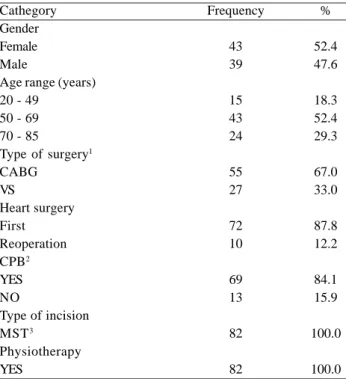
We studied 82 patients, 43 (52.4%) were female and 39 (47.6%) were male, 55 (67%) patients had a diagnosis of coronary artery disease and 27 (33%) with valvular heart disease, were divided for purposes of this study into three age groups: 20-49 years (18.3%), 50-69 years (52.4% - Class of greater concentration of patients) and 70-85 years (29.3%). The age ranged 31-83 years, mean 60.4 ± 13.2 years. The level of education focused on primary education. Patients entered the study consecutively, according to the criteria of inclusion and exclusion.
Procedures
Patients were evaluated using a protocol developed by the researcher, according to the literature [16-18], stating the following: personal data, diagnosis, type of surgery,
type of incision, CPB, performing first heart surgery or reoperation , physical therapy and scale for assessing the quality of service.
To assess the quality of service perceived by the patient it was performed literature review, reaching a consensus to adapt the SERVQUAL scale according to specific features of the environment of this research. This was followed by orientation of the authors of the SERVQUAL scale [9-11], which recommend adaptation of the instrument and proof of its effectiveness, testing its reliability and validity. We also used guidance from Herc & Berezovsky [15], who in their studies adapted and validated the modified SERVQUAL for outpatient eye care.
It has become the specific vocabulary to the study environment, adding a statement to evaluate the quality of service in the care of cardiac surgery, the according to the model adapted by Herc & Berezovsky [15], obtaining the SERVQUAL-Card. Further, this version of scale was submitted for review by judges (six experts), working with people experiencing the problem mentioned. The judges reviewed and discussed each of the items of the instrument, especially the adaptation of phrases, words, examples, verbal expressions and situations included in the scale for the Brazilian context, and the research in focus, getting the version to be used in pre-test of the instrument.
We carried out the pre-test of the SERVQUALCard scale, applying the instrument in 10 patients of elective cardiac surgery in SUS, in the preoperative and in the sixth day of postoperative, recording information that rose doubts to the respondents and after consideration thereof, the necessary corrections were made and submitted to the judges and after the correlation of changes, it was written the version for use in research [18].
The final instrument: scale adapted for cardiac surgery (SERVQUAL-Card) consisted of 23 items, assessed on a 7-point Likert scale, where the number 1 corresponds to a statement “strongly disagree” and the number 7 to the statement “totally agree “. Structured in five dimensions of the original scale: tangibility, items 1-4; reliability, items 5-9; service, items 10-13; security, items 14-17; empathy, items 18-22, with additional Item 23, overall quality of service.
To validate the SERVQUAL-Card we study the reliability of the latter by calculating Cronbach’s alpha and construct validity through factor analysis [2.19].
Patients were evaluated at two times: preoperative (PRE) and 6th day postoperatively (6th PO), every moment it was
sixth postoperative day, patients were asked to record their perceptions (P) on the care received during hospitalization. Also in the sixth postoperative day, we jointly applied a questionnaire of point allocation to determine the
importance of each of the five dimensions. The patients divided 100 points among the five original dimensions: tangibility, reliability, service, safety, empathy, demonstrating their relative importance (Chart 2).
Chart 1. SERVQUAL-Card Scale: adapted for cardiac surgery
ITEMS / DIMENSIONS
TANGIBILITY
1. The hospital must have preserved and modern equipment
2. The hospital’s physical facilities must be visually appealing and pleasant 3. The staff1 at the hospital must have neat appearance and outfits in accordance with the characteristics of the work environment
4. The reports and other documents delivered to the patient must be easily understood and visually appealing
RELIABILITY
5. The hospital must conduct their activities on time
6. The hospital must demonstrate sincere interest in solving the problems of the patient
7. The hospital must perform the services and procedures correctly the first time, not causing rework
8 The hospital must provide its services within the implementation time promised
9. The hospital must submit reports, documents and information about the patient without errors
ASSISTANCE
10. At the hospital, the staff must inform patients exactly when services will run
11. At the hospital, the staff must meet promptly the patients needs 12. At the hospital, the staff must try to help the patients
13. At the hospital, the staff must be available to respond to the requests of the patient
SAFETY
14. At the hospital, the behavior of the staff must reassure patients 15. Hospital patients must feel secure in using its services
16. At the hospital, the staff must be polite and courteous to the patients 17. At the hospital, the staff must have adequate knowledge to answer questions from patients
EMPATHY
18. At the hospital, the team must pay individual attention to each patient 19. The hospital must operate at times suitable to the patients
20. The hospital must have a team to give personal attention to the patients 21. The hospital must prioritize the interests of the patient
22. At the hospital, the team must understand the specific needs of the patients
QUALITY OF SERVICE
23. At the hospital, the overall quality of care in cardiac surgery must be satisfactory
Perfect attendance (PRE) 1 2 3 4 5 6 7
Assistance received (6th PO) 1 2 3 4 5 6 7
The result acquired was the difference between the values of care received (perceptions) and the values of the ideal service (expectations), called gap [19]. The scale properties were assessed from the GAP variable, which in this study measures the quality of service offered by the SUS to elective cardiac surgery patients.
To calculate the score of satisfaction (Gapji), we used the formula [20]:
nj
Gap ji = ∑(Pi – Ei) I nj
i =1
To analyze the results of perceived quality we used the following criteria [21]:
1. Expectations < Perception = perceived quality is good, with a maximum of 6;
2. Expectations = Perception = perceived quality is acceptable; zero or near zero;
3. Expectation> Perception = perceived quality is poor, with a minimum of -6 (minus six)
The notes to the perceived performance below expectations mean a negative result, showing that perceived quality is lower than expected, in contrast, they will rather indicate that perceived quality is higher than expected, and the grade of zero will signal that the quality is satisfactory [15].
Data analysis
For analysis, patients were classified according to gender, age, type of surgery, first heart surgery or reoperation, and CPB.
Qualitative variables were presented with their relative and absolute values and quantitative variables with mean and standard deviation. For the comparison of the scores of Expectation (E) and Perception (P), in each item of each dimension of the original SERVQUAL-Card it was used the paired t test. In comparing the original dimensions and the importance attached by the consulted, obtained through the SERVQUAL-Card, we used the Friedman test, for comparison between age groups and dimensions; we used the Kruskal-Wallis. To relate the quality of service in the perception of patients with gender and cardiopulmonary bypass it was used the Mann-Whitney test. The level of significance in all tests was 5%. For descriptive analysis, hypothesis testing, reliability analysis and confirmatory factor analysis it was used the statistical software SPSS 13.0 [22].
RESULTS AND DISCUSSION
The results acquired for the validation of the scale were: the minimum sample size, considering an effect size of 1.5, it was estimated at n = 82 individuals [19], taking into account a significance level of 5% an initial type II error of 20% for a minimum expected parametric correlation coefficient r = 0.40 (Pearson type), maintaining a power of 79.5% probability of rejecting the null hypothesis when it is false [23].
The Cronbach’s Alpha for the whole scale was 0.965, with values above 0.700 for the five dimensions of the original scale (tangibility, reliability, service, safety and empathy) and above 0.700 for all 23 items, agreeing with Herc & Berezovsky [15] and meeting the theoretical assumptions set out in this study [2.19], demonstrating and confirming the reliability of the instrument.
It was used the factor analysis to confirm the construct validity, acquiring the following results. The correlation matrix was as expected, with all correlations (total of 231) with significant results (P <0.05) and only eight values below 0.30, and the others between 0.30 and 0.70 and none too high, being 17% of the correlations above 0.70, which is considered good, agreeing with Herc & Berezovsky [15] and with the theoretical assumptions adopted in this study [2.19]. The adequacy of the sample for factor analysis was measured by the Kaiser-Meyer-Olkin test, obtaining the statistics KMO = 0.910 (value above the minimum recommended in the literature used in 0.50), with P <0.001 for the Bartlett test for sphericity demonstrating the appropriateness of using factor analysis in this sample. Chart 2. Questionnaire of point allocation
CHARACTERISTICS
1 - The appearance of physical facilities,
personnel, communication materials and
equipment of the hospital
2 - Execution of the service in an accurate,
reliable and secure way by the hospital
3 - The patient care and responsiveness to his
needs by the hospital
4 - The knowledge, courtesy and reliability
transmitted by the team (doctors, nurses,
physiotherapists, nutritionists and
administrators) to patients in the hospital
5 - The individualized attention to patients by
hospital staff
TOTAL
POINTS
Extracting the factors, there is a predominance of the first factor, agreeing with Babakus & Mangold [3], accounting for 59.45% of the total variation of the categories assessed for the total GAP, there was also a factor loading greater than 0.50 for all items, agreeing with Herc & Berezovsky [15] and with was advocated in this research [2.19]. Therefore, there was confirmation of the validity of SERVQUAL-Card for this study to measure the perceived quality of service for elective cardiac surgery patients of the SUS.
Table 1 shows the general characteristics of the patients. We observed a female predominance, age range 50-69 years, coronary artery disease who underwent cardiac surgery without CPB. All patients underwent MST and underwent respiratory physiotherapy.
The age ranged from 31-83 years, mean age 60.4 years, which is above the average age in post-cardiac surgery studies cited by Braga & Cruz [24], with 57.2 years, and by Borges et al. [17], with 58.3 years.
The days of hospitalization were considered from the first days after cardiac surgery until the day of discharge. There was a mean hospital stay of 6.5 days (± 1.1 days), however, the mode was 6, showing that most patients (78%) were discharged on the sixth postoperative day.
The level of education focused on primary education (81.7%) and only one patient at a higher level, these results are similar to those of other researchers, showing the profile of the SUS more concentrated in the low educational level [15,17].
Quality of service
In Table 2 is presented in detail all the viewing of the results of the SERVQUAL-Card scale.
It was observed that the average expectations of quality of service varied between 5.02 and 6.66 and the perception of service received was from 5.43 to 6.89, demonstrating high levels of expectations and perceptions on a scale of seven points and when compared they are close, showing a discrepancy or gap close to zero. To Malhotra [2], these results imply the need for planning services that are innovative and exceed the expectations of the patient.
Regarding the gaps, the negative variation shown in Table 2 means that the expectation level was higher than the perception. This occurred in items 4, 5, 9 and 10. In other items, the values were positive, i.e., the level of perception was higher than the expectation of patients.
Still in Table 2, there is a relationship between total scale (overall score) and quality measured by item 23 with no significant result, i.e., the measures are similar, showing consistency and proof of the service quality measure by the SERVQUAL Card scale, results also found by Herc & Berezovsky [15].
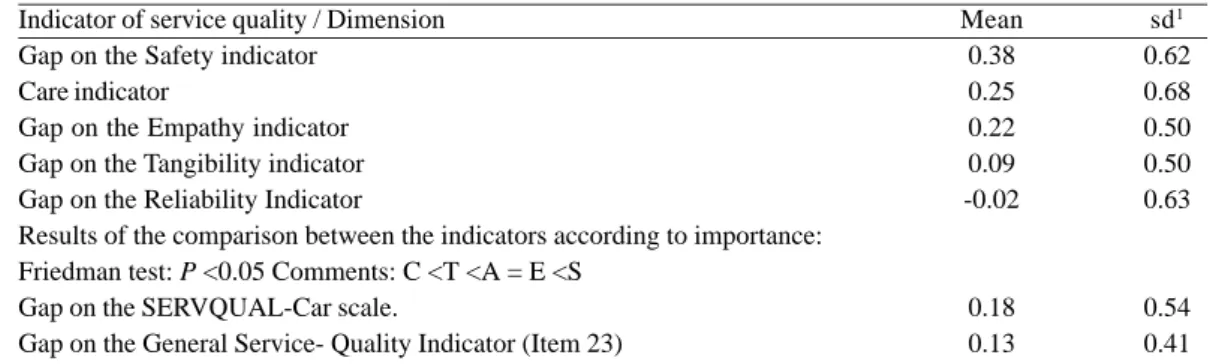
As a result of the overall scale, it appeared that the 0.18 GAP (near zero) showed balance between patient’s expectation regarding the service he would receive, scored preoperatively, and perception of the service he received during hospitalization, indicating appropriate quality, according to Slack et al. [21], who advocated in his studies that, when there is equality between expectation and perception, the service is considered of adequate quality.
When we observed the results of the comparison between expectations and perceptions for each item of the scale, it was found that for items 9, 10 and 20, the results are non-significant and express an acceptable quality of service, meaning room for improvement in information and patient care (Table 2).
For other items, the differences were significant. In items 4, 5 and 8, we obtained negative differences, which shows the expected quality of service greater than the perception of service received, i.e., the perceived quality does not meet the expectation of the patient in understanding the documents received and punctuality in the completion of Table 1. General characteristics of patients and the surgical
procedure in 82 patients who underwent elective cardiac surgery at the Heart Surgery Service of Santa Casa de Misericordia de Marília
Cathegory Gender Female Male
Age range (years) 20 - 49
50 - 69 70 - 85
Type of surgery1 CABG
VS
Heart surgery First Reoperation CPB2 YES NO
Type of incision MST3
Physiotherapy YES
Frequency
43 39
15 43 24
55 27
72 10
69 13
82
82
%
52.4 47.6
18.3 52.4 29.3
67.0 33.0
87.8 12.2
84.1 15.9
100.0
100.0
Table 2. Performance of the items and dimensions, by means and standard deviations of scores Expectation (E), Perception (P), Gap = [P -E], comparison of E and P scores through statistical P value, regarding the application of SERVQUAL-Car scale to the 82 patients in study
Items / Dimensions TANGIBILITY
1. The hospital must have preserved and modern equipment
2. The hospital's physical facilities must be visually appealing and pleasant
3. The staff1 at the hospital must have neat appearance and outfits in accordance with the characteristics of the work environment
4. The reports and other documents delivered to the patient must be easily understood and visually appealing
MEAN TANGIBILITY RELIABILITY
5. The hospital must conduct its activities on time
6. The hospital must demonstrate sincere interest in solving the problems of the patient 7. The hospital must perform the services and procedures correctly the first time, not causing rework
8 The hospital must provide its services within the implementation time promised 9. The hospital must submit reports, documents and information about the patient without errors
MEAN RELIABILITY ASSISTANCE
10. At the hospital, the staff must inform patients exactly when services will run
11. At the hospital, the staff must meet promptly the patients needs 12. At the hospital, the staff must try to help the patients
13. At the hospital, the staff must be available to respond to the requests of the patient MEAN ASSISTANCE
SAFETY
14. At the hospital, the behavior of the staff must reassure patients 15. Hospital patients must feel secure in using its services
16. At the hospital, the staff should be polite and courteous to the patients
17. At the hospital, the team must have adequate knowledge to answer questions from patients
MEAN SAFETY EMPATHY
18. At the hospital, the staff must pay individual attention to each patient 19. The hospital must operate at times suitable to the patients
20. The hospital must have a team to give personal attention to the patients 21. The hospital must prioritize the interests of the patient
22. At the hospital, the staff must understand the specific needs of the patients MEAN EMPATHY
SERVICE QUALITY:
23. At the hospital, the overall quality of care in cardiac surgery should be satisfactory MEAN OF SCALE SERVQUAL-Card
OVERALL RESULT - CONTRAST: SERVQUAL-Car X SERVICE QUALITY (ITEM 23)
ITEM
SERVQUAL-Card (TOTAL SCALE) SERVICE QUALITY (ITEM 23)
MÉDIA 0.18 0.13 DP 0.54 0.41 Teste t 1.18NS
* For these items P < 0.05; NS = for these items P > 0.05. 1- Staff = doctors, nurses, physiotherapists, assistants and clerks.
2 - E = Expectation 3 - sd = standard deviation; 4 - P = perception; 5 - Gap = perception - expectation
service. The patients are medium / low school-level and hope to have understanding of reports and warnings from the hospital. Therefore, it is an indicator for improving the service offered. For other items we obtained positive differences, indicating the perceived quality of service provided.
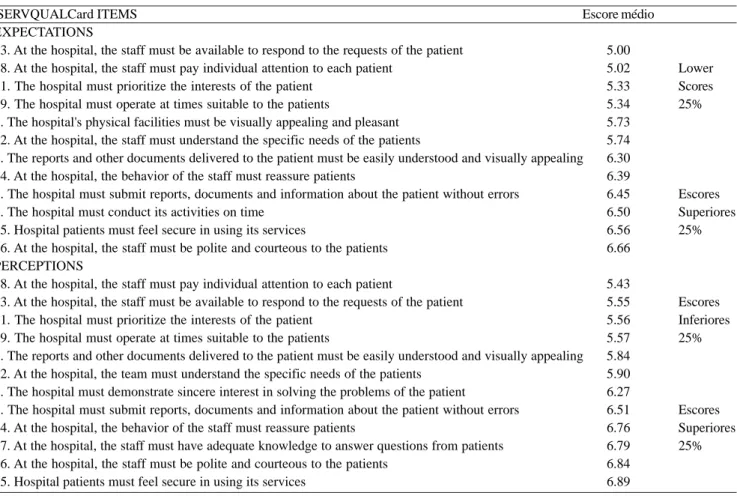
In Table 3, are summarized items for expectation and perception, in increasing order of values, divided into bands: below 25% and 25% higher, aiming the analysis of extreme values.
In the analysis of expectations observing extremes upper (25%) and lower (25%), the higher scores were 6.30 to 6.66 and the lower scores ranged from 5.00 to 5.74. The significance of the highest indicator (item 16) referred to the interpersonal relationship, meaning high expectation of the patient’s in the relationship with the professional team in warmth and friendliness. The significance of the lower indicator (item 13) referred to the availability of professional staff to meet the requests of the patient, meaning a customer not demanding this feature. Relating and comparing these two extremes, we observed in this
Table 3. Performance of items related to Expectations and Perceptions in relation to the average score of the lower and upper extremes of the 82 patients studied
SERVQUALCard ITEMS EXPECTATIONS
13. At the hospital, the staff must be available to respond to the requests of the patient 18. At the hospital, the staff must pay individual attention to each patient
21. The hospital must prioritize the interests of the patient 19. The hospital must operate at times suitable to the patients
2. The hospital's physical facilities must be visually appealing and pleasant 22. At the hospital, the staff must understand the specific needs of the patients
4. The reports and other documents delivered to the patient must be easily understood and visually appealing 14. At the hospital, the behavior of the staff must reassure patients
9. The hospital must submit reports, documents and information about the patient without errors 5. The hospital must conduct its activities on time
15. Hospital patients must feel secure in using its services
16. At the hospital, the staff must be polite and courteous to the patients PERCEPTIONS
18. At the hospital, the staff must pay individual attention to each patient
13. At the hospital, the staff must be available to respond to the requests of the patient 21. The hospital must prioritize the interests of the patient
19. The hospital must operate at times suitable to the patients
4. The reports and other documents delivered to the patient must be easily understood and visually appealing 22. At the hospital, the team must understand the specific needs of the patients
6. The hospital must demonstrate sincere interest in solving the problems of the patient
9. The hospital must submit reports, documents and information about the patient without errors 14. At the hospital, the behavior of the staff must reassure patients
17. At the hospital, the staff must have adequate knowledge to answer questions from patients 16. At the hospital, the staff must be polite and courteous to the patients
15. Hospital patients must feel secure in using its services
Escore médio
5.00 5.02 5.33 5.34 5.73 5.74 6.30 6.39 6.45 6.50 6.56 6.66
5.43 5.55 5.56 5.57 5.84 5.90 6.27 6.51 6.76 6.79 6.84 6.89
Lower Scores 25%
Escores Superiores 25%
Escores Inferiores 25%
Escores Superiores 25% study that the cardiac surgery patients demonstrated a high expectation towards the professional team regarding friendliness and warmth, but this relationship is not necessarily of availability of all that they demand.
This evidence agreed with Kurki & Laitila [25] and Sant’Anna [26] when stating that the patient in the hospital organizes a social relationship with the professional team, turning it in his focus of comfort and safety, also, Eagleton & Goldman [27] observed that the patient needs to be seen within a context of family to be recognized as an identity.
It is important to note that the expectation with the relational aspect is not the requirement based on “whims,” agreeing with Williams et al. [28] to report that patients do not want to cause problems or be considered difficult.
Table 4. Characterization of the 82 patients who underwent elective cardiac surgery at the Heart Surgery Service of Santa Casa de Misericordia de Marília, according to the indicators of service quality obtained through the SERVQUAL-Car scale
Indicator of service quality / Dimension Gap on the Safety indicator
Care indicator
Gap on the Empathy indicator Gap on the Tangibility indicator Gap on the Reliability Indicator
Results of the comparison between the indicators according to importance: Friedman test: P <0.05 Comments: C <T <A = E <S
Gap on the SERVQUAL-Car scale.
Gap on the General Service- Quality Indicator (Item 23)
Mean 0.38 0.25 0.22 0.09 -0.02
0.18 0.13
sd1 0.62 0.68 0.50 0.50 0.63
0.54 0.41
1- sd= standard deviation
Table 5. Characterization of the 82 patients who underwent elective cardiac surgery at the Heart Surgery Service of Santa Casa de Misericordia de Marília, according to the importance attached to the indicators of service quality
Dimension of service quality Reliability
Safety Assistance Empathy Tangibility
Mean 29.88 26.83 18.72 12.93 12.01
SD1 4.97 4.55 4.83 4.30 4.00
1- SD= standard deviation
The significance of the lower indicator (item 18) referred to the individualized attention to the patient, meaning that the patient did not notice the attention to individual care that he wanted to receive. Relating these two indicators, it was observed in this study that the heart surgery patient had a high perception of safety when using the service at the hospital and a low perception of individual attention in the work team.
The performance analysis of attributes related to Gap = P -E, depending on the extreme values, shows that higher scores (25%) ranged from 0.30 to 0.63 and the lower scores (25%) of – 0.46 to 0.09. The significance of the indicator for highest Gap (item 17) referred to the appropriate knowledge to answer questions of the patient and the smallest gap indicator (item 4) to the visual-material aspect of care. This meant that the highest gap showed high expectations for clarification that is not being met. The smallest gap showed that the expectation on that item is higher than the service received.
The relationship of these Gaps indicated that the heart surgery patient has high expectations for clarification of doubts, agreeing with Nogueira [29], emphasizing that
proper communication stimulates changes in attitudes and behavior in the patient, facilitating the achievement of the goals of assistance.
It was evident that the patient’s expectations concerned the desire to receive information necessary and appropriate to achieve the effective realization of his activities, agreeing with the observations of Kong et al. [30] and also with Craft [31], when they observed that patients with low education have high expectations in relation to information and health education.
REFERENCES
1. Matta GC. Políticas de saúde. Organização e operacionalização do Sistema Único de Saúde. Rio de Janeiro:EPSJV/ Fiocruz;2007. p.29-30.
2. Malhotra NK. Pesquisa de marketing: uma orientação aplicada. 4ª ed. Porto Alegre: Bookman;2006. p.720.
3. Babakus E, Mangold WG. Adapting the ServQual scale to hospital services: an empirical investigation. Health Serv Res. 1992;26(6):767-86.
4. Rodríguez-Cuéllar E, Ruiz-López P, Alcalde-Escribano J, Landa-García I, Villeta-Plaza R, Jaurrieta-Mas E. Satisfacción del paciente tras el tratamiento quirurgíco del cáncer colorretal. Cir Esp. 2004;76(4):237-44.
5. Donabedian A. Criteria, norms and standards of quality: what do they mean? Am J Public Health. 1981;71(4):409-12.
6. Ferraz MB. Tradução para o português e validação do questionário para avaliar a capacidade funcional “Stanford Health Assessment Questionnaire” [Tese de Doutorado]. São Paulo: Escola Paulista de Medicina;1990. 80p.
7. Rigolin VOS. Avaliação clínico-funcional de idosos hospitalizados [Dissertação de Mestrado]. São Paulo: Universidade Federal de São Paulo, Escola Paulista de Medicina;2001.
8. Schraiber LB. No encontro da técnica e com a ética: o exercício de julgar e decidir no cotidiano do trabalho em medicina. Interface - Comunic, Saúde, Educ. 1997;1(1):123-38.
9. Parasuraman A, Zeithaml VA, Berry LL. A conceptual model of service quality and its implications for future research. J Marketing. 1985;49:41-50.
10. Parasuraman A, Zeithaml VA, Berry LA. ServQual:A multiple-item scale for measuring consumer perceptions of service quality. J Retailing. 1988;64(1):12-40.
11. Parasuraman A, Berry LA, Zeithaml VA. Refinement and reassessment of the SERVQUAL scale. J Retailing. 1991;67(4):420-50.
12. Prieto Rodriguez MA, March Cerda JC, López Fernandez LA. The quality perceived by the users of health centers and by private insurance companies. Aten Primaria. 1999;24(5):259-66.
13. Cho WH, Lee H, Kim C, Lee S, Choi KS. The impact of visit frequency on the relationship between service quality and outpatient satisfaction: a South Korean Study. Health Serv Res. 2004;39(1):13-33.
14. Brasil VS. Análise da qualidade percebida em serviços hospitalares diferenciados [Dissertação de Mestrado]. Porto Alegre: Universidade Federal do Rio Grande do Sul;2002. Table 5 shows the importance attributed by patients to
indicators. Reliability was considered the most important followed by safety, care, empathy and tangibility. There was no significant difference between empathy and tangibility.
Relationship between perception of service quality and subgroups (gender, age and CPB, in moments of Pre and 6PO) By linking the quality of service with the subgroups gender, age and CPB, it was observed regarding gender, a significant relationship only for the quality indicator empathy (P = 0.04), where women had greater perception than men. In other subgroups, comparisons were not significant.
Comparing age group with the SERVQUAL-Card scale, we observed a significant relationship in the quality indicator reliability (P = 0.02), patients from 20-49 years have a greater perception of reliability, while the 50-69 years had the least perception. In the other dimensions, the difference was not significant.
Regarding the use of CPB, there was no significant result in this sample. CPB did not influence perceptions.
CONCLUSIONS
In the relation of expectation and service received, the heart surgery patient has high expectations about the medical and hospital service.
The quality of services given to cardiac surgery patients and perceived by the patients in our study was satisfactory. The heart surgery patient gives importance to the security dimension in patient care, not being relevant structural aspects of tangibility and reliability.
The heart surgery patient shows a high expectation towards the professional team expecting to receive friendliness, warmth and guidance to their state of health, but the perception of these services has resulted in dissatisfaction.
Women have a higher perception of quality of service in the dimension of empathy.
Younger patients have a higher perception of quality of service in the scale reliability.
The CPB did not correlate with the perception of patients regarding the quality of service.
The data from this study suggest that the quality of health service can be monitored through the periodic use of the SERQUAL scale, by monitoring the responses to this health service.
ACKNOWLEDGEMENTS
15. Hercos BVS, Berezovsky A. Qualidade do serviço oftalmológico prestado aos pacientes ambulatoriais do Sistema Único de Saúde – SUS. Arq Bras Oftalmol. 2006;69(2):213-9.
16. Dias FH. Avaliação da qualidade dos serviços de saúde (consultórios médicos). Pesquisa Quantitativa M.K.T. In: V Semead, 2001. [citado 2006 Jul 21] Disponível em: URL: http:/ /www.ead.fea.usp.br/Semead/5semead/Mkt.htm
17. Borges JBC, Ferreira DLMP, Carvalho SMR, Martins AS, Andrade RR, Silva MAM. Avaliação da intensidade de dor e da funcionalidade no pós-operatório recente de cirurgia cardíaca. Rev Bras Cir Cardiovasc. 2006;21(4):393-402.
18. Pasquali L. Princípios de elaboração de escalas psicológicas. Rev Psiq Clin. 1998;25(5):206-13.
19. Hair JF, Tatham RL, Anderson, RE, Black W. Multivariate data analysis. 5th ed. New Jersey:Prentice-Hall;1998.
20. Parasuraman A, Zeithaml VA, Berry LL. Reassessment of expectations as a comparison standard in measuring service quality: implications for further research. J Marketing. 1994;58(1):111-24.
21. Slack N, Johnston R, Chambers S. Administração da produção. São Paulo:Atlas;1997.
22. Norusis MJ. SPSS 13.0: Guide to Data Analysis. Upper Saddle River:Prentice-Hall;2005.
23. Hulley SB, Cummings SR, Browner WS, Grady D, Hearst N, Newman RB. Designing clinical research: an epidemiologic
approach. 2nd ed. Baltimore: Lippincott Williams and Wilkins;2001.
24. Braga CG, Cruz DALM. Resposta psicossocial de impotência em pacientes no pós-operatório de cirurgia cardíaca. Rev Esc Enferm USP. 2003;37(1):26-35.
25. Kurki PA, Laitila AH. Good nursing practive as perceived by clients: a starting point for the development of professional nursing. J Adv Nurs. 1992;17(10):1195-9.
26. Sant’Anna DB. Pacientes e passageiros. Interface - Comunic, Saúde, Educ. 2000;4(6):11-20.
27. Eagleton BB, Goldman L. The quality connection satisfaction of patients and their families. Crit Care Nurse. 1997;17(6):76-80.
28. Willians S, Weinman J, Dale J, Newman S. Patient expectations: what do primary care patients want from the gp ad how far does meeting expectations affect patient satisfaction. Fam Pract. 1995;12(2):193-201.
29. Nogueira N. Em que medida a comunicação afeta a percepção da qualidade nos serviços de saúde? Comunicação e Saúde. 2004;1(1). [citado 2006, Jul 21] Disponível em: URL: http:// www.comunicasaude.com.br/rev1artigonelsonnogueira.htm
30. Kong KH, Kevorkian CG, Rossi CD. Funcional outcomes of patients on a rehabilitation unit after open heart surgery. J Cardiopulm Rehabil. 1996;16(6):413-8.
![Table 2. Performance of the items and dimensions, by means and standard deviations of scores Expectation (E), Perception (P), Gap = [P -E], comparison of E and P scores through statistical P value, regarding the application of SERVQUAL-Car scale to the 82](https://thumb-eu.123doks.com/thumbv2/123dok_br/15419822.589720/7.892.67.805.215.1062/performance-dimensions-deviations-expectation-perception-comparison-statistical-application.webp)