Fisioter. Mov., Curitiba, v. , n. , p. - , jan./mar. Licenciado sob uma Licença Creative Commons
[T]
Lower-limb endurance training program influences
thoracoabdominal motion of patients with COPD?
[)]Um programa de treinamento de endurance inl uencia o
movimento toracoabdominal de pacientes com DPOC?
[A]
Danielle Corrêa França[a], Danielle Soares Rocha Vieira[b], Bruna da Silva Pinto Pinheiro Vieira[c], Trícia Guerra e Oliveira[d], Raquel Rodrigues Britto[e],Verônica Franco Parreira[f]
[a] Ph.D. student, Sciences Rehabilitation Program, Federal University of Minas Gerais, Belo (orizonte, MG - Brazil, e-mail:
daniellecf @yahoo.com.br
[b] Professor, Department of Physical Therapy, Federal University of Minas Gerais, Belo (orizonte, MG - Brazil, e-mail:
[c] Undergraduate student, Department of Physical Therapy, Federal University of Minas Gerais, Belo (orizonte, MG - Brazil,
e-mail: [email protected]
[d] Professor, Department of Physical Therapy of Vila Velha University, Vila Velha, ES - Brazil, e-mail: [email protected] [e] Full Professor, Department of Physical Therapy, Federal University of Minas Gerais, Belo (orizonte, MG - Brazil, e-mail:
[f] Full Professor, Department of Physical Therapy, Federal University of Minas Gerais, Belo (orizonte, MG - Brasil,
e-mail:[email protected]
[R] Abstract
Introduction: Thoracoabdominal-TA asynchrony is an important sign of Chronic Obstructive Pulmonary
Disease COPD . Studies investigating the influence of endurance training on TA asynchrony have not been found. Objective: To analyze lower-limb endurance training effects on TA asynchrony in patients with
COPD. Materials and methods: Two patients with severe COPD were evaluated in a single-subject design
142
analyses. Data are presented as mean ± SD for phases A and B. Results: During phase B, Patient presented
significant decrease of PhR)B . ± . x . ± . and PhAng . ± . x . ± . for same load and PhREB . ± . x . ± . and PhAng . ± . x . ± . at peak load. Patient showed sig-nificant decrease of PhR)B for same load and . ± . x . ± . at peak load . ± . x . ± . .
Conclusions: These results suggest that lower-limb endurance training reduced TA asynchrony in patients
with severe COPD. The findings may be related, according to the literature, to the lower ventilatory demand and greater exercise capacity of patients with COPD undergoing endurance training.
[P]
Keywords: Rehabilitation. Physiotherapy. Physical exercise. Chronic obstructive pulmonary disease.
[#] [B]Resumo
Introdução: A assincronia toracoabdominal (TA) é um importante sinal da Doença Pulmonar Obstrutiva Crônica (DPOC). Estudos investigando a influência do treinamento de endurance sobre assincronia TA não foram encon-trados. Objetivo: Analisar as repercussões do treinamento de endurance dos membros inferiores-MMI sobre a assincronia TA em indivíduos com DPOC. Materiais e métodos: Dois pacientes com DPOC grave foram avaliados em um estudo experimental de caso único AB (A-baseline por seis semanas, B-treinamento em cicloergômetro com intensidade de 70% da carga pico atingida no baseline, por 12 semanas) com medidas repetidas das variáveis: relação da fase inspiratória (PhRIB), relação da fase expiratória (PhREB) e ângulo de fase (PhAng). Essas variáveis foram analisadas pela pletismografia respiratória por indutância durante testes de exercício incremental em ciclo-ergômetro (isocarga e carga pico em cada teste). Os métodos estatísticos incluíram análise visual, two-standard deviation band e split middle line test, considerando significativo p < 0,05. Foram considerados os resultados com concordância de pelo menos duas análises. Resultados: Durante a fase B, o paciente 1 apresentou redução signifi-cativa da PhRIB (22,7 ± 3,4 x 17,0 ± 4,9) e PhAng (16,5 ± 5,1 x 13,2 ± 2,1) para isocarga e PhREB (16,8 ± 3.1 x 13,3 ± 3,1) e PhAng (23,4 ± 1,7 x 20,1 ± 2,3) na carga pico. O paciente 2 mostrou redução significativa do PhRIB para isocarga (14,4 ± 3,8 x 13,9 ± 3,9) e na carga pico (23,4 ± 1,7 x 20,1 ± 2,3). Conclusões: Os resultados sugerem que o treinamento de resistência dos MMII reduziu a assincronia TA nos pacientes avaliados. Os resultados podem estar relacionados, de acordo com a literatura, com a menor demanda ventilatória e maior capacidade de exercício dos pacientes submetidos a um treinamento de endurance.
[K]
Palavras-chave: Reabilitação. Fisioterapia. Exercícios físicos. Doença pulmonar obstrutiva crônica.
Introduction
An important sign of COPD, related to disease severity, is the presence of asynchronous thora-coabdominal motion TAM during the respiratory cycle - . Asynchronous TAM can be described in two categories: asynchrony, which reflects the delay between thoracic and abdominal compartments in expansion or retraction and paradoxical movement which consists of opposite movement between rib cage RC and abdomen AB , also reported as com-plete asynchrony , .
Several studies have assessed TAM in patients with COPD - , , - . According to the literature, these patients present more thoracoabdominal asyn-chrony compared to healthy subjects, both at rest ,
and during exercise . Exercise may reinforce
the asynchrony in patients with COPD , , and the presence of asynchronous TAM in these patients was associated with higher severity of the disease, in-creased risk of respiratory failure and worse prog-nosis - . (owever, in most of the studies objective measurements were not used - , .
Another disturbing sign of COPD is the intolerance to exercise . One of the primary symptoms that limits the exercise in patients with COPD is dyspnea , , which can be related to the dynamic hyper-inflation , - .
143 of two bands Teflon®-coated inductance used to
measure the changes in cross-sectional area of the RC and AB. Signals were calibrated using the Qualitative Diagnostic Calibration and the following vari-ables were analyzed:
- Phase Angle PhAng : it reflects the delay be-tween RC and AB excursions and has been studied in patients with COPD , , . )t ranges from ° perfect synchrony to ° paradoxical movement . This variable has the advantage of incorporating data from the whole respiratory cycle, but in the presence of irregular or figure Konno-Mead loops, PhAng values may be wrong .
- )nspiratory Phase Relation PhR)B and Expiratory Phase Relation PhREB : express the per-centage of agreement between RC and AB movements directions during inspiratory or expiratory time, re-spectively. Range from % perfect synchrony to
% paradoxical movement . These parameters have the advantage of quantifying thoracoabdomi-nal asynchrony at each point of the respiratory cycle and of not depending on calculations derived from Konno-Mead loops .
- Cross-Correlation Function CCF : it determines the delay in seconds s between the signals of RC and AB at each respiratory cycle. CCF equal s reflects perfect thoracoabdominal synchrony . )ts calcula-tion does not depend on Konno-Mead loops , .
Intervention
Patients underwent a -week exercise training, three times per week, on a cycle ergometer at % – target load – of the mean peak loads achieved in baseline tests. The goal was to reach minutes of cycling at this intensity. Pedal frequency was main-tained at rpm. SpO , BP, (R and perceived exertion were evaluated every five minutes. Recovery intervals where the workload was decreased to the basal load were allowed, according to participant tolerance or occurrence of any exercise interruption criterion .
Data reduction
The peak work load was defined as the last load at which the participant was able to complete at least s of pedaling. Plethysmography data pro-cessing was made by a blinded investigator for the addressing the influence of lower-limb endurance
training on thoracoabdominal asynchrony of patients with COPD have not been found.
Materials and methods
)t was conducted a single-subject experimental design AB aiming at documenting lower-limb endur-ance training effects on TA asynchrony in patients with COPD. The study consisted of weekly assess-ments for six weeks Phase A followed by lower-limb endurance training for weeks with evaluations every days Phase B . The University Ethics Research Committee approved the protocol and the subjects gave informed consent.
Subjects
Two patients with severe COPD , negative re-sults on bronchodilator tests , clinical stability, aged participant and participant years old, normal body mass index BM) , former smok-ers, without cardiac and metabolic diseases and not performing physical exercise on a regular basis.
Assessment
Patients underwent a maximal incremental symp-tom-limited exercise test on cycle ergometer Ergo Cycle , Pirmasens, Germany consisting of: three minutes resting, one minute cycling at the basal bi-cycle work load watts , -watt increments per minute until exhaustion or occurrence of any exercise interruption criterions , three minutes cycling at the basal work load. Throughout testing, except during the recovery phase, pedal cadence was kept at rpm. Electrocardiographic signs were monitored continuously. Transcutaneous oxygen saturation SpO , heart rate (R and perceived exertion were evaluated every one minute, while blood pressure
BP was measured every two minutes.
The respiratory inductive plethysmography Respitrace® , N)MS, Miami, FL, USA was used
144
Results
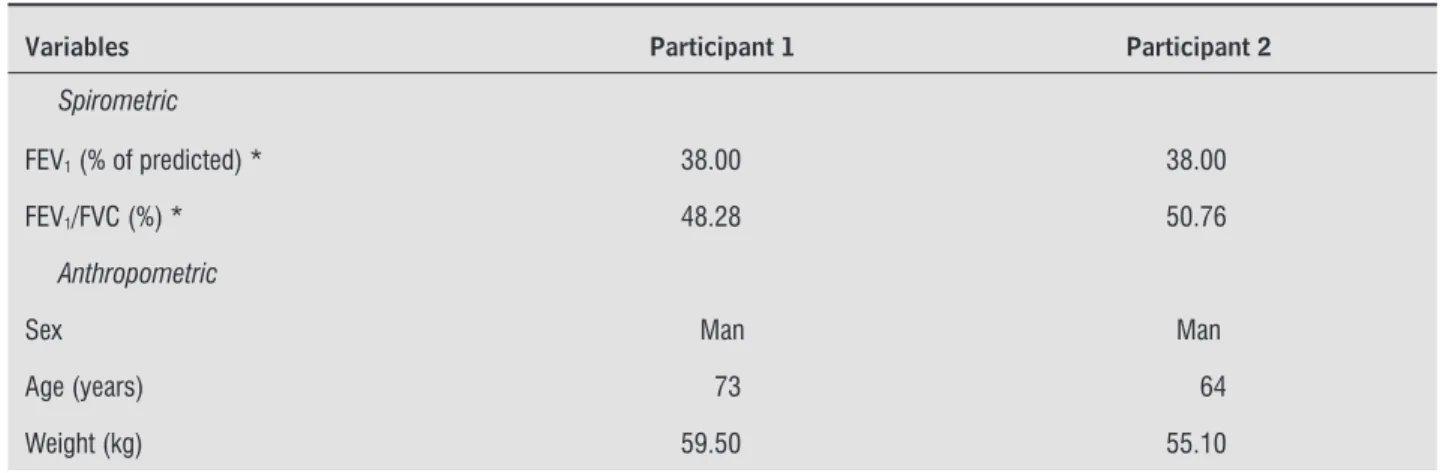
Table shows the spirometric and anthropomet-ric data for the two participants.
Figure panel ) presents a typical example of waveforms at rest A and during exercise B seen through the software RespEvents, N)MS, USA . At rest, the TAM can be considered almost synchronic, with delay occurring between thoracic and abdomi-nal compartments only in some respiratory cycles
indicated by dotted lines . During exercise, in ad-dition to the delay between compartments, it can be observed asynchrony within the cycles indicated by arrows . )t was also observed that tidal volume waveform during exercise was non-sinusoidal and irregularities appear to be arising out of the abdomi-nal compartment. Similar waveforms were observed in both participants in all tests. The bottom of Figure panel )) shows examples of Konno-Mead loops with a, b and c and without d figure .
Table presents TAM data at rest and during ex-ercise. Comparisons showed significant increases in PhR)B, PhREB and CCF during exercise, in both par-ticipants, without significant differences between the two levels of exercise.
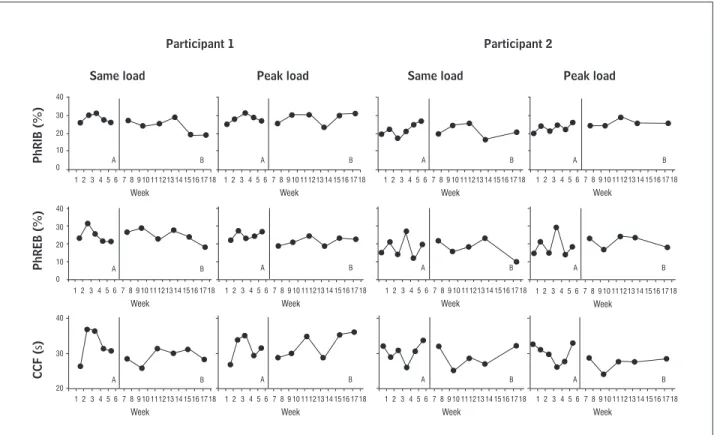
Figure presents charts of TAM variables through-out the study phases at same load and peak load which were used as the basis for Visual Analysis. Phase Angle was not analyzed due to the high number of respiratory cycles presenting Konno-Mead loops with figure , particularly during exercise.
Phase Angle was not analyzed due to the high number of respiratory cycles presenting Konno-Mead loops with figure , particularly during exercise. study phase. )n each evaluation, the following
peri-ods were considered: at rest - s during steady state; same load - the last s of the highest load tolerated for one minute in all baseline tests ; peak load - the last minute before peak load of each assessment.
Respiratory cycles with loops in figure were excluded from PhAng analysis . )n order to de-crease data variability, PhR)B and PhREB were sub-mitted to angle transformation for the data analysis.
Data analysis
Comparisons of TAM among rest and the two levels of exercise same load and peak load were performed using ANOVA for repeated measures. Comparisons of TAM between baseline and intervention phases at two levels of exercise same load and peak load were car-ried out using three methods: Two Standard Deviation Band and Celeration Line tests , , and Visual Analysis, performed by three independent and blinded investigators. For assessing the concordance between assessors , Kappa statistics was used . )t was considered as response to intervention results with concordance between Visual Analysis and at least one statistical test.
For statistical tests, the level of significance was set at α = . . For ANOVA, Bonferroni correction was used, modifying the level of significance to . . Kappa statistics and ANOVA were performed using the Statistical Package for the Social Sciences SPSS . , Chicago, )L, USA . Data are present as mean ± standard deviation when appropriate.
Table 1 - Spirometric and anthropometric data for the two participants
Variables Participant 1 Participant 2
Spirometric
FEV1 (% of predicted) * 38.00 38.00
FEV1/FVC (%) * 48.28 50.76
Anthropometric
Sex Man Man
Age (years) 73 64
Weight (kg) 59.50 55.10
145
Table 1 - Spirometric and anthropometric data for the two participants
Variables Participant 1 Participant 2
Height (m) 1.63 1.65
BMI (kg/m2) 22.39 20.20
Source: Research data.
Notes: FEV1 = forced expiratory volume in fi rst second; FVC = forced vital capacity; * = according to Pereira (39), BMI = body mass index; HAP
= Human Active Profi le; MRC = Medical Research Council. When appropriated, data are reported as mean ± standard deviation.
(Conclusion)
I
II
A
Vt
a b c d
RC
AB
B
Figure 1 - Example of typical waveforms at rest (A) and during exercise (B) on panel I, and Konno-Mead loops with "8 figure"
(a, b and c) and without "8 figure" (d) on panel II Source: Research data.
146
Table 2 - All tests mean of asynchronous TAM data at rest and during two exercise levels (same load and peak load) for
both participants
Variables Rest Same load Peak load
Participant 1
PhRIB (%) 7.10 ± 2.54 19.57 ± 5.06* 22.81 ± 3.80*
PhREB (%) 3.14 ± 1.54 17.16 ± 4.96* 14.88 ± 3.37*
CCF (s) 0.02 ± 0.01 0.10 ± 0.04* 0.12 ± 0.03*
Participant 2
PhRIB (%) 5.12 ± 1.25 13.36 ± 3.69* 17.22 ± 3.03*
PhREB (%) 4.56 ± 1.89 9.49 ± 5.10* 11.18 ± 5.37*
CCF (s) 0.01 ± 0.02 0.10 ± 0.03* 0.09 ± 0.03*
Source: Research data.
Notes: Data are presented as mean ± standard deviation. PhRIB = inspiratory phase relation; PhREB = expiratory phase relation; CCF =
cross-correlation function; * = statistical signifi cant difference between rest and the two levels of exercise, considering signifi cant
p < 0.017, according to Bonferroni’s correction.
Same load
PhRIB (
%
)
PhREB (
%
)
CCF (
s
)
Same load
Peak load Peak load
Participant 1
1
Week
2 0
A B
A B
A B
A B A B A B
A B
A B
A B
A B A B A B
10 20 30 40
0 10 20 30 40
20 30 40
3 4 5 6 7 8 9 10 111213 14 1516 1718 1
Week
2 3 4 5 6 7 8 9 10 111213 14 1516 1718 1
Week
2 3 4 5 6 7 8 9 10 111213 14 1516 1718
1
Week
2 3 4 5 6 7 8 9 10 111213 14 1516 1718 1
Week
2 3 4 5 6 7 8 9 10 111213 14 1516 1718 1
Week
2 3 4 5 6 7 8 9 10 111213 14 1516 1718
1
Week
2 3 4 5 6 7 8 9 10 111213 14 1516 1718 1
Week
2 3 4 5 6 7 8 9 10 111213 14 1516 1718 1
Week
2 3 4 5 6 7 8 9 10 111213 14 1516 1718 1
Week
2 3 4 5 6 7 8 9 10 111213 14 1516 1718 1
Week
2 3 4 5 6 7 8 9 10 111213 14 1516 1718 1
Week
2 3 4 5 6 7 8 9 10 111213 14 1516 1718
Participant 2
Figure 2 - Graphics of TAM variables during baseline (A) and intervention (B) phases at rest, same load and peak loak on the
two participants studied Source: Research data.
147 variables and for only one variable there was substan-tial agreement Kappa from . to . .
Discussion
The main results of this study were: Com-parisons of TAM between baseline and intervention phase showed significant decrease in thoracoab-dominal asynchrony at same load and peak load;
Comparisons between rest and exercise showed significant increase in asynchronous TAM at same load and peak load, without significant differences between these two levels of exercise.
To the best of our knowledge, this study was the first one to assess the impact of a lower-limb endur-ance training program on variables that reflect tho-racoabdominal asynchrony during exercise in COPD patients. Comparisons of TAM variables between baseline and training phase showed significant decrease in thoracoabdominal asynchrony at two levels of exercise. This reduction can be considered as a positive impact of endurance training, since the presence of asynchronous TAM in patients with COPD has been associated with higher severity of the disease, increased risk of respiratory failure and worse prognosis - .
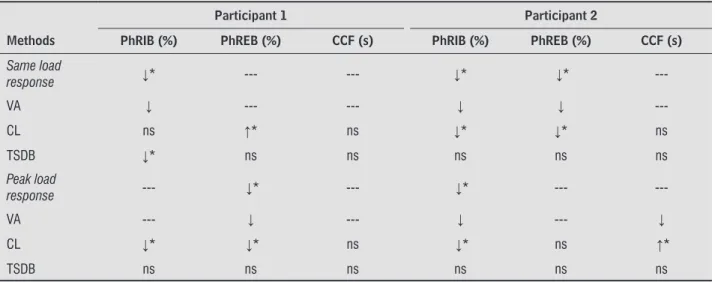
Table presents the results regarding Visual Analysis, Celeration Line and Two Standard Devi-ation Band, and the response to intervention of each variable at same load and peak load. Participant showed significant decrease in PhR)B at same load and in PhREB at peak load, without significant dif-ferences in other variables. Participant showed a significant decrease in PhR)B and PhREB at same load and in PhR)B at peak load. No significant chang-es were observed in other variablchang-es. With rchang-espect to Visual Analysis, it was observed almost perfect agreement Kappa from . to . between two of the three examiners for most variables and for only one variable there was substantial agreement
Kappa from . to . .
Table presents the results regarding Visual Analysis, Celeration Line and Two Standard Deviation Band, and the response to intervention of each variable at same load and peak load. Participant showed sig-nificant decrease in PhR)B at same load and in PhREB at peak load, without significant differences in other variables. Participant showed a significant decrease in PhR)B and PhREB at same load and in PhR)B at peak load. No significant changes were observed in other variables. With respect to Visual Analysis, it was observed almost perfect agreement Kappa from . to . between two of the three examiners for most
Table 3 - Response to intervention according to Visual Analysis, Celeration Line and Two Standard Deviation Band during
same load and peak load
Participant 1 Participant 2
Methods PhRIB (%) PhREB (%) CCF (s) PhRIB (%) PhREB (%) CCF (s) Same load
response ↓* --- --- ↓* ↓*
---VA ↓ --- --- ↓ ↓
---CL ns ↑* ns ↓* ↓* ns
TSDB ↓* ns ns ns ns ns
Peak load
response --- ↓* --- ↓* ---
---VA --- ↓ --- ↓ --- ↓
CL ↓* ↓* ns ↓* ns ↑*
TSDB ns ns ns ns ns ns
Source: Research data.
Notes: VA = Visual Analysis; CL = Celeration Line; TSDB = Two Standard Deviation Band, PhRIB = phase inspiratory relation; PhREB = phase
expiratory relation; CCF = cross-correlation function, --- = without change, ↓ = decrease, ↑ = increase, * = statistical signifi cance,
148
subjects of each study, which can be verified by the standard deviation values. This variability may be due to the analysis of respiratory cycles based on altered Konno-Mead loops since those authors did not report the exclusion of figure Konno-Mead loops dur-ing PhAng analysis. Thus, a rigorous assessment of Konno-Mead loops with exclusion of figures is an important step to be followed in PhAng calculation. )n the present study, the large number of figure Konno-Mead loops was determinant for the exclusion of this variable from data analysis.
Both participants studied increased their peak exercise capacity at the end of weeks of training. )t may be evidenced by the increase in the work load reached in the last incremental test when compared to mean peak load of baseline tests: and watts in participants and , respectively. These values are in agreement with results observed in previous studies , , and may be related to the im-provement of the physical performance provided by the lower-limb endurance training program.
Conclusion
Using a single-subject experimental design, the ef-fects of a lower-limb endurance training program on variables reflecting thoracoabdominal motion were evaluated in two patients with severe COPD. The re-sults suggest that despite the exercise augmented the asynchrony compared to rest, the endurance training program influenced positively the thoracoabdominal motion leading to significant decrease in asynchrony during exercise in patients assessed.
Funding acknowledgements
This work was partially supported by FAPEM)G [grant number CDS APQ- . / ]; CNPq [grant number / - ] and Capes [Danielle C. França scholarship].
References
. Ashutosh K, Gilbert R, Auchincloss J( Junior, Peppi D. Asynchronous breathing movements in patients with chronic obstructive pulmonary disease. Chest.
; : - . doi: . /chest. . . .
(owever, it was observed that TAM variables responses were not the same for the participants evaluated. This difference could be the result of distinct dynamic hyperinflation patterns, as re-ported in the literature , - , since respira-tory muscles dysfunction, related to lung hyper-inflation, has been described as the main factor responsible for thoracoabdominal asynchrony in patients with COPD , , - . (owever, it can-not be confirmed as dynamic hyperinflation was not assessed in this study. Different thoracoabdom-inal asynchrony patterns , and progression of these patterns during exercise in some patients with COPD may also have contributed to this difference between the participants.
Comparisons between rest and the two levels of exercise showed significant increase in asynchronous TAM at same load and peak load, without significant differences between these exercise levels. This result is similar to that observed by Alves et al. , who compared the TAM of COPD patients at rest and during three levels of progressive exercise - %, - % and % of the peak work load performed on a cycle ergometer. These authors observed signifi-cant increase in asynchronous TAM during all exer-cise levels, without difference between them.
During exercise, non-sinusoidal waves were observed, showing irregularities from abdominal compartment. This finding was observed in both participants. Similar waves have been observed in COPD patients during spontaneous breathing , and exercise , . Ashutosh et al. as-sessed TAM during spontaneous breathing at rest in stable patients and in patients with exac-erbation. Asynchronous TAM was observed in patients, stable and exacerbated. Three types of thoracoabdominal asynchrony were observed, all involving abdominal compartment irregulari-ties. Delgado et al. observed, during progres-sive exercise on a treadmill, similar movements of RC among patients but distinct AB movement pat-terns. )t was also found that asynchronous TAM was related to underlying pulmonary abnormality and exercise limitation.
149
. Nici L, Donner C, Wouters E, Zuwallack R, Ambrosino N, Borbeau J, et al. on behalf of the ATS/ERS Group. American Thoracic Society/European Respiratory Society statement on pulmonary rehabilitation. Am J Respir Crit Care Med. ; : - . doi: . /rccm. - ST.
. Ferguson GT. Why does the lung hyperinflate? Proc Am Thorac Soc. ; : - . doi: . /pats.
- DO.
. Mac)ntyre NR. Muscle dysfunction associated with chronic obstructive pulmonary disease. Respir Care.
; : - . PMid: .
. O’Donnell DE, Revill SM, Webb KA. Dynamic hyper-inflation and exercise intolerance in chronic obstruc-tive pulmonary disease. Am J Respir Crit Care Med.
; : - . PMid: .
. Ortega F, Toral J, Cejudo P, Villagomez R, Sanchez (, Castillo J, et al. Comparison of effects of strength and endurance training in patients with chronic obstruc-tive pulmonary disease. Am J Respir Crit Care Med.
; : - . doi: . /rccm. . . Mador MJ, Bozkanat E, Aggarwal A, Shaffer M, Kufel
TJ. Endurance and strength training in patients with COPD. Chest. ; : - . doi: . / chest. . . .
. Pulmonary rehabilitation- . American Thoracic Society. Am J Respir Crit Care Med. ; :
-. PMid: .
. Porszasz J, Emtner M, Goto S, Somfay A, Whipp BJ, Casaburi R. Exercise training decreases ventila-tory requirements and exercise-induced hyperin-flation at submaximal intensities in patients with COPD. Chest. ; : - . doi: . / chest. . . .
. Ong KC, Chong WF, Soh C, Earnest A. Comparison of dif-ferent exercise tests in assessing outcomes of pulmo-nary rehabilitation. Respir Care. ; :
-. PMid: .
. Georgiadou O, Vogiatzis ), Stratakos G, Koutsoukou A, Golemati S, Aliverti A, et al. Effects of rehabilita-tion on chest wall volume regularehabilita-tion during exercise in COPD patients. Eur Respir J. ; : - . doi: . / . .
. Capria ME, D’Negri C, De Vito EL. Relationship be-tween (oover sign, functional and variables, and cur-vature radius in patients with obstructive pulmonary disease. Medicina B Aires . ; : - . . Garcia-Pachon E, Padilla-Navas ). Frequency of (oover’s
sign in stable patients with chronic obstructive pul-monary disease. )nt J Clin Pract. ; : - . doi: . /j. - . . .x.
. Global Strategy for the Diagnosis, Management, and Prevention of Chronic Obstructive Pulmonary Dis-ease – GOLD. Global strategy for the diagnosis man-agement, and prevention of COPD. . Available at: http://www.goldcopd.org.
. Sackner MA, Gonzalez (, Rodriguez M, Belsito A, Sackner DR, Grenvik S. Assessment of asynchronous and paradoxic motion between rib cage and abdo-men in normal subjects and in patients with chronic obstructive pulmonary disease. Am Rev Respir Dis.
; : - . PMid: .
. Tobin MJ, Perez W, Guenther SM, Lodato RF, Dantzker DR. Does rib cage-abdominal paradox signify respira-tory muscle fatigue? J Appl Physiol. ; :
-. PMid: .
. Alves GS, Britto RR, Campos FC, Vilaça AB, Moraes KS, Parreira VF. Breathing pattern and thoracoabdominal motion during exercise in chronic obstructive pulmo-nary disease. Braz J Med Biol Res. ; :
-. doi: -. /S - X . . Bloch KE, Li Y, Zhang J, Bingisser R, Kaplan V, Weder
W, et al. Effect of surgical lung volume reduction on breathing patterns in severe pulmonary emphyse-ma. Am J Respir Crit Care Med. ; : - . PMid: .
. Delgado (R, Braun SR, Skatrud JB, Reddan WG, Pe-gelow DF. Chest wall and abdominal motion during exercise in patients with chronic obstructive pulmo-nary disease. Am Rev Respir Dis. ; : - . PMid: .
. Tobin MJ, Chadha TS, Jenouri G, Birch SJ, Gazeroglu (B, Sackner MA. Breathing patterns. . Diseased Subjects. Chest. ; : - . doi: . / chest. . . .
. Rochester CL. Exercise training in chronic obstructive pulmonary disease. J Rehabil Res. ; Suppl :
150
. Munro B(. Differences among group means: one way analyses of variance. )n: Munro B(, editor. Statistical methods for health care research. Philadelphia: Lip-pincott; . p. - .
. Aliverti A, Stevenson N, Dellaca RL, Lo MA, Pedotti A, Calverley PM. Regional chest wall volumes dur-ing exercise in chronic obstructive pulmonary dis-ease. Thorax. ; : - . doi: . /thorax.
. .
. Vogiatzis ), Stratakos G, Athanasopoulos D, Georgiadou O, Golemati S, Koutsoukou A, et al. Chest wall volume regulation during exercise in COPD patients with GOLD stages )) to )V. Eur Respir J. ; : - . doi: . / . .
. Puente-Maestu L, Abad YM, Pedraza F, Sanchez G, Stringer WW. A controlled trial of the effects of leg training on breathing pattern and dynamic hyperin-flation in severe COPD. Lung. ; : - . doi: . /s - - -x.
. Aliverti A, Quaranta M, Chakrabarti B, Albuquer-que ALP, Calverle PM. Paradoxical movement of the lower ribcage at rest and during exercise in COPD patients. Eur Respir J. : : - . doi:
. / . .
. Gosselink R. Physical therapy in adults with respi-ratory disorders: where are we? Braz J Phys Ther.
; : - .
. Pereira CAC. Espirometria. J Pneumol. ; [suppl ]:S -S .
Received: / /
Recebido: / /
Approved: / /
Aprovado: / /
. Standards for the diagnosis and care of patients with chronic obstructive pulmonary disease. Ameri-can Thoracic Society. Am J Respir Crit Care Med.
; :S -S . PMid: .
. ATS/ACCP Statement on cardiopulmonary exercise testing. Am J Respir Crit Care Med. ; :
-. doi: -. /rccm. . . .
. Tobin MJ, Jenouri G, Lind B, Watson (, Schneider A, Sackner MA. Validation of respiratory induc-tive plethysmography in patients with pulmonary disease. Chest. ; : - . doi: . / chest. . . .
. Clarenbach CF, Senn O, Brack T, Kohler M, Bloch KE. Monitoring of ventilation during exercise by a por-table respiratory inductive plethysmograph. Chest.
; : - . doi: . /chest. . . . . Nims )NC. RespEvents: operations manual for health care practitioners. . [cited Dec. ]. Avail-able at: http://www.nims-inc.com.
. Beydon N, Davis SD, Lombardi E, Allen JL, Arets (G, Aurora P, et al. An official American Thoracic Society/ European Respiratory Society statement: pulmonary function testing in preschool children. Am J Respir Crit Care Med. ; : - . doi: . / rccm. - ST.
. Millard RK. )nductive plethysmography components analysis and improved non-invasive postoperative apnoea monitoring. Physiol Meas. ; : - . doi: . / - / / / .
. Black AMS, Millard RK. Assessing thoracoab-dominal asynchrony: short communication. J Clin Psychol. ; : - . doi: . /j.
- . . .x.
. Portney LG, Watkins MP. Single subject designs. )n: Portney LG, Watkins MP, editors. Foundations of clini-cal research: applications to practice. Vol. . New Jer-sey: Prentice-(all; . p. - .
. Landis JR, Koch GG. The measurement of observer agreement for categorical data. Biometrics. ;
: - . doi: . / .