Meta-analysis for bioequivalence studies:
interchangeability of generic drugs and similar
containing Hydrochlorothiazide is possible but not
for those with Enalapril Maleate
Authors
Renato Almeida Lopes1 Francisco de Assis Rocha Neves2
1National Health
Sur-veillance Agency (Agên-cia Nacional de Vigilân(Agên-cia Sanitária -Anvisa), Brasí-lia, DF, Brazil
2Medical School of the
Universidade de Brasília (UnB), Brasília, DF, Brazil
Institution: Based on the master’s thesis: Metaná-lise de estudos de bio-equivalência: avaliação da intercambiabilidade de medicamentos anti-hipertensivos registrados no Brasil. UnB, 2009.
Submitted: 12/03/2009 Accepted: 02/10/2010
Correspondence to: Renato Almeida Lopes Agência Nacional de Vigilância Sanitária - setor de Indústria e
Abastecimento (SIA), Trecho 5, Área Especial 57, Lote 200 – Brasília, DF, Brasil
CEP 71205-050 E-mail: renato.lopes@ anvisa.gov.br
A
BSTRACTIntroduction: The generic drugs program provided a better population’s access to medicines. To ensure interchangeabil-ity between a brand-name and generic or similar drugs is necessary that they are bioequivalent. With the growing number of generic drugs, it is common for patients to replace a generic to another or one similar. However, this exchange can not guarantee the maintenance of bioequiva-lence. To evaluate the safety interchange-ability between different generic and similar drugs with Hydrochlorothiazide and Enalapril Maleate, a meta-analysis was carried out with several bioequiva-lence studies with these drugs. Methods:
Data from bioequivalence of generic and similar drugs approved by the National Health Surveillance Agency (Anvisa) (drug regulatory agency in Brazil) were used. The compatibility of data from each study was analyzed and the determination of a confidence interval for the differences between the means of pharmacokinetic parameters, area under the curve (ASC0-t) and maximum plasma concentration
(Cmax), was made for each study by
meta-analysis. Results: The interchangeability between the combinations of the three products with Hydrochlorothiazide was confirmed based on the obtained con-fidence intervals. For the drugs studied with Enalapril Maleate interchangeability has not been confirmed for 50% of the
product comparisons. Conclusion: The
exchange was established between the three products with hydrochlorothiazide. However, for the Enalapril Maleate half of the products studied are not interchange-able, considering they do not match the established intervals for bioequivalence
tests, so the pharmacokinetics behavior and thus the effectiveness of the product may be changed.
Keywords: therapeutic equivalency, meta-analysis, antihypertensive agents, drugs generic, interchange of drugs.
[J Bras Nefrol 2010;32(2):173-181]©Elsevier Editora Ltda.
I
NTRODUCTIONWhen a reference drug loses its patent, the pharmaceutical companies that manufactu-re generic drugs submit processes manufactu-requesting permission to produce copies of those refe-rence drugs. No generic drug can be marke-ted before the regulatory agency – Food and Drug Administration (FDA) in the United States and the National Health Surveillance Agency (Agência Nacional de Vigilância Sanitária - Anvisa) in Brazil – determines that it has a performance as good as the re-ference drug, based on a series of criteria, such as bioequivalence tests. To consider that a generic drug is bioequivalent to a re-ference drug is to assume that they will have equivalent therapeutic effects.1
Aiming at assuring the offer of quality and low-cost drugs to the market and at promoting the population access to those products, in 1999 the generic drugs were established. Their interchangeability wi-th wi-the reference drugs is assured wi-through pharmaceutical equivalence and bioequi-valence tests.2
The current legislation on bioequivalence assu-res interchangeability of generic drugs and some similar drugs with their respective reference drugs, but interchangeability between two generic or si-milar drugs has not been established.
According to Chow and Liu,1 interchangeability
between drugs relates to the change of one drug for another alternative product with the same phar-macokinetic characteristics, being, thus, safe and effective. However, patients often replace not only a reference drug for the corresponding generic or similar drug, but also one generic drug for ano-ther generic drug, or one generic drug for a simi-lar drug. The reason for that is, when acquiring a generic drug, usually there is no instruction not to change the pharmaceutical company that manufac-tures the drug used.4
Considering that the consumption and number of commercially available generic drugs increa-se on a daily basis, to assure their quality, safety, and efficacy is a matter of public health. Thus, a meta-analysis aims at bringing together the results of several bioequivalence studies of a same acti-ve principle and generates information capable of evidencing or not the interchangeability between several formulations of a single drug.
One class of drugs that deserves special atten-tion is that of the antihypertensive agents, because, in addition to being used in approximately 20% of the Brazilian population, there is currently in the Brazilian market a great number of different formulations of generic and similar drugs used for the treatment of arterial hypertension. Only for the two active principles selected for this study, 59 di-fferent products were found, many of them availa-ble in the Farmácia Popular program.5 Considering
that those drugs are of continuous use, mainly by older individuals, among whom the prevalence of arterial hypertension is extremely high, almost re-aching 60%,6 determining the interchangeability
between drugs is paramount from the clinical view point.
Thus, this study consisted in applying a sys-tematic review of several bioequivalence stu-dies to assess safety in interchangeability betwe-en differbetwe-ent gbetwe-eneric and similar drugs containing Hydrochlorothiazide and Enalapril Maleate in their formulations, because those medications are frequently used by innumerous patients and are part of the Farmácia Popular program of the Brazilian Ministry of Health (MH).
M
ATERIAL ANDM
ETHODSTo apply the meta-analysis methodology, we used data from bioequivalence studies of generic and similar drugs approved and registered by Anvisa, under the following conditions:
I. The number of volunteers was not very different.
II. Same experimental design applied to all stu-dies: crossover 2x2 (delineation for two pe-riods and two formulations: reference and test).
III. Drugs whose parameters of bioavailability we-re within the limits accepted by Anvisa.
Regarding the selection of studies to be inclu-ded in the analysis, an instrument was defined assuring the reproducibility of the form of selec-tion (protocol of meta-analysis). The search was conducted in the database of bioequivalence stu-dies of Anvisa, according to the criteria defined in the selection protocol and the above described requirements. The identity of the supporters of the studies and drug manufacturers tested were protected.
The variables analyzed were the following pharmacokinetic measures: area under the curve of plasma concentration versus time (AUC0-t) and maximum plasma concentration observed (Cmax). Two drugs are considered bioequivalent if the upper and lower limits of the 90% confidence in-terval of the AUC and Cmax variables are within the 80% and 125% limits.7
To determine the differences of the means of the AUC0-t and Cmax pharmacokinetic parameters, the method proposed by Chow and Liu8 of
meta-analysis in bioequivalence studies was applied. A 90% confidence interval for the difference of the means was constructed for each possible combina-tion of the drugs studied to assess the interchange-ability between them.
A Chi-square test was applied to test the hy-pothesis of statistical homogeneity between data from several studies as a prerequisite to combine them in the same analysis.
The calculations required for the meta-analy-sis were performed in specific programs for sta-tistic analyses, the Minitab®, version 14, and the
PROTOCOLFORSELECTING THE STUDIESFORTHE META
-ANALYSIS
The present protocol was developed prior to the selection of the studies comprising the meta-analy-sis, aiming at standardizing the methods for the in-clusion/exclusion of studies.
The protocol was divided into three parts: the first, aiming at sorting the studies; the second, to assess the availability and adequacy of the studies; and the third, to check the epidemiological criteria, that is, if data were compatible with the analysis, from the view point of the study design, sample size, and population.
First part: The studies should:
I. Be the most recent and registered at Anvisa be-tween 2003 and 2009.
II. Comprise the conclusion of bioequivalence. III. Be analyzed and approved by Anvisa. IV. Not be repeated (excluding the copies).
Second part:
I. The drugs should be part of the list of the Farmácia Popular program of the MH.
II. The drugs should be commercialized according to the list of the Chamber of Regulation of the Drug Market.
III. Data should be available at Anvisa for analysis.
Third part:
I. Data should be compatible for the analyses (epidemiological criteria), study design, sample size, and population studied.
The compatibility of the data of each study was assessed according to the criteria defined by Chow and Liu8 for meta-analysis. The studies meeting the previously described criteria were selected and included in the calculation of the meta-analysis.
R
ESULTSMETA-ANALYSIS OFHYDROCHLOROTHIAZIDE
For the meta-analysis of Hydrochlorothiazide, se-ven studies were selected. One of them could not be included in the combined final calculations, due to lack of homogeneity of the data of the reference drug, and three others were excluded because they were not part of the list of the Farmácia Popular pro-gram.5 Thus, three studies were included in the final
calculations of the meta-analysis. All of them used the same reference drug with different batches.
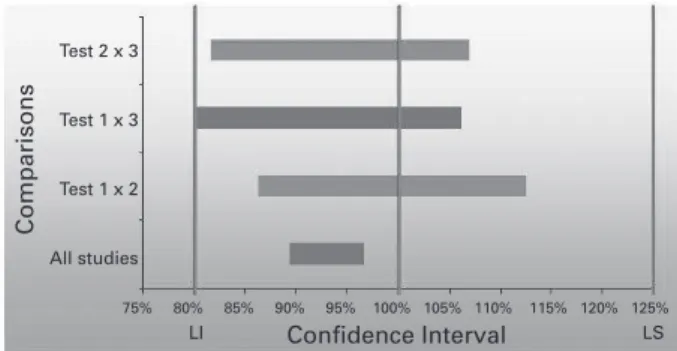
The 90% confidence intervals of the meta-analysis between the combinations of the test pro-ducts 1, 2, and 3 for the Cmax and AUC pharma-cokinetic parameters are shown in Table 1 and 2, and Figures 1 and 2, respectively.
In Table 1 and Figure 1, the comparison between the three studies shows that the test drugs are very similar, except for a small difference in the rate of absorption (Cmax) between products 1 and 3, in whi-ch the confidence interval was borderline (79.96% to 106.19%), classifying them as non bioequivalent. The other comparisons show no difference between the Hydrochlorothiazide formulations. On the other hand, in the analysis of the extent of absorption, as-sessed by AUC (Table 2 and Figure 2), no significant difference was observed between the several formu-lations, considering that the confidence intervals we-re between 85.88% and 117.26%.
Table 1 CPHARMACEUTICALONFIDENCEINTERVALSFORMULATIONSOF CMAXCONTAININGANDCONCLUSION HYDROCHLOROTHIAZIDEOFTHECOMBINATIONSOFSTUDIESINTHEMETA-ANALYSISOFTHREE
LnCmáx
Comparison D^* Var (D^)* Ratio** Lower limit** Upper limit * Confi rmation of bioequivalence All studies -0.0729 0.0005549 92.96825 89.39 96.69 Yes
Test 1 x 2 -0.0142 0.0063659 98.58760 86.31 112.61 Yes
Test 1 x 3 -0.0818 0.0072467 92.14990 79.96 106.19 No
Test 2 x 3 -0.0675 0.0066222 93.47007 81.62 107.04 Yes
Figure 1. Confi dence intervals of Cmax of the combinations of studies in the meta-analysis of three pharmaceutical formulations containing Hydrochlorothiazide.
Figure 2. Confi dence intervals of Cmax of the combinations
of studies in the meta-analysis of three pharmaceutical formulations containing Hydrochlorothiazide.
Table 2 CPHARMACEUTICALONFIDENCEINTERVALSFORMULATIONSOF AUC CONTAININGANDCONCLUSION HYDROCHLOROTHIAZIDEOFTHECOMBINATIONSOFSTUDIESINTHEMETA-ANALYSISOFTHREE
LnASC
Comparison D^* Var (D^)* Ratio** Lower limit** Upper limit** Confi rmation of bioequivalence All studies -0.0150 0.000228 98.50439 96.05 101.02 Yes
Test 1 x 2 0.0263 0.006365 102.6627 89.88 117.26 Yes
Test 1 x 3 0.0096 0.007246 100.9668 87.61 116.35 Yes
Test 2 x 3 -0.0167 0.006622 98.34807 85.88 112.63 Yes
*= logarithmic scale; **= original scale, D^hh= (ŶTh - ŶRh) - (ŶTh - ŶRh).
CONFIDENCEINTERVALSOF AUC ANDCONCLUSIONOFTHECOMBINATIONSOFSTUDIESINTHEMETA-ANALYSISOFTHREE PHARMACEUTICALFORMULATIONSCONTAINING HYDROCHLOROTHIAZIDE
Table 2
Table 2 PHARMACEUTICAL FORMULATIONS CONTAINING HYDROCHLOROTHIAZIDE
Confi dence Interval
Comparisons
75% 80% 85% 90% 95% 100% 105% 110% 115% 120% 125%
Test 2 x 3
Test 1 x 3
Test 1 x 2
All studies
LI LS Confi dence Interval
Comparisons
75% 80% 85% 90% 95% 100% 105% 110% 115% 120% 125%
LI LS
Test 2 x 3
Test 1 x 3
Test 1 x 2
All studies
META-ANALYSISOFENALAPRILMALEATE
For the meta-analysis of the active principle Enalapril Maleate, 19 studies were selected, five of which were not part of the Farmácia Popular program,5 four were repeated, one could not be
in-cluded in the final calculations of the combination of studies, due to lack of homogeneity regarding the data of the reference drug, and another study because the reference drug was different. Thus, ei-ght studies were included in the final calculations of the meta-analysis. All of them used the same re-ference drug of different batches.
The Cmax and AUC parameters were analyzed in the logarithmic scale to test bioequivalence between the test and reference products. The Cmax and AUC0-t parameters were within the limits established by Anvisa in all studies.
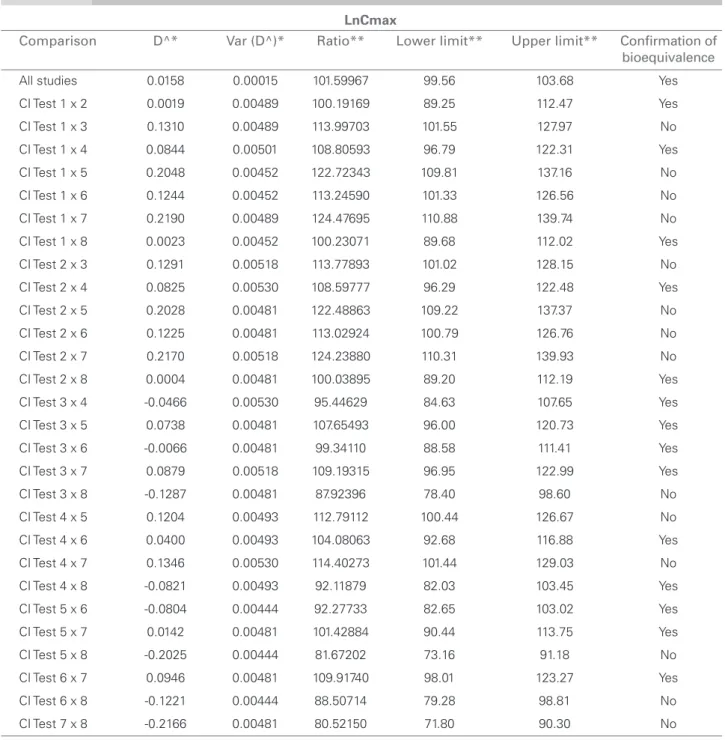
The 90% confidence intervals of the meta-analysis between the combinations of test products 1 to 8 for the Cmax and AUC pharmacokinetic parameters are shown in Tables 3 and 4, and Figures 3 and 4, respectively.
D
ISCUSSIONAnvisa, in one of its resolutions regarding medici-ne dispensing, allows the pharmacist to replace the reference drug prescribed by the physician with the corresponding generic drug, except in case of explicit restriction by the prescriber. When the drugs are pres-cribed by their generic names, that is, according to the Brazilian Common Denomination (Denominação Comum Brasileira - DCB) or to the International
Common Denomination (ICD), the pharmacist can dispense either the reference drug or the correspon-ding generic or similar drugs.9
However, it has not been established if a generic drug can be replaced by another generic drug. This is an important issue not only because the number of approved generics of the same reference drug can be very high – 67 in Brazil and greater than 160 in the United States – but also because those medicines are not identical regarding their inactive ingredients,
Table 3 PHARMACEUTICALCONFIDENCEINTERVALSFORMULATIONSOF CMAXCONTAININGANDCONCLUSION ENALAPRILOFTHE MALEATECOMBINATIONSOFSTUDIESINTHEMETA-ANALYSISOFEIGHT
LnCmax
Comparison D^* Var (D^)* Ratio** Lower limit** Upper limit** Confi rmation of bioequivalence All studies 0.0158 0.00015 101.59967 99.56 103.68 Yes
CI Test 1 x 2 0.0019 0.00489 100.19169 89.25 112.47 Yes
CI Test 1 x 3 0.1310 0.00489 113.99703 101.55 127.97 No
CI Test 1 x 4 0.0844 0.00501 108.80593 96.79 122.31 Yes
CI Test 1 x 5 0.2048 0.00452 122.72343 109.81 137.16 No
CI Test 1 x 6 0.1244 0.00452 113.24590 101.33 126.56 No
CI Test 1 x 7 0.2190 0.00489 124.47695 110.88 139.74 No
CI Test 1 x 8 0.0023 0.00452 100.23071 89.68 112.02 Yes
CI Test 2 x 3 0.1291 0.00518 113.77893 101.02 128.15 No
CI Test 2 x 4 0.0825 0.00530 108.59777 96.29 122.48 Yes
CI Test 2 x 5 0.2028 0.00481 122.48863 109.22 137.37 No
CI Test 2 x 6 0.1225 0.00481 113.02924 100.79 126.76 No
CI Test 2 x 7 0.2170 0.00518 124.23880 110.31 139.93 No
CI Test 2 x 8 0.0004 0.00481 100.03895 89.20 112.19 Yes
CI Test 3 x 4 -0.0466 0.00530 95.44629 84.63 107.65 Yes
CI Test 3 x 5 0.0738 0.00481 107.65493 96.00 120.73 Yes
CI Test 3 x 6 -0.0066 0.00481 99.34110 88.58 111.41 Yes
CI Test 3 x 7 0.0879 0.00518 109.19315 96.95 122.99 Yes
CI Test 3 x 8 -0.1287 0.00481 87.92396 78.40 98.60 No
CI Test 4 x 5 0.1204 0.00493 112.79112 100.44 126.67 No
CI Test 4 x 6 0.0400 0.00493 104.08063 92.68 116.88 Yes
CI Test 4 x 7 0.1346 0.00530 114.40273 101.44 129.03 No
CI Test 4 x 8 -0.0821 0.00493 92.11879 82.03 103.45 Yes
CI Test 5 x 6 -0.0804 0.00444 92.27733 82.65 103.02 Yes
CI Test 5 x 7 0.0142 0.00481 101.42884 90.44 113.75 Yes
CI Test 5 x 8 -0.2025 0.00444 81.67202 73.16 91.18 No
CI Test 6 x 7 0.0946 0.00481 109.91740 98.01 123.27 Yes
CI Test 6 x 8 -0.1221 0.00444 88.50714 79.28 98.81 No
CI Test 7 x 8 -0.2166 0.00481 80.52150 71.80 90.30 No
which can vary from one version to the other. This area of bioequivalence is usually ignored, but it actu-ally requires immediate attention.1,10
Regulatory agencies are based only on the criterion of mean bioequivalence and do not require the calcu-lations of individual and population bioequivalence,
which assure interchangeability in different approa-ches (prescribability and switchability). Thus, Chow and Liu8 have suggested a meta-analysis combining data of different studies of bioequivalence, aiming at providing a systematic review of bioequivalence be-tween generic and reference products.
Table 4 PHARMACEUTICALCONFIDENCEINTERVALSFORMULATIONSOFAUCCONTAININGANDCONCLUSIONENALAPRILOFTHEMCOMBINATIONSALEATE OFSTUDIESINTHEMETA-ANALYSISOFEIGHT
LnASC
Comparison D^* Var (D^)* Ratio** Lower limit** Upper limit** Confi rmation of bioequivalence All studies 0.0149 0.00009 101.50165 99.93 103.09 Yes
CI Test 1 x 2 0.0236 0.00288 102.38930 93.70 111.88 Yes
CI Test 1 x 3 0.0551 0.00288 105.66389 96.70 115.46 Yes
CI Test 1 x 4 0.0808 0.00295 108.41705 99.11 118.60 Yes
CI Test 1 x 5 0.1566 0.00266 116.94935 107.39 127.36 No
CI Test 1 x 6 0.0256 0.00266 102.58923 94.20 111.72 Yes
CI Test 1 x 7 0.1751 0.00288 119.14091 109.03 130.19 No
CI Test 1 x 8 0.0361 0.00266 103.67348 95.20 112.90 Yes
CI Test 2 x 3 0.0315 0.00305 103.19818 94.20 113.06 Yes
CI Test 2 x 4 0.0572 0.00312 105.88709 96.56 116.12 Yes
CI Test 2 x 5 0.1330 0.00283 114.22029 104.61 124.72 Yes
CI Test 2 x 6 0.0020 0.00283 100.19527 91.76 109.40 Yes
CI Test 2 x 7 0.1515 0.00305 116.36070 106.22 127.47 No
CI Test 2 x 8 0.0125 0.00283 101.25422 92.73 110.56 Yes
CI Test 3 x 4 0.0257 0.00312 102.60558 93.56 112.52 Yes
CI Test 3 x 5 0.1015 0.00283 110.68053 101.37 120.85 Yes
CI Test 3 x 6 -0.0295 0.00283 97.09015 88.92 106.01 Yes
CI Test 3 x 7 0.1200 0.00305 112.75461 102.92 123.52 Yes
CI Test 3 x 8 -0.0190 0.00283 98.11629 89.86 107.13 Yes
CI Test 4 x 5 0.0758 0.00290 107.86989 98.69 117.91 Yes
CI Test 4 x 6 -0.0553 0.00290 94.62463 86.57 103.43 Yes
CI Test 4 x 7 0.0943 0.00312 109.89130 100.21 120.51 Yes
CI Test 4 x 8 -0.0447 0.00290 95.62470 87.48 104.52 Yes
CI Test 5 x 6 -0.1310 0.00261 87.72108 80.62 95.45 Yes
CI Test 5 x 7 0.0186 0.00283 101.87394 93.30 111.23 Yes
CI Test 5 x 8 -0.1205 0.00261 88.64819 81.47 96.46 Yes
CI Test 6 x 7 0.1496 0.00283 116.13393 106.36 126.80 No
CI Test 6 x 8 0.0105 0.00261 101.05689 92.87 109.96 Yes
CI Test 7 x 8 -0.1391 0.00283 87.01754 79.69 95.01 No
* = logarithmic scale; **= original scale; D^hh= (ŶTh - ŶRh) - (ŶTh - ŶRh).
CONFIDENCEINTERVALSOFAUCANDCONCLUSIONOFTHECOMBINATIONSOFSTUDIESINTHEMETA-ANALYSISOFEIGHT PHARMACEUTICALFORMULATIONSCONTAININGENALAPRILMALEATE
Table 4
Anvisa has all data relating to studies of bioequi-valence and relative bioavailability already conducted for the registration of drugs in Brazil, which allow the use of meta-analysis to assess interchangeability between generics different from the reference drug.4
Because generics have existed in Brazil for only ten years and because the requirement that similar drugs undergo bioequivalence studies has been even more recent (2003), that type of analysis is very useful for refining the criteria for granting registration or even as a tool for monitoring generic and similar drugs after registration. This can be especially applied to drugs that treat chronic diseases and are of continuous use, whose replacement for a new copy may not provide absorption levels required by the body to reach the aimed therapeutic results.
Meta-analysis has already been used in bioequi-valence studies of immunosuppressive medications (mycophenolate mofetil) and antibiotics (amoxicillin) to support health professionals and patients in choosing between formulations of the same medicine.4,11 Those
studies have concluded that interchangeability was possible between the different formulations tested.
Figura 4. Confi dence intervals of AUC of the
combinations of studies in the meta-analysis of eight pharmaceutical formulations containing Enalapril Maleate.
Figura 3. Confi dence intervals of Cmax of the
combinations of studies in the meta-analysis of eight pharmaceutical formulations containing Enalapril Maleate.
Aiming at analyzing interchangeability between the formulations of generic and similar drugs containing Hydrochlorothiazide and Enalapril Maleate, a syste-matic review was conducted with several studies of bioequivalence with those drugs submitted to Anvisa.
META-ANALYSISOFHYDROCHLOROTHIAZIDE
The 90% confidence intervals for comparing test products 1, 2, and 3 obtained in the meta-analysis have shown that the test drugs had similar extent of absorption (AUC) values, because the confidence intervals were within the 80% to 125% limits.7
However, for the Cmax parameter, a small diffe-rence was observed in the rate of absorption be-tween products T1 and T3, in which the confiden-ce interval was borderline (79.96% to 106.19%). According to the limits established by Anvisa, this hinders the conclusion of bioequivalence between formulations, and, consequently, their interchan-geability. For the remaining combinations of the test products, the confidence intervals were within the limits, confirming the possibility of change be-tween formulations.
Confi dence Interval Confi dence Interval
Comparisons Comparisons
70% 75% 80% 85% 90% 95% 100% 105% 110% 115% 120% 125% 130% 70% 75% 80% 85% 90% 95% 100% 105% 110% 115% 120% 125% 130% CI Test 7 x 8
CI Test 6 x 8 CI Test 6 x 7 CI Test 5 x 8 CI Test 5 x 7 CI Test 5 x 6 CI Test 4 x 8 CI Test 4 x 7 CI Test 4 x 6 CI Test 4 x 5 CI Test 3 x 8 CI Test 3 x 7 CI Test 3 x 6 CI Test 3 x 5 CI Test 3 x 4 CI Test 2 x 8 CI Test 2 x 7 CI Test 2 x 6 CI Test 2 x 5 CI Test 2 x 4 CI Test 2 x 3 CI Test 1 x 8 CI Test 1 x 7 CI Test 1 x 6 CI Test 1 x 5 CI Test 1 x 4 CI Test 1 x 3 CI Test 1 x 2 All studies
In the case of Hydrochlorothiazide, the diffe-rence observed in the rate of absorption between products T1 and T3 should not have significant clinical repercussions in a patient’s treatment, be-cause of the following reasons: the difference was very small (0.04%); AUC was very similar; the drug has a wide therapeutic range; and its thera-peutic effect does not depend on acute action, but on cumulative effect.
META-ANALYSISOFENALAPRILMALEATE
The comparison of the extent of absorp-tion (AUC) values of some products containing Enalapril Maleate has shown significant differen-ces between several products, considering that the confidence intervals were not within the 80% to 125% limits. 7 This has also been observed in the analysis of the rate of absorption (Cmax) between products, in which several combinations had confidence intervals not within the establi-shed limits.
Regarding Cmax, 14 of the 28 combinations of studies (50%) have concluded for non-bioequi-valence between the tested formulations, and the most frequent were Tests 1, 2, 5, 7, and 8, which, according to data, were not interchangeable with four other drugs. None of the test products could be considered interchangeable with all the others. Regarding AUC, six of the 28 combinations (21%) have been concluded non-bioequivalent. Test product 7 was the most frequent, and non-interchangeability between other four copies was concluded. Although Enalapril Maleate is a very safe medicine, with a wide therapeutic window, the results have suggested that the replacement of a generic drug with another can determine diffe-rentiated therapeutic responses.
According to the instructions of Anvisa, the sum of those results hinders the conclusion of bioequivalence between the several formulations of Enalapril Maleate, indicating, thus, that those pharmaceutical products are not interchangea-ble. The clinical importance of those findings, in regard to safety and efficacy, still requires fur-ther investigation through clinical trials compa-ring the different pharmaceutical formulations of Enalapril Maleate. However, it is clear that a generic or similar drug cannot be always replaced by another. This is particularly important for a medicine of narrow therapeutic index, whose lack of therapeutic effect or presence of toxic effects can significantly impair efficacy and safety.
C
ONCLUSIONThe results obtained indicate that, of the gene-ric and similar antihypertensive drugs distributed by the Farmácia Popular program studied, the three Hydrochlorothiazide products can be sa-fely interchanged. However, when assessing the interchangeability of the drugs with the Enalapril Maleate active principle, the products studied do not contemplate the intervals recommended by the national regulation. Thus, the pharmacoki-netic response, and, consequently, the efficacy of the drug can be affected in some patients using different brands of generic or similar drugs for treating arterial hypertension and other cardio-vascular diseases. Clinical trials comparing the therapeutic effects of different formulations are required for better assessing that question. New measures related to pharmacovigilance of drugs are necessary to assure a police of interchangea-bility between generic and similar drugs.
R
EFERENCES1. Chow SC, Liu JP. Design and analysis of bioavailability and bioequivalence studies, 2 ed. New York: Marcel Dekker, 2000; pp. 379-408.
2. Quental C, Salles Filho S. Ensaios clínicos: capacitação nacional para avaliação de medicamentos e vacinas. Revista Brasileira de Epidemiologia 2006; 9(4):408-24. 3. Brasil. Anvisa. Resolução – RDC n.° 16 de 2 de março
de 2007. Aprovar o regulamento técnico para medica-mentos genéricos. Diário Oficial da União, Brasília, DF, 2007.
4. Schramm SG. Emprego de metanálise para avaliação da intercambiabilidade entre medicamentos [tese de douto-rado]. São Paulo: Faculdade de Ciências Farmacêuticas, Universidade de São Paulo, 2008.
5. Ministério da Saúde. Cidadão, ações e programas: me-dicamentos disponibilizados nas drogarias e farmácias credenciadas na expansão do programa para a rede privada. Disponível na internet no site: http://portal. saude.gov.br/portal/arquivos/pdf/lista_medicamentos_ pfpb_co_pagamento.pdf. Acessado em: 15 de setembro de 2009.
6. Ministério da Saúde. Vigitel. Disponível na internet no site: http://portal.saude.gov.br/portal/arquivos/pdf/ta-belas_vigitel_hipertensao_2008.pdf. Acessado em: 15 de setembro de 2009.
7. Brasil. Anvisa. Resolução – RE n.° 1.170 de 19 de abril de 2006. Determina a publicação do guia para provas de biodisponibilidade relativa/bioequivalência de medi-camentos. Diário Oficial da União, Brasília, DF, 2006. 8. Chow SC, Liu JP. Meta-analysis for bioequivalence
9. Brasil. Anvisa. Resolução – RDC n.º 51 de 15 de agosto de 2007. Altera o item 2.3, VI, do Anexo I, da Resolução RDC n.º 16 de 2 de março de 2007 e o Anexo da Resolução RDC n.º 17 de 2 de março de 2007. Diário Oficial da União, Brasília, DF, 2007. 10. Anvisa. Medicamento genérico: listas. Disponível na
internet no site: http://www.anvisa.gov.br/hotsite/ge-nericos/lista/Medicamentos_registrados_alfabetica_ novembro_09.xls. Acessado em: 28 de novembro de 2009.