Fisioter. Mov., Curitiba, v. , n. , p. - , Jul./Set.
Licenciado sob uma Licença Creative Commons
DO): http://dx.doi.org. . / - . . .AO
[T]
Influence of classic massage on cardiac autonomic modulation
[)]Influência da massagem clássica sobre a modulação autonômica cardíaca
[A]
Mário Augusto Paschoal[a]*
[a] Ponti ícia Universidade Católica de Campinas PUC-Campinas , Campinas, SP, Brazil
[R]
Abstract
Introduction:Massage can be defi ned as the rhythmic and smooth manipulation of body tissues, with the aim to promote health and well-being. Objective: To assess the infl uence of classic massage on cardiac autonomic modulation. Methods: Cross-sectional study that evaluated healthy participants, with mean age between 18 and 25 years, divided into two groups: test group (TG, n=11) and control group (CG, n=10). The TG had their heart-beat recorded for 5min before receiving a classic massage for 40min and during three periods after this procedure: 0-5min, 5-10min and 10-15min. The CG had their heartbeats recorded at the same time; without receive massage. Cardiac autonomic modulation was investigated by heart rate variability (HRV). Results: The mean values of HRV rates were: pNN50, respectively, for the TG: before massage (10.5 ± 9.5%), and after massage: 0-5min (11.6 ± 7.2%), 5-10min (12.1 ± 8.0%) and 10-15min (11.1 ± 7.9%), with no signifi cant statistical di erence. The same result was found for the mean values of rMSSD index of the TG; before massage: 52.1 ± 46.2 ms, and after massa-ge: 0-5min (50.0 ± 21.6ms), 5-10min (52.0 ± 27.4 ms) and 10-15min (48.2 ± 21.1 ms). Also, the values of LFnuand HFnu indexes did not change signifi cantly before and after massage, and they were not statistically di erent from the values presented by the control group. Conclusion: The study results suggest that one session of classic mas-sage does not modify cardiac autonomic modulation in healthy young adults.
Keywords: Heart Rate. Massage. Autonomic Nervous System.
Resumo
com idades entre 18 e 25 anos divididas em dois grupos: grupo testado (GT, n=11) e grupo controle (GC, n=10). As do GT tiveram seus batimentos cardíacos registrados por 5min antes de uma sessão de massagem clássica recebida por 40min e durante três momentos após a mesma: 0-5min, 5-10min e 10-15min. As do GC tiveram registrados seus batimentos cardíacos nos mesmos momentos, porém não receberam a massagem. A modula-ção autonômica cardíaca foi investigada por meio da variabilidade da frequência cardíaca (VFC).
Resultados: Os valores médios de índices da VFC, foram: pNN50, respectivamente, para o GT: pré-massagem (10,5±9,5%), e após a massagem: 0-5min (11,6±7,2%), 5-10min (12,1±8,0%) e 10-15min (11,1±7,9%), sem diferença estatística entre eles. O mesmo aconteceu com relação ao índice rMSSD do GT, sendo: pré-massagem: 52,1±46,2ms, e pós-massagem: 0-5min (50,0±21,6ms), 5-10min (52,0±27,4ms) e 10-15min (48,2±21,1ms). Os valores de BFune AFunpré-massagem e pós-massagem também não se modiϔicaram, e também não se diferi-ram signiϔicativamente dos valores apresentados pelo GC. Conclusão: O estudo sugere que não há modiϔicação da modulação autonômica cardíaca em jovens saudáveis após uma sessão de massagem clássica.
Palavras-chave: Frequência Cardíaca. Massagem. Sistema Nervoso Autônomo.
Introduction
Massage can be de ined as the rhythmic and smooth manipulation of body tissues, with the aim to promote health and well-being . The irst reports of massage date back to years before Christ, and reveal that this practice was part of many ancient cultures, which inhabited the territories where the modern nations of China, Egypt, Greece, )ndia, Japan and )taly are today .
From antiquity, there are reports of (ippocrates praising massage as a resourceto relieve muscle and joint stiffness. Celsius and Galen, on the other hand,emphasizedthe medicinal and therapeutic ben-e its of massagben-e, rben-elating thben-em to othben-er procben-edurben-es such as anointing oils, baths and physical exercise .
)n the early nineteenth century, massage received a boost with the creation of classic or Swedish mas-sage, developed by Per (enrik Ling. Ling had no higher education, but succeeded in his therapeutic proposals, and later taught these to physicians in-terested in knowing them, and also passed them on to other colleagues , .
)n the twentieth century, some therapeutic ef-fects of massage that had hitherto been unproven were demonstrated and accepted by modern sci-ence. (owever, according to Moyer et al. , the cur-rent literature is still very lacking on the topic, and many researchers continue to present their indings without proper scienti ic evidence. )n other circum-stances, theories are presented, but important details are omitted.
Currently, classic or Swedish massage is recog-nized as the most common form of massage, used primarily by athletes for various purposes. Among the objectives and bene its attained from massage, the following are highlighted: anti-stress effect, in-creased venous return, inin-creased local circulation and decreased muscle spasms . There are also studies that showthe effects of massage on stimulation of the parasympathetic nervous system , .
Nevertheless, there is a general consensus that many of the studies related to massage techniques are empirical, and there is a need to conduct more consistent studies with larger samples. The same can be said regarding studies that evaluate the pos-sible effect of classical massage on cardiac autonom-ic modulation.
Current paradigms on this topic show that classic massage alters the cardiac sympathovagal balance by increasing the parasympathetic tone while simulta-neously reducingcardiovascular activity and stress hormones, thereby promoting a sense of calm and well-being - . )n contrast, studies show that classic massage increases cardiac sympathetic activity .
489 Thus, the aim of this study was to evaluate the
effects of a single massage session on cardiac auto-nomic modulation.
Methods
Study participants
Sample size was calculated using the GraphPadStatMatesoftware, version . San Diego, California, USA . To achieve statistical signi icance p< . with % power, a sample size of nine par-ticipants was needed to demonstrate the difference of data before and after classical massage.
Therefore, given the calculation of the sample size, college women aged between and years were selected, all of whom were considered healthy and sed-entary. These were randomly dividedinto a test group
TG n= and a control group CG . )nclusion criteria were: not being in any regular physical activity program in the last six months, and having a body mass index BM) between and obesity is a factor that interferes with cardiac autonomic modulation .
Exclusion criteria were: having cardiovascular and/or respiratory problems detected by clinical examination, being a current smoker or having used tobacco up to two months prior to data collection, making current use of any medication, drinking alco-hol more than once per week, being pregnant, having anxiety syndrome and refusing to sign the free and informed consent form.
The participants selected in previous clinical examinations remained in the study, and there was no need to modify or insert other participants. The fact that only women participated in the study was due to the fact that only women showed interest in participating. The study was approved by (uman Research Ethics Committee of the Ponti ical Catholic University of Campinas protocol no. / , and adhered to the principles of the (elsinki Declaration.
Procedures
Each participant visited the physical therapy out-patient clinic in order to become familiar with the environment where they would undergo the tests. The participants then responded to a questionnaire on lifestyle habits and cardiovascular pro ile on the
data shown in the inclusion and exclusion criteria, and then underwent anthropometric and clini-cal evaluations.
Anthropometric evaluation
To characterize the study sample, weight and height were measured in order to calculate BM). To obtain body weight, the participants were positioned without shoes on a Filizola® scale São Paulo, Brazil pre-calibratedin g units, on which each partici-pant stood with their back to a metal Toesascaled in centimeters, and were asked to maintain a horizontal view so that the researcher could measure their height exactly at the point where the Toesa touched thepar-ticipant’s head.
Clinical evaluation
)n order to avoid any cardiovascular disorder, each patient underwent an anamnesis and benchmarking of the heart rate (R and blood pressure BP . The (R was obtained using a Polar® heart rate monitor, model S i Kempele, Finland , after the partici-pant remained in the supine position for min, in an air-conditioned room with a temperature between °C and °C. While still in the supine position, BP was measured using a mercury sphygmomanometer and a Littman® Classic )) stethoscope São Paulo, Brazil . This also enabled pulmonary and heart aus-cultation, according to techniques widely described in the literature.
After undergoing the evaluation procedures de-scribed above, eachparticipant received a brochure with guideline information on the hours before the scheduled date of their massage, which included in-structions not to practice physical exercise, consume alcohol, take medicines, drink coffee or tea, eatchoco-late, and to try to get at least eight hours of sleep the night before the massage.
Application of massage
All the participants of the TG were scheduled to receive the massage at the same time of day between : pm and : pm , so that the circadian effects of the (R did not interfere in data collection. On the scheduled day and time, the participant went to the outpatient physical therapy clinic and, before the massage was started, responded to questions about whether she had followed all the guidelines. )t was also noted whether the participant had gone to the bath-room minutes before to empty their bladder. Before the start of the massage and when properly dressed, the participantwas directed to, from that moment forward, not talk to the researcher nor move.
Data recording began after the heart monitor was attached to the participant’s chest. After staying in the same position for min, the participant’s heart rate was recordedduring min.After this recording, the massage was started, which was performed always by the same professional. Speci ic aspects of classic mas-sage were applied, including: surface sliding, deep slid-ing, kneadslid-ing, friction, percussion, vibration and sur-face sliding again. These procedures were performed for min, with min dedicated to each region of the body, beginning with the face and proceeding to the upper limbs, and then the lower limbs.)mmediately at the end of the massage, and without the participant having moved, the (R was recorded again for min. The CG participants remained lying down and un-der the same conditions of the TG, yet did not receive massage. The location, date and time of the CG proce-durewas also scheduled, and their heartbeats were recordedduring the same time of day as the TG.
Interpretation and analysis of heart rate
variability (HRV) data before and after application of classic massage
The heartbeats recorded before and immediately after the classic massage session were transferred to a computer via an )RPolar®interface,and analyzed using the softwarePolar Precision Performance®.
Cardiac autonomic modulation analysis was per-formed by evaluating heart rate variability (RV for
min after the massage, divided into three min parts, analyzed during the time slots - min, - min and - min. A very strong ilter existing in the
software was appliedto prevent artifacts and ectopic heartbeats from being considered in analysis of the RR intervals.
The softwarecreated a report of the (RV, dividing it into analysis done in the time domain TD and analy-sis done in the frequency domain FD , the parameters of which are explained below.
For analysis of (RV in FD, the Fast Fourier Transform FFT algorithmwas used. The FFT algo-rithm analyzes spectral power in certain frequency bands, already established as bands related to the pre-dominantly sympathetic activity and bandsrelative to the parasympathetic activity - .
Statistical analysis
Statistical analysis of the data on the parameters of the TD and FD of the (RV, compared before and after the massage, and between the TG and CG, was carried out using the softwareGraphPad Prism® . San Diego, USA . Repeated Anova test measurements were performed for comparison of intra-group values of the TG pre- and post-massage , and comparison of these data with those of the CG. The signi icance level was p< . .
The variables used in the study (RV parame-ters and their respective information are presented as follows.
Time domain (TD)
The root mean square standard deviation rMSSD is the square root of the mean of the sum of squares of the differences between adjacent normal RR intervals RRi in a time interval expressed in milliseconds ms . The higher the value of this calculation, the greater the cardiac vagal activity present - .
The pNN is the percentage of adjacent RRi with a difference of more than ms.The higher the value of this percentage, the greater the parasympathetic activity at the time - .
Frequency domain (FD)
491
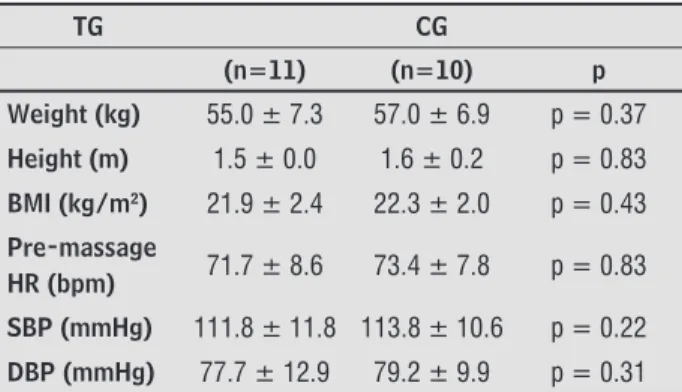
Table 1 - Anthropometric and clinical data (mean and standard deviation)
TG CG
(n=11) (n=10) p
Weight (kg) 55.0 ± 7.3 57.0 ± 6.9 p = 0.37
Height (m) 1.5 ± 0.0 1.6 ± 0.2 p = 0.83
BMI (kg/m2) 21.9 ± 2.4 22.3 ± 2.0 p = 0.43
Pre-massage
HR (bpm) 71.7 ± 8.6 73.4 ± 7.8 p = 0.83
SBP (mmHg) 111.8 ± 11.8 113.8 ± 10.6 p = 0.22
DBP (mmHg) 77.7 ± 12.9 79.2 ± 9.9 p = 0.31 Note: TG = test group; CG = control group; BMI = body mass index; HR = heart rate; SBP = systolic blood pressure; DBP = diastolic blood pressure.
As presented in Figure , after the massage, the mean (R observed in the TG was: - min = . ± . bpm; - min = . ± . bpm; - min = . ± . bpm, with no CG or intra-group differences at all times recorded.
The same applies to the mean value of systolic BP SBP and diastolic BP DBP , as they both show that the groups, despite being made up of sedentary individuals, showed normal values of these variables. These data were important to verify that the cardio-circulatory conditions prior to the beginning of the records were adequate.
Figure 1 - Mean HR values obtained with the test group (white,
n=11) and control group (gray, n=10). The HR values 0-5min, 5-10min and 10-15min refer to records made after application of the massage, which are compared to the same times of the CG, which remained lying down, but did not receive massage.ns = no signifi cative. There was no statistically signifi cant difference(s) be-tween the data.
Figures and show the behavior of the values of the (RV variable relative to the TD. Both the pNN and the rMSSD re lect the vagal behavior on the heart, and it is shown that the classic massage had no in lu-ence on these values when the pre-and post-massage on this band expresses the joint action of the
parasympathetic and sympathetic cardiac ac-tivity, however, most authors believe that the sympathetic activity is more effective in this frequency band , .
b The high-frequency (F band varies from . to . (z, and the greater the spectral power focusing on this band, the greater the parasym-pathetic activity. )t expresses the vagal activity on the heart - .
)n this study, both LF and the (F components were calculated in normalized units n.u. , which represent the relative values of each component in proportion to total output, mi-nus the ultra lowfrequency ULF and very low frequency VLF components , , . c The low/high frequency ratio LF/(F ratio
expresses the division of the LF value by the (F value. Whenever the value is greater than , it means that at the moment of the particular record, greater cardiac sympathetic tone ex-ists, while a value of the LF/(F ratio less than one indicates parasympathetic predominance on the heart , .
Results
The data in Table show the anthropometric and clinical values of the participants.All values are ad-equate, since they are within the normal range and met the inclusion criteria.
)t should be noted that the mean BM) obtained con irms that none of the participants were over-weight or obese, a condition which could interfere with data.
The pre-massage (R was important to show that the participants were not in a state of stress or antici-pation, because the mean (R of . bpm of the TG and . bpm of the CG suggest the absence of factors which could have an impact on the data obtained and the (RV.
adjacent RR intervals (iRR), obtained from the test group (white, n=11) and the control group (gray, n=10). The HR values 0-5min, 5-10min and 10-15min refer to records made after application of the massage, which are compared to the same times of the CG, which remained lying down, but did not receive massage.ns = no signifi cative. There was no statistically signifi cant difference be-tween the data.
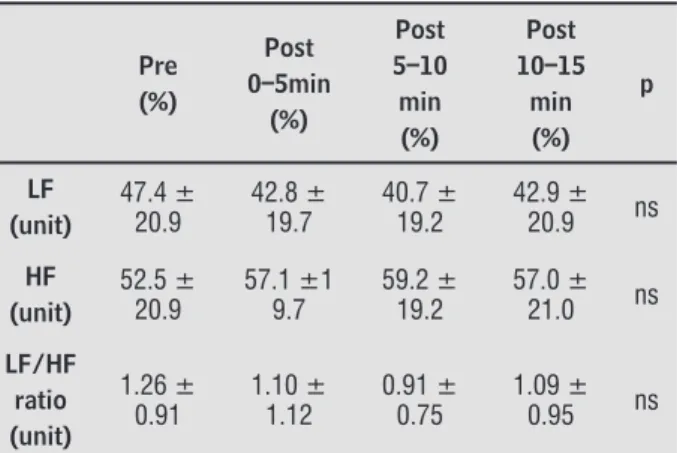
Table shows the mean values of the LF and (F rates and the LF/(F ratio, calculated in normalized units n.u. before and after the classic massage and the values of the CG, at the same times. )t was also found that the massage did not signi icantly affect these values, con irming what had been demonstrat-ed in analysis of the TD rates.
Table 2 - Mean values of low frequency (LF) and high fre-quency (HF) calculated in standard units, from the analysis of the frequency domain (FD) of heart rate variability (HRV) pre- and post-classic massage (0-5min, 5-10min, 10-15min)
Test group (TG, n=11)
Pre (%) Post 0–5min (%) Post 5–10 min (%) Post 10–15 min (%) p LF (unit) 47.4 ± 20.9 42.8 ± 19.7 40.7 ± 19.2 42.9 ± 20.9 ns HF (unit) 52.5 ± 20.9 57.1 ±1 9.7 59.2 ± 19.2 57.0 ± 21.0 ns LF/HF ratio (unit) 1.26 ± 0.91 1.10 ± 1.12 0.91 ± 0.75 1.09 ± 0.95 ns
Control group (CG, n=10)
Pre (%) Post 0–5min (%) Post 5–10 min (%) Post 10–15 min (%) p LF (n.u.) 38.1 ± 14.9 37.6 ± 19.0 37.7 ± 19.2 38.2 ± 18.3 ns HF (n.u.) 60.8 ± 14.9 61.3 ± 18.9 60.3 ± 19.42 59.6 ± 19.0 ns LF/HF ratio 0.72 ± 0.48 0.82 ± 0.81 0.88 ± 0.70 0.97 ± 0.78 ns
Note: LF = low frequency; HF = high frequency; n.u. = normal-ized units.
data were compared. Similarly, these values were not different from those presented by the CG.
The mean values of the pNN rate presented by the TG were, respectively: pre-massage . ± . % , - min . ± . % , - min . ± . % and - min after the massage . ± . % , while the mean values of the rMSSD rate of the same group were: pre-massage = . ± . ms, and post-mas-sage at - min, - min and - min, respective-ly: . ± . ms, . ± . ms and . ± . ms.
Figure 2 - Mean values of percentage of adjacent RR intervals,
with duration difference greater than 50 milliseconds (pNN50), ob-tained from the tested group (white, n=11) and control group (gray, n=10). The HR values 0-5min, 5-10min and 10-15min refer to re-cords made after application of the massage, which are compared to the same times of the CG, which remained lying down, but did not receive massage.
ns = no signifi cative. There was no statistically signifi cant differ-ence between the data.
Figure 3 - rMSSD mean values, which represent the square root
493 showed a reduction in the value of this variable. )n part, these differences also occurred for the reasons provided above, but there are other aspects to be taken into consideration.
Kaye et al. showed that there was a signi icant reduction of mean (R of . bpm, however, both the method of measuring the (R and the massage tech-nique were different from the present study, thereby limiting comparison of the behavior of this variable between the two studies.
Also with regard to (R responses, Sethi and Bojadsen concluded that massage signi icantly reduced (R during the irst ive minutes of the ses-sion, and also after minutes. )n the present study, it should be noted that the (R was not monitored during the massage session, because it was under-stood that data could be created in this period that would harm analysis of the (R and (RV. (owever, with respect to data recorded min after applica-tion of the massage, the results were also discordant because the TG showed an oscillation of only bpm in the value of the mean (R from the pre-massage rate until min after its conclusion, showing great stability in the behavior of the variable.
(owever, the primaryfocus of the present study was not to ascertain whether the (R would decrease with application of classic massage, but also to verify if this reduction would be related to changes of the vago-sympathetic balance, which also did not occur
Figure .
)t should be noted that in the study by Siqueira and Bojadsen , reduction of (R may not have been due to autonomic adjustment, because analysis of the (RV was not performed to obtain this knowledge. (ence, it cannot be concluded if the decreased (R was accompanied by increased vagal activity or reduced sympathetic activity, or if both situations occurred.
Although some studies are not clear with respect to the autonomic response of the (R due to massages, there are consistent studies that showed decreased (R and concomitant increased cardiac parasym-pathetic tone, as, for example, those conducted by Cottingham et al. and Okvat et al. , although in these studies the massage technique applied was not the same as that used in the present study.
Some studies report that massage can cause in-creased permeability of the vessel walls, which leads to better irrigation of the dermis and subcutaneous tissue, thereby interfering in peripheral vascular re-sistance, and, consequently, on the BP value , .
Discussion
The main inding of this study was that in appar-ently healthy young adults, classic massage did not interfere in the cardiac autonomic modulation
quanti-ied by means of the (RV.
)t is believed that the lack of effect of the massage on the parameters of (RV is partly due to the lack of documented changes prior to start of the massage on the participants, such as: bone and joint disorders, aches, malaise, stress, depression, and anxiety. This statement is based on the fact that, in most studies in which changes in the cardiac autonomic modulation-were observed after application of classic massage, there were previous situations of emotional and/or physical disorders , .
One example is the study by (ulme et al. , who reported increased vagal tone during application of therapeutic massage. (owever, before the start of the massage, the participants presented high values of stress hormones, and therefore had greater cardiac sympathetic tone. That is, this study suggests that when the cardiac vago-sympathetic balance is leaning to the sympathetic side, massage can normalize it.
Similarly, it was found that the participants evalu-ated by Lindgren et al. , which had anxiety due to the aortic surgery that they would undergo, showed reduction of anxiety after being subjected to massage procedures.
Toro-Velasco et al. also managed to show that with just one session of massage on the neck region, (RV rates were increased and perceived pain and ten-sion were reduced in patients with pain from tenten-sion headache that existed prior to the massage.
Therefore, the presence of functional changes or problems that can interfere with cardiac auto-nomic modulation before the massage appears to be a strong indication that application of massage on those conditions can succeed.
Another aspect to be considered in a discussion about the positive effects of massage involves techni-cal knowledge what type of massage was done and duration of massage. Because there are many tech-niques and different amounts of time of application of massage, analyzing these studies is dif icult and the conclusions must be carefully assessed , .
similar values between the pre-massage and post-massage period, as shown in Figure .
Analysis of the rMSSD values Figure showed very similar behavior to what was obtained with re-spect to pNN , and reinforced the main conclusion of this study, which was that classic massage, in the intensity and time it was applied, does not change cardiac parasympathetic tone.
By observing the results of Table , which shows the behavior of the LFnu and (Fnu rates, and the LF/(F ratio of the analysis of the (RV on the FD, one can con irm what had been reported in relation to the parameters of the TD, because these also did not change after application of the massage and did not differ from the values of the CG.
Finally, the results of the LF/(F ratio observed in Table serve to reinforce what was stated in the paragraph above. Although the TG showed a tendency to decrease sympathetic tone in a comparison of the pre-massage values and the values of - min and - min after the same, there was no statistically signi icant difference between these values. )n addi-tion, it was found that when the values of the vari-ables were compared to CG, statistically signi icant difference was also not obtained.
Unfortunately, the authors of the present study were unable to ind studies that applied the same methods, both for type of massage and parameters of (RV, so that they could deepen comparison between the results. Only the study by Diego and Field , cited above, also had a study sample composed of healthy young adults. (owever, although massage was applied for only minutes, one of the massage intensities used was similar to that applied by the present study, and, in that condition, the results were equal, thereby showing that changes in the vago-sym-pathetic balance do not occur when pressures on the skin are very light or mild.
The absence of any difference between the pre- and post-classic massage values of (R, BP and (RV obtained in this study have their importance. These results can be used as a parameter in new studies focused on expanding knowledge about a therapeutic procedure used by physical therapists from all over the world, the practice of which appears to show good results, but that still requires further research on the actual physiological effects.
)t should be noted that in the present study, the massage was not performed in the prone position, which would merit another comparative analysis of Others suggest that the effects of massage on BP have
a cellular route, because it has been shown that by stretching the tissues, massage can modify the size and extent of ibroblasts, and also cause lower pe-ripheral vascular resistance and reduction of BP . One of the most relevant studies on this topic was undertaken in by Kaye et al. , whoapplied deep massage for to minutes on partici-pants % male and % female with a mean age of . years. The results showed a mean reduction of . mm(g of the systolic BP p = . , and mean reduction of diastolic BP of . mm(g p= . .
)n the following year, Takamoto et al. also obtained decreased BP, associated with increased-parasympathetic cardiac activity by means of applica-tion of compression of the trigger pointson the legs. (owever, in this study, there was technical application of breath control in conjunction with the massage, which can increase respiratory sinus arrhythmia and cardiac parasympathetic activity , , caus-ing bias and hindercaus-ing establishment of the exact extent ofthe effect of the massage on the autonomic response documented.
This veri ies that in both studies cited above, the massage techniques were different from those in the present study, but showed an relevant aspect, that be-ing the possibility of reducbe-ing BP. (owever, there are strong indications that to achieve this goal, the mas-sage should be deeper and more energetic than clas-sic massage or conventional relaxation, performed with lighter touches and sliding on the skin.
The study by Diego and Field appears to con irm exactly what was proposed in the paragraph above, because the participants who received mas-sage for min, with moderate pressure, showed an increase in the value of the (F rate and reduc-tion of the value of the LF/(F ratio of the (RV, thus con irming elevation of the cardiac parasympathetic tone. On the other hand, those who received massage with light pressure had decreased (F rate value and elevation of the LF/(F ratio, suggesting increased sympathetic activity.
495
. Saved SG. Massage therapy: Principles and practice. Philadelphia: Saunders; .
. Weerapong P, (ume PA, Kolt GS. The mechanisms of massage and effect on performance, muscle recovery and injury prevention. Sports Med.
; : - .
. Sara ino EP. (ealth psychology: Biopsychosocial in-teractions. New York: Wiley; .
. (ulme J, Waterman (, (illier VF. The effect of foot massage on patients´perception of care following laparoscopic sterilization the day case patients. J Ad-vNurs. ; : - .
. Schachner L, Field T, (ernandez-Reif M, Duarte AM, KrasnegorJ. Atopic dermatitis symptoms decreased in children following massage therapy. PediatrDermatol.
; : - .
. Barr JS, Taslitz N. The in luence of back massage on autonomic functions. PhysTher. ; : - . . Akselrod S, Gordon D, Madwed JB, Snidman NC,
Shan-non DC, Cohen RJ. (emodynamic regulation: investi-gation by spectral analysis. Am J Physiol. ; Pt :( - .
. (eathers JA. Everything (ertz: methodological issues in short term frequency-domain (RV. Front Physiol.
; : - .
. Pagani M, Lucini D, Door A. Sympathovagal balance from heart rate variability: time for the second round? Exp Physiol. ; : - .
. Task Force of the European Society of Cardiology and the North American Society of Pacing and Electro-physiology. (eart rate variability: standards of mea-surement, physiological interpretation and clinical use. Circulation. ; : - .
. Vanderlei LCM, Pastre CM, (oshi RA, Carvalho TD, Godoy MF. Basic notions of heart rate variability and its clinical applicability. RevBrasCirCardiovasc.
; : - .
. Furlan R, Piazza S, Dell'Orto S, Gentile E, Cerutti S, Pagani M, et al.Early and late effects of exercise and athletic training on neural mechanisms controlling heart rate. Cardiovasc Res. ; : - . the behavior of the variables in the supine and prone
positions, because there are studies showing differ-ences in cardiovascular responses in these positions
.
The fact that the massage was not applied on the back is one limitation of this study. (owever, it was not possible to perform the massage on this region due to the fact that the prone position causes pain or discomfort in the chest area due to compression of the heart monitor attached on this region.
As a suggestion for future studies, it would be in-teresting to carry out analysis of (RV after applica-tion of massage on each region on which massage was performed on the participants of this study. The idea is to know what region might be more effective to promote greater relaxation and eventual interfer-ence in cardiac autonomic modulation.
Conclusion
The main conclusionof this study is that a classic massage session performed on the face and limbs of healthy young women does not modify cardiac au-tonomic modulation, as measured by (RV compared before and up to min after this procedure.
Acknowledgements
The author would like to thank the physical thera-pist Giovanna Lilian Saccomani for applying classic massage on all participants in the experimental group.
References
. CafarelliE, Flint F. The role of massage in prepara-tion for and recovery from exercise. Sports Med.
; : - .
. Elton D, Stanley G, Burrows G. Psychological control of pain. New York: Grune& Stratton; .
. Moyer CA, Rounds J, (annum JW. A meta-anal-ysis of massage therapy research. PsycholBull.
; : - .
. Okvat (A, Oz MC, Ting W, Namerow PB. Massage therapy for patients undergoing cardiac catheteriza-tion. AlternTher (ealth Med. ; : - . . Langevin (M, Bouffard NA, Badger GJ, )atridis JC,
(owe AK.Dynamic cytoskeletal ibroblast response to subcutaneous tissue stretch ex vivo and in vivo. Am J Physiol Cell Physiol. ; :C -C . . Takamoto K, Sakai S, (ori E, Urakawa S, Umeno K, Ono
T, et al.Compression on trigger points in the leg muscle increases parasympathetic nervous activity based on heart rate variability. J Physiol Sci. ; : - . . Shields RW. (eart rate variability with deep breathing
as a clinical test of cardiovagal function. Cleve Clin J Med. ; Suppl :S - .
. Diego MA, Field T. Moderate pressure massage elicits the parasympathetic nervous system response. )nt J Neurosci. ; : - .
. Watanabe N, Reece J, Polus B). Effects of body po-sition on autonomic regulation of cardiovascular function in young, healthy adults. ChiroprOsteopat.
; : - .
Received in / /
Recebido em 24/10/2014
Approved in / /
Aprovado em 15/10/2015
. Shin K, Minamitani (, Onishi S, Yamazaki (, Lee M. Autonomic differences between athletes and non-athletes: spectral analysis approach. Med Sci Sports Exerc. ; : - .
. Malliani A, Pagani M, Lombardi F, Cerutti S.Cardiovascular neural regulation explored in the frequency domain. Circulation. ; : - . . Lindgren L, Lehtipalo S, Winsö O, Karlsson M, Wiklund
U, Brulin C.Touch massage: a pilot study of a complex intervention. NursCrit Care. ; : - . . Toro-Velasco C, Arroyo-Morales M,
Fernández-de-Las-Peñas C, Cleland JA, Barrero-(ernández FJ. Short-term effects of manual therapy on heart rate vari-ability, mood state, and pressure pain sensitivity in patients with chronic tension-type headache: a pilot study. J Manipulative PhysiolTher. ; : - . . Givi M. Durability of effect of massage therapy on
blood pressure. )nt J Prev Med. ; : - . . Kaye AD, Kaye AJ, Swinford J, Baluch, Bawcom BS,
Lambert TJ, et al. The effect of deep-tissue massage therapy on blood pressure and heart rate. J Altern Complement Med. ; : - .
. Sesay (P, Bojadsen TWA. Analysis of physiological changes from classical massage as a function of the time of application. S Magazine. ; : - . . Cottingham JT, Porges SW, Richmond K. Shifts in
pel-vic inclination angle and parasympathetic tone pro-duced by Rol ing soft tissue manipulation. PhysTher.