Cognitive functioning in
adolescents with migraine
Melissa Andréia Costa-Silva1, Ana Carolina de Almeida Prado2, Leonardo Cruz de Souza2, Rodrigo Santiago Gomez1, Antônio Lúcio Teixeira1,2
ABSTRACT. Although migraine is highly prevalent in children and teenagers, it often goes undetected in these patients, resulting in underdiagnosis and inadequate treatment. Several studies have investigated cognitive changes in adults with migraine. However, there are few studies focusing on children and adolescents. Objective: To investigate cognitive performance of adolescents with migraine. Methods: Twenty-eight adolescents diagnosed with migraine and twenty-six individuals without a history of headache were recruited for the study. All participants were evaluated using standardized neuropsychological tests. Results: Adolescents with migraine had worse performance on tests evaluating short- and long-term verbal memory, attention, executive function, and speed of processing information than controls. Conclusion: Cognitive dysfunction is common in adolescents with migraine. Since the cognitive deficits found in adolescents with migraine are similar to those reported in adults with migraine, cognitive impairment seems to persist throughout life. Key words: migraine, neuropsychology, adolescents, cognitive dysfunction, neuropsychological assessment.
FUNCIONAMENTO COGNITIVO EM ADOLESCENTES COM MIGRÂNEA
RESUMO. Apesar de apresentar uma prevalência alta em crianças e adolescentes, nem sempre a migrânea é corretamente identificada nessa faixa etária, o que resulta em tratamentos inadequados e ineficazes. Vários estudos investigaram disfunções cognitivas associadas à migrânea em adultos. No entanto, poucos foram direcionados às crianças e aos adolescentes. Objetivo: Investigar o funcionamento cognitivo de adolescentes com migrânea. Métodos: Participaram do estudo 28 adolescentes diagnosticados com migrânea e 26 controles. Os participantes foram avaliados através de testes neuropsicológicos padronizados. Resultados: Os adolescentes com migrânea apresentaram pior desempenho que controles em testes que avaliaram memória verbal de curto e de longo prazo, atenção, funções executivas, velocidade de processamento. Conclusão: Disfunção cognitiva é comum em adolescentes com migrânea. Os resultados apontam para a persistência dos prejuízos cognitivos ao longo da vida, uma vez que os prejuízos encontrados nos adolescentes são semelhantes aos encontrados em adultos com migrânea.
Palavras-chave: migrânea, neuropsicologia, adolescentes, disfunção cognitiva, avaliação neuropsicológica.
INTRODUCTION
H
eadache is a symptom often presentdur-ing childhood and adolescence, and one of the most frequent complaints in pediatric oices. Despite this, the condition is often underdiagnosed, resulting in inadequate
treat-ment.1 Migraine is highly prevalent among
children and adolescents, afecting approxi-mately 10% of all teenagers aged between 10- and 18.1-3
Several studies have indicated cognitive changes in patients with migraine.4-9 here is
evidence that adults with migraine may pres-ent deicits in attpres-ention, processing speed (reaction time), verbal memory, working memory, and verbal skills.4-9 Regarding other
cognitive domains, such as visual memory and visuospatial/constructional skills, results are more conlicting.5 Few studies have assessed
the impact of migraine parameters, such as
This study was conducted at the Laboratory of Medical Investigation, School of Medicine, Federal University of Minas Gerais, Belo Horizonte, Brazil.
1Headache Clinic, University Hospital, Federal University of Minas Gerais, Belo Horizonte, Brazil. 2Neuroscience Division, Interdisciplinary Laboratory of Medical
Investigation, School of Medicine, Federal University of Minas Gerais, Belo Horizonte, Brazil.
Antônio Lúcio Teixeira. Laboratório Interdisciplinar de Investigação Médica / Sala 281 / Faculdade de Medicina / UFMG – Av. Prof. Alfredo Balena, 190 – 30130-100 Belo Horizonte MG – Brazil. E-mail: [email protected]
Disclosure: The authors report no conflits of interest.
Received November 24, 2015. Accepted in final form January 26, 2016.
episode frequency and duration, on cognitive perfor-mance, and results have failed to show any signiicant inluence of these factors.4-6,10-12
Scant information is available regarding the impact of migraine on the cognition of children and adolescents.4
A previous study involving children with migraine aged 7 to 11 years found no global intelligence or visual-motor skill deicits, but identiied short and long-term memory impairments.13 Inhibition deicits, impairment in speed
of processing information, and in selecting and shifting attention were also reported in children sufering from migraine.14 hese indings may partly explain the
com-plaints related to poor academic performance in migraine subjects.15
Considering that childhood and adolescence are piv-otal periods for appropriate schooling, and that cognitive deicits related to migraine may interfere with academic performance, thorough investigation of cognitive impair-ment in migraine subjects is crucial for subsequent fol-low-up by physicians.
he goals of the present study were: [1] to compare the cognitive performance of children and adolescents with migraine against performance of subjects without neurological disorders; and [2] to identify the neuro-psychological tests which are sensitive to the cognitive alterations associated with migraine.
METHODS
Subjects. Fifty-four subjects aged 10 to 18 years were
recruited for this study. Twenty-eight patients (22 women, 6 men) diagnosed with migraine (according to the Headache Society criteria)16 attended the headache
service at the Neurology Service of the Federal Univer-sity of Minas Gerais. Twenty-six individuals (19 women, 7 men) without a history of headache episodes were recruited from friends and family members of patients to ensure socioeconomic status matching.
Exclusion criteria for all subjects were as follows: [1] presence of headache, except migraine in the patient group; [2] history of head trauma; [3] history of any psy-chiatric disorder; [4] and history of other clinical con-ditions (concomitant disease). All subjects were exam-ined by both a neurologist and a psychiatrist who also assessed participants’ ability to understand the cognitive tests. If eligible, patients and controls were subjected to neuropsychological evaluation. All patients were free of pain and migraine efects during the neuropsychological evaluation session. No patients were in use of prophylac-tic medication.
Instruments. Neuropsychological evaluation was
perf-ormed by a trained neuropsychologist (MACS). Episodic memory and learning were evaluated by the Rey Audi-tory Verbal Learning Test (RAVLT). he Trail-Making Test (A and B) (TMTa and TMTb) and the Stroop Test (ST) were used to evaluate executive functions. he Verbal Fluency Test (VFT) was administrated to assess language abilities. hese instruments are traditional neuropsychological tests and have been widely used in neuropsychological assessment of children and adoles-cents with migraine.10-14
All tests were administrated within a single session. Informed consent was obtained from children and ado-lescents’ parents or guardians. he study was approved by the Ethics Committee of the Federal University of Minas Gerais (COEP/UFMG).
Statistical analysis. Variables were checked for normality with the Kolmogorov-Smirnov test. For statistical anal-yses, the Chi-Square test was employed to compare cate-gorical variables. As continuous data have a parametric distribution, Student’s t-tests were used to compare control vs. migraine groups. he signiicance level was < 0.05. All statistical analyses were performed using the Statistical Package for Social Sciences (SPPSS version 11.5).
RESULTS
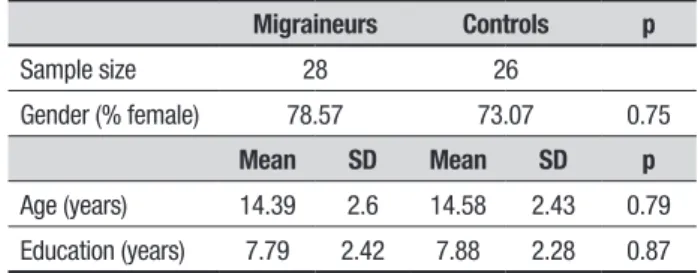
here were no diferences in age, sex and education between groups (Table 1).
Neuropsychological assessment showed signiicant diferences between groups in short-term and long-term verbal memory (RAVLT), attention and executive func-tions (ST and TMT) and speed of processing information and visuomotor tracking and selective attention (TMTa and TMTb) (Table 2). Subjects with migraine performed worse than controls on all tests.
Regarding RAVLT, migraine patients had signii-cantly lower scores than control subjects. his result indicates changes in verbal memory and cued recall and recognition of verbal stimuli. Signiicant diferences were detected in visuomotor selective attention and speed of
Table 1. Descriptive data.
Migraineurs Controls p
Sample size 28 26
Gender (% female) 78.57 73.07 0.75
Mean SD Mean SD p
Age (years) 14.39 2.6 14.58 2.43 0.79
Table 2. Performance on neuropsychological tests
Test
Controls Mean (SD)
Migraineurs
Mean (SD) p
RAVLT A1* 7.19 (1.93) 6.00 (1.41) 0.012
A2* 10.62 (1.79) 9.14 (2.30) 0.012
A3* 12.50 (1.27) 10.89 (2.00) 0.001
A4* 12.96 (1.53) 11.64 (2.14) 0.013
A5* 13.92 (1.54) 12.11 (2.06) 0.001
Σ A1A5* 57.19 (6.24) 49.79 (8.48) 0.001
B1* 7.04 (1.21) 5.93 (1.78) 0.011
A6* 12.69 (2.18) 10.14 (2.41) 0.000
A7* 13.04 (1.68) 9.79 (2.94) 0.000
Recognition* 14.62 (0.57) 13.79 (1.75) 0.025
Trail-Making Test Trail A (time, s)* 30.50 (8.08) 40.04 (18.65) 0.02
Trail A (errors) 0.62 (0.94) 0.32 (0.61) 0.176
Trail B (time, s)* 77.19 (34.72) 110.36 (68.89) 0.032
Trail B (errors) 0.88 (1.24) 1.21 (1.28) 0.344
Stroop Test Dots (time, s)* 14.19 (2.59) 16.04 (2.84) 0.016
Dots (errors) 0.54 (0.81) 0.68 (0.90) 0.553
Words (time, s) 17.31 (3.96) 19.14 (4.34) 0.112
Words (errors) 0.31 (0.47) 0.32 (0.72) 0.935
Colors (time, s) 26.31 (4.96) 29.29 (7.43) 0.092
Colors (errors) 1.85 (1.78) 1.32 (1.41) 0.235
Verbal Fluency Test F 11.69 (3.69) 11.14 (2.82) 0.54
A 10.08 (3.68) 9.39 (2.98) 0.45
S 9.58 (3.26) 9.64 (3.12) 0.94
Σ FAS 31.38 (9.12) 30.14 (7.64) 0.589
Animals* 18.15 (4.79) 14.71 (4.36) 0.008
*p<.05
processing information between groups, as measured by reaction time (time in seconds) on the TMTa and TMTb. On the TMT, there were no diferences in error rates between groups. Migraineurs also scored signiicantly lower on the ST than controls. here were no signiicant diferences in word reading or ink color naming between groups. Lastly, regarding the VFT, patients with migraine displayed lower performance in the animals category. here were no signiicant diferences in phonemic verbal luency (FAS test).
DISCUSSION
Patients with migraine had poorer cognitive perfor-mance on neuropsychological testing than controls. his result supports previous indings showing that children
and adolescents with migraine have impaired short- and long-term verbal memory, speed of processing informa-tion, and selective and divided attention.13,14,17,18
We observed that teenagers with migraine had ver-bal memory and learning impairments. Migraineurs are more afected by distractors during the learning process and have diiculties in recognition and recall. he poor test performance of migraineurs suggests deicits during registration, consolidation, and recall of verbal stimuli. hese deicits are associated with changes in the ability to organize thoughts and to use strategies to search for information. he impairment in short- and long-term memory in children with migraine may be linked to learning diiculties.13
execution time on the TMT where migraineurs took lon-ger to complete the test. Similar results have previously been reported.14 he TMT measures executive
function-ing and is associated with selective and divided attention, speed of processing information, and visuomotor track-ing. Deicits in visuomotor tracking and selective atten-tion are consistent with the available data on adults8
and children17 with migraine, but one study found no
signiicant diferences in sequential and simultaneous information processing between children with migraine and controls.19 Calandre et al.8 found diferences only in
reaction time between migraineurs and controls. To rec-oncile these indings, it is tempting to hypothesize that the speed of information processing might be the irst sign of cognitive dysfunction in migraine. Over time, other cognitive domains may be progressively compro-mised. Interestingly, visuomotor processing speed has been reported to be one of the main deicits associated with white matter abnormalities. hese are frequent unspeciic indings described in brain magnetic reso-nance imaging studies of patients with migraine.8
he neurochemical and molecular substrates related to cognitive alterations in migraine are not yet fully under-stood. Neuroimaging studies have found associations between white matter abnormalities and headache frequency in adults.20-22 Moreover, neurotransmitters
known to be involved with cognition such as dopamine, noradrenaline, and glutamate, seem to play a key role in the pathophysiology of migraine.23
Studies evaluating the verbal and phonological (F, A and S) luency of adults reported no changes in cognitive function.7,10,24 he current study found no signiicant
dif-ference in verbal luency performance between patients and controls. However, the migraine group showed poorer semantic verbal luency performance (animals). here are no consistent data in the literature on seman-tic verbal luency in adolescents with migraine. Quan-titative disparities found in semantic and phonological verbal luency may suggest that the two groups have sig-niicant diferences in long-term memory representation and strategies used during the retrieval process. Seman-tic luency seems to depend more on access to semanSeman-tic memory and its integrity than on executive processes, with greater temporal lobe activation. In phonological luency, the process of searching requires the creation of non-habitual strategies based on lexical representation, also with greater frontal lobe activation.25,26
In a cohort study assessing cognitive and academic performance in patients aged 3 to 26, subjects with migraine were slightly, but signiicantly impaired in comparison to individuals with tension type headache
and headache-free controls.18 he tests used in this study
measured verbal ability (especially language reception) in patients aging from 3 to 13 years, regardless of the exis-tence of any headache history, medication use, severity, or duration of episode. he association between migraine and verbal functioning also appeared to impact later aca-demic performance.
he current study has several limitations, includ-ing its cross-sectional design and small sample size. he restrictive study inclusion criteria, i.e. lack of any psychiatric disorder and not to be under prophylactic treatment, partly explain the study numbers, and relect the challenges of recruiting such patients. he study is clinic-based where patients were drawn from a referral center where more severe or disabling cases are usually followed. herefore, the current indings must be viewed with caution as they do not necessarily relect the cogni-tive status of patients in the community or individuals with milder forms of migraine.5,6 Also, the
aforemen-tioned indings have frequently been observed in other neurological conditions and do not seem to be speciic to migraine. Future studies involving larger samples and enrollment of subjects from the community are war-ranted to overcome these limitations. In future studies, it is of paramount importance to evaluate whether cogni-tive changes identiied impact school performance and/ or academic achievement.
In conclusion, the current results suggest that chil-dren and teenagers with migraine may exhibit cogni-tive symptoms. As similar changes are reported in adult patients with migraine,8,27,28 it remains to be established
whether cognitive impairment persists throughout life and/or re-emerges later.
Support. his work was partially supported by CAPES,
CNPq and Fapemig.
Acknowledgements. We would like to thank all the partic-ipants and their families for their collaboration in the study. We would also like to thank João Vieira Monteiro de Barros for revising the manuscript, as well as the Neurology Service of the Federal University of Minas Gerais, CNPq, and FAPEMIG for all their support on the research project.
Author contribution. MACS and ALT designed the study
REFERENCES
1. Lagman-Bartolome AM, Lay C. Pediatric migraine variants: a review of epidemiology, diagnosis, treatment, and outcome. Curr Neurol Neurosci Rep 2015;15:34.
2. Wöber-Bingöl C. Epidemiology of migraine and headache in children and adolescents. Curr Pain Headache Rep 2013;17:341.
3. Barea L, Tannhauser M, Rotta N. An epidemiologic study of headache among children and adolescents of southern Brazil. Cephalalgia 1996; 16:545-549.
4. Araújo CM, Barbosa IG, Lemos S, Domingues RB, Teixeira AL. Cognitive impairment in migraine. Dement Neuropsychol 2012;6:74-79. 5. Suhr JA, Seng EK. Neuropsychological functioning in migraine: clinical
and research implications. Cephalalgia 2012;32:39-54.
6. Rist PM, Kurth T. Migraine and cognitive decline: a topical review. Head-ache 2013;53:589-598.
7. Le Pira F, Zappala G, Giuffrida S, et al. Memory disturbances in migraine with and without aura: a strategy problem? Cephalalgia 2000;20: 475-478.
8. Calandre E, Bembibre J, Arnedo M, Becerra D. Cognitive disturbances and regional cerebral blood flow abnormalities in migraine patients: their relationship with the clinical manifestations of the illness. Cephalalgia 2002;22:291-302.
9. Schmitz N, Arkink E, Mulder M, et al. Frontal lobe structure and executive function in migraine patients. Neurosci Lett 2008;440:92-96. 10. Le Pira F, Lanaia F, Zappala G, et al. Relationship between clinical
vari-ables and cognitive performances in migraineurs with and without aura. Funct Neurol 2004;19:101-106.
11. Leijdekkers M, Passchier J, Goudswaard P, Menges L, Orlebeke J. Migraine patients cognitively impaired? Headache 1990;30:352-358. 12. Pearson A, Chronicle E, Maylor E, Bruce L. Cognitive function is not
impaired in people with a long history of migraine: a blinded study. Cephalalgia 2006;26:74-80.
13. D’Andrea G, Nertempi P, Milone F, Joseph R, Cananzi A. Personality and memory in childhood migraine. Cephalalgia 1989;9:25-28.
14. Villa T, Correa Moutran A, Sobirai Diaz L, et a. Visual attention in chil-dren with migraine: a controlled comparative study. Cephalalgia 2009; 29:631-634.
15. Rocha-Filho PA, Santos PV. Headaches, quality of life, and academic performance in schoolchildren and adolescents. Headache 2014;54: 1194-202.
16. Headache Classification Subcommittee of the International Headache Society. The international classification of headache disorders. 2nd
Edition. Cephalalgia 2004;24:1-149.
17. Riva D, Aggio F, Vago C, et al. Cognitive and behavioral effects of migraine in childhood and adolescence. Cephalalgia 2006;26:596-603. 18. Waldie K, Hausmann M, Milne B, Poulton R. Migraine and cognitive
function: A life-course study. Neurology 2002;59:904-908.
19. Haverkamp F, Honscheid A, Muller-Sinik K. Cognitive development in children with migraine and their healthy unaffected siblings. Headache 2002;42:776-779.
20. O’Bryant S, Marcus D, Rains J, Penzien D. The neuropsychology of recurrent headache. Headache 2006;46:1364-1376.
21. Kruit M, van Buchem M, Launer L, Terwindt G, Ferrari M. Migraine is associated with an increased risk of deep white matter lesions, subclin-ical posterior circulation infarcts and brain iron accumulation: the popu-lation-based MRI CAMERA study. Cephalalgia 2010;30:129-136. 22. Porter A, Gladstone J, Dodick D. Migraine and white matter
hyperintensi-ties. Curr Pain Headache Rep 2005;9:289-93.
23. Akerman S, Goadsby P. Dopamine and migraine: biology and clinical implications. Cephalalgia 2007;27:1308-1314.
24. Camarda C, Monastero R, Pipia C, Recca D, Camarda R. Interictal exec-utive dysfunction in migraineurs without aura: relationship with duration and intensity of attacks. Cephalalgia 2007;27:1094-1100.
25. Azuma T. Working Memory and Perseveration in Verbal Fluency. Neuro-psychology 2004;18:69-77.
26. Baldo J, Schwartz S, Wilkins D, Dronkers N. Role of frontal versus temporal cortex in verbal fluency as revealed by voxel-based lesion symptom mapping. J Int Neuropsychol Soc 2006;12:896-900. 27. Hooker W, Raskin N. Neuropsychologic alterations in classic and
common migraine. Arch Neurol 1986;43:709-712.