Thyroid Unit, Division of Endocrinology, Department of Clinical Medicine, University of São Paulo Medical School, São Paulo, Brazil.
Email: [email protected]
Received for publication on January, 19, 2006. Accepted for publication on April 27,2006.
ORIGINAL RESEARCH
PREVALENCE OF CHRONIC AUTOIMMUNE
THYROIDITIS IN THE URBAN AREA NEIGHBORING A
PETROCHEMICAL COMPLEX AND A CONTROL
AREA IN SAO PAULO, BRAZIL
Rosalinda Y. A. Camargo, Eduarto K. Tomimori, Solange C. Neves, Meyer Knobel, Geraldo Medeiros-Neto
Camargo RYA, Tomimori EK, Neves SC, Knobel M & Medeiros-Neto G. Prevalence of chronic autoimmune thyroiditis in the urban area neighboring a petrochemical complex and a control area in São Paulo, Brazil. Clinics. 2006;61(4):307-12.
PURPOSE: To evaluate the prevalence of chronic autoimmune thyroiditis in 2 urban areas of metropolitan São Paulo (Brazil): Polo Area neighboring a large petrochemical complex and São Bernardo Campo Area (control area).
SUBJECTS AND METHODS: Subjects were randomly included from the adult population (20 to 70 years of age) of both genders (women 80%, men 20%) who voluntarily agreed to participate. From the Polo Area, in the vicinity of a large petrochemical industrial complex, 409 subjects were included; from the control area (São Bernardo Campo Area) 420 individuals were included. All subjects were clinically examined, and a detailed record of past thyroid illness and medications was obtained. Ultrasonographic studies were performed using a portable GE Medical Systems apparatus. Blood samples were obtained for free T4, serum TSH, and serum anti-thyroid peroxidase autoantibodies. Urine specimens were collected in Monovette syringes for assaying iodine content. Salt samples were collected at households, and the iodine content was measured.
RESULTS: Chronic autoimmune thyroiditis was diagnosed both echographically (marked hypoechogenicity) and immunologically (presence of autoantibodies against thyroid peroxidase). In the Polo Area, 15.6% of the examined population had chronic autoimmune thyroiditis, and in the control area (São Bernardo Campo Area), 19.5% of the population had evidence of chronic autoimmune thyroiditis (P > 0.057, not significant). The prevalence of hypothyroidism was 4.9% in the Polo Area and 8.3% in the São Bernardo
Campo Area (P = 0.0461 significant). Taking the 2 populations together, 6.6% had hypothyroidism (about one third of these
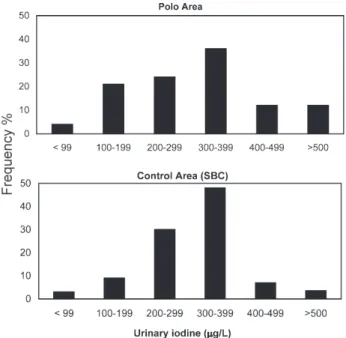
patients were on L-T4 treatment). The mean thyroid volume was 11.2 mL. Domestic salt had a normal concentration of iodine (35.5 + 6.61 mg/kg). Urinary excretion of iodine was above 300 µg Iodine/L in 58.5% of the total population.
CONCLUSION: The high iodine intake (above 300 µg Iodine/L of urine) that was present from 1998 through 2005 may be
related to a higher prevalence of chronic autoimmune thyroiditis in both areas that were studied. There was no apparent or documented relationship of chronic autoimmune thyroiditis prevalence to the proximity to the petrochemical complex.
KEY WORDS: Hashimoto’s Thyroiditis, Iodine Intake, Autoimmune Disease, Hypothyroidism, Thyroid Antibodies, Petrochemical Pollutants.
INTRODUCTION
Several studies from various countries around the world differ in their prevalence estimates of thyroid dysfunction.1
The difficulty with these reports lies in the variable defi-nition of disease states, in the heterogeneity of the studied population, in the relatively insensitive measurements of thyroid function, and in the absence of imaging (echography) of the thyroid gland.2-7 In one longitudinal
stud-ies across many different countrstud-ies, Vanderpump et at3
con-cluded that primary thyroid failure occurs in 5% of multi-ple populations. In a very large (n = 25,862) population-based study, Canaris et al4 indicated that elevated serum
TSH levels, indicative of hypothyroidism, was present in 9.5% of the participants from Colorado, USA. Virtually all studies report higher prevalence rates for hypothyroidism in women and with advancing age, with rates as high as 24% among women older than 60 years.4
Nutritional iodine is an important factor linked to the risk of thyroid dysfunction. As indicated by the World Health Organization, more than two thirds of the 5 billion people living in countries affected by iodine deficiency now have access to iodized salt.8 In South America, iodine
nu-trition has considerably improved over the last decade.9
However, high iodine intake has been detected in some countries: > 300 µg Iodine/L of urine in Brazil, and > 500 µg Iodine/L of urine in Chile. Excess dietary iodine may
increase the risk for chronic autoimmune thyroiditis (CAT) (mostly in women) and for the hyperthyroidism that is fre-quently detected in the elderly.10,11
In Brazil, a relatively low iodine intake was detected in the 1994-1995 national survey of 20,000 schoolchil-dren.12 Urinary excretion of iodine was less than 100 µg
Iodine/L of urine in more than 50% of these children. Ac-cordingly, in 1998 the Brazilian Health Authorities in-creased the fortification of iodine in salt for human use from 40 to 100 mg/kg of salt (40 to 100 ppm).
In 2001, the Thyromobil project12 examined 2,106
schoolchildren from 21 villages of 8 States and concluded that more than 67% of the children had a urinary iodine excretion over 300 µg Iodine/L and 35% had values greater
than 500 µg Iodine/L of urine. This was confirmed by
an-other recent study by Duarte et al13 who found that 57%
of the examined schoolchildren (n = 829) in São Paulo State had high urinary iodine excretion (>300 µg Iodine/L).
In this study, we aimed to evaluate the consequences to the thyroid gland of more than 5 years of excessive nutri-tional iodine intake in Brazil (1998-2003). We have exam-ined 829 participants from the Metro Region of São Paulo, subdivided into 2 groups. One group (Polo Area, n = 409) lived close to the petrochemical complex, and the other group (São Bernardo Campo Area, n = 420) lived in the same ur-ban conditions but were located 10 miles southwest of the petrochemical complex. For all participants, imaging stud-ies of the thyroid were conducted by ultrasonography. Free T4 and TSH serum levels, serum concentration of anti-thy-roid peroxidase (anti-TPO) antibodies, and urinary excretion of iodine were measured. Moreover, we examined the io-dine content of samples of domestic salt, ie, salt that was actually being used in the participants’ homes.
SUBJECTS AND METHODS
This was a population-based cross-sectional study in which subjects, aged 20 to more than 70 years of age, ap-proximately 80% women and 20% men, were randomly included. The relatively low proportion of men in this study may be explained by the fact that the study was conducted during working hours (Friday afternoon and Saturday morn-ing) when most men (blue-collar workers) were away from their respective homes. The main objective of this study was to compare the prevalence of CAT between two dif-ferent areas: Polo Area (neighboring the petrochemical complex) and the control area (São Bernardo Campo area, about 10 miles from the petrochemical complex). These results may not be extended to the whole population liv-ing in that part of metropolitan São Paulo City, due to higher proportion of women in both populations studies. Table 1- Prevalence of chronic autoimmune thyroiditis in two distinct areas of São Paulo, Brazil.
Age groups (years)
20-30 31-50 51-70 >70 Total
Polo Area (n) 8 39 22 4 64
(%) 11.1 15.1 18.8 19.0 15.6
S. B. Campo Area (n) 14 37 30 1 82
(%) 20.0 20.8 19.3 5.9 19.5
P = 0.143 (chi square test, not significant)
The reason for studying two distinct areas was based in the debatable assumption that a higher prevalence of CAT could be associated with pollutants from the petro-chemical complex as extensively publicized in the local lay media. Although the Health Authorities could find no sci-entific basis for this association, it was decided that a popu-lation-based, comparative study of prevalence should be conducted in two areas, ie, close to the petrochemical com-plex and a control area.
A detailed map of the two urban areas was obtained, and blocks were selected at random. Within the blocks, streets were included by arbitrary numbers, and the homes within the streets were randomly included. Each home was visited by 2 medical students, and 1 or more inhabitants were, voluntarily, selected to be included and offered a de-tailed consent form to be signed. This study was approved by the Ethical Committee for Research Projects of the Hos-pital das Clinicas University of São Paulo Medical School. A total of 346 women (84.6%) and 63 men (15.4%), aged 45.2 ± 14.3 years (mean ± SD), were included from the Polo Area, and 366 women (87.1%) and 54 men (12.9%), aged 46.4 ± 14 years (mean ± SD) were included in the São Bernardo Campo Area (control area). Subjects in both areas were subdivided into 4 age groups: 20-30, 31-50, 51-70, and > 70 years old. There were no statisti-cal differences in any of the above variables for the two independent populational areas. All patients underwent echographic studies of the thyroid; samples of total blood and a urine specimen were collected. Additionally, subjects were asked to bring a sample of the salt actually being used in their homes.
Echographic studies. Thyroid ultrasonographic studies were conducted by the same investigators (RYAC and EKT) using a portable GE Medical Systems apparatus with a 7.5 mHz probe. Thyroid volume was calculated as previously described.7 Hypoechogenicity was expressed in arbitrary
units: grade 1, normal and hyperechoic to neck muscles; grade 2, lightly hyperechoic to neck muscles; grade 3, isoechoic to neck muscles; and grade 4, extensively hypoechoic to neck muscles16.
Thyroid function tests. Serum free T4 (normal range, 0.7-1.7 ng/mL) and serum TSH (normal range, 0.5-4.0 µU/
mL) were assayed by electrochemiluminescence (Roche Diagnostics, Indianopolis, USA). Anti-TPO antibodies were assayed using Perkin-Elmer kits (Auto Delphia TPOAb, Wallac Oy, Finland). The normal value for TPO anti-bodies is less than 35 U/mL.
Urinary excretion of iodine. Urinary excretion of iodine was assayed by a modified Sandell-Kolthoff method13 in a
fasting sample of urine and expressed as µg of lodide per
liter of urine.
Concentration of iodine in salt samples. The current le-gal concentration of iodine in salt for human use is 20-60 mg of iodine/kg of salt (National Agency for Sanitary Sur-veillance, March 2003). The iodine content in salt samples was assayed by the official Laboratory for Food Control, São Paulo.
Statistical analysis. Quantitative variables are presented as mean ± standard deviation, and qualitative variables are presented as proportions.14 The chi-square test was used to
compare proportions between independent groups. The Stu-dent t test was used to compare 2 group means for
nor-mally distributed data. The Kruskal-Wallis ANOVA on ranks test was performed to test for differences in the TSH among the 4 age groups followed by post-hoc Student-Newman-Keuls tests as appropriate. Statistical analysis was conducted using SAS 8.0 software (Statistical Analysis Sys-tem, Cary, NC, USA) and Minitab version 14 (State Col-lege, PA, USA).
RESULTS
The main purpose of this project was to evaluate the comparative prevalence of CAT in the Polo Area versus the control area. We used the well-known criteria for diagno-sis of CAT that include ultrasonographic structural changes and hypoechogenicity, and the presence of TPO anti-bodies.15-18 Therefore, we anticipated that CAT could be
defined as follows:
(1). An ultrasonographic pattern of marked absence of echos within the limits of the thyroid gland (Grades 3 and 4, or marked hypoechogeinicity) or the presence of an atrophic thyroid gland (less than 3 mL).
(2). The presence of anti-TP0 autoantibodies (>35 U/ mL) associated with the echographic pattern of marked hypoechogeinicity or thyroid atrophy.
Both events were present in 64/409 subjects (15.6%) in the Polo Area and in 82/420 individuals (19.5%) in the con-trol area (São Bernardo Campo Area). These prevalences were not statistically different (chi-square test, P = 0.143).
Taking both populations together 146/829 subjects (17.6%) had the diagnosis of chronic autoimmune thyroiditis.
Clinical and subclinical hypothyroidism in the populations studied. An elevated serum TSH level (> 4.5
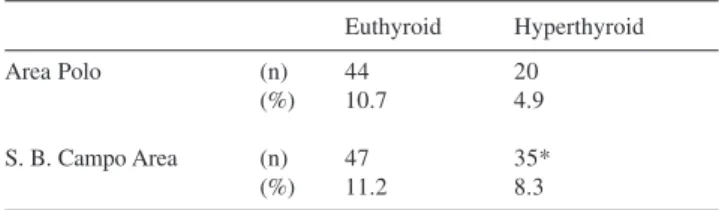
µU/mL) was found in 20/64 patients with CAT (4.9%) in
the Polo Area, whereas 35/82 (8.3%) in the São Bernardo Campo Area had elevated serum TSH levels, suggestive of a diagnosis of hypothyroidism; the difference between ar-eas was significant (P = 0.046, chi square test).
Prevalence of hyperthyroidism. Hyperthyroidism was defined by serum TSH values below 0.1 µU/mL and
409) patients, and in the São Bernardo Campo Area, 14/ 420 patients (3.3%) had a laboratory diagnosis of hyper-thyroidism; (the difference between areas was not signifi-cant (P = 0.137, chi square test).
Thyroid volume. There was a significant difference be-tween the mean + SD measurements for thyroid volume for the Polo Area (10.1 + 4.1 mL) and the São Bernardo Campo Area (12.3 + 6.1 mL) (P < 0.001, Student t test).
Iodine concentration in the “spot” urine specimen. We analyzed 119 urine specimens in the Polo Area and 112 urine specimens in the São Bernardo Campo Area from ran-domly selected subjects. The median values were, respec-tively, 306.0 µg Iodine/L (Polo Area) and 306.8 µg Iodine/
L (São Bernardo Campo Area). The mean + SD values for these areas (Polo Area 285.9 + 114.4 µg Iodine/L) and São
Bernardo Campo Area 296.8 + 88.4 µg Iodine/L) were not
significantly different p>0,05. Most of those tested in both communities had an elevated urinary excretion of iodine (above 300 µg Iodine/L) as follows: 59.7% (Polo) and
58.0% (São Bernardo Campo).
Iodine in domestic salt (home samples). In the Polo Area, the iodine content in the home salt sample ranged from 24.7 to 51.4 mg I/kg, whereas in the São Bernardo Campo Area, the iodine in the salt ranged from 23.8 to 81.2 mg I/kg. Three samples in the São Bernardo Campo Area were above the legal limit of 60 mg I/kg. The mean + SD were, respectively, 35.5 + 6.6 mg I/kg (Polo Area) and 35.6 + 12.7 mg I/kg salt (São Bernardo Campo Area).
DISCUSSION
The influence of dietary iodine is clearly shown in sev-eral studies using experimental autoimmune thyroiditis, and this could be related to the increase in immunogenicity of thyroglobulin (and other thyroid antigens) attracting anti-thyroid antibodies and causing anti-thyroid injury.1 In humans,
susceptibility to autoimmune thyroid disease clearly in-creases with age, resulting from extended exposure to en-vironmental factors (such as excessive nutritional iodine intake) and, obviously, changes in immunoregulation. In many countries, the introduction of iodine prophylaxis has induced an increased prevalence of CAT and the surge of thyroid autoantibodies.16-24 More recently, Zois et al23 have
reported the impact of increased nutritional iodine intake in schoolchildren (n = 300) in Northern Greece. After 7 years of iodine prophylaxis, 10% of the schoolchildren had an echographic pattern of CAT associated with the pres-ence of anti-TPO autoantibodies. Moreover, 2.5% of the children had laboratory evidence for subclinical hypothy-roidism.
In a recent study conducted by Teng et al24 in 3 areas
in China with different iodine intake low, (median 84 µg/L) adequate, (median 243µg/L) and excessive iodine intake, (median 651 µg/L), it was demonstrated that the area with excessive iodine intake had 5.6 times more CAT as com-pared with the area with low iodine intake (p<0.001). Moreover clinical and sub clinical hypothyroidism was 6.6 times more prevalent in the area with excessive iodine in-take as compared with the area with low iodine inin-take. The authors concluded that more than adequate, or excessive iodine intake may lead to autoimmune thyroiditis and hy-pothyroidism.
As previously reported,12 a population-based survey
con-ducted in 1994 in Brazil concluded that about half of the examined schoolchildren (n = 20,000) had evidence of a relatively low iodine intake (urinary excretion of iodine was less than 100 µg Iodine/L). In the same year, Tomimori et
al7 examined 547 normal, obese subjects in São Paulo
us-ing thyroid echographic studies, thyroid function tests, and tests for the presence of anti-TP0 autoantibodies. They con-cluded that in this largely urban population, the prevalence of CAT was 9.4%, with a 4.9% prevalence of clinical and laboratory evidence for hypothyroidism.
In 1995 following the introduction of legislation mak-ing salt iodination mandatory for human use in the pro-portion of 40 to 100 mg Iodine/kg, it was believed that io-dine deficiency and its consequences would be abolished in Brazil. However, when we started the Thyromobil Project in 20017 and examined 2,013 schoolchildren in 21 villages
of 8 Brazilian States, we concluded that goiter was pratically eliminated, but that 67% of the schoolchildren excreted more than 300 µg Iodine/L of urine and 35%
ex-creted more than 500 µg Iodine/L of urine.7 This situation
was compatible with excessive iodine intake mainly—if not exclusively—from iodized salt. Therefore, in 2003 the Health Authorities reduced the level of salt iodination to 20-60 mg Iodine/kg of salt.
In any event, it became clear that for almost 6 years the Brazilian population had been exposed to excessive io-dine intake. As a consequence, we observed a significant increase in the prevalence of CAT to a level of 17.6% in the São Paulo Metro area as compared to 9.4% in 1994. However, this comparison has limitations. First, the study by Tomimori et al7 was conducted in normal, obese
indi-viduals that were included from the population that came for consultation at the University Hospital. Second, the uri-nary excretion of iodine in this population was relatively low (median 106 µg Iodine/L). Third, the objective of the
Excessive iodine intake, as indicated by more than 500
µg Iodine/L of urine, has been also associated with
in-creased thyroid volume.16 In our patients, thyroid volume
was considered to be within the normal range in both ar-eas. A number of recent studies15-18 have indicated that
thy-roid hypoechogenicity associated with the presence of anti-TPO autoantibodies is highly indicative of the presence of autoimmune thyroiditis. Indeed Raber et al,16 using an
ar-bitrary scale to define hypoechogenicity, have concluded that a pattern of marked hypoechoic thyroid gland has a positive predictive value for detection of autoimmune thy-roiditis of 94% with any degree of hypothyroidism. Oth-ers17 have introduced a quantitative evaluation of thyroid
echogenicity (Gray-scale analysis) for patients with Hashimoto’s thyroiditis, concluding that hypoechogenicity is significantly correlated with high serum TSH values and presence of anti-TPO autoantibodies.
Based on these observations, we believe that our study clearly demonstrates a higher prevalence of chronic autoimmune thyroiditis (CAT) in both areas in which the epidemiological survey was conducted. There was no sig-nificant difference between the prevalence of CAT in the population living close to the petrochemical complex as compared to the control area. Both populations had the same elevated iodine intake. The only significant difference was that hypothyroidism was more prevalent in the con-trol area (São Bernardo do Campo).
In conclusion, as clearly demonstrated in past studies conducted in several distinct geographical areas of the world, a 5-year exposure to a higher nutritional iodine in-take may have had resulted in a higher prevalence of CAT in the urban population of Metropolitan São Paulo. There was no connection between prevalence of CAT and the vi-cinity to the petrochemical complex. As a corollary to the present study, we would suggest that the addition of po-tassium iodate to the salt for human use should be revised by the Health Authorities in the near future.
ACKNOWLEDGMENTS
This study was made possible through a Research grant from the Research Foundation of the State of São Paulo (FAPESP 03/00827-0). We gratefully acknowledge the ex-cellent contribution in the field studies conducted by the Medical Students, Thiago Ueda and Ana Carulina Lessa Moreno, both from the University of São Paulo Medical School, the laboratorial work of Maria Silvia Cardia (Thy-roid tests) and Ana Luiza Galrão (urinary iodine excretion). We are also grateful to the Health Authorities, nurses and social workers of the urban areas of São Bernardo do Campo, Santo Andre, Maua and Capuava for their help in the epidemiological survey.
Table 3 - Prevalence of hypothyroidism (associated with chronic autoimmune thyroiditis) in both areas.
Euthyroid Hyperthyroid
Area Polo (n) 44 20
(%) 10.7 4.9
S. B. Campo Area (n) 47 35*
(%) 11.2 8.3
*P = 0.046 (chi square test, significant)
Table 2- Prevalence of chronic autoimmune thyroiditis by gender in the two studied areas.
Women Men Total
Polo Area (n) 56 8 64
(%) 13.7 1.9 15.6*
S. B. Campo Area (n) 74 8 82
(%) 17.6 1.9 19.5*
*Relative (%) prevalence in each of the studied areas.
RESUMO
Camargo RYA, Tomimori EK, Neves SC, Knoel M & Medeiros-Neto G. Prevalência de tireoidite de Hashimoto na população vicinal ao Polo Petroquímico de Capuava (área Polo) e área controle (São Bernardo Campo) na região metropolitana da grande São Paulo, Brasil. Clinics. 2006;61(4):307-12.
OBJETIVO: Analisar a prevalência populacional de
diferenças significativas quanto a idade e sexo). Na área Polo 15,6% apresentava sinais ecográficos e de positividade para anticorpos anti TPO, confirmando tireoidite crônica autoimune (TCA) comparativamente a 19,5% na área controle (p > 0,05, NS). A presença de hipotiroidismo foi confirmada em 4,9% da população na área Polo e 8,3% na área controle (São Bernardo Campo) (p = 0,046, significativo). No conjunto 6,63% dos pacientes com TCA apresentavam hipofunção tireóidea. A excreção urinária de iodo ultrapassou 300 mcg Iodo/L de urina em 58,5% de ambas populações. O sal coletado nas casas dos examinados apresentava concentração
normal de iodo (35,5 + 6,6 mg I/Kg de sal).
CONCLUSÕES: A maior prevalência de tireoidite crônica autoimune em ambas as áreas é, provavelmente, decorrente da elevada ingestão nutricional de iodo durante o quinqüênio que precedeu esta pesquisa (1998-2004). A suposta conexão epidemiológica de maior prevalência epidemiológica de TCA com vicinidade com o Polo Petroquímico de Capuava é improvável.
UNITERMOS: Tireoidite crônica, Iodo nutricional, Doença autoimune, Hipotireoidismo, Anticorpos anti-tireóide, Poluentes petroquímicos.
REFERENCES
1. Weetman AP, McGregor AM. Autoimmune thyroid disease: further developments in our understanding. Endocr Reviews. 1994;15:788-829. 2. Tunbridge WMG, Evered DC, Hall R, Appleton D, Brewis M, Clark F, et al. The spectrum of thyroid disease in a community: the Whickham survey. Clin Endocrinol. 1997;7:481-93.
3. Vanderpump MPJ, Tunbridge WMG, French JM, Appleton D, Bates D, Clark F, et al. The incidence of thyroid disorders in the community: a twenty year follow-up of the Wickham survey. Clin Endocrinol. 1995;43:55-68.
4. Canaris GJ. Monowitz NR, Mayor G, Ridgway EC. The Colorado Thyroid Disease Prevalence Study. Arch Intern Med. 2000;160:506-34.
5. Hollowell JG, Stachling NW, Flanders DW, Hannon WH, Gunter EW, Spencer CA, et al. Serum TSH, T4, and thyroid antibodies in the USA population (1988-1994). J Clin Endocrinol Metab. 2002;87:489-99. 6. Lima N, Cavaliere H, Medeiros-Neto G. A retrospective study of thyroid
autoimmunity and hypothyroidism in random obese population. Med Sci Research. 1997;15:317-32.
7. Tomimori EK, Pedrinola F, Cavaliere H, Knobel M, Medeiros-Neto G. Prevalence of incidental thyroid disease in a relatively low iodine intake area. Thyroid. 1995;5:273-6.
8. World Health Organization / UNICEF / ICCIDD. Assessment of iodine deficiency disorders and monitoring their elimination. WHO, Geneva Switzerland, NHD/01.01 2001.
9. Pretell EA, Delange F, Hostalek U, Corigliano S, Barreda L, Higa AM. Iodine nutrition improves in Latin America. Thyroid. 2004;14:590-9. 10. Diez JJ & Iglesias P. Spontaneous subclinical hypothyroidism in patients
older than 55 years. J Clin Endocrinol Metab. 2004;89:4890-7. 11. Bagchi N, Brown TR, Parish RF. Thyroid dysfunction in adults over
age 55 years. Arch Int Med. 1990;150:785-7.
12. Knobel M & Medeiros-Neto G. Chronic Iodine deficiency disorders. Arq Bras Endocr Metab. 2004;48:53-61.
13. Duarte GC, Tomimori EK, Boriolli RA, Ferreira JE, Catarino RM, Camargo RYA, et al. Avaliação ultra-sonografica da tireóide e determinação da ioduria em escolares de diferentes regiões do estado de São Paulo. Arq Bras Endocrinol Metab. 2004;49:842-8.
14. Newcombe RG. Two-sided confidence intervals for the single proportion: comparison of seven methods. Statistics in Medicine. 1998;17:857-72.
15. Pedersen OM, Aardal NP, Larssen TB, Varhaug JE, My King O, Vik-Mo H. The value of ultrasonography in predicting autoimmune thyroid disease. Thyroid. 2000;10:251-9.
16. Raber W, Gessl A, Nowtny P, Vierhapper H. Thyroid ultrasound versus antithyroid peroxidase antibody determination: a cohort study of four hundred fifty one subjects. Thyroid. 2002;12:725-31.
17. Mazziotti G, Sorvillo F, lorio S, Carbone A, Romeo A, Piscopo M, et al. Grey-scale analysis allows a quantitative evaluation of thyroid echogenicity in the patients with Hashimoto s thyroiditis. Clin Endocr. 2003;59:223-9.
18. Pedersen IB, Lawberg P, Knudsen N, Jorgensen T, Perrild H, Ovesen L, et al. A population study of the association between thyroid autoantibodies in serum and abnormalities in thyroid function and structure. Clin Endocrinol. 2005;62:713-20.
19. Bensenor I. Screening for thyroid disorders in asymptomatic adults from Brazilian populations. São Paulo Medical J. 2002;120:146-51. 20. Harach HR, Escalante DA, Onativia A, Outes JL, Day ES, Williams ED.
Thyroid carcinoma and thyroiditis in an endemic goiter region before and after iodine prophylaxis. Acta Endocrinol. 1985;108:55-60. 21. Mizukami Y, Michigishi T, Nonomura E, Hashimoto T, Tonami N,
Matsubara F, et al. Iodine-induced hypothyroidism: a clinical and histological study of 28 patients. J Clin Endocrinol Metab. 1993;76:466-71.
22. Monteiro E, Galvão-Teles A, Santos ML, Mourão L, Coréia MJ, Tuna JL, et al. Antithyroid antibodies as a marker for thyroid disease induced by amiodarone. Br Med J. 1986;292:227-8.
23. Zois C, Stavrou I, Kalogera C, Svarna E, Dimoliatis I, Seferiadis K, et al. High prevalence of autoimune thyroiditis in schoolchildren after elimination of iodine deficiency in northwestern Greece. Thyroid. 2003;13:485-9.