CONTACT DERMATITIS
Review Article
Allergic contact dermatitis from modified
colophonium in wound dressings
TERESAM. PEREIRA1, MARIAFLOUR2ANDANGOOSSENS2
1Servicxo de Dermatologia e Venereologia, Hospital de Sa˜o Marcos, Braga, Portugal, and 2Department of Dermatology, Katholieke Universiteit Leuven, B-3000 Leuven, Belgium
This study concerns a 69-year-old female patient with a longstanding history of venous ulcerations on both lower legs and multiple sensitivities, who developed eczematous lesions with the hydrocolloid dressing Combiderm1 (Convatec Ltd., a Bristol-Myers Squibb division, Ickenham, Middlesex, UK). Epicutaneous tests were positive to this dressing and to a modified colophonium derivative, i.e. glyceryl rosinate, however not to the unmodified colophonium from the standard series. A review of the literature showed several case reports about sensitization to similar hydrocolloids being distributed under various brand names in different countries and which contain the pentaerythritol ester of the hydrogenated rosin as the tackifying agent. Some of the patients described did, while others did not, react to colophonium but only to a modified derivative. In our patient, the reaction to glyceryl rosinate most probably represent cross-sensitivity with the modified colophonium derivative used in Combiderm1, the presence (but not the exact nature) of which was showed by the company. In patients where allergic contact dermatitis from hydrocolloid dressings is strongly suspected and colophonium tests negatively, patch testing to modified colophonium derivatives should therefore be performed. As the complete composition of wound dressings is most often unknown, we urgently advocate legal requirements for labelling of those and in fact all medically used devices.
Key words: allergic contact dermatitis; colophonium; glyceryl rosinate; leg ulcer; modified colophonium; patch test; rosin; treatment; wound dressings.#Blackwell Munksgaard 2007.
Accepted for publication 29 September 2006
Leg ulcers represent a chronic condition affecting more than 1.7% of the population older than 65 years (1). Because healing is difficult to achieve, these patients are exposed to many topical drugs and dressings for long period of time. Sensitiza-tion therefore occurs in these patients and increases with duration of the ulcer (2). Over the past years, because of their sophisticated compos-ition, hydrocolloids dressing have been introduced routinely in the treatment of various types of wounds, which may be clean, granulating or necrotic, or with low to moderate exudates. They provide a moist environment, promoting autolytic debridement, and stimulation of angiogenesis. While these dressings may be more expensive, if used correctly, they are cost-effective because they have a longer wear time. However, long-term application often leads to inflammation of the skin in the immediate neighbourhood of the ulcer, being an irritant dermatitis in many cases, but sometimes also leads to contact sensitization.
Case Report
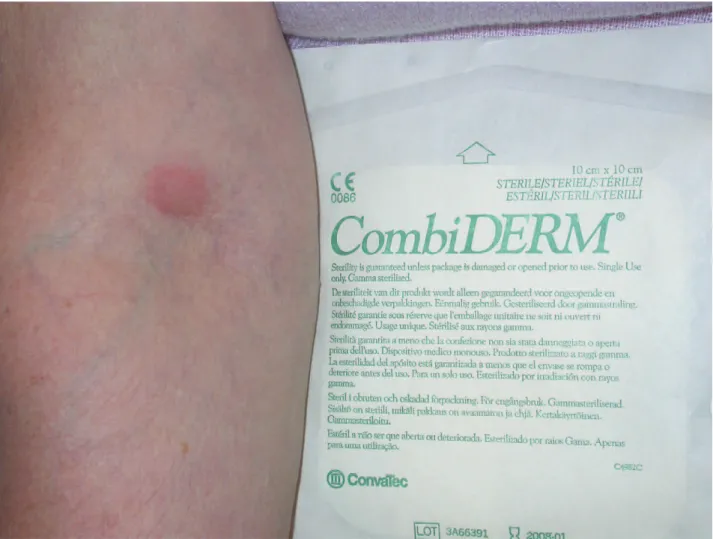
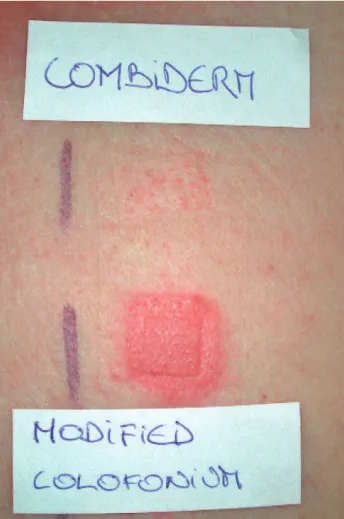
suspected, and she was asked to apply the adhe-sive part of both hydrocolloids to her forearms, the adhesive part of the Combiderm1 clearly producing an eczematous reaction 3 days later (Fig. 1). Patch tests were again performed in September 2005 with Combiderm1(tested as is), colophonium (Trolab, Reinbeck, Germany) as present in the standard series and other allergens possibly present in adhesives, such as polyethylene glycol 400 20% aqua, acrylate components, and modified colophonium (Table 1), i.e. glyceryl ros-inate [20% petrolatum (pet.)] that was available to us from Reckitt Benckiser (Massy, France) (3). Positive reactions were obtained to this hydro-colloid as well as to the modified colophonium derivative (Fig. 2).
Convatec informed us that Combiderm1 con-sists of 2 elements: a non-adhesive layer based on polypropylene in contact with the wound (to which the patient did not react positively) and an adhesive part having a similar composition as Duoderm extra thin1 (also from Convatec), which contains the pentaerythritol ester of rosin
(Pentalyn1), a modified colophonium deriva-tive that is not present in the regular Duoderm (4) to which our patient had not reacted on her forearm.
The ulcer was first treated with KMnO4
com-presses (dilution 1/4000) and zinc oxide paste, and compressive therapy was given. Because of
Fig. 1. Positive ‘use’ test with Combiderm1(reading at 3 days).
Table 1. Patch tests results
Patch tests D2 D4
Combiderm1
(as is) þ þ
Colophonium 20% pet.
Modified colophonium (glyceryl rosinate, 20% pet.)
þ þ
Polyethylene glycol 400, 20% aqua
Acrylate components:
methyl methacrylate 2% pet., 2-hydroxyethylacrylate 2% pet., hydroxyethylmethacrylate 2% pet., ethyleneglycol dimethacrylate 2% pet., and epoxy-acrylate 0.5% pet.
(all from Chemotechnique, Malmo, Sweden)
Staphylococcus aureus infection, she was given antibiotic therapy with erythromycin ethyl suc-cinate (Erythroforte1; Abbott, Ottignies, Belgium). The dermatitis cleared, and the ulcer became better but did not heal completely before May 2006.
Discussion
Investigations on the sensitizing potential of mod-ern wound dressings are few and focus only on sin-gle sensitizing agents. In a study by Gallenkemper et al. (5), 20 different wound dressings were tested in 36 patients with chronic venous insufficiency and positive reactions were observed in 3 of them, i.e. 8.3%. All the cases were related to propylene glycol as an ingredient of hydrogels. They did not detect sensitization to hydrocolloids, alginates or polyurethane foams. Later on, Tavadia et al. (6) and Machet et al. (2) have obtained similar results and observed very low rates of sensitivity to the newer dressings, with the exception of hydrogels. They did observe positive reactions to colopho-nium; however, they did not test modified colo-phonium derivatives.
Nevertheless, a review of the literature shows several isolated case reports of sensitization to similar hydrocolloids being produced by the same manufacturer but distributed under various brand names in different countries. This concerns case reports about Duoderm E1 or CGF1(3 cases) (4) and 1 case to Varihesive1(Duoderm E) (7), all containing the pentaerythritol ester of the hydro-genated rosin (Pentalyn1) as the tackifying agent. In these cases, positive patch test reactions were observed to the dressings as well as to colopho-nium. However, none of the patients was tested to the ester of hydrogenated rosin (modified colo-phonium), but the authors assumed that the patients became sensitized to this compound, in view of their concomitant reaction to colopho-nium. Mallon and Powell (8) identified Pentalyn1, i.e. the pentaerythritol ester of hydro-genated rosin (diluted 10% and 20% pet.), as the responsible allergen in 2 patients with allergic con-tact dermatitis from Granuflex E1 that also reacted positively on patch testing. They also obtained positive reactions to colophonium and ester gum resin (glycerol ester). Schliz et al. (9) per-formed patch tests with Varihesive E1 and Comfeel1 (Coloplast BV, Peterborough, UK) in 41 consecutive patients with leg ulcers, 8 of whom reacted to one or both dressings; they identified the contact allergen Pentalyn1 in 1 patient and a derivative of polyisobutylene in another patient. In the other 6 cases that patch tested positively to hydrocolloid dressings, the authors could not iden-tify the responsible allergen. Mollin (10) tested 25 consecutive patients hospitalized for chronic venous ulcers and found 13 patients with positive patch test reactions to various types of Duoderm1 dressings: among them, 10 reacted to Duoderm E1 and 8 were allergic to Pentalyn1. However, they did not address the question of cross-sensitization with unmodified colophonium nor mentioned the allergen responsible in the other cases.
Some authors have reported cases in which, as in our patient, in contrast to a positive test to a modified colophonium derivative, unmodified colophonium did not react (11, 12). Downs et al. (11) described 7 patients with allergic contact dermatitis from Granuflex1: patch testing was positive to unmodified colophonium and the hydrogenated pentaerythritol-esterified gum rosin in 3 patients but positive only to the latter in another 2 patients. In 1270 patients with leg ulcer tested, by Salim and Shaw (12), with both colo-phonium and ester gum rosin, positive reactions to both colophonium and ester gum rosin were observed in 31% of the patients and to colopho-nium alone in 29% but to ester gum rosin alone in 40% of the patients.
Colophonium (rosin) derived from pine resin, tall oil and stump extractives. It is used as is or in chemically modified forms: hydrogenated, dis-proportionated, esterified, polymerized, as salt, or reaction products with maleic anhydride or form-aldehyde. The pentaerythritol rosinate is an ester gum derived from rosin (mostly abietic acid) and pentaerythritol (13). Modifications of colopho-nium form new potent allergens not found in unmodified colophony. Hausen et al. (14) per-formed patch testing with 6 types of unmodified colophonium and 12 types of modified colopho-nium products and found that 17 of 137 patients did not react to the unmodified colophonium but responded to 1 or more of the modified products. The hydrogenated pentaerythritol rosinate is likely to be a complex blend of chemicals because hydrogenation of gum rosin will produce a mixture rich in dihydro-, tetrahydro-, and dehydroabietic acids (15). These modifications of gum rosin do not appear to alter its allergenicity after penta-erythritol esterification because cross-reactivity with fully hydrogenated pentaerythritol rosinate is preserved.
In our case, the patch testing was positive to the glyceryl rosinate, but we failed to identify the exact nature of the ester gum derivative present in Combiderm1. Major allergens have been identi-fied and synthesized from glycerol-modiidenti-fied, fuma-ric acid-modified, and maleic anhydride-modified gum rosins that do not cross-react with nium (16). This explains why unmodified colopho-nium (in the standard series) is often negative in patients sensitized by modified rosin derivatives, the latter being probably more potent sensitizers.
Due to their resistance to oxidation and dis-colouration (16), colophonium derivatives are used as ‘tackifiers’ in natural and synthetic rubber, in adhesives for lamination of paper and in several other protective coating compositions. In medicine, besides hydrocolloids, they are found in adhesive tapes, plasters, bandages and medicated creams and ointments. Unfortunately, these tacki-fiers – as all other ingredients – are not declared ingredients of medical devices including wound dressing.
Conclusion
As in several literature reports, this case illustrates that unmodified gum rosin or colophonium 20% pet., as present in the European standard series, often fails to detect contact allergy to hydrocol-loids and that patch testing should include modi-fied colophonium derivatives such as glycerol esters present in them. Moreover, in the Leuven Contact Allergy Unit, we already did observe
sev-eral patients with leg ulcer suspected to suffer from allergic contact dermatitis when hydrocol-loids were used on damaged skin but for whom patch testing with the dressing itself failed to pro-duce a positive reaction on normal skin. As the complete composition is in most cases not known, it is not possible to identify the responsible aller-gens nor to give advice for safer alternatives. Therefore, we advocate that medical devices, including wound dressings, bandages, adhesives, etc., that are used medically and applied on dam-aged skin, should be labelled with their complete qualitative composition (as is the case for all cos-metic products, which are applied to normal skin!).
Acknowledgements
We thank Convatec Ltd. for informing us about the composition of Combiderm1.
References
1. Margolis D J, Bilker W, Santanna J, Baumgarten M. Venous leg ulcer: incidence and prevalence in the elderly.J Am Acad Dermatol2002: 46: 381–386.
2. Machet L, Couhe´ C, Perrenaud A, Hoarau C, Lorette G, Vaillant L. A high prevalence of sensitization still persists in leg ulcer patients: a retrospective series of 106 patients tested between 2001 and 2002 and a meta-analysis of 1975–2003 data.Br J Dermatol2004: 150: 929–935.
3. Goossens A, Armingaud P, Avenel-Audran M et al. An epi-demic of allergic contact dermatitis due to epilating prod-ucts.Contact Dermatitis2002: 47: 67–70.
4. Sasseville D, Tennstedt D, Lachapelle J M. Allergic con-tact dermatitis from hydrocolloid dressings. Am J Contact Dermatitis1997: 8: 236–238.
5. Gallenkemper G, Rabe E, Bauer R. Contact sensitization in chronic venous insufficiency: modern wound dressings.
Contact Dermatitis1998: 38: 274–278.
6. Tavadia S, Bianchi J, Dawe R S et al. Allergic contact dermatitis in venous leg ulcer patients.Contact Dermatitis
2003: 48: 261–265.
7. Korber A, Kohaus S, Geisheimer M, Dissemond J. Aller-gisches Kontaktekzem durch einen Hydrokolloidverband bei Sensibilisierung auf Kolofonium. Hautarzt 2006: 57: 242–245.
8. Mallon E, Powell S M. Allergic contact dermatitis from Granuflex hydrocolloid dressing.Contact Dermatitis 1994: 30: 110–111.
9. Schliz M, Rauterberg A, Weiss J. Allergic contact dermatitis from hydrocolloid dressings. Contact Dermatitis1996: 34: 146–147.
10. Mollin J. Allergic contact dermatitis induced by tackifying agents in hydrocolloid dressing.Eur Acad Dermatol Venereol
1996: 7(Suppl. 2): S142–S143 [abstract].
11. Downs A M R, Sharp L A, Sansom J E. Pentaerythritol-esterified gum rosin as a sensitizer in Granulex1 hydrocol-loid dressing.Contact Dermatitis1999: 41: 162–163. 12. Salim A, Shaw S. Recommendation to include ester gum
resin when patch testing patients with leg ulcers.Contact Dermatitis2001: 44: 34.
14. Hausen B M, Jensen S, Mohnert J. Contact allergy to colophony. (I V.). The sensitizing potency of commercial products. An investigation of French and American modi-fied colophony derivatives. Contact Dermatitis 1989: 20: 133–143.
15. Karlberg A T, Boman A, Nilsson J L G. Hydrogena-tion reduces the allergenicity of colophony (rosin).Contact Dermatitis1988: 19: 22–29.
16. Downs A M R, Sansom J E. Colophony allergy: a review.
Contact Dermatitis1999: 41: 305–310.
Address:
Professor An Goossens Department of Dermatology Katholieke Universiteit Leuven Kapucijnenvoer 33
B-3000 Leuven Belgium
Tel: 00 32 16 33 78 60 Fax: 00 32 16 33 70 12