Costs of topical treatment of pressure ulcer patients
* Extracted from the dissertation “Avaliação epidemiológica e econômica do tratamento de pacientes com úlcera por pressão em uma unidade da Fundação Hospitalar de Minas Gerais” Faculdade de Farmácia, Universidade Federal de Minas Gerais, 2015.
1 Fundação Hospitalar de Minas Gerais, Maternidade Odete Valadares, Belo Horizonte, MG, Brazil.
2 Pontifícia Universidade Católica de Minas Gerais, Instituto de Educação Continuada, Belo Horizonte, MG, Brazil.
3 Prefeitura de Belo Horizonte, Belo Horizonte, MG, Brazil.
4 Fundação Hospitalar de Minas Gerais, Hospital Cristiano Machado, Belo Horizonte, MG, Brazil. 5 Fundação Hospitalar de Minas Gerais, Observatório de Custos, Belo Horizonte, MG, Brazil.
6 Universidade Federal de Minas Gerais, Faculdade de Farmácia, Belo Horizonte, MG, Brazil.
7 Universidade Federal de Minas Gerais, Faculdade de Enfermagem, Belo Horizonte, MG, Brazil.
abstract
Objective: To evaluate the costs of a topical treatment of pressure ulcer (PU) patients in a hospital unit for treatment of chronic patients in 2014. Method: his is an activity-based costing study. his method encompasses the identiication, measurement and pricing of physical and human resources consumed for dressings. Results: Procedure costs varied between BRL 16.41 and BRL 260.18. For PUs of the same category, of near areas and with the same type of barrier/adjuvant, the cost varied between 3.5% and 614.6%. For most dressings, the cost increased proportionally to the increase of the area and to the development of PU category. he primary barrier accounted for a high percentage of costs among all items required to the application of dressings (human and material resources). Dressings applied in sacral PUs had longer application times. Conclusion: his study allowed us to understand the costs involved in the treatment of PUs, and it may support decision-makers and other cost-efectiveness studies.
descriPtOrs
Pressure Ulcer; Uniied Health System; Hospital Costs; herapeutics.
Costs of topical treatment of pressure ulcer patients*
Custos do tratamento tópico de pacientes com úlcera por pressão Costos del tratamiento tópico de pacientes con úlcera por presión
Cynthia Carolina Duarte Andrade1,2, Cláudia Fernanda dos Santos Calixto de Almeida3, Walkíria Euzébio Pereira4, Márcia
Mascarenhas Alemão5, Cristina Mariano Ruas Brandão6, Eline Lima Borges7
How to cite this article:
Andrade CCD, Almeida CFSC, Pereira WE, Alemão MM, Brandão CMR, Borges EL. Costs of topical treatment of pressure ulcer patients. Rev Esc Enferm USP. 2016;50(2):292-298. DOI: http://dx.doi.org/10.1590/S0080-623420160000200016
Received: 09/10/2015 Approved: 03/09/2016
Original article DOI: http://dx.doi.org/10.1590/S0080-623420160000200016
Corresponding author: Cynthia Carolina Duarte Andrade Av. do Contorno, 9494, Prado
INTRODUCTION
Skin changes are one of the most common consequenc-es of long periods of hospitalization. Among thconsequenc-ese changconsequenc-es, pressure ulcers (PU) are the ones with the greatest impact, for both patients and their relatives and the health system, since they involve longer hospital stays, a risk of infections and other complications(1), in addition to high costs.
he WOCN (Wound, Ostomy and Continence Nurses Society) considers that most PUs can be avoided by means of preventive measures(2). If the PU occurs despite the
implementation of these measures, we can say that it was inevitable and did not happen as a result of care negligence, but rather because of its multiple causes(3). his fact
en-couraged Medicare (American health insurance system) to refuse reimbursement of costs related to hospital-acquired PUs since 2008(4).
Although the evolution of health care is continuous, the occurrence of PUs remains high, especially in hospitalized patients(5). In the international setting, the prevalence varies
between 5.0 and 15%, and the incidence between 1.9 and 7%(3,6-9). International studies show a prevalence of 11.1 to
23.2%, and an incidence of 22.5 to 66.6%(10-14).
Costs of PU management represent a constant chal-lenge for health institutions, since the economic aspect is essential for making decisions related to the use of tech-nologies(15). he use of diferent barriers for treating PUs
is common, although there is not a broad discussion con-cerning the comparative eiciency/efectiveness and costs related to treatment. here are few studies available in the literature that measure the economic impact of this dis-ease, and these studies have countless limitations regarding their generalization(16).
In the United Kingdom, it was estimated that 412 thou-sand people develop a new PU every year and that the cost variation for PU healing is GBP 1.064 (Category I) up to GBP 10.551 (Category IV)(17). In Portugal, EUR 9 million
were allocated to PU treatment in Macaronesia (Azores, Madeira, Canary and Cape Verde archipelagos) in 2006. his cost corresponded to 4.5% of the public spending on health in Azores and 0.3% of its GDP that year(18). Another
study carried out in Ireland that evaluated the cost of PU in category IV showed that EUR 119 thousand per patient are spent over a period of ive months. In this same study, the authors stated that EUR 250 million are spent every year to manage PUs in all places of care in Ireland(19). In
Brazil, eight studies on PU costs were found. In the irst one, the average cost per patient varied between BRL 98.90 and BRL 180.00 per day, and it increased proportionally to the increase of the extent of tissue destruction(15). he
sec-ond, carried out in Minas Gerais, found a monthly spend-ing that varied between BRL 915.75 and BRL 36,629.95. he estimated annual costs were BRL 445,664.38, exclud-ing spendexclud-ings with human and physical resources (such as water, electricity, telephone and others)(20).
Given the high costs involved, cost studies are relevant to support professionals in the development of strategies for the management of PUs(19). In that sense, the objective of
this study was to evaluate the costs of a topical treatment of pressure ulcer (PU) patients in a hospital unit for the treat-ment of chronic patients in 2014.
METHOD
his is a cost study developed in a hospital unit of the Minas Gerais Hospital Foundation (FHEMIG, as per its acronym in Portuguese), which is responsible for care of patients who are mostly victims of trauma and who need long-term hospitalizations. We included in the study PUs of adult patients who had been hospitalized for more than 24 hours. Data were collected by a researcher, between June and December 2014.
he cost study was composed of ive stages, as deined by the ABC methodology (Activity-Based Costing)(21):
I. Identiication and deinition of macroprocesses, pro-cesses and activities related to PUs;
II. Creation of mapping of typical processes of patients who sufer from PU;
III. Identiication of resources used in each activity, such as time spent with each activity, medical-hospital equip-ment and human resources;
IV. Construction of a database connected with the Hospital Management Integrated System (SIGH) linked with the ABC of FHEMIG, which consists of valuating the whole process according to the costs reported by FHEMIG;
V. Study validation by a board of experts.
he cost measurement methodology was based on the Activity-based costing – ABC, which seeks a more organic vision of the institution at the origin and pricing of events, procedures, packages, resources, allocations, transactions, and especially processes by means of a systemic view(21).
his methodology was previously applied to describe the costing of procedures and services, with the aim to ground the institution’s managing development(22).
he process design (stage I) followed the interview model based on the method proposed by Gonçalves and Meireles (2004)(23) of critical success factors (Rockart). he
interviews were conducted in the place of study, i.e. the hos-pital, with two nurses of the commission of prevention and treatment of injuries, and they included two phases: survey and conirmation.
In the stage of mapping typical processes (stage II), the application of 26 dressings by two nurses of the aforemen-tioned commission were mapped on-site. Of these dress-ings, four corresponded to PU category II; one to category III; 13 to category IV and six to PUs that could not be classiied. he number of mapped dressings was deined by data saturation, that is, time spent and the amount of inputs consumed to perform each activity began to present similar or approximate igures after the 26 dressings were mapped. During that stage, all inputs consumed in the process ac-tivities (dressing) were reported: medication (saline solu-tion at 0.9%), medical-hospital equipment (such as needles, syringes, gloves, gauze compresses of 7.5 x 7.5 cm²) and human resources (nursing professionals).
Costs of topical treatment of pressure ulcer patients
activities (Stage III). he activity drivers tracked the activ-ity costs to the object of cost, thus allowing for a higher degree of certainty regarding its efectiveness in the activity allocation. To deine these drivers, each resource was ana-lyzed, and also the activities in which these resources were used. To identify the workforce, time spent (in minutes) was found for each activity, and to allocate consumable material, a direct identiication of the amount used was performed (medication and medical equipment).
Stage IV consisted of the use of FHEMIG’s SIGH-Costs to build the database, under direct allocation, tracking and distribution. Constitutive activity resources and costs were measured (stage V).
Personnel costs were obtained by means of information generated by SIGH-Costs. Data were based on the payroll of all employees involved by means of the Employees Time Clock System (SAPT, as per its acronym in Portuguese). Costs with consumable materials were obtained by means of reports from the storage of the Material Management Integrated System (SIAD), in addition to those generated by SIGH-Costs. he consumable materials group was in turn divided into medical-hospital materials, medication and barrier/adjuvants.
his study addresses the Uniied Health System ap-proach. Since the range of time variation and use of materi-als is wide, data were reported according to their minimum and maximum values. herefore, it was possible to deine a range of values in which each procedure had to be included.
he values are expressed in local currency (Brazilian Real) for the year 2014.
his study complied with rules set out in Resolution 466, of December 2012, by the National Health Council for human research(24). Interviews and procedures carried
out by professionals regarding stages I and II of the ABC were monitored by the main researcher, after the Free and Informed Consent Form was signed by members of the nursing staf. he study was approved by the Research Ethics Committee under number 31711014.5.3001.5119.
For the purpose of understanding the terms used in this article, some deinitions follow: Barriers are all material,
sub-stance or product applied on the wound which forms a phys-ical barrier that is able to cover and protect the wound bed(25).
It is called primary when it is applied directly on the wound bed and/or surrounding skin, and secondary when placed onto a primary dressing. Adjuvants are auxiliary products
used together with barriers or as a complement to wound healing. And Category refers to the translation of the
classi-ication used by the National Pressure Ulcer Advisory Panel (NPUAP)(26), which assesses the severity of PUs according
to the loss and anatomical depth of the wounded tissue(27).
RESULTS
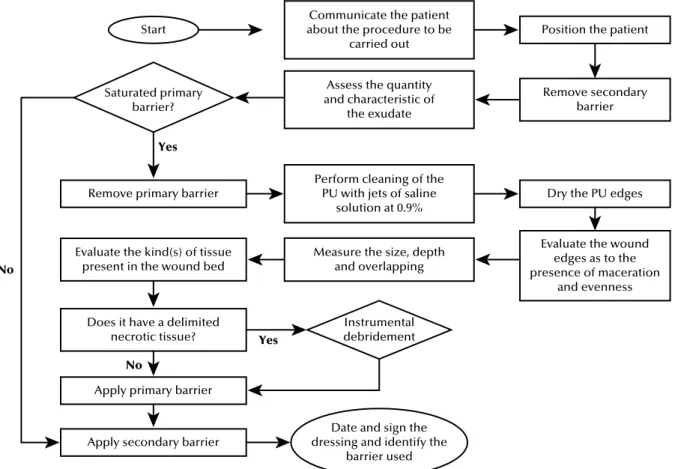
In stage I of the ABC methodology, the procedure PU dressing was mapped and resulted in a lowchart of the
con-stitutive stages of the process (Figure 1).
Start
Perform cleaning of the PU with jets of saline
solution at 0.9%
Dry the PU edges
Evaluate the kind(s) of tissue present in the wound bed
Measure the size, depth and overlapping
Evaluate the wound edges as to the presence of maceration
and evenness Assess the quantity
and characteristic of the exudate
Apply primary barrier
Apply secondary barrier
Date and sign the dressing and identify the
barrier used Communicate the patient about the procedure to be
carried out
Position the patient
Remove secondary barrier Saturated primary
barrier?
No
Yes
Instrumental debridement
No
Yes
Does it have a delimited necrotic tissue? Remove primary barrier
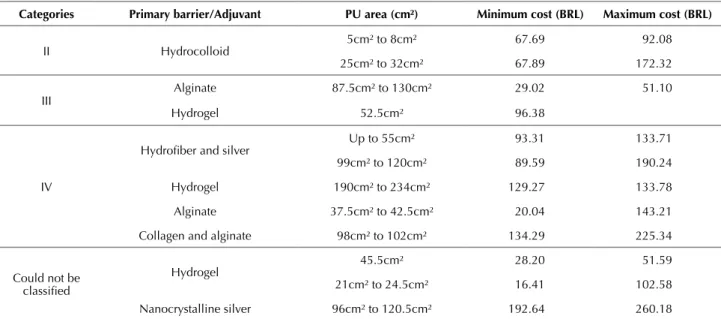
he minimum and maximum costs were described ac-cording to PU category of barrier/adjuvants used for dress-ings and PU area (Table 1). For category II, smaller sized areas (5-8 cm2) had costs which ranged from BRL 67.69 to
BRL 92.08; whereas larger areas (25-32 cm2) costs ranged
from BRL 67.89 to BRL 172.32. he maximum cost varied up to 154.6% compared to the minimum cost for the same barrier (hydrocolloid) of diferent sizes.
For category III PUs, dressings applied with alginate had a variation between minimum and maximum costs of 76.1% Due to the impossibility of grouping the only PU in category III with the others done with hydrogel adjuvant, its cost was expressed in one single value.
For category IV PUs, it was seen that hydroiber and sil-ver dressings had minimum and maximum costs that varied 112.3% (from BRL 89.59 to BRL 190.24). With the hydro-gel barrier, the variation was 3.5%. he variation observed between the minimum (BRL 20.04) and maximum (BRL 143.21) costs with alginate barrier was signiicant (614.6%). he diference between the costs of collagen and alginate was 67.8%.
For PUs that could not be classiied, it was found that the minimum cost of dressings done with hydrogel var-ied up to 525.10% (BRL 16.41 to BRL 102.58) for dif-ferent sizes. he cost variation with nanocrystalline silver was 35.1%.
Table 1 – Costs (minimum and maximum) according to the PU category, barrier/adjuvant used and PU area in a public hospital of Minas Gerais – Belo Horizonte, MG, Brazil, 2014.
categories Primary barrier/adjuvant PU area (cm²) Minimum cost (brl) Maximum cost (brl)
II Hydrocolloid 5cm² to 8cm² 67.69 92.08
25cm² to 32cm² 67.89 172.32
III Alginate 87.5cm² to 130cm² 29.02 51.10
Hydrogel 52.5cm² 96.38
IV
Hydroiber and silver Up to 55cm² 93.31 133.71
99cm² to 120cm² 89.59 190.24
Hydrogel 190cm² to 234cm² 129.27 133.78
Alginate 37.5cm² to 42.5cm² 20.04 143.21
Collagen and alginate 98cm² to 102cm² 134.29 225.34
Could not be classiied
Hydrogel 45.5cm² 28.20 51.59
21cm² to 24.5cm² 16.41 102.58
Nanocrystalline silver 96cm² to 120.5cm² 192.64 260.18
Of dressings that needed a secondary barrier, the pri-mary barrier accounted for a greater percentage of costs, except for those in which hydrogel and alginate were used, and which the secondary barrier (hydrocolloid) and acrylic copolymer spray (Cavilon spray®) were used.
Considering the price per unit of barrier/adjuvant in re-lation with the total cost of PU treatment (human resources and medical-hospital material), it is seen that the variation ranges from 4.9% to 96.7% (Table 2). he barrier with the
lowest cost per unit is alginate (BRL 7.02) and those with the highest costs are collagen with alginate (BRL 129.00) and nanocrystalline silver (BRL 160.00). he price of bar-riers in relation with the total cost varied between 4.9 and 35%, 57.2 and 96.1% and 61.5 and 83.1%, respectively. he price of calcium alginate accounted for a lower percentage in relation with total costs (4.9 to 35.0%). As for the price of hydrocolloid, it accounted for a higher percentage in rela-tion with total costs (38.0 to 96.7%).
Table 2 – Price per unit of barriers/adjuvants and percentage of barrier price in relation with total cost in a public hospital of Minas Gerais – Belo Horizonte, MG, Brazil, 2014.
barrier/adjuvant Unit price (brl)a
Percentage of (a) in relation with total costs (%) Minimum Maximum
Calcium alginate 7.02 35.0 4.9
Hydrogel 13.5 82.3 10.1
Hydrocolloid 65.48 96.7 38.0
Hydroiber and silver 65.48 73.1 34.4
Collagen and alginate 129.00 96.1 57.2
Costs of topical treatment of pressure ulcer patients
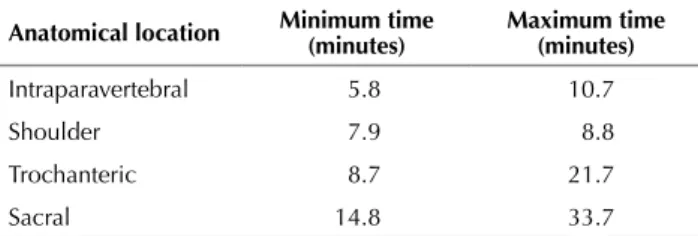
Table 3 presents the minimum and maximum times spent to apply dressings, according to the PU location. Dressings applied in intravertebral PUs were applied more quickly (5.8 to 10.7’), whereas sacral PUs took the longest to apply (14.8 to 33.7’).
Table 3 – Minimum and maximum times to apply dressings, ac-cording to the PU anatomical location in a public hospital of Minas Gerais – Belo Horizonte, MG, Brazil, 2014.
anatomical location Minimum time(minutes) Maximum time(minutes)
Intraparavertebral 5.8 10.7
Shoulder 7.9 8.8
Trochanteric 8.7 21.7
Sacral 14.8 33.7
DISCUSSION
Pressure ulcers are a serious public health issue, both for being often avoidable and the high costs related to their management. In this study, a wide variation of costs of pri-mary barriers and adjuvants was observed in PU treatment. Considering the costs with barriers, medical-hospital ma-terial and human resources, they ranged from BRL 16.41 to BRL 260.18, depending on the type of barrier and PU size. he cost variation within the same category and type of barrier was large, from 3.5% to 614.6%.
For most dressings, the cost increased proportionally to the increase of the area and to the development of PU category. Studies carried out in 2004 and 2013 also showed a cost increase according to the PU category(15,17). Larger
areas clearly need more material resources and require more time for execution. Dressing costs are occasional measure-ments, and the variation according to the PU category could be better observed if spendings on PU treatment were ac-counted for from its outbreak until its healing, as time for healing tends to be longer for more severe PUs.
he primary barrier accounted for a high percentage of costs among all items required to the application of dress-ings (human and material resources), except for those in which hydrogel and calcium alginate were used. In that sense, cost comparisons are important since unit prices of barriers alone are not the best savings indicator in the con-sumption of resources. In addition to this, eiciency/efec-tiveness evaluations of these technologies must be carried out to assess the procedure eiciency.
In the unit where this study was carried out, all hydrocol-loid plates used for dressings were 15cm x 15cm²; however, in some cases, the whole plate was not used. he remaining hydrocolloid plate was left in patients’ compartments in or-der to be used afterwards. However, it was noticed that ste-rility control and maintenance could be afected. his could have an inluence on cost increase, in addition to impair patients’ safety. herefore, it is the institution’s responsibility to provide diferent sizes of barrier/adjuvants, and it is up to nurses to anticipate the size of the adequate barrier for the PU location and/or depth. While the 15x15cm² hydrocol-loid plate costs BRL 65.48, the 10x10 one costs only BRL
16.00. For dressings described in this study and done with hydrocolloid, the 10x10 plate would it well, considering PU areas.
he 15x15cm² hydrocolloid plate (BRL 65.48 per unit), used as a secondary barrier, was the input that most in-creased the costs of dressings done with calcium alginate as a primary barrier. As this barrier and the hydrocolloid belong to diferent categories, with diferent mechanisms of action as well, the best option would be a diferent second-ary barrier, such as the 10x12cm² transparent ilm, which costs BRL 10.00. In addition to leaving the primary bar-rier visible, the polyurethane ilm allows for savings of BRL 55.48 when it is used as a secondary barrier in this case. he product indication is associated with diferent factors, such as scarring, resource availability, cost-beneit and PU char-acteristics, but in this decision-making process, a trained professional makes all the diference(28). Health
profession-als’ knowledge and skill about indication and replacement frequency of barriers is essential for the choice of the most efective and economic treatment.
When compared to other dressings, those in which nanocrystalline silver and collagen and alginate were the most expensive, since barriers have higher costs, (BRL 160.00 and BRL 129.00 respectively). However, the sec-ondary barrier (hydrocolloid plate) was the main respon-sible for the cost variation between dressings done with these two barriers. Both nanocrystalline silver and colla-gen-alginate belong to diferent categories of barriers and mechanism of action when compared to the hydrocolloid. herefore, for these two cases it would be useful to have a traditional secondary barrier (sterile gauze and micropore surgical tape). he hydrocolloid plate unit costs BRL 65.48, and the traditional secondary barrier costs between BRL 1.12 and BRL 2.36. Once again, the choice of a more ap-propriate secondary barrier would result in savings of BRL 63.12 and BRL 64.36 respectively.
Comparing hydrocolloid and polyurethane ilm in this study, only the hydrocolloid was used as a primary barrier. However, a meta-analysis that compared these barriers showed that the polyurethane ilm is more likely to heal a PU(29).
Regarding the execution time of dressings, there was a variation of 5.75 to 33.73’ in the application of all barriers. When comparing sacral PU dressings with other PUs, it was observed that the time to position patients and clean sacral PUs was longer. Sacral PUs had longer minimum and maximum times when compared to other PUs. Probably due to the proximity to anal and genital regions, sacral PU dressings took longer, since they require more care to avoid contamination of the PU barrier and bed by intestinal and bladder evacuation.
he use of economic grounds favors the rational use of resources and it is essential to the management of public health institutions in Brazil, considering that spendings on this ield have been increasing, whereas resources available have not increased in the same proportion(17). Economic
matters must be considered when choosing the most appro-priate treatment for patients, since this may provide nurses with arguments regarding the cost needs of diferent bar-riers, and allow them to decide together with the manage-ment upon the allocation of resources for diferent activities.
CONCLUSION
Pressure ulcers are considered as a public health issue and they afect mainly hospitalized individuals, impairing patients’ safety. In addition, they result in high costs for the health system. Diferent barriers have costs that vary ac-cording to the area and severity of PUs. his study allowed us to understand the costs involved in the treatment of PUs, and it may support decision makers and other cost-efec-tiveness studies.
resUMO
Objetivo: Realizar uma avaliação do custo do tratamento tópico de pacientes com úlceras por pressão (UP), em uma unidade hospitalar de atendimento a pacientes crônicos no ano de 2014. Método: Trata-se de um estudo de custos baseado no Sistema de custeio Baseado em Atividades. Este método contempla a identiicação, mensuração e preciicação dos recursos físicos e humanos consumidos para a realização de curativos. Resultados: Os custos dos procedimentos variaram de R$16,41 a R$260,18. Para UP de mesma categoria, de áreas aproximadas e mesmo tipo de cobertura/adjuvante, a variação entre os custos foi de 3,5% a 614,6%. Para a maioria dos curativos, o custo aumentou proporcionalmente ao aumento da área e à progressão da categoria das UP. A cobertura primária representou elevado percentual nos custos entre todos os itens necessários para realizar os curativos (recursos humanos e materiais). Os curativos realizados nas UP sacrais foram os que apresentaram maiores tempos para execução. Conclusão: Este estudo permitiu conhecer os custos envolvidos no tratamento das UP e pode fornecer subsídios para os tomadores de decisão, assim como para a realização de estudos de custo-efetividade.
descritOres
Úlcera por Pressão; Sistema Único de Saúde; Custos Hospitalares; Terapêutica.
resUMen
Objetivo: Llevar a cabo una evaluación del costo del tratamiento tópico de pacientes con úlceras por presión (UP), en una unidad hospitalaria de atención a pacientes crónicos en el año de 2014. Método: Se trata de un estudio de costos basado en el Sistema de pago Basado en Actividades. Este método contempla la identiicación, mensuración y preciicación de los recursos físicos y humanos consumidos para la realización de apósitos. Resultados: Los costos de los procedimientos variaron de R$16,41 a R$260,18. Para UP de misma categoría, de áreas aproximadas y mismo tipo de cobertura/adyuvante, la variación entre los costos fue del 3,5% al 614,6%. Para la mayoría de los apósitos, el costo aumentó proporcionalmente al aumento del área y la progresión de la categoría de las UP. La cobertura primaria representó elevado porcentual en los costos entre todos los elementos necesarios para realizar los apósitos (recursos humanos y materiales). Los apósitos realizados en las UP sobre el sacro fueron los que presentaron mayores tiempos para ejecución. Conclusión: Este estudio permitió conocer los costos involucrados en el tratamiento de las UP y puede proporcionar subsidios para los tomadores de decisión, así como para la realización de estudios de costo-efectividad.
descriPtOres
Úlcera por Presión; Sistema Único de Salud; Costos de Hospital; Terapéutica.
REFERENCES
1. Brasil. Ministério da Saúde. Anexo 02: Protocolo para Prevenção de Úlcera por Pressão [Internet]. Brasília: MS/ANVISA/Fiocruz; 2013 [citado 2014 set. 12]. Disponível em: http://proqualis.net/sites/proqualis.net/iles/000002429jFPtGg.pdf
2. Stevenson K. Pressure ulcer prevention: when are e negligent? Wound Care Canada. [Internet]. 2009 [cited 2013 June 20];7(2):30-32. Available from: http://cawc.net/images/uploads/wcc/7-2-stevenson.pdf
3. Costa IG. Incidência de úlcera por pressão em hospitais regionais do Mato Grosso, Brasil. Rev Gaúcha Enferm [Internet]. 2010 [citado 2013 out. 11];31(4):693-700. Disponível em: http://www.scielo.br/pdf/rgenf/v31n4/a12v31n4.pdf
4. Waters TM, Daniels MJ, Bazzoli GJ, Perencevich E, Dunton N, Staggs VS, et al.. Effect of Medicare’s nonpayment for hospital-acquired conditions lessons for future policy. JAMA Intern Med. 2015;175(3):347-54.
5. Rocha JA, Miranda MJ, Andrade MJ. Abordagem terapêutica das úlceras de pressão: Intervenções baseadas na evidência. Acta Med Port [Internet]. 2006 [citado 2013 maio 4];28(19):29-38. Disponível em: http://www.actamedicaportuguesa.com/revista/index.php/amp/article/ view/908/581
6. Gardiner JC, Reed PL, Bonner JD, Haggerty DK, Hale DG. Incidence of hospital-acquired pressure ulcers – a population-based cohort study. Int Wound J. 2014 Dec 3. [Epub ahead of print]
7. Igarashi A, Yamamoto-Mitani N, Gushiken Y, Takai Y, Tanaka M, Okamoto Y. Prevalence and incidence of pressure ulcers in Japanese long-term-care hospitals. Arch Gerontol Geriatr. 2013;56(1):220-6.
Costs of topical treatment of pressure ulcer patients
9. Moore ZEH, Cowman S. Risk assessment tools for the prevention of pressure ulcers. Cochrane Database Syst Rev. 2008;(3):CD006471. 10. Moore Z. US Medicare data show incidence of hospital-acquired pressure ulcers is 4.5%, and they are associated with longer hospital
stay and higher risk of death. Evid Based Nurs. 2013;16(4):118-9.
11. Queiroz ACCM, Mota DDCF, Bachion MM, Ferreira ACM. Pressure ulcers in palliative home care patients: prevalence and characteristics. Rev Esc Enferm USP [Internet]. 2014 Apr [cited 2015 Dec 09];48(2):264-71. Available from: http://www.scielo.br/pdf/reeusp/v48n2/0080-6234-reeusp-48-02-264.pdf
12. Freitas MC, Medeiros ABF, Guedes MVC, Almeida PC, Galiza FT, Nogueira JM. Úlcera por pressão em idosos institucionalizados: análise da prevalência e fatores de risco. Rev Gaúcha Enferm. [Internet]. 2011 [citado 2013 mar. 7];32(1):143-50. Disponível em: http://www. scielo.br/pdf/rgenf/v32n1/a19v32n1.pdf
13. Rogenski NMB, Kurcgant P. The incidence of pressure ulcers after the implementation of a prevention protocol. Rev Latino Am Enfermagem [Internet]. 2012 [cited 2015 Dec 13];20(2):333-9. Available from: http://www.scielo.br/pdf/rlae/v20n2/16.pdf
14. Borghardt AT, Prado TN, Araújo TM, Rogenski NMB, Bringuente MEO. Evaluation of the pressure ulcers risk scales with critically ill patients: a prospective cohort study. Rev Latino Am Enfermagem [Internet]. 2015 [cited 2015 Dec 8];23(1):28-35. Available from: http://www.ncbi. nlm.nih.gov/pmc/articles/PMC4376028/
15. Lima ACB, Guerra DM. Avaliação do custo do tratamento de úlceras por pressão em pacientes hospitalizados usando curativos industrializados. Ciênc.saúde coletiva [Internet]. 2011 Jan [cited 2013 Jan 11];16(1):267-77.
16. Silva AJ, Pereira SM, Rodrigues A, Rocha AP, Varela J, Gomes LM, et al. Custo econômico do tratamento das úlceras por pressão: uma abordagem teórica. Rev Esc Enferm USP. 2013;47(4):971-6.
17. Bennett G, Dealey C, Posnett J. The cost of pressure ulcers in the UK. J Woundcare. 2004;33(3):230-5.
18. Grupo Investigação Cientíica em Enfermagem. Enfermagem e úlceras por pressão: da relexão sobre a disciplina às evidências nos cuidados: colectânia [Internet]. Angra do Heroísmo, PT; 2008 [citado 2014 dez. 1]. Disponível em: http://sociedadeferidas.pt/documentos/ Enfermagem_e_ulceras_por_Pressao_-_Colectanea.pdf
19. Gethin G, Jordan-O’Brien J, Moore Z. Estimating costs of pressure area management based on a survey of ulcer care in one Irish hospital. J Wound Care. 2005;14(4):162-5.
20. Costa AM, Matozinhos ACS, Trigueiro PS, Cunha RCG, Moreira LR. Custos do tratamento de úlceras por pressão em unidade de cuidados prolongados em uma instituição hospitalar de Minas Gerais. Enferm Rev [Internet]. 2015 [citado 2015 jun. 8]; 18(1): 58-74. Disponível em: http://periodicos.pucminas.br/index.php/enfermagemrevista/article/view/9378
21. Nakagawa M. ABC: custeio baseado em atividades. São Paulo: Atlas; 1994.
22. Brandão CMR, Machado GPM, Mascarenhas MA, Drumond HA, Acurcio FA. Custos de fraturas relacionadas à osteoporose no Sistema Único de Saúde. J Bras Econ Saúde. [Internet]. 2014 [citado 2015 dez. 14];6(1):2-8. Disponível em: http://www.jbes.com.br/images/v6n1/ v6n1.pdf
23. Gonçalves CA, Meirelles AM. Projetos e relatórios de pesquisa em administração. São Paulo: Atlas; 2004.
24. Brasil. Ministério da Saúde; Conselho Nacional de Saúde. Resolução n. 466, de 12 de dezembro de 2012. Dispõe sobre diretrizes e normas regulamentadoras de pesquisas envolvendo seres humanos [Internet]. Brasília; 2012 [citado 2013 mar. 25]. Disponível em: http:// conselho.saude.gov.br/resolucoes/2012/Reso466.pdf.
25. Borges EL, Saar SRC, Magalhães MBB, Gomes FSL, Lima VLAN. Feridas: como tratar. 2ª ed. Belo Horizonte: COOPMED; 2010. 26. Santos VLCG, Caliri MHL. Conceito e classiicação de úlcera por pressão: atualização do NPUAP. Rev Estima 2007;5(3):43-4.
27. Marques LG, Vieira MLC, Pereira SRM. A Construção dos conhecimentos dos enfermeiros perante a nova classiicação da úlcera por pressão. Rev Estima. 2013;11(1):13-21.
28. Melo EM, Fernandes VS. Avaliação do conhecimento do enfermeiro acerca das coberturas de última geração. Rev Estima. 2011;9(4):12-20. 29. Pott FS, Meier MJ, Stocco JG, Crozeta K, Ribas JD. The effectiveness of hydrocolloid dressings versus other dressings in the healing
of pressure ulcers in adults and older adults: a systematic review and meta-analysis. Rev Latino Am Enfermagem [Internet]. 2014 [cited 2015 Dec 15];22(3):511-20. Available from: http://www.ncbi.nlm.nih.gov/pmc/articles/PMC4292618/