ECOLOGY, BEHAVIOR AND BIONOMICS
Ef
fi
cient Sampling of Ground-Dwelling Arthropods Using Pitfall Traps in
Arid Steppes
G
ERMÁNH C
HELI1, J
UANC C
ORLEY21Unidad de Investigación Ecología Terrestre, CENPAT-CONICET, Bvd. Brown 2825 (9120), Puerto Madryn, Chubut, Argentina
2Lab de Ecología de Insectos, INTA EEA Bariloche, CC 277 (8400), Bariloche, Río Negro, Argentina Edited by Paulo R Pereira – EMBRAPA
Neotropical Entomology 39(6):912-917 (2010)
ABSTRACT - Pitfall trapping is probably the most frequently used method for sampling ground-dwelling arthropods. While the capture of specimens in pitfall traps largely depends on the number of individuals in the sampled area, trap design and trapping effort for a given environment, can also affect sampling success. The aim of this study was to determine the best pitfall trapping design for collecting ground-dwelling arthropods in the wind-blown and cold arid steppe areas of Patagonia. We tested four designs of traps, six types of preservative and different times of activation as well as the quantity of traps. Both preservation attributes and sampling effi ciency differed between different trap designs and fl uids compared. We conclude that in order to obtain reliable data on the structure of a community of ground-dwelling arthropods in Patagonia, at least three pitfall traps per experimental unit are required. In addition, traps should be opened for a minimum of 10 days fi lled with 300 ml of 30% ethylene glycol. We also suggested the use of a simple trap design (i.e. without funnel or roof). We believe these fi ndings will contribute to more appropriate sampling of the ground dwelling fauna of Patagonia as well as other arid areas, leading to more reliable diversity studies.
KEY WORDS: Epigeal arthropod, sampling method, trap design, Patagonia
Pitfall traps are the most frequently used method for sampling ground-dwelling arthropods (Southwood 1978, Niemelä et al 1992, Pekár 2002, Phillips & Cobb 2005). This method estimates relative arthropod activity rather than absolute density, refl ecting individual abundances of species and movement rates within a given habitat (Mazía et al 2006). Current literature shows that pitfall traps can be used in a variety of ways: to evaluate the distribution of macroinvertebrates in diverse ecosystems at different scales, to describe activity patterns, habitat associations as well as to establish relative species abundances, or the effects that disturbance can have on biodiversity (Niemelä et al 1992, Pekár 2002, Mazía et al 2006). In some cases pitfall traps are the only method that is a realistic alternative, as is the case of studies covering large geographic areas in which the aims are to establish a qualitative inventory or to compare different assemblages (Niemelä et al 1993, Pearsal 2007). Pitfall trap sampling has the advantage of being a quick and cheap method. Furthermore, it works even in the absence of an observer (Pekár 2002). This latter fact contributes to the objectivity of the pitfall trapping method (i.e., reduces bias due to factors such as observer fatigue or knowledge about the environment or the biology of the species) and makes comparisons better (e.g., daily and seasonal dynamics of activity, etc.) (Vennila & Rajagopal 1999).
The total capture of arthropods in pitfall traps depends
on several factors. On one hand, the number of individuals crossing the sampling area, which is largely determined by species surface activity and their relative population densities (Luff 1975). On the other hand captures also depend on some trap features and the sampled environment. At least 18 factors that affect the pitfall-trap capture effi ciency are known: size of the trap, shape (Luff 1975, Adis 1979, Spence & Niemelä 1994), materials of construction (Luff 1975), type of preservative (Luff 1975, Pekár 2002, Schmidt et al 2006, Jud & Schmidt-Entling 2008), physical characteristics of the environment (Greenslade 1964, Koivula et al 1999, Mazía et al 2006), time of activation and the quantity of traps deployed (Jud & Schmidt-Entling 2008). Changes to any of these factors can have a profound infl uence on the capture probability and consequently on the resulting number of arthropods collected. Still, there is no uniformity in protocols of pitfall trapping and sampling is largely based on the researchers past experience (Pekár 2002).
design. This is especially important in arid environments, where temperature complicates the preservation of the material caught during the sampling period. Although there are many published contributions on desert arthropods using pitfall traps, few of them, if any, carry out some optimization studies of the pitfall trapping for these environments.
The aim of this study was to determine the best pitfall trapping design for collecting ground-dwelling arthropods in the wind-blown and cold arid steppe areas of Patagonia, Argentina. We expect to contribute not only to improve sampling of the ground-dwelling arthropods in the area, but also shed light on some factors to be considered when using pitfall sampling protocols on other arid environments.
Material and Methods
We tested capture effi ciency of pitfall traps studying three aspects involved, which we believe are particularly important in arid habitats with extreme weather conditions like northeastern Patagonia: (a) design of the trap, (b) type of preservative and (c) optimum time of activation and quantity of traps. For all trials we used plastic cups, dug into the ground, with a capacity of 1000 ml and 12 cm of diameter.
The study was carried out in an experimental plot placed in Centro Nacional Patagónico (CENPAT-CONICET) were natural vegetation is preserved. The climate is arid, temperate and windy. Mean annual temperature is 13,5ºC and mean annual precipitation is 175mm. Annual as well as monthly totals exhibit a high variability; for annual rainfall the coeffi cient of variation is 40% at least (Barros & Ribero 1982, Súnico et al 1994).
Trap design. The optimum trap has to maximize captures and at the same time minimize the probability of drying-out. For this, we tested two frequently used strategies: fi rstly, the use of a metal roof that would prevent direct sunlight on the trap, decreasing evaporation rates as well as serving as a shelter during the hours of maximum sun radiation, and secondly, the implementation of a funnel that would maintain evaporated water by condensation (decreasing total evaporation) and decrease the probability of escape of individuals already in the trap. Four treatments resulted from the combination of the above methods: (1) without roof and without funnel; (2) with roof and without funnel; (3) with funnel and without roof and (4) with roof and with funnel. All these treatments were arranged randomly and replicated fi ve times each. In this way, twenty traps were set in a regular grid, separated 20 m from each other. Traps were activated with 300 ml of water and a few drops of detergent (in order to weaken water surface tension) and were activated in the fi eld for one week. In each trap, the total number of collected individuals, the species richness and the fi nal volume of liquid was quantifi ed. Trends in these variables were analyzed using generalized linear models (McCullagh & Nelder 1989) with the R software (R Development Core Team 2008). Negative binomial error models were applied in the analysis of the number of collected individuals and the richness of species collected, while gamma error models were used for the fi nal volume analysis. All these analysis were performed using the log link function. Their
performance was evaluated by checking for homogeneity of variance in plots of the deviance residuals against the fi tted values (Crawley 2007). All terms in the models were fi xed and the evaluation of model signifi cance was based on the Likelihood ratio test (F tests for gamma models and X2 tests for negative binomial).
Type of preservative. The type of fl uid in the trap is very important, because it should preserve the trapped material in good conditions for further identifi cation, but also, it should be effective enough to paralyze and thus decrease the escape ability of arthropods. In order to do this, the preservative has to completely cover the material trapped during the whole sampling period. In this way, a preservative with low evaporation rates would better serve this purpose. Otherwise, a preservative with high evaporation rates would have to be replaced periodically and larger volumes would be needed. So, to evaluate which type of preservative is more effi cient, pitfall traps were fi lled with six different types of fl uids and the time during which they remained active at the fi eld was registered. We tested the following fl uids: (1) water with a few drops of detergent (commercial dish cleaner), (2) brine (8L of hot water + 2 kg of salt + 1.5 L of vinegar + 3 soup spoons of detergent), (3) glycerin (glycerin + 10% water), (4) isopropyl alcohol, (5) commercial car antifreezing
fl uid and (6) ethylene glycol. The latter was tried at three different concentrations (10, 20 and 30%). We used 300 ml of fl uid in each trap. All types of preservative were tested simultaneously for fi ve times (n = 5).
Optimum time of activation and quantity of traps. Five pitfall traps were placed at a distance of 20 m between each other in a regular grid plot of 20 x 20 m. This was done to assure independence of the samples, minimizing the probability of individuals from another plot falling in a trap of the target plot. Each trap was activated with 300 ml of ethylene glycol 30% and three squares of fi ve pitfall traps were taken out at different time intervals: 3, 7, 10, 13 and 16 days of sampling. For each sample, the species richness and the number of new species caught were quantifi ed, generating a cumulative morphospecies-richness curve to fi nd the optimum time for sampling. To estimate the minimum number of pitfall traps in an experimental unit, a similar cumulative morphospecies-richness curve was generated using the number of new species accumulated. This last curve was done using the pitfall traps that had been activated for 16 days in the fi eld.
Results
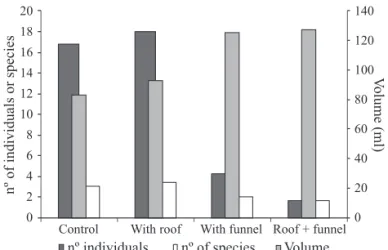
Design of the traps. There were no signifi cant differences in the fi nal volume of any of the four trap designs, even though there was a tendency to preserve a higher volume of fl uid in the traps with funnel (Fig 1, Table 1).
As regards the species richness, although there was a tendency to fi nd a larger quantity of species in the pitfall traps without funnel in comparison with those with funnel (Fig 1), treatments did not signifi cantly differ (Table 1).
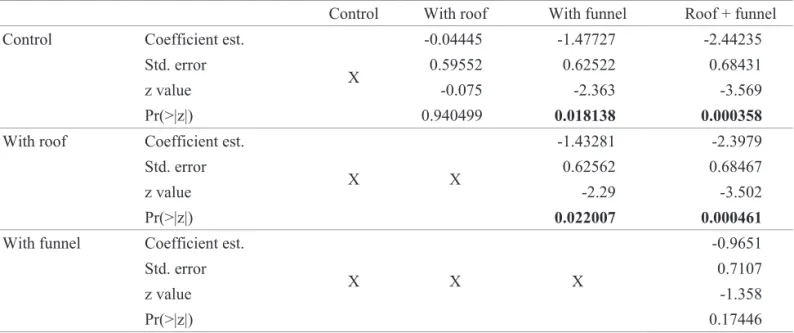
However, the total number of individuals collected was greatly affected by the trap design (Table 1). When the differences between treatments were considered, the trap designs including funnel were signifi cantly different from traps without it, and there was no difference when roof was either present or not (Table 2). To confi rm this fi nding we carried out an additional analysis, by comparing the pooled samples of all traps with funnel (with and without roof) and those without funnel (with and without roof) (using GLM). We found that there was a signifi cant difference in the total number of individuals collected (GLM, X2
0,05;1= 10.4629, P = 0.0012) and that the abundance was lower in pitfalls with funnel than in those without it (z-test, z = -3.865, P= 0.0001).
Type of preservative. Traps with water and detergent and those with isopropyl alcohol remained active (with enough preservative) for a maximum of seven days, even though
some of them collected specimens which showed some signs of deterioration. The traps with brine, in turn were active for 14 days, but they generated a 3 cm-thick layer of salt in which the material was enclosed and highly degraded. The traps with glycerin preserved the material well for 20 days, but generated a very dense and jelly-like layer that covered the specimens, again making it diffi cult to obtain good quality samples. Those traps with commercial car antifreeze fl uid lasted active for 15 days at the end of which period they still bore 94 ml of fl uid covering the material. While in this case, specimens were well preserved, they were dyed in an irreversible way (G. Cheli, per sobs.) In relation to those traps deployed with ethylene glycol, those containing a 10% concentration were active for 12 days, those with 20% lasted for 16 days of sampling (ending up with 38 ml); while traps with 30% concentration lasted for 16 days of sampling, ending up with 92 ml. A simple linear regression analysis (Fig 2) was calculated for the evaporation of ethylene glycol at 30%, turning out to be the fi nal volume (FV): FV ml = -6.77 * days + 150.62 ml*day -1 (r² = 0.935; P= 0.026). Optimum time of activation and minimum number of traps. The cumulative morphospecies-richness curves (Figs 3, 4) showed that data points for a more effi cient trapping was at day 13 and 5 traps, the number necessary at any experimental unit.
Discussion
Both preservation attributes and sampling effi ciency differed between the various designs of pitfall traps and fl uids compared in this study. Regarding the design of the trap, the use of roof or funnel did not decrease signifi cantly evaporation rates nor changed the richness of collected species. The addition of a roof did not change the number of collected individuals, and neither infl uenced qualitatively the collected taxa. Because the metal material of the roof probably warmed-up during the hours of sun exposure, this presumably cancels its potential for decreasing evaporation rates. Adding a funnel tended to result in low losses of preservative fl uid but also lowered the total number of collected individuals and tended to decrease species richness. This could be due to the infl uence of funnels on the detection of the pitfall trap by arthropods and/or increase their probability of escaping, because the funnel lowers the slope of the lateral walls of the trap.
Table 1 Effects of roof and funnels on pitfall traps over the fi nal volume of fl uid, species richness and total number of individuals collected.
Full model = (control) + (with roof) + (with funnel) + (roof + funnel) Fig 1 Average effects of trap design on the number of
individual or species captured and on the fi nal volume on fl uid at the end of trapping time.
Model Model error Resid. df Resid. dev Df Deviance exp. Sign. test P
Final volumen Null Gamma 19 3.8862
Full Gamma 16 3.2051 -3 0.6812 F(16,19) = 1.3109 0.3053
Richness Null Neg. Binomial 19 25.759
Full Neg. Binomial 16 22.402 -3 3.357 X2(0.05;3) = 3.0790 0.3796
Nº of individuals Null Neg. Binomial 19 39.574
Full Neg. Binomial 16 22.488 -3 17.086 X2(0.05;3) = 12.2566 0.0066
0 20 40 60 80 100 120 140
0 2 4 6 8 10 12 14 16 18 20
Control With roof With funnel Roof + funnel
V
o
lume (ml)
nº of individuals or species
Concerning to the type of preservative, fi lling the traps with water and detergent and isopropyl alcohol was not adequate, because they dried before the accurate time of sampling was achieved. Also, these preservatives could not prevent decay occurring in the material that had been caught. Therefore, if used anyway, it would be necessary to re-fi ll traps and remove the material collected at least once before reaching the accurate time of sampling is achieved. The pitfall traps fi lled with brine and glycerin remained active during the period suggested by the saturation curve. However, these also damaged the specimens collected, and probably diminished both species richness and total catches. This reduced capture effi ciencies may be due to the fact that arthropods usually fl oat in liquids whose specifi c gravity is distinctly higher than that of water. So, arthropods
fl oating at brine and glycerin surfaces could facilitate the escape of newly trapped individuals falling on top of them (Schmidt et al 2006). At the same time, the brine turned out
to be powerfully attractive for lepidopterans, generating a biased sampled of ground-dwelling arthropods. Those pitfall traps fi lled with commercial car antifreeze fl uids also achieved optimal activation time and the specimens were well preserved, however they were dyed in an irreversible way. The 30% ethylene glycol did not show the drawbacks mentioned above, indicating their better conservation attributes and probably higher sampling effi ciency than the other fl uids tested. Arthropods may also fl oat in pure ethylene glycol, but this problem did not arise because the preservative was used diluted. Also, diluting ethylene glycol with water improved the state of conservation of the individuals collected (see also Jud & Schmidt-Entling 2008) and besides it may have improved their capture effi ciency (Schmidt et al 2006). Moreover the effi ciency of any preservative might also be due to an interaction between the repellence (or attractancy) and the killing effi ciency of the fl uid: the greater the concentration of the fl uid, the greater preservative Table 2 Estimated coeffi cients, standard errors, z value and P-value of contrasts between the four combinations of roof and funnel for total number of collected individuals in pitfall traps.
In bold, signifi cant differences
Fig 2 Simple linear regression analysis for the evaporation rates of 30% ethylene glycol.
Fig 3 Cumulative morphospecies-richness curve for optimum sampling time.
Control With roof With funnel Roof + funnel Control Coefficient est.
X
-0.04445 -1.47727 -2.44235
Std. error 0.59552 0.62522 0.68431
z value -0.075 -2.363 -3.569
Pr(>|z|) 0.940499 0.018138 0.000358
With roof Coefficient est.
X X
-1.43281 -2.3979
Std. error 0.62562 0.68467
z value -2.29 -3.502
Pr(>|z|) 0.022007 0.000461
With funnel Coefficient est.
X X X
-0.9651
Std. error 0.7107
z value -1.358
Pr(>|z|) 0.17446
30 50 70 90 110 130 150 170
0 5 10 15
V
o
lume (ml)
Days
0 2 4 6 8 10 12 14 16
0 2 4 6 8 10 12 14 16 18
A
c
c
u
m
u
lat
ed s
p
ec
ies
effi ciency. At the same time, the more concentrated a fl uid the more repellent it can become, thus maximum catch would be obtained at intermediated concentrations (Pekár 2002). In this study we found the maximum preservative effi ciency at low/ medium ethylene glycol concentration (30%). In addition, the species richness was not signifi cantly affected by any kind of preservative used. Consequently, ethylene glycol could have not signifi cant repellent/attractive effect. Therefore, 300 ml of 30% ethylene glycol is recommended to reliably prevent decomposition and drying in pitfall traps exposed to an arid landscape for two weeks. These fi ndings are in agreement with previous studies (Clark & Blom 1992, Koivula et al 2003, Schmidt et al 2006, Jud & Schmidt-Entling 2008).
Even thought ethylene glycol is potentially hazardous to wildlife, if used 30% diluted, it would be necessary to drink it on great quantities to damage the fauna. We also used visual stimulus (a stake with a red fl ag in its top, set near each trap) which signifi cantly decreases the destruction of traps by large mammals, probably because of the movement and uncommon color that scares away many vertebrates. Other techniques to avoid the hazard of ethylene glycol to wildlife are the use of a bittering agent (like quinine sulphate) and the employment of physical obstacles to avoid access by vertebrates (Schmidt et al 2006, Jud & Schmidt-Entling 2008). Finally a good substitute for ethylene glycol not tested here is propylene glycol, which has a similar performance, yet it is more expensive (Weeks & McIntyre 1997, Schmidt et al 2006, Jud & Schmidt-Entling 2008).
With respect to the optimum time of activation and minimum number of traps, the cumulative morphospecies-richness curve for the time of pitfall traps activation suggested that they remained active for thirteen days, but it could be ten days as well with a minimum effi ciency decrease. Also the cumulative curve for the minimum number of pitfall traps suggested that the best measure of species richness would be achieved by using fi ve traps per experimental unit; however it showed a high sign of curving toward an asymptote with three traps.
There are some important factors that have not been taken into account in this study, such as materials for constructing the traps and roofs, or the diameter of trap openings. However we have analyzed here the most important attributed affecting
sampling. In conclusion to obtain reliable data on the structure of a community of ground-dwelling arthropods in Patagonia, it is recommended to use a minimum of three pitfall traps per experimental unit and leave them at least for 10 days fi lled with 300 ml of 30% ethylene glycol, as well as to use a simple trap design. All these fi ndings may be also applicable to other sites with similar environmental conditions.
Cleary, the use of pitfall traps with distinct effi ciency will give a different impression of species richness and abundance in a community. It is well appreciated that capture rates of pitfall traps depend on trapping effi ciency, species activity and species density (Curtis 1980). Because of these distortions many authors concluded that this trapping method is of limited value for quantitative estimations of population sizes or for the comparison of communities (e.g., Greenslade 1964, Ahearn 1971). Still, there is an extensive use of pitfall traps. The high numbers of species recorded in pitfall traps, coupled with the continuous nature of their sampling, would argue in favor of their use (Ahearn 1971). In any case, an environment specifi c testing that considers the infl uences of preservation attributes and sampling effi ciency as presented here should be carried out prior to any extensive sampling.
Acknowledgments
The authors are grateful to F Grandi, L Castillo, F Martínez, N Martínez Román, M del Brío, I Ríos and E Bagnato for their invaluable collaboration. We deeply thank Centro Nacional Patagónico and its staff for providing facilities and logistic support. Finally recognition is also to L Cella and L Venerus for language and statistical assistance. G Cheli was supported by a PhD fellowship given by CONICET. This work was declared of interest by the Administration of the Natural Protected Area Península Valdés. This paper is especially dedicated to A Johnson, a pioneer in conservation studies in Argentina, and an excellent naturalist and friend.
References
Adis J (1979) Problems of interpreting arthropod sampling with pitfall traps. Zool Anz 202: 177-184.
Ahearn G A (1971) Ecological factors affecting population sampling of desert Tenebrionid beetles. Am Midl Nat 86: 385-406.
Barros V, Rivero M M (1982) Mapas de probabilidad de precipitación de la Provincia del Chubut. Contribución Nº 45. Centro Nacional Patagónico CONICET, Puerto Madryn, Chubut, Argentina, 12p.
Clark W H, Blom P E (1992) An effi cient and inexpensive pitfall trap system. Ent News 103: 55-59.
Crawley M J (2007) The R Book. Chester, West Sussex, John Wiley and Sons, 942p.
Curtis D J (1980) Pitfalls in spider community studies (Arachnida, Araneae). J Arachnol 8: 271-280.
Greenslade P J M (1964) Pitfall trapping as a method for studying Fig 4 Cumulative morphospecies-richness curve for the
number of pitfall traps. 0
2 4 6 8 10 12 14 16
0 1 2 3 4 5 6 7
Accumulated species
populations of Carabidae (Coleoptera). J Anim Ecol 33: 301-310.
Jud P, Schmidt-Entling M H (2008) Fluid type, dilution and bitter agent infl uence spider preservation in pitfall traps. Entomol Exp Appl 129: 356-359.
Koivula M, Kotze D J, Hiisivuori L, Rita H (2003) Pitfall trap effi ciency: do trap size, collecting fl uid and vegetation structure matter? Entomol Fenn 14: 1-14.
Koivula M, Punttila P, Haila Y, Niemelä J (1999) Leaf litter and the small-scale distribution of carabid beetles (Coleoptera, Carabidae) in the boreal forest. Ecography 22: 424-435.
Luff M L (1975) Some features infl uencing the effi ciency of pitfall traps. Oecologia 19: 345-457.
McCullagh P, Nelder J A (1989) Generalized Linear Models (2nd edn). Monographs on statistics and applied probability 37. London, Chapman and Hall, 511p.
Mazía C N, Chaneton E J, Kitzberger T (2006) Small-scale habitat use and assemblage structure of ground-dwelling beetles in a Patagonian shrub steppe. J Arid Environ 67: 177-194.
Niemelä J, Spence J R, Langor D W, Haila Y, Tukia H (1993) Logging and boreal ground beetle assemblages on two continents: implications for conservation p. 29-50. In Gaston K J, New T R, Samways M J (eds) Perspectives in insects conservation. Intercept Ltd. Andover, 250p.
Niemelä J, Spence J R, Spence D H (1992) Habitat associations and seasonal activity of ground beetles (Coleoptera) in central Alberta. Can Entomol 124: 521-540.
Pearsal I A (2007) Carabid Beetles as Ecological Indicators. Paper presented at the “Monitoring the Effectiveness of Biological Conservation” conference, 2-4 November 2004, Richmond, B.C. Available at: http://www.forrex.org/events/mebc/papers.html
Pekár S (2002) Differential effects of formaldehyde concentration and detergent on the catching efficiency of surface active arthropods by pitfall traps. Pedobiologia 46: 539-547.
Phillips I D, Cobb T P (2005) Effects of habitat structure and lid transparency on pitfall catches. Environ Entomol 34: 875-882.
R Development Core Team (2008) R: A language and environment for statistical computing Vienna, Austria: R Foundation for Statistical Computing. Available at http:// www.r-project.org.
Schmidt M H, Clough Y, Schulz W, Westphalen A, Tscharntke T (2006) Capture effi ciency and preservation attributes of different fl uids in pitfall traps. J Arachnol 34: 159-162.
Spence J R, Niemelä J (1994) Sampling carabid assemblages with pitfall traps: the method and the madness. Can Entomol 126: 881-894.
Southwood T R E (1978) Ecological methods: with special reference to the study of insect populations. Chapman and Hall, New York 524p.
Súnico A, del Valle H, Bouza P, Videla L, Cano C, Monti A (1994) Guía de campo Península Valdés y Centro-Este del Chubut. In Séptima Reunión de campo CADINQUA. Puerto Madryn, Argentina, 75p.
Vennila S, Rajagopal D (1999) Optimum sampling effort for study of tropical ground beetles (Carabidae: Coleoptera) using pitfall traps. Curr Sci 77: 281-3.
Weeks R D, McIntyre N E (1997) A comparison of live versus kill pitfall trapping techniques using various killing agents. Entomol Exp Appl 82: 267-273.