Printed in Brazil - ©2006 Sociedade Brasileira de Química 0103 - 5053 $6.00+0.00
A
r
ti
c
le
* e-mail: [email protected]
A New System for the Spectrophotometric Determination of Trace Amounts of
Nitrite in Environmental Samples
Tom Cherian and Badiadka Narayana*
Department of Post Graduate Studies and Research in Chemistry, Mangalore University, Mangalagangothri -574 199, India
Apresentamos um método espectrofotométrico seletivo e rápido para determinação de nitrito. O princípio do método é a reação do nitrito com p-nitroanilina, em meio ácido, formando o íon diazônio. O íon complexa com 2-etoxi maleato de dietila ou etilenoacetato, em meio básico, formando pigmentos tipo azo, com absorção máxima a 439 e 465 nm, respectivamente. O método obedece a lei de Beer no intervalo de 0,5-15 µg mL-1 para o nitrito com 2-etoxi maleato de dietila,
e 0,2-12 µg mL-1 para o nitrito com etileno acetato. A absortividade molar e a sensitividade de
Sandell encontradas para os respectivos pigmentos azo foram 5,04×10⁴ L mol-1cm-1, 0,98×10⁻² µg
cm-2 e 1,21×10⁴ L mol-1 cm-1, 0,98×10⁻² µg cm-2 . Foram avaliadas as condições ótimas de reação,
bem como outros parâmetros analíticos. O método foi aplicado com sucesso na determinação de nitrito em várias amostras de água e solos.
A selective and rapid spectrophotometric method for the determination of nitrite is presented. It is based on the reaction of nitrite with p-nitroaniline in acid medium to form diazonium ion, which is coupled with ethoxyethylenemaleic ester or ethylcyanoacetate in basic medium to form azo dyes, showing absorption maxima at 439 and 465 nm respectively. The method obeys Beer’s law in the concentration range of 0.5-16 µg mL-1 of nitrite with ethoxyethylenemaleic ester and
0.2-18 µg mL-1 of nitrite with ethylcyanoacetate. The molar absorptivity and Sandell’s sensitivity
of p-nitroaniline-ethoxyethylenemaleic ester and p-nitroaniline-ethylcyanoacetate azo dyes are 5.04×10⁴ L mol-1cm-1, 0.98×10⁻² µg cm-2 and 1.21×10⁴ L mol-1 cm-1, 0.98×10⁻² µg cm-2 respectively.
The optimum reaction conditions and other analytical parameters were evaluated. The method was successfully applied to the determination of nitrite in various water samples and soil samples.
Keywords: spectrophotometry, diazotization, nitrite, p-nitroaniline, ethoxyethylenemaleic ester, ethylcyanoacetate
Introduction
Nitrogen forms two environmental important oxyacids: nitrous acid and nitric acid. Corresponding nitrite and nitrate anions are common in the environment. In aquatic systems, nitrite is formed by biological oxidation of ammonium, and converted subsequently to nitrate. Nitrite is a characteristic pollutant.1 High concentrations of nitrite are
present in industrial water, sewage and in biologically purified effluents and in polluted streams. The determination of nitrite is of considerable interest because of many reasons. Traces of nitrite and nitrate in drinking water may lead to methemoglobinemia in infants and with long term exposure is possible cancer risk. Nitrite can react with secondary amines present in the body resulting in the formation of
carcinogenic nitrosamines.2-4 The reduction of nitrate to
nitrite is possible in the stomach of infants, where low acidity allows the growth of nitrite-reducing micro-organisms. Nitrite levels, when correlated with other forms of nitrogen in waters, provide indexes of organic pollution in water.5 General procedures for the determination of
nitrites are usually based up on some form of diazotization reaction. AOAC official method of analysis for nitrite and nitrate determination was based on the diazocoupling reaction between sulfanilamide and N-(1-naphthyl) ethylenediamine hydrochloride.6 This method required
careful control of acidity in each step of the process and generates carcinogenic7 compound when naphthalene
nucleus is present.Some of the reported methods for the determination of nitrite are kinetic,8,9 chromatographic,10
and flow injection.11 The spectrophotometric methods for
determination of nitrite, as the naphthylamines and some others have non-linear calibration graph, lack of sensitivity, selectivity and involves rigorous experimental conditions. The present work introduces new coupling agents, ethoxyethylenemaleic ester and ethylcyanoacetate for the selective and rapid spectrophotometric determination of nitrite in water and soil samples without involving complicated steps. p-Nitroaniline is diazotized in acidic medium, and coupled with ethoxyethylene maleic ester or ethyl cyanoacetate to give water-soluble colored dyes in alkaline medium having absorption maximum at 439 and 465 nm respectively. The method has been successfully applied to the determination of nitrite in various water samples and soil samples.
Experimental
Apparatus
A Secomam Anthelie NUA 022 UV-VIS spectrophoto-meter with 1cm quartz cell was used for the absorbance measurements and a WTW pH 330, pH meter were used.
Reagents
All chemicals used were of analytical reagent grade (Merck) or chemically pure grade and double distilled water was used for the dilution of reagents and samples. Standard nitrite (1000 µg mL-1) was prepared by dissolving 0.150 g
sodium nitrite in water and diluting to 100 mL, preserved with 2 mL chloroform. A (0.05%) solution of p-nitroaniline,
ethoxyethylenemaleic ester (5%), ethylcyanoacetate (5%), hydrochloric acid (0.25 mol L-1), sodium hydroxide
(5 mol L-1), EDTA (0.02 mol L-1) and sodium carbonate
(1%) were used.
General procedure for the determination of nitrite
An aliquot of the sample solution containing 0.2-20 µg mL-1 of nitrite was transferred to a series of 10
mL calibrated flasks. To this solution 1 mL of 0.05%
p-nitroaniline and 0.5 mL of 0.25 mol L-1 hydrochloric
acid were added and the solution was shaken thoroughly for 2 minutes to allow the diazotization reaction to go to completion. Then, volumes of 1 mL of 2% ethoxyethylenemaleic ester or ethylcyanoacetate and 2 mL of 5 mol L-1 sodium hydroxide solutions were
added and the contents were diluted to 10 mL using double distilled water and mixed well. After 5 minutes, the absorbance of the colored azo dyes was measured at 439 or 465 nm against the reagent blank.
Determination of nitrite in water samples19
A 5 mL of water sample (containing not more than 10
µg mL-1 of nitrite) was treated with 0.5 mL of 1 mol L-1
NaOH and 0.5 mL of 0.2 mol L-1 EDTA. The solution
was mixed and centrifuged to remove any precipitate formed. The centrifugate was transferred to a 10 mL standard flask and directly used for the color development by following the procedure described above. The concentration of the nitrite was established by reference
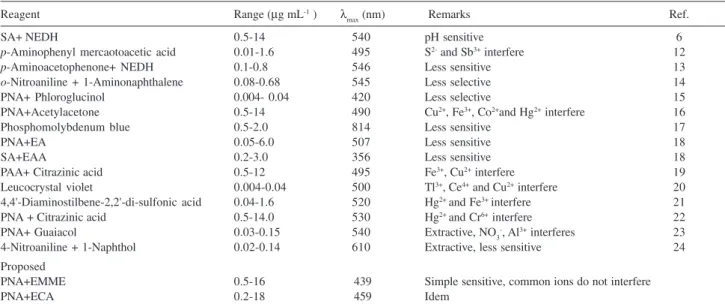
Table 1. Comparison to the spectrophotometric methods for the determination nitrite
Reagent Range (µg mL-1) λ
max (nm) Remarks Ref.
SA+ NEDH 0.5-14 540 pH sensitive 6
p-Aminophenyl mercaotoacetic acid 0.01-1.6 495 S2- and Sb3+ interfere 12
p-Aminoacetophenone+ NEDH 0.1-0.8 546 Less sensitive 13
o-Nitroaniline + 1-Aminonaphthalene 0.08-0.68 545 Less selective 14
PNA+ Phloroglucinol 0.004- 0.04 420 Less selective 15
PNA+Acetylacetone 0.5-14 490 Cu2+, Fe3+, Co2+and Hg2+ interfere 16
Phosphomolybdenum blue 0.5-2.0 814 Less sensitive 17
PNA+EA 0.05-6.0 507 Less sensitive 18
SA+EAA 0.2-3.0 356 Less sensitive 18
PAA+ Citrazinic acid 0.5-12 495 Fe3+, Cu2+ interfere 19
Leucocrystal violet 0.004-0.04 500 Tl3+, Ce4+ and Cu2+ interfere 20
4,4'-Diaminostilbene-2,2'-di-sulfonic acid 0.04-1.6 520 Hg2+ and Fe3+ interfere 21
PNA + Citrazinic acid 0.5-14.0 530 Hg2+ and Cr6+ interfere 22
PNA+ Guaiacol 0.03-0.15 540 Extractive, NO3-, Al3+ interferes 23
4-Nitroaniline + 1-Naphthol 0.02-0.14 610 Extractive, less sensitive 24
Proposed
PNA+EMME 0.5-16 439 Simple sensitive, common ions do not interfere
PNA+ECA 0.2-18 459 Idem
with a calibration graph prepared using 0.2-20 µg mL-1 of
nitrite in 10 mL standard flasks using distilled water.
Determination of nitrite in soil samples19
About 1 g of soil sample was weighed (0.9931 g and 0.9894 g respectively) and placed in a 50 mL beaker and then extracted 4 times with 5 mL portions of 1% sodium carbonate. The extract was filtered and made up to 25 mL with distilled water. Suitable aliquot of the sample solution was directly used for the analysis of nitrite in soil samples.
Results and Discussion
The method involves the diazotization of p-nitroaniline, followed by the coupling of ethoxyethylenemaleic ester or ethylcyanoacetate in alkaline medium (Scheme 1). The absorption spectra of the azo dyes formed between
p-nitroaniline-ethoxyethylenemaleic ester and p -nitroaniline-ethylcyanoacetate have absorption maxima at 439 and 465 nm respectively (Figure 1).
Effect of acid concentration and temperature on diazotization
Diazotization and coupling reactions were found to be temperature dependent. Diazotization was carried out at 0-5 ºC and coupling reactions wass carried out at room temperature. Above 50 ºC there is a decrease in intensity of the color. The effect of acidity on the diazotization reaction was studied in the range 0.1- 0.5 mol L-1
hydrochloric acid, and constant absorbance was observed in this range. Above this range, a decrease in the absorbance was observed. The optimum acidity for the diazotization was fixed at 0.25 mol L-1 and minimum time
for the complete diazotization was found to be 2 minutes.
The effect of the p-nitroaniline concentration
The effect of the p-nitroaniline concentration on the color intensity was studied using the proposed procedure and adding 1 mL of 1-4% solutions of p-nitroaniline in hydrochloric acid (0.25 mol L-1) to a series of nitrite
solutions. The results showed that a 2% p-nitroaniline solution was sufficient for complete color development. Higher concentration did not enhance the absorbance further, and lower concentration did not give good results.
Effect of coupling agent
The effect of varying the concentration of coupling agent was studied using the proposed procedure and adding 0.2-2.0 mL of 2% ethoxyethylenemaleic ester or 0.2-0.2-2.0 mL of 2% ethylcyanoacetate to a series of nitrite solutions. It was found that maximum and stable color was formed with 1 mL of each ethoxyethylenemaleic ester (2%) or ethyl-cyanoacetate (2%) solution in a final volume of 10 mL.
Effect of sodium hydroxide concentration
The effect of sodium hydroxide concentration on the absorbance was studied; volumes from 0.1-1.0 mL of 5 mol L-1 sodium hydroxide solutions were examined. The
investigations showed that 0.4-0.5 mL of NaOH gave maximum absorbance and 0.5 mL of 5 mol L-1 NaOH
solutions was chosen for the procedure. Other alkaline solutions were tried, but best results were obtained by using sodium hydroxide.
Analytical data
The agreement of Beer’s law was studied by measuring the absorbance values of solutions varying nitrite
Figure 1. Absorption spectra of diazocouple of p-nitroaniline and
ethoxyethylene maleic ester vs. reagent blank (a), Absorption spectra of diazocouple of p-nitroaniline and ethylcyanoacetate vs. reagent blank (b) and reagent blank vs. distilled water (c).
concentration. A straight line graph was obtained by plotting absorbance against concentration of nitrite. This method obeys Beer’s law in the concentration range of 0.5-16 µg mL-1 for nitrite with p
-nitroaniline-ethoxyethyl-enemaleic ester and 0.2-18 µg mL-1 for nitrite with
p-nitroaniline-ethylcyanoacetate couples. The molar absorptivity, Sandell’s sensitivity of colored system with
p-nitroaniline- ethoxyethylenemaleic ester and
p-nitroaniline-ethylcyanoacetate couples were found to be 5.04×10⁴ L mol-1 cm-1, 0.98×10⁻² µg cm-2 and 1.21×10⁴
L mol-1 cm-1, 0.98×10⁻² µg cm-2 respectively. The detection
limit (DL = 3.3σ/ S) and quantitation limit (QL= 10σ/ S) [where σ is the standard deviation of the reagent blank (n=5) and S is the slope of the calibration curve ] for the nitrite determination with p -nitroaniline-ethoxy-ethylenemaleic ester diazocouple and p -nitroaniline-ethylcyanoacetate diazocouple were found to be 0.07 µg mL-1 , 0.21 µg mL-1 and 0.05 µg mL-1, 0.15 µg mL-1.
The stability of the reagents and also the reliability of the proposed method were tested by determining the concentration of 10 samples containing 2 µg mL-1 nitrite
per 10 mL over a period of 6h, the mean absorbance was found to be 0.6 and relative standard deviation 1.5% respectively. The results showed no systematic error in the method and thus indicate its reliability.
Effect of interfering species
The effect of other ions on the determination of nitrite using the proposed method was studied for solutions containing 5 µg mL-1 nitrite. Metal ions forming
hydroxides in alkaline medium such as Co(II), Cu(II), Hg(II), and Fe(III) were found to interfere, but a large number of these ions were masked with EDTA. Iron(III) was masked using sodium fluoride. The tolerance limit
of the foreign ions is shown in Table 2 as the amounts that caused not more than ±2% changes in the values of absorbance during the determinations.
Applications
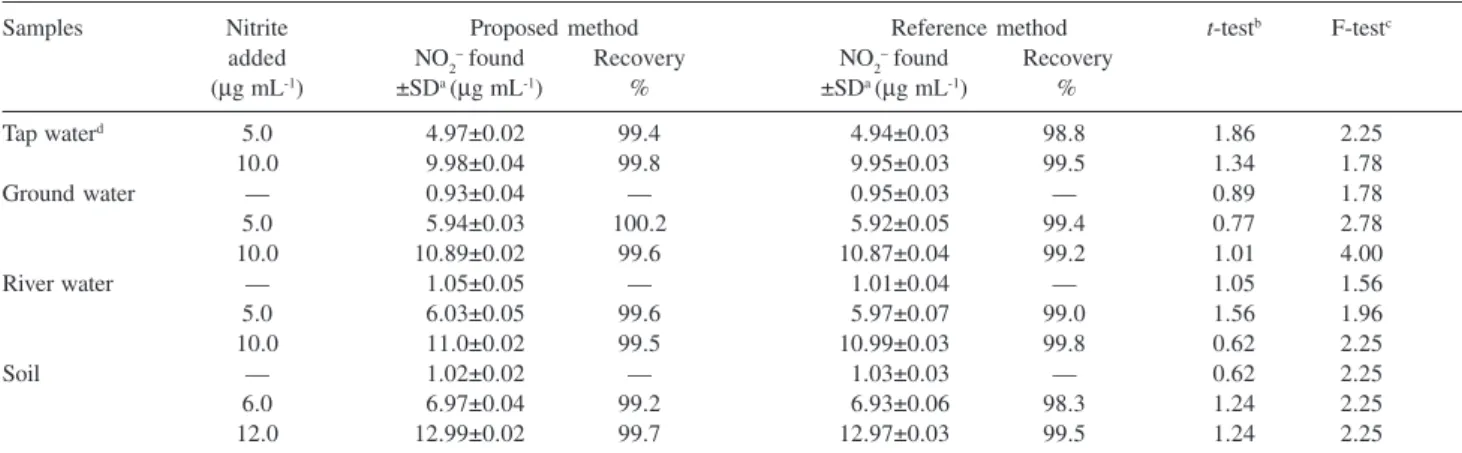
The proposed methods were applied to the determination of nitrite in water and soil samples. The water samples were collected from different sources, and were filtered before analysis. As the concentration of common pollutants in the natural water is generally far below the tolerance levels shown in Table 2, the method was applied directly to the determination of nitrite in natural water samples. The results obtained are compared with the standard sulfanilamide-NEDA6 method (Tables 3 and 4). Statistical analysis of the
results by t and F-tests showed no significant difference in accuracy and precision of the proposed and reference method.6 The reliability of the method to analyze real samples
was checked by recovery experiments, which gave quantitative results with convenient reproducibility.
Table 2. Effect of diverse ions on the determination of nitrite (5 µg mL-1)
ion Tolerance ion Tolerance
limit (µg mL-1) limit (µg mL-1)
Ba(II) 500 Fluoride 2000
Cd(II) 500 Iodide 2000
Ca(II) 200 Tartrate 1000
Co(II)* 100 Citrate 1000
Cu(II)* 100 Acetate 1000
Pb(II) 200 Oxalate 1000
Mn(II) 200 Sulfate 1200
Mg(II) 200 Chloride 1000
Hg(II)* 50 Nitrate 1000
Al(III) 500 Phosphate 1000
Fe(III)* 75
Cr(VI) 100
* Masked with masking agents.
Table 3. Determination of nitrite in different water and soil samples using diazocouple of p-nitroaniline with ethoxyethylenemaleic ester
Samples Nitrite Proposed method Reference method t-testb F-testc
added NO2– found Recovery NO
2
– found Recovery
(µg mL-1) ±SDa (µg mL-1) % ±SDa (µg mL-1) %
Tap waterd 5.0 04.97±0.02 99.4 04.94±0.03 98.8 1.86 2.25
10.0 09.98±0.04 99.8 09.95±0.03 99.5 1.34 1.78
Ground water — 00.93±0.04 — 00.95±0.03 — 0.89 1.78
5.0 05.94±0.03 100.2 05.92±0.05 99.4 0.77 2.78
10.0 10.89±0.02 99.6 10.87±0.04 99.2 1.01 4.00
River water — 01.05±0.05 — 01.01±0.04 — 1.05 1.56
5.0 06.03±0.05 99.6 05.97±0.07 99.0 1.56 1.96
10.0 011.0±0.02 99.5 10.99±0.03 99.8 0.62 2.25
Soil — 01.02±0.02 — 01.03±0.03 — 0.62 2.25
6.0 06.97±0.04 99.2 06.93±0.06 98.3 1.24 2.25
12.0 12.99±0.02 99.7 12.97±0.03 99.5 1.24 2.25
a Mean ± standard deviation (n=5); b tabulated t-value for 8 degrees of freedom at P(0.95) is 2.306; c tabulated F-value for (4, 4) degrees of freedom at
Conclusions
The proposed method for the determination of nitrite is simple and sensitive has a wide analytical range without the need for extraction or heating. The reagent proposed has the advantage of high sensitivity and low absorbance of reagent blank. The developed method does not involve any stringent reaction conditions and offers the advantages of high color stability (more than 6 hours). The proposed method has been successfully applied to the determination of trace amounts of nitrite in water and soil samples.
Acknowledgments
Authors also thank the Microtron facility Center, Mangalore University for technical help.
References
1. BIBRA working Group, Toxicity Profile , BIBRA,; Toxicol.
Int. 1990, 12.
2. Hurst, J. K.; Lumar, S. V.; Chem. Res. Toxicol. 1997, 10, 804. 3. Reszka, K. J.; Matuszak, Z.; Chignell.; C. F.; Chem. Res.
Toxicol. 1997, 10, 1325.
4. Wang, C. J.; Huang, H. P.; Tseng, T. H.; Lin, Y. L.; Shiow, S. J.; Arch. Toxicol. 1995, 70, 12.
5. Gabby, J.; Almong, Y.; Davidson, M.; Donagi, A. E.; Analyst
1997, 102, 371.
6. AOAC Method; Official Methods of Analysis, 16th ed., AOAC,
1995, 8-9.
7. Allen, A. A.; Chemical Analysis of Ecological Material, Blackwell: Oxford, 1974, p. 203.
8. Ghasemi, J.; Jabbari, A.; Amini, A.; Oskoei, A. G.; Abdolahi, B.; Anal. Lett. 2004, 37, 2205.
9. Tomiyasu, T.; Konagayoshi,Y.; Anazawa, K.; Sakamoto, H.; Anal. Sci. 2001, 17, 1437.
10. Mou, S. F.; Wang, T. H.; Sun, Q. J.; J. Chromatogr. 1993, 640, 161.
11. Andrade, R.; Viana, C.O.; Guadagnin, S. G.; Reyes, F. G. R.; Rath, S.; Food Chem.2003, 80, 597.
12. Rathore, D. P. S.; Tarafder, P. K.; J. Indian. Chem. Soc.1989, 26, 185.
13. Kaur, P.; Gupta, V. K.; J. Indian. Chem. Soc.1987, 64, 428. 14. Kaveeshwar, R.; Gupta, V. K.; Analyst, 1991, 116, 667. 15. Kesari, R.; Gupta, V. K.; J. Indian. Chem. Soc.1998, 75, 416. 16. Revanasiddappa, H. D.; Kumar, K.; Bilwa, M.; Mikrochim. Acta
2001, 137, 249.
17. Nidal, A. Z.; Maher, A. A.; Abdullah, F. E.; Talanta1999, 50, 819.
18. Sreekumar, N. V.; Narayana, B.; Hegde, P.; Munjunatha, B. R.; Sarojini, B. K.; Microchem. J. 2003, 74, 27.
19. Revanasiddappa, H. D.; Kiran Kumar, T. N.; Fresenius Environ. Bull. 2001, 10, 781.
20. Sukumar, C.; Sunitha, M. B.; Gupta, V. K;. J. Indian Chem. Soc. 2004, 81, 522.
21. Reddy, M. C. S.; J. Sci. Indust. Res. 2004, 63, 172.
22. Revanasiddappa, H. D.; Kiran Kumar, T. N.; Chem. Anal. (Warsaw)2003, 48, 759.
23. Sunitha, S.; Gupta, V.K.; Intern. J. Environ. Anal. Chem. 1984, 19, 11.
24. Baveja, A. K.; Gupta, V.K.; Analyst 1981, 106, 955.
Received: July 7, 2005
Published on the web: April 12, 2006
Table 4. Determination of nitrite in different water and soil samples using diazocouple of p-nitroaniline with ethylcyanoacetate
Samples Nitrite Proposed method Reference method t-testb F-testc
added NO2– found Recovery NO
2
– found Recovery
(µg mL-1) ±SDa (µg mL-1) % ±SDa (µg mL-1) %
Tapd water 7.0 06.98±0.03 99.7 06.95±0.04 99.2 1.34 1.78
14.0 13.95±0.02 99.6 13.92±0.03 99.4 1.86 2.25
Ground water — 00.92±0.02 — 00.95±0.03 — 1.86 2.25
7.0 07.93±0.05 100.1 07.92±0.03 99.6 0.38 2.78
14.0 14.90±0.07 99.8 14.92±0.05 99.7 0.52 1.96
River water — 01.04±0.02 — 01.01±0.04 — 1.49 4.00
7.0 07.97±0.02 99.0 07.95±0.03 99.1 1.24 2.25
14.0 15.01±0.01 99.8 14.98±0.02 99.7 2.99 4.00
Soil — 01.05± 0.02 — 01.03±0.03 — 1.24 2.25
7.0 08.01±0.03 99.4 07.99±0.04 99.4 0.89 1.78
14.0 15.06±0.04 100.1 15.00±0.06 99.8 2.94 2.25
a Mean ± standard deviation (n=5); b tabulated t-value for 8 degrees of freedom at P (0.95) is 2.306; c tabulated F-value for (4, 4) degrees of freedom at P