School of Business and Economics.
The Money Mission Matrix:
A Model for Social
Entrepreneurship
Mirthe Liz Cuperus
2706
A Work Project carried out within the Master in Management Program, under supervision of:
Miguel Munoz Duarte
INDEX
Index 2
Abstract 3
1. Introduction & Methodology 4
1.1 Introduction 4
1.2 Methodology 5
2. Literature Review: What is Social Entrepreneurship? 6
2.1 Defining Social Entrepreneurship 6
2.2 Existing Frameworks, Models and Theories for Social Entrepreneurship 8
2.3 Conclusion of Literature review 9
3. The Stakeholder 10
3.1 The Customer 10
3.2 The Entrepreneur 12
3.3 The Incubator 13
3.4 The Investor 14
3.5 Conclusion 16
4. Description of The Model: The Money Mission Matrix 16
4.1 The Key Factors 16
4.2 The Dimensions 17
4.3 The Profiles 18
4.4 Applications and Assumptions 21
5. Conclusion & Outlook 22
ABSTRACT
Social entrepreneurship is popular in current academics and other media. This thesis adds to this literature by discovering what the drivers are for sustainable social entrepreneurship. Several stakeholders were identified, creating profiles of the key players in social entrepreneurship. These stakeholders uncovered key factors that represent the drivers for sustainable social
entrepreneurship. Key factors were then aligned along the two dimensions: Money and Mission. This created four profiles of organisations, each representing several key factors. The model helps explain the drivers for sustainable social entrepreneurship (competitiveness, financial
sustainability, social impact, network, motivation and structure) by using these four profiles.
1. INTRODUCTION & METHODOLOGY
1.1 Introduction
Dopper, Lush, Goldiblox, Indiegogo, Mpesa. Just 5 examples of social enterprises that change the face business and make the world a better place. Social entrepreneurs are creating innovative new solutions to current societal problems. From sexism (Goldiblox), to excess packaging (Lush and Dopper), and providing services to people without easy access (Mpesa and Indigogo).
Why social entrepreneurship? Current government services are failing the poor, the environment and the marginalised over the world. New solutions are needed to solve new problems (Yunus, 2010; Seelos & Mair, 2005). Initially, solutions included for example charities, classic non-profits and public institutions. But currently, a new form of business appears to triumph: the social
enterprise (Dees, 1998; Seelos & Mair, 2005).
Social entrepreneurship is a concept that has grown in prominence over the last couple of years. Both popular and academic press are intrigued by the form of organisation that combines
entrepreneurship and social impact. The initiatives have popped up all around the world, and take all shapes, forms and sizes (Seelos & Mair, 2005; Yunus, 2010). Social entrepreneurship appears to be here to stay, so additional research on the topic is needed (Seelos & Mair, 2005; Peredo & McLean, 2006).
This thesis aims to find drivers of sustainable social entrepreneurship. Unveiling these drivers will help understand and promote the concept of social entrepreneurship. To achieve this goal two research questions answered.
1. What are the drivers for sustainable social entrepreneurship?
2. How can social entrepreneurship be represented in a comprehensive model to engage more
companies in this practice and add to the existing literature?
developed, the theoretical studies are not always aligned with the practical needs. Therefore an approach that combines the two is an interesting addition.
1.2 Methodology
Qualitative research was the main source of research in this thesis and it includes "any kind of research that produces findings not arrived at by means of statistical procedures or other means of quantification" (Straus & Corbin, 1998). Therefore the knowledge that is obtained by qualitative research is different from the knowledge obtained by quantitative research. Intuition and
interpretation are always used in quantitative research.(Galofshani, 2003). The conclusions were drawn by studying real-world people and phenomena and generating a narrative from this research (Patton, 2005).
Since a significant amount of literature focusses on what the meaning of social entrepreneurship is, this additional research was necessary. By combining the research that already exists with some new qualitative research, a new perspective was composed.
Preliminary research
To define the direction of this thesis, a preliminary research was performed to look into the most current opinions of the topic. A variety of published articles, popular media and interviews lead to the definition of the research question and the sub questions of this thesis. Also, the path of research was determined, by finding out what sources were needed to proceed on answering the research question.
Literature Review
To be able to form an interesting and novel opinion on the topic it was important to look at the concept in a bigger context and look at the current framework of social entrepreneurship research. Literature offered the perfect solution to finding relevant definitions and analysis already
add to this thesis. At the same time, limitations were investigated, to find out if the research question was adding to the literature.
Stakeholder Profiles
A thorough qualitative research was done of several social entrepreneurship stakeholders. These stakeholders were the customer, the entrepreneur, the investor, and the incubator. These
stakeholders were determined based on the literature review.
Qualitative research into the opinions and knowledge of the stakeholders was done based on literature, interviews and surveys. This research was condensed into stakeholder profiles, enabling the researcher to analyse the stakeholder in a more summarised way. Each stakeholder profile explains the drivers for sustainable social entrepreneurship.
Model Development
Based on the stakeholder profile, several conclusions were drawn that made the basis of the model. Key factors for social entrepreneurship were identified among the different stakeholders. These key factors could be seen as drivers for sustainable social entrepreneurship. In addition, the two dimension of the model were set to be the two main characteristics of social
entrepreneurship. The dimensions and the key factors resulted in four profiles, to describe the position of social entrepreneurship. This model is a new representation of existing opinions and aims to offer new insights.
2. LITERATURE REVIEW: WHAT IS SOCIAL ENTREPRENEURSHIP?
2.1 Defining Social Entrepreneurship
Most of the literature of social entrepreneurship focusses on defining the concept. This literature review outlines the most prominent definitions. Defining social entrepreneurship is not easy considering many conflicting theories and opinions. According to Dees (1998), one of the early researchers on the topic, a social enterprise combines a social mission in combination with business like discipline, enabling them to stay sustainable.
Yunus (2010), one of the pioneers on this topic disagrees with all of this. According to him social enterprises differ vastly from the social business concept that he promotes. Social business should be a non-loss, non-dividend company. Meaning that investors only receive their invested money back, and no more, but that the business at the same time should be self sufficient. The argument here is that profit would distract from the social objective.
Abu Saifan (2012) is able to unify these definitions in one that satisfies both sides. His
perspective is that a social enterprise can take two different forms: the non-profit that keeps itself financially independent, and the competitive enterprise that includes a social goal in its outcome or business model. The non-profit can in fact make a monetary profit, but this will be reinvested into the company, and not paid out to investors or employees. The competitive enterprise that includes a social goal can pay out dividends to their investors or employees, and will still be considered social as long as a social aim is integrated in their outcomes or business model. A reason to use this unified definition is that Yunus’ theories have caused some controversy among social entrepreneurs worldwide. An example is Schwartz (2010), who thinks Yunus is underrating social impact that other companies make, since he is excluding some very important social enterprises.
Other papers that discuss the definition of social entrepreneurship are (among others): Peredo & McLean (2006), Mair & Marti (2006), Elkington & Hartigan (2008), Baron (2007).
The first is social business, defined by Yunus (2010). He states that social business should be a non-loss, non-dividend company. Although this is one form of social entrepreneurship, it does not cover the complete scope.
Also confusing is the difference between corporate social responsibility (CSR) and social entrepreneurship. CSR is social and charitable actions performed by corporations. As Baron (2007) states, the crucial difference is that corporations use CSR activities to increase profits strategically, whether through marketing or other benefits, and this is not an integrated part of the company. On the other side, social entrepreneurs carry this strategy beyond profit and value maximisation, as it is an integrated part in their business model.
Lastly, social entrepreneurship differs greatly from social work. Social work encompasses the different activities that have to do with personal interactions and service. An example of social work is a family care officer, or planned parenthood. These are all majorly important social institutions, but they are not similar to social entrepreneurship. Sometimes, however, social work can be a part of social enterprises (Horner, 2012).
2.2 Existing Frameworks, Models and Theories for Social Entrepreneurship
Social entrepreneurship as a concept is well developed in practice. However, on academic level there are few existing frameworks and models. Most literature refers to defining the concept, as was summarised in the previous section, or making a case study. Only some literature tries to move towards a model. In addition there are plenty of books from popular press that aim to instruct on how to practice social entrepreneurship. Two prominent theories are Elkington & Hartigan and Weerawardena.
Elkington & Hartigan (2008)
defined by social enterprises: leveraged non-profit, the hybrid non-profit, and the social business. All have a different financial approach, but all have social goals.
The book helps understand that social entrepreneurship is an open concept that is hard to confine in a box, but that most social entrepreneurs have factors in common. For example, they all have struggles finding funds to operate their social goals, since they fall in between the NGO and the profit maximising companies, and they seek different kinds of funds.
In addition, there is always the struggle between social and financial, Elkington & Hartigan write that (unfortunately) because of market forces the financial side often wins. Finally, they state that social entrepreneurs are creators and not followers, and they create new markets and
opportunities. Their activities may include social supply chains, social labor and social
consumers. Some social entrepreneurs even develop disruptive technology to further their social goal.
Weerawardena (2006)
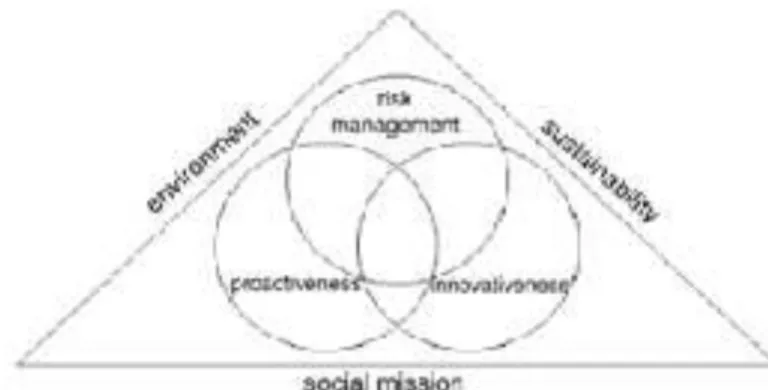
One of the few conceptual models out these is the model made by Weerawardena (2006). This multidimensional model implicates that Social Value Creation (SVC) is influenced by
innovativeness (I), productiveness (P), risk management (RM), sustainability (S), social
mission (SM) and the environment (E). This relationship can be stated like: SVC = ƒ(I,P,RM) subject to S, SM, E. This model mostly helps explain the relationship between finances and social impact as the model describes a relationship between behaviour and the business in social value creation. Internal qualities of the entrepreneur are at the centre of the model, where they are affected by social mission, environment and sustainability.
2.3 Conclusion of Literature review
As this literature review shows us, most of the literature on social entrepreneurship consists of defining the topic and the key player: the social entrepreneur. However, also there is a gap
between the academic and practical work at this moment. There are clearly two sides in the story: the popular literature like Elkington & Hartigan (2008), promoting social entrepreneurship and explaining phenomena that occur. On the other side there are academics, preoccupied with defining what social entrepreneurship is and which companies are included in this term. There is clearly a need for an academic approach that still explains in an interesting way how social entrepreneurship can be done and what the drivers are for sustainable social entrepreneurship.
3. THE STAKEHOLDER
To analyse what the important drivers of sustainable social entrepreneurship are it is important to assess the stakeholders that are involved in the process. Four different stakeholders have been analysed to find out about social entrepreneurship and the drivers for sustainable execution: The Customer, The Entrepreneur, The Incubator, The Investor. These stakeholders were chosen based on what literature describes as the most involved parties (Yunus, 2010; Schwab
Foundation, 2016; Abu-Saifan, 2012; Seelos & Mair, 2005).
To research the key stakeholders, they were interviewed or surveyed and researched in literature. The research is grouped together to create four different stakeholders profiles on which the model will be based. The biography of the interviewees and more extended summaries can be found in the appendix. This section includes an overview of the findings.
3.1 The Customer
A survey was taken by 43 consumers (full survey can be found in the appendix). The average age of the sample was 30,97, with a range 19 to 61. 70% of the respondents were female, and 30% were male. The sample was randomly picked from the population. 70% of the sample has
purchased a product from a social enterprise at one or more occasions and 60% has used a service from a social enterprise. Although the sample is relatively small, the results of the survey can give an indication of the population, as the survey indicates that people make certain choices when purchasing from a social enterprise.
Firstly, the questions was asked how much the customers valued price and quality in social enterprises. This indicates that on average the sample thought quality was of a 78 out of 100 importance. Price was thought 64 out of 100 important. Therefore this indicates that a social enterprise has to be competitive to ordinary products, because both price and quality are considered important attributes.
The second finding is that people will make certain concessions when purchasing. The sample indicates us that people are willing to pay more for a social product (72% said they would spend more on a social product).
In addition an interesting finding was that people would not do a concession on quality (25,6% would buy a social product or service if the quality was less, 74,4% wouldn’t buy a product if the quality was less than a non-social product). This indicates that social enterprises have to be competitive to non-social enterprises, but they may be able to charge a premium. In
addition, 95% said that they would chose the social option if the quality and the price was equal. But, then again, when asked how much the customers take social options in consideration on a daily basis, the question was answered 48 out of a 100.
they are buying is social or not, making it even more important to compete not just with other social products, but also with traditional products.
3.2 The Entrepreneur
Who is the social entrepreneur? According to Leadbeater (1997) the social entrepreneur is the answer to current social problems. Social entrepreneurs are able to use entrepreneurial skills to develop solutions to social problems, by using new ways, or innovating old ways. Dees (1998) adds to this that markets are equipped for personal value creation: money. The markets still have a hard time valuing social developments and value creation. This is a challenge for entrepreneurs. However, the previous literature states some of the earlier opinions on social entrepreneurs. According to Steven Volkers an important change is that more social entrepreneurs now actually integrate their goals into the business model, in stead of taking part of the revenue and using it to do good. This means that the structure of a social enterprise is changing and improving. This development that has made social entrepreneurship more popular for the consumers, since they can now buy a social product as they would an ordinary product and make impact at the same time.
In addition Jens Kok (Dopper) and Paul Vermeer (Autitalent), two social entrepreneurs, add that they consider financial independence an important part of being a social entrepreneur. Without this independence, it is hard to make a lasting impact because funding could stop at any time. If a social enterprise performs as a traditional company would, the social enterprise stays competitive and can make a sustainable long term impact. Dopper is a great example, a company that
produces water bottles. They make impact in two ways: by diminishing the need for
According to both, the important way to achieve this is to be competitive to not just other social products, but also to similar, ordinary products or services. Take Autitalent, which consists of IT support for other businesses, while employing a usually excluded group: people with autism. Autitalent has to provide a service just as good as the competitor, otherwise their customers would go to another IT support, since the customer’s profits depend on this service. Other social entrepreneurs interviewed mentioned similar competitiveness in their branch.
According to Jens Kok, a large network of partners is what any social enterprise needs. Although financial independence is key, a social enterprise does not have to be completely solo. When starting Dopper, the entrepreneurs depended heavily on the support of friendly designers, web-builders and colleagues to help them develop a good and marketable product. These partners now also help spreading the word about the product. The other social entrepreneurs mentioned similar stories.
Concluding, there are definitely things that these social entrepreneurs have in common or find important. These things are: the structure of the enterprise, competitiveness, financial
sustainability and a network of partners.
3.3 The Incubator
For incubators, social entrepreneurship poses a new opportunity and a new challenge. The concept of social entrepreneurship makes for a new “market” of incubators, but also classical incubators are interested in this form of entrepreneurship.
Tom Dalenberg (Enactus) mentions that ultimately the balance between the social and financial
will prevail. In his experience with young social entrepreneurs, he noticed that when one or the other was the focus, the idea didn’t last long. He also mentions that motivation is a key ingredient in a social enterprise. Especially when working with students, he notices the more motivated students achieve more with their social enterprise.
In addition Tom Dalenberg mentions that the structure of the enterprise is also relevant. He believes that including the beneficiaries in the process was good for future sustainability. Also, because the customers have more understanding of the social outcome of the product. For
example, if they know a product is made by refugees, the effect is more tangible than when 5% of profits is used for certain activities.
3.4 The Investor
Social enterprise investors come in three forms: classic capital venture firms (e.g. Andreessen Horowitz), social investors that seek return (e.g. Capricorn Investment Group, MaRS) and foundations that invest in social enterprises (e.g. Grameen). Classical venture capitalists are mostly focussed on monetary return and will therefore put low emphasis on the social part; it is considered a plus rather than a need. Social investors that seek return look for financially viable startups that make proven social impact. Often they invest in social enterprises that have a proven concept, and they enable scaling. However, their requirements for financial success are often lower because social success is valued as well. The foundations that invest in social enterprises put most value on the social part, where the financial stability is a necessity rather than a plus. They seek reimbursement of their investment, but do not desire to receive return beyond this. (Echoing Green, 2017; MaRS, 2017; Capricorn Investment Group, 2017; Yunus, 2010; Andreeesen Horowitz, 2017)
enterprises that have proven they are viable. An example of this is the support available from the European Commission (European Comission, 2017).
Most big social investors (of all types) have a list of criteria on their website which they apply to social enterprises that seek funding. A summary of the criteria set by big investors is listed below.
-
Social Impact: Social investors want to make sure the startup they are investing in is makingthe impact that they claim. Therefore, investors pose a high value on the method of social impact measurement. When looking for funding, social impacts have to proof their worth by social impact measurement.
-
Return on Investment: Most investors have as an important criteria that the investment is used wisely and will eventually be paid back. As Jan Dijk mentioned: “Although we are more lenient with lending our credit with social enterprises, we do choose healthy business models when investing in social enterprises”. Meaning that financial sustainability is needed when seeking investment.-
Focus: Some social investors seek enterprises in a certain field. This could be a criteria for funding. For example, Grameen bank (Yunus, 2010) will only deal with startups that solve (or relieve) poverty. Other funds like the EchoingGreen fund are focussed on environmental entrepreneurship (EchoingGreen, 2017).Concluding, it is suggested by this research that most investors have some criteria to apply to social entrepreneurship. In addition, they often look for a balance between the social and financial aspect.
3.5 Conclusion
Different stakeholders have different views on a social enterprise. However, some communal factors were found among the stakeholders. The factors are considered drivers towards
sustainable social entrepreneurship. These were competitiveness, financial sustainability, social impact, network, intrinsic motivation and structure.
4. DESCRIPTION OF THE MODEL: THE MONEY MISSION MATRIX
This model is based on findings during the survey, several interviews and literature research that has been mentioned before in this work, although occasionally a new source may be added to clarify.
The model is based on key factors discovered in research. These factors are what the research indicates are important factors for becoming and maintaining a social enterprise. Secondly, the dimensions of the model will be explained: money and mission. This results in 4 different quadrants, or profiles: The Hangover, Unfinished Business, Deep Impact and The Hulk. The key factors were each assigned to a different profile, clarifying what distinguishes a social enterprise from a profit maximising enterprise and a non-profit or charity, and what they have in common. Finally, some applications and assumptions will be explained.
4.1 The Key Factors
-
Financial sustainability: it was very clear that all stakeholders mentioned that the financial stability of a social enterprise is a key factor in making it sustainable. The fact that the companies are focussed on growth as well as impact, makes sure that their impact remains.-
Network: Although the enterprises aim to be financially independent, especially theentrepreneurs mentioned they could not have done it without their network. Networks provide with a support that is not financial, but still very valuable.
-
Social impact: They key component of a social enterprise is of course social impact. This social impact can be made as a result of the business, embedded into the business model, or both.-
Competitiveness: The competitiveness seems to be a really important factor in this model. To be competitive with profit maximising companies, the product or service has to be equal, or better. If the companies are not competitive, they are not sustainable.-
Intrinsic Motivation: For a social entrepreneur, the motivation to do good is intrinsic. A social entrepreneur does not just want to make money, but make a positive impact in the process.-
Structure: The structure of a business is relevant in achieving a social enterprise. There are ofcourse several ways of structure that could be sustainable. To achieve a social enterprise, there has to be some form of social mission in the business model or final result. Whether the revenues are used to create impact in a separate place, or whether the target social group is integrated in the business model, to create a social enterprise there has to be some form of social impact in the business model structure.
4.2 The Dimensions
Money: The first dimension is money, on the y-axis. The dimension money contains concepts related to the financial part of the enterprise. This dimension is a hybrid between several concepts: financial sustainability (how will it do in the future? is it lasting?), business model or structure (how is the money made?), and competitiveness or execution (are they better than competitors? how are they differentiated?).
Mission: The second dimension is mission, on the x-axis. The dimension mission contains
several concepts related to the social aspect of the enterprise. This dimension is a hybrid between: social mission (what is the goal/who are the beneficiaries?), impact (how do they help the
beneficiaries?), and reach (how many do they help?).
What do these hybrid dimensions mean? The dimensions are hybrids to help explain that there is not just one good way to create money or mission. Take for example Dopper: the impact they make per individual is rather low. However, they have sold over 3 million products, making their reach very high. Therefore they still score a high on the mission hybrid.
The aforementioned dimensions can be divided in two parts: Low and High. This results in 4 quadrants, which each represent a different profile. These profiles can help us understand what drivers are for sustainable social entrepreneurship.
The Hangover
In the Hangover, there is low money and low mission. This scenario is a place that many people start, which is not a problem, since we all start somewhere. However, this is not a place where people stay for a long time. In the Hangover you either move forward or you stop. Although the situation could work for a while at low money and mission, ultimately competition and other forces will end this situation.
An example of an organisation in this position is hard to name, since they either fight or flight in this quadrant.
Key factors: This profile has none of the key factors that were identified in the previous section,
however they could have some key factors under development. For example an aspiring social entrepreneur could have an intrinsic motivation under development, or a network.
Unfinished Business
Unfinished business is a position many organisations in our world are in currently. Organisations in this section are traditional for-profit companies. These companies may have some form or CSR or volunteering practices, but this is not social entrepreneurship. “Money” is high, since
organisations in this quadrants are business and competition, financial sustainability and the business model are very important in a for-profit world. The organisations in Unfinished Business are making great financial impact on the economy.
Apple is just one example of the giants that run our economy. But with great power comes great responsibility. What if companies in this profile could become effective on both the money and the mission dimension?
Key factors: This part of the matrix consists usually of competitiveness and financial
independence. Most companies have a network, but it should be researched if they have the network for social entrepreneurship.
Deep Impact
Deep Impact is making high social impact and low financial sustainability. Fitting this profile are mostly charities, NGO’s and such. The organisations are dependent for most of their activities from outside financing or donations.
Although the idea of charity is not as sustainable as social enterprises, there are definite uses for organisations in this sector. As Yunus (2010) states, the best example is emergency relief. When a hurricane hits, a refugee crisis emerges or similar situations arise, the emergency relief has to be there fast and plentiful. The people in the affected areas need help sooner rather than later and there is no time to create a business model. An example of Deep Impact is the relief fund for Haiti.
However, a lot of potential social enterprises are stuck in this phase. Due to a lack of business model, they remain dependant from outside donations. Plenty of these projects could make the same impact in a sustainable way (Yunus, 2010). Can we turn social work in to social
entrepreneurship and create impact in a a lasting, more meaningful way?
Key factors: Network, intrinsic motivation and social impact are all part of charity organisations.
The intention is there, but outside financing is still the main source of income.
The Hulk
in common: they provide for themselves and are independent from outside donations, they create social value during this process and they are motivated by more than money.
A great example of a social enterprise is Autitalent, which sells business to business IT services. They provide a unique service because their employees are all people with Autism: people that would ordinarily have trouble to find a job. These people are coached through their jobs and specialists are always available to help. In addition to this “mission” aspect, the company also delivers a great service and is financially independent. Therefore, it is the perfect combination of money and mission.
This combination of green and strong is not unique. There are many great examples of social enterprises. But even more organisations with the potential to become the Hulk.
Key factors: The Hulk has all of the identified key factors, making it completely able to live in a
competitive market, while making social impact at the same time. Drivers for sustainable social entrepreneurship are: competitiveness, financial sustainability, social impact, network, motivation and structure.
4.4 Applications and Assumptions
Since this model tries to explain the real world in an adjusted and simplified way, there are some assumptions connected to the model. The assumptions in the model are as follows:
-
The research and key factors are representative for the populations. This assumption existsbecause the sample is rather small so it is needed to justify that the outcomes are expected to predict for the population.
-
There are only four quadrants. According to the model, there are four profiles. In the realworld however there are many more options. For simplification and clarification it was chosen to create only two options: high and low.
-
Social entrepreneurship is the ultimate goal. For this model, the best outcome is socialHowever, in the real world the other systems can have as much value. Therefore it is important to take into account that the thesis is written from a social entrepreneurship perspective. The model has several applications within the constricts of the assumptions. The model can be used to create understanding about the concept it represents: social entrepreneurship. Also, it helps to simplify and describe the process and entity of social entrepreneurship. In addition it proposes some drivers for sustainable social entrepreneurship and classifies the drivers that are missing from different organisations. The model should be used as a tool to explain, and engage.
5. CONCLUSION & OUTLOOK
The model in this thesis aims to show that social entrepreneurship could be an option for more organisations. While developing this model a focus of social entrepreneurship was applied, therefore the model shows an new and interesting representation of existing concepts. The model offers a new perspective by showing a social enterprise as the ultimate goal, in stead of an
inferior form of entrepreneurship. The model aims to indicate that considering social entrepreneurship should be at the front of everybody’s mind.
From this research is can be concluded that there are definitely drivers for sustainable social entrepreneurship. The limited research that was done indicated that there are different stakeholders that value similar characteristics. These drivers are competitiveness, financial sustainability, social impact, network, motivation and structure. Knowing about these drivers can help social enterprises and aspiring social enterprises discover on what is missing or needs to be improved.
Future research should focus on validating these conclusions within a larger sample. In addition, some other research could be added, like the effect of environment, government and culture on social entrepreneurship, since external factors were excluded from this research. It could also be an interesting addition to include the beneficiary in future research. In addition, it could be interesting to further research a quantification of the model, actually posing values on both dimensions.
Another interesting addition to the model would be to figure out how companies move from one profile to the other: what are the paths that are taken and what are the steps companies could take to achieve social entrepreneurship.
6. REFERENCES
Abu-Saifan, S. 2012. Social Entrepreneurship: Definition and Boundaries. Technology
Innovation Management Review. February 2012: 22-27.
Andreessen Horowitz (2017). Retrieved 02-01-17 from: https://a16z.com/2015/02/27/16- common-questions-about-fundraising/
Baron, D. P. 2007. Corporate social responsibility and social entrepreneurship. Journal of
Economics & Management Strategy, 16(3), 683-717.
Capricorn Investment Group (2017). Retrieved 02-01-17 from: http://skoll.org/organization/ capricorn-investment-group/
Dees, J. G. (1998). The meaning of social entrepreneurship.
Echoing Green (2017). Retrieved 02-01-12 from: http://www.echoinggreen.org/fellowship Elkington, J., & Hartigan, P. (2013). The power of unreasonable people: How social
entrepreneurs create markets that change the world. Harvard Business Press.
European Commission (2017). Retrieved 02-01-17 from: http://ec.europa.eu/social/main.jsp? langId=en&catId=89&newsId=1093&furtherNews=yes
Golafshani, N. (2003). Understanding reliability and validity in qualitative research. The
qualitative report, 8(4), 597-606.
Horner, N. (2012). What is social work?. Learning Matters.
Leadbeater, C. (1997). The rise of the social entrepreneur (No. 25). Demos.
Mair, J., & Marti, I. (2006). Social entrepreneurship research: A source of explanation, prediction, and delight. Journal of world business, 41(1), 36-44.
MaRS (2017). Retrieved 02-01-17 from: https://www.marsdd.com/funding/
Osterwalder, A., & Pigneur, Y. (2010). Business model generation: a handbook for visionaries, game changers, and challengers. John Wiley & Sons.
Peredo, A. M., & McLean, M. (2006). Social entrepreneurship: A critical review of the concept.
Journal of world business, 41(1), 56-65.
Salamon, L.M. & Anheier, H.K. 1992. In search of the non-profit sector. I: The question of definitions. Voluntas, 1992, 3: 125. doi:10.1007/BF01397770
Schwab Foundation (2016).Retrieved 22-11-16 from: http://www.schwabfound.org/content/what-social-entrepreneur
Schwartz, R. (2010). Hear, Hear, For Profits. Stanford Social Innovation Review. Retrieved 22-11-16 from: https://ssir.org/book_reviews/entry/
building_social_business_muhammad_yunus
Seelos, C., & Mair, J. (2005). Social entrepreneurship: Creating new business models to serve the poor. Business horizons, 48(3), 241-246.
Seelos, C., & Mair, J. (2005). Entrepreneurs in service of the poor: Models for business contributions to sustainable development. Business Horizons, 48(3), 241-246. Seelos, C., Ganly, K., & Mair, J. (2006). Social entrepreneurs directly contribute to global
development goals. In Social entrepreneurship (pp. 235-275). Palgrave Macmillan UK. Strauss, A., & Corbin, J. (1998). Basics of qualitative research: Techniques and procedures for
developing grounded theory . Sage Publications, Inc.
Weerawardena, J., & Mort, G. S. (2006). Investigating social entrepreneurship: A multidimensional model. Journal of world business, 41(1), 21-35.