The relationship among pre-task planning,
working memory capacity,
and L2 speech performance: a pilot study
Maria da Glória Guará Tavares Universidade Federal do Ceará
Abstract: This article reports on a pilot study that investigated the relationship among pre-task planning (Skehan, 1996, 1998), working memory (WM) capacity, and L2 speech performance. Participants were 25 learners of English as a foreign language performing two tasks each. Results show that (1) planning leads to gains in fluency and accuracy but not complexity of L2 speech performance, (2) there are no significant correlations between WM capacity and L2 speech performance of the first narrative tasks for both control and experimental groups under no planning conditions, (3) there are significant correlations between WM capacity and L2 speech performance of the second narrative task of the experimental group (planning condition), and also between WM capacity and L2 speech performance of the second narrative task of the control group (no planning condition). Therefore, results are not conclusive and suggest a complex relationship between pre-task planning, WM capacity and L2 speech performance. Results are discussed in terms of Fortkamp’s (2000) view of L2 speech production as a controlled processing activity (Engle, Kane & Tuholsky, 1999).
Key words: working memory; planning; oral performance.
INTRODUCTION
Yuan; Ellis, 2003). One interesting finding of the studies on the impact of planning on L2 speech performance is the evidence of trade-off effects. Foster and Skehan (1996), Mehnert (1998), and Yuan and Ellis (2003) discuss results of their studies in terms of an attentional model of learning and performance. In this sense, they emphasize that there are trade-off effects among the goals of fluency, complexity and accuracy in the context of the use of the learners’ limited capacity attentional1 resources. In other words,
these three goals of performance-fluency, accuracy and complexity-compete for learners’ limited attentional resources. The trend of research results tends to show that planning leads to gains in fluency and complexity at the expense of gains in accuracy (Mehnert, 1998). Working memory (hereafter WM) is the limited capacity cognitive system responsible for both storage and processing of information during the performance of complex cognitive tasks (McLaughlin; Heredia, 1996; Daneman; Carpenter, 1980, 1983; Baddeley, 1992a). Despite the fact that researchers explain results in terms of learners’ limited attentional resources, individual differences in WM capacity have not been taken into account in any of these studies as a feasible variable affecting learners’planned performance. Although planning is a means of helping learners overcome limitations in WM capacity and improve performance (Ellis, 2005), in my view, there are at least two reasons to suppose that individual differences in WM capacity may still emerge in planned performance. First, planning seems to assist performance by triggering a range of strategic, metalinguistic and metacognitive behaviors (Ortega, 2005). Research on memory has shown that individuals with higher WM capacity tend to be more strategic (Mendonça, 2002; McNamara; Scott, 2001; Weissheimer, 2004), thus, WM capacity may play a role on how successful one is in engaging in strategic behavior during planning. Second, the benefits of planning on performance may also depend on the ability to execute what was planned into performance (Ortega, 1999). In
1 In the present paper, the terms limitation in attentional resources and limitations in
other words, on the ability to actually retrieve what was planned into on-line performance. According to Rosen and Engle (1997), WM capacity plays a crucial role in retrieval, that is to say, individuals with higher WM capacity tend to more effectively retrieve information during the performance of complex cognitive tasks.
REVIEWOFTHELITERATURE L2 Speech Production
Levelt’s (1989) model of L1 speech production has four specialized components, which underlie the speech production: the conceptualizer, the formulator, the articulator, and the speech comprehension system. In the conceptualizer, the message content is planned by retrieving background knowledge, knowledge about topic as well as knowledge of discourse patterns. In the formulator, the preverbal message turns into a linguistic structure through two processes: grammatical encoding and phonological encoding. In the articulator, the phonetic plan is executed and results in overt speech. Finally, the speech comprehension-system makes overt and internal speech available for monitoring.
According to Levelt (1989, p.10), working memory plays a crucial role in the act of speech. It is the limited capacity system that makes information currently accessible to the speaker- processed information in message generation and monitoring. “It is the information attended to by the speaker”. Speaking requires procedural knowledge because of the limited nature of working memory capacity and the usual speed of speech production (Levelt, 1989).
that is, there is only a single lexicon; however, it is divided into different subsets which undergo activation in different extents, according to the language being spoken. Finally, De Bot (1992) suggests only one articulator for both languages and it is assumed to store a large amount of sounds and pitch patterns from both L1 and L2. By assuming only one articulator in which sounds and pitch patterns of both languages are stored together, L1 interferences in L2 can be explained. While L1 speech production is highly automatized, Poulisse (1997) postulates that: (1) L2 knowledge is not complete, (2) L2 is more hesitant, has shorter sentences and slips of the tongue, (3) L2 may carry traces of L1 and (4) proficient speakers can keep one or more languages apart when they wish to do so. Thus, such a high degree of automatization as in L1 does not apply to an L2 to the same extent. For this reason, in many situations L2 learners may need to creatively construct plans for communicative situations since ready-made chunks may not be available and this activation of procedures demands high degrees of cognitive control (Mehnert, 1998). These control processes take place under a limited capacity cognitive system, namely, working memory.
Working memory and L2 speech performance
tested whether there was a relationship between WM capacity and the ability to produce synonyms for words presented in context. They found a correlation between WM capacity scores and the synonym lexical test scores. Later, Daneman (1991) investigated whether WM capacity could account for individual differences in verbal L1 fluency. Fortkamp (1999) expanded Daneman’s (1991) study in order to investigate whether working memory would be a good predictor of L2 verbal fluency. Fortkamp (1999) also found significant correlations between WM capacity as measured by the SST and L2 speech rate in the speech generation task. Fortkamp (2000) investigated whether WM capacity would predict individual differences in L2 fluency, accuracy, complexity and weighted lexical density. Results indicated that individuals with higher working memory capacity tend to be more fluent, accurate and complex in L2. Interestingly, the study provided evidence of trade-off effects since accuracy, fluency and complexity of speech tended to be achieved at the expense of weighted lexical density.
Planning and L2 speech performance
THE CURRENT STUDY
Based on the preceding review, individual differences in WM capacity seem to be a potential source of individual differences in L2 speech performance. In addition to that, WM capacity may play a role in how successfully one may engage in strategies during planning as well as in how effectively one may retrieve what was planned into performance. Previous studies on planning have raised the issue of trade-off effects in performance due to limitations in attentional resources (Foster; Skehan, 1996; Mehnert, 1998; and Yuan; Ellis, 2003). However, individual differences in working memory capacity have not been taken into account as a feasible variable for affecting ‘planned’ performance. In order to address this gap, three research questions are pursued:
1. Does L2 speech performance (under no planning conditions) significantly correlate with learners’ WM capacity ?
2. Does pre-task planning significantly increase fluency, accuracy and complexity of L2 speech performance?
3. Does L2 speech performance (under planning conditions) significantly correlate with learners’ WM capacity?
METHOD
Design of the study
The study employed a between-subject design, in which participants in the control group completed both first and second narrative tasks under a no-planning condition, and participants in the experimental group completed the first task under a no-planning and the second task under a planning condition.
Data collection procedures
Table 1.1 – Data collection procedures for the experimental group
Table 1.2 – Data collection procedures for the control group
was run in order to find the degree of reliability, the means and the standard deviation of participants’ performance. Reliability estimates for the rating procedure were .85, which is considered an acceptable level.The mean of participants’ performance was 2.5. In order to be able to select 25 participants at proximal2 levels of
proficiency, participants with means ranging from 2.2 to 3.2 were selected. Due to participants’ time constraints and for the sake of practicality, the first narrative task was used for assessing proficiency level as well as for eliciting the first sample of speech in the no planning condition. After selecting the 25 participants of the present study according to their level of proficiency, they were randomly divided into a control group and an experimental group. Independent t-tests indicated no significant differences between the two groups in the performance of the first task in terms of accuracy (errors per 100 words: t = .549; p = .591), fluency (Speech rate unpruned: t = .206; p = .143 and speech rate pruned: t = .343; p = .178) and complexity (clauses per c-unit: = .198; p = .202), thus, the two groups were similar in terms of proficiency level. In the second phase of data collection, all participants of both groups performed a Speaking Span Test (SST) in order to assess their working memory capacity scores. Each participant completed the test individually with the present researcher in the language lab. In the third phase of data collection, participants of the control group performed a second picture-cued narrative task also under a no-planning condition. On the other hand, participants of the experimental group performed the second narrative task under a planned condition in which they had 10 minutes to plan their performance.
The speech generation tasks
The two tasks used in the present study were both ‘there-and- then’ picture cued narratives (Robinson, 1995). In both tasks, participants had 40 seconds to look at the set of pictures and then put pictures away. According to Robinson (1995), these tasks are more complex since in ‘there-and-then’ narratives, as opposed to ‘here- and-now’, the participants are not allowed access to the visual stimuli of the tasks during performance. In order for
2 In order to investigate individual differences in WM, it is important that individual
individual differences in WM capacity to emerge, the task performed has to be complex (Just; Carpenter, 1992; Tomitch, 1996; Fortkamp, 2000), thus, the choice of ‘there-and-then’ narratives for the present study.The order of tasks was counterbalanced among participants. In other words, half of the participants carried out Task A as their first task (no-planning condition) and Task B as their second task (planning condition). The other half of participants carried out the opposite procedure; they performed Task B as their first task and Task A as their second task.The control group carried out both tasks under a no-planning condition. They were instructed to start telling their stories immediately after looking at the pictures for 40 seconds. On the other hand, participants of the experimental group were instructed to plan the second task for 10 minutes after looking at the pictures for 40 seconds. The pictures were removed from them before they started planning their task. Since one minute planning may be enough for gains in accuracy to take place (Mehnert, 1998), the purpose of giving both groups only 40 seconds to look at the pictures was to minimize planning as much as possible while they were looking at the pictures.
The Speaking Span Test
they could generate grammatically and semantically acceptable sentences in English. Following Daneman (1991) and Daneman and Green (1986), in this study, participants’ responses, which were recorded, transcribed and analyzed, generated two different speaking span scores: a speaking span strict score, when all the sentences the subject produced contained the target word in the exact form and order of presentation, and a speaking span lenient score, when credit was given for sentences that contained the target word in a form other than that of presentation (e.g., target word being ‘guy’ and the word in the sentence produced being ‘guys’), and half credit was given to words recalled in a different order. No credit was given to ungrammatical sentences in terms of syntax and semantics.
The measures of L2 speech production
Measures of accuracy, fluency and complexity were used in the present study to evaluate participants’ oral performance. These measures have all been used in previous studies (e.g. Foster; Skehan, 1996; Bygate 2001; Skehan; Foster, 1999, 2005; Mehnert, 1998; Ortega, 1999 among others).
Fluency
Fluency was operationalized in two versions of speech rate: unpruned and pruned (Lennon, 1990; Ortega, 1999; Fortkamp, 2000). Speech rate unpruned, which was calculated by dividing the total number of semantic units produced, including repetitions, by the total time –including pausing time and expressed in seconds-the participant took to complete seconds-the task. Speech rate pruned is calculated in the same way but excluding repetitions. The resulting figure was then multiplied by 60 to express the number of semantic units produced per minute.
Accuracy
errors by the total number of words produced and multiplying the result by 100. All errors in syntax, morphology or lexical choice were counted, including repetitions. Errors which were immediately self-corrected were not counted and errors in pronunciation were not included in the analysis.
Complexity
Complexity was measured through the number of clauses per c-unit (Foster; Skehan, 1996), which was obtained by dividing the total number of clauses in the speech sample (either a simple independent finite clause or a dependent finite clause or nonfinite clause) by the number of c-units (independent utterances providing referential or pragmatic meaning).
DATAANALYSIS
The normal distribution of the two groups’ scores on all variables (Fluency, accuracy, complexity and WM capacity) was tested by checking skewness and kurtosis. A series of Pearson Correlations was performed to verify the relationship between performance and WM capacity. One way ANOVAs were run to compare the performance in the second narrative task of the two groups (under a planning condition for the experimental group and under a no-planning condition for the control group). The alpha for achieving statistical significance was .05.
RESULTS
In this section, results will be briefly reported. In the next section, results will be further discussed by readdressing research questions in light of existing research in the areas of pre-task planning, WM capacity and L2 speech performance.
In the present study, L2 speech performance under no-planning condition is the one in which participants had no time to plan before performance. The control group carried out both first and second narrative tasks under no-planning conditions. However, the experimental group carried out only the first narrative task under no-planning condition.
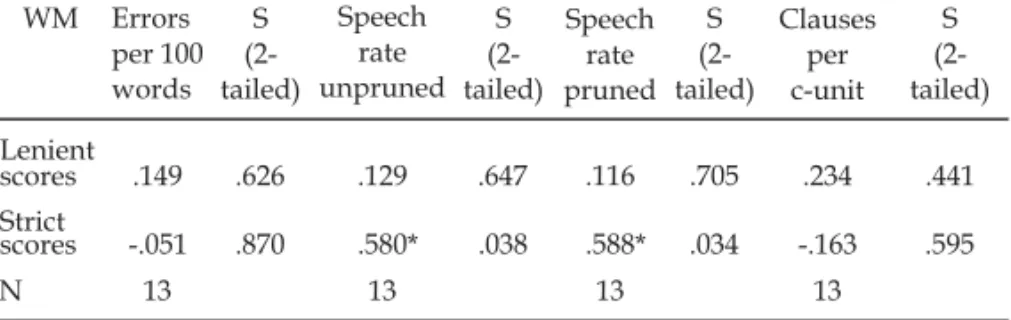
Table 2 – Correlations between measures of working memory capacity (lenient and strict scores) and speech production in the
first narrative task (no-planning condition) of control group
* p<0. 05
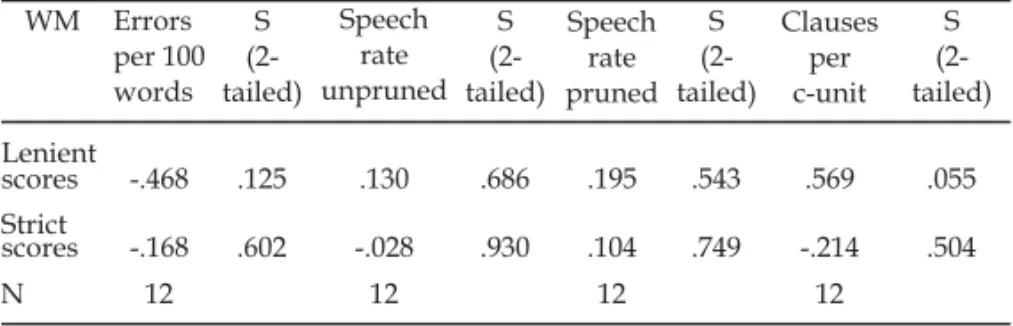
Table 3 – Correlations between measures of working memory capacity (lenient and strict scores) and speech production in the
second narrative task (no-planning condition) of control group
Table 4 – Correlations between measures of working memory capacity (lenient and strict scores) and speech production in the
first narrative (no-planning condition) task of experimental group
*p<0. 05
correlations between measures of WM capacity and fluency scores (SRU, SRP) failed to reach significance. Likewise, correlations between measures of working memory capacity and accuracy scores failed to reach significance (ACC). Finally, WM capacity scores and complexity scores also failed to show significance. Thus, measures of WM capacity failed to show significance with all
measures of L2 speech performance (no-planning condition) of the
first narrative task of the experimental group. These results are similar to the results displayed in Table 2 in which performance of the control group in the first narrative task also yielded no significant correlations between measures of WM capacity and measures of L2 speech performance. In brief, results show no correlations between WM capacity and L2 speech production in the performance of the first narrative task of the control group (no planning condition) and no correlations between WM capacity scores and L2 speech production in the performance of the first narrative task of the experimental group (no planning condition). As for the performance of the second narrative task of the control group (no planning condition), significant correlations were found between WM capacity lenient scores and fluency as measured by both speech rate unpruned and pruned.
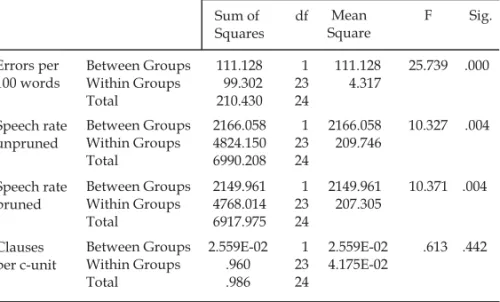
Table 6 – Summary of findings from ANOVAs in all performance measures
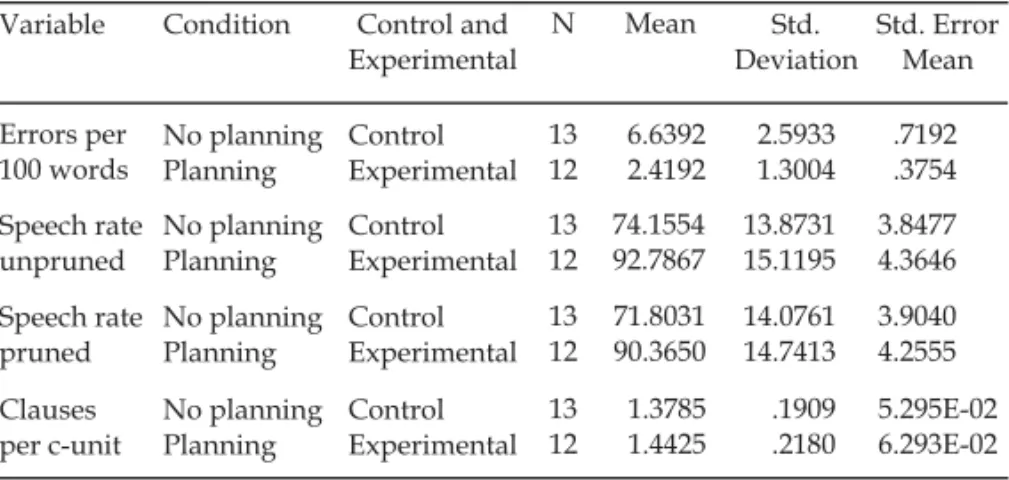
Table 5 presents a summary of the descriptive statistics for the four performance measures of the second narrative tasks of the control group (no planning condition) and the experimental group (planning condition). As can be seen, all means favored the experimental group (planning condition) over the control group (no-planning condition). In order to further determine where the statistically significant effect in favor of the planning condition might be obtained, univariate analyses of variance were performed.Table 6 shows a summary of the ANOVAs for the four performance measures. As can be seen, speech rates unpruned and pruned were significantly higher in the planning condition. As regards grammatical accuracy, the number of errors per a hundred words was significantly lower in the planning condition. Finally, the difference in the mean of clauses per c-unit in favor of the planning condition was not statistically significant. It important to highlight that there were no significant differences between the two groups in the performance of the first task in which both groups performed under no planning condition.
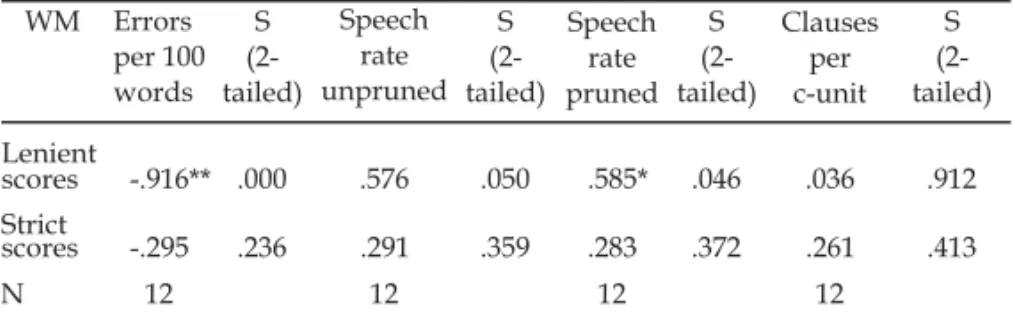
Table 7 – Correlations between measures of working memory capacity (lenient and strict scores) and speech production in the
second narrative task (planning condition) of the experimental group
**Correlation is significant at the 0.01 level (2-tailed) *Correlation is significant at the 0.05 level (2-tailed)
As can be seen in Table 7, the correlation between speech rate unpruned and WM capacity lenient scores only approached significance r(12).576 (p =.050), whereas speech rate pruned correlated significantly with WM capacity lenient scores, r(12).585*. The correlations between accuracy and WM capacity lenient scores also reached significance, r(12).916**. There were no significant correlations between complexity and WM capacity lenient scores. In addition to that, there were no significant correlations between WM capacity strict scores and measures of L2 speech performance. DISCUSSION
The relationship between WM capacity and L2 speech performance (under no- planning and planning conditions)
To reiterate, research questions 1 and 3 asked whether L2 speech performance (under no-planning and planning conditions) significantly correlates with learners’ WM capacity. There were three instances of L2 speech performance under no-planning conditions in the present study: the first narrative tasks of both
control and experimental groups, and the second narrative task of the
control group. As regards the performance of the first narrative task of the control group, there were no correlations between WM capacity and measures of L2 speech performance. Likewise, the performance of the first narrative task of the experimental group yielded no significant correlations between WM capacity and L2 speech performance. These results contradict previous studies in the literature (Daneman, 1991; Fortkamp 1999, 2000). However, measures of WM capacity correlated significantly with fluency (as measured by speech rate unpruned and pruned) in the second
narrative task of the control group which was also carried out under no planning conditions. These results, therefore, corroborate previous studies in the literature (Daneman, 1991; Fortkamp 1999, 2000). In face of these mixed results, the intriguing question to be asked seems to be: in no-planning conditions, why did WM measures
only correlate significantly with fluency in the performance of the
Excerpts
Participant 7: “ time to look at the pictures was very short and I didn’t understand the story after this time and I think my story was terrible because I didn’t have what to say”
Participant 13: “It’s impossible to understand the story, the sequence, the story in 40 seconds and it’s impossible to tell a story after the 40 seconds, my vocabulary was very bad”
Participant 21: “It’s good to do things in a calm way, I was so stressed”
As can be seen, the no-planning conditions seem to have been extremely difficult for participants of the present study. For individual differences in WM capacity to emerge, the task under performance has to be complex. In other words, tasks which are either too complex or too easy do not seem to reveal individual differences in WM capacity (Just; Carpenter, 1992; Tomitch, 1996; Fortkamp, 2000). The picture cued tasks chosen for present study-‘there and then’ narratives- are considered complex (Robinson, 1995) and, thus, would allow individual differences to emerge. However, the time pressure imposed to look at the pictures in the
no-planning conditions may have turned the task into an overly complex one. In face of these results, one question still remains: if lack of correlations between WM measures and L2 speech performance (in no-planning conditions) may be tentatively explained by the extreme complexity of the tasks and task performance condition, why correlations between working memory capacity measures and fluency in the performance of the second
for correlations between WM and L2 speech production. According to Fortkamp (2000), L2 speech production at the formulation stage, more specifically at grammatical encoding (Lelvet, 1989), is a controlled processing activity. According to Engle and Orasky (1999), a controlled processing activity involves activation, temporary maintenance, suppression, serial search and retrieval and monitoring. In other words, in L2 speech production, individuals need to activate L1 and L2 information, maintain activation of L2 information, suppress L1 information, search and retrieve L2 information and monitor L2 production (Fortkamp, 2000). In a controlled processing activity it is attention that is controlled to be shared among activation, maintenance, suppression, serial search and retrieval, and monitoring (Engle, Kane; Tuholsky, 1999). Individuals with higher WM capacity have more attentional resources available to allocate towards these processes more effectively and, thus, achieve more fluent and accurate speech performance (Fortkamp, 2000). By contrast, the correlations between WM capacity scores and complexity of L2 speech performance under planning conditions failed to show significance and are, therefore, at odds with previous results reported in the literature (Fortkamp, 2000; Weissheimer; Fortkamp, 2004). One possible explanation for the lack of correlations between WM capacity scores and complexity measures of speech performance may be that participants could only attain more accurate and fluent language in planned speech performance at the expense of complexity. In other words, it seems that the attentional resources allocated to achieve two goals (speaking more accurately and more fluently) reduced the capacity remaining for achieving a third goal (using more complex language). As a consequence, accuracy and fluency became the preeminent goals, but complexity was penalized to some degree. This explanation is in line with other empirical results from studies in the area of planning and L2 speech performance
attentional resources (Foster; Skehan, 1996; Mehnert, 1998, among others). Therefore, it would be expected that higher spans would have more cognitive resources available to be allocated towards fluency, accuracy and complexity of speech, and would, thus, deal better with such trade-off effects. Since correlations between working memory capacity scores and complexity measures of speech performance failed to achieve significance, it seems that even higher spans suffered trade-off effects. Then, an intriguing question can be raised: why did not higher spans have more cognitive resources available to be allocated in a more balanced way among the goals of fluency, accuracy and complexity?A possible explanation for the lack of correlations between WM capacity scores and complexity measures of speech performance may be that complexity of speech involves taking risks and may be a goal which was beyond these learners’ priorities. Thus, higher spans despite having more cognitive resources to allocate among fluency, accuracy andcomplexity may have decided not to take any risks3
and prioritized fluency and accuracy as preeminent goals. According to Ellis’ (2003), it is the learner who decides on what kind of ‘activity’ to engage in during performance, and such choices determine what to prioritize.Bearing these results in mind, it is important to highlight that correlations between WM capacity and L2 speech performance were only found in the performance of the second task of the control group (no-planning) and experimental group (planning). This suggests that it may not necessarily be pre-task planning but rather familiarity (performing a task of the same type a priori) that makes the task more manageable and, thus, individual differences in WM capacity can emerge. Therefore, results seem inconclusive as regards the relationship between WM capacity, pre-task planning and L2 speech performance. It is also important to highlight that strict scores of WM capacity were the ones which correlated with fluency in the performance of the first narrative task of the control group under no-planning conditions, whereas lenient scores correlated with measures of L2 speech performance (fluency and accuracy) under planning conditions. Daneman (1991) argued in favor of lenient scores for assessing the relationship between WM and L1 speech fluency; Fortkamp (1999)
3 As previously stated, complexity is related to learners’ willingness to take risks and
argued in favor of strict scores for assessing the relationship between WM and L2 speech fluency. In the present study, strict scores correlated with L2 speech under no-planning conditions and lenient scores with L2 speech under planning conditions. In face of these mixed results it is not possible to state which measures of WM – strict or lenient scores – are more suitable.
The impact of planning on L2 speech performance
SUMMARYANDCONCLUSION
of learning in order to expand the bases of interpretation on learner’s orientation.
As expected, the present study also has several limitations. As a small scale study, the findings reported here are to be seen as modest and suggestive rather than conclusive. First of all, the reduced sample size (25) does not allow results to be generalized. No strong claims can be made based on this small data set. Moreover, limited sample size may also have weakened correlations between WM capacity and L2 speech performance.Secondly, due to time constraints, only the SST was used for assessing WM capacity. Future studies should employ complementary measures of WM
capacity. In addition to that, more research is needed in order to understand the complexities of the SST concerning the relationship between its strict and lenient scores. Although there is a considerable body of research on the complexities of the RST (Duff; Logie, 2001; Friedman; Miyake, 2004; Saito; Miyake, 2004, among others), not much is known about the SST. The finding that the correlations between WM capacity and accuracy were higher than between WM capacity and fluency (under the planning condition) may have been an artifact of the SST. Participants are instructed to produce grammatically acceptable sentences which may lead them to focus on grammar. Moreover, participants varied considerably in the time they took to perform the SST. Research on the Reading Span Test has shown that lack of time control in the performance of span tests may allow participants to employ strategies to improve their scores (Friedman; Miyake, 2004). Therefore, in my main study the time participants take to perform the SST will be taken into account.
from planning. A range of factors other than WM capacity may play a role on planned performance. Despite its limitations and lack of conclusive evidence, the findings of the present study may be relevant since they seem to demonstrate that the relationship among WM capacity, planning and L2 speech performance is a complex one which merits further scrutiny. Although the present study revealed correlations between WM capacity and L2 speech performance, it is still not possible to determine whether higher spans were more able to benefit from task familiarity or pre-task planning. In general terms, results suggest that if the task is made more manageable (either due to task familiarity or pre-task planning); individuals with higher WM capacity outperform individuals with lower WM capacity. One interesting avenue of investigation on the relationship between WM capacity and planning would be to explore whether higher and lower spans undergo similar strategies during planning. It is possible that higher spans are more strategic during planning and, thus, may benefit more from planning than lower spans. Moreover, it would also be interesting to investigate whether higher spans are actually more able to retrieve what was planned into performance. It may be that lower and higher spans undergo similar strategies during planning and the differences may rely on the ability to retrieve what was planned. More research is needed in order to reach firmer grounds on the relationship between WM capacity, planning and L2 speech performance. According to Ellis (2005), the study of planning is relevant both for its importance for theorizing about L2 acquisition in terms of information processing theory and for its usefulness to language pedagogy once it is a condition that can be implemented in language classrooms. Thus, individual differences in WM capacity may be an interesting avenue from which to look at pre-task planning for at least two main reasons. First, WM as a limited cognitive system is one of the tenets of information processing theory (McLaughlin; Heredia, 1996), hence, being a relevant construct for theorizing about L2 acquisition.Second, WM may constitute a central component of language aptitude (Miyake;
Friedman, 1998), a predictor of reading comprehension (Daneman;
may need more teacher assistance and guide on how to plan. Therefore, a better understanding of the relationship among WM capacity, pre-task planning, and L2 speech performance may also shed some light on how to implement pre-task planning more effectively so that both higher and lower capacity individuals may benefit from planning their performance. Research on planning has focused solely on performance (Foster; Skehan, 1996; Mehnert, 1998; Ortega, 1999; Yuan; Ellis, 2003, just to mention a few). I believe the field of research on planning seems ripe for taking a further step and investigate the impact of planning on learning as well. Further research is needed in order to investigate whether planning leads to L2 learning. Research focusing on the impact of planning on learning will hopefully shed some light on how to implement planning as a pedagogical tool for fostering L2 speech in the L2 classroom.
REFERENCES
BADDELEY, Alan D. Human memory: theory and practice. Hove, UK: Lawrence Erlbaum Associates, 1990.
______. Working memory. Science, n.225, p.556-559, 1992a.
______. The episodic buffer: a new component of working memory?
Trends in Cognitive Science, v.4, n.11, p.417-423, 2000.
BADDELEY, Alan D; HITCH, Graham. Working memory. In: BOWER, Gordon A. (Ed.). The psychology of learning and motivation. New York: Academic Press,1974. V.8, p.47-89.
BADDELEY, Alan D; LOGIE, Robert H. Working memory: the multiple component model. In: MIYAKE, Akira; SHAH, Priti (Ed.). Models of
working memory. Cambridge: Cambridge University Press, 1999.
p.28-59.
BYGATE, Martin. Effects of task repetition on the structure and control of oral language. In: BYGATE, Martin; SKEHAN, Peter; SWAIN, Merrill (Ed.). Researching pedagogic tasks: second language learning and testing. London: Longman, 2001.
COWAN, Nelson. An embedded-proceses model of working memory.
In: MIYAKE, Akira; SHAH, Priti (Ed.). Models of working memory. Cambridge: Cambridge University Press, 1999 p. 62-101.
CROOKES, Graham. Planning and interlanguage variation. Studies in
DANEMAN, Meredyth. Working memory as a predictor of verbal fluency. Journal of Psycholinguistic Research, v.20, n.6, p.445-464, 1991. ______; CARPENTER, Patricia. Individual differences in working memory capacity and reading. Journal of Verbal Learning and Verbal Behavior, v.19, p.450-466, 1980.
______; ______. Individual differences in integrating information between and within sentences. Journal of Experimental Psychology: learning, memory and cognition, v.9, p.561-584,1983.
______; GREEN, Ian. Individual differences in comprehending and producing words in context. Journal of Memory and Language, v.25, i.1, p.1-18, 1986.
DE BOT, Kees. A bilingual production model: levelt’s speaking model adapted. Applied Linguistics, v.13, p. 1-24, 1992.
D’ELY, Raquel C. S. F; WEISSHEIMER, Janaína. Unpublished speaking rating scale. Florianópolis: Universidade Federal de Santa Catarina, 2004.
DUFF, Simon C; LOGIE, Robert H. Processing and storage in working memory span. Quarterly Journal of Experimental Psychology A, v.54, p.31-48, 2001.
ELLIS, Rod. Interlanguage variability in narrative discourse: style shifting in the use of the past tense. Studies in Second Language Acquisition, v.9, p. 12-20, 1987.
______. Task-based teaching and learning. Oxford: Oxford University Press, 2003.
______. Planning and task performance in a second language. Amsterdam; Philadelphia: John Benjamins, 2005.
ENGLE, Randall W.; KANE, Michael J; TUHOLSKY, Stephen W. Individual differences in working memory capacity and what they tell us about controlled attention, general fluid intelligence, and functions of the prefrontal cortex. In: MIYAKE, Akira; SHAH, Priti (Ed.). Models of working
memory. Cambridge: Cambridge University Press, 1999. p.28-59.
______; ORANSKY, Natalie. The evolution from short-term memory to working memory: Multi-store to dynamic models of temporary storage. In STERNBERG, Robert J. (Ed.). The nature of cognition. Cambridge: Cambridge University Press, 1999.
FORTKAMP, Mailce Borges M. Working memory capacity and aspects of
______. Working memory capacity and L2 speech production: an
exploratory study. 2000.Tese (Doutorado) – Pós-Graduação em Inglês
e Literatura Correspondente, Universidade Federal de Santa Catarina, Florianópolis, 2000.
FOSTER, Pauline; SKEHAN, Peter. The influence of planning and task type
on second language performance. Studies in Second Language
Acquisition, v.18, p. 299-323, 1996.
FRIEDMAN, Naomi; MIYAKE, Akira. The reading span test and its predictive power for reading comprehension ability. Journal of Memory and Language, v.51, n.1, p.136-158, 2004.
GREENE, John O. Speech preparation processes and verbal fluency.
Human Communication Research, v. 11, n.1, p. 61-84, 1984.
______; CAPELLA, Joseph N. Cognition and talk: the relationship of Semantic Units to Temporal Patterns of fluency in spontaneous speech.
Language and Speech, v. 29, part 2, p.141-157, 1986.
HARRINGTON, Mark; SAWYER, Mark. Working memory and reading skill.
Studies in Second Language Acquisition, v.14, p.25-38, 1992. JUST, Marcel A.; CARPENTER, Patricia. A capacity theory of comprehension: individual differences in Working memory.
Psychological Review, v.99, n.1, p.122-149, 1992.
KAWAUCHI, Chieco. The effects of strategic planning on the oral narrative of learners with low and high intermediate L2 proficiency. In: ELLIS, Rod (Ed.). Planning and task performance in a second language. Amsterdam; Philadelphia: John Benjamins, 2005.
LENNON, Paul. Investigating fluency in EFL: a quantitative approach.
Language Learning, v.40, n.3, p.387-417, 1990.
LEVELT, Willem J. M. Speaking: from intention to articulation. Cambridge, Massachusetts: The MIT Press, 1989. Chapters 1-2.
MCLAUGHLIN, Barry; HEREDIA, Roberto. Information-processing approaches to research on second language acquisition and use. In: RITCHIE, William C.; BHATIA, Tej K. (Ed.). Handbook of second language
acquisition. San Diego, CA: Academic Press, 1996. Chapter 7, p. 213-225.
MENDONÇA, Daniela M. Working memory capacity and the retention of L2
vocabulary. 2002. 172 f. Thesis (Master) – Centro de Comunicação e Expressão, Programa de Pós-Graduação em Letras/Inglês e Literatura Correspondente, Universidade Federal de Santa Catarina,
Florianópolis, 2002.
MIYAKE, Akira; FRIEDMAN, Naomi. Individual differences in second language proficiency: working memory as language aptitude. In: HEALY, Alice F.; BOURNE JR., Lyle E. (Ed.). Foreign language learning: Psycholinguistic studies on training and retention. Mahawah, N. J: Lawrence Erbaum, 1998. p. 339-364.
______; SHAH, Priti. Models of working memory. Cambridge: Cambridge University Press, 1999. p.28-59.
ORTEGA, Lourdes. Planning and focus on form in L2 oral performance.
Studies in Second Language Acquisition, v.21, p. 109-148, 1999. ______. What do learners plan? Learner-driven attention to form during pre-task planning. In: ELLIS, Rod (Ed.). Planning and task performance in a second language. Amsterdam; Philadelphia: John Benjamins Publishing Company, 2005.
POULISSE, Nanda. Language production in bilinguals. In DE GROOT, Annette M. B.; KROLL, Judith F. (Ed.). Tutorials in bilingualism:
psycholinguistic perspectives. Mahwah, NJ: Lawrence Erlbaum, 1997. p. 201-225
ROBINSON, Peter. Task complexity and second language narrative discourse. Language Learning, v. 45, p.99-140, 1995.
ROSEN, Virginia M.; ENGLE, Randall W. The role of working memory capacity in retrieval. Journal of Experimental Psychology, v.126, n.3, p.211-227, 1997.
SAITO, Satoru; MIYAKE Akira. On the nature of forgetting and the processing-storage relationship in reading span performance. Journal of Memory and Language, v.50, n.4, p.425-443, 2004.
SANGARUN, Jiraporn. The effects of focusing on meaning and form in strategic planning. In: ELLIS, Rod. Planning and task performance in a
second language. Amsterdam; Philadelphia: John Benjamins Publishing
Company, 2005.
SKEHAN, Peter. A framework for the implementation of task-based instruction. Applied Linguistics, v.17, p.38-62, 1996.
______. A cognitive approach to language learning. Oxford: Oxford University Press, 1998.
SKEHAN, Peter. Strategic and on-line planning: the influence of surprise information and task time on second language performance. In ELLIS, Rod. Planning and task performance in a second language. Amsterdam; Philadelphia: John Benjamins Publishing Company, 2005.
TOMITCH, Leda Maria B. Individual differences in text organization
perception and working memory capacity. Revista da ANPOLL, v.2,
p.71-93, 1996.
WEISSHEIMER, Janaina. The effects of practice and strategy use on L2 working
memory capacity and fluency. Universidade Federal de Santa Catarina, 2004. Unpublished research paper.
______; FORTKAMP, Mailce Borges M. Working memory capacity and L2
fluency development. Universidade Federal de Santa Catarina, 2004. Unpublished research paper.
YUAN, Fangyuan; ELLIS, Rod. The effects of pre-task planning and on-line planning on fluency, complexity and accuracy in L2 monologic oral production. Applied Linguistics, v.24, p.1-27, 2003.
Recebido em agosto de 2007 e aceito em fevereiro de 2008.
Título: A relação entre planejamento pré-tarefa, memória de trabalho e desempenho oral em L2: um estudo piloto
Resumo: O presente estudo piloto teve como objetivo investigar a relação entre planejamento pré-tarefa (Skehan, 1996, 1998), memória de trabalho e desempenho oral em L2. Os participantes foram 25 aprendizes de inglês como L2 os quais desempenharam duas tarefas orais. Os resultados indicam que (1) o planejamento leva a ganhos em fluência e acurácia da produção oral, mas não leva a ganhos em complexidade, (2) não há correlações significativas entre desempenho oral e memória de trabalho na primeira tarefa dos grupos controle e experimental (sem planejamento), (3) há correlações significativas entre desempenho oral e memória de trabalho na segunda tarefa dos grupos controle (sem planejamento) e experimental (com planejamento). Portanto, os resultados não são conclusivos e apontam para uma complexa relação entre planejamento pré-tarefa, memória de trabalho e desempenho oral. Os resultados são discutidos com base na proposta de Fortkamp (2000), segundo a qual a produção oral em L2 é uma tarefa que demanda controle da atenção por parte dos aprendizes (Engle; Kane; Tuholsky, 1999).