267
Radiol Bras. 2012 Set/Out;45(5):267–272
Comparative dosimetry of prostate brachytherapy with I-125
and Pd-103 seeds via SISCODES/MCNP
*
Dosimetria comparativa de braquiterapia de próstata com sementes de I-125 e Pd-103 via SISCODES/MCNP
Bruno Machado Trindade1, Marília Tavares Christóvão2, Daniela de Fátima Maia Trindade3, Patrícia Lima Falcão4, Tarcisio Passos Ribeiro de Campos5
Objective: The present paper is aimed at presenting a comparative dosimetric study of prostate brachytherapy with I-125 and Pd-103 seeds. Materials and Methods: A protocol for both implants with 148 seeds was simulated on a heterogeneous three-dimensional pelvic phantom by means of the SISCODES/MCNP5 codes. Dose-volume histograms on prostate, rectum and bladder, dose indexes D10, D30, D90, D0.5cc, D2cc and D7cc, and representations of the spatial
dose distribution were evaluated. Results: For a D90 index equivalent to the prescription dose, the initial activity of
each I-125 seed was calculated as 0.42 mCi and of Pd-103 as 0.94 mCi. The maximum dose on the uretra was 90% and 108% of the prescription dose for I-125 and Pd-103, respectively. The D2cc for I-125 was 30 Gy on the rectum and
127 Gy on the bladder; for Pd-103 was 29 Gy on the rectum and 189 Gy on the bladder. The D10 on the pubic bone
was 144 Gy for I-125 and 66 Gy for Pd-103. Conclusion: The results indicate that Pd-103 and I-125 implants could deposit the prescribed dose on the target volume. Among the findings of the present study, there is an excessive radiation exposure of the pelvic bones, particularly with the I-125 protocol.
Keywords: Radiotherapy; Dosimetry; Prostate cancer; Brachytherapy; SISCODES; MCNP.
Objetivo: O presente artigo visa apresentar um estudo dosimétrico comparativo de braquiterapia de próstata com sementes de I-125 e Pd-103. Materiais e Métodos: Um protocolo adotado para ambos os implantes com 148 se-mentes foi simulado em um fantoma tridimensional heterogêneo de pelve por meio dos códigos SISCODES/MCNP5. Histogramas dose-volume na próstata, bexiga e reto, índices de doses D10, D30, D90, D0,5cc, D2cc e D7cc, e
representa-ções de distribuição espacial de dose foram avaliados. Resultados: A atividade inicial de cada semente de I-125, para que D90 seja equivalente à dose de prescrição, foi calculada em 0,42 mCi, e de Pd-103, em 0,94 mCi. A dose
máxima na uretra foi 90% e 108% da dose de prescrição para I-125 e Pd-103, respectivamente. A D2cc para I-125
foi 30 Gy no reto e 127 Gy na bexiga, e para Pd-103 foi 29 Gy no reto e 189 Gy na bexiga. A D10 no osso do púbis foi
144 Gy para I-125 e 66 Gy para Pd-103. Conclusão: Os resultados indicam que os implantes de Pd-103 e I-125 puderam depositar a dose prescrita no volume alvo. Entre os achados, observou-se excessiva exposição de radiação nos ossos da pelve, principalmente no protocolo com I-125.
Unitermos: Radioterapia; Dosimetria; Câncer de próstata; Braquiterapia; SISCODES; MCNP.
Abstract
Resumo
* Study developed at Universidade Federal de Minas Gerais (UFMG), Belo Horizonte, MG, Brazil.
1. PhD, Postdoctoral Researcher, Núcleo de Radiações Ioni-zantes – Universidade Federal de Minas Gerais (NRI/UFMG), Belo Horizonte, MG, Brazil.
2. PhD, Technologist, Comissão Nacional de Energia Nuclear (CNEN), Belo Horizonte, MG, Brazil.
3. Master, Teacher, Centro Universitário Una, Belo Horizonte, MG, Brazil.
4. Postdoctoral Researcher, Núcleo de Radiações Ionizantes – Universidade Federal de Minas Gerais (NRI/UFMG), Belo Hori-zonte, MG, Brazil.
5. Postdoctoral Researcher, Associate Professor, Universidade Federal de Minas Gerais (UFMG), Belo Horizonte, MG, Brazil.
Trindade BM, Christóvão MT, Trindade DFM, Falcão PL, Campos TPR. Comparative dosimetry of prostate brachytherapy with I-125 and Pd-103 seeds via SISCODES/MCNP. Radiol Bras. 2012 Set/Out;45(5):267–272.
volving insertion of radiation sources into natural body cavities; interstitial brachy-therapy, insertion of the radioactive sources into the target tissue; intraluminal or intra-vascular brachytherapy, where the radiation sources are placed in the lumen of the esophagus, bronchi or blood vessels; and superficial brachytherapy, as the source is directly positioned on the skin or mucosa of the area to be treated(2). Also, it can be
classified as temporary or permanent. On the report no.38 of the International Com-mission on Radiation Units (ICRU)(3),
brachytherapy was classified, according to the dose rate, as low dose rate (LDR), me-dium dose rate (MDR) and high dose rate sources positioned adjacent to or in the
interstitium of the cancerous tissue. As the absorbed dose is inversely proportional to the square of the distance from the emitting source, brachytherapy allows for the safe application of high absorbed doses at a determined target over a short period of time(2).
According to the space where brachy-therapy is applied, it can be classified as follows: intracavitary brachytherapy,
in-INTRODUCTION
Brachytherapy is a safe and effective treatment for localized prostate cancer(1).
Such technique utilizes sealed radioactive
Mailing Address: Dr. Bruno Machado Trindade. Rua Guilherme de Almeida, 255, ap.302, Santo Antônio. Belo Horizonte, MG, Brazil, 30350-230. E-mail: [email protected]
(HDR) for dose rates of 0.4 to 2 Gy.h–1; 2
to 12 Gy.h–1; and > 12 Gy.h–1, respectively.
Interstitial brachytherapy with perma-nent implants of radioactive seeds is one of the methods utilized for treatment of pros-tate tumors, in general applied for neo-plasms at T1 or T2 stages, with Gleason scores between 2 and 6, and serum PSA
≤ 10 ng. The indications for implants are mostly for small volumes, particularly at early stages of disease located within the prostatic capsule (T1B-T1C, T2A-T2B-T2C stages, and absence of metastasis and lymphatic compromise). Such technique may be associated with teletherapy, particu-larly in cases of patients considered as be-ing at high risk(4). Prostate brachytherapy
primarily utilizes metal seeds of Iodine-125 (I-125) or, most recently, Palladium-103 (Pd-103)(5). Seeds of I-125 and Pd-103 are
constituted of material doped with radio-active isotope encapsulated in a titanium casing. The external dimensions of the seeds are 4.5 to 5 mm in length, and 0.8 mm in diameter(6,7). Such seeds are represented
on Figure 1.
I-125 is a radioactive isotope with a half-life of 60.1 days, emitting gamma rays some of which are internally converted into X-rays. The main photon emission energies are 27.20 keV, 27.47 keV and 30.97 keV, with the respective probabilities of 39.80%, 74.20% and 25.70%. On its turn, Pd-103 has a 17-day half-life and X-ray photon emission at the main energies of 20.07 keV, 20.22 keV and 22.71 keV, with probabili-ties of 19.83%, 37.55% and 11.88%, re-spectively(8). Because of their lower
ener-gies, Pd-103 photons have a lower range in the tissue than those emitted by I-125. Thus, for a same distribution of seeds with equal activity, the spatial dose distribution obtained by Pd-103 theoretically tends to be less homogeneous that that obtained with I-125. On the other hand, and for the same reason, Pd-103 seeds will produce lower absorbed doses at longer distances, particularly in the surrounding healthy tis-sues. The Pd-103 dose rate as well as its relative biological effectiveness (RBE) is higher than that of I-125(9). Thus, the
pre-scription dose for Pb-103 seeds is lower
than the recommended dose for I-125 seed implants, 125 and 144 Gy, respectively(10,11).
The value corresponding to 80% of the dose deposited by I-125 seeds is delivered in 140 days, while the Pd-103 seeds deliver such value in 39 days. This is due to the fact that Pd-103 seeds generate higher dose rate and, consequently, produce a greater bio-logical effect, particularly on cancer strains with a high proliferation index.
The number of seeds implanted in the prostate depends upon the following pa-rameters: reference volume to be irradiated, individual seeds activity, adopted prescrip-tion dose, as well as the selected model of seeds spatial distribution(12). The seeds are
applied in an aligned pattern, by means of ultrasonography-guided insertion of needles containing a set of seeds. Such seeds are deployed on a one-by-one basis on the tissue, with a predetermined space between each other. The number and spa-tial distribution of the seeds are selected in such a manner to meet the prescription dose to the prostate, at the same time minimiz-ing the dose delivered to adjacent tissues and structures. Obviously, there is a strong dependence between the management of the disease and the applied doses and also between applied doses and the arrangement of the seeds in the implant.
In order to measure the treatment effec-tiveness, as well as the possibility of ad-verse effects, reference or merit parameters related to absorbed dose, are established for comparison purposes. For example, the Dx parameter corresponds to the minimum dose value in x% of an irradiated volume. Such volume may refer to an organ or to a predefined volume of interest in the radio-therapy planning. On its turn, the Dycc
pa-rameter corresponds to the minimum dose in the volume of y cm³ containing the high-est absorbed dose in an organ or volume of interest defined in the planning(13).
The Monte Carlo method is a math-ematical technique applied in the reproduc-tion of a statistical process. Such technique is particularly interesting in the resolution of complex problems which cannot be modeled by deterministic computational methods. The Monte Carlo N-Particle (MNCP) code applies such technique in the transport of nuclear particles, tracking each one of the many primary or secondary
par-Figure 1. Diagram of I-125 (A) and Pd-103 (B) seeds. The seeds are composed of: 1 – titanium capsule; 2 – iodine oxide; 3 – Pd-103 doped polystyrene; 4 – Metal markers for the visualization of the seeds on X-ray images.
ticles generated by a radioactive source, from the emission of such particles to some terminal event such as absorption, annihi-lation, escape from the system, among oth-ers(14). The three dimensional simulation of
the nuclear particle transport is aimed at eliminating the two dimensional planning deficiencies by means of an analytical method in homogeneous medium, consti-tuting an important tool to improve the quality of radiotherapy procedures in on-cology(15,16).
Computational methods have been highly relevant for dosimetric evaluation utilizing heterogeneous models(17–20). The
SISCODES (Computational System for Dosimetry by Neutrons and Photons by Stochastic Methods) is a tool for the con-struction of computational simulation ob-jects and simulation of radiotherapy treat-ments by means of stochastic codes such as MCNP(21,22). Such system allows the
conversion of tomographic images into a voxel model. Based on a database includ-ing tissue chemical composition and nuclear data, SISCODES allows the asso-ciation of nuclear and chemical data with the model of voxels by selection of the tis-sue of each voxel, as well as the position-ing of brachytherapy and teletherapy sources. The system utilizes the MCNP for the simulation of nuclear particles transport in the model, consequently obtaining the absorbed dose. From the results, relevant dosimetry data are extracted and presented as spatial dose distribution and dose versus
volume histogram (DVH)(21,22).
The present article is aimed at investi-gating the dosimetry in prostate permanent implants of I-125 and Pd-103 seeds, by means of DVHs, isodoses and reference parameters, such as Dx and Dycc, with the
purpose of performing comparisons be-tween the two protocols.
MATERIALS AND METHODS
A protocol of permanent prostate im-plant of I-125 seeds was arbitrarily adopted. The same implant protocol was reproduced with Pd-103 seeds. The distri-bution and number of seeds were not al-tered between the protocols. The I-125 seeds were simply replaced by the Pd-103 ones.
For the simulation of nuclear particle transport, a voxels model of a male pel-vis(23) was utilized, with voxels of 5 x 5 x
5 mm. In such a model, the prostate volume corresponds to approximately 40 cm3.
Fig-ure 2 shows two sections of such a model. The seeds were positioned according to the
modified uniform distribution proposed by
Butler et al.(24), as shown on Figure 3. In
total, 148 seeds were positioned in 24 ap-plications, forming parallel lined-up seg-ments in tangential direction to the pubic bones, on a spacing grid between segments of 1 cm, maintaining the seed spacing on a single segment of 6 mm between the cen-ters of consecutive seeds.
Figure 2. Frontal (A) and radial (B) sections of the voxel model, where the following anatomical struc-tures can be observed: 1 –prostate; 2 – urethra; 3 – bladder; 4 – rectum; 5 – femur; 6 – iliac bones; 7 – seminal vesicle; 8 – colon.
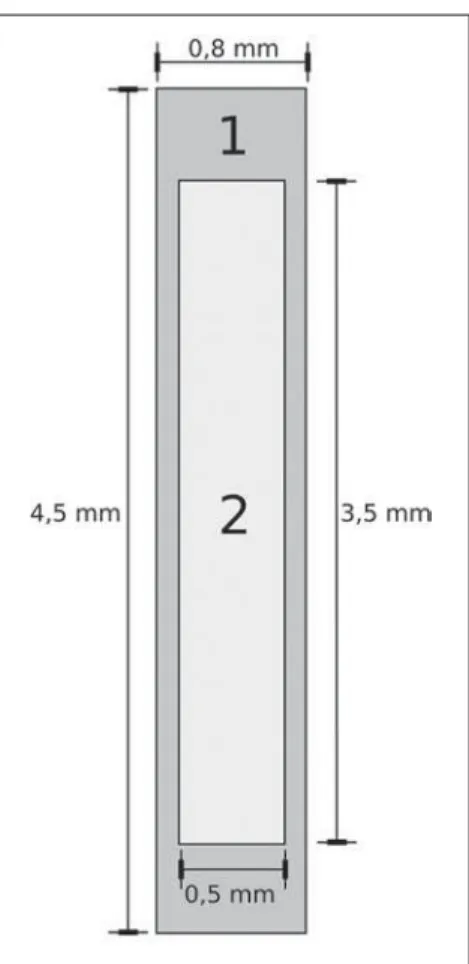
Both seeds types were represented by a cylinder of radioactive material measuring 3.5 mm in length and 0.5 mm in diameter contained inside another titanium cylinder with 5 mm in length and 0.8 mm in diam-eter, as shown on Figure 4. The radioactive matrix adopted for the I-125 seed was io-dine oxide, and for the palladium seed, polystyrene doped with Pd-103.
After simulation of each protocol with the MCNP (version 5.2), the results were imported by the SISCODES code. Then, the spatial dose distributions and DVHs of each procedure were generated. The initial activity of the seeds was calculated in or-der to obtain the prescription dose to the prostate recommended for each implant. The SISCODES code works as an interface for the MCNP code. The whole evaluation and simulation of nuclear particles trans-port is carried out by the MCNP code. Consequently, dosimetry is evaluated by MCNP. The SISCODES allows for the
definition of the model and protocol to be simulated, and helps in the manipulation and presentation of the results as charts and histograms.
The particle transport code calculates the deposited energy per mass unit for each voxel, in MeV.g–1 units per particle
emit-ted by the source. Such value is converemit-ted into Gy (J.kg–1) by particle unit emitted by
the source. The emissions from the sources are evaluated as a function of activity (Bq = transformations.s–1) multiplied by the
photon production rate per transition unit. The results from such calculations gener-ate the dose in Gy for each voxel. In the present case, one adopted the same activ-ity for all seeds. The seed activactiv-ity was cal-culated so that the prescribed doses (D90) were 144 and 125 Gy, respectively for I-125 and Pd-103. Thus, the activities were found in such a way to adjust D90 to the
value equivalent to the prescribed dose in a clinical protocol.
With such activities, the absorbed doses were evaluated in the target regions as well as in the adjacent tissues, utilizing repre-sentation of isodoses regions and DVHs.
RESULTS
In order for the D90 to be equal to the
recommended dose, the initial activity of each seed was calculated to be 0.42 mCi and 0.94 mCi, for I-125 and Pd-103, re-spectively. The resulting DVH for the pros-tate is shown on Figure 5A. Considering such activities and the adopted seeds spa-tial distribution, the maximum absorbed dose in the urethra was approximately 90% of the prescribed dose for I-125 and 108% of the prescribed dose for Pd-103. The D2cc
dose in the rectum was 30 Gy for I-125 and 29 Gy for Pd-103, as shown on the DVH represented at Figure 5B. The same dose (D2cc) for the bladder was 127Gy for I-125
and 189 Gy for Pd-105 (Figure 5C). The
Figure 4. Model of the seed utilized at MCNP. The volume marked as 1 corresponds to the titanium capsule. The volume marked as 2 corresponds to the radioactive compound - iodine oxide or Pd-103 doped polystyrene.
Figure 5. Dose volume histograms for the pros-tate, rectum and blad-der.
A
B
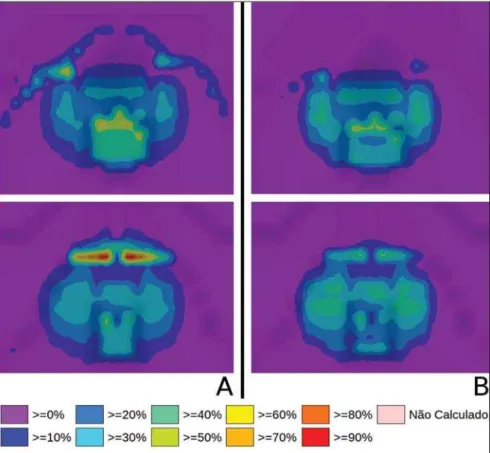
pelvic bones presented high doses on the soft tissue-bone interface, particularly with the I-125 seeds. With I-125 seeds, the D10 value for the pubic bones was 144 Gy and for the iliac bones, the value was 2.7 Gy. The Pd-103 seeds presented a D10 value of 66 Gy for pubic bones, and 165 mGy for iliac bones. The differences in spatial dose distribution can be observed on the repre-sentation of spatial dose distribution shown on Figure 6.
Figure 6A shows high absorbed doses in the soft tissue-bone interface for the I-125 seed implants. However, such high ab-sorbed doses were not observed for Pd-103 seed implants (Figure 6B).
The dose/volume ratios in the target vol-ume (D90) with the dose in the rectum (D2cc)
and in the bladder (D2cc) for the I-125 seeds
implant were 0.208 and 0.882 respectively, while for Pd-103, the ratios were 0.232 and 1.512 respectively. The D90/D2cc dose ratio
in the bladder and rectum for the Pd-103 seeds was higher than the one obtained with the I-125 seeds.
DISCUSSION
The following effects were taken into consideration in the present simulations: self-absorption in the matrix and in the metal casing of the seeds; interseed attenu-ation; tissue heterogeneity, including high densities in bone regions and present empty spaces; boundary effect and proximity with external air. This fact differentiates the method in the present article from the ana-lytical calculations utilized for dosimetry in brachytherapy recommended by the AAPP Task Group 43, which considers an infinite homogeneous water-equivalent me-dium(10).
The maximum absorbed dose in the ure-thra was below the threshold doses of the value D10 < 150% and D30 < 130% of the
prescription dose with both seeds. The D2cc
doses in the rectum were significantly lower than the threshold dose limit 145 Gy(24).
The doses in the most irradiated vol-umes of the rectum, starting from D0.5cc, as
well as in the bladder starting from D7cc, are
higher with the Pd-103 seeds than with I-125 seeds. This can be explained by the lower range of the Pd-103 photons, so that the energy is deposited on a smaller vol-ume, increasing the absorbed dose in the seed surroundings. If a Pd-103 seed is close to one of the vital organs, the dose to this organ will be high. On the other hand, with the I-125 seed, the spatial dose distribution is more ample, but tending towards lower dose values per volume.
Surprisingly, high doses in the order of 100% of the prescription dose were found in the interface between the pelvic bones and soft tissues. In such region, the doses from I-125 seeds are significantly higher than the doses from Pd-103 seeds, with D10
= 144 Gy and D10 = 66 Gy for I-125 and
Pd-103, respectively. Such fact may also be explained by the greater range of I-125 photons, reaching the pelvic bones with higher intensity than those emitted by Pd-103. The effects of I-125 implants on such organs must be considered in clinical situ-ations, requiring further investigation. It is important to observe that such effect is not observed in cases where the dosimetry is evaluated with analytical models and with homogeneous medium.
CONCLUSIONS
The Pd-103 and I-125 implants could deliver the prescription dose to the target volume. The Pd-103 implant is associated with a lower dose in pelvic bones, provided that the positioning of the seeds is carefully studied and that they are correctly posi-tioned during the clinical protocol. The D2cc/D90 dose ratio in the rectum was 11.5%
higher for Pd-103 seeds. In the studied case, the Pd-103 implants deposited a higher dose in the rectum and bladder as compared to I-125 implants. The main finding of the present study was the high absorbed doses outside the target region in bone tissues adjacent to the prostate, par-ticularly in the case of I-125 implants. The computational methods utilized in the present study can be useful in future com-parative clinical evaluations of brachyther-apy with I-125 and Pd-103 seeds implants, among other radioactive seeds, and can be later validated by means of experimental
trials simulating clinical protocols and do-simetry in realistic phantoms.
Acknowledgements
The authors wish to thank the Coorde-nação de Aperfeiçoamento de Pessoal de Nível Superior (Capes) and Conselho Nacional de Desenvolvimento Científico e Tecnológico (CNPq), for the support and assistance fin the investigations with the research group Núcleo de Radiações Ioni-zantes da Universidade Federal de Minas Gerais (NRI/UFMG).
REFERENCES
1. Emami B. Oral cavity. In: Perez CA, Brady LW, editors. Principles and practice of radiation on-cology. 3rd ed. Philadelphia, PA: Lippincott-Raven; 1998. p. 981–1002.
2. Williamson JF, Brenner DJ. Physics and biology of brachytherapy. In: Halperin EC, Perez CA, Brady LW, et al., editors. Perez and Brady’s Prin-ciples and practice of radiation oncology. 5th ed. Philadelphia, PA: Lippincott Williams & Wilkins; 2008. p. 424–76.
3. International Commission on Radiation Units. Dose and volume specifications for reporting in-tracavitary therapy in gynecology. ICRU Report No. 38. Bethesda, MD: International Commission on Radiation Units; 1985. p. 1–16.
4. Chung HT, Speight JL, Roach M III. Intermedi-ate and high-risk prostIntermedi-ate cancer. In: Halperin EC, Perez CA, Brady LW, et al., editors. Perez and Brady’s Principles and practice of radiation on-cology. 5th ed. Philadelphia, PA: Lippincott Wil-liams & Wilkins; 2008. p. 1484–503. 5. Zelefsky MJ, Valicenti RK, Hunt M, et al.
Low-risk prostate cancer. In: Halperin EC, Perez CA, Brady LW, et al., editors. Perez and Brady’s Prin-ciples and practice of radiation oncology. 5th ed. Philadelphia, PA: Lippincott Williams & Wilkins; 2008. p. 1440–83.
6. Sowards K, Meigooni AS. A Monte Carlo evalu-ation of the dosimetric characteristics of the Best Model 2301 125I brachytherapy source. Appl Radiat Isot. 2002;57:327–33.
7. Li Z, Palta JR, Fan JJ. Monte Carlo calculations and experimental measurements of dosimetry pa-rameters of a new 103Pd source. Med Phys. 2000;27:1108–12.
8. ENDF/B-VI Decay data. [acessado em 11 de no-vembro de 2011]. Disponível em: http://t2.lanl. gov/data/endf/decayVI.html
9. Ling CC, Li WX, Anderson LL. The relative bio-logical effectiveness of I-125 and Pd-103. Int J Radiat Oncol Biol Phys. 1995;32:373–8. 10. Nath R, Anderson LL, Luxton G, et al. Dosimetry
of interstitial brachytherapy sources: recommen-dations of the AAPM Radiation Therapy Commit-tee Task Group No. 43. American Association of Physicists in Medicine. Med Phys. 1995;22:209– 34.
11. Beyer D, Nath R, Butler W, et al. American brachytherapy society recommendations for clini-cal implementation of NIST-1999 standards for (103)palladium brachytherapy. The clinical re-search committee of the American Brachytherapy Society. Int J Radiat Oncol Biol Phys. 2000;47: 273–5.
12. Butler WM, Merrick GS, Lief JH, et al. Compari-son of seed loading approaches in prostate brachytherapy. Med Phys. 2000;27:381–92. 13. Pötter R, Haie-Meder C, Van Limbergen E, et al.
Recommendations from gynaecological (GYN) GEC ESTRO working group (II): concepts and terms in 3D image-based treatment planning in cervix cancer brachytherapy-3D dose volume pa-rameters and aspects of 3D image-based anatomy, radiation physics, radiobiology. Radiother Oncol. 2006;78:67–77.
14. X-5 Monte Carlo Team. MCNP – A general Monte Carlo N-Particle transport code, version 5. Los Alamos, NM: Los Alamos National Laboratory; 2003.
15. Purdy JA. Three-dimensional physics and treat-ment planning. In: Perez CA, Brady LW, editors. Principles and practice of radiation oncology. 3rd
ed. Philadelphia, PA: Lippincott-Raven; 1998. p. 343–70.
16. Emami B, Graham MV, Michalski JM, et al. Three-dimensional conformal radiation therapy: clinical aspects. In: Perez CA, Brady LW, editors. Principles and practice of radiation oncology. 3rd ed. Philadelphia, PA: Lippincott-Raven; 1998. p. 371–86.
17. Fonseca KR, Trindade BM, Campos TPR. Devel-opment of a voxel model of the heart for dosim-etry. Artif Organs. 2011;35:459–64.
18. Brandão SF, Campos TPR. Brain tumour and in-filtrations dosimetry of boron neutron capture therapy combined with 252Cf brachytherapy. Radiat Prot Dosimetry. 2012;149:289–96. 19. Christóvão MT, Campos TPR, Trindade BM.
Simulation and dosimetric analysis of proton and carbon ion therapy in the treatment of uveal mela-noma. Radiol Bras. 2011;44:367–73. 20. Campos TPR. Computational simulations in
medical radiation. A new approach to improve therapy. [acessado em 11 de novembro de 2011]. Disponível em: http://www.sbmac.org.br/bol/ boletim_2002/campos-4emc.pdf
21. Trindade BM, Campos TPR. Sistema computa-cional para dosimetria de nêutrons e fótons ba-seado em métodos estocásticos aplicado a radio-terapia e radiologia. Radiol Bras. 2011;44:109– 16.
22. Trindade BM. Remodelagem do sistema compu-tacional para dosimetria em radioterapia por nêu-trons e fótons baseado em métodos estocásticos – SISCODES. [tese de doutorado]. Belo Hori-zonte, MG: Universidade Federal de Minas Ge-rais;2011.
23. Silva CHT. Desenvolvimento de fantomas: com-putacional de voxels e antropomórfico-antropo-métrico de pelve masculina para dosimetria em braquiterapia de próstata. [dissertação de mes-trado]. Belo Horizonte, MG: Universidade Fede-ral de Minas Gerais; 2004.