Spatial distribution of
asthma-related hospitalizations of the
elderly in the Brazilian Amazon
Distribuição espacial das
internações por asma em idosos na
Amazônia Brasileira
Poliany Cristiny Oliveira Rodrigues
IEliane Ignotti
IIAntonia Maria Rosa
IIISandra de Souza Hacon
II Programa de Saúde Pública e Meio Ambiente da Escola Nacional de Saúde
Pública (ENSP-FIOCRUZ)
II Disciplina de Saúde Coletiva e Epidemiologia da Universidade do Estado de
Mato Grosso – UNEMAT; Programa de Mestrado e Doutorado em Saúde Pública e Meio Ambiente da Escola Nacional de Saúde Pública (ENSP-FIOCRUZ) III Docente da Disciplina de Saúde da Criança e do Adolescente da Universidade
do Estado de Mato Grosso - UNEMAT
Considerações Éticas: O presente estudo foi aprovado pelo Comitê de Ética em Pesquisa do Hos-pital Universitário Júlio Muller, conforme parecer 388/CEP/HUJM/07.
Correspondência: Eliane Ignotti,Departamento de Saúde Coletiva e Epidemiologia da Uni-versidade do Estado de Mato Grosso - UNEMAT, Av. São João S/N, Cavalhada, Cáceres, MT, CEP 78200-000 - E-mail: [email protected]
Abstract
Introduction: In Brazil, there are appro-ximately 370,000 asthma-related hospita-lizations per year, representing the fourth leading cause of hospitalizations in public health services. In 2007, 157,000 elderly patients were hospitalized, 2.3% of which due to asthma in the Brazilian Amazon. Considering the implications of asthma on the quality of life of the elderly, analyses regarding this issue in the Amazon are
sur-prisingly uncommon. Objective: To analyze
the geographical and seasonal distribution of asthma-related hospital admissions in the elderly population of the Brazilian Ama-zon during the period from 2001 to 2007.
Methods: Descriptive study of short-stay, non-elective hospital admissions, based on Kernel’s method, standardized rates of hospitalization in annual and monthly series, seasonal climate, and a comparison of the proportion of hospitalizations during dry, intermediate and rain seasons. Results: Asthma-related hospitalizations among the elderly were spatially distributed in the northern and eastern parts of the Brazilian Amazon. The Amazon experienced a decline in the rate of hospitalizations during the study period. Rondônia had approximately twice the number of hospitalizations as the other states, ranging from 10.9 ‰ in 2002 to 13.4 ‰ in 2006 in standardized rates. The rate of hospitalizations during the dry season was as much as three times that of the rain and intermediate seasons, with the highest rates in Rondônia (5.8 ‰) and
Mato Grosso (3.3 ‰). Conclusion:
Asthma-related hospital admissions in the elderly presented a declining trend and a signiicant seasonal variation, with the highest rate of hospitalizations observed during the dry season.
Introduction
Asthma is a chronic obstructive in-lammatory disease characterized by lower airway hyper-responsiveness and variable airflow limitation2 due to an interaction
of genetic predisposition and exposure to allergens1. Asthma ‘attacks’ can be triggered
by respiratory infections, environmental pollutants, sudden temperature changes, medications and exercise, among other factors3.
The elderly are vulnerable to a range of diseases, with the natural aging process gradually reducing bodily functions and physiological resistance in the individual. With respect to asthma, reduced lung func-tion compromises the immune system and becomes a risk factor4 facilitating the onset
of other respiratory infections or exacerba-ting the disease5. Cases of asthma and other
lower respiratory tract diseases are directly related to a greater likelihood of hospita-lization and debilitation in the elderly 4,6,7.
Annually there are approximately 370 000 hospitalizations for asthma in Brazil, becoming the fourth leading cause of hos-pitalizations by the Uniied Health System (SUS)8. In a study conducted among
resi-dents of São Paulo, there was a stable trend in hospital admissions for asthma in the
elderly between 1995 and 20009. Admission
records from 2005 show asthma as accoun-ting for 18.7% of all respiratory problem admissions and 2.6% of total admissions, a decline from previous decades10. In 2007, the
Amazon reported admissions in the elderly population totaling 157 055 in the SUS, with asthma accounting for 3 554 (2.3%)8.
Specific studies on forest burning in Asia have shown an increased incidence of asthma and acute respiratory infections (ARI)11-14 in those areas. Studies in the
Sou-theast have also shown an increasing trend in hospitalizations for asthma and other res-piratory diseases related to biomass burning in urban areas15-18, with a greater frequency
of hospitalization for respiratory diseases in the dry season for various age groups19-20.
The Amazon is exposed to constant
an-Resumo
Introdução: No Brasil ocorrem aproxima-damente 370 mil inter nações por asma anualmente, constituindo a quarta causa de hospitalizações pelo sistema público de saúde. Considerando as implicações da asma na qualidade de vida dos idosos, os estudos referentes a essa temática na
Amazônia são escassos. Objetivo: Analisar
a distribuição geográica e a sazonalidade climática das internações hospitalares por asma em idosos na Amazônia brasileira, no
período de 2001 a 2007. Material e
Méto-do: Estudo descritivo das autorizações de
internações hospitalares (AIHs) de curta permanência, não-eletivas, baseado em suavização espacial pelo método de Kernel, taxas padronizadas de internação em séries anuais e mensais e sazonalidade climática e comparação das proporções de internações nos períodos seco, intermediário e chuvoso, ao nível de signiicância de 5%. Resultados: As internações por asma em idosos se dis-tribuem espacialmente na área meridional e oriental da Amazônia brasileira. Toda a Amazônia apresentou declínio nas taxas de internação durante o período estudado. O Estado de Rondônia apresentou aproxima-damente o dobro de internações em relação aos outros estados em análise, com varia-ção de 10,9‰ em 2002 a 13,4‰ em 2006 nas taxas padronizadas. No período seco veriicou-se até o triplo de internações se comparado ao período de chuvas, com taxas mais elevadas em Rondônia (5,8‰) e Mato
Grosso (3,3‰). Conclusão:as internações
por asma em idosos apresentam tendência decrescente ao longo do período estudado, bem como importante variação sazonal com predominância deste evento durante o período seco.
thropic action as such burning has because common practice for land use and timber. This agricultural frontier area initiated
in-tense migration beginning in 197021.
Defo-restation, however, is not distributed evenly but concentrated along the so-called “arc of deforestation”, which covers the southeast of Maranhão, northern Tocantins, south of Pará, northern Mato Grosso and Rondônia, south of the Amazon and southeast of Acre, concentrating over 85% of ires that occur in Brazil during the dry season in that region22.
During this time, levels of ine particulate matter (PM2,5) in this area range from 300 to 600μg/m3 in intense ire areas23.
Epidemiological aspects relating to asthma have been extensively studied worl-dwide. However, studies relating to asthma are lacking in the elderly population of the Brazilian Amazon, an area where signiicant emissions of air pollutants is an issue.
This study aims to examine the geogra-phical distribution and climatic seasonality of hospital admissions for asthma in the elderly in the states that compose the Bra-zilian Amazon during the period of 2001 to 2007.
Material and methods
We conducted a descriptive study on hospital admissions for asthma in the elderly of the Brazilian Amazon over the period 2001 to 2007, with attention to the geographical distribution and climatic seasonality. Individuals living in the states of the Brazilian Amazon and were over 60 years of age, considered elderly as deined
by WHO1, formed the study population. The
total population of the region is approxima-tely 24,5 million inhabitants, of which about 6.0% are aged24.
The study covered the current area of the Brazilian Amazon comprised of the entire states of Acre, Amapá, Amazonas, Mato Grosso, Pará, Rondônia, Roraima and Tocantins, as well as, a portion of the state of Maranhão located west of longitude 44° – to-tal area is equivalent to 61.0% of the country. While part of the state of Maranhão does not
belong to the Amazon region it was included in full in the study as the unit of analysis was deined as micro region and states.
The Brazilian Amazon region generally has hot and humid climate25, with exception
of some drier areas in the state of Mato Grosso, Tocantins and Maranhão. The rains, though regular, are not equally distributed throughout the year, luctuating between signiicant seasonal rain and drought. In this study, the months were grouped together to form rainy, intermediate and dry seasons based on averages of monthly precipitation records from the National Institute of Me-teorology26. The rainy season is designated
as the months from December to March, having a large surplus of water. The inter-mediate season, the months of April, May, October and November; and the dry season from June till September27. In the northern
hemisphere, which includes the states of Amapá, Roraima, and portions of Amazo-nas and Pará, the dry and rainy season is reversed; however interim periods remain the same26.
The hospital records were obtained through the database of the Hospital Infor-mation System of the Uniied Health System (SIH-SUS) as provided by the Ministry of Health8. Authorization of hospital
admis-sions (AIH) records for short stay, paid/non-elective hospitalization for asthma between 2001 and 2007 were collected. Variables utilized in the analysis included: year and month of admission: state and micro region; ICD-10 principal diagnosis of asthma and secondary diagnosis status asthmaticus. The population data and digital grids of the Brazilian Amazon by micro region and state were obtained from the Brazilian Institute of Geography and Statistics (IBGE).
The data transfer system of SUS impro-ves each year, with higher rates of accuracy beginning in 200028-30. Therefore, for higher
levels of reliability, records from the SUS between 2001 and 2007 were selected for this study.
identifying areas of greatest concentration of the disease and hot areas. In descriptive spatial analysis, as generated through the TerraView 3.2.0 program, the standardized rate indicator of hospitalization for asthma in the elderly was presented in the Kernel estimation, using as parameters a grid of 200 columns for the region, with quartic function algorithm, adaptive radius, calcu-lation of density of 10 slices and accuracy 12. Matrix calculating, took into account the centroid of the micro region, but the vector map was plotted in states for better viewing. The standardization of rates was done by the age structure of the elderly in Brazil stratiied as 60-69, 70-79, 79< years of age.
Through spatial distribution analysis, states were selected with the highest rates of hospitalization for the annual and monthly series. The monthly series were calculated using average rates of gross admission. For analysis of seasonal climate the proportion of hospitalizations according to periods of drought, rain or intermediary were used with the ratio of proportions. To verify that the proportions were different from each other, we performed a chi-square test at a signiicance level of 5% through the EPI-Info 3.2.2.
Ethical Considerations
This study was approved by the Research Ethics Review Board of University Hospital Júlio Muller, as 388/CEP/HUJM/07.
Results
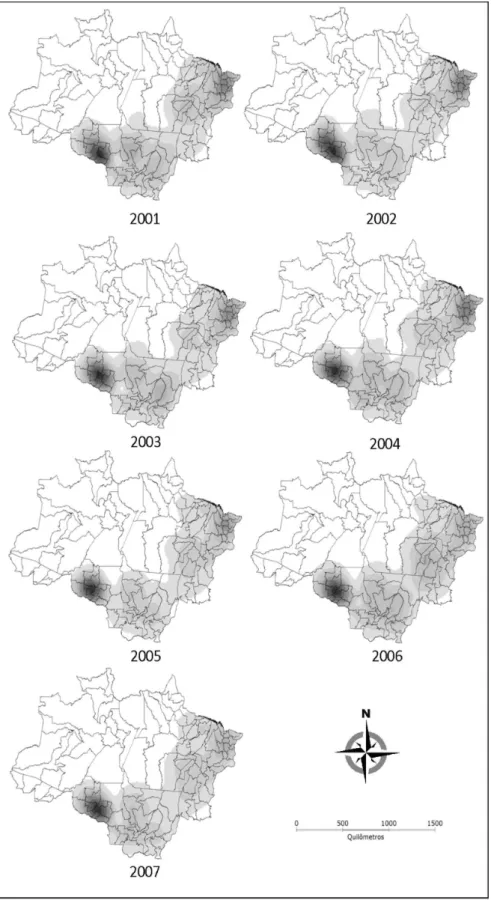
Hospital admissions for asthma in the elderly were distributed spatially in the sou-thern and eastern portions of the Brazilian Amazon. The main hotspots were found in the center-south of Rondônia with mortality rates reaching 10.9 with admissions at 13.6 ‰, while other areas such as the north-central Amazon held at 0.74 ‰ admissions. Hot areas were also observed in Mato Gros-so and the border between the states of Tocantins and Pará which ranged between 2.5 to 13.4 ‰ (Figure 01). For the states of
Maranhão, Tocantins, Pará and Mato Grosso a reduction was seen in hospitalization rates between 2001 and 2007.
A signiicant downward trend was ob-served in the crude rates of hospitalization for all states studied except Tocantins. The state of Rondonia presented the greatest drop in hospitalization rates in the year 2002 (β = 0.57) yet was still nearly double the rates found in other states throughout the series, ranging from 11.8 ‰ to 7.2 ‰ in 2002 and 2006, respectively (Figure 2).
Monthly hospitalization rates for as-thma in the elderly were found highest in the months from July to October. February observed a decline in admissions where March had peak attendances. The states of Rondonia and Mato Grosso held the highest monthly rates with up to 5.8 ‰ and 3.3 ‰ respectively (Figure 03).
The proportion of asthma hospitalization in the elderly was higher in the dry season, both when compared to the intermediate pe-riod and rainy season with double and even triple the volume of admissions (Table 01).
Discussion
The spatial distribution of asthma ad-missions in the Amazon showed “hot spots” mainly in south-central Rondônia. The state of Rondônia was found as an exception with extreme asthma admissions rates in the el-derly. Similarities are easily drawn between the map of spatial distribution across the Brazilian Amazon and the spatial conigu-ration of the “arc of deforestation”.
It is possible to relate this phenomenon to the number of outbreaks of ire throu-ghout the study period as well as the in-luence of smoke coming from Mato Grosso, Acre and even Bolivia27,31. However, there is
Figure 1 – Spatial distribution according to the Kernel smoothing method for annual
* Tendência/Trend: Rondônia β =0,57 (p = 0,039); Mato Grosso β =0,31 (p < 0,000); Maranhão β
=0,38 (p < 0,000); Tocantins (p = 0,82); Pará β =0,14 (p = 0,013).
Figure 2 –Annual asthma-related hospitalization rates (‰ inhabitants) in the elderly for the states of Maranhão, Mato Grosso, Pará, Rondônia and Tocantins, 2001 to 2007.
The entire border of the Amazon ecosys-tem, also an agricultural frontier, has an intense migration of people from other re-gions of the country. Thus, these individuals affront climatic variations and exposure to potentially allergenic agents such as fungi, pollen, and pollution emitted by burnings in nearby regions. The maps which were constructed from standardized rates of hos-pitalization, showed little inluence of the population density of the newly occupied area of the Amazon. Taking into account access to hospitals in the geographic areas, the capitals of Belem, Manaus, Rio Branco, Boa Vista and Macapá were depicted as “hotspots”.
The trend of reducing rates of hospita-lization for asthma among the elderly may have followed the general movement of
admissions in the SUS8, both due to
impro-vements in hospital care and the expanding network of primary care32. Although asthma
is a chronic disease, it can be treated in pri-mary health care2, requiring hospitalization
only for the most serious cases3,32.
It is known that among the physiologi-cal resilience of the elderly the respiratory system becomes more dificult to diagnosis. According to some authors, the disease may be under-diagnosed by the interpretation
of dyspnea as a natural consequence of age and the existence of non-speciic symptoms found in other pathologies such as chronic obstructive pulmonary disease, congestive heart failure, hypothyroidism, cancer and bronchiectasis33, 34. Another possibility
relates to the bias regarding the severity of disease and disability leading health pro-fessionals to regard asthma as symptoms of other diagnoses including: allergic bron-chitis, bronchial asthma, allergic attack,
chronic bronchitis, among others2.
Seasonal asthma admissions in the el-derly were signiicant, with a higher number of hospitalizations prevailing in the dry season. In the months from July to October the rates of hospitalization for asthma in the elderly were the highest, especially in the areas of Rondônia and Mato Grosso. These states, as well, held the largest num-ber of outbreaks of ire during the study period. Further research11-14 found similar
occurrences with ire burning in Asia and an association with an increase in hospita-lizations for asthma and other respiratory illnesses. Though, higher rates in the period may be explained by the decrease in relative humidity during this season and the conse-quent increase in the amplitude between
maximum and minimum temperatures27.
Table 01 – Absolute value, proportion and rate of admissions of the elderly for asthma during dry
intermediate and rainny periods in the Brazilian Amazon states (including Maranhão, Mato Grosso, Pará, Rondônia and Tocantins) 2001 to 2007.
Year
Period of the year Ratio*
Dry Intermediate Rainny Dry/
Intermediate
Dry/Rainny
n % n % n %
2001 3.548 69.20 1.579 30.80 1.567 30.64 2.25 2.26
2002 3.608 69.32 1.597 30.68 1.669 31.63 2.26 2.16
2003 3.479 70.81 1.434 29.19 1.400 28.69 2.43 2.49
2004 3.474 72.19 1.338 27.81 1.730 33.24 2.60 2.01
2005 3.280 70.52 1.371 29.48 1.429 30.35 2.39 2.30
2006 3.325 73.14 1.221 26.86 1.109 25.01 2.72 3.00
2007 3.342 75.44 1.088 24.56 922 21.62 3.07 3.62
Mean 3.437 71.42 1.375 28.58 1.404 29.00 2.50 2.45
Source: IBGE - MS/Datasus. 2001 to 2007. n = absolute value % = proportion
Contrary to this study, the seasonal distribution of hospitalization rates for as-thma for children in the Brazilian Amazon is higher during the rainy season35. Although
most hospitalizations of the elderly occurred during the dry period, all states had a peak in hospitalizations in March, the transition between the rainy and intermediate sea-son, with the exception of the Amazonas state which presented the admission peak in April. Biogenic material (fungi, spores, bacteria and a variety of organic particles) present in humid air, could account for these peaks36., as well as the concentration of fungi
in the environment during the rainy season. Atkinson et al.37 and Dales et al.38 observed
a correlation between fungal spores and asthma exacerbations in the United States. In Brazil, Valença et al.39 found in Brasilia, a
prevalence of emergency visits for asthma for children during the rainy season, possibly inluenced by changes in microorganisms concentrations in the environment.
Rosa et al.20 suggests that the reduced
number of hospital admissions of children during December, January and February may be due to the corresponding holiday se-ason for most professionals, thus peaking in
March, where Nesti and Goldbaum40 found
that the return of children to school could inluence the infection of other children. Overturf41 suggests that children may be
asymptomatic carriers of various diseases; this could inluence the contagion of the elderly, causing subsequent asthma attacks,
possibly because children’s need for close interpersonal contact and constant direct physical contact with adults 42.
One limitation of this study may be the SUS database hospital admission records. We calculated the reported admissions which ultimately may include the same pa-tient repeatedly if admitted more than once during the study period – thus inlating the representation of distribution of asthma in the population confounding with the seve-rity of cases. In addition, we analyzed only the AIH, therefore, including predominantly only the lower socioeconomic classes who are reliant upon the public health system8.
Despite this limitation, on average 85% of the population are exclusive users of SUS43
and the reliability of data in the AIH for epi-demiological research and demographics has been demonstrated28-30.
In conclusion, hospitalizations for asthma in the elderly show a decreasing trend over the study period. Based on our indings, we suggest an expansion of health awareness, prevention and care to the elder-ly population, particularelder-ly in asthma care and taking into consideration the unique social, demographic and epidemiological characteristics of the Brazilian Amazon. We suggest that further medical education be offered to professionals in these regions to aid in the differential diagnoses of asthma in the elderly population as the seasonal variation for asthma during the dry season places the elderly at risk.
References
1. World Health Organization [homepage na internet]. United Nations System, 2009. [acesso em 15 jan. 2008]. Disponível em: http://www.who.int/en/.
2. Global Initiative for Asthma [homepage na internet]. 2008 [acesso em 29 set. 2008]. Disponível em: http:// www.ginasthma.com
3. Associação Brasileira de Alergia e Imunologia, SBPT – Sociedade Brasileira de Pneumologia e Tisiologia, SBP – Sociedade Brasileira de Pediatria. IV Diretrizes Brasileiras para o Manejo da Asma. J Bras Pneumol 2006; 32(Supl 7): 447-74.
4. Francisco PMSB, Donalisio MR, Lattorre MRDO. Internações por doenças respiratórias em idosos e a intervenção vacinal contra inluenza no Estado de São Paulo. Rev bras epidemiol 2004; 7(2): 220-7.
6. Lima e Costa MFF, Guerra HL, Barreto SM, Guimarães RM. Diagnóstico da situação de saúde da população idosa brasileira: um estudo da mortalidade e das internações hospitalares públicas. Inf Epidemiol SUS 2000; 9(1): 43-50.
7. Loyola Filho AI, Leite Matos D, Giatti L, Afradique ME, Peixoto SV, Lima-Costa MF. Causas de internações hospitalares entre idosos brasileiros no âmbito do Sistema Único de Saúde. Epidemiol Serv Saúde 2004; 13(4): 229-38.
8. Sistema de Informações Hospitalares do SUS [base de dados na Internet]. Brasília: Ministério da Saúde; 2008. [acesso em 22 ago. 2008] Disponível em: www.datasus. gov.br
9. Toyoshima MTK, Ito GM, Gouveia N. Morbidade por doenças respiratórias em pacientes hospitalizados em São Paulo / SP. Rev Assoc Med Bras 2005; 51(4): 209-13
10. Organização Pan-Americana da Saúde/Organização Mundial de Saúde [homepage na internet]. Brasília: 2008 [acesso em 29 set 2008]. Disponível em: http://www. opas.org.br/
11. Aditama TY. Impact of haze from forest ire to
respiratory health: Indonesian experience. Respirology 2000; 5: 169-174.
12. Awang MB, Jaafar AB, Abdullah AM, Ismail MB, Hassan MN, Abdullah R et al.. Air quality in Malaysia: Impacts, management issues and future challenges. Respirology 2000; 5: 183–196.
13. Emmanuel SC. Impact to lung health of haze from forest ires: The Singapore experience. Respirology 2000; 5: 175–182.
14. Kunii O, Kanagawa S, Hojo M, Iajima I, Hisamatsu Y, Yamamura S et al.. Assessment of lung health among the inhabitants exposed to haze from the 1997 forest ire in Indonesia. Respirology 2000; 5: 167.
15. Martins LC, Latorre MRDO, Saldiva PHN, Braga ALF. Relação entre poluição atmosférica e atendimentos por infecção de vias aéreas superiores no município de São Paulo: avaliação do rodízio de veículos. Rev Bras Epidemiol 2001; 4(3):220-9.
16. Arbex MA, Cançado JED, Pereira LAA, Braga ALF, Saldiva PHN. Queima de biomassa e efeitos sobre a saúde. J. bras pneumol 2004; 30(2): 158-75.
17. Cançado JED, Braga A, Pereira LAA, Arbex MABDO, Saldiva PHN, Santos UP. Repercussões clínicas da exposição à poluição atmosférica. J bras pneumol 2006; 32(2): 5-11.
18. Ribeiro H. Queimadas de cana-de-açúcar no Brasil: efeitos à saúde respiratória. Rev Saúde Pública 2008; 42(2): 370-6.
19. Botelho C, Correia AL, Silva AMC, Macedo AG, Silva COS. Fatores ambientais e hospitalizações em crianças menores de cinco anos com infecção respiratória aguda. Cad Saúde Pública 2003; 19(6):1771-80.
20. Rosa AM, Ignotti E, Hacon SS, Castro HA. Análise das internações por doenças respiratórias em Tangará da Serra - Amazônia Brasileira. J Bras Pneumol 2008; 34(8): 575-82.
21. Becker B. Geopolítica da Amazônia. Estud. av. 2005; 19 (53): 71 – 86.
22. Ministério da Ciência e Tecnologia. Inventário nacional de emissão de gases de efeito estufa [homepage na internet]. Brasília: MCT, 2005 [acesso em 29 set 2008]. Disponível em: http://www.mct.gov.br
23. Yamasoe MA, Artaxo P, Miguel AH, Allen AG. Chemical composition of aerosol particles from direct emissions of biomass burning in the Amazon Basin: water-soluble species and trace elements. Atmospheric Environment 2000; 34: 1641-53.
24. Instituto Brasileiro de Geograia e Estatística [homepage na internet]. Brasília: Ministério do Planejamento, Orçamento e Gestão, 2007 [acesso em 20 ago 2008]. Disponível em: www.ibge.gov.br
25. Fish G, Marengo JA, Nobre CA. Boletim Climanálise Especial. 1996
26. Instituto Nacional de Metereologia [homepage na internet] 2007. [acesso em 14 ago 2008]. Disponível em: http://www.inmet.gov.br
27. Instituto Nacional de Pesquisas Espaciais [homepage na internet]. 2009 [acesso em: 22 mar. 2009]. Disponível em: http://pirandira.cptec.inpe.br/queimadas/#
28. Campos MR, Martins M, Noronha JC, Travassos C. A Proposal to Integrate Data from the Hospitals Information System of the Uniied Health System (SIH-SUS) (SIH-SUS) for Research Use. Inf Epidemiol Sus 2000; 9(1): 51-58.
29. Lessa FJD, Mendes ACG, Farias SF, Sá DA; Duarte PO; Melo Filho DA. Novas metodologias para vigilância epidemiológica: uso do Sistema de Informações Hospitalares - SIH/SUS. Inf Epidemiol Sus 2000; 9 (supl 1): 3-19.
30. Veras CMT, Martins MAS. Coniabilidade dos dados nos formulários de Autorização de Internação Hospitalar (AIH). Cad Saúde Publ 1994;10(3):339-55.
31. Prins EM, Feltz JM, Menzel WP, Ward DE. An Overview of GOES-8 Diurnal Fire and Smoke Results for SCAR-B and 1995 Fire Season in South America. J Geophys Res. 1998;113(D24):31821-35.
32. Ministério da Saúde [homepage na internet]. Brasília: 2008 [acesso em 15 out 2008]. Disponível em: http:// portal.saude.gov.br/saude/
33. Milgrom H, Wamboldt F, Bender B. Monitoring adherence to the therapy of asthma. Curr Opin Allergy Clin Immunol 2002; 2(3): 201-5.
35. Silva PRS, Rosa AM, Hacon SS, Ignotti E. Hospitalization of children for asthma in the Brazilian Amazon: trend and spatial distribution. J Pediatr 2009; 85(6): 541- 546.
36. Artaxo P, Oliveira PH, Lara LL, Pauliquevis TM, Rizzo LV, Pires Junior C, Paixão MA, Longo KM, Freitas S, Correia A L. Química atmosférica na Amazônia: a loresta e as emissões de queimadas controlando a composição da atmosfera amazônica. Acta Amaz 2005; 35(2): 185-96.
37. Atkinson RW, Strachan DP, Anderson HR, Hajat S,
Emberlin J. Temporal associations between daily
counts of fungal spores and asthma exacerbations.
Occup Environ Med 2006; 63(9): 580-90.
38. Dales RE, Cakmak S, Judek S, Dann T, Coates F, Brook JR,
Burnett RT. The Role of Fungal Spores in Thunderstorm
Asthma. Chest 2003; 123(3): 745 - 50.
39. Valença LM, Restivo PCN, Nunes MS. Variação sazonal nos atendimentos de emergência por asma em Gama, Distrito Federal. J Bras Pneumol 2006; 32(4): 284-9.
40. Nesti MM e Goldbaum M. Infectious diseases and daycare and preschool education. J Pediatr (RJ) 2007; 83(4): 299-312.
41. Overturf GD. Endemic giardiosis in the United States– role of the day–care center. Clin Infec Dis 1994; 18:764–5.
42. Thompson SC. Infectious diarrhoea in children: controlling transmission in the child care setting. J Paediatr Child Health 1994; 30:210–9.
43. Pesquisa Nacional por Amostra de Domicílio/Instituto Brasileiro de Geograia e Estatística. Acesso e utilização de serviços de saúde; 2003. [Acesso em 22 ago 2008]. Disponível em: www.ibge.gov.br