ABSTRACT
Objectives
The aim of this literature review about malocclusion was to identify epidemiologic instruments which are being used in Public Health, as well as to bring information regarding the occlusal alterations more prevalent in children and adolescents.
Methods
Information presented in previous studies was reviewed, in articles published in period 1997-2007, considering the production registered in the following databases: Latin American and Caribbean Health Sciences, Scientiic Electronic Library Online, International Database for Medical Literature and Brazilian Dentistry Bibliography.
Results
The total of 191 identiied references, 170 had been eliminated after the implementation of the exclusion criteria and 21 articles met the proposed inclusion criteria and had served of base for this work. The use of different criteria made dificult the comparison of studies in literature and did not offer parameters that can guide the scientiic evidences.
Conclusion
The most used epidemiologic indices were Dental Aesthetic Index and Index of Orthodontic Treatment Need and it was observed predominance of open bite in the deciduous dentition and crowding in the mixed and permanent dentitions.
Indexing terms: Epidemiology. Malocclusion. Public Health Dentistry.
RESUMO
Objetivos
Identiicar os instrumentos epidemiológicos que estão sendo utilizados em Saúde Pública e trazer informações a respeito das alterações oclusais mais prevalentes em crianças e em adolescentes por meio de uma revisão da literatura sobre a má oclusão.
Métodos
Foram recuperadas informações apresentadas em trabalhos anteriores, incluídas em artigos publicados no período 1997-2007, considerando a produção registrada nas seguintes bases de dados bibliográicas: Literatura Latino-Americana e do Caribe em Ciências da Saúde, Scientiic Electronic Library Online, Literatura Internacional em Ciências da Saúde e Bibliograia Brasileira de Odontologia.
Resultados
Do total de 191 referências identiicadas, 170 foram eliminadas após a implementação dos critérios de exclusão e 21 artigos atenderam aos critérios de inclusão pré-estabelecidos, servindo, portanto, de base para este trabalho. A utilização de critérios distintos diicultou a comparação entre os estudos, não disponibilizando parâmetros que pudessem nortear as evidências cientíicas. Conclusão: Os índices epidemiológicos mais adotados foram o Índice de Estética Dental e o Índice de Necessidade de Tratamento Ortodôntico, sendo observado predomínio de mordida aberta anterior na dentição decídua e de apinhamento nas dentições mista e permanente.
Termos de indexação: Epidemiologia. Má oclusão. Odontologia em Saúde Pública.
Epidemiology of malocclusion in children and adolescents:
a critic review
Epidemiologia da má oclusão em crianças e adolescentes: uma revisão crítica
Fábio Silva de CARVALHO1
Cristiane Alves Paz de CARVALHO1
Arsenio SALES-PERES2
José Roberto de Magalhães BASTOS2
Sílvia Helena de Carvalho SALES-PERES2
1 Universidade Estadual do Sudoeste da Bahia, Departamento de Saúde. Jequié, BA, Brasil.
2 Universidade de São Paulo, Faculdade de Odontologia, Departamento de Odontopediatria, Ortodontia e Saúde Coletiva. Al. Octávio Pinheiro Brisola, 9-75, 17012-901, Bauru, SP, Brasil. Correspondência para / Correspondence to: SHC PERES-SALES. E-mail: < [email protected]>.
and conditions gaining importance in Public Health1.
During this period, there has been growing interest in the development of researches about the etiology, methods of prevention and treatment of different oral pathologies and problems, such as malocclusions.
INTRODUCTION
In this context, the aim of this study was to identify the epidemiological instruments that are being used in Public Health, and to bring information with respect to the most prevalent occlusal alterations in children and adolescents, by means of a review of the literature about malocclusion.
METHODS
The strategy of search for articles included researching the scientiic literature using the “Biblioteca Virtual em Saúde” (BVS), by means of the following databases: Literatura Latino-Americana e do Caribe em Ciências da Saúde (Lilacs),
Scientiic Electronic Library Online (SciELO), Literatura Internacional em Ciências da Saúde (Medline) e Bibliograia Brasileira de Odontologia (BBO). A bibliographic search was made on the central theme of this study: the epidemiology of malocclusion and the criteria used in studies.
For this purposes, the references were located after an advanced search in BVS, by means of grouping the following descriptors: epidemiologia (epidemiology),
maloclusão (malocclusion), dentição primária (primary dentition), dentição permanente (permanent dentition),
dentição mista (mixed dentition), criança (child), adolescente
(adolescent), odontologia em saúde pública (public health dentistry), Organização Mundial da Saúde (World Health Organization), Índices (indexes), located with the use of the Descriptors in Ciências da Saúde (DeCS) (Health Sciences (DeHSc). In addition the following limits were used: Aspects = epidemiology (/EP) AND Gender = male OR female AND Year of publication = 2007 OR 2006 OR 2005 OR 2004 OR 2003 OR 2002 OR 2001 OR 2000 OR 1998-1999 OR 1996-1997 AND Language = Portuguese OR English.
All the productions in the form of articles, whose titles or abstracts mentioned the epidemiology of malocclusion in children or adolescents, in the period 1997-2007, were obtained in full and analyzed afterwards with regard to inclusion or exclusion. Studies with reference to clinical cases, radiographic comparative studies, or studies with speciic populations (for example, individuals with cleft-lip and palate), in spite of appearing in the search, were not considered eligible for inclusion in the present review. Furthermore, repetitions and some articles with limited availability in electronic databases were not considered.
Some bibliographic references of the studies located were also traced with the intention of locating other studies of potential interest for preparing this work, which eventually were not identiied by the electronic search. The high prevalence of malocclusion in the population has
led the World Health Organization (WHO) to considering it the dental public health problem ranked in third place all over the world2.
Malocclusion is an anomaly in the development of the dental arches, causing esthetic and/or functional problems, with the most common causes being osteogenic development, hereditariness, and acquired functional conditions. The above-mentioned conditions, such as pasty diets, mouth breathing and deleterious oral habits, especially paciier sucking3, are among the main causes
attributed to the development of malocclusion.
From the Public Health point of view, the purpose of knowledge of occlusal problems is to enable identiication of individuals according to the priority of their needs. Therefore, clear deinition of diagnostic criteria is important, in order to allow their application at epidemiological level and provide the planning of actions and obtainment of resources for orthodontic treatment1.
In the scientiic literature, diverse clinical and epidemiological methods are found for the classiication of occlusal problems, which differ with regard to objectives. The most widespread clinical method was developed by Angle. Other proposals, such as establishing the need for treatment have been developed to allow the classiication of malocclusion according to the level of priority4. In the epidemiological ield, we emphasize
the Index of Orthodontic Treatment Need (IOTN) and Dental Esthetics Index (DAI), recommended by the WHO in 19975.
The possibility of multiple occlusal alterations makes it dificult to have a simple classiication that represents the epidemiological picture. Although there are a large number of studies in the literature about malocclusion, the different criteria for recording the occlusal condition limit comparisons among the results of different epidemiological surveys1,4.
There is a consensus in the literature and among professionals that malocclusion does not exclusively represent the characteristic of permanent dentition, and it is also present in the stages that precede occlusal maturity6.
of obtaining the complete version of the article (10), in addition to the repetitions (57 articles catalogued in more than one database).
Therefore, the sample of this study consisted of 21 articles. These were obtain in full and then analyzed and categorized according to the year of publication, place where the research was conducted and period chosen for publication (Chart 1).
RESULTS
According to the strategy established, the bibliographic search resulted in 191 references, distributed as follows: Lilacs (45), Medline (66), BBO (76) and SciELO
(4). However, after implementation of the exclusion criteria, 170 references were eliminated: theses (43), books (2), theme not pertinent to the proposal (58), impossibility
Authors Year of Publication City/State/Country: Journal
Locker et al.8 2007 Toronto Community Dent Oral Epidemiol
Schwertner et al.9 2007 Foz do Iguaçu, PR RGO (Porto Alegre)
Alves et al.10 2006 Feira de Santana, BA RGO (Porto Alegre)
Gábris et al.11 2006 Hungary Eur J Orthod
Oliveira et al.12 2006 Rio de Janeiro, RJ Rev CEFAC
Souames et al.13 2006 Val d’Oise, France Eur J Orthod
Thomaz & Valença2 2005 São Luís, MA RPG Rev Pós-Grad
Marques et al.14 2005 Belo Horizonte, MG Cad Saúde Pública
Frazão et al.15 2004 São Paulo, SP Rev Saúde Pública
Cunha et al.4 2003 Rio de Janeiro, RJ Rev Dent Press Ortont Ortop Maxilar
Iwasa et al.16 2003 Region of Campinas, SP, Brazil. RFO UPF
Silva Filho et al.6 2003 Bauru, SP J Bras Odontopediatr Odontol Bebê
Abdullah & Rock17 2001 Malaysia Community Dent Oral Epidemiol
Pires et al.5 2001 Salvador, BA Rev Bras Odontol
Chi et al.18 2000 New Zealand Aust Orthod J
Jonhson et al.19 2000 New Zealand Aust Orthod J
Pereira et al.20 2000 São Paulo, SP Odontol USF
Tomita et al.3 2000 Bauru, SP Pesq Odont Bras
Alves et al.21 1999 Rio de Janeiro, RJ J Bras Odontopediatr Odontol Bebê
Otuyemi et al.22 1999 Nigeria Int Dent J
Tomita et al.23 1998 Bauru, SP Rev Fac Odontol Bauru
Chart 1. Characteristics of the studies on epidemiology of malocclusion, according to year, place and journal in which published.
In Chart 1, some of the general characteristics of the studies reviewed are described. The majority of the publications (57%) were concentrated in the last ive years (12)2,4,6,8-16 and
the remaining portion (9), in the period of 1998-20013,5,17-23.
There was diversity as regard the periodical published, however, the following periodicals: Revista Gaúcha de Odontologia, Jornal Brasileiro de Odontopediatria e Odontologia para Bebê, Community Dentistry and Oral Epidemiology, Australian Orthodontic Journal and European Journal of Orthodontics were those that allowed the largest number of articles to be located (2 in each)6,8-11,13,17-19,21. The other periodicals presented a
uniform distribution with one article in each2-5,12,14-16,20.
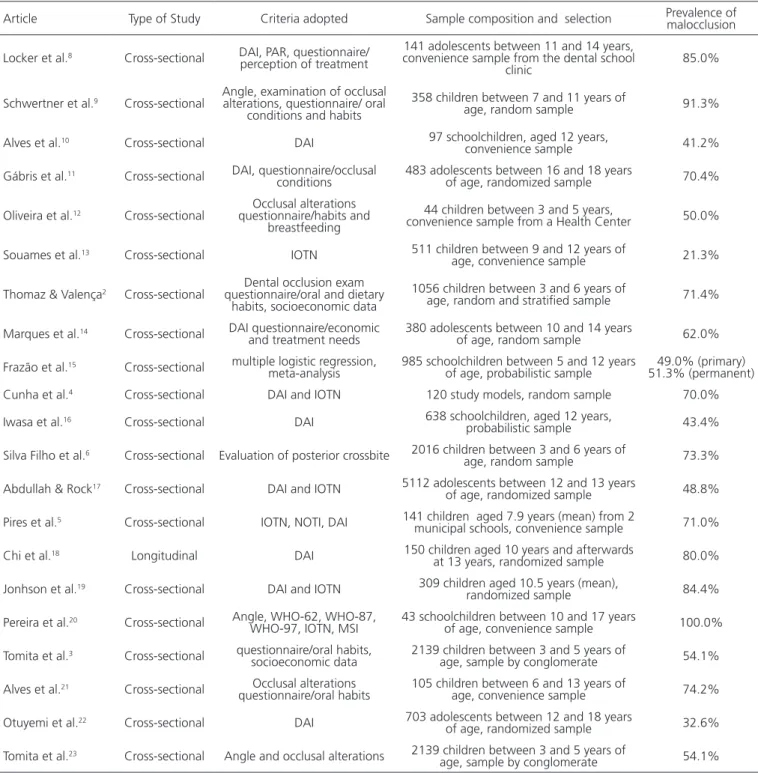
The type of study, criteria used for evaluating malocclusion, sample composition and manner in which it was selected, and prevalence of malocclusion in the studies are described in Table 1.
As regards design, 20 articles2-6,8-17,19-23 were
characterized as being cross-sectional and 1 as longitudinal18. With regard to the criteria adopted in
the studies, 12 articles adopted the DAI4-5,13,17,19-20, 7
articles selected used more than one index for evaluating malocclusion4,5,8,15,17,19,20, 6 articles adopted the IOTN
index4,5,13,17,19,20, 5 articles related the prevalence of diverse
occlusal alterations2-3,6,12,21 and 2 articles used the Angle
classiication9,23.
With reference to the origin of the participating individuals, there was predominance of samples formed by children and adolescents located in schools, clinics or in the author’s dental school of origin.
With regard to sample selection, it was randomly performed in 5 studies2,4,6,9,14, randomized in another 5 11,17-19,22, by convenience in 7 articles5,8,10,12-13,20-21, probabilistic
DISCUSSION
Malocclusion has been the object of study in diverse countries, due to its high prevalence in populations. Furthermore, the possibility of prevention and treatment is pointed out, in addition to the interference in the quality
of life of the human being. For this reason, malocclusion may be considered a public health problem. Epidemiology may contribute to the elucidation of important questions with reference to malocclusion, such as the description of its distribution in the population, determination of the different alterations and factors associated with its development.
Article Type of Study Criteria adopted Sample composition and selection Prevalence of malocclusion
Locker et al.8 Cross-sectional DAI, PAR, questionnaire/
perception of treatment
141 adolescents between 11 and 14 years, convenience sample from the dental school
clinic 85.0%
Schwertner et al.9 Cross-sectional Angle, examination of occlusal alterations, questionnaire/ oral
conditions and habits
358 children between 7 and 11 years of
age, random sample 91.3%
Alves et al.10 Cross-sectional DAI 97 schoolchildren, aged 12 years,
convenience sample 41.2% Gábris et al.11 Cross-sectional DAI, questionnaire/occlusal
conditions 483 adolescents between 16 and 18 years of age, randomized sample 70.4%
Oliveira et al.12 Cross-sectional questionnaire/habits and Occlusal alterations
breastfeeding
44 children between 3 and 5 years,
convenience sample from a Health Center 50.0% Souames et al.13 Cross-sectional IOTN 511 children between 9 and 12 years of
age, convenience sample 21.3%
Thomaz & Valença2 Cross-sectional questionnaire/oral and dietary Dental occlusion exam
habits, socioeconomic data
1056 children between 3 and 6 years of
age, random and stratiied sample 71.4% Marques et al.14 Cross-sectional DAI questionnaire/economic
and treatment needs 380 adolescents between 10 and 14 years of age, random sample 62.0% Frazão et al.15 Cross-sectional multiple logistic regression,
meta-analysis 985 schoolchildren between 5 and 12 years of age, probabilistic sample 51.3% (permanent)49.0% (primary) Cunha et al.4 Cross-sectional DAI and IOTN 120 study models, random sample 70.0%
Iwasa et al.16 Cross-sectional DAI 638 schoolchildren, aged 12 years,
probabilistic sample 43.4% Silva Filho et al.6 Cross-sectional Evaluation of posterior crossbite 2016 children between 3 and 6 years of
age, random sample 73.3% Abdullah & Rock17 Cross-sectional DAI and IOTN 5112 adolescents between 12 and 13 years
of age, randomized sample 48.8% Pires et al.5 Cross-sectional IOTN, NOTI, DAI 141 children aged 7.9 years (mean) from 2
municipal schools, convenience sample 71.0% Chi et al.18 Longitudinal DAI 150 children aged 10 years and afterwards
at 13 years, randomized sample 80.0% Jonhson et al.19 Cross-sectional DAI and IOTN 309 children aged 10.5 years (mean),
randomized sample 84.4% Pereira et al.20 Cross-sectional Angle, WHO-62, WHO-87,
WHO-97, IOTN, MSI 43 schoolchildren between 10 and 17 years of age, convenience sample 100.0% Tomita et al.3 Cross-sectional questionnaire/oral habits,
socioeconomic data 2139 children between 3 and 5 years of age, sample by conglomerate 54.1% Alves et al.21 Cross-sectional Occlusal alterations
questionnaire/oral habits 105 children between 6 and 13 years of age, convenience sample 74.2% Otuyemi et al.22 Cross-sectional DAI 703 adolescents between 12 and 18 years
of age, randomized sample 32.6% Tomita et al.23 Cross-sectional Angle and occlusal alterations 2139 children between 3 and 5 years of
age, sample by conglomerate 54.1%
Table 1. Characteristics of studies on epidemiology of malocclusion according to the type of study, criteria evaluated, sample composition, sample
inherent to this gender. There was statistically signiicant association between malocclusion and deleterious oral habits, especially with paciier and inger sucking2,5,6,12,21.
Therefore, the removal of these habits as early as possible must be recommended, so that this alteration does not attain bone levels.
With reference to breast feeding, greater prevalence of occlusal alterations was observed in children who were fed for a period shorter than six months (71.4%)12, reiterating health promotion for pregnant
women with a focus on the baby’s oral health.
Studies that adopted the DAI index in the investigation of malocclusion found that approximately 10.0% of individuals were evaluated in the incapacitating category10,16,22, with the most signiicant value being
related in Toronto, where 42.6% of the sample were found to have this degree of malocclusion8. Locker et al.8 justiied
this by bearing in mind that his was a convenience sample, using orthodontic patients.
In France, approximately 20.0% of children evaluated in accordance with the IOTN index presented treatment needs. The association between the occlusal component and esthetics in this index was shown to have high statistical signiicance in this study13. The perception
of schoolchildren as regards their dental esthetics was shown to be coherent in view of the real orthodontic treatment needs.
Cunha et al.4 in their study evaluated the most
frequent malocclusions and degree of treatment need by means of comparison between the DAI and IOTN indices. The data revealed that 72.5% and 74.2% of the cases presented severe orthodontic treatment need when using the DAI and IOTN, respectively. The same was found in New Zealand with similar results for the two indices19. In
Malaysia, the two indices were also sued, with the IOTN being more eficient in the identiication of adolescents with treatment needs17.
Schoolchildren and patients of a university in São Paulo, SP, Brazil, were evaluated with the aim of inding out about their occlusal conditions, using different epidemiological instruments in the exams. As instruments of measure, the following were used: Angle, WHO-62, WHO-87, WHO-97 (DAI), IOTN and MSI (Malocclusion Severity Index). The intraexaminer agreement was calculated at two distinct time intervals, with the greatest error being observed in the use of the DAI and MSI indices (85.71% in both). With regard to orthodontic treatment needs, the MSI presented a statistically different proportion The epidemiologic instruments adopted by
researchers in their investigations has been rather varied. The IOTN and DAI were the most frequently adopted indices4-5,8,10-11,13-14,16-20,22, while some studies were based on
the evaluation of a speciic occlusal alteration2-3,6,9,12,21,23.
The amplitude of occlusion conditions, allied to the diverse methods of measuring malocclusions has made it dificult to perform comparisons of the results of epidemiological studies.
The prevalence of malocclusion was considered high in various Brazilian municipalities, attaining values of over 70.0%2,5,6,9, as occurred in Hungary11. The lowest prevalence
found was in France13 (21.3%) and Nigeria22 (32.6%).
Knowledge of the most prevalent alterations allows the adoption of public policies directed towards the needs of the population. Crowding4-5,9-10,13-14 was the alteration
described most frequently in the articles analyzed, as presented by Schwertner et al., in 2007, who evaluated children in Foz do Iguaçu-PR9, Brazil, and found 65.5%
of them with this problem. However, other investigations pointed out anterior open bite6,12,21, maxillary protrusion 2,
presence of diastemas23, alteration in molar relationship16
and spacing11.
With regard to the distribution of malocclusion according to gender, higher prevalence could be observed in the female gender2-3,6,23, although the study conducted
in Campinas-SP16, Brazil, presented contradictory results.
Socioeconomic determinants were analyzed in some studies, and some associations were related to the occurrence of malocclusion, such as location and/or type of school, and children whose mothers were included in the work market. As regards the pre-school location, greater prevalence of alterations was found in children resident in the urban zone2, and as regard public or private
type of school, greater alterations were found children at public schools6,16. In Bauru, SP, Brazil, higher prevalence
of malocclusion was related in children whose mothers were included in the work market3, a fact that could be
extrapolated, seeing that these mothers left their children at an early age, to go back to work, so that artiicial bottle-feeding was introduced into the children’s routine.
The presence of deleterious oral habits has been indicated as a strong risk factor for the development of malocclusions in individuals3. Among the most
common habits related were paciier sucking2,5,6,12,
inger sucking2,5,6,12,21 and onicophagia (nail-biting)9. The
CONCLUSION
The results allowed one to afirm that the epidemiological instruments most frequently adopted were the DAI and IOTN. There was predominance of anterior open bite in primary dentition, and in the mixed and permanent dentitions, there was the highest prevalence of crowding.
Collaborators
FS CARVALHO, CAP CARVALHO, A SALES-PERES, JRM BASTOS and SHC SALES-PERES participated in all stages of preparation of the article, right from conception through to the inal writing of it.
to that of all the other indices (97.57%). There was also statistically signiicant difference between the IOTN and WHO-87 (67.44% and 32.56%) and between IOTN and DAI (67.44% and 44.19%)indices20. These results lead to
the relection that further longitudinal studies should be conducted, which are better able to demonstrate the way to measure malocclusion in public health.
There was high prevalence of malocclusion among children and adolescents, with the use of different criteria making comparisons among the studies dificult. There are no parameters available that could bring to light, knowledge of strong scientiic evidence. The identiication of occlusal conditions allows for planning and the adoption of public policies in oral health directed towards prevention and treatment.
REFERENCES
1. Peres KG, Tomita NE. Oclusopatias. In: Antunes JLF, Peres MA. Epidemiologia da saúde bucal. Rio de Janeiro: Guanabara Koogan; 2006. p. 83-101.
2. Thomaz EBAF, Valença AMG. Prevalência de má-oclusão e fatores relacionados à sua ocorrência em pré-escolares da cidade de São Luís - MA - Brasil. RPG Rev Pos-Grad. 2005;12(2):212-21. 3. Tomita NE, Sheiham A, Bijella VT, Franco LJ. Relação entre
determinantes socioeconômicos e hábitos bucais de risco para más-oclusões em pré-escolares. Pesqui Odontol Bras. 2000;14(2):169-75. doi: 10.1590/S1517-74912000000200013 4. Cunha ACPP, Miguel JA, Lima KC. Avaliação dos índices DAI
e IOTN no diagnóstico de más oclusões e necessidade de tratamento ortodôntico. Rev Dent Press Ortodon Ortop Maxilar. 2003;8(1):51-8.
5. Pires DM, Rocha MCBS, Cangussu MCT. Prevalência de oclusopatias na dentadura mista em escolares - Salvador-BA. Rev Bras Odontol. 2001;58(6):414-7.
6. Silva Filho OG, Silva PRB, Rego MVNN, Capelozza Filho L. Epidemiologia da mordida cruzada posterior na dentadura decídua. JBP, J Bras Odontopediatr Odontol Bebê. 2003;6(29):61-8. 7. Brasil. Ministério da Saúde. Coordenação de Saúde Bucal da
População Brasileira. Projeto SB Brasil 2003: resultados principais [citado 2009 Jan 15]. Disponível em: <http://dtr2004.saude.gov. br/dab/saudebucal/vigilancia.php>.
8. Locker D, Jokovic A, Tompson B, Prakash P. Is the child perceptions questionnaire for 11-14 year olds sensitive to clinical and self-perceived variations in orthodontic status? Community Dent Oral Epidemiol. 2007;35(3):179-85. doi: 10.1111/j.1600-0528.2006.00324.x
9. Schwertner A, Nouer PRA, Garbui IU, Kuramae M. Prevalência de maloclusão em crianças entre 7 e 11 anos em Foz do Iguaçu, PR. RGO, Rev Gaúch Odontol. 2007;55(2):155-61.
10. Alves TDB, Gonçalves APR, Alves NA, Rios FC, Silva LBO. Prevalência de oclusopatia em escolares de 12 anos de idade: estudo realizado em uma escola pública do município de Feira de Santana-BA. RGO, Rev Gaúch Odontol. 2006;54(3):269-73. 11. Gábris K, Márton S, Madléna M. Prevalence of malocclusions in
Hungarian adolescents. Eur J Orthod. 2006; 28(5):467-70. doi: 10.1093/ejo/cjl027
12. Oliveira AB, Souza FP, Chiappetta ALML. Relação entre hábitos de sucção não-nutritiva, tipo de aleitamento e má oclusões em crianças com dentição decídua. Rev CEFAC. 2006;8(3):352-9. 13. Souames M, Bassigny F, Zenati N, Riordan PJ, Boy-Lefevre
ML. Orthodontic treatment need in French schoolchildren: an epidemiological study using the index of orthodontic treatment need. Eur J Orthod. 2006;28(6):605-9. doi: 10.1093/ejo/cjl045
14. Marques LS, Barbosa CC, Ramos-Jorge ML, Pordeus IA, Paiva SM. Prevalência da maloclusão e necessidade de tratamento ortodôntico em escolares de 10 a 14 anos de idade em Belo Horizonte, Minas Gerais, Brasil: enfoque psicossocial. Cad Saúde Pública. 2005;21(4):1099-106. doi: 10.1590/S0102-311X2005000400012
15. Frazão P, Narvai PC, Latorre MRDO, Castellanos RA. Are severe occlusal problems more frequent in permanent than deciduous dentition? Rev Saúde Pública. 2004;38(2):247-54. doi: 10.1590/ S0034-89102004000200014
16. Iwasa EAP, Sousa MLR, Cypriano S. Prevalência de alterações oclusais de dentição permanente em escolares de 12 anos da região de Campinas, SP. RFO UPF. 2003;8(2):40-4.
17. Abdullah MS, Rock WP. Assessment of orthodontic treatment need in 5,112 Malaysian children using the IOTN and DAI indices. Community Dent Health. 2001;18(4):242-8.
23. Tomita NE, Bijella MFTB, Silva SMB, Bijella VT, Lopes ES, Novo NF, et al. Prevalência de má oclusäo em pré-escolares de Bauru-SP-Brasil. Rev Fac Odontol Bauru. 1998;6(3):35-44.
24. Peres KG, Traebert ESA, Marcenes W. Diferenças entre autopercepção e critérios normativos na identiicação das oclusopatias. Rev Saúde Pública. 2002; 36(2):230-6. doi: 10.1590/S0034-89102002000200016
Received on: 19/12/2011 Final version resubmitted on: 23/5/2009 Approved on: 8/6/2012 19. Johnson M, Harkness M, Crowther P, Herbison P. A comparison
of two methods of assessing orthodontic treatment need in the mixed dentition: DAI and IOTN. Aust Orthod J. 2000;16(2):82-7. 20. Pereira AC, Lascala CMM, Romero LG, Narvai PC. Avaliação de
alguns instrumentos para detecção de má-oclusão dentária. Odontol USF. 2000;18(1):33-9.
21. Alves AC, Castro GF, Leite ICG, Bastos EPS. Sucção digital em crianças institucionalizadas: prevalência e relação com a maloclusão. JBP, J Bras Odontopediatr Odontol Bebê. 1999; 2(9):375-82.