(Recebido em 11/03/2012; Texto final em 03/05/2012).
(Revestimentos Nb/Al depositados por PTA)
Karin Graf, Ana Soia Clímaco Monteiro D’Oliveira
Universidade Federal do Paraná, Departamento de Engenharia Mecânica, Curitiba, Brazil, [email protected], [email protected]
Abstract
Hardfacing is widely applied to components yet the majority of the welding techniques available restrain the variety of hard alloys that can be deposited. Plasma Transferred Arc hardfacing offsets this drawback by using powdered feedstock offering the ability to tailor the chemical composition of the coating and as a consequence its properties. The high strength and chemical inertia of aluminide alloys makes them very suitable to protect components. However, the strong interaction with the substrate during hardfacing requires analysis of each alloy system to optimize its properties and weldability. This work analyzed coatings processed with a cast and ground Nb40wt%Al alloy and the effect of Fe and C on the coatings features. It conirmed that sound Nb aluminide coatings can be processed by plasma Transferred arc hardfacing and will have a strong interaction with the substrate, which determines the inal microstructure and properties of coatings. Final remarks point out that during Nb-Al coating tailoring the interaction with the substrate has to be considered at the early stages of design process.
Keywords: Aluminides; hardfacing; coatings, PTA; Nb/Al.
Resumo: Revestimentos soldados são amplamente usados para proteger componentes mecânicos entretanto a maioria das técnicas
de soldagem disponíveis restringe a variedade de ligas de alta resistência que podem ser depositadas. O processo de plasma por arco transferido permite ultrapassar esta limitação ao utilizar material de adição na forma de pó, oferecendo a possibilidade de se customizar a composição dos revestimentos e em consequências as suas propriedades. A elevada resistência mecânica e inercia química das ligas de aluminetos tornam estas ligas atrativas para a proteção de componentes diversos. Entretanto a grande interação com o substrato que ocorre quando do processamento exige que para a otimização das propriedades e soldabilidade seja realizada uma a análise de cada sistema liga e substrato. Neste trabalho foram processados e caracterizados revestimentos utilizando uma liga fundida e triturada de Nb40wt%Al e analisado o efeito do Fe e do C nas características dos revestimentos. O trabalho conirmou que é possível processar revestimentos íntegros de Nb40wt%Al por PTA e que ocorre uma forte interação com o substrato, que vai determinar a microestrutura inal e as propriedades do revestimento. Destaca-se que na customização de revestimentos de Nb-Al a diluição tem de ser considerada logo nos estágios iniciais do projeto do revestimento.
Palavras-Chave:Aluminetos, revestimento soldados, plasma por Arco transferido, Nb/Al.
1. Introduction
The need for more eficient processes imposes a permanent search for materials that can better withstand the aggressive operating conditions of processing equipment [1, 2]. Protecting components includes enhancing surface properties to attend chemical and/or mechanical operating requirements. Therefore the selection of the processing technique and the surface alloy are of fundamental importance as failure most frequently initiates at the component surface. Hardfaced coatings act as a protection and a sacriicial material, wearing out without compromise the structure of the component. Hardfacing is widely applied to components yet the majority of the welding techniques available
restrain the variety of alloys that can be deposited. Plasma Transferred Arc (PTA) hardfacing offsets this drawback using powdered feedstock. The high quality coatings with low dilution, low distortion and ine microstructure, have been reported before [3,4] but little has been mentioned regarding the ability to tailor the chemical composition of the coating and as a consequence its properties. The potential of PTA to develop surfaces that meet speciic requirements dictated by each application (tailoring) is an important innovation on hardfacing procedures particularly for the deposition of hard alloys that are dificult to fabricate as wire or rods.
[6-9]. Studies evaluated carbides precipitation, Laves phase and other intermetallic as strengthening particles in ordered Fe/Al/ Nb alloys [10,11] but the more attractive compounds of these systems are Nb3Al [12] and NbAl3 [13].
Previous work [14, 15] has suggested that the processing of aluminide PTA coatings does not respond to processing parameters in the same manner as superalloy coatings. In particular, a very high dilution has been reported and associated with the exothermal synthesis of the aluminides, the interaction of the plasma arc with the feedstock and with the melt pool. Therefore, to optimize processing parameters it is a key factor to anticipate the effects of the interaction between the feedstock and the substrate. This work analyzed Nb/Al coatings processed with a cast and ground alloy and the changes that may arise from the presence of elements from the substrate steel. In particular, the effect of Fe and C on the coatings features is discussed.
2. Experimental procedure
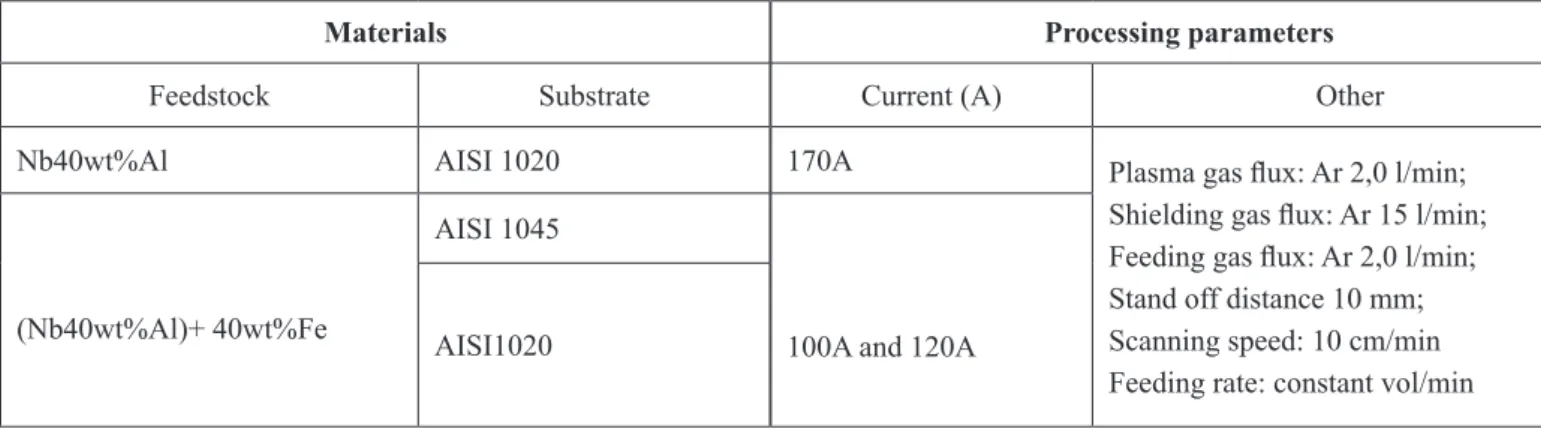
Coatings were processed by plasma-transferred arc (PTA) on (100 x 50 x 12mm) steel plates, using the processing parameters and feedstock shown on table 1. The feedstock was dried at 110ºC in an air furnace for 1 hour before deposition.
These materials and processing parameters were combined to carry out two sets of tests to analyze the effect of two elements known to have a strong afinity with at least one of the elements in the Nb-Al deposited alloy:
- Fe: mixing Fe powders with the cast and ground Nb40wt%Al
alloy and
- C: deposition of the (Nb40wt%Al)+ 40wt%Fe powder mixture on two carbon steel plates AISI 1020 and AISI 1045.
Deposits were analyzed regarding their soundness by visual inspection. Rockwell hardness on the face of coatings and Vickers microhardness (HV0,5) on the transverse section were carried out. The later considered the average of ive proiles, going from the external surface and crossing the fusion line into the substrate until measurements exhibited similar values to that of the as-received steel plates.
X-ray diffraction analysis with Cu Kα was performed on the top surface of coatings for phase identiication. Specimens were prepared following standard metallographic procedures of grinding on silicon carbide papers and polishing with alumina suspension. Microstructure on the transverse section was
revealed by immersion samples in a solution of 2,5 ml HNO3;
2,5 ml HCl and 0,5 g picric acid solution, in 100ml alcohol, for 22 sec. Subsequently, specimens were evaluated by optical and scanning electron microscopy (SEM) and Energy Dispersive Spectroscopy (EDS) semi-quantitative chemical composition analysis. Dilution, as a measure of the fraction of the substrate that melted and mixed with the deposited material, was calculated according to Eq.1.
(1)
Figure 1 shows a schematic representation of the procedure used to determine the dilution on the transverse section of sample.
Figure 1. Schematic representation of areas used to calculate dilution of coatings where A is the total melted area and B the
melted area of the substrate steel
100
%
x
A
B
3. Results and Discussion
3.1. Processing Nb40wt%Al alloy
The Nb40wt%Al alloy deposited on the AISI 1020 plates resulted on high hardness homogeneous coatings measured by the uniform layer hardness 61HRC±1. The irst evidence of the development of Nb aluminide compounds in the coatings also accounts for the low toughness of coatings and transverse cracks evenly spaced along the deposited layer were observed.
In spite of the high hardness, coatings exhibit a high dilution level, 39%. Although this value agrees with results reported for aluminide coatings [14,15] it contrasts with the low dilution reported for Co and Ni based superalloys coatings processed by PTA on low carbon steels [16,17]. The high dilution of aluminide coatings has been associated with the exothermal synthesis of the aluminides compounds, and the interaction of the plasma arc both with the substrate and with the feedstock [15].
Although in agreement with previous dilution results it is important to investigate the inluence of the interaction with the substrate on the coating characteristics.
Deposition of the mixture of the Nb40wt%Al cast and ground alloy with Fe powders was carried out with a low deposition current (100A and 120A) aiming to reduce dilution. Sound coatings without cracks or porosity, were processed with 100A current intensity on the two substrates steels. The observed increase on coatings toughness can be associated with a larger fraction of the solid solution Nb-Fe-Al phase, expected to form [18]. Coatings homogeneity assessed by the hardness measured along the face of the deposits (64HRC±2 and 59HRC±3, for deposits processed respectively on AISI 1020 and AISI 1045 plates) was not compromised. However, the predicted reduction on dilution with the decrease of deposition current [17, 19] did not occur and measurements on coatings processed with 100A revealed dilution levels of 38% and 44% for the coatings processed on AISI 1020
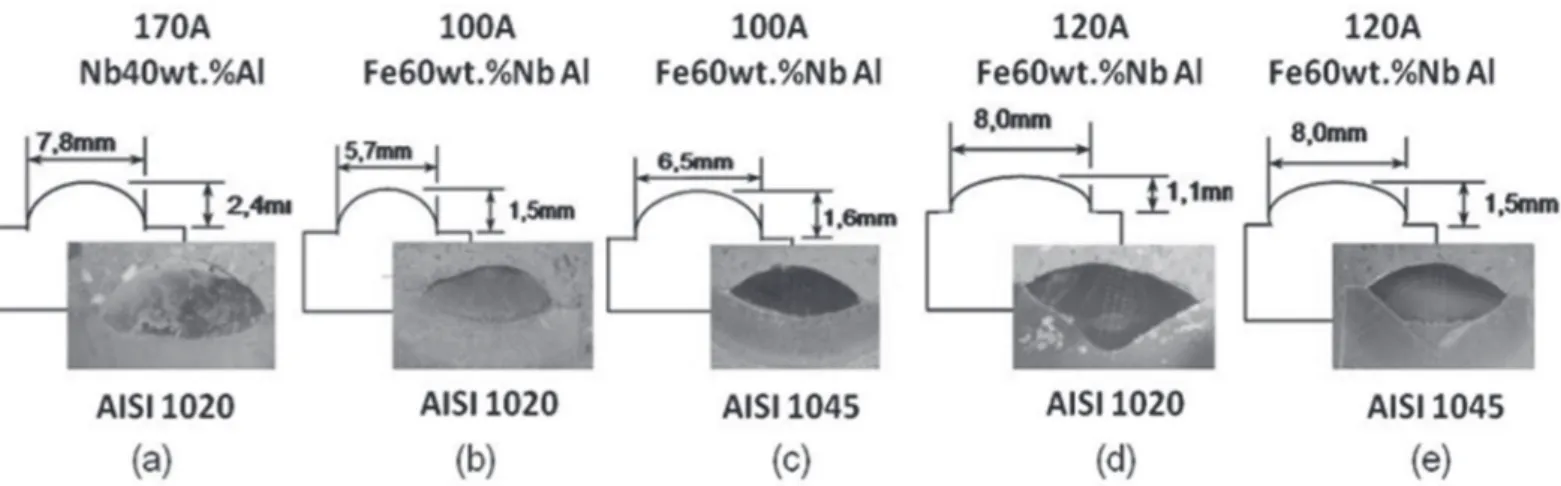
Figure 2. Cross section and geometric features of deposits (a) processed with the Nb/Al cast and ground alloy on AISI 1020 with 170A, (b) Fe/Nb/Al powder processed on AISI 1020 with 100A, (c) Fe/Nb/Al powder processed on AISI 1045 with 100A, (d) Fe/Nb/
Al powder processed on AISI 1020 with 120A, (e) Fe/Nb/Al powder processed on AISI 1045 with 120A.
and AISI 1045, respectively.
Although sound coatings were also produced with the 120A, the increase on the deposition current caused a decrease on the coatings hardness and on the uniformity of coatings assessed by the dispersion on the hardness values, 55HRC±5 and 58HRC±4, for deposits on the AISI 1020 and AISI 1045 plates. A change of behavior was also identiied on coatings dilution and signiicantly higher values were measured: 63% and 65% on coatings processed on AISI 1020 AISI 1045, respectively. These results suggest that the increment on the deposition current increased the interaction of the plasma arc with the feedstock allowing for some species to ionize increasing the energy of the arc [15]
Assessment of the geometry of deposited layers conirms the higher wettability of coatings processed with the powder mixture containing Fe in spite of the lower deposition current used, igure 2. The higher penetration depth observed on the transverse cross section of coatings corroborates with the assumption that an increase on the plasma arc energy occurred.
Microhardness proiles were analyzed to further assess the inluence of Fe and C on the coating characteristics. Figure 3 compares the proiles for the coatings processed with the Nb40wt.%Al cast and ground alloy, with and without Fe, on steel plates with different carbon content.
Figure 3. Microhardness proiles for coating processed with the cast and ground alloy Nb40wt.%Al on AISI 1020 and for Fe-Nb-Al coatings processed on AISI 1020 and AISI 1045 with
100A and 120A.
3.2. Microstructural features
The presence of low toughness aluminide compounds and carbides, identiied by X-Ray diffraction analysis on the coatings processed with the cast and ground Nb40wt.%Al alloy, igure 4, explains the observed transverse cracks.
Figure 4. X-ray diffraction tests for the coating processed with the cast and ground Nb40wt.%Al alloy.
The analysis also conirmed the strong interaction with the
complex Fe rich aluminides, (Fe,Nb)3Al.
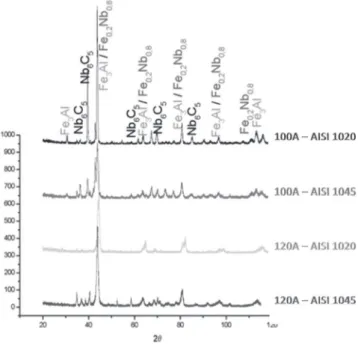
The effect of Fe on coatings is also perceived from the X-ray diffraction analysis, igure 5, as Nb rich aluminide is no longer identiied and the Fe0.2Nb0.8 solid solution forms. It is interesting
to notice that similar phases were identiied when depositing Fe/ Nb/Al powder mixture: (Fe,Nb)3Al, Fe/Nb rich solid solution
and Nb6C5 carbides, regardless of the deposition current and the
chemical composition of the substrate.
Further understanding of the effect of carbon and Fe on coatings was gained from the analysis of their microstructure. Figure 6 shows the cross section of the coating processed with the cast and ground alloy on AISI 1020 steel and EDS carried out on the different phases. A solidiication structure with rich Nb, (Nb,Fe)Al3, dendrites, a rich on Fe, (Fe,Nb)3Al interdendritic region and rich Nb precipitates of Nb6C5 (bright spots) can be
observed.
Figure 6. Transverse cross section microstructures of the coating processed with the cast and ground Nb40wt.%Al alloy (a) and corresponding EDS phase analysis (b).
The inluence of Fe and C on the microstructures of coatings can be observed on igure 7 and 8. Coatings processed with the 100A current exhibited richer Nb dendrites (the Fe-Nb solid solution) and a rich iron interdendritic (Fe,Nb)3A,l igure 7. As
before, Nb rich precipitates, identiied as Niobium carbides, were also observed. The observed changes due to the presence of a higher Fe content agree with literature results on ternary
Fe-Nb-Al alloys [22]. The strong afinity of Nb with C is conirmed by
the larger apparent volume fraction of carbides and the decrease on the Nb content of the dendritic region. Further changes were observed following the increase on the deposition current to 120A that caused a signiicantly increase on dilution (63% and 65% for AISI 1020 and 1045, respectively), displacing the system towards Fe richer compositions. This composition shift impacted on the coatings microstructure as shown in igure 8. A columnar eutectic solidiication structure is identiied. The high
Fe content measured by EDS analysis on the columnar grains suggest the development of the eutectic. On coatings processed on the richer carbon substrate the high dilution accounts for the larger fraction of carbides and dendritic and interdendritic regions with very high and similar Fe contents. The higher Al content of the dendrites suggest that (Fe,Nb)3Al forms whereas
the higher Nb content of interdendritic eutectic agrees with the
development of the Fe0,2Nb0,8/(Fe,Nb)3Al
5. Acknowledgements
The authors acknowledge CNPq and ANP/PRH24 for the inancial support of this project. Special thanks are due to Mr Sérgio Medeiros dos Santos for assistance with the MEV and Ms Verônica Alexandra Buss Almeida helpful discussions.
6. References
[1] AMERICAN SOCIETY FOR MATERIALS “Surface Engineering for corrosion and wear resistance”, Ed: J. R. Davis, 2001.
[2] KIM, H. J. AND KIM, Y.J. Microstructural Evaluations of the Plasma Transferred Arc coated layers on the hardness, wear resistance and corrosion for the hardfacing of Ni- and Co-based alloys, In: International Thermal Spray Conference, Nice, France, 1998, p 217-224
[3] SUCHENTRUNK, R., STAUDIGL, G, JONKE, D., FUESSER, H.J. Industrial Applications for Plasma Processes – Examples and Trends, Surface and Coatings Technology, p. 1-9, 1997
[4] WANG XIBAO, LIU HUA Metal powder thermal behaviour during the plasma transferred arc surfacing process, Surface and Coatings Technology, v.106 p.156-161, 1998
[5] DEEVI S. C., SIKKA V. K., LIU C. T. Processing, properties and applications of Nickel and Iron aluminides, Progress in Materials Science, v. 42, p.177-192, 1997
[6]MRIDHA, S., ONG, H. H., POH, L.S., CHEANG, P. Intermetallic coatings produced by TIG surface melting, Journal of Materials Processing Technology, v.113, p.516-520, 2001. [7] NRC - NATIONAL RESEARCH COUNCIL Future R&D Environments – A report for the National Institute of Standards and Technology, Division of Engineering and Physical Sciences, National Academic Press, Washington, DC, USA, 2002. [8] LEE, K. M. et al. Effect of thermal treatment on the atomic
ordering of mechanically alloyed Al3Nb, Journal of Alloys and
Compounds, v. 313, p.214 – 217, 2000.
[9] MORRIS D. G. et al. Strengthening at ordered Fe-Al-Nb
[14] ALMEIDA, V. A. B. et al. Evaluation of Ni Al coatings processed by Plasma Transferred arc, Surface Engineering, v. 27, p. 266-271, 2011.
[15] D’OLIVEIRA, A. S. C. M., et al. Solidiication of PTA aluminide coatings, International Journal of Materials Research, in press, 2012.
[16] D’OLIVEIRA, A. S. C. M., VILAR, R., GROWOSKI, C. F. High Temperature behaviour of plasma transferred arc and laser Co based alloys coatings, Applied Surface Science, v.201, p.154-160, 2002.
[17] DÍAZ, V. M. V., DUTRA, J. C. ; D´OLIVEIRA, A. S. C. M. Deposição por Plasma com arco Transferido, Soldagem e Inspeção, v. 15, p. 41-51, 2010.
[18] RAGHAVAN, V. Phase diagram evaluations Al-Fe-Nb (Aluminum-Iron-Niobium), Journal of phase equilibria and diffusion, v. 31, n. 2, p.166-167, DOI: 10.1007/s11669-010-9649 [19] YAEDU, A. E., D´OLIVEIRA, A. S. C. M. Co based alloy PTA hardfacing with different dilution levels. Materials Science and Technology, v. 21, n. 4, p. 459-466, 2005.
[20] CHUNG, D-S, ENOKI, M., KISHI, T. Microstructure analysis and mechanical properties of in-situ Nb/Nb-aluminide layered materials, Science and Technology of Advanced materials , v.3, p. 129-135, 2002.
[21] KRATOCHVÍL P., NEUMANN H., Welds of Fe3Al-type alloy with hardened structure, Intermetallics, p.1–3, 2009
[22] MOTA, M.A. et al. Fe–Al–Nb phase diagram investigation and directional growth of the (Fe, Al)2Nb–(Fe, Al, Nb)ss eutectic