CERN-PH-EP/2013-200 2013/11/25
CMS-SMP-12-010
Probing color coherence effects in pp collisions at
√
s
=
7 TeV
The CMS Collaboration
∗Abstract
A study of color coherence effects in pp collisions at a center-of-mass energy of 7 TeV is presented. The data used in the analysis were collected in 2010 with the CMS de-tector at the LHC and correspond to an integrated luminosity of 36 pb−1. Events are selected that contain at least three jets and where the two jets with the largest trans-verse momentum exhibit a back-to-back topology. The measured angular correlation between the second- and third-leading jet is shown to be sensitive to color coherence effects, and is compared to the predictions of Monte Carlo models with various im-plementations of color coherence. None of the models describe the data satisfactorily.
Submitted to the European Physical Journal C
c
2013 CERN for the benefit of the CMS Collaboration. CC-BY-3.0 license
∗See Appendix A for the list of collaboration members
arXiv:1311.5815v1 [hep-ex] 22 Nov 2013
1
Introduction
An important feature of the color interaction in quantum chromodynamics (QCD) is that the outgoing partons produced in the hard interaction continue to interfere with each other during their fragmentation phase. This phenomenon, called color coherence, manifests itself by the rel-ative abundance of soft radiation in the region between the color connected final-state partons and the suppression of soft radiation elsewhere.
Color coherence phenomena were initially observed in e+e−collisions by several experiments at PETRA and LEP [1–6]. These experiments showed the coherence effect in e+e−→qqg three-jet events through the suppression of particle production in the region between the quark and antiquark jets.
In hadron collisions, in addition to the color connection between the final-state partons, the color connection between the outgoing partons and the incoming partons must be considered. The Tevatron experiments CDF and D0 have both reported evidence for color coherence effects in measurements of the spatial correlations between neighboring jets [7, 8]. These correlations were not well reproduced by Monte Carlo (MC) simulations that use incoherent parton shower models. However, the data were successfully described by simulations that include color co-herence effects through the ordering of the parton emission angles [9].
The technique originally developed by the Tevatron experiments is used to study color coher-ence effects in pp collisions at√s = 7 TeV with the Compact Muon Solenoid (CMS) detector. Events with at least three jets (called three-jet events) are selected, and these jets are ordered by their transverse momenta pT1 > pT2> pT3with respect to the beam direction. We measure the
angular correlation between the second and third jet to probe the effects of color coherence. The CMS detector has a right-handed coordinate system with its origin at the center of the detector. The z axis points along the direction of the counterclockwise beam, φ is the azimuthal angle in the transverse plane perpendicular to the beam, and θ is the polar angle relative to the z axis. The pseudorapidity of the ith jet is denoted by ηi = −ln[tan(θi/2)]and its azimuthal
angle by φi.
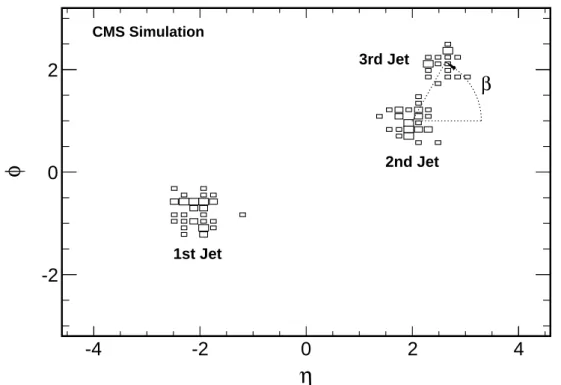
The measured observable β [8] is defined as the azimuthal angle of the third jet with respect to the second jet in (η, φ) space as shown in Fig. 1. Implicitly, this can be expressed by
tan β= |∆φ23|
∆η23
, (1)
where ∆φ23 = φ3−φ2 (defined so that −π ≤ ∆φ23 ≤ π), ∆η23 = sign(η2) · (η3−η2), and
0 ≤ β ≤ π. The absolute value of∆φ23 in Eq. 1 and the sign of the pseudorapidity of the
second jet, sign(η2), in the definition of∆η23are introduced to map symmetric configurations
around∆φ23 = 0 or η = 0 onto the same β value. For∆φ23 = 0, β is defined to be zero or π
depending on the sign of∆η23being positive or negative. In the case of∆η23=0, which cannot
happen simultaneously with∆φ23=0, β is defined to equal π/2.
In a naive leading-order model the two partons are produced back-to-back in the transverse plane. One of the two partons may radiate a third parton. In the absence of color coherence effects there is no preferred direction of emission of this third parton around the radiating parton. In contrast, when color coherence effects are present, the third parton will tend to lie in the event plane defined by the emitting parton and the beam axis. Therefore, in the presence of color coherence, the third jet population along the event plane (in particular near β≈0) will be enhanced and out of the plane (β≈π/2) will be suppressed.
2 2 The CMS detector
η
-4
-2
0
2
4
φ
-2
0
2
β
2nd Jet 3rd Jet 1st Jet CMS SimulationFigure 1: Visualization of the observable β in (η,φ) space using a simulated three-jet event. The sizes of the rectangular boxes are proportional to the particle energies.
The aims of this paper are
• To measure the β distributions, normalized to the total number of events in each region, as a function of β separately in the central (|η2| ≤ 0.8) and forward region
(0.8< |η2| ≤2.5):
Fη2,i(β) =
Nη,i Nη
, (2)
where Nη is the total number of events in the η2 region, Nη,i the number of events in the given ith β bin of the η2region. The choice of this normalization significantly
reduces the impact of experimental systematic uncertainties such as the uncertainty in the luminosity.
• To gauge the sensitivity of the variable β to color coherence effects.
• To compare our measurements to the predictions of MC event generators with vari-ous implementations of color coherence.
2
The CMS detector
A detailed description of the CMS experiment can be found elsewhere [10]; so here we describe the detector systems most relevant to the present analysis. The central feature of the CMS ap-paratus is a superconducting solenoid of 6 m internal diameter, providing a magnetic field of 3.8 T. Within the field volume, a silicon pixel and strip tracker, a lead tungstate crystal elec-tromagnetic calorimeter and a brass/scintillator hadron calorimeter (HCAL) are installed. The central tracking system provides coverage up to|η| =2.5 in pseudorapidity and the
covers the pseudorapidity range 3.0< |η| <5.0.
3
Event selection
The CMS detector records events using a two-level trigger system consisting of a hardware-based level-1 (L1) trigger and a software-hardware-based high-level trigger (HLT). For this study, single jet triggers that reconstruct jets from calorimeter energy deposits at L1 and HLT are used to select events based on different pTjet thresholds. Five different triggers with pTthresholds of
30, 50, 70, 100, and 140 GeV are used to select the events. The triggers were prescaled during the 2010 run when the associated rate exceeded the allocated band width except the highest-threshold one. Therefore, the events are split into five different bins in pT1 with each bin
con-taining the events collected during a period when the appropriate trigger was not prescaled. Each bin starts at pTmindefined in such a way that the associated trigger efficiency exceeds 99%.
Table 2 lists the binning in pT1, and, for each bin, it gives the associated trigger, the number of
selected events, and the integrated luminosity for the period during which the given trigger was not prescaled.
Jets are reconstructed with the anti-kT algorithm [11], which is implemented in the FASTJET
package [12] using a distance parameter R=0.5, from a list of particle candidates reconstructed using the particle-flow (PF) algorithm. This PF algorithm [13] reconstructs all particle candi-dates in each event using an optimized combination of information from all CMS subdetector systems: muons, electrons (with associated bremsstrahlung photons), photons (unconverted and converted), and charged/neutral hadrons. The four-vectors of the neutral particles are computed by assuming that they come from the primary vertex, which is defined as the ver-tex with the highest sum of transverse momenta of all reconstructed tracks pointing to it. The reconstructed jet energy E is defined as the scalar sum of the energies of the constituents, and the jet momentum~p is the vector sum of the momenta of the constituents. The jet transverse momentum pTis the component of~p perpendicular to the beam. The E and~p values of a
recon-structed jet are further corrected for the response of the detector, which is obtained from MC simulations, test beam results, and pp collision data [14, 15]. The corrections account for the presence of multiple pp collisions in the same or adjacent bunch crossings (pileup interactions) using the jet area method [16].
Events are required to have a primary vertex reconstructed within 24 cm of the detector center along the beam line [17]. Additional selection criteria are applied to each event to remove any spurious jet-like features originating from isolated noise patterns in certain HCAL regions [18]. Events having at least three jets with pT >30 GeV are selected. The pseudorapidity of the two
leading jets must be within|η1|,|η2| ≤2.5, while for the third jet no constraints are applied in
order to avoid a bias in the β measurement.
To further reduce the background from misidentified jets, i.e., jets resulting from noise in the electromagnetic, hadron and/or hadron forward calorimeters, a set of tight identification crite-ria are applied: each jet should contain at least two particles, one of which is a charged hadron, and the jet energy fraction carried by neutral hadrons, photons, muons, and electrons should be less than 90%. With these criteria the contamination of the sample with misidentified jets is suppressed to a level less than 1% [13].
The dijet invariant mass of the two leading jets, M12, is required to exceed 220 GeV to ensure a
back-to-back configuration. With this requirement more than 98% of the events have|∆φ12− π| <1. Finally the distance in the (η, φ) space between the second and third jets is constrained
to be 0.5<∆R23 =p(∆η23)2+ (∆φ
4 4 Monte Carlo models
third jet is closer to the second jet.
Table 1: Summary of the event selection. Selection criteria
pT1 >100 GeV, pT3 >30 GeV
|η1|,|η2| ≤2.5
M12>220 GeV
0.5<∆R23 <1.5
The selections used in the analysis are summarized in Table 1. The numbers of events passing the selection criteria in each pT1 bin are summarized in Table 2. The measured∆η23and∆φ23
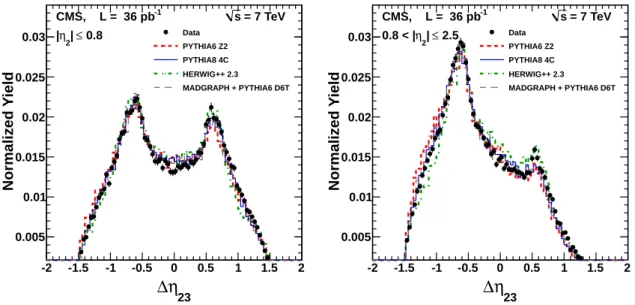
distributions are compared to various MC models in Figs. 2 and 3. In general a reasonable agreement is observed with the different models. A study of the amount of energy collected by the HF detector indicated that there is no diffractive component in the data sample.
23 η ∆ -2 -1.5 -1 -0.5 0 0.5 1 1.5 2 N o rm a li z e d Y ie ld 0.005 0.01 0.015 0.02 0.025 0.03 Data PYTHIA6 Z2 PYTHIA8 4C HERWIG++ 2.3 MADGRAPH + PYTHIA6 D6T 0.8 ≤ | 2 η | = 7 TeV s -1 CMS, L = 36 pb 23 η ∆ -2 -1.5 -1 -0.5 0 0.5 1 1.5 2 N o rm a li z e d Y ie ld 0.005 0.01 0.015 0.02 0.025 0.03 Data PYTHIA6 Z2 PYTHIA8 4C HERWIG++ 2.3 MADGRAPH + PYTHIA6 D6T 2.5 ≤ | 2 η 0.8 < | = 7 TeV s -1 CMS, L = 36 pb
Figure 2: Observed∆η23distributions, corrected for detector effects, compared to MC
predic-tions byPYTHIA 6, PYTHIA8, HERWIG++, and MADGRAPH+PYTHIA6. The MC samples are normalized to the total number of events in data.
4
Monte Carlo models
The reconstructed jets are compared to the predictions of four different Monte Carlo generators that simulate jet production in pp collisions at √s = 7 TeV. The numbers of events for all generator samples is much higher than the number of collected data events so the statistical uncertainties in the MC predictions are not visible in the figures.
The PYTHIA [19] (version 6.422) event generator uses leading-order (LO) matrix elements to generate the 2 → 2 hard process in perturbative QCD (pQCD) and the parton shower (PS) model to simulate higher-order processes [9, 20, 21]. The PS model gives a good description of parton emission when the emitted partons are close in phase space. Events are generated
23 φ ∆ -2 -1.5 -1 -0.5 0 0.5 1 1.5 2 N o rm a li z e d Y ie ld 0.005 0.01 0.015 0.02 0.025 Data PYTHIA6 Z2 PYTHIA8 4C HERWIG++ 2.3 MADGRAPH + PYTHIA6 D6T 0.8 ≤ | 2 η | = 7 TeV s -1 CMS, L = 36 pb 23 φ ∆ -2 -1.5 -1 -0.5 0 0.5 1 1.5 2 N o rm a li z e d Y ie ld 0.005 0.01 0.015 0.02 0.025 Data PYTHIA6 Z2 PYTHIA8 4C HERWIG++ 2.3 MADGRAPH + PYTHIA6 D6T 2.5 ≤ | 2 η 0.8 < | = 7 TeV s -1 CMS, L = 36 pb
Figure 3: Observed∆φ23distributions, corrected for detector effects, compared to MC
predic-tions byPYTHIA 6, PYTHIA8, HERWIG++, and MADGRAPH+PYTHIA6. The MC samples are normalized to the total number of events in data.
Table 2: The binning in pT1 and, for each bin, the associated trigger, the integrated luminosity
for the period during which the given trigger was not prescaled, and the number of selected events. The selection criteria are described in Table 1.
pT1bin edges Trigger online Lint Number of events
(GeV) threshold (GeV) (pb−1) Total |η2| ≤0.8 0.8 < |η2| ≤2.5
100–120 30 0.35 4511 1671 2840 120–160 50 4.5 67 086 27 069 40 017 160–200 70 9.2 50 071 23 055 27 016 200–250 100 20 39 464 18 987 20 477 >250 140 36 31 999 16 728 15 271 All 193 131 87 510 105 621
with the Z2 tune for the underlying event. This Z2 tune is identical to the Z1 tune described in Ref. [22], except that Z2 uses the CTEQ6L1 [23] parton distribution functions (PDFs) of the proton in which the parton showers are ordered in pT. The hadronization is simulated using
the Lund string model [24, 25]. The older D6T tune [26, 27], where parton showers are ordered in Q2, is considered for comparison. The D6T tune was designed to describe the lower-energy results of UA5 and CDF. The color coherence effects are implemented in PYTHIA6 by means of an angular ordering algorithm where the effects can be switched on and off via the steering parameters MSTP(67) and MSTJ(50), which control the initial-state and the final-state showers, respectively.
The PYTHIA 8 [28] (version 8.145) event generator, used with tune 4C [29], orders the parton showers in pT and models the underlying event using the multiple-parton interaction model
6 5 Measurement of the normalized β distribution and systematic uncertainties
implemented in a similar manner as for the pT-ordered showers inPYTHIA6.
The HERWIG++ [30] (version 2.4.2) event generator takes LO matrix elements and simulates parton showers using the coherent branching algorithm with angular ordering of showers. The cluster hadronization model is used in the formation of hadrons from the quarks and gluons produced in the parton shower. The underlying event is simulated using the eikonal multiple partonic scattering model [31]. The color coherence effects are implemented by the angular ordering of emissions in the parton shower using the coherent branching algorithm [32]. The MADGRAPH4 [33] (version 2.24) event generator is interfaced withPYTHIA6 for the par-ton showering and the hadronization using the D6T tune and uses fixed-order matrix element calculations for the multiparton topologies. The color coherence for the hard jets at leading order comes from the exact QCD color amplitudes in the model. Matching algorithms ensure that no double counting occurs between the partons from MADGRAPHand the PS.
5
Measurement of the normalized β distribution and systematic
uncertainties
The measurement of the β distribution is performed in two regions defined by the pseudora-pidity of the second jet: the central region|η2| ≤0.8 and the forward region 0.8 < |η2| ≤ 2.5.
The angular correlation effects considered in this analysis appear to have a reduced sensitivity to the transverse momentum of the leading jet pT1. Consequently different pT1bins are merged
into one single bin.
The β distribution in a given η2 region is obtained as a sum of the events weighted by the
luminosity collected by the trigger used in the associated pT1 bin. In case of MC samples the βdistribution is obtained by summing together the events weighted by their generation level
weight in a given η2 region. The normalized β distribution is then obtained by dividing the
weighted number of events in a given bin of β by the total weighted number of events in the given η2region.
In order to correct for the smearing effects induced by the detector resolution, an unfolding procedure is performed using the response matrices obtained from MC event generators. For this purpose the events generated with the MC programs (PYTHIA6, PYTHIA 8, MADGRAPH +PYTHIA 6, and HERWIG++) are processed through a full CMS detector simulation package based onGEANT4 [34].
Particle-level jets are built from the four-vectors of the MC generated particles with hadroni-zation, but without detector effects. These jets are obtained using the same jet algorithm as for the reconstructed events. The resolutions in∆η23and∆φ23are found to be of the order of 0.005
to 0.01, depending on the transverse momentum and pseudorapidity of the jets.
An iterative Bayesian unfolding technique [35] implemented in the RooUnfold package [36] is used to derive the unfolding corrections to the measured β distributions from the detector effects. The response matrix used to unfold the data is built usingHERWIG++. The impact of the unfolding on the normalized distributions is typically of the order of 1%.
Most of the systematic effects cancel out in the normalized β distribution, but the residual influence of several sources of systematic uncertainty has been considered:
• The jet energy scale uncertainty is evaluated varying the jet response by 2.5–5%, depending on the η and pT of the jets [37]. The impact of this source of systematic
• The jet energy and angular resolutions are accounted for by varying them by±10% [38] and rebuilding the response matrices for the unfolding accordingly. The observed impact from both sources is in the range of 0.4–0.6%.
• The uncertainty due to the unfolding procedure is estimated by the dependence of the response matrix on the choice of MC generator, Alternative response matrices are build using alternative generators: PYTHIA6,PYTHIA8 and MADGRAPH+PYTHIA6. The observed effect is of the order of 0.5%.
The measurement is found to be insensitive to the number of pileup interactions within statisti-cal fluctuations. In the data corresponding to this analysis the average number of pileup events per bunch crossing was around two. The total systematic uncertainties for each bin are about 2%, and a list of the major uncertainties is summarized in Table 3. Each systematic source was found to be fully correlated between β and η2 bins [37, 38]. However, the various systematic
sources are uncorrelated among themselves.
Table 3: Typical systematic and statistical uncertainties in the normalized β spectrum and the statistical errors.
Uncertainty sources |η2| ≤0.8 0.8< |η2| ≤2.5
Jet energy scale (JES) 1.0% 1.0%
Jet energy resolution (JER) 0.4% 0.5%
Jet angular resolution (JAR) 0.5% 0.6% Physics model (PM) used in unfolding 0.6% 0.7%
Statistical uncertainty 4.0% 3.7%
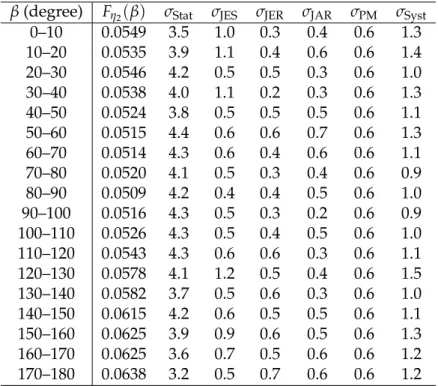
Table 4: The unfolded β distributions and their uncertainties for the central region|η2| ≤0.8.
All uncertainties are symmetric and given in percent (%).
β(degree) Fη2(β) σStat σJES σJER σJAR σPM σSyst
0–10 0.0549 3.5 1.0 0.3 0.4 0.6 1.3 10–20 0.0535 3.9 1.1 0.4 0.6 0.6 1.4 20–30 0.0546 4.2 0.5 0.5 0.3 0.6 1.0 30–40 0.0538 4.0 1.1 0.2 0.3 0.6 1.3 40–50 0.0524 3.8 0.5 0.5 0.5 0.6 1.1 50–60 0.0515 4.4 0.6 0.6 0.7 0.6 1.3 60–70 0.0514 4.3 0.6 0.4 0.6 0.6 1.1 70–80 0.0520 4.1 0.5 0.3 0.4 0.6 0.9 80–90 0.0509 4.2 0.4 0.4 0.5 0.6 1.0 90–100 0.0516 4.3 0.5 0.3 0.2 0.6 0.9 100–110 0.0526 4.3 0.5 0.4 0.5 0.6 1.0 110–120 0.0543 4.3 0.6 0.6 0.3 0.6 1.1 120–130 0.0578 4.1 1.2 0.5 0.4 0.6 1.5 130–140 0.0582 3.7 0.5 0.6 0.3 0.6 1.0 140–150 0.0615 4.2 0.6 0.5 0.5 0.6 1.1 150–160 0.0625 3.9 0.9 0.6 0.5 0.6 1.3 160–170 0.0625 3.6 0.7 0.5 0.6 0.6 1.2 170–180 0.0638 3.2 0.5 0.7 0.6 0.6 1.2
8 6 Results
Table 5: The unfolded β distributions and their uncertainties for the forward region 0.8 < |η2| ≤2.5. All uncertainties are symmetric and given in percent (%).
β(degree) Fη2(β) σStat σJES σJER σJAR σPM σSyst
0–10 0.0388 3.9 1.6 0.5 0.5 0.7 1.9 10–20 0.0391 4.6 0.6 0.5 0.6 0.7 1.2 20–30 0.0406 4.4 0.7 0.4 0.5 0.7 1.2 30–40 0.0404 4.6 0.5 0.4 0.5 0.7 1.1 40–50 0.0414 4.2 0.6 0.5 0.5 0.7 1.2 50–60 0.0438 3.9 0.7 0.4 0.4 0.7 1.1 60–70 0.0430 4.4 0.8 0.5 0.6 0.7 1.3 70–80 0.0476 4.2 0.5 0.5 0.6 0.7 1.2 80–90 0.0491 4.0 1.2 0.4 0.5 0.7 1.5 90–100 0.0520 3.9 0.8 0.5 0.4 0.7 1.2 100–110 0.0567 3.6 0.8 0.5 0.5 0.7 1.3 110–120 0.0625 3.5 0.7 0.5 0.5 0.7 1.2 120–130 0.0662 3.2 0.8 0.5 0.6 0.7 1.3 130–140 0.0692 3.2 0.7 0.4 0.6 0.7 1.2 140–150 0.0736 3.1 0.6 0.6 0.5 0.7 1.2 150–160 0.0774 2.9 0.7 0.4 0.6 0.7 1.2 160–170 0.0795 2.9 0.8 0.5 0.5 0.7 1.3 170–180 0.0791 2.6 0.8 0.6 0.5 0.7 1.3
6
Results
The unfolded β distributions are shown in Fig. 4 together with the predictions from the various MC models for the central (|η2| ≤ 0.8) and forward (0.8 < |η2| ≤ 2.5) regions. The values of
the unfolded β distributions and their uncertainties are presented in Tables 4 and 5.
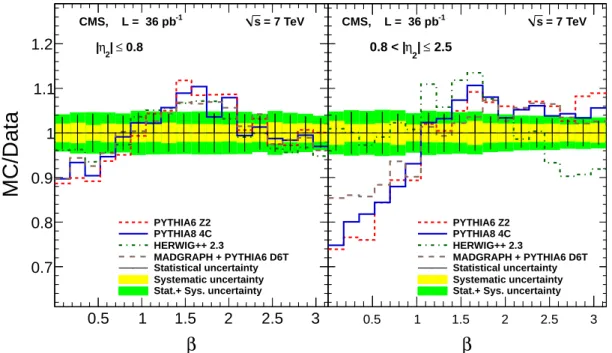
The ratios of the various MC predictions to the measured β distributions are shown in Fig. 5. The data exhibit a clear enhancement of events compared to thePYTHIAand MADGRAPH gen-erators near the event plane (β =0) and a suppression in the transverse plane (β =π/2). The χ2comparisons of data with MC simulation, taking into account the statistical and systematic
correlations between different data points, are shown separately for the central and forward regions in Table 6. The number of degrees of freedom (NDF) is 17, which is the number of bins minus one to account for the constraint imposed by the normalization.
None of the models used in the analysis describes the data satisfactorily. Even though PYTHIA 6 was adjusted with the Tevatron data, it fails to describe the LHC data since the χ2/NDF is large. No significant difference is observed between the tunes D6T and Z2. The PYTHIA 8 tune 4C generator describes the data than PYTHIA 6 over the entire phase space, but the dis-agreement in the forward region is not negligible. TheHERWIG++ event generator agrees well with the data in the central region, but the agreement is poorer in the forward region. Finally, when MADGRAPHis used with the exact 2 → 3 matrix element calculations at LO, the global description of the data is improved with respect toPYTHIA6 alone.
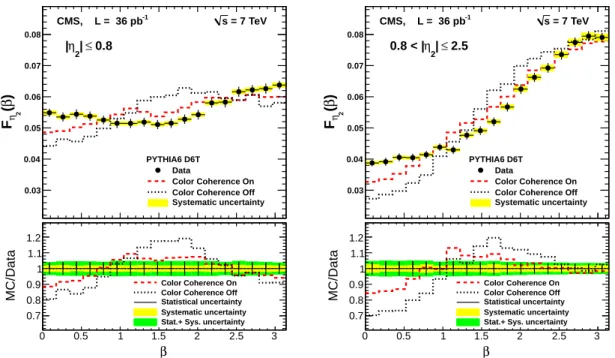
The impact of the color coherence effects is studied by switching them on and off for the first emission in the initial- and final-state showers inPYTHIA6. One can observe in Fig. 6 that the agreement between the data and the simulation deteriorates when the color coherence effects in the MC events are suppressed. More quantitatively, the χ2 divided by the number of
de-β
0.5 1 1.5 2 2.5 3)
β
(
η 2F
0.03 0.04 0.05 0.06 0.07 0.08 Data PYTHIA6 Z2 PYTHIA8 4C HERWIG++ 2.3 MADGRAPH + PYTHIA6 D6T Systematic uncertainty 0.8 ≤ | 2 η | = 7 TeV s -1 CMS, L = 36 pbβ
0.5 1 1.5 2 2.5 3 0.03 0.04 0.05 0.06 0.07 0.08 Data PYTHIA6 Z2 PYTHIA8 4C HERWIG++ 2.3 MADGRAPH + PYTHIA6 D6T Systematic uncertainty 2.5 ≤ | 2 η 0.8 < | = 7 TeV s -1 CMS, L = 36 pbFigure 4: Observed β distributions for the data, corrected for detector effects, and for the MC generators (PYTHIA6,PYTHIA8,HERWIG++, and MADGRAPH+PYTHIA6) in the central (|η2| ≤
0.8) and forward (0.8 < |η2| ≤ 2.5) regions. The error bars show the statistical uncertainties,
while the yellow shaded bands correspond to the combined systematic uncertainty.
β
0.5 1 1.5 2 2.5 3MC/Data
0.7 0.8 0.9 1 1.1 1.2 PYTHIA6 Z2 PYTHIA8 4C HERWIG++ 2.3 MADGRAPH + PYTHIA6 D6T Statistical uncertainty Systematic uncertainty Stat.+ Sys. uncertainty0.8 ≤ | 2 η | = 7 TeV s -1 CMS, L = 36 pb
β
0.5 1 1.5 2 2.5 3 0.7 0.8 0.9 1 1.1 1.2 PYTHIA6 Z2 PYTHIA8 4C HERWIG++ 2.3 MADGRAPH + PYTHIA6 D6T Statistical uncertainty Systematic uncertainty Stat.+ Sys. uncertainty= 7 TeV s -1 CMS, L = 36 pb 2.5 ≤ | 2 η 0.8 < |
Figure 5: The ratio of the various MC predictions to the measured β distribution. The error bars show the statistical uncertainty of the data. The yellow band represents the systematic uncertainty, while the green band represents the total uncertainty.
10 7 Summary β 0 0.5 1 1.5 2 2.5 3 ) β (η 2 F 0.03 0.04 0.05 0.06 0.07 0.08 0.8 ≤ | 2 η | = 7 TeV s -1 CMS, L = 36 pb PYTHIA6 D6T Data Color Coherence On Color Coherence Off Systematic uncertainty β 0 0.5 1 1.5 2 2.5 3 MC/Data 0.7 0.8 0.9 1 1.1 1.2 Color Coherence On Color Coherence Off Statistical uncertainty Systematic uncertainty Stat.+ Sys. uncertainty
β 0 0.5 1 1.5 2 2.5 3 ) β (η2 F 0.03 0.04 0.05 0.06 0.07 0.08 2.5 ≤ | 2 η 0.8 < | = 7 TeV s -1 CMS, L = 36 pb PYTHIA6 D6T Data Color Coherence On Color Coherence Off Systematic uncertainty β 0 0.5 1 1.5 2 2.5 3 MC/Data 0.7 0.8 0.9 1 1.1 1.2 Color Coherence On Color Coherence Off Statistical uncertainty Systematic uncertainty Stat.+ Sys. uncertainty
Figure 6: The MC predictions for the β distribution from PYTHIA 6, with and without color coherence effects in the first branching of the initial- and final-state showers, compared to the measurement. The error bars show the uncorrelated statistical uncertainty of the data. The yellow band represents the systematic uncertainty, while the green band represents the total uncertainty.
Table 6: Values of χ2for comparisons of the β distribution for the data with the predictions of various MC generators. The number of degrees of freedom for both regions is 17.
χ2/NDF MC event generator |η2| ≤0.8 0.8< |η2| ≤2.5 PYTHIA6 Z2 2.5 8.1 PYTHIA8 4C 1.7 6.4 HERWIG++ 2.3 1.2 3.5 MADGRAPH(+PYTHIA6 D6T) 1.6 3.3
grees of freedom increases up to 7.7 in the central region and 11.5 in the forward region. The first emission in the initial- and final-state showers contributes roughly the same order. Using PYTHIA, it has been verified that the impact of the non-perturbative component of the QCD cal-culation (hadronization and underlying event) is negligible for this analysis. One conclusion from thisPYTHIAstudy, as shown Fig. 6, is that the data clearly support larger color coherence effects than in present MC implementations.
7
Summary
Color coherence effects in multijet events have been studied in a sample of pp collisions cor-responding to an integrated luminosity of 36 pb−1, collected with the CMS detector at √s =
7 TeV. Distributions of the variable β, which was previously used in similar analyses at the Tevatron, are used to measure the angular correlation between the second and third jets in
transverse-momentum order, in the pseudorapidity and azimuthal angle space. The measure-ments, unfolded for detector effects, are compared to the predictions of the MC event genera-torsPYTHIA6, PYTHIA8, HERWIG++, and MADGRAPH+PYTHIA 6 in the central and forward rapidity regions. We have shown that the variable β is sensitive to color coherence effects, and insensitive to the hadronization and underlying event. It is necessary to implement the color coherence effects in MC simulations to better describe the data. Although the MC mod-els in the analysis include this effect by default, none of them describes the data satisfactorily for all β values. ThePYTHIA6 expectations predict weaker color coherence effects than those observed, whilePYTHIA8 exhibits a better agreement with the data. The MADGRAPHMC gen-erator, which uses the exact 2 →3 matrix element calculations at LO matched toPYTHIA6 for parton showering, improves the agreement with data with respect to PYTHIA 6 alone, while HERWIG++ describes the data well in the central region but shows some discrepancies in the forward region.
Acknowledgements
We congratulate our colleagues in the CERN accelerator departments for the excellent perfor-mance of the LHC and thank the technical and administrative staffs at CERN and at other CMS institutes for their contributions to the success of the CMS effort. In addition, we gratefully ac-knowledge the computing centers and personnel of the Worldwide LHC Computing Grid for delivering so effectively the computing infrastructure essential to our analyses. Finally, we ac-knowledge the enduring support for the construction and operation of the LHC and the CMS detector provided by the following funding agencies: BMWF and FWF (Austria); FNRS and FWO (Belgium); CNPq, CAPES, FAPERJ, and FAPESP (Brazil); MES (Bulgaria); CERN; CAS, MoST, and NSFC (China); COLCIENCIAS (Colombia); MSES (Croatia); RPF (Cyprus); MoER, SF0690030s09 and ERDF (Estonia); Academy of Finland, MEC, and HIP (Finland); CEA and CNRS/IN2P3 (France); BMBF, DFG, and HGF (Germany); GSRT (Greece); OTKA and NIH (Hungary); DAE and DST (India); IPM (Iran); SFI (Ireland); INFN (Italy); NRF and WCU (Republic of Korea); LAS (Lithuania); CINVESTAV, CONACYT, SEP, and UASLP-FAI (Mex-ico); MBIE (New Zealand); PAEC (Pakistan); MSHE and NSC (Poland); FCT (Portugal); JINR (Dubna); MON, RosAtom, RAS and RFBR (Russia); MESTD (Serbia); SEIDI and CPAN (Spain); Swiss Funding Agencies (Switzerland); NSC (Taipei); ThEPCenter, IPST, STAR and NSTDA (Thailand); TUBITAK and TAEK (Turkey); NASU (Ukraine); STFC (United Kingdom); DOE and NSF (USA).
References
[1] JADE Collaboration, “Test of fragmentation models by comparison with three-jet events produced in e+e− →hadrons”, Phys. Lett. B 134 (1984) 275,
doi:10.1016/0370-2693(84)90687-7.
[2] TPC/2γ Collaboration, “Comparison of the Particle Flow in q ¯qg and q ¯qγ Events in e+e−
Annihilation”, Phys. Rev. Lett. 57 (1986) 945, doi:10.1103/PhysRevLett.57.945. [3] TASSO Collaboration, “A study of 3-jet events in e+e−annihilation into hadrons at 34.6
GeV c.m. energy”, Zeit. Phys. C 29 (1985) 29, doi:10.1007/BF01571375. [4] MARK2 Collaboration, “Comparison of the particle flow in Three-Jet and radiative
Two-Jet Events from e+e−Annihilation at Ec.m. =29 GeV”, Phys. Rev. Lett. 57 (1986)
12 References
[5] OPAL Collaboration, “A study of coherence of soft gluons in hadron jets”, Phys. Lett. B 247(1990) 617, doi:10.1016/0370-2693(90)91911-T.
[6] L3 Collaboration, “Evidence for gluon interference in hadronic Z decays”, Phys. Lett. B 353(1995) 145, doi:10.1016/0370-2693(95)00552-V.
[7] CDF Collaboration, “Evidence for color coherence in p ¯p collisions at√s =1.8 TeV”, Phys. Rev. D 50 (1994) 5562, doi:10.1103/PhysRevD.50.5562.
[8] D0 Collaboration, “Color coherent radiation in multijet events from p ¯p collisions at√ s =1.8 TeV”, Phys. Lett. B 414 (1997) 419,
doi:10.1016/S0370-2693(97)01190-8.
[9] G. Marchesini and B. Webber, “Monte Carlo simulation of general hard processes with coherent QCD radiation”, Nucl. Phys. B 310 (1998) 461,
doi:10.1016/0550-3213(88)90089-2.
[10] CMS Collaboration, “The CMS experiment at the CERN LHC”, JINST 3 (2008) S08004, doi:10.1088/1748-0221/3/08/S08004.
[11] M. Cacciari, G. P. Salam, and G. Soyez, “The anti-ktjet clustering algorithm”, JHEP 04
(2008) 063, doi:10.1088/1126-6708/2008/04/063.
[12] M. Cacciari, G. P. Salam, and G. Soyez, “FastJet User Manual”, Eur. Phys. J. C 72 (2012) 1896, doi:10.1140/epjc/s10052-012-1896-2, arXiv:1111.6097.
[13] CMS Collaboration, “Particle–Flow Event Reconstruction in CMS and Performance for Jets, Taus, and EmissT ”, CMS Physics Analysis Summary CMS-PAS-PFT-09-001, (2009). [14] CMS Collaboration, “Determination of the Jet Energy Scale in CMS with pp Collisions at√
s =7 TeV”, CMS Physics Analysis Summary CMS-PAS-JME-10-010, (2010). [15] CMS Collaboration, “Jet Energy Resolution in CMS at√s=7 TeV”, CMS Physics
Analysis Summary CMS-PAS-JME-10-014, (2010).
[16] M. Cacciari and G. P. Salam, “Pileup subtraction using jet areas”, Phys. Lett. B 659 (2008) 119, doi:10.1016/j.physletb.2007.09.077.
[17] CMS Collaboration, “Tracking and Primary Vertex Results in First 7 TeV Collisions”, CMS Physics Analysis Summary CMS-PAS-TRK-10-005, (2010).
[18] CMS Collaboration, “Calorimeter Jet Quality Criteria for the First CMS Collision Data”, CMS Physics Analysis Summary CMS-PAS-JME-09-008, (2010).
[19] T. Sj ¨ostrand, S. Mrenna, and P. Skands, “PYTHIA 6.4 physics and manual”, JHEP 05 (2006) 026, doi:10.1088/1126-6708/2006/05/026.
[20] I. Knowles, “Spin correlations in parton-parton scattering”, Nucl. Phys. B 310 (1998) 571, doi:10.1016/0550-3213(88)90092-2.
[21] I. Knowles, “A linear algorithm for calculating spin correlations in hadronic collisions”, Comput. Phys. Commun. 58 (1990) 271, doi:10.1016/0010-4655(90)90063-7. [22] R. Field, “Early LHC underlying event data-findings and surprises”, (2010).
[23] J. Pumplin et al., “New generation of parton distributions with uncertainties from global QCD analysis”, JHEP 07 (2002) 012, doi:10.1088/1126-6708/2002/07/012. [24] B. Anderson, G. Gustafson, G. Ingelman, and T. Sj ¨ostrand, “Parton fragmentation and
string dynamics”, Phys. Rep. 97 (1983) 31, doi:10.1016/0370-1573(83)90080-7. [25] T. Sj ¨ostrand, “The merging of jets”, Phys. Lett. B 142 (1984) 420,
doi:10.1016/0370-2693(84)91354-6.
[26] R. Field, “Physics at the Tevatron”, Acta Phys. Polon. B 39 (2008) 2611.
[27] R. Field, “Studying the underlying event at CDF and the LHC”, in Proceedings of the First International Workshop on Multiple Partonic Interactions at the LHC MPI’08, P. Bartalini and L. Fan ´o, eds., p. 12. Perugia, Italy, October, 2009. arXiv:1003.4220.
[28] T. Sj ¨ostrand, S. Mrenna, and P. Skands, “A brief introduction to PYTHIA 8.1”, Comput. Phys. Commun 178 (2008) 852, doi:10.1016/j.cpc.2008.01.036.
[29] R. S. Corke, “Interleaved parton showers and tuning prospects”, JHEP 03 (2011) 032, doi:10.1007/JHEP03(2011)032.
[30] M. B¨ahr et al., “HERWIG++ Physics and Manual”, Eur. Phys. J. C 58 (2008) 639, doi:10.1140/epjc/s10052-008-0798-9.
[31] M. B¨ahr, S. Gieseke, and M. H. Seymour, “Simulation of multiple partonic interactions in Herwig++”, JHEP 07 (2006) 076, doi:10.1088/1126-6708/2008/07/076.
[32] S. Gieseke, P. Stephens, and B. Webber, “New formalism for QCD parton showers”, JHEP 12(2003) 045, doi:10.1088/1126-6708/2003/12/045.
[33] J. Alwall et al., “MadGraph/MadEvent v4: the new web generation”, JHEP 09 (2007) 028, doi:10.1088/1126-6708/2007/09/028.
[34] S. S. Agostinelli et al., “GEANT4—a simulation toolkit”, Nucl. Instr. Meth. A 506 (2003) 250, doi:10.1016/S0168-9002(03)01368-8.
[35] G. D’Agostini, “A multidimensional unfolding method based on Bayes’ theorem”, Nucl. Instrum. Meth. A 362 (1995) 487, doi:10.1016/0168-9002(95)00274-X.
[36] T. Adye, “Unfolding algorithms and tests using RooUnfold”, (2011). arXiv:1105.1160.
[37] CMS Collaboration, “Determination of jet energy calibration and transverse momentum resolution in CMS”, JINST 6 (2011) P11002,
doi:10.1088/1748-0221/6/11/P11002.
[38] CMS Collaboration, “Jet Performance in pp Collisions at√s=7 TeV”, CMS Physics Analysis Summary CMS-PAS-JME-10-003, (2010).
A
The CMS Collaboration
Yerevan Physics Institute, Yerevan, Armenia
S. Chatrchyan, V. Khachatryan, A.M. Sirunyan, A. Tumasyan Institut f ¨ur Hochenergiephysik der OeAW, Wien, Austria
W. Adam, T. Bergauer, M. Dragicevic, J. Er ¨o, C. Fabjan1, M. Friedl, R. Fr ¨uhwirth1, V.M. Ghete, N. H ¨ormann, J. Hrubec, M. Jeitler1, W. Kiesenhofer, V. Kn ¨unz, M. Krammer1, I. Kr¨atschmer, D. Liko, I. Mikulec, D. Rabady2, B. Rahbaran, C. Rohringer, H. Rohringer, R. Sch ¨ofbeck,
J. Strauss, A. Taurok, W. Treberer-Treberspurg, W. Waltenberger, C.-E. Wulz1 National Centre for Particle and High Energy Physics, Minsk, Belarus V. Mossolov, N. Shumeiko, J. Suarez Gonzalez
Universiteit Antwerpen, Antwerpen, Belgium
S. Alderweireldt, M. Bansal, S. Bansal, T. Cornelis, E.A. De Wolf, X. Janssen, A. Knutsson, S. Luyckx, L. Mucibello, S. Ochesanu, B. Roland, R. Rougny, Z. Staykova, H. Van Haevermaet, P. Van Mechelen, N. Van Remortel, A. Van Spilbeeck
Vrije Universiteit Brussel, Brussel, Belgium
F. Blekman, S. Blyweert, J. D’Hondt, A. Kalogeropoulos, J. Keaveney, S. Lowette, M. Maes, A. Olbrechts, S. Tavernier, W. Van Doninck, P. Van Mulders, G.P. Van Onsem, I. Villella
Universit´e Libre de Bruxelles, Bruxelles, Belgium
C. Caillol, B. Clerbaux, G. De Lentdecker, L. Favart, A.P.R. Gay, T. Hreus, A. L´eonard, P.E. Marage, A. Mohammadi, L. Perni`e, T. Reis, T. Seva, L. Thomas, C. Vander Velde, P. Vanlaer, J. Wang
Ghent University, Ghent, Belgium
V. Adler, K. Beernaert, L. Benucci, A. Cimmino, S. Costantini, S. Dildick, G. Garcia, B. Klein, J. Lellouch, A. Marinov, J. Mccartin, A.A. Ocampo Rios, D. Ryckbosch, M. Sigamani, N. Strobbe, F. Thyssen, M. Tytgat, S. Walsh, E. Yazgan, N. Zaganidis
Universit´e Catholique de Louvain, Louvain-la-Neuve, Belgium
S. Basegmez, C. Beluffi3, G. Bruno, R. Castello, A. Caudron, L. Ceard, G.G. Da Silveira, C. Delaere, T. du Pree, D. Favart, L. Forthomme, A. Giammanco4, J. Hollar, P. Jez, V. Lemaitre, J. Liao, O. Militaru, C. Nuttens, D. Pagano, A. Pin, K. Piotrzkowski, A. Popov5, M. Selvaggi, M. Vidal Marono, J.M. Vizan Garcia
Universit´e de Mons, Mons, Belgium
N. Beliy, T. Caebergs, E. Daubie, G.H. Hammad
Centro Brasileiro de Pesquisas Fisicas, Rio de Janeiro, Brazil
G.A. Alves, M. Correa Martins Junior, T. Martins, M.E. Pol, M.H.G. Souza Universidade do Estado do Rio de Janeiro, Rio de Janeiro, Brazil
W.L. Ald´a J ´unior, W. Carvalho, J. Chinellato6, A. Cust ´odio, E.M. Da Costa, D. De Jesus Damiao,
C. De Oliveira Martins, S. Fonseca De Souza, H. Malbouisson, M. Malek, D. Matos Figueiredo, L. Mundim, H. Nogima, W.L. Prado Da Silva, A. Santoro, A. Sznajder, E.J. Tonelli Manganote6, A. Vilela Pereira
Universidade Estadual Paulistaa, Universidade Federal do ABCb, S˜ao Paulo, Brazil
C.A. Bernardesb, F.A. Diasa,7, T.R. Fernandez Perez Tomeia, E.M. Gregoresb, C. Laganaa, P.G. Mercadanteb, S.F. Novaesa, Sandra S. Padulaa
16 A The CMS Collaboration
Institute for Nuclear Research and Nuclear Energy, Sofia, Bulgaria V. Genchev2, P. Iaydjiev2, S. Piperov, M. Rodozov, G. Sultanov, M. Vutova University of Sofia, Sofia, Bulgaria
A. Dimitrov, R. Hadjiiska, V. Kozhuharov, L. Litov, B. Pavlov, P. Petkov Institute of High Energy Physics, Beijing, China
J.G. Bian, G.M. Chen, H.S. Chen, C.H. Jiang, D. Liang, S. Liang, X. Meng, J. Tao, X. Wang, Z. Wang
State Key Laboratory of Nuclear Physics and Technology, Peking University, Beijing, China C. Asawatangtrakuldee, Y. Ban, Y. Guo, Q. Li, W. Li, S. Liu, Y. Mao, S.J. Qian, D. Wang, L. Zhang, W. Zou
Universidad de Los Andes, Bogota, Colombia
C. Avila, C.A. Carrillo Montoya, L.F. Chaparro Sierra, J.P. Gomez, B. Gomez Moreno, J.C. Sanabria
Technical University of Split, Split, Croatia
N. Godinovic, D. Lelas, R. Plestina8, D. Polic, I. Puljak University of Split, Split, Croatia
Z. Antunovic, M. Kovac
Institute Rudjer Boskovic, Zagreb, Croatia
V. Brigljevic, K. Kadija, J. Luetic, D. Mekterovic, S. Morovic, L. Tikvica University of Cyprus, Nicosia, Cyprus
A. Attikis, G. Mavromanolakis, J. Mousa, C. Nicolaou, F. Ptochos, P.A. Razis Charles University, Prague, Czech Republic
M. Finger, M. Finger Jr.
Academy of Scientific Research and Technology of the Arab Republic of Egypt, Egyptian Network of High Energy Physics, Cairo, Egypt
A.A. Abdelalim9, Y. Assran10, S. Elgammal9, A. Ellithi Kamel11, M.A. Mahmoud12, A. Radi13,14 National Institute of Chemical Physics and Biophysics, Tallinn, Estonia
M. Kadastik, M. M ¨untel, M. Murumaa, M. Raidal, L. Rebane, A. Tiko Department of Physics, University of Helsinki, Helsinki, Finland P. Eerola, G. Fedi, M. Voutilainen
Helsinki Institute of Physics, Helsinki, Finland
J. H¨ark ¨onen, V. Karim¨aki, R. Kinnunen, M.J. Kortelainen, T. Lamp´en, K. Lassila-Perini, S. Lehti, T. Lind´en, P. Luukka, T. M¨aenp¨a¨a, T. Peltola, E. Tuominen, J. Tuominiemi, E. Tuovinen, L. Wendland
Lappeenranta University of Technology, Lappeenranta, Finland T. Tuuva
DSM/IRFU, CEA/Saclay, Gif-sur-Yvette, France
M. Besancon, F. Couderc, M. Dejardin, D. Denegri, B. Fabbro, J.L. Faure, F. Ferri, S. Ganjour, A. Givernaud, P. Gras, G. Hamel de Monchenault, P. Jarry, E. Locci, J. Malcles, L. Millischer, A. Nayak, J. Rander, A. Rosowsky, M. Titov
Laboratoire Leprince-Ringuet, Ecole Polytechnique, IN2P3-CNRS, Palaiseau, France
S. Baffioni, F. Beaudette, L. Benhabib, M. Bluj15, P. Busson, C. Charlot, N. Daci, T. Dahms, M. Dalchenko, L. Dobrzynski, A. Florent, R. Granier de Cassagnac, M. Haguenauer, P. Min´e, C. Mironov, I.N. Naranjo, M. Nguyen, C. Ochando, P. Paganini, D. Sabes, R. Salerno, Y. Sirois, C. Veelken, A. Zabi
Institut Pluridisciplinaire Hubert Curien, Universit´e de Strasbourg, Universit´e de Haute Alsace Mulhouse, CNRS/IN2P3, Strasbourg, France
J.-L. Agram16, J. Andrea, D. Bloch, J.-M. Brom, E.C. Chabert, C. Collard, E. Conte16, F. Drouhin16, J.-C. Fontaine16, D. Gel´e, U. Goerlach, C. Goetzmann, P. Juillot, A.-C. Le Bihan, P. Van Hove
Centre de Calcul de l’Institut National de Physique Nucleaire et de Physique des Particules, CNRS/IN2P3, Villeurbanne, France
S. Gadrat
Universit´e de Lyon, Universit´e Claude Bernard Lyon 1, CNRS-IN2P3, Institut de Physique Nucl´eaire de Lyon, Villeurbanne, France
S. Beauceron, N. Beaupere, G. Boudoul, S. Brochet, J. Chasserat, R. Chierici, D. Contardo, P. Depasse, H. El Mamouni, J. Fan, J. Fay, S. Gascon, M. Gouzevitch, B. Ille, T. Kurca, M. Lethuillier, L. Mirabito, S. Perries, L. Sgandurra, V. Sordini, M. Vander Donckt, P. Verdier, S. Viret, H. Xiao
Institute of High Energy Physics and Informatization, Tbilisi State University, Tbilisi, Georgia
Z. Tsamalaidze17
RWTH Aachen University, I. Physikalisches Institut, Aachen, Germany
C. Autermann, S. Beranek, M. Bontenackels, B. Calpas, M. Edelhoff, L. Feld, N. Heracleous, O. Hindrichs, K. Klein, A. Ostapchuk, A. Perieanu, F. Raupach, J. Sammet, S. Schael, D. Sprenger, H. Weber, B. Wittmer, V. Zhukov5
RWTH Aachen University, III. Physikalisches Institut A, Aachen, Germany
M. Ata, J. Caudron, E. Dietz-Laursonn, D. Duchardt, M. Erdmann, R. Fischer, A. G ¨uth, T. Hebbeker, C. Heidemann, K. Hoepfner, D. Klingebiel, S. Knutzen, P. Kreuzer, M. Merschmeyer, A. Meyer, M. Olschewski, K. Padeken, P. Papacz, H. Pieta, H. Reithler, S.A. Schmitz, L. Sonnenschein, J. Steggemann, D. Teyssier, S. Th ¨uer, M. Weber
RWTH Aachen University, III. Physikalisches Institut B, Aachen, Germany
V. Cherepanov, Y. Erdogan, G. Fl ¨ugge, H. Geenen, M. Geisler, W. Haj Ahmad, F. Hoehle, B. Kargoll, T. Kress, Y. Kuessel, J. Lingemann2, A. Nowack, I.M. Nugent, L. Perchalla, O. Pooth, A. Stahl
Deutsches Elektronen-Synchrotron, Hamburg, Germany
I. Asin, N. Bartosik, J. Behr, W. Behrenhoff, U. Behrens, A.J. Bell, M. Bergholz18, A. Bethani, K. Borras, A. Burgmeier, A. Cakir, L. Calligaris, A. Campbell, S. Choudhury, F. Costanza, C. Diez Pardos, S. Dooling, T. Dorland, G. Eckerlin, D. Eckstein, G. Flucke, A. Geiser, I. Glushkov, A. Grebenyuk, P. Gunnellini, S. Habib, J. Hauk, G. Hellwig, D. Horton, H. Jung, M. Kasemann, P. Katsas, C. Kleinwort, H. Kluge, M. Kr¨amer, D. Kr ¨ucker, E. Kuznetsova, W. Lange, J. Leonard, K. Lipka, W. Lohmann18, B. Lutz, R. Mankel, I. Marfin, I.-A. Melzer-Pellmann, A.B. Meyer, J. Mnich, A. Mussgiller, S. Naumann-Emme, O. Novgorodova, F. Nowak, J. Olzem, H. Perrey, A. Petrukhin, D. Pitzl, R. Placakyte, A. Raspereza, P.M. Ribeiro
18 A The CMS Collaboration
Cipriano, C. Riedl, E. Ron, M. ¨O. Sahin, J. Salfeld-Nebgen, R. Schmidt18, T. Schoerner-Sadenius, N. Sen, M. Stein, R. Walsh, C. Wissing
University of Hamburg, Hamburg, Germany
M. Aldaya Martin, V. Blobel, H. Enderle, J. Erfle, E. Garutti, U. Gebbert, M. G ¨orner, M. Gosselink, J. Haller, K. Heine, R.S. H ¨oing, G. Kaussen, H. Kirschenmann, R. Klanner, R. Kogler, J. Lange, I. Marchesini, T. Peiffer, N. Pietsch, D. Rathjens, C. Sander, H. Schettler, P. Schleper, E. Schlieckau, A. Schmidt, M. Schr ¨oder, T. Schum, M. Seidel, J. Sibille19, V. Sola, H. Stadie, G. Steinbr ¨uck, J. Thomsen, D. Troendle, E. Usai, L. Vanelderen
Institut f ¨ur Experimentelle Kernphysik, Karlsruhe, Germany
C. Barth, C. Baus, J. Berger, C. B ¨oser, E. Butz, T. Chwalek, W. De Boer, A. Descroix, A. Dierlamm, M. Feindt, M. Guthoff2, F. Hartmann2, T. Hauth2, H. Held, K.H. Hoffmann, U. Husemann, I. Katkov5, J.R. Komaragiri, A. Kornmayer2, P. Lobelle Pardo, D. Martschei, M.U. Mozer, Th. M ¨uller, M. Niegel, A. N ¨urnberg, O. Oberst, J. Ott, G. Quast, K. Rabbertz, F. Ratnikov, S. R ¨ocker, F.-P. Schilling, G. Schott, H.J. Simonis, F.M. Stober, R. Ulrich, J. Wagner-Kuhr, S. Wayand, T. Weiler, M. Zeise
Institute of Nuclear and Particle Physics (INPP), NCSR Demokritos, Aghia Paraskevi, Greece
G. Anagnostou, G. Daskalakis, T. Geralis, S. Kesisoglou, A. Kyriakis, D. Loukas, A. Markou, C. Markou, E. Ntomari, I. Topsis-giotis
University of Athens, Athens, Greece
L. Gouskos, A. Panagiotou, N. Saoulidou, E. Stiliaris University of Io´annina, Io´annina, Greece
X. Aslanoglou, I. Evangelou, G. Flouris, C. Foudas, P. Kokkas, N. Manthos, I. Papadopoulos, E. Paradas
Wigner Research Centre for Physics, Budapest, Hungary
G. Bencze, C. Hajdu, P. Hidas, D. Horvath20, F. Sikler, V. Veszpremi, G. Vesztergombi21, A.J. Zsigmond
Institute of Nuclear Research ATOMKI, Debrecen, Hungary N. Beni, S. Czellar, J. Molnar, J. Palinkas, Z. Szillasi
University of Debrecen, Debrecen, Hungary J. Karancsi, P. Raics, Z.L. Trocsanyi, B. Ujvari
National Institute of Science Education and Research, Bhubaneswar, India S.K. Swain22
Panjab University, Chandigarh, India
S.B. Beri, V. Bhatnagar, N. Dhingra, R. Gupta, M. Kaur, M.Z. Mehta, M. Mittal, N. Nishu, A. Sharma, J.B. Singh
University of Delhi, Delhi, India
Ashok Kumar, Arun Kumar, S. Ahuja, A. Bhardwaj, B.C. Choudhary, A. Kumar, S. Malhotra, M. Naimuddin, K. Ranjan, P. Saxena, V. Sharma, R.K. Shivpuri
Saha Institute of Nuclear Physics, Kolkata, India
S. Banerjee, S. Bhattacharya, K. Chatterjee, S. Dutta, B. Gomber, Sa. Jain, Sh. Jain, R. Khurana, A. Modak, S. Mukherjee, D. Roy, S. Sarkar, M. Sharan, A.P. Singh
Bhabha Atomic Research Centre, Mumbai, India
A. Abdulsalam, D. Dutta, S. Kailas, V. Kumar, A.K. Mohanty2, L.M. Pant, P. Shukla, A. Topkar Tata Institute of Fundamental Research - EHEP, Mumbai, India
T. Aziz, R.M. Chatterjee, S. Ganguly, S. Ghosh, M. Guchait23, A. Gurtu24, G. Kole, S. Kumar, M. Maity25, G. Majumder, K. Mazumdar, G.B. Mohanty, B. Parida, K. Sudhakar, N. Wickramage26
Tata Institute of Fundamental Research - HECR, Mumbai, India S. Banerjee, S. Dugad
Institute for Research in Fundamental Sciences (IPM), Tehran, Iran
H. Arfaei, H. Bakhshiansohi, S.M. Etesami27, A. Fahim28, A. Jafari, M. Khakzad, M. Mohammadi Najafabadi, S. Paktinat Mehdiabadi, B. Safarzadeh29, M. Zeinali
University College Dublin, Dublin, Ireland M. Grunewald
INFN Sezione di Baria, Universit`a di Barib, Politecnico di Baric, Bari, Italy
M. Abbresciaa,b, L. Barbonea,b, C. Calabriaa,b, S.S. Chhibraa,b, A. Colaleoa, D. Creanzaa,c, N. De Filippisa,c, M. De Palmaa,b, L. Fiorea, G. Iasellia,c, G. Maggia,c, M. Maggia, B. Marangellia,b, S. Mya,c, S. Nuzzoa,b, N. Pacificoa, A. Pompilia,b, G. Pugliesea,c, G. Selvaggia,b, L. Silvestrisa, G. Singha,b, R. Vendittia,b, P. Verwilligena, G. Zitoa
INFN Sezione di Bolognaa, Universit`a di Bolognab, Bologna, Italy
G. Abbiendia, A.C. Benvenutia, D. Bonacorsia,b, S. Braibant-Giacomellia,b, L. Brigliadoria,b, R. Campaninia,b, P. Capiluppia,b, A. Castroa,b, F.R. Cavalloa, G. Codispotia,b, M. Cuffiania,b,
G.M. Dallavallea, F. Fabbria, A. Fanfania,b, D. Fasanellaa,b, P. Giacomellia, C. Grandia, L. Guiduccia,b, S. Marcellinia, G. Masettia, M. Meneghellia,b, A. Montanaria, F.L. Navarriaa,b, F. Odoricia, A. Perrottaa, F. Primaveraa,b, A.M. Rossia,b, T. Rovellia,b, G.P. Sirolia,b, N. Tosia,b, R. Travaglinia,b
INFN Sezione di Cataniaa, Universit`a di Cataniab, Catania, Italy
S. Albergoa,b, G. Cappelloa,b, M. Chiorbolia,b, S. Costaa,b, F. Giordanoa,2, R. Potenzaa,b, A. Tricomia,b, C. Tuvea,b
INFN Sezione di Firenzea, Universit`a di Firenzeb, Firenze, Italy
G. Barbaglia, V. Ciullia,b, C. Civininia, R. D’Alessandroa,b, E. Focardia,b, S. Frosalia,b, E. Galloa, S. Gonzia,b, V. Goria,b, P. Lenzia,b, M. Meschinia, S. Paolettia, G. Sguazzonia, A. Tropianoa,b INFN Laboratori Nazionali di Frascati, Frascati, Italy
L. Benussi, S. Bianco, F. Fabbri, D. Piccolo
INFN Sezione di Genovaa, Universit`a di Genovab, Genova, Italy
P. Fabbricatorea, R. Ferrettia,b, F. Ferroa, M. Lo Veterea,b, R. Musenicha, E. Robuttia, S. Tosia,b
INFN Sezione di Milano-Bicoccaa, Universit`a di Milano-Bicoccab, Milano, Italy
A. Benagliaa, M.E. Dinardoa,b, S. Fiorendia,b, S. Gennaia, A. Ghezzia,b, P. Govonia,b, M.T. Lucchinia,b,2, S. Malvezzia, R.A. Manzonia,b,2, A. Martellia,b,2, D. Menascea, L. Moronia, M. Paganonia,b, D. Pedrinia, S. Ragazzia,b, N. Redaellia, T. Tabarelli de Fatisa,b
INFN Sezione di Napoli a, Universit`a di Napoli ’Federico II’ b, Universit`a della
Basilicata (Potenza)c, Universit`a G. Marconi (Roma)d, Napoli, Italy
S. Buontempoa, N. Cavalloa,c, A. De Cosaa,b, F. Fabozzia,c, A.O.M. Iorioa,b, L. Listaa, S. Meolaa,d,2, M. Merolaa, P. Paoluccia,2
20 A The CMS Collaboration
INFN Sezione di Padovaa, Universit`a di Padovab, Universit`a di Trento (Trento)c, Padova,
Italy
P. Azzia, N. Bacchettaa, M. Bellatoa, D. Biselloa,b, A. Brancaa,b, R. Carlina,b, P. Checchiaa, T. Dorigoa, U. Dossellia, M. Galantia,b,2, F. Gasparinia,b, U. Gasparinia,b, P. Giubilatoa,b,
A. Gozzelinoa, K. Kanishcheva,c, S. Lacapraraa, I. Lazzizzeraa,c, M. Margonia,b, A.T. Meneguzzoa,b, J. Pazzinia,b, N. Pozzobona,b, P. Ronchesea,b, M. Sgaravattoa, F. Simonettoa,b, E. Torassaa, M. Tosia,b, A. Triossia, P. Zottoa,b, A. Zucchettaa,b, G. Zumerlea,b
INFN Sezione di Paviaa, Universit`a di Paviab, Pavia, Italy
M. Gabusia,b, S.P. Rattia,b, C. Riccardia,b, P. Vituloa,b
INFN Sezione di Perugiaa, Universit`a di Perugiab, Perugia, Italy
M. Biasinia,b, G.M. Bileia, L. Fan `oa,b, P. Laricciaa,b, G. Mantovania,b, M. Menichellia, A. Nappia,b†, F. Romeoa,b, A. Sahaa, A. Santocchiaa,b, A. Spieziaa,b
INFN Sezione di Pisaa, Universit`a di Pisab, Scuola Normale Superiore di Pisac, Pisa, Italy
K. Androsova,30, P. Azzurria, G. Bagliesia, J. Bernardinia, T. Boccalia, G. Broccoloa,c, R. Castaldia, M.A. Cioccia, R.T. D’Agnoloa,c,2, R. Dell’Orsoa, F. Fioria,c, L. Fo`aa,c, A. Giassia, M.T. Grippoa,30, A. Kraana, F. Ligabuea,c, T. Lomtadzea, L. Martinia,30, A. Messineoa,b, C.S. Moona,31, F. Pallaa, A. Rizzia,b, A. Savoy-Navarroa,32, A.T. Serbana, P. Spagnoloa, P. Squillaciotia, R. Tenchinia,
G. Tonellia,b, A. Venturia, P.G. Verdinia, C. Vernieria,c
INFN Sezione di Romaa, Universit`a di Romab, Roma, Italy
L. Baronea,b, F. Cavallaria, D. Del Rea,b, M. Diemoza, M. Grassia,b, E. Longoa,b, F. Margarolia,b, P. Meridiania, F. Michelia,b, S. Nourbakhsha,b, G. Organtinia,b, R. Paramattia, S. Rahatloua,b, C. Rovellia, L. Soffia,b
INFN Sezione di Torino a, Universit`a di Torino b, Universit`a del Piemonte Orientale
(No-vara)c, Torino, Italy
N. Amapanea,b, R. Arcidiaconoa,c, S. Argiroa,b, M. Arneodoa,c, R. Bellana,b, C. Biinoa, N. Cartigliaa, S. Casassoa,b, M. Costaa,b, A. Deganoa,b, N. Demariaa, C. Mariottia, S. Masellia, E. Migliorea,b, V. Monacoa,b, M. Musicha, M.M. Obertinoa,c, N. Pastronea, M. Pelliccionia,2, A. Potenzaa,b, A. Romeroa,b, M. Ruspaa,c, R. Sacchia,b, A. Solanoa,b, A. Staianoa, U. Tamponia
INFN Sezione di Triestea, Universit`a di Triesteb, Trieste, Italy
S. Belfortea, V. Candelisea,b, M. Casarsaa, F. Cossuttia,2, G. Della Riccaa,b, B. Gobboa, C. La Licataa,b, M. Maronea,b, D. Montaninoa,b, A. Penzoa, A. Schizzia,b, A. Zanettia
Kangwon National University, Chunchon, Korea S. Chang, T.Y. Kim, S.K. Nam
Kyungpook National University, Daegu, Korea
D.H. Kim, G.N. Kim, J.E. Kim, D.J. Kong, S. Lee, Y.D. Oh, H. Park, D.C. Son
Chonnam National University, Institute for Universe and Elementary Particles, Kwangju, Korea
J.Y. Kim, Zero J. Kim, S. Song Korea University, Seoul, Korea
S. Choi, D. Gyun, B. Hong, M. Jo, H. Kim, T.J. Kim, K.S. Lee, S.K. Park, Y. Roh University of Seoul, Seoul, Korea
Sungkyunkwan University, Suwon, Korea
Y. Choi, Y.K. Choi, J. Goh, M.S. Kim, E. Kwon, B. Lee, J. Lee, S. Lee, H. Seo, I. Yu Vilnius University, Vilnius, Lithuania
I. Grigelionis, A. Juodagalvis
Centro de Investigacion y de Estudios Avanzados del IPN, Mexico City, Mexico
H. Castilla-Valdez, E. De La Cruz-Burelo, I. Heredia-de La Cruz33, R. Lopez-Fernandez, J. Mart´ınez-Ortega, A. Sanchez-Hernandez, L.M. Villasenor-Cendejas
Universidad Iberoamericana, Mexico City, Mexico S. Carrillo Moreno, F. Vazquez Valencia
Benemerita Universidad Autonoma de Puebla, Puebla, Mexico H.A. Salazar Ibarguen
Universidad Aut ´onoma de San Luis Potos´ı, San Luis Potos´ı, Mexico E. Casimiro Linares, A. Morelos Pineda, M.A. Reyes-Santos
University of Auckland, Auckland, New Zealand D. Krofcheck
University of Canterbury, Christchurch, New Zealand P.H. Butler, R. Doesburg, S. Reucroft, H. Silverwood
National Centre for Physics, Quaid-I-Azam University, Islamabad, Pakistan
M. Ahmad, M.I. Asghar, J. Butt, H.R. Hoorani, S. Khalid, W.A. Khan, T. Khurshid, S. Qazi, M.A. Shah, M. Shoaib
National Centre for Nuclear Research, Swierk, Poland
H. Bialkowska, B. Boimska, T. Frueboes, M. G ´orski, M. Kazana, K. Nawrocki, K. Romanowska-Rybinska, M. Szleper, G. Wrochna, P. Zalewski
Institute of Experimental Physics, Faculty of Physics, University of Warsaw, Warsaw, Poland G. Brona, K. Bunkowski, M. Cwiok, W. Dominik, K. Doroba, A. Kalinowski, M. Konecki, J. Krolikowski, M. Misiura, W. Wolszczak
Laborat ´orio de Instrumenta¸c˜ao e F´ısica Experimental de Part´ıculas, Lisboa, Portugal
N. Almeida, P. Bargassa, C. Beir˜ao Da Cruz E Silva, P. Faccioli, P.G. Ferreira Parracho, M. Gallinaro, F. Nguyen, J. Rodrigues Antunes, J. Seixas2, J. Varela, P. Vischia
Joint Institute for Nuclear Research, Dubna, Russia
S. Afanasiev, P. Bunin, M. Gavrilenko, I. Golutvin, I. Gorbunov, A. Kamenev, V. Karjavin, V. Konoplyanikov, A. Lanev, A. Malakhov, V. Matveev, P. Moisenz, V. Palichik, V. Perelygin, S. Shmatov, N. Skatchkov, V. Smirnov, A. Zarubin
Petersburg Nuclear Physics Institute, Gatchina (St. Petersburg), Russia
S. Evstyukhin, V. Golovtsov, Y. Ivanov, V. Kim, P. Levchenko, V. Murzin, V. Oreshkin, I. Smirnov, V. Sulimov, L. Uvarov, S. Vavilov, A. Vorobyev, An. Vorobyev
Institute for Nuclear Research, Moscow, Russia
Yu. Andreev, A. Dermenev, S. Gninenko, N. Golubev, M. Kirsanov, N. Krasnikov, A. Pashenkov, D. Tlisov, A. Toropin
Institute for Theoretical and Experimental Physics, Moscow, Russia
V. Epshteyn, M. Erofeeva, V. Gavrilov, N. Lychkovskaya, V. Popov, G. Safronov, S. Semenov, A. Spiridonov, V. Stolin, E. Vlasov, A. Zhokin
22 A The CMS Collaboration
P.N. Lebedev Physical Institute, Moscow, Russia
V. Andreev, M. Azarkin, I. Dremin, M. Kirakosyan, A. Leonidov, G. Mesyats, S.V. Rusakov, A. Vinogradov
Skobeltsyn Institute of Nuclear Physics, Lomonosov Moscow State University, Moscow, Russia
A. Belyaev, E. Boos, M. Dubinin7, L. Dudko, A. Ershov, A. Gribushin, V. Klyukhin, O. Kodolova, I. Lokhtin, A. Markina, S. Obraztsov, S. Petrushanko, V. Savrin, A. Snigirev
State Research Center of Russian Federation, Institute for High Energy Physics, Protvino, Russia
I. Azhgirey, I. Bayshev, S. Bitioukov, V. Kachanov, A. Kalinin, D. Konstantinov, V. Krychkine, V. Petrov, R. Ryutin, A. Sobol, L. Tourtchanovitch, S. Troshin, N. Tyurin, A. Uzunian, A. Volkov University of Belgrade, Faculty of Physics and Vinca Institute of Nuclear Sciences, Belgrade, Serbia
P. Adzic34, M. Djordjevic, M. Ekmedzic, D. Krpic34, J. Milosevic
Centro de Investigaciones Energ´eticas Medioambientales y Tecnol ´ogicas (CIEMAT), Madrid, Spain
M. Aguilar-Benitez, J. Alcaraz Maestre, C. Battilana, E. Calvo, M. Cerrada, M. Chamizo Llatas2, N. Colino, B. De La Cruz, A. Delgado Peris, D. Dom´ınguez V´azquez, C. Fernandez Bedoya, J.P. Fern´andez Ramos, A. Ferrando, J. Flix, M.C. Fouz, P. Garcia-Abia, O. Gonzalez Lopez, S. Goy Lopez, J.M. Hernandez, M.I. Josa, G. Merino, E. Navarro De Martino, J. Puerta Pelayo, A. Quintario Olmeda, I. Redondo, L. Romero, J. Santaolalla, M.S. Soares, C. Willmott
Universidad Aut ´onoma de Madrid, Madrid, Spain C. Albajar, J.F. de Troc ´oniz
Universidad de Oviedo, Oviedo, Spain
H. Brun, J. Cuevas, J. Fernandez Menendez, S. Folgueras, I. Gonzalez Caballero, L. Lloret Iglesias, J. Piedra Gomez
Instituto de F´ısica de Cantabria (IFCA), CSIC-Universidad de Cantabria, Santander, Spain J.A. Brochero Cifuentes, I.J. Cabrillo, A. Calderon, S.H. Chuang, J. Duarte Campderros, M. Fernandez, G. Gomez, J. Gonzalez Sanchez, A. Graziano, C. Jorda, A. Lopez Virto, J. Marco, R. Marco, C. Martinez Rivero, F. Matorras, F.J. Munoz Sanchez, T. Rodrigo, A.Y. Rodr´ıguez-Marrero, A. Ruiz-Jimeno, L. Scodellaro, I. Vila, R. Vilar Cortabitarte
CERN, European Organization for Nuclear Research, Geneva, Switzerland
D. Abbaneo, E. Auffray, G. Auzinger, M. Bachtis, P. Baillon, A.H. Ball, D. Barney, J. Bendavid, J.F. Benitez, C. Bernet8, G. Bianchi, P. Bloch, A. Bocci, A. Bonato, O. Bondu, C. Botta, H. Breuker,
T. Camporesi, G. Cerminara, T. Christiansen, J.A. Coarasa Perez, S. Colafranceschi35,
M. D’Alfonso, D. d’Enterria, A. Dabrowski, A. David, F. De Guio, A. De Roeck, S. De Visscher, S. Di Guida, M. Dobson, N. Dupont-Sagorin, A. Elliott-Peisert, J. Eugster, G. Franzoni, W. Funk, G. Georgiou, M. Giffels, D. Gigi, K. Gill, D. Giordano, M. Girone, M. Giunta, F. Glege, R. Gomez-Reino Garrido, S. Gowdy, R. Guida, J. Hammer, M. Hansen, P. Harris, C. Hartl, A. Hinzmann, V. Innocente, P. Janot, E. Karavakis, K. Kousouris, K. Krajczar, P. Lecoq, Y.-J. Lee, C. Lourenc¸o, N. Magini, L. Malgeri, M. Mannelli, L. Masetti, F. Meijers, S. Mersi, E. Meschi, R. Moser, M. Mulders, P. Musella, E. Nesvold, L. Orsini, E. Palencia Cortezon, E. Perez, L. Perrozzi, A. Petrilli, A. Pfeiffer, M. Pierini, M. Pimi¨a, D. Piparo, M. Plagge, L. Quertenmont, A. Racz, W. Reece, G. Rolandi36, M. Rovere, H. Sakulin, F. Santanastasio, C. Sch¨afer, C. Schwick,
S. Sekmen, A. Sharma, P. Siegrist, P. Silva, M. Simon, P. Sphicas37, D. Spiga, B. Stieger, M. Stoye, A. Tsirou, G.I. Veres21, J.R. Vlimant, H.K. W ¨ohri, S.D. Worm38, W.D. Zeuner
Paul Scherrer Institut, Villigen, Switzerland
W. Bertl, K. Deiters, W. Erdmann, K. Gabathuler, R. Horisberger, Q. Ingram, H.C. Kaestli, S. K ¨onig, D. Kotlinski, U. Langenegger, D. Renker, T. Rohe
Institute for Particle Physics, ETH Zurich, Zurich, Switzerland
F. Bachmair, L. B¨ani, L. Bianchini, P. Bortignon, M.A. Buchmann, B. Casal, N. Chanon, A. Deisher, G. Dissertori, M. Dittmar, M. Doneg`a, M. D ¨unser, P. Eller, K. Freudenreich, C. Grab, D. Hits, P. Lecomte, W. Lustermann, B. Mangano, A.C. Marini, P. Martinez Ruiz del Arbol, D. Meister, N. Mohr, F. Moortgat, C. N¨ageli39, P. Nef, F. Nessi-Tedaldi, F. Pandolfi,
L. Pape, F. Pauss, M. Peruzzi, M. Quittnat, F.J. Ronga, M. Rossini, L. Sala, A.K. Sanchez, A. Starodumov40, M. Takahashi, L. Tauscher†, A. Thea, K. Theofilatos, D. Treille, C. Urscheler, R. Wallny, H.A. Weber
Universit¨at Z ¨urich, Zurich, Switzerland
C. Amsler41, V. Chiochia, C. Favaro, M. Ivova Rikova, B. Kilminster, B. Millan Mejias, P. Robmann, H. Snoek, S. Taroni, M. Verzetti, Y. Yang
National Central University, Chung-Li, Taiwan
M. Cardaci, K.H. Chen, C. Ferro, C.M. Kuo, S.W. Li, W. Lin, Y.J. Lu, R. Volpe, S.S. Yu National Taiwan University (NTU), Taipei, Taiwan
P. Bartalini, P. Chang, Y.H. Chang, Y.W. Chang, Y. Chao, K.F. Chen, C. Dietz, U. Grundler, W.-S. Hou, Y. Hsiung, K.Y. Kao, Y.J. Lei, R.-W.-S. Lu, D. Majumder, E. Petrakou, X. Shi, J.G. Shiu, Y.M. Tzeng, M. Wang
Chulalongkorn University, Bangkok, Thailand B. Asavapibhop, N. Suwonjandee
Cukurova University, Adana, Turkey
A. Adiguzel, M.N. Bakirci42, S. Cerci43, C. Dozen, I. Dumanoglu, E. Eskut, S. Girgis, G. Gokbulut, E. Gurpinar, I. Hos, E.E. Kangal, A. Kayis Topaksu, G. Onengut44, K. Ozdemir,
S. Ozturk42, A. Polatoz, K. Sogut45, D. Sunar Cerci43, B. Tali43, H. Topakli42, M. Vergili
Middle East Technical University, Physics Department, Ankara, Turkey
I.V. Akin, T. Aliev, B. Bilin, S. Bilmis, M. Deniz, H. Gamsizkan, A.M. Guler, G. Karapinar46, K. Ocalan, A. Ozpineci, M. Serin, R. Sever, U.E. Surat, M. Yalvac, M. Zeyrek
Bogazici University, Istanbul, Turkey
E. G ¨ulmez, B. Isildak47, M. Kaya48, O. Kaya48, S. Ozkorucuklu49, N. Sonmez50
Istanbul Technical University, Istanbul, Turkey
H. Bahtiyar51, E. Barlas, K. Cankocak, Y.O. G ¨unaydin52, F.I. Vardarlı, M. Y ¨ucel
National Scientific Center, Kharkov Institute of Physics and Technology, Kharkov, Ukraine L. Levchuk, P. Sorokin
University of Bristol, Bristol, United Kingdom
J.J. Brooke, E. Clement, D. Cussans, H. Flacher, R. Frazier, J. Goldstein, M. Grimes, G.P. Heath, H.F. Heath, L. Kreczko, C. Lucas, Z. Meng, S. Metson, D.M. Newbold38, K. Nirunpong, S. Paramesvaran, A. Poll, S. Senkin, V.J. Smith, T. Williams
Rutherford Appleton Laboratory, Didcot, United Kingdom
24 A The CMS Collaboration
S. Harper, J. Ilic, E. Olaiya, D. Petyt, B.C. Radburn-Smith, C.H. Shepherd-Themistocleous, I.R. Tomalin, W.J. Womersley
Imperial College, London, United Kingdom
R. Bainbridge, O. Buchmuller, D. Burton, D. Colling, N. Cripps, M. Cutajar, P. Dauncey, G. Davies, M. Della Negra, W. Ferguson, J. Fulcher, D. Futyan, A. Gilbert, A. Guneratne Bryer, G. Hall, Z. Hatherell, J. Hays, G. Iles, M. Jarvis, G. Karapostoli, M. Kenzie, R. Lane, R. Lucas38, L. Lyons, A.-M. Magnan, J. Marrouche, B. Mathias, R. Nandi, J. Nash, A. Nikitenko40, J. Pela, M. Pesaresi, K. Petridis, M. Pioppi54, D.M. Raymond, S. Rogerson, A. Rose, C. Seez, P. Sharp†, A. Sparrow, A. Tapper, M. Vazquez Acosta, T. Virdee, S. Wakefield, N. Wardle
Brunel University, Uxbridge, United Kingdom
M. Chadwick, J.E. Cole, P.R. Hobson, A. Khan, P. Kyberd, D. Leggat, D. Leslie, W. Martin, I.D. Reid, P. Symonds, L. Teodorescu, M. Turner
Baylor University, Waco, USA
J. Dittmann, K. Hatakeyama, A. Kasmi, H. Liu, T. Scarborough The University of Alabama, Tuscaloosa, USA
O. Charaf, S.I. Cooper, C. Henderson, P. Rumerio Boston University, Boston, USA
A. Avetisyan, T. Bose, C. Fantasia, A. Heister, P. Lawson, D. Lazic, J. Rohlf, D. Sperka, J. St. John, L. Sulak
Brown University, Providence, USA
J. Alimena, S. Bhattacharya, G. Christopher, D. Cutts, Z. Demiragli, A. Ferapontov, A. Garabedian, U. Heintz, S. Jabeen, G. Kukartsev, E. Laird, G. Landsberg, M. Luk, M. Narain, M. Segala, T. Sinthuprasith, T. Speer
University of California, Davis, Davis, USA
R. Breedon, G. Breto, M. Calderon De La Barca Sanchez, S. Chauhan, M. Chertok, J. Conway, R. Conway, P.T. Cox, R. Erbacher, M. Gardner, R. Houtz, W. Ko, A. Kopecky, R. Lander, T. Miceli, D. Pellett, J. Pilot, F. Ricci-Tam, B. Rutherford, M. Searle, S. Shalhout, J. Smith, M. Squires, M. Tripathi, S. Wilbur, R. Yohay
University of California, Los Angeles, USA
V. Andreev, D. Cline, R. Cousins, S. Erhan, P. Everaerts, C. Farrell, M. Felcini, J. Hauser, M. Ignatenko, C. Jarvis, G. Rakness, P. Schlein†, E. Takasugi, P. Traczyk, V. Valuev, M. Weber University of California, Riverside, Riverside, USA
J. Babb, R. Clare, J. Ellison, J.W. Gary, G. Hanson, J. Heilman, P. Jandir, H. Liu, O.R. Long, A. Luthra, M. Malberti, H. Nguyen, A. Shrinivas, J. Sturdy, S. Sumowidagdo, R. Wilken, S. Wimpenny
University of California, San Diego, La Jolla, USA
W. Andrews, J.G. Branson, G.B. Cerati, S. Cittolin, D. Evans, A. Holzner, R. Kelley, M. Lebourgeois, J. Letts, I. Macneill, S. Padhi, C. Palmer, G. Petrucciani, M. Pieri, M. Sani, V. Sharma, S. Simon, E. Sudano, M. Tadel, Y. Tu, A. Vartak, S. Wasserbaech55, F. W ¨urthwein, A. Yagil, J. Yoo
University of California, Santa Barbara, Santa Barbara, USA
D. Barge, C. Campagnari, T. Danielson, K. Flowers, P. Geffert, C. George, F. Golf, J. Incandela, C. Justus, D. Kovalskyi, V. Krutelyov, R. Maga ˜na Villalba, N. Mccoll, V. Pavlunin, J. Richman, R. Rossin, D. Stuart, W. To, C. West
California Institute of Technology, Pasadena, USA
A. Apresyan, A. Bornheim, J. Bunn, Y. Chen, E. Di Marco, J. Duarte, D. Kcira, Y. Ma, A. Mott, H.B. Newman, C. Pena, C. Rogan, M. Spiropulu, V. Timciuc, J. Veverka, R. Wilkinson, S. Xie, R.Y. Zhu
Carnegie Mellon University, Pittsburgh, USA
V. Azzolini, A. Calamba, R. Carroll, T. Ferguson, Y. Iiyama, D.W. Jang, Y.F. Liu, M. Paulini, J. Russ, H. Vogel, I. Vorobiev
University of Colorado at Boulder, Boulder, USA
J.P. Cumalat, B.R. Drell, W.T. Ford, A. Gaz, E. Luiggi Lopez, U. Nauenberg, J.G. Smith, K. Stenson, K.A. Ulmer, S.R. Wagner
Cornell University, Ithaca, USA
J. Alexander, A. Chatterjee, N. Eggert, L.K. Gibbons, W. Hopkins, A. Khukhunaishvili, B. Kreis, N. Mirman, G. Nicolas Kaufman, J.R. Patterson, A. Ryd, E. Salvati, W. Sun, W.D. Teo, J. Thom, J. Thompson, J. Tucker, Y. Weng, L. Winstrom, P. Wittich
Fairfield University, Fairfield, USA D. Winn
Fermi National Accelerator Laboratory, Batavia, USA
S. Abdullin, M. Albrow, J. Anderson, G. Apollinari, L.A.T. Bauerdick, A. Beretvas, J. Berryhill, P.C. Bhat, K. Burkett, J.N. Butler, V. Chetluru, H.W.K. Cheung, F. Chlebana, S. Cihangir, V.D. Elvira, I. Fisk, J. Freeman, Y. Gao, E. Gottschalk, L. Gray, D. Green, O. Gutsche, D. Hare, R.M. Harris, J. Hirschauer, B. Hooberman, S. Jindariani, M. Johnson, U. Joshi, K. Kaadze, B. Klima, S. Kunori, S. Kwan, J. Linacre, D. Lincoln, R. Lipton, J. Lykken, K. Maeshima, J.M. Marraffino, V.I. Martinez Outschoorn, S. Maruyama, D. Mason, P. McBride, K. Mishra, S. Mrenna, Y. Musienko56, C. Newman-Holmes, V. O’Dell, O. Prokofyev, N. Ratnikova, E. Sexton-Kennedy, S. Sharma, W.J. Spalding, L. Spiegel, L. Taylor, S. Tkaczyk, N.V. Tran, L. Uplegger, E.W. Vaandering, R. Vidal, J. Whitmore, W. Wu, F. Yang, J.C. Yun
University of Florida, Gainesville, USA
D. Acosta, P. Avery, D. Bourilkov, M. Chen, T. Cheng, S. Das, M. De Gruttola, G.P. Di Giovanni, D. Dobur, A. Drozdetskiy, R.D. Field, M. Fisher, Y. Fu, I.K. Furic, J. Hugon, B. Kim, J. Konigsberg, A. Korytov, A. Kropivnitskaya, T. Kypreos, J.F. Low, K. Matchev, P. Milenovic57, G. Mitselmakher, L. Muniz, R. Remington, A. Rinkevicius, N. Skhirtladze, M. Snowball, J. Yelton, M. Zakaria
Florida International University, Miami, USA
V. Gaultney, S. Hewamanage, S. Linn, P. Markowitz, G. Martinez, J.L. Rodriguez Florida State University, Tallahassee, USA
T. Adams, A. Askew, J. Bochenek, J. Chen, B. Diamond, J. Haas, S. Hagopian, V. Hagopian, K.F. Johnson, H. Prosper, V. Veeraraghavan, M. Weinberg
Florida Institute of Technology, Melbourne, USA
M.M. Baarmand, B. Dorney, M. Hohlmann, H. Kalakhety, F. Yumiceva University of Illinois at Chicago (UIC), Chicago, USA
M.R. Adams, L. Apanasevich, V.E. Bazterra, R.R. Betts, I. Bucinskaite, J. Callner, R. Cavanaugh, O. Evdokimov, L. Gauthier, C.E. Gerber, D.J. Hofman, S. Khalatyan, P. Kurt, F. Lacroix, D.H. Moon, C. O’Brien, C. Silkworth, D. Strom, P. Turner, N. Varelas