Gnxrrrc
Drvnnsrry
AND
Symuorrc
ErrEcrrvENESS
or
CsrcKpne
Rnr
zoBrl
Srnems
Marta
Sofia
Serrano
valente
Casimiro
FerretraLaranjo
Dissertation presented to obtain the Ph.D. degree
in
Biology
at
the
Universidade
de
E,rora
Supervisor:
Prof. SolangeOliveira
Assistant Professor Department ofBiology
University
of
Evora, PortugalCo-supervisor:
Prof. J. Peter W. YoungFull
ProfessorDepartment
of Biology
University of
York, U.K.
4
353
z\
)C
CC
-t^'
;(dr-nen.^
-) a
r t,
'This thesis
does
not include the
critics
and suggestions made by
the
juri.
oo...the
way
in
which
I
approach
microbiology...can be
concisely stated
as thestudy of
microbial
ecology,i.
e.,of
therelation
betweenenvironmental conditions
and the special
forms
oflife
corresponding
tothem."
ACKNOWLEDGEMENTS
The present study was carried out at the Soil Microbiology Laboratory tiom the Institute
of
Mediterranean Agrarian Sciences (ICAM) and the Department of Biology of the Universityof
Euora, to which I want to thank for providing the necessary conditions to perfotm this work.Thanks are also due to the "Fundaqdo para a Cidncia e a Tecnologia" for funding both a
PhD
fellowship
(SFRH/BD/677212001)and two
research projects
PRAXIS-(PRAXIS/P/AGR/ I t | 29 I r99 8) and SAPIENS (POCTI/B ME I 44r 40 I 2002).
Furthermore, this work would not have been possible without some people to whom I want to express my gratitude:
To Professor Solange Oliveira, my supervisor,
for
believingin
me from the beginning.She was always most demanding and at the same time most supportive, allowing me to grow up as a scientist. This is the result of her excellent guidance and invaluable friendship.
To Professor Peter Young, my co-supervisor, for receiving me in his lab and for having accepted the co-supervision of this thesis. He provided valuable help in critical moments, and
was always available for insightful email discussions.
To Doctor Jorge Machado from the INSA, for having kindly received me in his lab, where I performed the 165 rDNA gene sequencing.
To
Prof.
Encarna Yelinquezof
the
Universityof
Salamancafor
her
collaboration, especially in the sequencing of symbiotic genes.To
Doctor Isabel Duarte, from the ENMP;for
providing the chickpea seeds and someuseful information about the grain legume-chickpea, and also for her friendship.
To Prof. Peter Young, Prof. Encarna Yeliuquez, Prof. EsperanzaMartinez-Romero, Prof,
Kristina Lindstrom,
Prof. William
Broughton, Prof-. Tomas Ruiz-Argiieso andDr.
JulieWeaver for kindly providing the rhizobia reference and type strains.
To Dr. TAnia Tenreiro from ICAT for her help with the BioNumerics software. To Dr. Ivo Chelo from ICAT for his help with the PAUP software.
To Engo Luis Alho, the head of our lab, for his help during the first times in the lab, but also for his support and friendship.
To Gertrudes Mariano, our lab technician, for her precious helps in preparing some of the material and lending a hand in the chamber trials and strain maintenance.
To Ana Alexandre, with whom I have worked in the lab for the last three and a half years.
for her priceless help, and above all for her friendship.
To
all
the
other peoplewith
whomI
have sharedthe
bench, among other things,throughout
my
yearsin
the lab: Rute Rodrigues, Cristina Branco, Rebeca Soares, Carla Rodrigues, Catarina Campos and Clarisse Brigido.To my dear friends and colleagues
in
science, particularly, Ros6rio F6lix, Jos6 Manuel Martins, Joana Cardoso, Matilde Piteira, Carla Varanda, Vera Valadas, Elsa Lamy and Paulo Vieira thank you for your valuable helps and discussions (not always scientific ones!) and for making lifb fun.1.
THESIS
ORIGINAL PUBLICATIONS
This thesis is based on the following original papers, which are listed
by
chronological order of publication. Furthermore, Some unpublished results are presented.Laranio. M.,
Rodrigues R.,Alho
L.
and Oliveira,S.
2001.
Rhizobiaof
chickpea from southern Portugal: symbiotic efficiency and genetic diversity. J. Appl. Microbiol. 90: 662-667.Laranio. M., Branco, C., Soares, R., Alho,
L.,
Carvalho,M.
and Oliveira,S.
2002. Comparison of chickpea rhizobia isolates from diverse Portuguese natural populations based on symbiotic effectiveness andDNA
fingerprint. J. Appl.Microbiol.92:
1043-10s0.Laranio. M., Machado, J., Young, J. P.W. and Oliveira,
S.
2004. High diversityof
chickpea Mesorhizobium species isolated
in
a Portuguese agriculturalregion.
FEMS Microbiol. Ecol. 48: 101-107.Alexandre, A., Laranio.
M.
and Oliveira,S.
2006. Natural populations of chickpea rhizobia evaluatedby
antibiotic resistance profiles and molecular methods. Microb.Ecol.51: 128-136.
Yeldzquez, E., Rivas, R.,
!@io.
M.,
Mateos, P. F.,Oliveira,
S. andMartinez-Molina,
E.
Strainsof
Mesorhizobium amorphae andM.
tianshanense cwryingsymbiotic genes of common chickpea endosymbiotic species constitute a novel biovar
(ciceri)
of
these species ableto
nodulate Cicerarietinum.
Submitted to Letters in Applied Microbiologt
(LAM-2006-0954).6.
Laranio.
M.,
Alexandre,A.,
Rivas,
R.,
Velizquez,
E.,
Young,
J.
P.
W.
andOliveira,
S.
Phylogenetic analysisof
symbiotic genes supports lateral gene transfer within the genus Mesorhizobium. Manuscript in preparation.7.
Laranio.
M.,
Alexandre,A., Alho,
L.,
Young,J.
P.W.
andOliveira,
S.
A
new species of Mesorhizobium supported by a multilocus sequence approach. Manuscriptin preparation.
3.
4.
5.
OTHER PUBLICATIONS
1.
Rodrigues, C., Laranio.M.
and Oliveira,S.
2006. Effect of heat and pH stress inthe growth of chickpea mesorhizobia. Curr. Microbiol. 53: l-7.
2.
Laranio.M.
and Oliveira,S.
2006. Rhizobial Strain Improvement: Genetic Analysisand
Modification.
In
"Microbial
Biotechnologyin
Agriculture and Aquaculture" (Editor: R. C. Ray). Science Publisher Inc, Enfield, New Hampshire,USA.
Vol II, pp. 225-260.3.
Brigidoo C., Alexandre,A., Laranio.
M.
andOliveira,
S.
Moderately acidophilic mesorhizobia isolated from chickpea. Lett. Appl. Microbiol. Accepted for publication (LAM-2006-0709).4.
Alexandre, A., Brfgido, C., Laranio"M.,
Rodrigues, S., Alho,L.
and Oliveira, S.Assessment of chickpea rhizobia species diversity in Portugal: beyond the two known microsymbi onts. Manus cript in preparation.
ABSTRACT
Rhizobia are soil bacteria able
to
establish nitrogen-fixing symbioseswith
leguminous plants inside special root tissues, the nodules. These symbioses are of extreme importance inagriculture allowing many
plant
cropsto
be
cultivated withoutthe
needfor
chemical fertilisers.In
the present thesis work, the genetic diversity, phylogeny and symbiotic effectiveness (SE) of native rhizobia, able to nodulate chickpea (Cicer arietinum L.), have been addressed.Forty-one chickpea rhizobia isolated from
four
different Portuguese soils (Beja, Elvas, Elvas- ENMP and Evora) were phenotypically evaluated. Twenty-one isolates were further analysed and assignedto
the
genns Mesorhizobium based ontheir
165rDNA
sequences.Highly
diverse Mesorhizobium strains were identified, belongingto
six
different speciesgroups: M. ciceri and M. mediterraneum,the expected known chickpea symbionts, M. loti, M. tianshanense, and two probably new species.
A
correlation was found between 165rDNA
species groups andorigin
of
individual isolates.Rhizobial diversity
of
the forty-one isolates from natural populations was assessed by molecular methods, namely 165rDNA
restriction fragment length polymorphism(MLP)
analysis, plasmid profiles, direct amplified polymorphicDNA
(DAPD) fingerprinting and SDS-PAGE analysis of protein profiles. Plasmid number of isolates ranged from zero to sixand was found to be correlated with origin and with species groups. 165 rDNA RFLP, DAPD and protein profiles generated analogous clustering
ofthe
isolates, supporting results on 165rDNA sequence based phylogeny of the subgroup of twenty-one isolates. DAPD analysis, a
newly described PCR-based approach, proved
to
be the most discriminating approach instrain differentiation and can be used as a fast method
to
screen diversityin
new isolates. Evaluationof
genetic diversityby
thefour
molecular methods showed different levelsof
heterogeneityin
the natural populations.A
higher genetic diversity was foundin
Elvas-ENMP and Beja populations.The SE
determinedfor
the
twenty-one isolatesas
well
as
for
the two
chickpea microsymbionts, M. ciceri and M. mediterraneum, ranged from 4 to 84Yo. No correlation was depicted between SE and origin site of the isolates. However, Beja isolates show the highest mean SE, and Elvas-ENMP isolates have the lowest meanSE.
We detected no significant correlation between SE and species.A
multilocus phylogenetic approach
was
used
to
confirm
the
molecularphylogeny
of
the
subgroupof
twenty-one
chickpearhizobia isolates.
Phylogeneticanalysis based on the intergenic spacer between 165 and 23S
rRNA
genes (ITS), theATP
synthase
(atpD) or theDNA
recombinaseA
(recA) sequences corroborated the165
rDNA
phylogeny
and
confirmed
the
existenceof
six distinct
species groupsamong chickpea
mesorhizobia. Further
evidence isprovided
for
supporting
oneof
these
evolutionary
lineages
as
new
specieswithin the
genus
Mesorhizobium.Indeed,
sequencingof
another
housekeepingprotein coding
gene,the
glutamineslmthetase
I
gene(glnA), from this new group of
isolates,confirmed
its
separateposition
and assignment to a new species. The nameM.lusitanum
is
proposed,with
isolate 64b.-Beja as the type
strain.
A11 isolatesfrom
theM.
lusitanumgroup
showeda high
symbiotic
effectiveness (above 50%)and
may be potentially useful
field
inoculants.
Chickpea has been considered a restrictive host for nodulation by rhizobia. However, the present work, as well as other recent studies, have shown that several Mesorhizobium species
may
effectively nodulatechickpea.
In
orderto
investigatethe
relationships betweensymbiosis genes from different rhizobia species able to nodulate chickpea, the
nifH
and nodCgenes from the twenty-one Portuguese chickpea rhizobia isolates were sequenced and used for
phylogenetic studies.
The
phylogenies basedon
symbiosis genes showed that, regardlessof
their
speciesaffiliation, all chickpea rhizobia isolates formed a single highly supported cluster, an evidence
of
lateral transferof
symbiosis genes across different species. Chickpea is confirned as anon-promiscuous
host.
Thesix
different rhizobia species, that nodulate chickpea, sharecommon symbiosis genes, suggesting recognition
of
onlya
few Nod factorsby
chickpea.Further analysis
of
symbiosis genes, namely copy number and location, performed bySouthern hybridisation of plasmid profiles suggests the presence of, at least, two symbiosis plasmids
in
some isolates. Moreover, we provide evidence for the existence of at least two copiesof
the nodC genein
three isolates (6b.-Beja, 29-Beja and EE-29-ENMP), which is uncommon and has not been reported before in mesorhizobia.Overall, this work has contributed to the study of diversity and evolutionary relationships ilmong mesorhizobia and has presented further evidence
of
horizontal gene transfer ilmong several speciesof the
gents Mesorhizobium, being the first report on lateral gene transferbetween chickpea
mesorhizobia.
It
has
changedthe
current
view
on
chickpeamicrosymbionts, since
it
has revealed that several speciesof
Mesorhizobium can nodulate chickpea, besidesM. ciceri
andM.
mediterraneum. Furthermore,it
has contributed to the better understanding of the symbiosis between chickpea and rhizobia at the molecular level.RESUMO
ALARGADO
Os riz6bios s6o bact6rias do solo capazes de infectar as raizes das plantas leguminosas e
estabelecer simbioses fixadoras de azoto dentro de tecidos especiais dataiz, os n6dulos.
A
simbiose entre riz6bios e plantas leguminosas 6 um caso especial de uma associagdoentre organismos procariotas e organismos eucariotas, que tem sido intensivamente estudada
no decorrer das riltimas d6cadas por desempenhar um papel importante na agricultura.
Presentemente, a fixaqdo simbi6tica do azoto pelos riz6bios 6 um sistema bem estudado e 6 um modelo conveniente das interacgdes planta-micr6bio e da sua evolu96o.
A maior vantagem da fixagdo biol6gica do azoto em leguminosas de grSo e forrageiras 6 o aumento potencial dos rendimentos sem
o
recursoa
fertilizantes quimicos azotadose
aconsequente
diminuigio da
poluigio.
Esta simbiose entre riz6biose
leguminosas6
omecanismo biol6gico mais importante para fornecer azoto ao sistema planta-solo,
o
quejustifica a importdncia ecol6gica da cultura de leguminosas,
nlo
s6 para melhorar a reserva deazoto paraoutras culturas, tais como pastagens e cereais, mas tamb6m na remediagio do solo.
O
estabelecimento da simbiose requer uma interacado molecular complexae
din6mica entre os dois parceiros simbi6ticos. Os n6dulos formam-se como resultado de troca de sinais complexos entre os dois parceiros simbi6ticos. Este diSlogo quimico6
respons5vel pela especificidade da simbiose. Os microssimbiontes podem ter um espectro de hospedeiros estreito ou largo e, do mesmo modo, as leguminosas hospedeiro podem ser especificas ou promiscuas.Os flavon6ides parecem ser os exsudados da planta mais importantes para a simbiose, pois podem direccionar
a
bactlna
paraa
rizosferapor
quimiotaxiae
possibilitar aos riz6bios distinguir o seu hospedeiro. Os flavon6ides induzem a expressSo dos genes de nodulaqdo, indugdo esta que tamb6m requer a participagSo de uma proteina bacteiana activadora datranscrigdo, NodD.
O
controlo gen6ticoda
nodulagdo pelos riz6bios envolve genesde
nodulagio quedeterminam
a
produgdo de lipo-quito-oligossacdridos, conhecidospor
factoresNod.
Osfactores Nod comportam-se como mol6culas sinal especificas para as leguminosas e induzem respostas no hospedeiro, tais como, deformagdo do p61o radicular e divisdo celular cortical.
Sdo indispens6veis para a nodulagdo e slo reconhecidos por receptores das leguminosas para
os quais t6m elevada afinidade.
Na
regiio
mediterrinicaas
leguminosasde
gr5o,e o
grdo-de-bicoem
particular, constituem importantes culturas alternativas aos cereais, uma vez que s6o uma fonte deproteina essencial para
a
alimentagdo humanae
animal.
Em Portugal,o
grSo-de-bico 6tradicionalmente uma cultura de Primavera destinada ir alimentagio humana.
f
cultivado praticamente em todo o pais, mas a principal area produtiva est6 Localizada no Alentejo. Noentanto, as variedades tradicionais de Primavera, adaptadas
is
condig6es de seca, apresentamvalores de produqSo muito reduzidos. Ainda assim, desde os finais do s6culo
XX,
a 6rea decultivo de gr6o-de-bico tem vindo a ser reduzida, devido aos baixos rendimentos, entre outros factores. Cultivares melhoradas de gr6o-de-bico possibilitaram o seu uso como uma cultura de sementeira antecipada de Outono/Inverno com rendimentos potencialmente mais elevados, quando comparados com as variedades tradicionais de Primavera.
A avaliagSo da diversidade rizobiana 6 essencial paraa identificagdo e selecgso de estirpes inoculantes apropriadas para uma determinada cultura.
O estudo das populag6es rizobianas pode ser conseguido usando abordagens fenotipicas e
moleculares. V6rios mdtodos t€m sido usados para diferenciagdo de estirpes que permitem avaliar as estirpes de riz6bio a diferentes niveis, nomeadamente DNA, RNA, caracteristicas fenotipicas, funglo e expressio de proteinas, 6cidos gordos e marcadores quimiotaxon6micos.
A
grande variedade de t6cnicas disponivel conduziu ir proposta de uma abordagem poliflisicaem taxonomia bacteriana que inclua resultados obtidos com diferentes m6todos.
A
maioria das esp6cies de riz6bios possuem plasmideos grandes que podem variar emnrimero e peso molecular. Estes nem sempre se encontram associados ir simbiose, podem conter genes essenciais ao metabolismo celular e alguns podem ser cripticos.
Recentemente, tem vindo a ser recomendada a an6lise de v6rios genes para constituir uma base de dados de
iz6bio
que inclua sequ6ncias de genes essenciais, comoDNAr
1.65, dnaK (chaperonina molecular de 70 kDa),glnA
eglnll
(glutamina sintetasesI
eII),
atpD (ATPsintase
p), recA
(DNA
recombinaseA),
e
gltA
(citrato sintase) utilizados em filogenia molecular.Apesar da filogenia baseada na sequ6ncia do gene do RNA ribosomal 165 se ter tornado geralmente aceite,
6
6bvio
quea
hist6ria evolutiva das bact6rias s6 poderS ser melhor compreendida atrav6s de uma filogenia baseada nas sequ6ncias de varios genes.No trabalho da presente tese, a diversidade gen6tica, a filogenia e a eficiOncia simbi6tica de isolados de riz6bio nativos, capazes de nodular gr6o-de-bico (Cicer arietinum
L.),
foramestudadas.
Quarenta e um riz6bios de gr6o-de-bico isolados de quatro solos portugueses diferentes (Beja, Elvas, Elvas-ENMP e Evora) foram analisados fenotipicamente e atribuidos ao g6nero Mesorhizobium com base nas suas sequ6ncias de
DNAr
165. Foram identificadas estirpes deMesorhizobium
mtito
diversas, pertencentesa
seis esp6cies diferentes:M.
ciceri
e
M. mediterraneum, os simbiontes de gr6o-de-bico j6 conhecidos, M. loti, M. tianshanense, e duasprov6veis novas esp6cies.
A
diversidade rizobiana das quatro populagdes naturaisfoi
estimadapor
m6todos moleculares, nomeadamente an5lisede
fragmentos de restrigiodo
DNAI
perfisPAGE de perfis de proteinas. O nrimero de plasmideos dos isolados varia de zero a seis e
parece n6o estar correlacionado com a origem e a esp6cie. A an6lise de RFLP do
DNAr
165,os perfis DAPD
e
os perfis de proteinas geraram um agrupamento anSlogo dos isolados,suportando os resultados da filogenia baseada na sequ6ncia do
DNAr
165 de um subgrupo devinte
e
um isolados.
A
an6liseDAPD, uma
abordagem baseadaem
PCR
descrita recentemente, provou sera
abordagem mais discriminativa na diferenciaglo de estirpes epode ser usada como
um
m6todonlpido
para avaliar diversidade de novosisolados.
A
avaliaglo da diversidade gen6tica pelos quatro m6todos moleculares mostrou diferentes niveis de heterogeneidade em populag6es naturais. Foi encontrada uma maior diversidade gen6tica
nas populag6es de Elvas-ENMP e Beja.
A
efici€ncia simbi6tica determinada parao
subgrupo de vinte e um isolados, bem como para os dois microssimbiontes de gr6o-de-bico, M. ciceri e M. mediterraneum, foi de 4 a84%o.N6o se detectou correlagdo entre eficiOncia e local de origem dos isolados. Os isolados de
Beja mostram
a
maior eficidncia simbi6tica m6dia,e
os isolados de Elvas-ENMP t6m aefici€ncia simbi6tica m6dia mais
baixa.
N6ofoi
detectada qualquer correlagdo significativa entre eficiCncia simbi6tica e esp6cie.Uma abordagem filogen6tica com vi{rios genes
foi
usada para corroborara
filogenia molecular de um subgrupo de vinte e um isolados portugueses de riz6bio de gr6o-de-bico. An6lises filogendticas baseadas nas sequ6ncias do espagador interg6nico entre os genes doRNA
ribosomal 165e
23S (ITS), daATP
sintase B @tpD)e
da recombinaseA
(recA) corroboram a filogenia baseada noDNAr
165 e confirmam a exist6ncia de, pelo menos, seisgrupos distintos de esp6cies de mesoriz6bios de gr6o-de-bico.
Com
o
objectivo de determinar se existiam mais isolados pertencentes ds duas novas esp6cies suportadaspela
filogenia
baseadaem cinco
diferentesloci,
foi
realizada asequenciaglo parcial do gene do
DNAr
165 de mais nove isolados que se encontravam no mesmo grupo na iirvore de RFLP doDNAr 165.
Foram encontrados mais cinco isolados pertencentes a uma nova esp6cie e mais dois isolados pertencentes a outra nova esp6cie. Paraal6m disto encontrou-se um isolado, 87-6vora, que parece pertencer d esp6cie M. huakuii. Apresenta-se ainda evidOncia adicional que suporta uma desta linhas evolutivas como uma nova esp6cie dentro do g6nero Mesorhizobium.
De
facto,a
sequenciagio de outro geneessencial codificante para proteinas, o gene da glutamina sintetase
|
(glnA), deste novo grupo de isolados, confirmou a sua inclusSo numa nova esp6cie. O nomeM.
lusitanura 6 proposto, com o isolado 64b.-Beja como a estirpetipo.
Isolados do grupo de M. lusitanum mostratam uma elevada eficiCncia simbi6tica e podem ser riteis como inoculantes de campo.O gr6o-de-bico tem sido considerado um hospedeiro restritivo ir nodulagdo por riz6bios.
No
entanto,o
presente estudo, bem como outros estudos recentes, mostraram que vi{riasesp6cies de Mesorhizobium podem nodular efectivamente o grlo-de-bico. Para investigar as
relag6es evolutivas entre estas diferentes esp6cies com
a
capacidade de nodularo
mesmo hospedeiro, os vinte e um isolados portugueses de riz6bio de gr6o-de-bico foram analisados. Os genes simbi6ticosn{H
e nodC foram sequenciados e usados para estudos filogen6ticos.As filogenias baseadas em genes simbi6ticos mostraram que, independentemente da sua
afiliagSo em termos de esp6cie, todos os isolados de riz6bio de gr6o-de-bico formavam um rinico grupo bem suportado, evidenciando a transferdncialateral de genes simbi6ticos entre diferentes esp6cies. O grSo-de-bico 6 confirmado como hospedeiro n6o promiscuo. Apesar de ser nodulado por muitas esp6cies diferentes, estas partilham os mesmos genes simbi6ticos,
o que sugere o reconhecimento de poucos factores Nod pelo gr6o-de-bico.
A
anSlise mais aprofundada dos genes simbi6ticos, nomeadamente do nrimero de c6pias e da localizagdo pelom6todo
de
hibridagSo Southern sugerea
presengade, pelo
menos,dois
plasmideossimbi6ticos nalguns isolados. Para al6m disso, apresenta-se evid6ncia para a exist6ncia de
pelo menos duas c6pias do gene nodC emtr6s isolados, o que ndo 6 comum e ainda n6o tinha sido relatado para mesoriz6bios. Este 6 o primeiro relato sobre transfer6ncialateral de genes
entre esp6cies de Mesorhizobium de gr6o-de-bico.
Neste estudo foram descritas pela primeira yez estirpes de
M. loti
eM.
tianshanense capazesde
nodular grSo-de-bico.E
tamb6ma
primeira descrigdode
estirpesde
M
tianshanense isoladas em solos europeus. Este 6 tamb6m o primeiro trabalho em filogenia molecular de bact6rias do g6nero Mesorhizobium
qte
utiliza uma abordagem baseada naan6lise da sequ6ncia de diferentes loci.
Este trabalho mudou
o
actual panorama sobre microssimbiontesde
gr6o-de-bico econtribuiu para o conhecimento da filogenia de riz6bios em geral. Variag6es nas associagdes
entre genes essenciais e genes simbi6ticos podem constituir um problemapara a classificaqSo dos
riz6bios.
At6 agora as descrigdes de novas esp6cies de riz6bios t6m sempre incluido importantes caracteristicas acess6rias, como as propriedades simbi6ticas. No entanto, estass6o codificadas por genes que sdo bastante susceptiveis de serem lateralmente transferidos, e
este estudo reforga a noglo de que riz6bios com diferentes contextos cromossomais podem
ser portadores de genes simbi6ticos similares. Esta 6 uma possivel explicagio para o facto de
uma planta leguminosa, que 6 um hospedeiro restritivo para a nodulagio, como o gr6o-de-bico, seja nodulada por diferentes esp6cies de riz6bio.
No geral, este trabalho contribuiu para o estudo da diversidade e relaq6es evolutivas entre mesoriz6bios
e
apresentou evid6ncia adicional de transferdncia horizontal de genes entreesp6cies do g6nero Mesorhizobium, sendo o primeiro relato de transferdncialateral de genes
entre mesoriz6bios de grdo-de-bico. Revelou que diferentes esp6cies de Mesorhizobium podem nodular gr6o-de-bico, para al6m de
M.
ciceri eM.
mediterraneum. Para al6m disto, contribuiu para o conhecimento da simbiose entre grlo-de-bico riz6bios nivel molecular.AnsREvrlTIoNs
165 23S atpD bp BSA bv. DAPD DMSO DNA dNTP EDTA FAME (} bglnA
IAR
kbLMW
Mb min MLEE mM MPN n.d. n.dt. NDW NN PAGE PCR PFGE psym rDNA recA RDW RFLP RNA 165 ribosomal RNA 23S ribosomal RNA ATP synthase B base pairbovine serum albumin biovar
direct amplified polymorphic DNA
dimethyl sulfoxide deoxyribonucleic acid
deoxyribonucleotide triphosphate ethylenediaminetetraacetic acid fatty acids methyl esters
gravity acceleration glutamine synthetase
I
intrinsic antibiotic resistance kilobase
low molecular weight
megabase
minutes
multilocus errT1vrnre electrophoresis
milimolar
most probable number not detectable
not determined nodules dry weight number of nodules
polyacrilamide gel electrophoresis polymerase chain reaction
pulsed field gel electrophoresis symbiosis plasmid
ribosomal RNA gene
DNA recombinase
A
root dry weightrestriction fragment length polymorphism ribonucleic acid
RNase rRNA SDS SDW SE sec sp./spp. SSC TBE TE TEMED Tris tRNA U
wlv
ribonuclease ribosomal RNAsodium dodecyl sulphate shoot dry weight
symbiotic effectiveness
seconds species
sodium chloride/sodium citrate
Tri s/borate/EDTA buffer TrisiEDTA buffer
N, N, N', N'-tetrametylenediamine tris hydroximethyl aminomethane transfer RNA unit volume/volume weight/volume NuCr.Borron BASES
Y
RA
T G Cw
SK
M
N
Adenine Thymine Guanine Cytosine pYrimidine puRine Weak Strong Keto aMino any base (C or T) (A or G) (AorT)
(C or G) (T or G) (CorA)
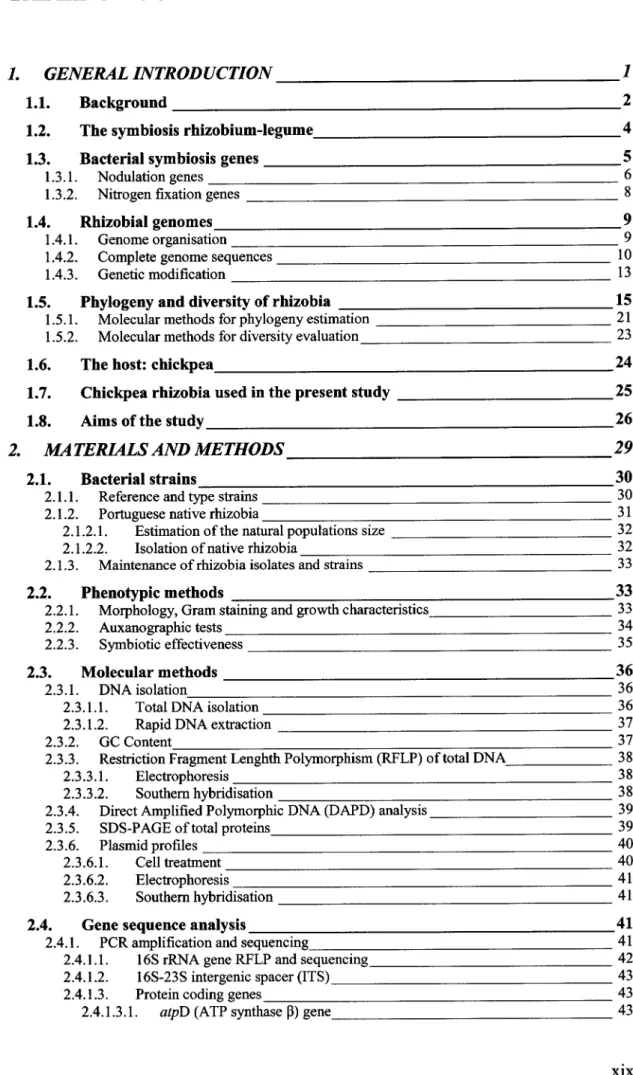
(A, T, G or C)TABLE
OF CONTENTS
1.
GENERALINTRODACTION
1.1.
Background 1.2. 1.3. 1.3.1. 1.3.2. 1.4. 1.4.1. t.4.2. 1.4.3. 1.5. 1.5.1. 1.5.2.The symbiosis rhizobium-legume Bacterial symbiosis genes
1 2 4 5 6 8 9 9 Nodulation genes
Nitrogen fixation genes
Rhizobial genomes
Genome organisation Complete genome sequences Genetic modification 10 13 15 2t 23 24 25 26 29 30 30 31 32 32 JJ 33 JJ 34 35 36 38 38 39 39 40 40
4l
4t4t
4t 42 43 43 43 1.6. 1.7. 1.8.Phylogeny and diversity of rhizobia
Molecular methods for phylogeny estimation Molecular methods for diversity evaluation
The host: chickpea
Chickpea rhizobia used in the present study Aims of the study
MATERIALS
AND
METHODS
2.1.
Bacterial strains2.1.1.
Reference and tlpe strains2.1.2.
Portuguese native rhizobia2.1.2.1.
Estimation of the natural populations stze2.1.2.2.
Isolation of native rhizobia2.1.3.
Maintenance of rhizobia isolates and strarnsPhenotypic methods
Morphology, Gram staining and growth characteristics
Auxanographic tests Symbiotic effectiveness Molecular methods 2. 2.2. 2.2.t. 2.2.2. 2.2.3. 2.3. 2.3.1. DNA
isolation
362.3.1.1.
Total DNA isolation2.3.1.2.
Rapid DNA extraction2.3.2.
GC Content2.3.3.
Restriction Fragment2.3.3.1.
ElectrophoresisknghthPolymorphism (RFLP) of total DNA
2.3.3.2.
Southernhybridisation2.3.4.
Direct Amplified Polymorphic DNA (DAPD) analysis2.3.5.
SDS-PAGE of total proteins2.3.6.
Plasmid profiles2.3.6.1.
Cell treatrnent2.3.6.2.
Electrophoresis2.3.6.3.
Southernhybridisation2.4.
Gene sequence analysis2.4.1.
PCR amplification and sequencing2.4.1.1.
165 rRNA gene RFLP and sequencing2.4.1.2.
165-23S intergenic spacer (ITS)2.4.1.3.
Protein coding genes36 37 37 38
2.4.1.3.1.
atpD (ATP synthase B) gene2.4.1.3.2. recA (DNA recombinase A) gene
2.4.1.3.3. glnA(glutamine synthetase I) gene
2.4.1.5.
Symbiosisgenes2.4.1.5.1. niJH gene
2.4.1.5.2. nodC gene
2.4.2.
Phylogenetic analysis2.4.2.1.
Multiple alignment and substitution model2.4.2.2.
Tree reconstruction and evaluation2.4.2.3.
Phylogenetic approach in the present study3.
IDENTIFICATION
OF CHICKPEA
3.1.
IntroductionRIIIZOBU
ISOLATES
3.2.
Results3.2.1.
Rhizobiaisolates3.2.1.1
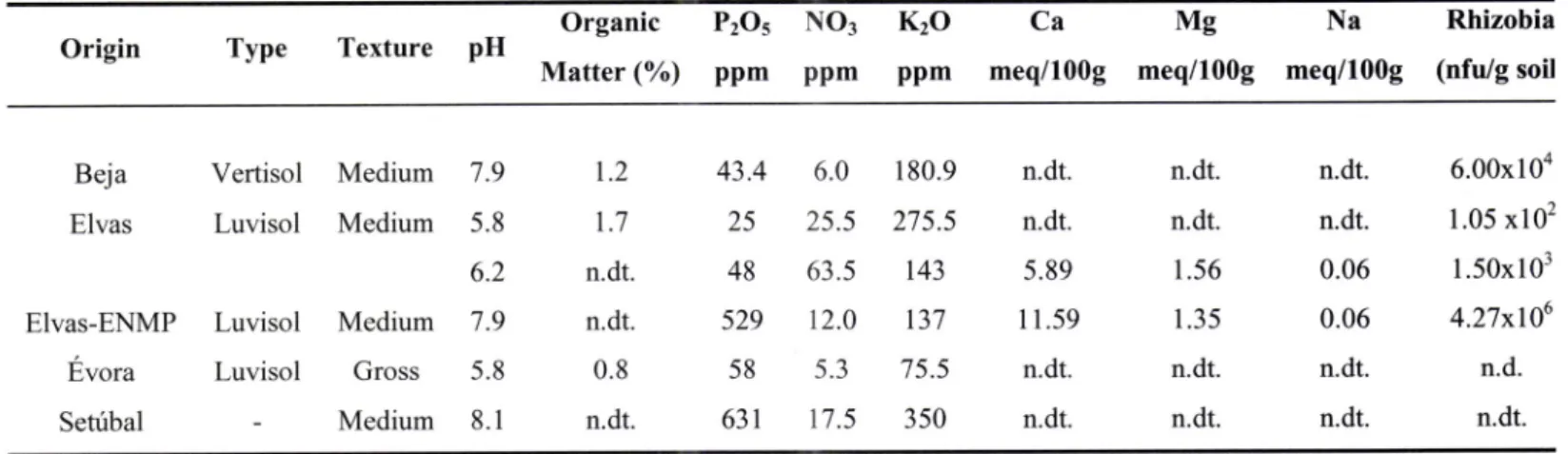
Soilcharacteristics3.2.1.2.
Portuguese native isolates3.2.2.
Identification of native rhizobia3.2.2.1.
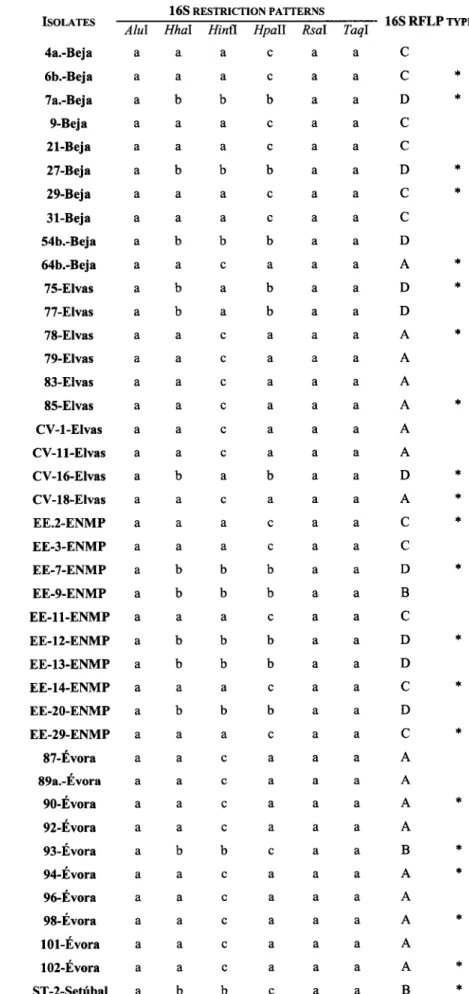
165 rDNA RFLP genotypes3.2.2.2
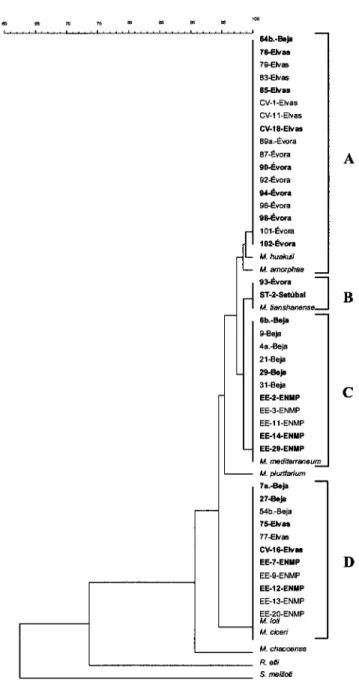
163 rDNA phylogeny3.3.
Discussion4.
DIVERSITY
OF CHICKPEA
RIIIZOBU
POPALATIONS
4.1.
Introduction4.2.
Results4.2.1.
Phenotypic characteristics4.2.1 .l
.
Morphology, Gram stain and growth characteristics4.2.1.2.
Auxanographic tests4.2.1.3.
Symbiotic effectiveness4.2.2.
Molecular features4.2.2.1.
DAPD profiles4.2.2.2.
Total protein profiles4.2.2.3.
Plasmidprofiles 4.3. Discussion5.
PHYLOGENY OF CHICKPEA
RHIZOBIA
BASED
ONMALTILOCUS
SEQUENCE
ANALYSIS: A NEW
SPECIES OF Mesorhizobium5.1.
Introduction5.2.
Results5.2.1.
165-23S intergenic spacer (ITS) phylogeny5.2.2.
Protein coding gene based phylogenies5.2.2.1.
atpD phylogeny5.2.2.2.
recAphylogeny5.2.2.3.
glnAphylogeny5.2.3.
Multilocus sequence analysis using concatenated sequences5.2.4.
165 rDNA extended phylogeny5.2.5.
DNA base composition5.3.
I)iscussion5.3.1.
Description of Mesorhizobium lusitanutm sp. nov.6.
EVIDENCE
FORLATERAL
GENE
TRANSFERBETWEEN
MesorhizobiumSPECIES
BASED
ONPHYLOGENY
OFSYMBIOSIS
GENES 109111
ttz
44 44 45 45 45 46 46 46 47 49 51 51 5l 52 53 55 55 586l
65 67 67 67 68 68 70 72 72 78 83 86 89 91 92 92 95 95 97 99 100 r03 105 105 108 6.1. Introduction6.2.1.1.
niJHphylogeny6.2.1.2.
nodCphylogeny6.2.2.
Localization of symbiosis genes by Southern analysis6.3.
Discussion7.
GENERAL DISCUSSION
7.1.
Phylogenies based on housekeeping loci and symbiosis genes7.2.
Diversity of chickpea mesorhizobia7.3.
New species of Mesorhizobium7.4.
Perspectives for future studiesREFERENCES
113ll5
118 120t2s
127 131 132 133 135xxi
Chapter I
General Infoduction
1.1.
Background
The symbiosis between rhizobia and legumes
is a
special exampleof
an association between prokaryotic and eukaryotic organisms (Perret et a1.,2000) and plays an important role in agriculture, having thus been intensively studied over the recent years.The main advantage of biological nitrogen fixation, in grain and forage legumes, is the increase in yield potentials without the use
of
chemical nitrogen fertilisers and with the consequent decrease inpollution (Freiberg et al.,1997; Stephens
&
Rask, 2000). This symbiosis rhizobia-legume is the most important biological mechanism for providing nitrogen to the soiVplant system, which justifies theecological importance
of
legume crops not onlyin
the improvementof
nitrogen nutritionto
other crops, such as pasture or cereals, but also in land remediation.In the late nineteenth century, Hellriegel and Wilfarth (1888) explained the principles of biological nitrogen fixation. Their work made way to all the subsequent studies in nitrogen fixation and legume-bacteria sSrmbioses and, at present, symbiotic nitrogen fixation by rhizobia is the best studied system (Young
&
Johnston, 1989) and a convenient model of plant-microbe interactions and their evolution (Quispel, I 988; Sprent, 1994).Although many legumes are important crops for human and animal nutrition, cereals are still the major food crops all over the
world.
Therefore, the long-term ambitious goal of biological nitrogenfixation research has been
to
design strategiesto
extendthe
nitrogen-fixing symbiosesto
non-nodulated cereal plants, such as rice and wheat. Recently, endophytic associations of nitrogen-fixing organisms with non-legumes have been reported: rhizobia with rice (Reddy et al., 1997; Yanni et al., 2001), wheat (Webster et
al.,
1997) and maize (Gtfiienez-Zamora&
Martrnez-Romero, 2001); andAzoarcus with various grasses and rice (Reinhold-Hurek et al., 1993).
Rhizobia are soil bacteria able to infect the roots of leguminous plants, promoting the formation
of
nitrogen-fixing
nodules.
These are produced as resultof
complex signal exchanges between thesymbiotic
partners. This
chemical dialogis
responsiblefor the
specificrtyof
the
symbiosis:microsymbionts can have a narow or broad host range and, similarly, host legumes are either specific or promiscuous (D6nari6 et a1.,1996; Fisher
&
Long, 1992; Spaink, 1995; van Rhijn&
Vanderleyden, r99s).Table 1 shows the rhizobial species that usually nodulate some of the most cultivated legumes in
Chapter I
Table 1. Rhizobial species that commonly nodulate legumes used for food and forage. Legume
Rhizobial Species Reference
Common Name Species
Chickpea Cicer arietinum Mesorhizobium ciceri M. mediterraneum
(Nour et al.,1994a)
(Nour et al., 1995)
Common
bean
Phaseolus vulgaris Rhizobium etliR. gallicum R. giardinii R. leguminosarum bv. phaseoli R. mongolense (Segovia et al., 1993) (Amarger et a1.,1997) (Amarger et a1.,1997) (Frank, 1879) (van Berkum et al., 1998)
R.
tropici
(Martinez-Romero et al., 1991) Faba bean Viciafoba R. leguminosarum bv. viciae (Frank, 1879)Soybean Glycine max B radyrhiz ob ium elkanii
B. japonicum B. liaoningense S. fredii (Kuykendall et al., 1992) (Jordan, 1982) (Xu et al., 1995) (de Lajudie et al., 1994)
Sinorhizobiumxiniiangense
(Pengetal.,2002)Pisum sativum R. leguminosarum bv. viciae @rank, 1879)
Alfalfa Medicago spp. S. medicae S. meliloti
(Rome et al., 1996) (de Lajudie et al., 1994)
Clover Trifolium spp. R. I e gumino s arum bv. trifo
lii
(Frank, 1879)The use
of
rhizobial inoculants has permitted the introductionof
legumes outside their native regions. Nitrogen fixation depends not only on the physiological state of the host plant, but also on the effectiveness and environmental fitness of the microsymbiont and on the interaction between the twopartners. Therefore, rhizobia strains used as inoculants must be competitive
with
the indigenouspopulations
for
nodule occupancy and be efficientin
nitrogen fixation afterwards (Bloem&
Law, 2001; Carter et a1.,1995; Okogun&
Sanginga,2003; Stephens&
Rask, 2000). Inoculant strains mustbe selected
for
individual cultivarsof
a
given legume, and also preferablyfor
particular soil and environmental conditions; they should show high tolerance to climatic and edaphic stress conditions,such
as
extreme temperatures, adversepH,
and
drought (Stephens&
Rask,2000).
Anotherfundamental characteristic is its persistence in the soil over time (Carter et al.,1995; Howieson, 1995).
At
the recommended inoculation rates (Brockwell&
Bottomley,t995;
Somasegaran&
Hoben, 1994), inoculant strains often dominatein
nodulationin
thefirst
yearof
a newly introduced crop (Singleton&
Tavares, 1986). Furthermore, upon nodule senescence, alarge number of viable rhizobia are released in the soil (McDermott et a1.,1987). Several studies have shown that inoculant strainsstill predominate in nodules 5
to
15 years after initial inoculation (Lindstrcim e/ a1.,1990), confirming that they are effective soil saprophytes persistingin
soil for many years in the absence of their host (Sanginga et al., 1994).A
good inoculant strain can be modified to have a few essential characteristics, such as increasedGeneral Infrodrrcfion
extended nodulation range to new hosts. Thus, the study of the biodiversity
of
indigenous rhizobia populations andthe
descriptionof
new rhizobial specieswill
providethe
necessary background information for strain modification with the purpose of inoculant development.1.2.
The
symbiosisrhizobium-legume
Root infection
by
rhizobia is initiated by pre-infection events in the rhizosphere. Rhizobia act inresponse to plant root exsudates by positive chemotaxis and move towards localised sites on legume
roots.
Rhizobia are attractedby
1ow concentrationsof
excreted compounds, known as flavonoids, such as isoflavones, chalcones, flavonols, flavones, anthocyanidins, etc (van Rhijn&
Vanderleyden,lees).
Environmental conditions can act as limiting factors to the establishment of the symbiosis and to nitrogen fixation. Different limiting or stress factors can be distinguished: salt and osmotic stress; soil moisture deficiency; temperature extremes and stress; soil acidity and sodicity; nutrient deficiency; soils amendment and amelioration (Zahran, 1999).
In general during root nodule formation, infection and nodule organogenesis occur simultaneously.
ln
order to infect the root, rhizobia first attach to the root hair, and then induce root hair deformationand curling followed
by
infection
threadformation.
At
the
sametime, root
cortical
cells dedifferentiate and enter division resulting in the formationof
a nodule primordium. The infection threadfull
of rhizobia grows from the root hair towards the nodule primordium localised in the innercortex.
Here, rhizobia are releasedinto
the
cytoplasmof
the
hostcells,
surroundedby
the peribacteroid membrane.At
this
stage, rhizobia differentiateinto their
endosymbiotic form, the bacteroids, which together with the peribacteroid membrane are called symbiosome. After infection,the primordia develop
into
nitrogenfixing
rootnodules.
This process as describedis
typicalof
legumes
from
temperate regions, such as chickpea, that develop indeterminate nodules (Lee&
Copeland, 1994). These contain a persistent meristem which results in cylindrical-shaped structures and transport fixed Nz as amides. Both determinate and indeterminate nodules have a similar tissue organisation,
a
central tissue where bacteria are hosted surroundedby
several peripheral tissues.These include the nodule cortex, the endodermis and the nodule parenchyma, which harbours the nodule vascular bundles.
The reduction
of
Nz to NlIq* is catalysed by nitrogenase within rhizobialcells.
This enzymaticcomplex
is
composedby two
proteins: componentI
or
molybdenum-iron (MoFe) protein andcomponent
II
or
iron (Fe) protein (Peters etal., 1995).
The productionof
Hzby
nitrogenaseis
awasteful reaction, which reduces the efficiency
of
the enzymein
about 25o/o. The Fe-proteinis
aChapter I
required for nitrogenase is mainly derived from Oz dependent oxidative phosphorylation within the
rhizobial
cell.
Thusthe
enzymeis
only
functionalin
low 02
environmental concentrations. Ieghemoglobin facilitates the diffusionof
available oxygen through the plant cell cytoplasm to the bacterial cells at appropriate concentrations (Appleby , 1984; Vance & Heichel, 1 991).1.3.
Bacterial
symbiosis genesThe
bacterial symbiosis genes,which
are responsiblefor
the
establishmentof
an
effectivesymbiosis, can be divided into two categories: nitrogen fixation genes (nif andy'x) (Kaminski et al., 1998) that are involved
in
atmospheric nitrogen fixation, and nodulation genes (nod,nol
and noe)(Downie,
1998),which
are
responsiblefor
nodulation (Freiberget al.,
1997;van
Rhijn
&
Vanderleyden, 1995). Other genes involved in the process of symbiosis are listed in Table 2.
Table 2. Other rhizobial genes involved in symbiotic nitrogen fixation.
Function Species Reference
exo hup gln dct exopolyssacharide production hydrogen uptake glutamine synthase dicarboxylate transport S. meliloti B. japonicum R. phaseoli R. leguminosarum S. meliloti S. meliloti S. meliloti R. phaseoli
(Glazebrook & Walker, 1989)
(Maier, 1986) (Carlson et a1.,1987)
(Iiang et al.,1989)
(Sanjuan & Olivares, 1989)
(Garcia-Rodrigoez & Toro, 2000) (Breedveld et al., 1994)
(Carlson et a1.,1987)
nfe
nodulation efficiency and competitivenessndv
p-1,2 glucans slmthesislps
lipopolysaccharide productionThe
symbiosis genes canbe
locatedon
a
symbiosis plasmid (pSym),as
in
Mesorhizobium amorphae(Wang
et al.,
1999a),or
on
a
symbiosisisland
insidethe
chromosome,like
inMesorhizobium
loti
(Sullivan etal.,
t995) and B. japonicum (Kaneko et al., 2002a; Nakamura et al., 2004), although they also have plasmids. At present, very little is known about the possible locationof symbiosis genes in other mesorhizobia (Xu
&
Murooka, 1995). The chromosomal location has also been suggested by Cadahia and colleagues (1986) for chickpea rhizobia.Several studies have shown that relatively few genes are required for nodulation of legumes (Long, 1989; van Rhijn & Vanderleyden, 1995).
The different rhizobial lineages probably diverged before the appearance
of
legumes (Turner&
General Introduction
diversification of bacteria and, consequently, symbiosis genes may have spread by lateral gene transfer among the different rhizobra (Hirsch
et al.,
2001).
This hypothesisis
supportedby
recent data obtained from the fully sequenced plasmids and genomes (Galibert et a1.,20011' Kaneko et al.,20O2a; Kaneko et aI.,2000a; Sullivan & Ronson, 1998; Sullivan et a\.,2002).Complex events
of
gene recruitment combinedwith
duplicationand lateral
gene transfercontributed to the evolution and spread of symbiotic abilities among rhizobia (Moulin et a1.,2004). Plant genes involved
in
symbiosis have been identifiedby
Expressed Sequence Tags (ESTs) sequencing rn Medicago truncatula (Journet et al., 2002) providing the means to study the interaction between macro- and microsymbiont, at the level of gene networks, in the symbiotic nitrogen fixationprocess.
1.3.1.
Nodulation
genesNodule formation requires
a
complex and dlmamic molecular interaction betweenthe
twosymbiotic partners. The onset of symbiosis is mediated by an exchange of diffi.rsible signals (Caetano-Anoll6s, 1997).
Flavonoids seem to be the most important plant exudates for the symbiosis (Perret et a1.,2000) since they direct the bacteria to the rhizosphere by chemotaxis and enable the rhizobia to distinguish their host (Hirsch et al., 2001). The flavonoids or isoflavonoids induce the expression of nodulation
(nod) genes. However this induction also requires the participation
of
the transcriptional-activatorprotein NodD (van Rhijn & Vanderleyden, 1995).
The
genetic controlof
nodulationby
rhizobia involves nodulation genesthat
determine the production of lipo-chitooligosaccharides (LCOs) known as Nod factors.Nod factors act as specific morphogenic signal molecules on legume hosts and induce early host responses such as root hair deformation and cortical cell division (Cullimore et
a1.,200t).
They areindispensable
for
nodulationand are
seemingly recognisedby
high-affinity
legume receptors (Cullimore et al., 2001).Root chitinases, some
of
which are specifically induced during symbiosis, can degrade the lipo-chitooligosaccharide backbone and may play an important role in the regulation of the Nod factors activity (Downie & Walker, 1999\.Chapter I
have also been described (Sadowsky et a1.,1991). These genes are responsible for the nodulation
of
specific plant genotypes within a single legume species.
The common nodABC genes are structurally and functionally conserved and are usually part of a
single operon
(van
Rhijn
&
Vanderleyden,1995).
The
lipo-chitooligosaccharide backbone issynthesised under
the
control
of
nodA (acyl
transferase),nodB
(deacetylase)and zodC
(N-acetylglucosaminyl transferase), allof
which are present as single copy genes in all known rhizobia (Downie, 1998).NodA varies in its fatty acid specificity, thus contributing to the rhizobial host range (Roche et al., 1996).
Nodl
andnodl
are located downstream of nodC and seem to be part of the same operon (vanRhijn
&
Vanderleyden, 1995). They encode two proteins belonging to a bacterial inner membrane transport system of small molecules (Yflzqtez et aI.,1993).The hsn genes are responsible
for
the host range and most mutations resultin
alteration or extension of host range (van Rhijn&
Vanderleyden, 1995). For example, nodF and nodG encode acyl carrier proteins, nodE encodes a B-acetoacethylsynthase (Sharma et a1.,1993) and nodP, nodQ and nodEl are involved in the sulfation of the Nod factor reducing sugar in S. meliloti (Roche etal.,l99l).
Examples of gsn genes are nolC,which is involved in cultivar-specific nodulation of soybean and
shares homology with a heat-shock gene (Krishnan
&
Pueppke, 1991) and no[BTIJYW that regulate the nodulation of G. max in a cultivar-specific manner (Meinhardt et aL.,1993).Most nod genes share a conserved promoter sequence called the nod box (Freiberg et a1.,1997). The regulatory NodD protein is crucial
in
the activationof
other nod genes. NodD is the only nodulation gene thatis
constitutively expressed evenin
non-symbiotic bacteria (Long, 1989). The spectrum of flavonoid specificity of NodD correlates with the broadness of the host range (van Rhijn&
Vanderleyden, 1995).The GC content
of
the nodulation genesis
lower than that found yetin all
studied rhizobial chromosomes. These differences in G+C content of essential and accessory genes could mean that the accessory genome came from another bacteriumwith
a distinct genomic composition. However,if
such a bacterium exists,it
has not been found yet (Downie&
Young, 2001). The same authors also propose a less plausible explanation, which is that different parts of the genome could share the samecell and diverge in composition.
Phylogeny based
on
common nodulation genes doesnot
correlatewith the
165 phylogenyof
rhizobia; instead it reflects the phylogeny of host plants (Dobert et a1.,1994).General Introduction
1.3.2.
Nitrogen
fixation
genesThere are two main types
of
nitrogen fixation genes:nif
andfix
genes. Rhizobialnif
genes are structurally homologous to those of Klebsiella pneumoniae, a free-living diazotrophic bacteria (Arnoldet al.,
1988; Drummond,1984).
Fix
genes are essentialto
nitrogen fixation,but do not
have homologous equivalents in K. pneumoniae (Fischer,7994).The nitrogenase complex, which has the catalytic function of nitrogen fixation, is encoded by the structural genes niJHDK. niJD and niJK code for the
o
and B subunits of the dinitrogenase or MoFeprotein
subunit.
niJH codesfor
the nitrogenase reductaseor
Fe protein subunitof
the
enzymecomplex. Phylogenetic studies have preferably focused on
this
nitrogen fixationgene.
A
MoFe cofactor is required for the activation of the MoFe protein and is assembled from the niJB,Y, N and Egene products (Freiberg et al.,1997).
The gene products of
nifA
and niJL control the regulation ofall
othernif
genes:NifA
is the positive activator of transcription ofnif
operons andNifL
is the negative activator (Morett et al., 1990).nif
gene expression is regulated by oxygen and ammonia levels in thesoil.
Ammonia causes niJLto
act as negative control and prevent the activator functionof
nifA.
This has been called theN
control system (Sadowsky
&
Graham,2000).
Symbiotic nitrogen fixationis
influencedby
thepresence of mineral nitrogen in the soil: the nodulation process may be promoted by relatively low
levels
of
available nitrateor
ammonia, higher concentrationsof
which
almost always depressnodulation (Davidson
&
Robson,
1986a; Davidson&
Robson, 1986b;
Eaglesham, 1989).Furthermore, soil NO3- inhibits root infection, nodule development and nitrogenase activity (Zahran, re99).
Nitrogenase is rapidly inactivated by oxygen, thus the enzyme must be protected from
02.
In theroot nodules
of
legumes, protectionis
providedby
the symbiotic synthesisof
the red pigmentedleghemoglobin, an oxygen binding protein (Quispel,
1988).
The globin portionof
the protein is synthesised by the plant in response to bacterial infection, while the heme group is slmthesised by the rhizobia (Appleby,1984).
Legfiemoglobin has a high affinityto
02, keeping its concentration low enough to protect the nitrogenase, while providing 02 transport for the aerobic rhizobia.The nitrogen fixation turnover
is
strongly associatedwith
the concentrationof
leghemoglobin (Werner etal.,l98l).
Leghemoglobins are interesting proteins as they are the only globins synthesised by plants, having genetic and structural homologies
with
animal oxyhemoproteins, like hemoglobin (Appleby, 1984).Chapter 1
Rhizobia have developed an independent enzymatic complex, Hup (Hydrogen uptake) system with
nitrogenase activity, able to oxidise all or part of the hydrogen produced by nitrogenase, allowing the recycling of hydrogen (Baginsky et aL.,2002).
The/xABCX
genes are usually located on a single operon, exceptn
B. japonicum and are directly involved in the electron transfer to nitrogenase (Fischer, 1994). The FixNOPQ proteins constitute amembrane-bound cytochrome-c-oxidase complex,
which
supports bacteroid respiration under low oxygen conditions inside the nodule (Preisig et a1.,1993). The/xGHIS genes encode transmembrane proteins (Fischer,1994).
Otherfix
genes are associatedto
the development and metabolismof
bacteroids (Fischer, t994).1.4.
Rhizobial
genomesAs the number
of
sequenced genomes increases, the richness of the bacterial world is becoming clearer. In particular, the availability of rhizobial complete genomes has opened a whole new field inthe biology and genomics of these bacteria, and has allowed the molecular analysis of genes involved in symbiosis, competitiveness and stress response. This
will
be of major importance in planning strain improvement strategiesfor
inoculant technology invaluablefor the
developmentof
a
sustainable agriculture.1.4.1. Genome
organisation
The release
of
rhizobia complete genome sequences has beena
very
important step towards comparative genomics of rhizobia and has improved our knowledge on symbiosis genes (Downie&
Young, 2001). An updated summary of complete genomes and genome projects is shown in Table 3.
Most species
of
rhizobia carry large plasmids that may varyin
number andsize.
These are not always associatedwith
symbiosis; they may contain essential or housekeeping genes (Barnett et al.,2001 ; Downie
&
Young , 2001; Finan et al., 2001; Galibert et al., 2001) and some of them are cryptic (Mercado-Blanco&
Toro, 1996).Although most housekeeping genes are located in the chromosome, it has been shown that, at least in Sinorhizobium meliloti, Sym plasmids also carry some essential genes (Barnett et a1.,200L; Downie
& Young,2001; Finan et a1.,2001; Galibert et a1.,2001).
The genes involved
in
symbiosis can be located on symbiosis plasmids (pSym), asin
,S. meliloti(Barloy-Hubler et a1.,2000b; Finan et
al.,
200t), R.etli
(Gonzblez et a1.,2003) andM.
amorphae (Wang etal.,
1999a), or on a symbiosis islandof low
GC contentin
the chromosome (Downie&
General Introduction
Young,200l),like
inM. loti
(Sullivan et a1.,1995) andB. japonicum (Kaneko et a1.,2002a). The chromosomal location has also been suggested for chickpea rhizobia (Cadahia et al., 1986).In evolutionary terms, plasmid encoded symbiosis genes have the advantage of being more easily exchangeable within populations, than genes located in the chromosome (Downie, 1997). Acquisition
and loss of Sym plasmids is a dynamic and continuous process, which seems to play a major role in the evolution of rhizobia.
1.4.2, Complete genome sequences
There are currently
two
major databases that gather most information availableon
complete genomesof
rhizobia
and
related bacteria: RhizoBase (http://www.kazusa.orjp/rhizobase) andRhizoBD (http : I I rhizo.bham. ac.uk).
The availability
of
complete genome sequences has demonstrated that lateral gene transfer and recombination are essential mechanismsin
the evolutionof
bacterial genomes (van Berkum et al.,2003).
Furthermore, the ability of bacteria to exploit new environments and to respond to different selective pressuresis
more easily explainedby
the acquisitionof
new genesby
horizontal genetransfer than by gene modification through accumulation of point mutations (Francia et al. , 2004). Lateral transfer has been an argument
to
explain the inconsistencies between phylogenetic treesderived from chromosomal or plasmid genes. This fact agrees with the hypothesis that Sym plasmids are a recent acquisition
of
soil bacteria, asit
has been suggestedby
the analysisof
the complete genome sequence of Sinorhizobium melilori (Galibert et a1.,2001).Work on whole genome sequence analysis of S. meliloti 1021 (Guo et a1.,2003) and Rhizobiurn sp. NGR234 (Mavingui et a1.,2002) has shown that the structure
of
rhizobial genomes can be highly dynamic generating different genomic reaffangements, through homologous recombination between reiterated DNA sequences.The transfer
of
symbiosis informationin
soil and the formationof
new symbiosis plasmids by genetic recombination could resultin
a
heterogeneous populationwith high
adaptive capacity to interact and nodulate different legumes (Sober6n-Chdvez etal.,l99t).
The existence of complete genome sequences has changed the whole basis upon which rhizobia can be studied. The way is now opened to the functional genomics of rhizobia: comparative genomics, transcriptomics and
proteomics.
Gene expression analyses include monitoring changesin
the transcriptome and the proteome. In the post-genomic era, experimental approaches have moved from the targeted investigationof
individual genes to the study of thousandsof
genes simultaneously by array techniques (Piihler et a1.,2004), giving us the possibility to study rhizobial genes involved inTrble 3. Complete gercmes and genome proj€cts ofrhizobia and reLted backria-
*i.fodation
mt
a\&ilable.Sprcrns
Srnux
Gnxourp
clrRoMosoMr
pr,,lsNrrps 'SnrceNns
Rpr,nasr yn^lnLOCATION RnrnnrNcB
Agrobacterium
radiobacterbv.ll K84
*
2-
ongomg proJect-5.67IvIb
-2.84\\nb(circular)
543 Kb (A0 -2.07 \nbQinear)
214 Kb (Ti)200r (Wood et a1.,2001)
A. tumefaciens
bv.I
c58A. vitis bv.
III
s4
-5.7Mb
2 ongoing projectBrudyrhizobium
japonbunt USDAllo
-r.l
Ilrb
-9.1Nlb
-
cbromosome
2002
(KarcLo eral,2002a; KaneLo etal'm02bt
B.japonicum
SEMIA5079
,(B.sp.
BTAiI
-8.4Mb
-8.4IVIb
-
chromosome
2006B. sp.
oRS278
-7Mb
-7 Mb chromosome ongoingproject Barkholderiaphymatum
STM815
-8.9 Mb ongoing projectMesorhizobium
loti
MAFF303099-7.6\[b
-7.0Mb
352Kb
Syzisland
2000208 Kb
(Kaneko et al., 2000a; 2000b)
M.loti (symbiosis
island)
R7A Syruisland
2002 (Sullivan eta1.,2002)Methylobacteriam
nodulans
ORS2060
-7.0Mb
**
ongoingproject -6.4Mb
-3.5]\db
-2.4\jlb
ongoing project Ralstoniataiwanensis
LMGI9424-500
Kb
psvm Rhizobium etli -6.5Mb
-4.41\Ib
642Kb 505 KbcFN42
371Kb
pSvm 251 Kb 194 Kb 184 Kb2006
(Goruiflez et a1.,2006; Gonzillez et a1.,2003)Tnfrnzfirnfinn
Table 4. (continued) Complete genomes and genome projects of rhizobia and related bacteria. *information not available.
Srrcrrs
Stnen
GENoME cHRoMosoMr
pr..c.sNrros
svtttcBwBs
Rrr,rasn yp^q,R LOCATION RBrBnrncB
-7.75t{b
-5.06Mb
870 Kb 2006 (Young et a1.,2006) R leguminosarumbv.viciae
3841 684 Kb 488Kb
pSym 352Kb 147 Kblsl
KbR leguminosarumbv.
trifolii
WSMI325
**
orgoing projectR
leguminosatambv.trifolii
WSM2304
'**
ongoingprojectR
sp. NGR234-5.6Mb
-3.5Mb
540Kb
pSym
1997
(Freiberg et a1.,1997;Streitet a1.,2004)-2.21\[b 2004
R
tropici PRF8I
**
pSym
ongoingprojectSinorhizobium
medicse
WSM4I9
-6.7\[b
* 2006S. meliloti t02t
-6.6
Mb
-3.6Mb
1,354Kb
pSymA
2000
(Barloy-Hubler et a1.,2000a;2000b; Capelaet1,683
Kb
pSymB al., 1999; Finan et al., 20011, Galibert et al. ,Chanter 1
1.4.3. Genetic
modification
For many years,
it
has beena
challengefor
researchers workingwith
rhizobiato
develop aninoculant that can promote higher levels of nitrogen fixation in practical field conditions. This is the
final goal
of
strain improvement and, nowadays, this might be achieved by molecular techniques atour reach.
Genetic modifications that have been introduced in rhizobia aimed at improving the strains used as
inoculants on traits such as competitiveness with indigenous strains and nitrogen fixation capacity. Generation of Rhizobiun strains with improved symbiotic properties has been achieved by random
DNA
amplification(RDA),
a
new strategyfor
the
improvementof
bacterial strains through theselection
of
desired properties withoutthe
needto
identiff
the
genes involvedin
the
process (Mavingui et al., 1997).The recent boom
of
complete genome sequences has madeit
possibleto
design pathwaysof
rearrangementsthat
leadto
different genomic structuresin
Rhizobiumwith
potential biological implications (Flores et al., 2000). However, there is evidence of a strong selective pressure imposed by the host, which favours the maintenance of certain chromosome-plasmid associations (Silva et al., 2003).An important prerequisite for genetic improvement of any bacterial species is the availability of a
highly efficient gene transfer system. Traditional transformation methods have been developed for
rhizobia
with
little
success (Bulleq'ahn&
Benzinger, 1982; Courtois etal.,
1988; Kiss&
Kblmin,
1982; Selvaraj&
Iyer,l98l).
The referred methods are all time consuming and restricted to plasmid vectors carrying the mob gene (Garg etal.,
1999). Thus, gene transfer to rhizobia has mainly beenpossible through conjugation
with
Escherichiacoli
(Johnstonet
al.,
1978),which
is
alsotime-consuming.
However,a
simple and rapid method, basedon the
freeze-thaw protocol used forAgrobacteriumtransformation, has been described very recently (Vincze & Bowra, 2006).
Electrotransformation protocols have also been developed for rhizobia (Garg et a1.,1999; Hayashi
et
al.,
2000).
Comparedto
the
conventional methods, electroporationyields
much
higher transformationefficiencies.
However, the optimal electroporation conditionsvary from
strain to strain, making it hard to establish an effrcient transformation system for rhizobial strains.Rhizobia genetically modified to be easily traceable and/or to be improved in their expression
of
beneficial traits have been constructed and released with plants in a number of experimental field plots (Selbitschka et al., 1995). With these releases, it has been possible to monitor the modified inoculant bacteria aftertheir
introductionin
field
ecosystems andto
assesstheir
impacton the
resident population (Amarger, 2002; Cullen et aL.,1998).Introduction
Marker genes that have been introduced in rhizobia to study the survival, persistence and spread
of
genetically modified bacteria
in
the field,
include transposonsor
genes conferring antibiotic or mercury resistance which can be used with reporter genes, such as gus{, luc or lacZ (Amarger,2002).To increase the nodulation competitiveness under field conditions two approaches have been used:
the introduction
of
genes involvedin
the biosynthesisof trifolitoxin,
an antibioticto
which native rhizobia are susceptible, in R. etli, the microsymbiont of common bean (Robleto et a1.,1,998); and the overexpressionof putA, a
metabolic gene involvedin
root
surface colonisation,in
,S. meliloti,associated with alfalfa (van Dillewrjn et aL.,2002; van Dillewijn et aL.,200L).
Two
strategies have also been developedto
improve the nitrogenfixing
capacityof
rhizobial inoculants: modificationsof
the expressionof nifA,
oneof
thenif
genes regulatory protein, andof
dicarboxylate transport
(dct)
getes, involvedin
the supplyof
carbon and energyto
the nitrogenfixation process. S. meliloti strains
with
an extra copyof nifA
and dct genes were constructed to inoculate alfalfa leading to an increase in plant yields under field conditions of nitrogen limitation, lowendogenous rhizobial competitors and sufficient moisture (Bosworth et a1.,1994). Nevertheless, other authors (Ronson et a1.,1990) have shown that, inoculation of two varieties of soybean with strains
of
B. japonicumwith an extra copy of nifA did not increase soybean yield.
Overall, the mentioned studies show that
it
may be possibleto
improve symbiotic effectiveness through genetic modificationof
rhizobial strains. However, despite muchis
already known about genetics of symbiotic nitrogen fixation and strain improvement, most commercial inoculants are native selected strains, usually best fitted, rather than modified strains.From the limited results obtained so far
in
engineering nitrogen-fixing plants,it
seems that the improvement of the nitrogen fixation process at the level of the microsymbiont symbiotic abilities may still be the best strategy.The opportunity to carry out large-scale analyses in functional genomics now opens the way to the identification of large sets of co-regulated genes involved in biological processes at the level of gene
networks instead
of
individual genes (Journet et a1.,2002). This kindof
approachis
striking for abetter global understanding
of
complex developmental programs such as those activated during interactions between plants and microorganisms.The importance
of
symbiotic nitrogen fixation for developing sustainable agricultural systems is enormous and current genome projects includea
diversityof
legumes and rhizobial species. Theapplication
of
new
genomictools
to
identify
symbiosis genesboth
in
model
macro- andmicrosymbionts makes way