
Spatial patterns of species composition and richness in iberian freshwater fish:a macroecological approach
240
0
0
Texto
(2)
(3) UNIVERSIDADE DE LISBOA FACULDADE DE CIÊNCIAS DEPARTAMENTO DE BIOLOGIA ANIMAL. SPATIAL PATTERNS OF SPECIES COMPOSITION AND RICHNESS IN IBERIAN FRESHWATER FISH A MACROECOLOGICAL APPROACH Ana Filipa da Silva Pereira Machado Filipe. Tese orientada por: Professora Maria João Collares-Pereira (Univ. Lisboa) Professor Paul Angermeier (Univ. Virgínia). DOUTORAMENTO EM BIOLOGIA (Especialidade Ecologia) 2010.
(4) This dissertation should be cited as: Filipe, A.F. (2010) Spatial patterns of species composition and richness in Iberian freshwater fish. PhD Thesis, Universidade de Lisboa, Portugal..
(5) N’ba N’ga, o teimoso celacanto que ainda hoje se recusa a viver em terra, e à minha família.. To N'ba N'ga, the stubborn freshwater Coelacanthus that still refuses to live on land, and to my family.. (N'ba N'ga primeiramente citado por Italo Calvino, Cosmicomicas, 1965) (N'ba N'ga was firstly cited by Italo Calvino, Cosmicomics, 1965).
(6)
(7)
(8)
(9) Preliminary note The present dissertation includes papers published or submitted in co-authorship. Papers are the output of collective works reflected in the list of co-authors and in the author’s contribution section of each paper. As doctoral candidate presenting the current dissertation and leading author of all papers, I was responsible for the specific scientific design and scheduling, datasets, statistical analyses, and writing. The advisors of the thesis were deeply involved on the dissertation conceptual framework and on all stages of work development, being also co-authors of the papers. Whereas the dissertation is a personal synthesis based on the mentioned papers where I benefited directly the co-authors participation, I also gained indirectly from informal discussions on a collaborative basis.. This work was supported by the Science and Technology Foundation and European Funding (SFRH/BD/10330/2002). Este trabalho foi ralizado com o apoio financeiro da Fundação para a Ciência e Tecnologia e do Fundo Social Europeu (SFRH/BD/10330/2002)..
(10) List of papers Filipe, A.F., Alves, M.J. & Collares-Pereira, M.J. How much data are we loosing? Challenges on building freshwater biodiversity databases to attain data quality. Bioscience. Submitted as Overview Article.. Filipe, A.F., Araújo, M.B., Doadrio, I., Angermeier, P.L. & Collares-Pereira, M.J. (2009) Biogeography of Iberian freshwater fishes revisited: the roles of historical versus contemporary constraints. Journal of Biogeography, 36, 2096-2110 Published as Original Article.. Filipe, A.F., Magalhães, M.F. & Collares-Pereira, M.J. Native and invasive fish species richness in Mediterranean streams: the role of multiple landscape influences. Diversity and Distributions. Submitted as Biodiversity Research.. Filipe A.F., Angermeier P.L. & Collares-Pereira M.J. Spatial gradients of species diversity in freshwater fishes: testing theory with empirical evidence. Global Ecology and Biogeography. Submitted as Research Review..
(11) Index Acknowledgements / Agradecimentos Resumo Summary. i vi xi. Chapter 1. Introduction 1.1 Why study stream fish ecological patterns? 1.2 Stream ecosystems and ecological communities 1.3 What drives the variability of patterns in stream fish communities?. 1. Detecting drivers and examining processes The stream fish ecological communities 1.4 The case study: the Iberian stream fish. 9. 3 5 9 11 15. Iberian Peninsula Iberian stream fish 1.5 Study aims and approach. 15. 1.6 Study outline 1.7 References. 24. Chapter 2. The freshwater fish databases. 35. 18 21. 26. Filipe, A.F., Alves, M.J. & Collares-Pereira, M.J. How much data are we loosing? Challenges on building freshwater biodiversity databases to attain data quality. Bioscience.. Chapter 3. Patterns of freshwater fish species in the Iberian Peninsula Filipe, A.F., Araújo, M.B., Doadrio, I., Angermeier, P.L. & CollaresPereira, M.J. (2009) Biogeography of Iberian freshwater fishes revisited: the roles of historical versus contemporary constraints. Journal of Biogeography, 36, 2096-2110.. 63.
(12) Chapter 4. Local richness of fish assemblages at the south-western. 85. Iberian basins Filipe, A.F., Magalhães, M.F. & Collares-Pereira, M.J. Native and invasive fish species richness in Mediterranean streams: the role of multiple landscape influences. Diversity and Distributions.. Chapter 5. Examining spatial patterns of freshwater fish. 125. Filipe A.F., Angermeier P.L. & Collares-Pereira M.J. Spatial gradients of species diversity in freshwater fishes: testing theory with empirical evidence. Global Ecology and Biogeography.. Chapter 6. General Discussion 6.1 Summary of the outcomes 6.2 Spatial patterns of freshwater fish species. 167. The drivers of current assemblages Species with distinct dispersal ability and biogeographical origin Again, the hierarchical faunal filters 6.3 Study key–strengths and weaknesses. 171. 6.4 Study implications. 179. Current environmental concerns Attaining effective conservation and management 6.5 References. 179. Chapter 7. Concluding Remarks 7.1 Future directions. 191. Appendix I. Biogeographical provinces delineated in previous studies Appendix II. Additional study: selection of priority areas for fish conservation. 169 171 174 175 177. 181 185. 194.
(13) Acknowledgements / Agradecimentos A todos aqueles me contribuíram, de alguma forma, para a realização deste trabalho aqui deixo o meu agradecimento. Estou profundamente grata aos meus amigos e família que sempre me encorajaram e apoiaram em todos os momentos deste projecto. Mas também aos meus orientadores, colaboradores e colegas por todas as valiosas sugestões e conhecimento partilhado que, em muito, contribuíram para o desenvolvimento deste trabalho. Assim, expresso aqui os meus agradecimentos a alguns deles. *To all who contributed to this dissertation in so many different ways and during distinct steps I hereby express my gratitude. I am deeply grateful to friends and family, who inspired and stood me during this project. I am especially thankful to my supervisors, collaborators, and colleagues from all the scientific inputs and knowledge sharing, which allowed developing this investigation. Therefore, here I express my gratitude to some of them: ____________________ Aos meus orientadores e colaboradores com os quais aprendi e pude ultrapassar dificuldades quotidianas, ganhei conhecimento e noção do trabalho necessário para encontrar as melhores soluções e cumprir os objectivos, mas também partilhei entusiasmo. Estou imensamente grata por terem aceitado os numerosos desafios e também as dificuldades, em particular: À Professora Maria João Collares-Pereira, por ter aceitado o desafio de orientar este projecto de doutoramento, e pelo seu constante entusiasmo ao longo dos trabalhos desenvolvidos, que me contagiou e incentivou sempre a progredir. Especial relevo merece todo o apoio científico e também logístico dado com uma prontidão inigualável. Estou muito grata pela confiança depositada e partilha em imensos desafios que surgiram ao FFishGUL. Também agradeço ter-me integrado em trabalhos da equipa desde 1997, e que me deram a oportunidade de desenvolver o interesse pelos ecossistemas dulciaquícolas e sua fauna, mas também partilhar ideias e conhecimento com extraordinários colegas de equipa. *To Professor Paul Angermeier, also for being supervisor of this work. I am particularly thankful of the valuable scientific contribution regarding stream ecology, in personal discussions during my sayings in Blacksburg, but also at the distance, from which I gained immense inputs. I also express thanks for all the welcoming in Virginia Tech Department of Fisheries and Wildlife, between its students, and family. Ao Professor Miguel Bastos Araújo, que aperar de não ser orientador formal pela instituição de acolhimento, a sua contribuição foi valiosa em muitas das fases da investigação, nomeadamente no que respeita ao meu conhecimento da ecologia teórica e aplicada. Ajudou a tomar decisões baseadas em rigor e acuidade de pensamento, mas também a esboçar e concretizar ideias em ecologia, e que estão presentes em diversos temas aqui apresentados.. i.
(14) À Professora Filomena Magalhães, por ter estado activamente presente em inúmeras fases deste trabalho, e que a sua proximidade e à vontade com a ecologia dos cursos de água e ictiofauna, em particular com os abordados no estudo, permitiram efectivas e produtivas discussões, sugestões, e partilha de ideias e preocupações quotidianas. Muito obrigada pela constante ajuda, que foi fundamental nalguns dos trabalhos efectuados. Al Profesor Ignácio Doadrio, por me ter recibido en el Museo Nacional de Ciencias Naturales en Madrid, por todo suporte durante la revisión de las ocurrencias de los peces en España e por compartir todo su vastísimo conocimiento de los peces y ríos. Muchas gracias también por ayudar en las dudas que han surgido durante este proyecto. Además, por todo el entusiasmo e amistad. À Doutora Maria Judite Alves, que além de ter contribuído directamente num dos trabalhos, foi, ao longo destes anos, uma ajuda valiosa e efectiva em questões da filogeografia das espécies e outros temas no que respeita aos peixes de água doce em Portugal. Estou especialmente grata por ter partilhado dados previamente recolhidos de ocorrências das espécies em Portugal. *I am also thankful to all researchers that helped me to resolve specific problems and doubts. I specially thank some experts who helped in specific questions, namely Pedro Peres-Neto (R software, PCNM analysis), Thiago Rangel (SAM software), Nicolas Gotelli (Ecosim software), Robert Colwell (EstimateS software), Bruce Patterson (Nestedness Calculator software), among others, as several authors of extensions tools for ArcView and ArcGIS software. I also thank to revisers of the papers, who were very useful on all improvements. Special thanks to the editors Robert McDowall and David Currie for editing and revising effort. ____________________ Aos meus colegas, um especial abraço e reconhecimento. Sem a vossa proximidade este trabalho não teria sido possível, ou pelo menos teria sido mais árduo de concretizar. Em particular agradeço: Ao Pedro Segurado, pela ajuda no tratamento de dados em em SIG aplicado a rios, e pela amizade. *To Emmanuel Frimpong, for the help on the GIS analyses, but also for sharing determination, enthusiasm and knowledge, and for being always here, for anything needed. À Maria Peixe Dias, pela iniciação ao programa R e ajudar em cálculos de autocorrelação espacial em curso de água *To Than Hitt, for all bibliography, and fantastic discussions, where problems, emerging ideas were always present. I am also thankful because all the shared moments in nature, as canoeing. I keep in my memory on that Thanksgiving, also with Mary Anne. Ao Luís Costa, pela partilha de problemas e incontáveis sugestões, mas especialmente pelo companheirismo e amizade ao longo destes anos.. ii.
(15) A Lluis Benejam, que me hay proporcionado, científica y personalmente, una magnífica convivencia y donde hay nascido una “bonica amistat”. Ao Filipe Ribeiro, pela partilha, desde bibliografia e dados de ocorrências a muitos outros aspectos das nossas espécies e rios, mas também pela amizade ao longo destes anos. *To Anita Lahey, for all the support in all discussions about fish, nature, thesis, books, etc, and for all the friendship and good times. A todos os colegas da Faculdade com quem partilhei muitos e bons momentos e um divertido ambiente de trabalho, em especial: Às companheiras de gabinete Vânia Proença, Zé Caramujo e Anabel Perdices, pelas inúmeras conversas, música, e mais umas quantas imensuráveis dimensões quotidianas e metafisicas. A todos os meus restantes colegas e ex-colegas do FFishGUL, em especial ao Joaquim Reis, Natacha Mesquita, Marta Gromicho, Carina Cunha, Patrícia Salgueiro, Hugo Gante, Irene Pala, e Maria Drago, Joana Martelo, Daniel Pires, Cláudia Mieiro, e outos “peixólogos” de renome... Agradeço em especial àqueles que partilharam os dados de ocorrência de espécies, oriuntos dos seus trabalhos, me ajudaram em campanhas de campo ou nos seus preparativos. Aos restantes colegas Sofia Lourenço, David Santos, Catarina Miranda, e outros incontáveis “seres voadores”, em especial ao Pedro Lourenço, pelo apoio em importantes fases deste trabalho, e muitos outros bons momentos. Mais ainda aos “terrestres” “Tatá” Teresa Sales, ao Nuno Pedroso , à Dália Freitas, è Carla Marques. Um especial agradecimento ao Joaquim Pedro, pela amizade e entusiasmo partilhados. *To all the remnant colleagues at the Virginia Tech, specially Jamie Roberts, Robert, David Bishop, Larissa Graham with which I shared moments during the stays in Virginia Tech. A todos os colegas do ICNB, com quem foram partilhadas mais de dois anos de aventuras, especialmente entre os da “equipa do Livro Vermelho”. Um reconhecimento terno à Leonor Rogado, por tanta partilha, e por me ter desafiado a integrar tal equipa. A tua dedicação à conservação dos cursos de água, em especial as espécies de peixes ameaçadas, bem como o teu riso e simplicidade perdurarão sempre entre nós, colegas do ICNB e da Faculdade. Por último, aos meus professores da Faculdade de Ciências pelo conhecimentnto transmitido durante a licenciatura, e aos da Virginia University durante estes anos de doutoramento. Também agradeço aos professores do Ar.Co., escola onde aprendi a observar e desenhar, e em especial ao Pintor João Queiroz, pela amizade que permanece.. iii.
(16) ____________________ Estou particularmente grata aos restantes amigos, e também à minha familia, que sempre me acompanharam em inumeráveis momentos. Não posso deixar de referir a alguns, aqui o meu imenso agradecimento: Aos restantes amigos de Blacksburg, um muito obrigado por me receberem em vossas casas durante as estadias no Virginia Tech, e terem tornado tudo tão leve e divertido, mesmo em momentos menos bons: vocês estiveram lá, para tudo! Anucha, Polanah, Abdul, Renata e bonequinhas lindas: neve ou não, haverá sempre vinho na sexta e “brunch” no sábado... Muito obrigada também à Ana de Nova Iorque: acolheste-me e mostraste e a cidade, entre divertidos momentos de humor. À Tânia Nobre, Maria Carlos e respectivos companheiros, pela partilha de muitos momentos de amizade inabalável, e também à Patrícia Tiago e ao Tiago Marques com quem partilhei tantos outros momentos, em trabalho de campo, viagens e gargalhadas. O maior abraço, cheio de força, para a Luísa Chaves, a mais corajosa e lutadora de todos nós. Um abraço enorme por tantos momentos à Inês Alves, Rui Valente, Enrique Sanchez, Gian Luca Bono, Rosário Oliveira e Maria João Amaro. Um com especial carinho à Susana Pereira, pelos “rasgos de genialidade” nos momentos de escrita na Biblioteca Nacional, e também pela amizade, ao longo de tantos anos! E também aos seus pequeninos, por priorizarem o que é mesmo importante. À Mariana Oliveira, pela amizade inabalável, por todo o apoio e interesse constante durante estes anos. Contigo aprendo a colocar os pés na terra, e a ver a realidade de outras perspectivas. Também à pequena Mia: atravessei o oceano para te ver e valeu a pena...! Aos meus pais e irmão, mesmo quando não compreendiam muito bem o porquê desta aventura. Mano, aquele grande ecrã foi mesmo útil na revisão e submissão dos documentos! Estou particularmente grata à minha mãe, por ser leve, gostar de rir, e me apoiar, incondicionalmente, com coragem, força e generosidade infinita. Também por aquela visita ao Jardim Botânico em pequena, e me ter contado coisas das flores, insectos, e outros bichos. A ti, Manel, gràcies por compartires dos meus anseios durante a finalização deste projecto, mas também muitos outros momentos, pequenos e simples, de risos, ideias, música, deambulações, e que me deram o alento e energia necessária. Sem ti não teria sido possível estar, aqui e agora, a escrever este texto.. *Finally, I am deeply grateful to all authors who, trough art, from painting and drawing to music and books, contributed to more pleasant daily times, but also to a more parsimonious understanding of nature(s).. iv.
(17) ____________________ Agradecimentos institucionais: Ao Departamento de Biologia Animal da Faculdade de Ciências da Universidade de Lisboa e ao Centro de Biologia Ambiental, por terem acolhido este doutoramento. Pela mesma razão, agradeço ao Department of Fisheries and Wildlife Sciences (Virginia Polytechnic Institute and State University, USA). À Fundação para a Ciência e Tecnologia e ao Fundo Estrutural Europeu no âmbito do III Quadro Comunitário de Apoio pela atribuição da bolsa individual SFRH/BD/10330/2002. Ao Museo Nacional de Ciencias Naturales (CSIC, Madrid) por ter apoiado os trabalhos desencvolvidos no âmbito do programa Synthesys (European Community Research Infrastructure Action under the FP6). Ao Instituto de Conservação da Natureza e Biodiversidade, por me ter dado a oportunidade de ter sido colaboradora e autora da actualização do Livro Vermelho dos Vertebrados de Portugal durante dois anos.. v.
(18) Resumo Apesar das espécies de peixes continentais ibéricas serem desde há muito alvo de estudos que visam conhecer a sua taxonomia, características biológicas e, mais recentemente, o seu património genético, existe ainda um significativo desconhecimento de muitos aspectos da sua ecologia, nomeadamente, de que forma se distribuem na paisagem, e quais os factores e processos ecológicos envolvidos. Saber quais e quantas espécies de peixes ocorrem num troco de rio e como se estruturam as comunidades piscícolas é essencial para compreender e proteger os cursos de água e a sua biodiversidade, o que é amplamente reconhecido como urgente face aos desafios ambientais deste início de século. A Península Ibérica tem merecido um destaque especial, tanto a nível mundial, como no contexto europeu e mediterrânico, uma vez que muitas das espécies são endemismos e encontram-se seriamente ameaçadas. Foi partindo desta ideia e do caso da Península Ibérica que se desenvolveu o presente estudo. Para tal, utilizaram-se ferramentas e metodologias de análise de âmbito macroecológico, tentando responder às seguintes questões: Como se distribuem os peixes de água doce na Península Ibérica? Que factores limitam essa distribuição? Quais os processos ecológicos envolvidos? Foi estudando a riqueza e composição das comunidades dos cursos de água existentes em toda a Península, e especialmente os localizados na área a sudoeste, que se desenvolveu este trabalho. Trata-sede uma primeira abordagem aos padrões espaciais da ictiofauna ribeirinha da Península baseada em dados actuais da ocorrência das espécies e recorrendo a ferramentas em Sistemas de Informação Geográfica (SIGs). Inicialmente, compilaram-se dados georreferenciados de ocorrências de espécies provenientes de amostragens de campo efectuadas em estudos prévios usando pesca eléctrica (de 1990 a 2008). Para tal, foram construídas duas bases de dados com uma componente SIG: a InFISH.PT relativa aos cursos de água portugueses, tendo como unidade de informação os locais de pesca, e a InFISH.IP para os dados ibéricos, onde o grau de informação corresponde a quadrículas 10*10 km. Assim, foi possível descrever a composição e a riqueza específica das comunidades piscícolas locais e cruzar essa informação com variáveis de paisagem (sucintamente, com a variação do ‘’pool’’ de espécies, clima, topografia, rede hidrográfica, a diferentes escalas). A informação sobre a distribuição e taxonomia nestas bases de dados é a mais completa até à data para as espécies dulciaquícolas ibéricas, incluindo espécies primárias (restritas às águas doces), secundárias (que ocasionalmente habitam águas com alguma salinidade) e periféricas (que realizam parte do seu ciclo de vida em águas marinhas),. vi.
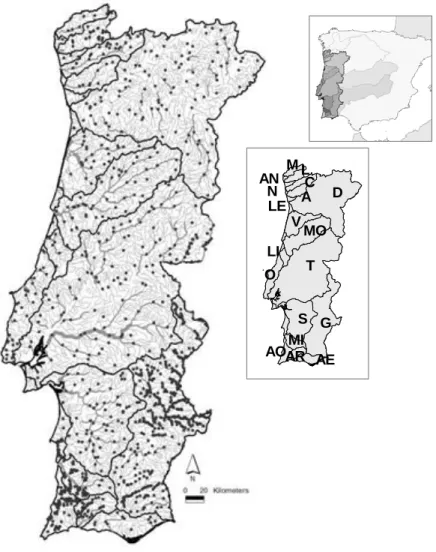
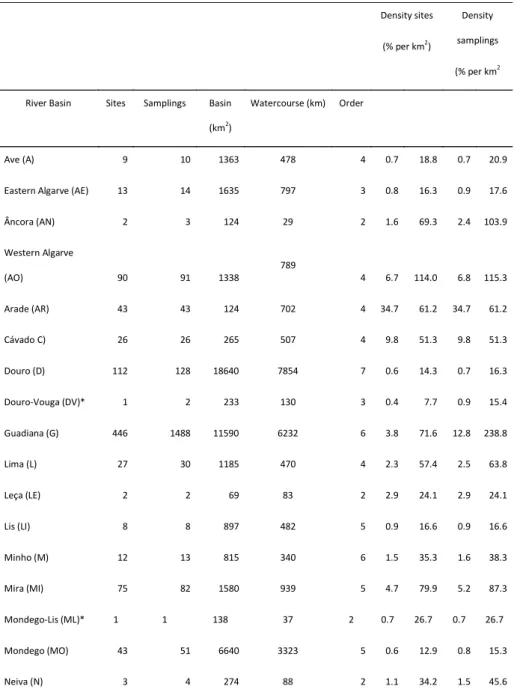
(19) independentemente de serem nativas ou não (i.e., invasoras). Uma primeira análise à InFISH.PT permitiu identificar potenciais lacunas e, assim, optimizar o processo de compilação, nomeadamente através da realização de amostragens adicionais, quando consideradas necessárias. Permitiu também evidenciar a importância de investir em procedimentos que permitam construir bases de dados de biodiversidade de elevada qualidade no que respeita à icitofauna continental. Deste modo, será potenciada a sua utilidade como ferramenta de base para investigadores, técnicos e gestores do território e educadores, tendo os Museus de História Natural um papel fundamental a desempenhar no processo de validação (Capítulo 2). Em segundo lugar, analisaram-se os padrões espaciais dos peixes de água doce na Península Ibérica com base em análises estatísticas de semelhança. Dos resultados das análises efectuadas, a variabilidade da composição de espécies das comunidades revelou-se fortemente associada aos limites das redes hidrográficas constituídos há 2,5-1,8 milhões de anos. De facto, desde essa época as bacias hidrográficas mantiveram-se isoladas, apenas com capturas pontuais (por exemplo, conexões temporárias de cursos de água usualmente independentes nas zonas médias ou de cabeceira e conexões hidrológicas na foz de bacias contíguas). Esses limites mostraram-se muito mais correlacionados com a composição das espécies do que com o clima actual, em particular, para as espécies primárias e secundárias. A dispersão e colonização dos organismos parecem ser os processos ecológicos mais relevantes à escala da Península. Partindo deste conhecimento, foram delineadas províncias biogeográficas para esta fauna. As onze províncias propostas constituem uma actualização de estudos biogeográficos prévios, que se basearam em dados considerados actualmente desactualizados relativamente às espécies existentes e às suas distribuições. Estes estudos anteriores também não se basearam nos limites das bacias agora considerados e, como tal, não permitiam examinar adequadamente a permeabilidade das bacias e inferir alguns processos de dispersão e colonização abordados no presente estudo (Capítulo 3). Seguidamente, analisaram-se os padrões espaciais das espécies piscícolas nos rios da área sudoeste da Península, tipicamente de carácter mediterrânico, com base em métodos estatísticos de regressão. Daí resultou que a riqueza local média encontrada nessas bacias hidrográficas é, em grande parte, explicada pelo total de espécies existente em cada bacia – o ‘’pool’’de espécies –, mesmo quando se distingue entre a riqueza das espécies nativas e invasoras já estabelecidas. Adicionalmente, as bacias com precipitação média anual elevada estão associadas a uma maior riqueza de espécies invasoras. Ao examinar em detalhe os padrões espaciais nas bacias hidrográficas dos Rios Mira e Guadiana, verificou-se que a riqueza local observada para ambos os grupos de espécies (nativas e invasoras) está associada às variáveis de paisagem que caracterizam cada local, como a sazonalidade da precipitação e o. vii.
(20) declive dos cursos de água. Mas as variáveis que caracterizam a estrutura da rede hidrográfica foram as mais explicativas, particularmente para as espécies nativas. Em geral, as variáveis à escala da paisagem explicaram grande parte da riqueza local das espécies analisadas, o que não implica que outras variáveis não tenham influência. Os resultados permitiram evidenciar que os processos de dispersão e colonização influenciam grandemente as comunidades estudadas (Capítulo 4). Por último, procedeu-se à análise comparativa de estudos relativos aos padrões espaciais dos peixes de água doce e às variáveis a eles associados que utilizaram dados à escala mundial, continental ou regional. A hipótese mais defendida é a que considera o clima contemporâneo como o factor mais associado às comunidades bióticas, pois estas foram capazes de adequar as suas áreas de distribuição às condições ambientais e, assim, eventuais marcas de eventos históricos poderão já não ser evidentes. Tal não foi confirmado nos resultados das análises efectuadas nesta dissertação e, após esta revisão bibliográfica, foi possível apontar a necessidade de realizar testes mais adequados que integrem, em situação de igualdade, os factores potencialmente mais relevantes, tal como foi agora efectuado. Esses testes poderão ajudar a corroborar, ou não, as hipóteses em debate (Capítulo 5). Os resultados obtidos apontam que os factores de larga escala têm uma forte influência na biodiversidade local, provavelmente em relação a processos de dispersão e colonização. Na realidade, diferentes factores actuam a níveis hierárquicos distintos. Em cada nível/escala, os factores predominantes divergem consoante os graus de tolerância fisiológica das espécies à salinidade e consoante são ou não oriundas de outras áreas biogeográficas. De realçar a importância da história das paisagens e das espécies, sendo que os ambientes contemporâneos têm também uma forte influência nas comunidades piscícolas actuais. De facto, as redes hidrográficas, tanto no que respeita ao limite das bacias hidrográficas (praticamente mantidas desde tempos geológicos relativamente remotos na Península) como à própria estrutura interna dessas bacias, foram fundamentais para explicar os padrões piscícolas contemporâneos. Também a associação do “pool” de espécies de cada bacia hidrográfica à riquea local reflecte a importância do passado dessas espécies e que levou à sua co-ocorrência nessas áreas. Por seu lado, as condições ambientais actuais revelaram-se também importantes para as comunidades piscícolas que habitam a Península Ibérica. O clima, juntamente com a topografia, está também associado à riqueza encontrada para as espécies invasoras nas bacias dos cursos de água a sudoeste. No interior das bacias hidrográficas, o clima local é relevante para a riqueza observada de espécies nativas e invasoras, nomeadamente, o seu carácter sazonal, embora as variáveis que reflectem a constituição da rede hidrográfica tenham sido mais preponderantes para as bacias analisadas. Assim, apesar. viii.
(21) da predominância dos factores históricos, o ambiente contemporâneo não deixou de se revelar importante, e os resultados não minimizam as consequências do impacto humano global, já bastante evidentes. Este estudo sugere que as marcas do passado poderão mesmo desaparecer se as alterações ambientais modificarem consideravelmente os padrões piscícolas actuais, pois os organismos, de entre aqueles que persistem, são forçados a dispersar e colonizar áreas menos adversas. Em síntese, a presente investigação, sendo inovadora nas metodologias e escalas utilizadas, contribuiu para o conhecimento dos padrães espaciais das comunidades actuais da ictiofauna dos cursos de água da Península Ibérica. Também enriqueceu debates científicos em torno dos temas abordados. A eventual fragilidade do estudo prende-se com a qualidade dos dados, a intercorrelação de alguns dos factores de paisagem e, por último, com a possível influência de factores não estudados, nomeadamente, dos relativos aos impactos humanos nos habitats. No entanto, não foram encontradas evidências de que estes aspectos possam ter afectado os resultados obtidos. As conclusões deste estudo têm consideráveis implicações para os investigadores destas temáticas, mas também para gestores do território e educadores. Nomeadamente, os resultados obtidos permitem uma melhor compreensão e consciencialização dos factores e processos ecológicos a larga escala, que influenciam as comunidades locais de peixes que habitam os cursos de água. No que respeita à conservação e gestão da ictiofauna, os desafios são inúmeros, pois este grupo faunístico é muito dependente do meio ribeirinho e, por consequência, os indivíduos encontram-se fortemente constrangidos pela conectividade das redes hidrográficas para dispersar e colonizar novas áreas. O sucesso destes processos é cada vez mais complexo, pois nessas áreas, se alcançadas, os indivíduos necessitam de condições climáticas adequadas e habitats disponíveis, o que é dificultado pela crescente destruição dos mesmos ou ocupação por espécies invasoras. Implicações detalhadas no contexto dos desafios ambientais prementes no âmbito europeu e global são mencionadas ao longo da dissertação, nomeadamente no que respeita: (1) à implementação de directivas europeias, como é o caso da Directiva Quadro da Água (DQA); (2) às alterações climáticas; e (3) à crescente homogeneização da fauna. As perspectivas de investigação mais pertinentes que emergem deste estudo prendem-se com a necessidade de (a) cruzar dados de biodiversidade (dados evolutivos, de riqueza e composição das comunidades, atributos biológicos e interacção de espécies) com a história das paisagens, ambientes contemporâneos e alterações ambientais (como as despoletadas pelas alterações climáticas), (b) examinar, nas comunidades contemporâneas, a influência de. ix.
(22) possíveis vias de dispersão no passado devido a alterações ambientais, (c) analisar o papel da pressão humana através da introdução de espécies nas comunidades. E, por último, (d) estudar processos ecológicos locais associados, por exemplo, às características biológicas e às interacções bióticas. Os desafios ambientais actuais exigem um maior conhecimento da biodiversidade dos cursos de água e a sua divulgação aos vários sectores da sociedade, de modo a fomentar a conservação das comunidades e dos seus habitats. Espera-se que a presente investigação tenha contribuído para tal, além de ter evidenciado a necessidade de abordagens mais integradas de investigação e acção. Por último, à medida que se encontaram respostas para as questões colocadas, novas questões, hipóteses, e problemas foram levantados para estudos futuros, os quais permitirão, certamente, avançar no conhecimento ecológico, a várias escalas, da biodiversidade ribeirinha.. Palavras-chave: comunidades piscícolas; conservação; cursos de água; influências da paisagem; Península Ibérica.. x.
(23) Summary Despite the threatened status of many freshwater fish species requiring attention, many questions about their biogeography and ecology remain unsolved. Modern analytical methodologies can help to solve this problem. The aim of this work was to examine the factors driving spatial patterns in Iberian freshwater fish species and the ecological processes involved. The focus was on investigating the composition and richness of stream assemblages across both Iberian Peninsula and south-western streams. In a first step, databases coupled with a Geographical Information System (GIS) were built with data from field observations (1997-2008) of freshwater fish species (Portugal and Spain). Databases allowed portraying local assemblages’ composition and richness, and crossing them with landscape describers. Attaining data voids helped obtaining complete and consistent data. The spatial variability of assemblage’s composition in the Iberian Peninsula was found to be strongly correlated with the hydrological basin boundaries, more than with current climate, especially for primary species; thus biogeographical provinces were delineated based on the former factor. Local richness for native and invasive species across south-western Mediterranean-type river basins was highly constrained by the regional pool of species. Within basins, stream network explained a large amount species variability patterns for both species groups but especially for the native ones, followed by climate and topography for both groups. Distinguishing among species, particularly concerning dispersal ability and alien origin clarified the patterns and processes involved. The literature review helped to compare findings with previous studies: our results did not support current climate as the main driver of current assemblages. More stringent tests are needed in future studies, as performed here. Results achieved have especially interest to researchers and managers, particularly to those focused on Iberian or Mediterranean-type fresh waters, and can constitute a knowledge basis, especially regarding the Water Framework Directive (WFD) context and for predicting future scenarios.. Keywords: assemblage composition and richness; conservation; Iberian Peninsula; landscape-scale; stream fish. xi.
(24) .. xii.
(25) Chapter 1. Introduction. Children’s Song. “Canção Infantil. It was an alder. After a watermill. And nearby a stream.. Era um amieiro. Depois uma azenha. E junto um ribeiro.. Everything so still. What could I do? I put everything in my pocket To not miss them.. Tudo tão parado. Que devia fazer? Meti tudo no bolso para os não perder.” Eugénio de Andrade, 1977, in "Primeiros Poemas".
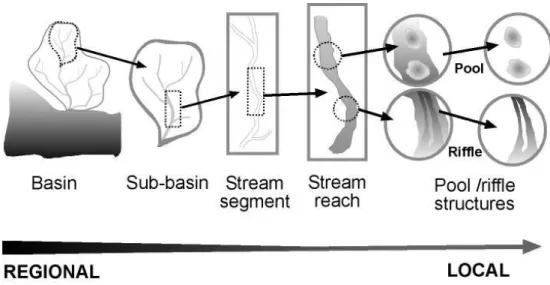
(26)
(27) Chapter 1. 1. Introduction Here, after describing the general problem statement and the pertinence of the work, both focal ecological topics and particulars of the study case – the freshwater fish in Iberian streams – are presented. At last, the study aims and the dissertation outline are described.. 1.1 Why study stream fish ecological patterns? How biodiversity patterns are generated in nature has long intrigued biologists. Currently, the impoverishment of biota is happening at unprecedented rates (e.g. Pimm, et al. 1995; Chapin et al., 2000; Vié et al., 2009), and the idea that we are now facing the sixth mass extinction on the earth has become generalized (see Eldredge, 1998). The biodiversity crisis has been widely noticed among the scientific community, and considerable efforts are being devoted to increase knowledge regarding the biodiversity patterns and the drivers related with biodiversity change (e.g. Gaston, 2000; Chapin, et al., 2000; Mace et al., 2005). Therefore, apart from the interest regarding biological research, acquiring a better knowledge of biodiversity patterns, their constraining factors, and biotic processes involved is crucial if we are committed to diminish the prevailing trend of the biodiversity loss and enhance the sustainable use of ecosystems to meet human needs (e.g. Millennium Ecosystem Assessment, 2005). The biodiversity of fresh waters is experiencing greater declines than the majority of terrestrial ecosystems, thus making prospects for biodiversity and services they provide alarming, especially in Mediterranean regions (e.g. Sala et al., 2000; Vié et al., 2009). From. 3.
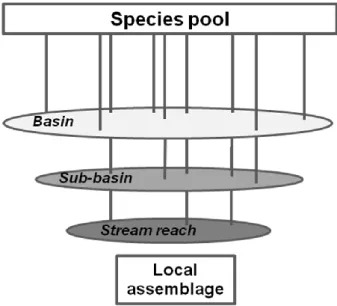
(28) Chapter 1. headwaters to large rivers, watercourses are currently threatened by landscape changes which lead to a loss, fragmentation, or degradation of habitats. The most recognized biodiversity threats include urbanization, land use and land cover changes, water impoundments (for water supply or electric power), as well as the introduction of non-native species and climate changes (e.g. Sala et al., 2000; Abell, 2001; Revenga et al., 2005; Dudgeon et al., 2006), for which recent efforts are being made to predict their effects (e.g. Buisson et al., 2008). The loss of freshwater biodiversity affects a broad cross-section of society since it has consequences at a range of highly valued ecosystem services, including fisheries, water supply, nutrient regulation, and recreation (Vörösmarty et al., 2005). In fact, there is a risk of depletion of the freshwater native faunas before we even know what has been lost, where it was located, or how the loss could have been prevented and freshwater services maintained (see Revenga et al., 2005). The world’s species diversity inhabiting fresh waters is disproportionately high as compared to other ecosystems (Vié et al., 2009): occupying only 0.8% of Earth’s surface, total species estimates on fresh waters are at least 100,000, nearly 6% of all described species. But a lack of knowledge regarding current and already extinct biodiversity components inhabiting fresh waters remains (Bailan et al., 2008). Among the freshwater taxa, fish are the best documented faunal group (Bailan et al., 2008; Lévêque et al., 2008), being, at the same time, seriously threatened: in the last updates of the worldwide IUCN Red List, freshwater fish amounted a high proportion of threatened species among the vertebrate species evaluated, registering alarming percentages: 37% worldwide (Vié et al., 2009), and 56% when only the Mediterranean endemic species are considered (see also Smith & Darwall, 2006). In the context of the current biodiversity crisis, improving knowledge on freshwater biodiversity and making it available is crucial for developing tools and actions for freshwater faunal conservation and ecosystem services maintenance (Bailan et al., 2008). The freshwater fish fauna might constitute a starting point to examine what drives current freshwater. 4.
(29) Chapter 1. biodiversity patterns and, ultimately, to understand the biodiversity patterns and processes observed in freshwater ecosystems and predict future changes.. 1.2 Stream ecosystems and ecological communities Among freshwater ecosystems, running waters - river and stream systems, here mentioned simply as streams - have a unique directional and hierarchical structure, where the environmental characteristics of surrounding and upstream landscapes have direct effects on the stream reaches downstream ( Allan & Johnson, 1997; Allan et al., 1997), and complex geomorphic and environmental processes operate at distinct scales (Frissell et al., 1986). The structure of streams comprises stream reaches within a stream segment, which is part of a watercourse (tributary or main stream) itself contained at a sub-basin of the whole river basin. In each stream reach, pool-riffle sequences can be found, being highly seasonal among Mediterranean-type streams, and ephemeral among temperate streams. Geomorphic and environmental characteristics at one level of the hierarchy influence successively lower levels, from broader scales variations to microhabitats found at the pool-riffle scale (Box 1.1, Fig. 1.1). For example, the topography and climate characteristics have a direct and indirect influence on catchment physiography, types of vegetation and soils, and ultimately, human uses characteristics; human uses by their turn influence sediment and water discharge regimes, setting the morphology and dynamics of the watercourses (e.g. Frissell et al., 1986; Naiman et al., 1992; Montgomery, 1999).. 5.
(30) Chapter 1. BOX 1.1 Stream spatial structures A range of terms and definitions regarding stream structures found across scales have been used in ecological and biogeographical studies, resulting in a difficult or inaccurate interpretation of data and results in spite of the stream structures constituting topographic and hydrological well defined units (Allan et al., 1997).. In this dissertation we followed the definitions of the hierarchical framework of Frissell et al. (1986) for scales and stream structures (see table below). Other authors classified the stream structures (Allan et al., 1997; Matthews, 1998). Terms are the ones used by Matthews (1998).. Stream hierarchical spatial structures commonly referred to in the literature. Terms typically used in this dissertation are shown in bold. Spatial structure. Description. Watercourses Stream reach. Part of a stream segment constituted by pools, rifles, and runs. Stream segment. Watercourse between confluences. Stream system. Watercourse composed of stream segments. Tributary. Watercourse flowing into main stream. Main stream. Watercourse flowed by tributaries. Hydrological basin network. Watercourses of a river basin constituted by tributaries and the main stream. Watercourses and draining areas Sub-basin. Area draining a tributary. Basin. Area draining into sea or ocean, with natural geographical barriers; also called river basin. Sub-catchment. General term for a draining area of small extent. Catchment. General term for a draining are a constituted by sub-catchments (correspond to sub-basins). Watershed. General term for a draining area of large extent (correspond to basin or sub-basin). Larger areas Biogeographical provinces. Ecozone 1 1. Area holding ecologically defined biotic communities (fauna, flora and/or ecosystems); also called ecoregion, biogeographic unit Area holding distinct biogeographical units. Also called realm. for recent delineation of the Freshwater Ecoregions worldwide see (http://www.feow.org; Abell et al., 2008).. 6.
(31) Chapter 1. Considering streams as hierarchical systems constituted the basis for adopting a heuristic framework of stream communities, which was firstly based on the faunal ‘filters’ concept proposed by Simpson (1953): the species constituting regional pool are ‘filtered’ (or ‘screened’) according with factors operating at distinct scales, resulting in a subset of species coexisting locally (Fig. 1.2). How a hierarchy of filters can affect stream fauna was firstly formalized by Smith & Powell (1971), and later on adopted by other researchers (e.g. Tonn et al., 1990; Poff, 1997), stating that the species are subjected to the existence of faunal filters progressively acting at finer spatial and temporal scales. The dynamic nature of filters through space and time was later on evidenced by Angermeier and Winson (1998).. Figure 1.1 Representation of the hierarchical spatial structures (landscape and habitats) found at streams across spatial scales. A stream reach is comprised by multiple pool-riffle units where multiple microhabitats are found. Reaches are contained within stream segments, forming a sub-basin, which is a tributary or the main stream of a river basin [adapted from Frissell et al. (1986b) to the range of scales mentioned in the present dissertation].. This framework - the hierarchical faunal filters – has been helpful to explain the processes that might be determining, at each scale, the ecological communities, by comparing. 7.
(32) Chapter 1. the differently filtered species regarding their biological attributes (fecundity, maximum age, body size, and physiological tolerance; Tonn et al., 1990; Poff, 1997; Jackson et al., 2001 Quist et al., 2005). For example, at the basin scale, history and climate (by controlling the potential range that any given species can occupy) may act on biogeographical processes such as species evolution and dispersal, thus shaping their distribution ranges. At the reach scale, contemporary factors as stream size (which affects habitat volume, food resources and stability) may filter species by the body size trait; biotic interactions are usually associated with the most local filter. If filters are minimal (as dispersal barriers, habitat variability, disturbance and biotic interactions), species occurring in a site are similar to the species pool (Angermeier & Winston, 1998).. Figure 1.2 The ‘filtering’ of species with certain attributes by landscape constraints, from broader to finer scales, resulting into the subset of species comprising the local assemblage. The environment or historical filters at regions or river basins restrict, at the sub-basin scale, the occurrence of species lacking certain traits, whereas the hydrological regime, among others, restrict the stream reach fauna, and so on to the microhabitat scale. Life-history and biological traits, and physiological limits of species define the filtering, as portrayed by the truncation of the vertical lines [adapted from Smith & Powell (1971) to the filters focused on the present dissertation].. 8.
(33) Chapter 1. The adoption of the hierarchical faunal filters as a general organization framework resulted as being useful in examining and understanding the drivers of species composition and richness, and particularly in the development of multiscale approaches, as previously refereed as by various stream ecologists (see Poff, 1997 and references therein).. 1.3 What drives the variability of patterns in stream fish communities? To begin with, some matters regarding the factors driving variations of species diversity and the involved processes are introduced, before particularising to the patterns found in stream. fish communities.. Detecting drivers and examining processes Patterns in ecological communities - the distribution, richness and diversity of species - depend on a complex interplay between processes acting at distinct temporal and spatial scales (Menge & Olson, 1990). At local-scale, processes as predation and competition, and adaptation to resources, disturbance or stochastic variations influence communities. At larger scales processes of speciation, dispersal, and colonization play their role (Ricklefs, 1987; Godfray & Lawton, 2001), and factors such as latitude, water availability, and long-range dispersal pathways act on shaping biological patterns (e.g. Menge & Olson, 1990; Willis & Whittaker, 2002). Moreover, ecological patterns and processes have been often documented as being scale dependent, and scale is now largely recognized as a critical component when examining ecological patterns in nature (Wiens, 1989, 2002a; Box 1.2). Among the factors to incorporate when investigating ecological communities, evidences have been given to the necessity of accommodate spatial characteristics of landscapes in spatial explicit approaches, whether these factors can constitute a statistical nuisance or a characteristic of interest (e.g. Dutilleul, 1993). Particularly, it has been proposed. 9.
(34) Chapter 1. checking for the presence of spatial autocorrelation in species or environmental data (Legendre & Legendre, 1998) should be a preliminary step in ecological studies dealing with large-scale patterns (Legendre, 1993; Diniz-Filho et al., 2003). An important consequence of dealing with spatially autocorrelated data is the potential statistical problem it brings with it, as important assumptions of standard statistical tests are violated, namely that the values of studied variables are independent among data points (Cliff and Ord, 1981; Legendre, 1993; Araújo & Guisan, 2006). This can affect the outcome of analyses regarding the relationships between the dependent biotic and the explanatory variables, particularly when the dependent variable exhibits some autocorrelation (see Diniz Filho et al., 2003); Lennon 2000). But positive spatial autocorrelation can indicate local communities are driven by biotic confounding processes operating at larger scales, as dispersal ability of organisms and colonization events; conversely, no spatial autocorrelation can suggest that biotic confounding processes might not be playing an important role (e.g. Selmi & Boulinier, 2001).. BOX 1.2 Scale dependency and components Scale dependency occurs if a relationship (form and/or parameterization) changes with grain or extent (Wiens, 1989, 2002a; Willig et al., 2003). Therefore the scale of investigation studies determines the range of patterns and processes that can be detected, and any inferences on scale dependency in a system are constrained by the scale of investigation (Wiens, 1989). When referring to spatial or temporal scale, two components are involved which define the upper and lower limits of resolution of a study (O’Neill, 1988; Wiens, 1989; Whittaker et al., 2001): grain is the size of the unit of analysis, and extent is the area or time scope of the study.. The spatial grain is normally coincident with the sampling resolution (or larger), while the spatial extent refers to the size of the study area. In studies on stream fish, spatial grain can vary along the stream hierarchical structure, ranging 2 2 between >10 m to >10,000 m , depending on sampling method, effort performed, and/or dataset used, but usually corresponds to stream reaches. The study area can encompass a wide range of stream structures, from microhabitat to river basins or the world surface (Matthews, 1998).. One solution to obtain reliable outputs is to perform statistical procedures that incorporate the spatial structure of landscapes in alternative to spatially independent approaches, specially when the considered variables, or the residuals of the analyses, are likely. 10.
(35) Chapter 1. to be spatially autocorrelated (Segurado & Araújo, 2004; Segurado et al., 2006; Dormann et al., 2007). As expected, the spatial variance can be also dependent on the scale of the investigation (Wiens, 1989).. BOX 1.2 Spatial autocorrelation Spatial autocorrelation occur when locations close to each other exhibit more similar values of certain attribute - positive autocorrelation or less similar - negative autocorrelation - than those further apart (Cliff & Ord, 1973).. Significance of spatial autocorrelation is calculated by comparing observed data with the expected values if the variable was not dependent of geographic location (Legendre & Legendre, 1998).. The fact we are now facing a biodiversity crisis has lead to a special concern on identifying the factors that determine biodiversity patterns and understanding the ecological processes behind (Godfray & Lawton, 2001; Willis & Wittaker, 2002). Despite the increasing number of empirical studies on patterns of biodiversity at larger scales (e.g. Fraser & Currie 1996; Saab, 1999; Valone & Hoffman, 2002), most studies have been conducted for terrestrial systems, thus enhancing a demand of studies conducted for freshwater biodiversity components (Abell, 2002; Olson et al., 2002).. The stream fish ecological communities Stream fish communities can be influenced by landscape factors at several scales (see Bain & Finn, 1988; Angermeier & Schossler, 1989; Rahel & Hubert, 1991; Schlosser, 1991, 1995). Some factors such as latitude, geological history, but also climate and topography (e.g. Tonn et al., 1990; Ricklefs & Schulter, 1993) operate on stream fish diversity over large spatial and temporal scales across and within river basins on processes such as speciation and dispersal (Livingston et al., 1982; Hughes et al., 1987; Hugueny, 1989; see Chapter 5). At finer spatial and temporal scales, the water flow across a fluvial landscape is thought to be the key factor describing fish species diversity, as it can have a strong effect on many other local abiotic. 11.
(36) Chapter 1. factors (e.g. Johnson et al., 1995; Poff & Allan, 1995; Sparks, 1995; Pegg & Pierce, 2002). Interactions among species, as competition, may structure the coexistence of species, but empirical evidences are not consensual about their relevance (e.g. Peres-Neto, 2004). Environmental disturbances (as climate change and other anthropogenic influences) are leading to species extirpation, and community recovering will depend on colonization events more than local processes (e.g. Angermeier & Winston, 1998;Buisson et al., 2008). Although the importance of multiple constraints across scales was recognized regarding the patterns and processes of biota inhabiting streams (see previous chapter section), current knowledge remains restricted to few taxa and ecosystems, for which datasets are available (Matthews, 1998; Bailan et al., 2008; see also Chapter 2). Also, few studies have examined the patterns across scales and their likely landscape constraints simultaneously and on an equal footing, and distinguishing species with distinct life-history traits [but see Labbe & Fausch (2000); see also Chapter 3 and 4]. Finally, as previously referred, progresses on stream ecology are far from being properly considered and referenced by ecologists from other fields, and thus to integrate holistic ecologic debates (Menge et al., 2009; see also Chapter 5). Therefore, there is a wide range of questions that remain unexplored. This is not surprising, since traditional stream ecology was dedicated to matters measured at small spatial scales (Matthews, 1998), and it was not until the 1990s that more generalized patterns across large scales started to be examined (see Lawton, 1999). In fact, the traditional view of stream ecologists before the 1990s was focused mainly on local population trends and habitat quality, but the improvement of computer capabilities, data available at larger scales and new and complex analytical methods triggered the recognition that freshwater populations persistence may depend on processes operating at broader temporal and spatial scales, namely at the basin and catchment scale (see Box 1.1 and Chapters 3 and 4). The importance of landscape characteristics was already implicit at previous works as the ‘river continuum’ concept (Vannote et al., 1980), but the emphasis was given later on with the development of the landscape ecology approach extended to freshwater systems (Wiens, 2002b), where the. 12.
(37) Chapter 1. spatial characteristics of landscapes were highlighted. New technology, namely on Geographic Information Systems (GIS) and analytical methods, are opening new possibilities for developing innovative ecological studies at broad scales and addressing some largely unanswered questions, and simultaneously providing new knowledge to meet management challenges. Studies have been showing that stream biotic and abiotic processes are complex, as they may operate simultaneously and be scale dependent (e.g. Palmer & Poff, 1997; Box 1.2). Scale dependency on patterns of stream biodiversity has been documented regarding a number of factors, from environmental variables, as habitat heterogeneity to spatial structure of streams (Lancaster & Belyea, 1997; Palmer et al., 2000; Fagan et al., 2002, 2005; Pegg & Taylor, 2007).Because of the noticeable spatial nature of streams, the spatial structure of data was considered at landscape-scales since the early times of stream ecology (e.g. Hugueny & Lévêque, 1994; Matthews & Robinson, 1998; Wilkinson & Edds, 2001). For example, some traditional geomorphic variables used to describe stream network configurations were adopted in studies to examine biotic variation along the upstream-downstream gradient and referred as determinant on shaping stream communities (see Mathews, 1998), and continue being used (e.g. Filipe et al., 2002, 2004; Grenouillet et al., 2004). These measures reflect the stream size at each site and describe upstream characteristics relative to the entire drainage upstream [e.g. the drainage area, stream order (Strahler, 1964; Shreve, 1967), and tributary spatial position (Osborne & Wiley, 1992)]. Currently, notable advances in the GIS treatment of stream networks allow building, accurately and at large-scale extents, spatial and geomorphic variables for streams, and also calculating distances between sampling locations along the stream paths (Box 1.3).. 13.
(38) Chapter 1. BOX 1.3 Geographical distance measures in streams Spatial distances between sampling sites of organisms that are exclusively depend on watercourse as fish are better addressed by network distances than by the Euclidian distances commonly used for overland distances (Box 1.3; e.g. Olden et al., 2001; Beisner et al., 2006). New tools for stream ecologists to calculate distances among sampling sites at Geographic Information Systems (GIS) allow calculating stream distances. Those distance measures may include directional characteristics of the network, from upstream to downstream reaches (e.g. Ganio et al. 2005, Peterson et al., 2006).. Distance between sampling sites at a stream network can be measured either as the shortest distance between two points (Euclidian distance, full line d2) or as the distance along the network pathway (dashed line d1).. Analytical techniques are able to statistically reduce the stream distances calculated on a set of spatial predictors (e.g. Principal Coordinates of Neighbour Matrices approach PCNM; Borcard & Legendre, 2002).. As a synthesis, an array of patterns and processes has been examined in freshwater biota, particularly regarding assemblages variability. Although some studies provided multiscale approaches (Downes et al., 2000; Labbe & Fausch, 2000), or considered explicitly the spatial structure of data (e.g. Heino et al., 2002; Grenouillet et al., 2004), advances in the species datasets and tools available are opening new opportunities of research.. 14.
(39) Chapter 1. 1.4 The case study: the Iberian stream fish The freshwater fish assemblages inhabiting the Iberian Peninsula streams offer an excellent model system to study the biodiversity patterns across space because of the highly diverse stream habitats and hydrological networks with well defined boundaries and pathways, which embrace an endemic and threatened fish community with a diversification history of species rather complex but considerably well known. Moreover, there is an absence of studies regarding this fauna, or the remnant freshwater faunal groups, aiming to explore the observed patterns across the peninsular landscape and driving factors involved. Studying this stream fauna allows performing specific empirical tests that can illuminate the ecological processes acting in face of the strong spatial constraints of dispersal to aquatic pathways. A particular emphasis was given to the Mediterranean-type south western streams because they comprise a highly endemic fish fauna, for which analyses across the region are scarce, but a considerable amount of data is available (but see some studies on within-basin extents, as Collares-Pereira et al., 1999; Magalhães et al., 2002; Filipe et al., 2002). Next, the characteristics of the Iberian Peninsula landscapes and of the fish fauna inhabiting these streams are presented. A more detailed characterization of the specific study-cases considered - the Iberian Peninsula (IP) and the south-western Iberia (SW) and their fish species - i s given in Chapter 3 and 4, respectively.. Iberian Peninsula Despite its size (581,000 km2, Fig. 1.3), the Iberian Peninsula (IP) has a remarkable landscape diversity as a consequence of its biogeographical location, climate transition between the Eurosiberia and the Mediterranean, and topography, with large mountain ranges primarily oriented east-west and a high central plateau, called the “Meseta” (Rivas-Martinez, 1987). The highly unique biodiversity of the Peninsula is attributed to the past events of (1) speciation enhancement and population’s differentiation, (2) preservation of the existent fauna during. 15.
(40) Chapter 1. glacial periods on refuge areas, or (3) inhibition of North-South biotic migrations (e.g. Puente et al., 1998; Vargas et al., 1998; Doadrio, 2002). Located at the western part of the Palaearctic Realm facing the Atlantic Ocean, the IP is geographically isolated from North Africa by the Atlantic Ocean and Mediterranean Sea (Strait of Gibraltar), and from Europe by the Pyrenees Mountain Chain. A wide range of microclimates can be found across the landscape, including the Alpine Climate in the high mountains, but mostly there are two major climatic zones, the Mediterranean and the Atlantic (Font Tullot, 1983). Most of IP has a Mediterranean climate, which is typically highly seasonal, with warm and dry summers, and cool and wet winters. In contrast, the Atlantic climate, mostly located along the western and northern coasts and the Pyrenees Mountains, is wetter, cooler and less seasonal (Fig. 1.3). Across IP mean annual temperatures oscillate between 2.2 ºC and 19 ºC, and total annual precipitation between 203 and 2990 mm (Font Tullot, 1983). These climatic zones host an enormous diversity of vegetation types, from deciduous and coniferous forests to sclerophyllous woodlands or annual steppe grasslands (Rey-Benayas & Scheiner, 2002).. Figure 1.3 Main geographical features of the Iberian Peninsula (adapted from Alcaraz et al., 2006).. 16.
(41) Chapter 1. The stream network that can be presently found at IP date from the PliocenePeistocene (2.5-1.8 Ma ago) (Calvo et al., 1993; Box 1.4) and are mostly of temperate and Mediterranean-type regimes following the landscape gradients referred above (Fig. 1.4). Mediterranean streams are normally found at the southern regions of IP, but also at some northern areas, whereas temperate streams are mostly located at the northern Atlantic areas. Temperate streams are mostly permanent with a flow regime dominated by flooding events, whereas Mediterranean streams are temporary, dominated by seasonal events, mostly climate driven by floods and dry periods (Gasith & Resh, 1999; Pardo & Álvarez, 2006). The riparian corridors of temperate streams are dominated by deciduous species with pulses of litter fall coupled with the vegetative seasonal activity, while riparian vegetation of Mediterranean streams is dominated by evergreen plants (Rey-Benayas & Scheiner, 2002).. Temperate. Mediterranean. . Figure 1.4. Climatic diagrams for the Atlantic coast (Ponte Areas; Vigo, Spain) and for the Mediterranean coast (Can Serra, Pollensa; Spain). Stream regimes follow these climatic gradients and therefore they have a temperate or Mediterranean-type regime (adapted from Pardo & Alvarez, 2006).. 17.
(42) Chapter 1. Iberian stream fish The Iberian freshwater fish fauna has relatively few species and most are endemic and highly threatened (Doadrio, 2002; Rogado et al., 2005; Smith & Darwall, 2006; Fig. 1.5).. Figure 1.5 Species richness of threatened endemic freshwater fish in the western Mediterranean. The greatest concentration in whole western Mediterranean area of threatened endemic freshwater fish is located in the Lower Guadiana River in southern Iberian Peninsula (adapted from Smith & Darwall, 2006).. Regarding the potential ability to disperse, according with Darlington’s classification (1957), most of native fish inhabiting Iberian freshwaters (Cyprinids family) are unable to disperse throughout salt waters – ‘primary’ species. A fewer number of species are seawatertolerant – the ‘peripheral’ species – and probable migrate back and forth from sea to freshwaters during their life-cycle or simply have occupied freshwaters during recent evolutionary times. An even smaller number of species inhabiting fresh waters is able of making limited incursions into seawaters, because of a partial tolerance to this environment – the ‘secondary’ species. Phylogenetic studies of some primary freshwater fish species indicated speciation was related to the formation of the current hydrographical network (namely for the genus. 18.
(43) Chapter 1. Squalius,. Barbus,. Achondrostoma,. Iberochondostoma,. Parachondrostoma,. and. Pseudochondrostoma; Doadrio et al., 2002; Cunha et al., 2004; Mesquita et al., 2007; Robalo et al., 2006a,b; Box 1.5). By contrast, the current distributions of peripheral fish species, tolerant to salt waters, are likely limited by other factors beyond terrestrial boundaries (Lucas et al., 2001). River basin boundaries have been used to describe the current distribution of freshwater fish species in the Iberian Peninsula, but such descriptions did not include the current amount of data available on species taxonomy and distribution, or phylogeny (see for references Chapter 3 and also Appendix I).. BOX 1.5 The Iberian Peninsula geological history Some geological evens might have influenced the current biodiversity patterns of freshwater fish, and therefore some of the history of the Iberian Peninsula is here described. Cyprinids colonized the Iberian Peninsula at the end of the Oligocene Epoch (Tertiary Period), 28 Ma1 ago. At this time this region had a quite distinct icthyofauna from the current one, as Characiforms, Siluriforms and other tropical fish fauna (De la Pena, 1995). During the following Miocene and main part of Pliocene Epoch (11–5 Ma), endorrheic drainages were formed along active geological faults (Calvo et al., 1993), and ~5.59 Ma the African and Iberian continental margins joined by a land corridor for about 260,000 years and lead to the partial evaporation of the Mediterranean Sea (the Messinian Salinity Crisis; Duggen et al., 2003). During the latter Pliocene and early Pleistocene (2.5-1.8 Ma), the current hydrographic network was formed (Calvo et al., 1993).. 1. At the Quaternary Period, during the Pleistocene, a succession of glaciations occurred (1.80 – 0.11 Ma) which resulted on partial ice coverage’s and consequent ice retreats across the Peninsula, accompanied by fluctuations of the sea level. These environmental changes are likely to have provoked alterations in inland fish species distributions, dispersal, colonization, and genetic subdivision or admixture of species (e.g. SousaSantos et al., 2007). Particularly, in the last glaciation (Würm, 16,000-18,000 years ago), the sea level along the Atlantic cost of Iberian Peninsula was estimated to be 130-140 m below the contemporary level, which might have allowed interconnection between river mouths of some adjacent rivers (Dias et al., 2000). In summary, since ~1.8 Ma ago the river basin boundaries constituted the main land barrier to dispersal of freshwater biota across the Peninsula, with few punctual stream captures and formation of pathways between neighbour river mouths likely to have occurred afterwards.. 6. Ma =10 = one million years. 19.
(44) Chapter 1. Regarding the current assemblage patterns of stream fish in the Iberian Peninsula, examining within and across river basins at some regions reported a strong heterogeneity of the patterns observed, and also that such heterogeneity is highly correlated with current environmental attributes (e.g. Carmona et al., 1999; Corbacho & Sánchez, 2001; Filipe et al., 2004; Mesquita et al., 2007). Particularly, those patterns have been associated with the typical ecological fluctuations across time and space in Mediterranean-type streams (Filipe et al., 2002; Magalhães et al., 2008). Among the environmental attributes associated with stream fish assemblage variation, variables of landscape context seem to have a determinant role and, at least in some Mediterranean-type streams, a substantial proportion of the assemblage composition may be explained by such large-scale factors, irrespective of microhabitats and local biotic interactions (Magalhães et al., 2002; see Chapter 4), whereas local abundances seem more driven by the habitat attributes (Mesquita et al., 2007). For temperate-type streams, assemblage composition of fish has been commonly associated with local habitat attributes, but there are evidences that landscape features might be determinant on shaping those patterns (e.g. Godinho et al., 1997, 2000; Santos et al., 2004; Ferreira et al., 2008). The majority of the established non-native species are piscivore amd belong to a wide spectrum of families which were introduced in Iberian inland waters (Centrarchidae, Cichlidae, Esocidae, Fundilidae, Ictaluridae, Percidae, Poeciliidae and Siluridae). They were introduced mainly because of recreational fisheries interests (Alcaraz et al., 2005; Ribeiro et al., 2009a). Analysis of their spatial distribution is being used to detect introduction and invasion routes, and to predict future invaders (see Chapter 4); for example, most non-native species have been dispersing by pathways from France to Spain and from Spain to Portugal (García-Berthou et al., 2005; Ribeiro et al., 2009b). 20.
(45) Chapter 1. 1.5 Study aims and approach As previously introduced, examining and understanding stream fish biodiversity patterns is scientifically interesting, but also imperative to the conservation and management of freshwater communities. Particularly, increasing knowledge of Iberian freshwater fish is required to management and conservation strategies and actions in the Peninsula since : 1) freshwater fish species are heavily endangered (Smith & Darwall 2006; section 1.4); 2) freshwater faunas are likely to be heavily affected by climate change, and predictions indicate freshwater fish biota will have difficulties on tracking with the subsequent environmental changes (e.g. Magalhães et al., 2008; Buisson et al., 2008); and 3) there is the compromise established by the Water Directive Framework (WDF) between European Community statemembers of achieving and maintaining good water status by 2015 (see www.euwfd.com/ website). Improving scientific knowledge on stream fish will help on building problem solving tools for freshwater conservation and management, which is a necessary investment in face of the threats to these ecosystems, their biodiversity, and ultimately to the services they provide (Millennium Ecosystem Assessment, 2005). performing the current dissertation aims to contribute to a better knowledge of the spatial patterns freshwater fish. In this context, the general objective of this dissertation was to examine the spatial patterns of species composition and richness in Iberian freshwater fish stream communities, and the ecological processes involved. In this context, some particular questions were formulated: (I). How complete, congruent and accurate are the data available for the native fish species of Portuguese mainland freshwaters? Which uncertainties and voids can be identified? How improvements on data collecting and gathering at biodiversity databases can be achieved?. 21.
(46) Chapter 1. (II). How does the diversity of native fish species vary across the Iberian Peninsula? Is there any distinctness among groups of species with different ability to disperse? What influence most the spatial distribution of these communities: the current environment or the historical constraints? What biogeographical regions can be defined based on this fauna?. (III). Does stream fish species richness vary among the South-western river basins? How much distinct landscape factors (as basin’s species pool, area, and environmental attributes) contribute to the local species richness found between basins? And within basins, how much environmental gradients and spatial structure account the species richness variability? Are the answers different for native and for invasive species?. (IV). What gaps in knowledge exist regarding the freshwater fish patterns found in nature? What are the possible ways to improve that knowledge? Which empirical tests on freshwater biodiversity might be the more useful?. To address these questions we used large-scale datasets of species occurrences to perform empirical tests. Achievements were framed on the current scientific knowledge by making a literature review. The study was based on a macroecological approach, which encompasses the traditional ecology and biogeography disciplines, and offers the possibility of answering some central questions regarding the spatial species patterns, while taking advantage of the current technological advances (Brown, 1995; Brown & Lomolino, 1998; Gaston & Blackburn, 2000). The focus was directed to ecological matters currently in debate on general and/or fresh waters specialized literature, and analytical procedures were based on correlations and multivariate statistical techniques to examine the variation of community attributes using. 22.
Imagem


+7



Documentos relacionados
Abstract: Objective: To contribute to the knowledge of patterns of spatial and seasonal distribution of composition and species richness of flagellate protozoa in tropical
The probability of attending school four our group of interest in this region increased by 6.5 percentage points after the expansion of the Bolsa Família program in 2007 and
Greater frequency of rotavirus was found to oc- cur between zero to 12 months old chil- dren.. Within this range of age the greater number of GEA and rotavirus
A produção e a padronização de documentos estão ligadas, pois uma produção de documentos sem a observação das normas e padrões pertinentes pode levar à
personalidade jurídica da empresa sub judice. Ora, o devido processo legal é o que se encontra instaurado, e a desconsideração como tal resulta de fato incidente neste mesmo
Plano de Ação II - NAJF Reunião com a direção do Núcleo Ambulatorial para apresentação do projeto e autorização para a intervenção; Reunião com os coordenadores
Existia uma relação pedagógica muito satisfatória entre as professoras (a titular e as de apoio) e os alunos, bem como com os restantes colegas, o que era bastante positivo, pois as
