M
ASTER OF
S
CIENCE IN
C
IÊNCIAS
E
MPRESARIAIS
M
ASTERS
F
INAL
W
ORK
D
ISSERTATION
SMES ACCESS TO FINANCE
:
PORTUGAL AND SPAIN CASE
M
ARTA
A
NDREIA
S
IMÃO
C
ORREIA
M
ENDONÇA
Page 2 of 2
M
ASTER OF
S
CIENCE IN
C
IÊNCIAS
E
MPRESARIAIS
M
ASTERS
F
INAL
W
ORK
D
ISSERTATION
SMES ACCESS TO FINANCE
:
PORTUGAL AND SPAIN CASE
M
ARTA
A
NDREIA
S
IMÃO
C
ORREIA
M
ENDONÇA
S
UPERVISOR
(
S
):
PROF.
JOSÉ
MANUEL
DIAS
LOPES
Acknowledgments
I wish to thank Professor José Dias Lopes, who managed to not only direct me with valuable
suggestions and recommendations, but also encouraged me to pursue my goal. I could not
wish for a better tutor – thank you for your openness and friendliness.
I also would like to thank my family who has given me the strength, the affection and
courage to pursue this new chapter of my life.
Lastly but certainly not least, to Ruben Oliveira for always pushing me forward, even in my
darkest moments.
Resumo
O princípio de “Acesso ao Financiamento” do SBA não está a ser aplicado de forma igualitária
nas PMEs da Europa. Mais especificamente, o desempenho de Portugal e Espanha ainda está
muito abaixo das médias europeias. As boas práticas da aplicação do SBA e das políticas
governamentais para apoiar as PMEs desenvolvidas no mundo estão disponíveis, mas as PMEs
portuguesas e espanholas ainda têm muita dificuldade em aceder a recursos financeiros. Este
estudo propõe uma análise dos problemas de acesso ao financiamento das PMEs em Portugal e
Espanha, assim como das suas estruturas de suporte – políticas e instrumentos. Este também tem
o objectivo de desenvolver um conjunto de recomendações para melhorar o acesso ao
financiamento das PMEs, utilizando práticas de países europeus e não-europeus. Para este fim,
criou-se um estudo documental através de documentos governamentais portugueses, espanhóis e
europeus. Conclusivamente percebeu-se que as políticas mundiais podem funcionar como um
incentivo para o aumento do desempenho das PMEs em Portugal e Espanha, assim como podem
contribuir para o desenvolvimento económico, caso sejam adaptadas à realidade de cada país, se
na sua implementação envolverem todas as entidades responsáveis e, em especial, se forem
sujeitas a avaliações de impacto.
Palavras-chave: PMEs, Acesso ao Financiamento, SBA, Estruturas de Suporte, Portugal,
Abstract
SBA principle “Access to Finance” and its’ country progress is not being evenly translated
into practice for SMEs across Europe. Moreover, Portuguese and Spanish performance is still
considerably behind European average. EU good practices on SBA performance and
government policies to improve SMEs access to finance in the world are available, but both
Portuguese and Spanish SMEs still struggle to access financial resources. This study provides
an analysis of the existing problems in SMEs access to finance in Portugal and Spain, as well
as their support structures – policies and instruments. It also intends to develop policy
recommendations to improve SMEs access to finance, in light of the research findings on
practices in European and non-European countries. To this end, a documentary research
through EU and Portuguese and Spanish governmental documents was carried out. As a
result, it was concluded that policy practices worldwide may act as policy recommendations
to boost SMEs performance in Portugal and Spain, as well as contribute to economic growth,
if they are adapted to the national frameworks, if they involve all parties in their development
and implementation, but especially, if they are a subjected to impact evaluations.
Table of Contents
1.! Introduction ... 1!
1.1!
Objectives ... 2!
2.! Literature Review ... 3!
2.1!
SMEs – definition and characterization ... 3!
2.2!
SMEs Access to Finance Problem ... 4!
2.3!
SMEs Access to Finance Support Structures (policies and instruments) ... 7!
2.3.1
!
Policies to Support SMEs Access to Finance ... 7
!
2.3.2
!
Instruments to Support SMEs Access to Finance ... 10
!
2.4!
Portugal and Spain Case ... 11!
2.4.1
!
Portugal: SMEs and Access to Finance ... 12
!
2.4.2
!
Spain: SMEs and Access to Finance ... 13
!
3.! Research Methodology ... 15!
3.1!
General Aspects ... 15!
3.2!
Research Design and Process ... 16!
4.! Data Analysis ... 19!
4.1.1
!
SMEs Access to Finance Problems: Portugal and Spain ... 19
!
4.1.2
!
SMEs Access to Finance Support Structures: Portugal and Spain ... 23
!
4.1.3
!
SMEs Access to Finance Support Structures: Worldwide Practices ... 24
!
4.1.4
!
SMEs Access to Finance Problems and Support Structures Evaluation ... 24
!
4.1.5
!
Policies and instruments recommendations to support Portuguese and Spanish SMEs Access
to Finance ... 28
!
5.! Conclusions, Contributes, Limitations and Future Research ... 31!
6.! Bibliography and References ... 34!
List of Tables
TABLE I: DATA ANALYSIS MATRIX ... 18!
TABLE II: GENERAL ECONOMIC OUTLOOK PROBLEMS ... 19!
TABLE III: BUSINESS CHARACTERISTICS PROBLEMS ... 19!
TABLE IV: ADMINISTRATIVE PROCEDURES PROBLEMS ... 20!
TABLE V: BANK FINANCING PROBLEMS ... 21!
TABLE VI: EQUITY FINANCING PROBLEMS ... 22!
TABLE VII: TRADE CREDIT FINANCING ... 22!
TABLE VIII: OTHER SOURCES OF FINANCING PROBLEMS ... 22!
TABLE IX: PORTUGUESE EVALUATION ... 25!
TABLE X: SPANISH EVALUATION ... 27!
TABLE XI: POLICIES AND INSTRUMENTS RECOMMENDATIONS - PORTUGAL 29!
TABLE XII: POLICIES AND INSTRUMENTS RECOMMENDATIONS - SPAIN ... 30!
TABLE XIII: BUSINESS DEMOGRAPHY FROM EUROPEAN ECONOMIES ... 40!
TABLE XIV: ENTERPRISES, EMPLOYMENT AND GROSS VALUE ADDED OF SMES IN
EU-27 FOR 2012 ... 40!
TABLE XV: TYPES OF FINANCIAL RESOURCES ... 40!
TABLE XVI: SBA PRINCIPLES ... 41!
TABLE XVII: SBA 6
THPRINCIPLE TRANSLATION INTO PRACTICE ... 42!
TABLE XVIII: SBA REVIEW TRANSLATION INTO PRACTICE ... 42!
TABLE XIX: PORTUGUESE SMES CHARACTERIZATION ... 42!
TABLE XX: SPANISH SMES CHARACTERIZATION ... 43!
TABLE XXI: DISTINCTIONS BETWEEN QUANTITATIVE AND QUALITATIVE DATA
... 43!
TABLE XXII: PORTUGUESE POLICIES ... 44!
TABLE XXIII: PORTUGUESE INSTRUMENTS ... 46!
TABLE XXIV: SPANISH POLICIES ... 48!
TABLE XXV: SPANISH INSTRUMENTS ... 51!
TABLE XXVI: ACCESS TO FINANCE EUROPEAN GOOD PRACTICES ... 52!
TABLE XXVIII: ACCESS TO FINANCE POLICY RECOMMENDATIONS ... 58!
List of Figures
FIGURE 1: SMES CATEGORIZATION CRITERIA ... 59!
FIGURE 2: LINKING FRAMEWORK BETWEEN ENTREPRENEURSHIP AND ECONOMIC
GROWTH ... 59!
FIGURE 3: MAIN PROBLEMS OF EUROPEAN SMES ... 60!
FIGURE 4: COMPANIES’ MOST PRESSING PROBLEMS – CHANGES BY YEAR .. 60!
FIGURE 5: FINANCING STAGES ... 61!
FIGURE 6: COMPANIES’ USE OF INTERNAL AND EXTERNAL FINANCING IN THE
PAST SIX MONTHS ... 61!
FIGURE 7: EU FINANCIAL POLICIES AND INSTRUMENTS AT SMES EACH LIFE
STAGE ... 62!
FIGURE 8: PORTUGAL’S SBA PERFORMANCE ... 62!
FIGURE 9: SMES MOST PRESSING PROBLEM – ACCESS TO FINANCE ... 63!
FIGURE 10: SUPPORT POLICIES TO SMES ACCORDING WITH LIFE CYCLE ... 63!
List of Abbreviations
AFI: Alliance for Financial Inclusion
AusAID: Australian Agency for International
Development
CGD: Caixa Geral de Depósitos
DGIPYME: Dirección General de Industria y
de la Pequeña y Mediana Empresa
EBAN: European Business Angel Network
EC: European Commission
ECB: European Central Bank
EIB: European Investment Bank
EIF: European Investment Fund
EU: European Union
ERDF: European Regional Development Fund
ESF: European Social Fund
EVCA: European Venture Capital Association
GIZ or GmbH: German Society for
International Cooperation
IBRD: International Bank for Reconstruction
and Development
IDA: International Development Association
IFC: International Finance Corporation
IMF: International Monetary Fund
IAPMEI: Instituto de Apoio às Pequenas e
Médias Empresas e à Inovação
JEREMIE: Joint European Resources for
Micro to Medium Enterprise
KfW: Kreditanstalt für Wierderaufbau
MIGA: Multilateral Investment Guarantee
Agency
OECD: Organization for Economic
Co-operation and Development
R&D: Research and Development
SECO: State Secretariat for Economic Affair
SMEs:
Small
and
Medium-Sized
EnterprisesUNCDF: United Nations Capital
Development Fund
USAID: US Agency for International
Development
1. Introduction
In Europe, SMEs represent more than 99% of all businesses (EC, 2011a). Even though they
have different natures which includes – crafts, micro-enterprises, family owned or social
economy enterprises –, and different national and local environmental operating conditions
(CEC, 2008).
SMEs are “the engines behind Europe’s economy” (EC, 2011a), therefore they are
fundamental to the local and regional communities wellbeing (CEC, 2008). An analysis of
some countries that integrate the European economy confirms this (TABLE XIII).
In 2008, a global financial crisis shook Europe, followed by the banking crisis in the USA.
But it had asymmetric effects across the euro area, which hid the financial and
macroeconomic imbalances. However, in 2009, some countries reported increases in
deficit/GDP
1ratios larger than expected. These, jointly with adverse factors in peripheral
nations, led to a rise in the spreads of sovereign bonds – a Sovereign Debt Crisis started in
Europe
2. First it hit Greece, then Ireland and Portugal, followed by Italy and Spain, finally
spreading to Germany and France. (Lane, 2012)
Although the crisis years have affected all sectors of economic activity, SMEs resisted it
better than large enterprises (Gagliardi, 2013).
The Sovereign Debt Crisis has generated significant discussion across member states and
inside EU bodies. It meant understanding the fragility of the monetary union, especially
under crisis conditions, and the delicate position of the business demography, dominated by
SMEs. (Lane, 2012)
The EU in the framework of the Europe 2020 Strategy
3, has established a system of financial
policies and instruments to support SMEs access to the most appropriate sources and types of
1 GDP stands for “Gross Domestic Product: the total value of goods and services produced in a country in a year”. (Cambridge
University Press 2014)
2 The sovereign debts in Europe are all denominated in a common currency – the Euro, so differences in expected yield of the
sovereign bonds are linked mainly with perceived risks and differences in volatility.
3 Europe 2020 Strategy: a EC srategy concerning fiscal consolidation, pro-active policies to drive growth in the EU, including
financing according with their life stage (ECDGEI, 2013b). However, the Sovereign Debt
Crisis provides an opportunity to take a step further and implement the necessary structural
reforms to boost Europe’s economic growth through the reinforcement of SMEs performance.
These reforms will be particularly important in those countries in need of help, such as Spain
– to recapitalize its banking system. Or that had a larger-scale bailout, such as Portugal.
(Lane, 2012)
1.1 Objectives
The following research adds to the existing literature and provides a comparative perspective
on SMEs access to finance in European and non-European countries. This study aims to
explore specific support structures – policies and instruments – that can be adopted by
Portugal and Spain. “Europe’s capacity to build on the growth and innovation potential of
SMEs will be decisive for the future prosperity of the EU” (CEC, 2008). Thus, the research
problem is: How to improve SMEs access to finance, in the context of exploring specific
measures that can be adopted by Portugal and Spain to boost SMEs financing?
Its’ objectives are:
- Identify and analyse the existing specific problems in SMEs access to finance in Portugal
and Spain;
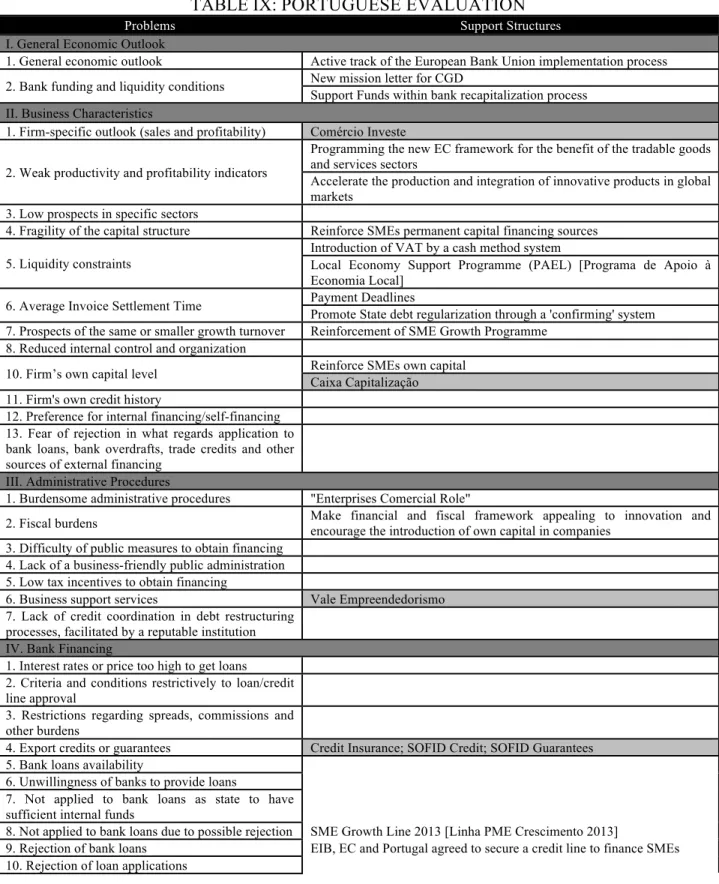
- Evaluate the SMEs access to finance problems and support structures (policies and
instruments) in Portugal and Spain;
- Propose policy and instrument recommendations to enhance Portuguese and Spanish
SMEs better access to finance, based on practices in European and non-European
countries.
Considering these objectives, the following literature review will focus on SMEs’
characterization and role in Europe, the access to finance problematic and in the SMEs’
access to finance support structures (policies and instruments). Finally, it will present the
Portuguese and Spanish particular case.
2. Literature Review
2.1 SMEs – definition and characterization
"SME" stands for small and medium-sized enterprise (CEC, 2003). However, there is no
internationally agreed definition of SMEs (Asian Development Bank, 2014).
According to the EC principles (CEC, 2003), SMEs can be broadly characterized as
enterprises that employ less than 250 persons, with an annual turnover that does not exceed
50 million EUR, and/or an annual balance sheet total not exceeding 43 million EUR. To
determine its’ classification in micro, small or medium-sized enterprises there are two or
three criteria (FIGURE 1): the staff headcount (number of employees), the annual turnover
and the balance sheet total
4(EC, 2005; ECDGEI, 2012).
According to the Annual Report on European SMEs (Gagliardi, 2013), in 2012 (TABLE
XIV) there were approximately 20 million SMEs in Europe: mostly micro-enterprises; 15
million SMEs in the services sector
5; and 5 million in the manufacturing
6and construction
sector. They employed 86.8 million people, accounting for 66.5% of all European jobs.
“SMEs and entrepreneurs play a significant role in all economies and are the key generators
of employment and income, and drivers of innovation and growth” (Asian Development
Bank, 2014). These evidence is largely supported by different authors: association between
SME development and economic growth (Beck, Demirgüç-Kunt, & Levine, 2005);
framework that links entrepreneurship to economic growth (Wennekers & Thurik, 1999)
(FIGURE 2); key role in economic development and important contribution to employment
(World Bank, 2012); SMEs creation and development vital to local economies and creation of
job opportunities (OECD, 2013c).
4 Annual turnover refers to “theamount of money that a company gets from sales during a particular period (annual)”. Balance
sheet total refers to” the total declared in the financial statement that shows a company's assets and debts at a particular time”. (Cambridge University Press 2014)
5 Services sector includes wholesale and retail trade; professional, scientific and technical services; accommodation and food
services; administrative and support services; real estate activities; transportation and storage; information and communication; and repair of motor vehicles and motorcycle. (Gagliardi, 2013)
“Recent studies on SMEs and their contribution to economic growth have shown that the
framework condition
7, within they operate and the entrepreneurial culture
8, are key factors in
determining the extent of SME performance and consequently their contribution to
macroeconomic growth” (Gagliardi, 2013).
The results of an SME survey, coordinated by Eurostat, show that the most important
constraints to business growth between 2011 and 2013 were: general economic outlook
(22%); price competition/small margins (16%); limited demand in the local/domestic markets
(12 %); and not enough financing (4%) (Ushilova & Schmiemann, 2011).
Additionally, according with OECD’s, LEED Programme
9, the key areas where SMEs face
difficulties are: social entrepreneurship, entrepreneurship skills, SME workforce skills,
business support framework, finance, and knowledge networks (OECD, 2013c). Finally, the
EC also points out that SMEs have difficulties, such as low productivity, slow growth, market
failures, competition with other players, structural difficulties and inflexibilities in labour
markets at national level (CEC, 2008).
Easy access to financial resources is essential for SMEs growth and development, especially
due to their specific needs and challenges (Ushilova & Schmiemann, 2011; Ipsos Mori, 2013;
World Bank, 2012).
2.2 SMEs Access to Finance Problem
“All businesses, whether engaged in mining, lumbering, agriculture, manufacturing,
distributing, providing services or retailing, require working capital to operate, to grow and to
compete successfully in the marketplace” (World Bank, 2013a).
However, access to financial services still is a significant constraint for SMEs, especially in
emerging economies (World Bank, 2012). A World Bank Enterprise Survey (2013b)
7 Framework conditions, refers to a general or systemic outlook including growth opportunities, rates of innovation and
investments in innovation. (Gagliardi, 2013)
8 Entrepreneurial culture or entrepreneurial orientation refers to the proactive behaviour towards risk-taking ventures and
innovation. (Gagliardi, 2013)
9 Refers to LEED (Local Economic and Employment Development) Programme cross-country comparative project that assesses
confirmed that smaller firms are less likely to have access to capital and are more likely to
rely on informal sources of capital.
The EC (2011b; ECDGEI, 2013a) pointed out that SMEs already experienced difficulties to
finance their growth, innovation and development, even before the crisis started. Confirming
the OECD (2006) statement that SMEs face a “financing gap”– “there are significant numbers
of SMEs that could use funds productively if they were available, but cannot obtain finance
from the formal financial system”.
In 2008, the EC presented access to finance
10as the second major problematic of SMEs
(FIGURE 3). In 2013, the summary paper “Progress on the Implementation of SBA in
Europe” maintained this indication (PCMEC, 2013). EU SME managers reinforced this –
access to finance was the second most pressing problem mentioned by 15% in 2013 and in
2011 (FIGURE 4) (Ipsos Mori, 2013).
Additionally, the report “Financing SMEs and Entrepreneurs 2013” from OECD (2013b)
states that “the European Sovereign Debt Crisis is likely to have led to a further deterioration
in the lending activities of banks in 2012-2013, increasing the constraints on small businesses
in those countries most affected”, furthering that the business environment will continue to be
challenging for SMEs.
The difficulties that SMEs experience when accessing financial resources can come from
several sources, such as: an incomplete range of financial products and services in the
domestic financial market; or inappropriate financing mechanisms, due to regulatory
rigidities or gaps in the legal framework (OECD, 2006).
Moreover, financial obstacles are linked to characteristics such as age of the firm, its
ownership, its size, its sales level or the sector in which it operates (Beck T. ,
Demirgüç-Kunt, Laeven, & Maksimovic, 2006; Coluzzi, Ferrando, & Martinez-Carrascal, 2012).
10 As European bodies are the main sources of information, regarding the financial resources access, and the study will focus on
two European countries – Portugal and Spain – from now on the term to refer this particular issue will be: access to finance problem.
Also, depending on the growth stage of the enterprise, the availability of financial resources
is different (FIGURE 5). As the enterprise grows and their financing needs increase, the
adequate financial resources differ (DGPPYME, 2009). Some of the financial sources
available to SMEs are Business angels, Credit Loans and Venture Capital (TABLE XV).
However many SMEs experience difficulties to get the right type of financial support – due to
lack of knowledge regarding the most suitable type for them and how to proper access it
(PCMEC, 2013). Development economists recognize “suppliers of finance may rationally
choose to offer an array of financial services that leaves significant numbers of potential
borrowers without access to credit” as a result of monitoring difficulties and asymmetric
information (OECD, 2006).
In the last six months, according with the 2013 SMEs’ Access to Finance Survey (Ipsos Mori,
2013), the European SMEs financing sources were (FIGURE 6): 54% used only external
financing, 4% used only internal funding sources (retained earnings/sales of assets), 22% used
both and 20% did not used any source of financing.
Finally, country government’s policy development affects the regulatory environment, which
may affect SME credit availability (Berger & Udell, 2006).
Promoting a favourable legal and regulatory environment complemented by a comprehensive
financial infrastructure and public interventions can expand SMEs financial access (World
Bank, 2012). Which contributes to reduce SMEs growth constraints and simultaneously boost
economic growth (Beck & Demirgüç-Kunt, 2006). Moreover, Patzelt & Shepherd (2009)
argue, “access to finance enhances the perceived access to other, nonfinancial resources
provided by policy programs”.
However, “the national and local environments in which SMEs operate are very different and
so is the nature of SMEs themselves” – each SME is different as they vary in size, field of
activity and legal form. Therefore, “policies addressing the needs of SMEs need to fully
recognise this diversity and fully respect the principle of subsidiarity”. (CEC, 2008)
2.3 SMEs Access to Finance Support Structures
11(policies and instruments)
Structural and financial policies should take into account macroeconomic and other structural
factors – such as demand conditions, strong research base and competitiveness nurturing – be
supported by the availability of key assets (human resources, finance, infrastructures and
services), and combined with an innovation-friendly environment and entrepreneurial culture
(Gagliardi, 2013).
The crisis is an opportunity to improve the SME legal framework and the business
environment, although the ability to overcome the crisis depends largely of the country
specific fiscal and monetary policies (OECD, 2009; OECD, 2013c).
The significant tighten of the credit supply conditions, enhanced by the current economic
environment, translates in a reduced ability and willingness of banks to provide financing
(EC, 2011b; Ipsos Mori, 2013). Note that bank financing is the main source of funding for
European SMEs (EC, 2014). Therefore, there is a need to develop financial instruments that
facilitate the access to external finance to smaller and younger firms (Berger & Udell, 2006;
Coluzzi, Ferrando, & Martinez-Carrascal, 2012; Torre, Pería, & Schmukler, 2010).
The EC and the World Bank continuously work towards the development of financial policies
and instruments to support SMEs, in order to provide the most appropriate sources and type
of financing according to their life stage (ECDGEI, 2013b; Ipsos Mori, 2013; World Bank
Group, 2013b) (FIGURE 7). Though it needs to take further significant policies and
instruments to release the full potential of SMEs (CEC, 2008).
2.3.1 Policies
12to Support SMEs Access to Finance
The World Bank (2013b) works globally with policy, regulatory and institutional institutions,
including the G20
13to develop guidelines, standards and good practices. At both the country
11 Structures: the way in which the parts of a system or object are arranged or organized, or a system arranged in this way
(Cambridge University Press 2014).
12 Policies: “a set of ideas or a plan of what to do in particular situations that has been agreed officially by a group of people, a
business organization, a government, or a political party” (Cambridge University Press 2014).
13 G20 refers to the Group of Twenty (G20), which is the premier forum for its members’ international economic cooperation and
and regional levels, it works closely with a wide variety of partners
14on financial inclusion,
not only to assess policy and regulatory barriers to SMEs finance, as well as to survey
financial service providers such as banks.
In fact, the OECD (2013a) declares, “red tape
15is particularly burdensome to smaller
companies and may inhibit entrepreneurship” – which is especially difficult in global markets
as the national regulatory and administrative environment may affect competitiveness.
Regarding this matter, the EU has significantly increased focus on SMEs, making real efforts
to cut red tape, in order to create an SME-friendlier business environment (CEC, 2008).
There have been improvements since 2008 in SMEs’ performance supported by policies and
instruments of the EU and the member states. These were taken under the umbrella of the
Small Business Act for Europe (SBA) and have been fundamental in mitigating crisis effects
and in driving attention to SMEs’ policy. (Gagliardi, 2013)
2.3.1.1 SBA
In 2007, a big step in SMEs support was given when the EC launched the idea of a SBA,
fully supported at EU and member states level, but also by the SME community (CEC, 2008).
It was adopted in June of 2008 and the symbolic name “Act” reflects the EC’s political
determination to recognize the central role of SMEs in the EU economy (CEC, 2008;
ECDGEI, 2014a). Further, since the beginning, the EC has collected examples of good
practice, today under the SBA Database of Good Practices (CEC, 2008; ECDGEI, 2014g).
The SBA aims to provide a comprehensive SME policy framework for the EU and its
member states for the first time – promoting entrepreneurship and anchoring the “Think
Small First” principle
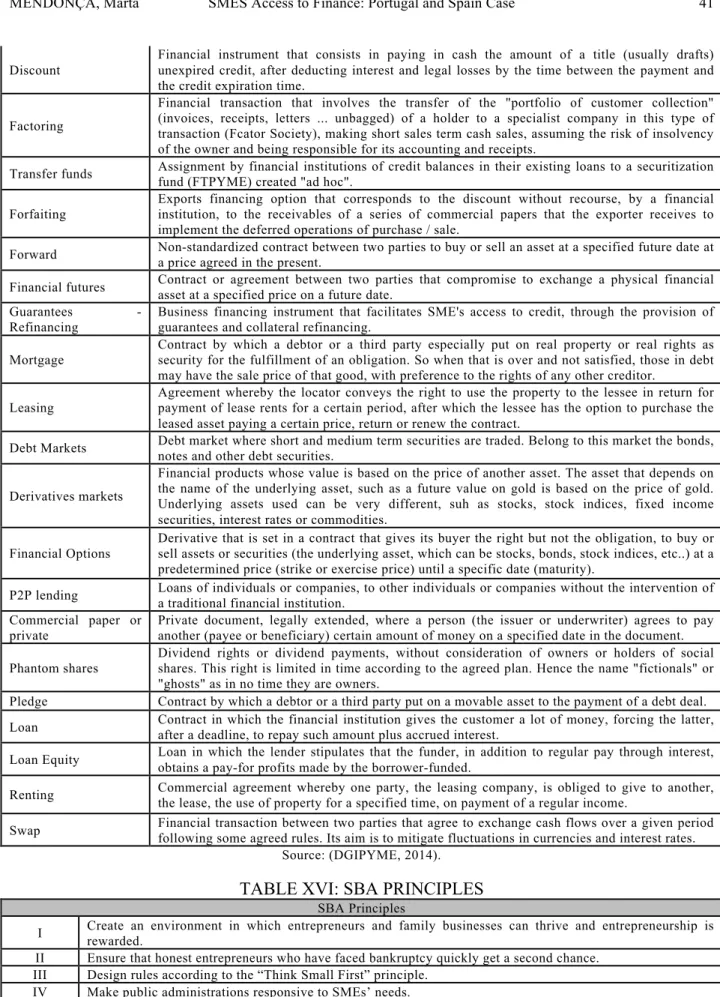
16(CEC, 2011; ECDGEI, 2014a). It was built around ten key principles
(TABLE XVI) and several concrete policy and legislative actions to implement them (CEC,
14 AFI, financial sector development trusts, UNCDF, the OECD, GIZ, USAID, AusAID, SECO14, the Bill and Melinda Gates
Foundation and regional development banks.
15 ‘Cut Red tape’ is an expression often used when refering that policies and being made in order to reduce administrative burdens
(OECD, 2013a).
16 “Think Small First” principle refers to listening to SMEs before introducing new laws, examining the legislation effects on
2008). It incorporated a priority policy action plan in order to better address SMEs needs
regarding the global crisis. These were concentrated on improving access to finance, access
to markets and the regulatory, administrative and business environment. (CEC, 2011; EC,
2009)
Some policy and legislative actions were proposed both at EC and member state level, in
what concerns the sixth principle “Facilitate SMEs’ access to finance and develop a legal and
business environment supportive to timely payments in commercial transactions” (TABLE
XVII).
2.3.1.2 SBA Review
Since SBAs’ adoption much has been achieved. On one hand, the EC has been faithful to
commitments and implemented most of the policies promised. On the other hand, member
states presented a more variable record. (CEC, 2011)
As a consequence of the global economic crisis, “the strategies for economic recovery of the
member states have been changing, creating significant transformations to many
SME-relevant policies and to the environment in which SMEs operate” (Gagliardi, 2013).
In 2011, a SBA Review (CEC, 2011) was developed to assess the SMEs needs. On this basis,
it proposed a set of new actions: making smart regulation a reality for European SMEs; paying
specific attention to SMEs’ financing needs; taking a broad-based approach to enhancing market
access for SMEs; helping SMEs to contribute to a resource-efficient economy; and promoting
entrepreneurship, job creation and inclusive growth. However, the main focus remained
structured around three areas: ensuring access to finance, taking full advantage of the Single
Market and SMART regulation
17(CEC, 2011).
Further actions to ensure access to finance were proposed, both at EC and member state level
(TABLE XVIII).
17SMART regulation is about business regulations that are – Streamlined, Meaningful, Adaptable, Relevant, Transparent (World
2.3.2 Instruments
18to Support SMEs Access to Finance
The World Bank (2013b) helps more than 60 countries – 24.5 SMEs benefit directly from it
through World Bank Group-supported institutions
19. This support comprises three financing
instruments:
- Investment Project – SMEs and low-income-individual credit lines from financial
institutions, and/or support to credit guarantees (risk-sharing with financial institutions);
- Development Policy – policy, regulatory and institutional actions/reforms agreed with
the national governments;
- Program-for-Results – supports the performance of government programs by
strengthening institutions and building capacity.
Furthermore, the EU plays its part by helping SMEs access to finance, doing it in five ways:
by making EU funds available to assist SMEs; by facilitating SMEs’ access to private sources of
funding and to alternative sources of financing; by establishing an SME Finance Forum; and by
creating a practical guide for SMEs funding.
Several EU funds are available: loans for SMEs from the EIB, channelled through
commercial banks; EU funding
20, available to SMEs through the Structural Funds
21; EC debt
and equity finance instruments for SMEs, funded under the CIP
22; and financial support for
micro-enterprises and for social enterprises, funded by the Progress Microfinance
23(EC,
2014).
18Instrument: “a way of achieving or causing something” (Cambridge University Press 2014).
19The World Bank Group comprises the following institutions: the IBRD, which provides financing, risk management products,
and other financial services to members; the IDA, which provides interest-free loans and grants to the poorest countries; the IFC, which makes equity investments, and provides loans, guarantees and advisory services to private-sector business in developing countries; and the Bank Group’s political risk insurance agency, the MIGA. (World Bank Group, 2013b)
20 The Commission makes direct financial contributions in the form of grants in support of projects or organisations. Grants are
available in the following areas: Agriculture, fisheries and foods, Business, Culture, education and youth, Economy, finance and tax, Employment and social rights, Energy and natural resources, Environment, consumers and health, External relations and foreign affairs, Justice, home affairs and citizens' rights, Regions and local development, Science and technology, Transport and travel, and Other. (EU, 2014)
21 European Structural & Investment Funds: the EU and member states share the five funds management: ERDF, ESF, CF,
EAFRD and EMFF. (EU, 2014)
22 CIP (Competitiveness and Innovation Framework Programme) supports innovation activities (including eco-innovation). It
provides guarantees in order to increase the supply of debt finance to SMEs and increases the supply of equity for SMEs. (EU, 2014)
23 Progress Microfinance: increases the availability of microloans (up to 25 000 EUR), including for disadvantaged and
Considering SMEs’ access to private sources of funding, the EU has proposed legislation to
make it easier for venture capital funds and socially oriented investment funds, to raise
capital on a EU-wide basis, and consequently make such investments more widely available
for SMEs (EC, 2014).
In order to give SMEs better access to alternative sources of financing through the capital
markets, the EU will help SMEs raise capital through public sale of shares. This will be
achieved through greater visibility to SME-focussed stock exchanges, through a SME-label,
and lower reporting requirements for listed SMEs, including the end of the obligation to
publish quarterly reports and less burdensome and costly documents for SMEs that go public.
(EC, 2014)
Finally, the EC (2011b) established the SME Finance Forum whose objective is to reflect on
the best way to solve the current challenges and long-term structural issues regarding the
access to finance for SMEs. It gathers frequently organisations that represent SMEs, banks
and other financial institutions.
To further facilitate access to finance, the EC (2014) has made a practical guide for SMEs,
available online
24. According to their needs, SMEs might be suitable for EU indirect funding,
via financial intermediaries at country level, or for direct grant funding from the EU.
2.4 Portugal and Spain Case
As already pointed out policy changes in the EU will be particularly important in countries in
need of help, such as Spain and Portugal.
First of all, it is important to present a general characterization of the SMEs in both countries,
acknowledge their role in each national economy and reflect on the depth of the access to
finance problem, as well as indicate the main guidelines that address them at national level.
2.4.1 Portugal: SMEs and Access to Finance
According to Eurostat (2014), the 0.8 million Portuguese SMEs play an important role in the
national economy. Portuguese enterprises (TABLE XIX) are characterized as being mostly
micro-enterprises (94.9%) and in 2011 SMEs value added was 67.2% of total business
economy and their turnover was 230 000 million EUR. This represents 70.9% of all
Portuguese enterprises turnover for that year.
“The economic crisis plunged Portugal into a deep and prolonged recession between 2008
and 2012, with both large and small companies experiencing decline across the board.
Construction and real estate were among the hardest hit sectors” (ECDGEI, 2014f).
The latest Fact Sheet (EC, 2013a) regarding the SBA implementation in Portugal refers that
in 2012 the country had an average SBA profile (FIGURE 8). In spite of the substantial
economic difficulties, SMEs benefited from the positive performance, such as better
framework conditions and support programmes, in some areas – “entrepreneurship”,
“responsive administration” and “second chance”. Also, in Portugal, the transposition and
application of EU law into domestic law is considered faster than anywhere in the EU.
However, Portugal’s SBA performance in two particular areas is still considerably behind
European average – “access to finance”, and “state aid and public procurement” (EC, 2013a;
ECDGEI, 2014f).
On a positive note, Portugal ranks number 30 in 185 economies, in terms of easiness to do
business as said by “Doing Business 2013” report from the World Bank (2013a). The
financial and economic crisis exposed even further the fragilities of the Portuguese economy,
as well as the necessity to revitalize its industrial sector, in order to boost exportations,
internationalization of the economy and labour (PWC, 2013b). According to PWC (2013b)
the Portuguese SMEs face three major challenges: fragility of the capital structure and access
to finance, reduced dimension, and low qualification of their human resources. Another
publication from PWC (2013a) concerning the 2
ndCEO survey in Portugal shows that one of
their major concerns is financing (72%).
In what concerns financial resources, Portugal ranked 24
thout of 28 countries in the 2013
SMAF Index
25(ECDGEI, 2014f). In 2013, SAFE results (Ipsos Mori, 2013) concerning
Portugal illustrate that 19% Portuguese SMEs find access to finance the most pressing
problem (FIGURE 9), showing that 58% SMEs “used only external funds”, but 36% avoided
the usage of any form of financing. Furthemore, 63% “used debt financing” and 0% “used
equity financing”.
The Inquiry to Banks on the Credit Market undertaken by Banco de Portugal (2014) shows
that the levels of demand for loans from SMEs had a slight increase in the latest trimester of
2013. However, the latest report from IMF (April 2014), points out that the credit profile of
SMEs “has deteriorated rapidly, with loans (provided by the eight largest banks) that are
overdue for more than 1 year having more than doubled since end-2011 to 7.4 billion (as per
end-September 2013)” (IMF, 2014).
In order to overcome the access to finance problem, Portuguese government (2013a) has
developed the “Estratégia de Fomento Industrial para o Crescimento e o Emprego
2014-2020”. Which regards incentives to SMEs in three main groups: entrepreneurship; growth,
exportation and internationalization; and revitalization. Its major aim is to “reinforce
available financing to enterprises through the diversification of financing sources, a raise in
liquidity and own capital, and more sustainability and competitive capacity in businesses”
(FIGURE 10).
Further, the Portuguese policies and instruments concerning SMEs access to finance
reproduce the Europe 2020 Strategy and SBA proposals.
2.4.2 Spain: SMEs and Access to Finance
In Spain, according to Eurostat (2014) the 2 million Spanish SMEs play a crucial position in
the national economy (TABLE XX). They are mostly micro-enterprises (94.1%) and in 2011
SMEs value added was 61.4% of total business economy and their turnover was 1 000 000
million EUR. This represents 61.5% of all Spanish enterprises turnover for that year.
25 SMAF: SMEs Access to Finance Index monitors developments in SMEs access to financial resources. It uses data from the
The economic crisis rushed Spain into a deep and prolonged recession between 2008 and
2012. It affected both small and large companies who suffered a decline, but construction and
manufacturing were among the hardest hit sectors. (ECDGEI, 2014e)
The latest Fact Sheet (EC, 2013b) regarding the SBA implementation in Spain refers that in
2012 the country had a sub-average SBA profile (FIGURE 11). It presented some areas with
good performance – “second chance”, “think small first” and “single market”. Nevertheless,
it has to improve in other areas, “access to finance” and “state aid and public procurement”,
which remain considerably behind European average (EC, 2013b; ECDGEI, 2014e).
Spain ranks number 44 in 185 economies, in terms of easiness to do business according to the
report “Doing Business 2013” from the World Bank (2013a).
On a positive note, according to ECDGEI (2014e) “the reforms currently implemented by
Spain should have a positive effect on growth and employment, but their effect will not
become evident until 2014. Export performance by SMEs and large companies will be the
main envisioned source of growth on the short and medium term.”
Furthermore, in what concerns financial resources, Spain ranked 22
ndout of 28 countries in
the 2013 SMAF Index
26(ECDGEI, 2014f) In 2013, the SAFE results (Ipsos Mori, 2013)
regarding Spain show that compared to the rest of the EU, the country occupies the third
position in terms of “access to finance” as the most pressing problem. It showed that 55% of
SMEs “used only external funds” and 18% avoided the usage of any form of financing,
indicating that 76% “used debt financing” and only 2% “used equity financing”.
The policies and instruments undertaken to SMEs better access to finance reproduce the
Europe 2020 Strategy, as well as the Spanish government strategy, and the SBA proposals
regarding access to finance.
26 SMAF: SMEs Access to Finance Index monitors developments in SMEs access to financial resources. It uses data from the
3. Research Methodology
3.1 General Aspects
According to Gray (2004) and to Saunders, Lewis, & Thornhill (2007) there are three forms
of study: exploratory, descriptive and explanatory.
This study can be classified as Descriptive
27in the sense that it enlightens SMEs’ access to
finance problems and the existing structures that support it, in the particular cases of Portugal
and Spain. This study can also be classified as Exploratory
28since it evaluates if the latest
supporting structures that were set up in Portugal and Spain, address their access to finance
problems. Moreover, it seeks new insights as it proposes a set of policy and instrument
recommendations to address the unsolved access to finance problems, based on existing
practices from European and non-European countries.
In what concerns the adopted research strategy it is an Archival/Documental
Analysis/Research, according to the research strategies presented in the research methods’
literature. This research strategy is characterized for its’ use of administrative records and
documents as data collection source.
However, even though it will be used secondary data, which may include both quantitative
and qualitative data, the objective is not only collecting it, but analysing it according to the
present study objectives (Saunders, Lewis, & Thornhill, 2007).
Nevertheless, the usage of secondary data has advantages and disadvantages. The first ones
may be: to have fewer resource requirements, being unobtrusive, the feasibility of
longitudinal studies, to provide comparative and contextual data, to result in unforeseen
discoveries and the permanence of data. The disadvantages can be: the collection for a
purpose that does not match the need, the difficulty of access or its cost, unsuitable
27 The object of descriptive research is ‘to portray an accurate profile of persons, events or situations’ (Saunders, Lewis, &
Thornhill, 2007).
28 An exploratory study is a valuable means of finding out ‘what is happening; to seek new insights; to ask questions and to assess
phenomena in a new light’. One of the three principal ways of conducting exploratory research is a search of the literature (Saunders, Lewis, & Thornhill, 2007).
aggregations and definitions, no real control over data quality, and the real purpose affecting
the data presentation. (Saunders, Lewis, & Thornhill, 2007)
The data analysis procedure followed in this study is qualitative. “Qualitative used as a
predominantly synonym for any data analysis procedure, such as categorising data, that
generates or uses non-numerical data” (TABLE XXI) (Saunders, Lewis, & Thornhill, 2007).
Qualitative researches can be seen as non-directional and broad, ultimately its objective is to
understand, explore and discover. Therefore, this research’s purpose is to develop a
comparative study based in document analysis from a primary set of questions and through a
qualitative research, based on data classification.
3.2 Research Design and Process
Regarding the research methodology adopted, it is important to clarify the design and process
of research followed. Therefore this comparative study, based in document analysis from a
primary set of questions and through a qualitative research constructed on data classification,
followed a number of steps. In its definition it was followed, with the required adaptations,
the method proposed by Henriques (2006).
First of all, the main research problem guided the literature review, from which resulted the
following four research questions:
- What are the Portuguese and Spanish SMEs specific problems in access to finance?
- What are the existing structures (policies and instruments) to support SMEs better access
to finance in Portugal and Spain?
- Do the SMEs access to finance support structures (policies and instruments) respond to
the existing specific problems in Portugal and Spain?
- Which policy and instrument recommendations can be applied in Portugal and Spain in
order to boost SMEs better access to finance?
Secondly, it was also settled the action lines regarding the research protocol as it was
conveyed that the preferred analysis element would be the level of aggregation of the data
collected (Henriques, 2006).
Accordingly with the research problem, the identification of the existing problems was the
basis to reach its conclusions. However, as pointed out in the literature review by OECD
(2006), SMEs access to finance problems’ are quite different in their nature. Hence, there was
a clear need to group them in order to better analyse and address them throughout the study.
So, after collecting all the problems and analysing them, the most appropriate categorization
was presented in the SMEs’ Access to Finance Survey (SAFE) – firstly established in 2009
by the EC and the ECB, it is conducted in 37 countries (28 EU and 17 euro area countries); it
aims to survey SMEs in what concerns: financial situation, growth, innovation and need for
external financing; use of internal and external funds; experiences with applications for
external financing; use of loans, the size and reasons for accessing specific loans; views on
the extent of accessibility to different types of available finance; and expectations on future
financing (Ipsos Mori, 2013).
Consequently, the collected data was analysed and organized according to the the level of
aggregation to the following categories:
- General Economic Outlook: SMEs views and expectations when applying different types
of external financing;
- Business Characteristics: SMEs access to finance problems regarding their financial,
growth and innovative situation;
- Administrative Procedures: experiences and views when applying different types of
external financing;
- Bank Financing, Equity Financing, Trade Credit and Other Sources of Financing: SMEs
usage of internal funds and external sources of finance and reasons behind it.
In this sense, it was established that in order to get a better data aggregation, a broader data
sample would be considered. So, in one hand realities completely different as access to
finance problems of a start-up were, as represented as, the ones from a mature SME; and on
the other hand the collected data was a representative sample which allowed to extrapolate
the analysis and its conclusions. Thus, the research was focused in documents and online
platforms from supra-national entities – such as the World Bank or the EU – and national
ones, as it was shown by the literature review the importance of regarding the national and
local environments in which SMEs operate. The Portuguese and Spanish realities were
chosen and therefore further research was done through documents and administrative
records of both Portuguese and Spanish Governments.
Moreover, Portugal and Spain were chosen for this research for several reasons. Firstly,
Portugal and Spain were two of the countries harshly hit by the sovereign debt crisis that
affected Europe. Secondly, this two countries share a common southern European culture and
they have a long history of trade due to their geographical proximity. Finally, both countries
have poor performance in what concerns SMEs SBA “Access to finance” principle.
As a third step, it was collected the data regarding the existing structures, in terms of policies
and instruments that support SMEs’ access to finance, in Portugal and Spain. At this level
there was the attempt to identify exclusively the ones concerning the “Access to Finance”
principle, despite the fact that these were merged many times with structures regarding other
SBA principles, such as “Internationalization”, “Entrepreneurship”, “Skills and Innovation”
and “State Aid & Public Procurement”.
Finally, the research focused in finding good practices in terms of policy and instruments
applied both at European and non-European level.
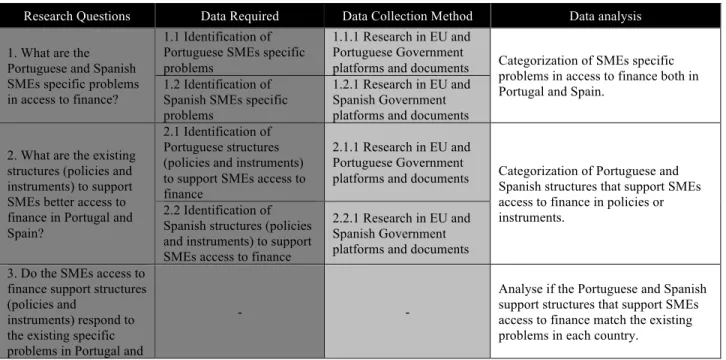
In order to better describe the research process, it was designed a data analysis matrix,
according with the method of Hospido et al. (2009), and with the necessary adaptations.
TABLE I: DATA ANALYSIS MATRIX
Research Questions Data Required Data Collection Method Data analysis
1. What are the Portuguese and Spanish SMEs specific problems in access to finance?
1.1 Identification of Portuguese SMEs specific problems
1.1.1 Research in EU and Portuguese Government
platforms and documents Categorization of SMEs specific problems in access to finance both in Portugal and Spain.
1.2 Identification of Spanish SMEs specific problems
1.2.1 Research in EU and Spanish Government platforms and documents
2. What are the existing structures (policies and instruments) to support SMEs better access to finance in Portugal and Spain?
2.1 Identification of Portuguese structures (policies and instruments) to support SMEs access to finance
2.1.1 Research in EU and Portuguese Government
platforms and documents Categorization of Portuguese and Spanish structures that support SMEs access to finance in policies or instruments.
2.2 Identification of Spanish structures (policies and instruments) to support SMEs access to finance
2.2.1 Research in EU and Spanish Government platforms and documents 3. Do the SMEs access to
finance support structures (policies and
instruments) respond to the existing specific problems in Portugal and
- -
Analyse if the Portuguese and Spanish support structures that support SMEs access to finance match the existing problems in each country.
Spain?
4. Which policy and instrument
recommendations can be applied in Portugal and Spain in order to boost SMEs better access to finance?
4.1 Identification of the good practices regarding access to finance support structures at European and Non-European level
4.1.1 Research in the SBA
database of good practices Match European and Non-European support structures good practices to the non-addressed problems for both Portugal and Spain.
4.1.2 Research in OECD and other EU documents
Source: Author, based on the Hospido et al. (2009).
This data analysis matrix together with the literature review will be the interpretative guide of
the collected data in the next part.
4. Data Analysis
In this chapter we will present and examine the major conclusions that can be inferred from
all the data collected.
4.1.1 SMEs Access to Finance Problems: Portugal and Spain
The General Economic Outlook problem group concerns the current financial and economic
environment. Its main conclusions are that for Spanish SMEs the general economic outlook
has worsened a lot more in comparison with Portuguese SMEs in the past six months.
TABLE II: GENERAL ECONOMIC OUTLOOK PROBLEMS
I. General Economic Outlook
Portugal Values Spain Values 1. General economic outlook ⇓ 19% General economic outlook ⇓ 31% 2. Bank funding and liquidity conditions
Sources: Author, based on (Banco de Portugal, 2011a; EC, 2013a; Ipsos Mori, 2013; PWC, 2013b).
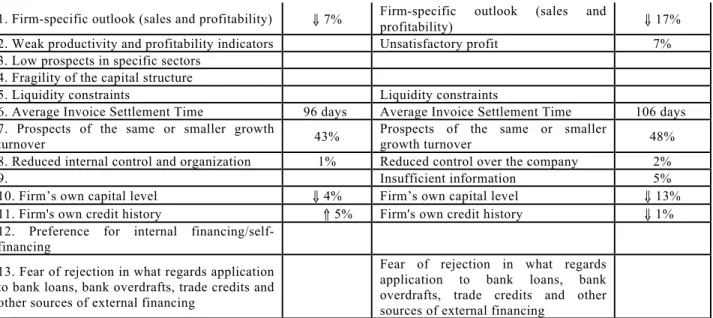
In what concerns Business Characteristics, this group relates to specific characteristics of
each company that affect their access to finance, such as company size, turnover, sector, type
of enterprise, enterprise financial situation or ownership structure, amongst others. It is
important to state that the firm-specific outlook, the firm own credit history as well as the
prospects of the same or smaller growth turnover and the average invoice settlement time are
the most worrisome problems in what regards both Portugal and Spain.
TABLE III: BUSINESS CHARACTERISTICS PROBLEMS
II. Business Characteristics
1. Firm-specific outlook (sales and profitability) ⇓ 7% Firm-specific outlook (sales and profitability) ⇓ 17% 2. Weak productivity and profitability indicators Unsatisfactory profit 7% 3. Low prospects in specific sectors 4. Fragility of the capital structure 5. Liquidity constraints Liquidity constraints 6. Average Invoice Settlement Time 96 days Average Invoice Settlement Time 106 days 7. Prospects of the same or smaller growth
turnover 43% Prospects of the same or smaller growth turnover 48% 8. Reduced internal control and organization 1% Reduced control over the company 2% 9. Insufficient information 5% 10. Firm’s own capital level ⇓ 4% Firm’s own capital level ⇓ 13% 11. Firm's own credit history ⇑ 5% Firm's own credit history ⇓ 1% 12. Preference for internal
financing/self-financing
13. Fear of rejection in what regards application to bank loans, bank overdrafts, trade credits and other sources of external financing
Fear of rejection in what regards application to bank loans, bank overdrafts, trade credits and other sources of external financing
Sources: Author, based on (Banco de Portugal, 2011a; Banco de Portugal, 2012; Banco de Portugal, 2014; DGPPYME, 2009; EC, 2013a; EC, 2013b; Ipsos Mori, 2013; PWC, 2013b; World Bank, 2014).
Another category is Administrative Procedures, which refers to the terms, conditions, policies
involved in access to finance procedures. The difficulty of public measures and the low tax
incentives to obtain financing, as well as a lack of business support services are the most
pointed out constraints.
TABLE IV: ADMINISTRATIVE PROCEDURES PROBLEMS
III. Administrative Procedures
Portugal Values Spain Values 1. Burdensome administrative procedures 2. Fiscal burdens 97% 3. Difficulty of public measures to obtain financing 73,1% Difficulty of public measures to obtain financing 72,1% 4. Lack of a business-friendly public administration 5. Low tax incentives to obtain financing 75,5% Low tax incentives to obtain financing 70,3% 6. Business support services 64,4% Business support services 61,9% 7. Lack of credit coordination in debt restructuring
processes, facilitated by a reputable institution Sources: Author, based on (IMF, 2014; Ipsos Mori, 2013).
Furthermore, as the access to finance problem is closely related with external sources of
financing availability and/or willingness, some categories regarding it were defined: Bank
Financing, Equity Financing, Trade Credit Financing and Other Sources of Financing.
Bank Finaning is mainly related with guarantees and collateral requirements, as well as other
criteria and restrictions to obtain financing. By analysing the data it is clear that bank loans
are the most used and preferred external financial resource, despite some constraints
regarding bank overdrafts.
In the category Equity Financing, the major consideration is: there is a strong belief that
measures to facilitate equity investments would be beneficial.
Trade Credit Financing constraints are mainly related with an unwillingness of business
partners to provide trade credit.
Finally, the group Other Sources of Financing state that there is a deficit in what regards
access to public financial support, more severe in Spain. However, in Portugal, in comparison
with Spain, SMEs state that they have less financing from other sources, such as
microfinance institutions and government-related sources.
TABLE V: BANK FINANCING PROBLEMS
IV. Bank Financing
Portugal Values Spain Values 1. Interest rates or price too high to get loans 61% Interest rates or price too high to get loans 31% 2. Criteria and conditions restrictively to
loan/credit line approval Criteria and conditions restrictively to loan/credit line approval 3. Restrictions regarding spreads, commissions
and other burdens
4. Export credits or guarantees 62,0% Export credits or guarantees 69,9% 5. Bank loans availability ⇓ 1% Bank loans availability ⇓ 6% 6. Unwillingness of banks to provide loans ⇓ 8% Unwillingness of banks to provide loans ⇓ 23% 7. Not applied to bank loans as state to have
sufficient internal funds 33%
Not applied to bank loans as state to
have sufficient internal funds 43% 8. Not applied to bank loans due to possible
rejection 7%
Not applied to bank loans due to
possible rejection 8% 9. Rejection of bank loans 11% Rejection of bank loans 17%
10. Rejection of loan applications 27% Rejection of loan applications
12% (DGPPYME,
2009) 21% (EC,
2013b) 11. Use bank loan as source of financing 50% Use bank loan as source of financing 59% 12. Provider of the most recent loan – bank 89% Provider of the most recent loan – bank 89% 13. Most preferred external financing: bank
loans 72%
Most preferred external financing:
bank loans 69% 14. Unavailability of financing at all to get bank
loan 7%
Unavailability of financing at all to
15. Not applied to bank overdrafts29 as state to
have sufficient internal funds 31%
Not applied to bank overdrafts as state to have sufficient internal
funds 44%
16. Not applied to bank overdrafts due to
possible rejection 6% Not applied to bank overdrafts due to possible rejection 7% Sources: Author, based on (Banco de Portugal, 2011a; Banco de Portugal, 2012; Banco de Portugal, 2014; DGPPYME,
2009; EC, 2013a; EC, 2013b; Ipsos Mori, 2013; World Bank, 2014).
TABLE VI: EQUITY FINANCING PROBLEMS
V. Equity Financing
Portugal Values Spain Values 1. Unavailability of equity/venture capital
investments 1%
Unavailability of equity/venture capital
investments 2. Unavailability of equity financing Limited availability of venture capital 3. Unwillingness of investors to invest in equity ⇓ 2% Unwillingness of investors to invest in equity ⇓ 2% 4. Need for equity investments ⇓ 1% Need for equity investments ⇓ 1% 5. Measures to facilitate equity investments 44,5% Measures investments to facilitate equity 55,7% 6. Managers' confidence to talk about financing
with equity investors/venture capital firms 13%
Managers' confidence to talk about financing with equity investors/venture
capital firms 13% Sources: Author, based on (EC, 2013b; Ipsos Mori, 2013).
TABLE VII: TRADE CREDIT FINANCING
VI. Trade Credit30 Financing
Portugal Values Spain Values 1. Expected availability of trade credit 3% Expected availability of trade credit 3% 2. Unwillingness of business partners to provide
trade credit ⇓ 7% Unwillingness of business partners to provide trade credit ⇓ 9% 3. Not applied to trade credit as state to have
sufficient internal funds 27% Not applied to trade credit as state to have sufficient internal funds 38% 4. Not applied to trade credit due to possible
rejection 3%
Not applied to trade credit due to
possible rejection 3% 5. Need for trade credit from business partners ⇑ 1% Need for trade credit from business partners ⇑ 5%
Sources: Author, based on (Ipsos Mori, 2013).
TABLE VIII: OTHER SOURCES OF FINANCING PROBLEMS
VII. Other Sources of Financing
Portugal Values Spain Values 1. Access to public financial support ⇓ 9% Access to public financial support ⇓ 36% 2. Few financing from other sources
(microfinance institutions and government-related sources)
8%
Few financing from other sources (microfinance institutions and government-related sources)
5% 3. Unsufficient allocation of EU Regional Funds
for entrepreneurship and SMEs 4. Unsufficient allocation of EU funds for
business creation and development
29 Bank overdraft: “an amount of money that a customer with a bank account is temporarily allowed to owe to the bank, or the
agreement which allows this”(Cambridge University Press 2014).
30 Trade Credit: “an arrangement in which a business allows other companies to pay for goods or services several weeks or
5. Insufficiently usage of seed funding from business-angels, venture capital and public start-up funds
6. Expected availability of other sources of
financing 2% Expected availability of other sources of financing 3% 7. Not applied to other sources as state to have
sufficient internal funds 29% Not applied to other sources as state to have sufficient internal funds 44% 8. Need for other sources of financing ⇑ 1% Need for other sources of financing ⇑ 4% 9. Provider of the most recent loan – private
individuals (family and friends/business angels) 3%
Provider of the most recent loan – private individuals (family and friends/business angels)
5% Sources: Author, based on (EC, 2013a; EC, 2013b; Ipsos Mori, 2013).