CERN-PH-EP/2012-244 2013/01/30
CMS-EXO-11-099
Search for pair produced fourth-generation up-type quarks
in pp collisions at
√
s
=
7 TeV with a lepton in the final state
The CMS Collaboration
∗Abstract
The results of a search for the pair-production of a fourth-generation up-type quark (t0) in proton-proton collisions at√s=7 TeV are presented, using data corresponding to an integrated luminosity of about 5.0 fb−1collected by the Compact Muon Solenoid experiment at the LHC. The t0 quark is assumed to decay exclusively to a W boson and a b quark. Events with a single isolated electron or muon, missing transverse momentum, and at least four hadronic jets, of which at least one must be identified as a b jet, are selected. No significant excess of events over standard model expectations is observed. Upper limits for the t0¯t0 production cross section at 95% confidence level are set as a function of t0 mass, and t0-quark production for masses below 570 GeV is excluded. The search is equally sensitive to nonchiral heavy quarks decaying to Wb. In this case, the results can be interpreted as upper limits on the production cross section times the branching fraction to Wb.
Submitted to Physics Letters B
∗See Appendix A for the list of collaboration members
1
Introduction
The standard model (SM) of particle physics includes three generations of fermions [1–3]. But the possibility of a sequential fourth generation of fermions is not ruled out by precision elec-troweak measurements (see, e.g. [4]). If the recently observed 125 GeV boson [5, 6] turns out to be the SM Higgs boson, the existence of a sequential fourth generation would be disfavoured (see, e.g. [7]).
However, many models of physics beyond the SM, such as theories with an extended Higgs sector (see, e.g. [8]), can still incorporate a sequential fourth generation of fermions if the 125 GeV boson turns out to be one of the predicted extended Higgs bosons. Furthermore, other models predict (see, e.g. [9, 10]) the existence of a heavy, nonchiral, vector-like quark whose left- and right-handed components transform in the same way under the symmetry group of the theory, as a partner to the top quark. This particle would cancel the divergent corrections of t-quark loops to the Higgs boson mass. The production of such a nonsequential quark would give rise to the same final-state signature described below in the search for a sequential up-type quark (denoted as t0in this paper), and thus the results of this search are also relevant for it. For a fourth-generation up-type quark, the mass splitting between the t0 quark and the corre-sponding down-type b0 quark is favoured to be smaller than the mass of the W boson [11–13]. In this case, the t0 quark cannot decay to Wb0. Assuming that the pattern of quark mixing ob-served in the CKM matrix extends to the fourth generation, the dominant t0-quark decay mode would then be t0 → Wb, and the lifetime of the t0 would be short, similar to that of the top quark.
It is interesting to note that the coupling to the Higgs field of a fourth-generation quark with a mass above about 550 GeV becomes large, its weak interactions start to become comparable to its strong interactions, and perturbative calculations begin to fail [14]. However, such effects are still small at the beginning of this mass range, as has been shown for the case of CKM mixing [15].
We present the results of a search for the strong production of t0¯t0quark pairs, with t0 decaying
into W+b and ¯t0 to W−b, in proton-proton collisions at√s = 7 TeV using the Compact Muon
Solenoid (CMS) detector. The search strategy requires that one of the W bosons decays to leptons (eν or µν) and the other to a quark-antiquark pair. The branching fraction into these final states is about 15% for each lepton flavour. We select events with a single charged lepton, missing transverse momentum, and at least four jets with high transverse momenta (pT). Previous searches for t0 quarks in this final state give lower limits for the mass of the t0 quark of 358 GeV [16, 17] at the Tevatron and 404 GeV [18] at the Large Hadron Collider (LHC). There are SM processes that give rise to the same signature, most notably tt and W+jets pro-duction. The present search considers a t0 quark with a mass larger than the SM t quark. We utilize two variables to distinguish between signal and background. The first is HT, defined as the scalar sum of the transverse momenta of the lepton, the missing transverse momentum, and the four jets from the decay of the t0and ¯t0quarks. The second variable is the t0-quark mass Mfit, obtained from a kinematic fit of each event to the process t0¯t0 →WbWb → `νbqq0b . We
use the two-dimensional distribution of HT versus Mfit to test for the presence of a signal for t0¯t0 production in the data.
We categorize events according to the flavour of the lepton. Events with an identified electron (muon) are classified as e+jets (µ+jets) events. The analysis procedures for the two channels are kept as similar as possible, with small differences mainly driven by the different trigger
condi-2 2 CMS detector and data samples
tions. Finally, a combined statistical analysis of both channels is performed and upper limits for the t0¯t0pair production cross section and a lower limit on the t0-quark mass are derived.
2
CMS detector and data samples
The CMS experiment uses the following coordinate system. The z axis coincides with the axis of symmetry of the detector, and is oriented in the anticlockwise proton beam direction. The x axis points towards the centre of the LHC ring and the y axis points up. The polar angle
θ is defined with respect to the positive z axis, and φ is the azimuthal angle. The transverse
momentum of a particle or jet is defined as its momentum times sin θ, and pseudorapidity is
η= −ln[tan(θ/2)].
The characteristic feature of the CMS detector is the superconducting solenoid, 6 m in diameter and 13 m in length, which provides an axial magnetic field of 3.8 T. Inside the solenoid are a multi-layered silicon pixel and strip tracker covering |η| < 2.5 to measure the trajectories of
charged particles, an electromagnetic calorimeter (ECAL) made of lead tungstate crystals and covering|η| < 3.0, a preshower detector covering 1.65 < |η| < 2.6 to measure electrons and
photons, and a hadronic calorimeter (HCAL) made of brass and scintillators covering|η| <3.0
to measure jets. Muons are identified using gas-ionization detectors embedded in the steel return yoke of the solenoid and covering |η| < 2.4. Extensive forward calorimetry
comple-ments the coverage provided by the barrel and endcap detectors. The CMS detector is nearly hermetic, allowing the measurement of the transverse momentum carried by undetected par-ticles. A detailed description of the CMS detector can be found elsewhere [19].
We use data collected in 2011, corresponding to an integrated luminosity of 5.0 fb−1 for the e+jets channel and 4.9 fb−1 for the µ+jets channel. The triggers for the e+jets data required at least one electron candidate with a pT threshold that varied between 25 and 32 GeV according to the average instantaneous luminosity. When the LHC instantaneous luminosity increased, three central jets with pT >30 GeV and|η| <2.6 were also required. The triggers for the µ+jets
channel required at least one muon candidate with a pT threshold that varied between 30 and 40 GeV. No requirements were made on jets in the triggers for the µ+jets events.
We model the t0¯t0 signal and SM background processes using Monte Carlo (MC) simulations.
The t0¯t0 signal events are generated for t0 masses from 400 to 625 GeV in 25 GeV steps. The
following SM background processes are simulated: tt production; single-t-quark production via the tW, s-channel, and t-channel processes; single- and double-boson production (W+jets, Z+jets, WW, WZ, and ZZ). All of these processes, except the dominant tt production, are collectively referred to as electroweak (EW) background.
The single-t-quark production is simulated with thePOWHEGevent generator [20–22]. All other
processes are simulated with the MADEVENT/MADGRAPH [23] programs. ThePYTHIA
pro-gram [24] is then used to simulate additional radiation and the fragmentation and hadroniza-tion of the quarks and gluons into jets. The generated events are processed through the CMS detector simulation based on GEANT4 [25]. Up to 20 minimum-bias events, generated with
PYTHIA, are superimposed on the hard-scattering events to simulate multiple pp interactions within the same beam crossing. The MC-simulated events are weighted to reproduce the dis-tribution of the number of vertices per event in the data (the average number of vertices per event is 8).
The simulated samples for the t0¯t0signal correspond to an integrated luminosity of between 100 and 2500 fb−1for each value of t0-quark mass. Samples for the background processes giving the
largest contributions correspond to 22 fb−1for the tt sample and 2.5 fb−1for W+jets.
3
Event reconstruction
Events are reconstructed using a particle-flow algorithm [26–28]. The particle-flow event re-construction consists in reconstructing and identifying each single particle with an optimized combination of all subdetector information: charged tracks in the tracker and energy deposits in the ECAL and HCAL, as well as signals in the the muon system and the preshower detector. This procedure categorizes all particles into five types: muons, electrons, photons, charged and neutral hadrons. The energy calibration is performed separately for each particle type.
Electron candidates are reconstructed from clusters of energy deposited in the ECAL. The clus-ters are first matched to track seeds in the pixel detector. The trajectory of the electron can-didate is reconstructed using a dedicated modelling of the electron energy loss. Finally, the particle-flow algorithm further distinguishes electrons from charged pions using a multivari-ate approach [28].
Muon candidates are identified by reconstruction algorithms using signals in the silicon tracker and muon system. The tracker muon algorithm starts from tracks found in the tracker and then associates them with matching signals in the muon chambers. The global muon algorithm starts from standalone muons and then performs a global fit combining signals in the tracker and muon system.
Jets from the fragmentation of quarks and gluons are reconstructed from all particles found by the particle-flow algorithm using the anti-kT jet clustering method [29] with the distance parameter of R = 0.5, as implemented in FASTJETversion 2.4 [30–32]. Small corrections [33]
are applied as a function of η and pTto the reconstructed jet energies.
A jet is identified as originating from a b quark using the combined secondary-vertex (CSV) algorithm [34], which provides optimal b-tagging performance. The algorithm is based upon a likelihood test that combines information about the impact parameter significance, secondary-vertex reconstruction, and jet kinematics. The small differences in the performance of the b-tagging algorithm in data and MC simulation are accounted for by data/MC scale factors. This is done by randomly removing or adding b tags on a jet-by-jet basis, using the pT- and
η-dependent scale factors discussed in [34].
The missing transverse momentum in an event is defined as the negative vector sum of the transverse momenta of all objects found from the particle-flow algorithm.
The vertex with the highest sum of p2Tof all associated tracks is taken as the primary vertex of the hard collision.
4
Event selection, signal and background estimation
For this analysis we use an event selection similar to that adopted previously for tt events in the lepton+jets channel [35]. To reduce the background from tt production, we apply higher jet pT thresholds.
Charged leptons from W-boson decays, which are themselves originating from decays of heavy t-quark-like objects, are expected to be isolated from nearby jets. A lepton isolation variable is calculated by summing the transverse momenta of all reconstructed particles inside a cone de-fined as∆R =p(∆φ)2+ (∆η)2 = 0.3, where∆φ and ∆η are the azimuthal angle and
pseudo-4 4 Event selection, signal and background estimation
rapidity differences with respect to the lepton direction. The lepton isolation variable is equal to this sum divided by the lepton’s pT.
Events with exactly one isolated lepton and at least four jets with|η| < 2.4 are selected. Jets
that are within a cone of ∆R = 0.3 around the lepton direction are not considered. At least one jet must be identified as originating from a b quark. The thresholds for the lepton pT are driven by the trigger requirements described in Section 2. The lepton track must have an impact parameter transverse to the beam direction with respect to the primary vertex of less than 0.02 cm and along the beam direction of less than 1 cm. The missing pTin the event must be greater than 20 GeV.
The selection of the e+jets events requires exactly one electron with pT >35 GeV and|η| <2.5,
electron isolation< 0.1, and at least four jets with pT > 120, 90, 50, and 35 GeV. The selection for the µ+jets channel requires exactly one muon with pT > 35 GeV or pT > 42 GeV for two running periods with different trigger conditions, |η| < 2.1, muon isolation < 0.125, and at
least four jets with pT >120, 90, 30, and 30 GeV. The thresholds for the two highest-pTjets are selected to maximize the signal-to-background ratio. The thresholds for the lepton pTand the third and fourth highest-pTjets are driven by the trigger conditions.
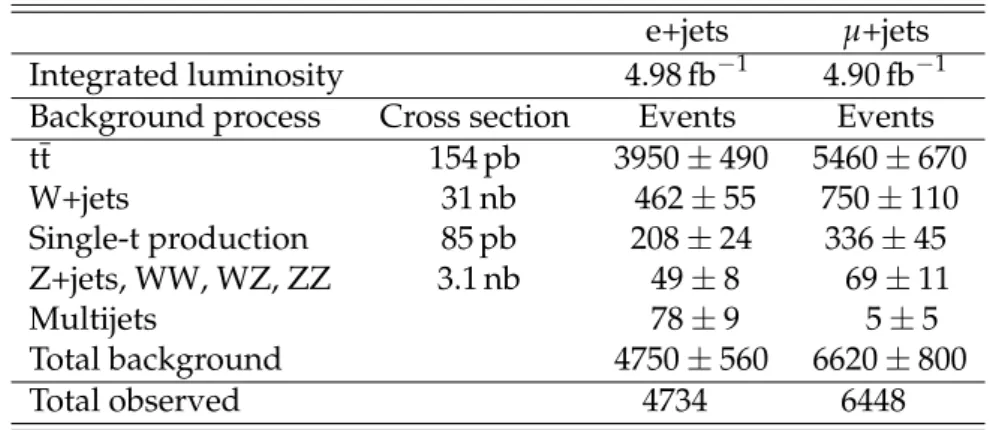
Table 1 lists the number of observed and expected events for the various background sources after selection. The expected numbers of background events are calculated from the cross sec-tions and integrated luminosities given in the table. The cross section for tt production is taken from a previous CMS measurement [35]. All other cross sections are computed with theMCFM
program [36]. In the case of the e+jets channel, the small multijet background is estimated from data by fitting the missing-pT distribution with shapes predicted by the MC simulation. The uncertainties shown include systematic uncertainties in the efficiency and acceptance. Un-certainties are strongly correlated for all sources. UnUn-certainties in the cross sections and the integrated luminosity are not included.
The fraction of tt events retained by our selection is 0.7% for the µ+jets channel and 0.5% for the e+jets channel.
Table 1: Background cross sections, number of events observed and background events pre-dicted for the e+jets and µ+jets samples. The prepre-dicted numbers of events are normalized to the integrated luminosity (except for the multijet events in the e+jets channel, see text).
e+jets µ+jets
Integrated luminosity 4.98 fb−1 4.90 fb−1 Background process Cross section Events Events
tt 154 pb 3950±490 5460±670 W+jets 31 nb 462±55 750±110 Single-t production 85 pb 208±24 336±45 Z+jets, WW, WZ, ZZ 3.1 nb 49±8 69±11 Multijets 78±9 5±5 Total background 4750±560 6620±800 Total observed 4734 6448
The comparisons between the data and the simulated background of multiple distributions for the final objects (leptons, jets, and missing transverse momentum) and their combinations have been performed, both for the initial tt selection [35] and for the final t0requirements. In all cases, the data are in agreement with the background model predictions, within the statistical
uncertainties.
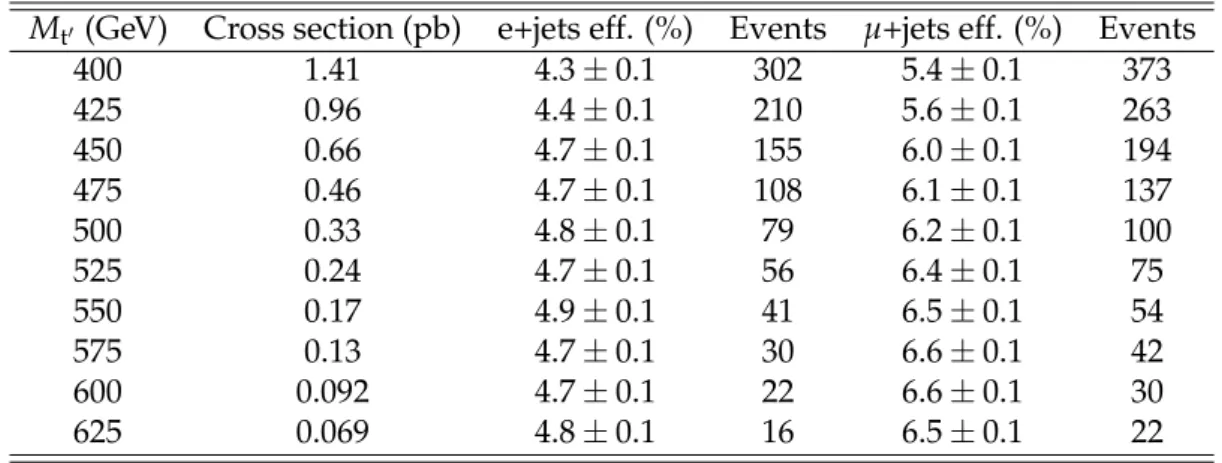
Table 2 shows the theoretical cross sections for the signal process for various t0-quark masses, along with the efficiencies of the event selection for the e+jets and µ+jets channels and the expected numbers of signal events. The t0¯t0 production cross sections are computed using
HATHOR [37]. The efficiencies include the branching fraction of the t0¯t0 system into a single-lepton final state, which can be obtained from the branching fractions for W → `ν and W →
qq0. The uncertainties quoted are the statistical uncertainties from the MC simulation.
Table 2: Theoretical cross sections [37], selection efficiencies, and numbers of expected events for the t0¯t0 signal with different t0 masses in the e+jets and µ+jets channels. The efficiencies include the branching fraction of the t0¯t0system into a single-lepton final state.
Mt0(GeV) Cross section (pb) e+jets eff. (%) Events µ+jets eff. (%) Events
400 1.41 4.3±0.1 302 5.4±0.1 373 425 0.96 4.4±0.1 210 5.6±0.1 263 450 0.66 4.7±0.1 155 6.0±0.1 194 475 0.46 4.7±0.1 108 6.1±0.1 137 500 0.33 4.8±0.1 79 6.2±0.1 100 525 0.24 4.7±0.1 56 6.4±0.1 75 550 0.17 4.9±0.1 41 6.5±0.1 54 575 0.13 4.7±0.1 30 6.6±0.1 42 600 0.092 4.7±0.1 22 6.6±0.1 30 625 0.069 4.8±0.1 16 6.5±0.1 22
5
Mass reconstruction
We perform a kinematic fit of each event to the t0¯t0 → WbWb → `
νbqq0b process. There are
two steps in the reconstruction of the t0-quark mass: the assignment of reconstructed objects to the quarks, and a kinematic fit to improve the resolution of the reconstructed mass of the t0-quark candidates. The four-momenta resulting from the kinematic fit of the particles in the final state must satisfy the following three constraints, where m is the invariant mass of the corresponding particles in parentheses, MW is the W-boson mass, Mfit is a free parameter in the fit (reconstructed t0mass), and`stands for electron or muon:
m(`ν) = MW, (1)
m(qq0) = MW, (2)
m(`νb) =m(qq0b) =Mfit. (3) Here`, ν, b denote either particle or antiparticle.
The reconstructed objects in the event are the charged lepton, the neutrino, and four or more jets. For the neutrino, only its transverse momentum can be measured as the missing trans-verse momentum in the event. The z component of the neutrino momentum can be deter-mined with two solutions from the kinematic constraints. The four quarks in the final state manifest themselves as jets and their momenta are measured. Thus, all but one of the momen-tum components of the considered final system are measured. With one unknown and three constraints, a kinematic fit is performed by minimizing the χ2 computed from the difference
6 6 Computation of t0¯t0cross section limits
between the measured momentum of each reconstructed object and its fitted value, divided by its uncertainty.
We have studied different strategies for pairing the observed jets with the four quarks from the decay of the t0 and ¯t0 quarks to find the best separation between the t0¯t0 signal and the tt background. In events with exactly four jets, we consider all possible jet-quark assignments. To reduce the number of combinations, we choose only those in which at least one b-tagged jet is assigned to a b quark from the t0¯t0 decay. In events with more than four jets, we take the five jets having the highest pT values, and consider all combinations of four out of these five jets. In each event, the kinematic fit is carried out for each jet-quark assignment, and the jet-quark assignment with the smallest χ2 value is chosen. This procedure selects the correct jet-quark assignment in 36–40% of the simulated t0¯t0events over a t0-quark mass range of 400–625 GeV for
all jet multiplicities together. For tt events this fraction is much lower, about 19%, because the jets from the decays of the t and t quarks are softer than from t0and ¯t0decays and, therefore, are less likely to be among the five highest-pT jets in the event. The χ2value does not distinguish the t0¯t0 signal from the tt background because both processes satisfy the fit hypothesis, but using the smallest value for each event does increase the fraction of correct quark assignments. Since a restriction on χ2does not improve the signal-to-background ratio, no such restriction is applied.
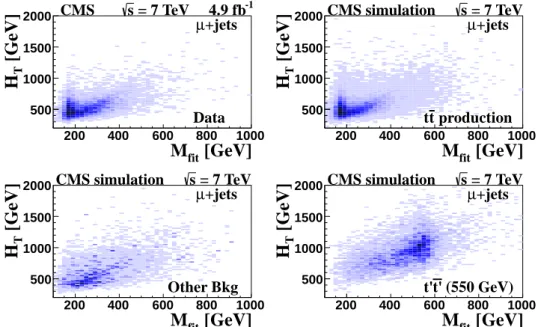
Figures 1 and 2 show the two-dimensional HT versus Mfit distributions for the data, tt sim-ulation, the other simulated backgrounds, and the t0¯t0 simulation with a particular t0 mass of 550 GeV in the e+jets and µ+jets channels, respectively. Figure 3 shows the corresponding Mfit and HT projections. The integrated luminosities given in Table 1 are used for the normaliza-tion of the background processes. The data are found to be in agreement with the predicted background Mfitand HTdistributions. The tt events that pass the selection criteria either have high-pTt and t quarks that produce high-pTjets in their decays or they have high-pTjets from initial-state gluon radiation. The former class of events is responsible for the relatively nar-row peak in the Mfit distribution at the t-quark mass. The Mfit distribution of the latter class of events is broad and typically populates the region above the t-quark mass, leading to the observed high-mass tail in the Mfitdistribution.
6
Computation of t
0¯t
0cross section limits
The two-dimensional distributions of HTversus Mfit, such as those shown in Figs. 1 and 2, are used to search for a t0¯t0 signal in the data. Simulated t0¯t0 signal distributions are produced for t0 masses from 400 to 625 GeV in 25 GeV steps. We do not use the two-dimensional histograms directly because it is not possible to simulate enough events to adequately populate all bins of the distributions for both signal and background. Therefore, we employ a new procedure that combines bins.
All the background distributions are added together to obtain the expected background event yield in each bin of the HTversus Mfithistogram. Then the projections of the two-dimensional signal and background histograms onto the HT and Mfit axes are separately fitted with ana-lytic functions. Next, we compute the expected signal-to-background (s/b) ratio for each two-dimensional bin as the product of the values of the two one-two-dimensional-bin fit functions for the signal and for the background at the bin center. This procedure of fitting the projections and neglecting their correlations is chosen because it reduces the sensitivity of s/b ordering to statistical fluctuations in the simulated samples. These functions are used only to define the or-dering of the bins. All two-dimensional bins are then sorted in increasing order of the expected s/b ratio, which we call the s/b rank.
[GeV]
fitM
200 400 600 800 1000[GeV]
TH
500 1000 1500 2000 Data -1 = 7 TeV 5.0 fb s CMS e+jets[GeV]
fitM
200 400 600 800 1000[GeV]
TH
500 1000 1500 2000 production t t = 7 TeV s CMS simulation e+jets[GeV]
fitM
200 400 600 800 1000[GeV]
TH
500 1000 1500 2000 Other Bkg = 7 TeV s CMS simulation e+jets[GeV]
fitM
200 400 600 800 1000[GeV]
TH
500 1000 1500 2000 (550 GeV) t' t' = 7 TeV s CMS simulation e+jetsFigure 1: HT versus Mfitfor the e+jets channel from data (top left), and simulations of tt pro-duction (top right), other backgrounds (bottom left), and t0¯t0 production (bottom right) for
Mt0 =550 GeV.
[GeV]
fitM
200 400 600 800 1000[GeV]
TH
500 1000 1500 2000 Data -1 = 7 TeV 4.9 fb s CMS +jets µ[GeV]
fitM
200 400 600 800 1000[GeV]
TH
500 1000 1500 2000 production t t = 7 TeV s CMS simulation +jets µ[GeV]
fitM
200 400 600 800 1000[GeV]
TH
500 1000 1500 2000 Other Bkg = 7 TeV s CMS simulation +jets µ[GeV]
fitM
200 400 600 800 1000[GeV]
TH
500 1000 1500 2000 (550 GeV) t' t' = 7 TeV s CMS simulation +jets µFigure 2: HT versus Mfit for the µ+jets channel from data (top left), and simulations of tt pro-duction (top right), other backgrounds (bottom left), and t0¯t0 production (bottom right) for Mt0 =550 GeV.
8 6 Computation of t0¯t0cross section limits
[GeV]
fitM
200
400
600
800
Events / 20 GeV
500
1000
Data t t Other Bkg 50 × (550 GeV) t' t' -1 = 7 TeV L = 4.9 fb s CMS +jets µ[GeV]
TH
500
1000
1500
Events / 40 GeV
500
1000
Data t t Other Bkg 50 × (550 GeV) t' t' -1 = 7 TeV L = 4.9 fb s CMS +jets µ[GeV]
fitM
200
400
600
800
Events / 20 GeV
200
400
600
800
Data t t Other Bkg 50 × (550 GeV) t' t' -1 = 7 TeV L = 5.0 fb s CMS e+jets[GeV]
fitM
200
400
600
800
Events / 20 GeV
500
1000
Data t t Other Bkg 50 × (550 GeV) t' t' -1 = 7 TeV L = 4.9 fb s CMS +jets µ[GeV]
TH
500
1000
1500
Events / 40 GeV
500
1000
Data t t Other Bkg 50 × (550 GeV) t' t' -1 = 7 TeV L = 4.9 fb s CMS +jets µ[GeV]
fitM
200
400
600
800
Events / 20 GeV
200
400
600
800
Data t t Other Bkg 50 × (550 GeV) t' t' -1 = 7 TeV L = 5.0 fb s CMS e+jets[GeV]
TH
500
1000
1500
Events / 40 GeV
200
400
600
Data t t Other Bkg 50 × (550 GeV) t' t' -1 = 7 TeV L = 5.0 fb s CMS e+jets[GeV]
fitM
200
400
600
800
Events / 20 GeV
500
1000
Data t t Other Bkg 50 × (550 GeV) t' t' -1 = 7 TeV L = 4.9 fb s CMS +jets µ[GeV]
fitM
200
400
600
800
Events / 20 GeV
500
1000
Data t t Other Bkg 50 × (550 GeV) t' t' -1 = 7 TeV L = 4.9 fb s CMS +jets µ[GeV]
TH
500
1000
1500
Events / 40 GeV
500
1000
Data t t Other Bkg 50 × (550 GeV) t' t' -1 = 7 TeV L = 4.9 fb s CMS +jets µFigure 3: Distributions of Mfit (left) and HT (right) for the e+jets (top) and µ+jets (bottom) channels. The data are shown as points, the simulated backgrounds as shaded histograms, and the expected signal for a t0 mass of 550 GeV as dashed histograms (multiplied by a factor of 50 to improve visibility).
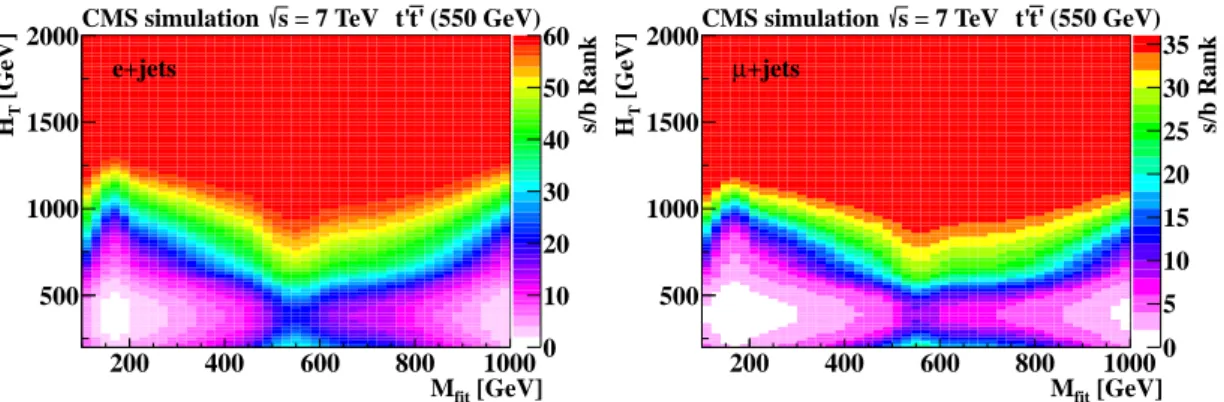
We then merge the two-dimensional bins that are adjacent after ordering by s/b ratio so that the fractional statistical uncertainty of both the signal and the background predictions is below 20% in all bins. We select the 20% value as a compromise between two effects. Increasing this value would increase the t0 signal sensitivity, but would also increase the potential biases in the t0¯t0cross section measurement, as determined from MC-generated “pseudo-experiments”, described below. Figure 4 shows the colour-coded maps of the merged bins obtained for the simulation of a t0quark with a mass of 550 GeV. The colour represents the rank of the bin in the s/b ordering. A higher rank corresponds to a higher s/b value.
200 400 600 800 1000 500 1000 1500 2000 0 10 20 30 40 50 60 [GeV] fit M [GeV] T H (550 GeV) t' t' CMS simulation s = 7 TeV s/b Rank e+jets 200 400 600 800 1000 500 1000 1500 2000 0 5 10 15 20 25 30 35 [GeV] fit M [GeV] T H (550 GeV) t' t' CMS simulation s = 7 TeV s/b Rank +jets µ
Figure 4: Map of the merged bins in the HT versus Mfit plane for a t0 quark with a mass of 550 GeV for the e+jets (left) and µ+jets (right) channels. The colour represents bins merged according to increasing signal-to-background (s/b) ratio. The vertical colour axis is labelled by s/b rank and corresponds to the bin index of the one-dimensional histograms of Fig. 5.
0 20 40 60 10 2 10 3 10 Data t t Other Bkg 50 × (550 GeV) t' t' CMS s = 7 TeV s/b Rank Events / Bin e+jets -1 L = 5.0 fb 0 10 20 30 10 2 10 3 10 4 10 Data t t Other Bkg 50 × (550 GeV) t' t' CMS s = 7 TeV s/b Rank Events / Bin +jets µ -1 L = 4.9 fb
Figure 5: Number of events per bin in the two-dimensional HT versus Mfithistogram after bin merging, as a function of the signal-to-background (s/b) rank for the e+jets (left) and µ+jets (right) channels. The data are shown by the points, the simulated tt and other background distributions by the histograms, and the prediction for a t0¯t0signal with a t0mass of 550 GeV by the dotted lines (multiplied by a factor of 50 for easier viewing).
In Fig. 5, the number of events in the merged bins is plotted versus s/b rank. In these his-tograms, signal events will predominantly cluster towards the right, and background events towards the left. These one-dimensional histograms are used as input to the t0¯t0 cross section
computation, and we will refer to these distributions as templates in the following. The data agree with the predicted background distributions in Fig. 5, with no evidence for a t0 signal. Thus, we use the results to set upper limits on the t0¯t0cross section as a function of t0 mass.
The computation of the limits for the t0¯t0 cross section uses the CLscriterion [38, 39]. The first step is to perform a likelihood fit to the data. We group the background in two components:
10 7 Systematic uncertainties
the larger one due to tt production and the smaller one from all EW processes (W+jets, Z+jets, single-t, and diboson production) and from multijet processes. Each background component is normalized to its expected yield and multiplied with a scale factor that is a free parameter in the fit. The t0¯t0cross section, σ, is also a free parameter in the fit. The following likelihood ratio
is used as the test statistic:
t(q|σ) =
(
L(q|σ, ˆασ)/L(q|ˆσ, ˆα) if σ> ˆσ
1 if σ≤ ˆσ. (4)
Here, L(q|σ, α)is the likelihood of the data having the value q for the parameter of interest
and the nuisance parameters α. The nuisance parameters account for effects that give rise to systematic uncertainties in the templates and include the normalizations of the background components. We do not include the per-bin statistical uncertainties on the signal and back-ground predictions in the likelihood fit because their effects were found to be negligible after applying the bin-merging procedure described above. The likelihood reaches its maximum when σ = ˆσ and α = ˆα. The symbol ˆασrefers to the values of the nuisance parameters α that
maximize the conditional likelihood at a given value of σ.
Using the asymptotic approximation for the test statistic described in [40], the probability to ob-serve a value t for the likelihood ratio that is larger than the obob-served value tobsis determined. This is done by producing samples of pseudo-experiments in which the expected numbers of signal and background events are allowed to vary according to their statistical and systematic uncertainties. For the pseudo-experiments generated with background only, this probability is denoted by CLb. For pseudo-experiments with a cross section σ for the t0¯t0signal, this probabil-ity is denoted by CLs+b(σ), which is a function of σ. The upper limit at the 95% confidence level
(CL) for the t0¯t0cross section is the value of σ for which CLs=CLs+b/CLb =0.05. To determine the limits for both lepton channels combined, we simultaneously fit the histograms from both channels, accounting for correlations among the nuisance parameters, and then apply the CLs method described above.
7
Systematic uncertainties
The signal and background predictions are subject to systematic uncertainties. Below, we de-scribe all sources of systematic uncertainties that have been considered. They can be divided into two categories: uncertainties that only impact the normalization of the signal and back-ground templates, and uncertainties that also affect the shapes of the distributions.
The uncertainties in the tt cross section, electroweak and multijet background normalizations, integrated luminosity, lepton efficiencies, and data/MC scale factors affect only the normaliza-tion.
The uncertainty on the cross section for tt production is taken from the CMS measurement of 154±18 pb at√s = 7 TeV [35]. The predicted yields of the EW and multijet backgrounds are determined as described in Section 4. A 50% uncertainty is assigned to the sum of these two backgrounds in the likelihood fit to the data in order to account for the uncertainty in the acceptance and the W+jets normalization.
The integrated luminosity affects the normalization of the t0¯t0signal and the background
tem-plates in a correlated way. The integrated luminosity is known to a precision of 2.2% [41]. Trigger efficiencies, lepton identification efficiencies, and data/MC scale factors are obtained
from data using decays of Z bosons to dileptons. Their uncertainties are included in the se-lection efficiency uncertainty. They amount to 2% for the µ+jets channel and 3% for the e+jets channel.
Uncertainties that affect the shapes of the distributions include those on the jet energy scale, jet energy resolution, missing-pT resolution, b-tagging efficiency, number of multiple pp interac-tions, factorization/renormalization scale Q, matrix-element/parton-shower matching thresh-old [42], and initial- and final-state radiation. To model these uncertainties, we produce addi-tional templates by varying the nuisance parameter that characterizes the systematic effect by
±1 standard deviation. To determine the signal and background templates used in the fit for any value of the nuisance parameter, we interpolate the content of each bin between the varied and nominal templates. This procedure is often referred to as vertical morphing.
The energy of all jets is obtained using the standard CMS jet energy calibration constants [33]. The sum of the four-momenta of the jets is 100% correlated with the measured missing pT. The jet energy scale uncertainty affects the normalization and the shape of the HT vs. Mfit distribution. This is taken into account by generating HTvs. Mfitdistributions for values of the jet energy scaled by±1 standard deviation of the η- and pT-dependent uncertainties from [33]. The energy resolution of jets in the simulation is better than in the data. Therefore, random noise is added to the jet energies in the simulation to worsen the resolution by 10%, to match the actual resolution of the detector. To estimate the corresponding uncertainty, the analysis is performed without smearing and with 20% smearing. The missing-pT resolution is also simultaneously corrected for this effect.
The systematic uncertainty from the b-tagging efficiency is estimated by varying this efficiency by±1 standard deviation taken from [34].
To evaluate the uncertainties related to the modelling of multiple interactions in the same beam crossing, the average number of interactions in the simulation is varied by±8% relative to the nominal value.
The uncertainty in the factorization/normalization scale Q, used for the strong coupling con-stant αs(Q2), is estimated by using two sets of simulated tt samples in which the Q value is increased and decreased by factors of two relative to the nominal value.
The uncertainty arising from the threshold for matching between matrix elements and parton showers [42] is estimated using two simulated tt samples generated with the matching thresh-old varied up and down by a factor of two from the default value.
The impact of initial- and final-state radiation is estimated using a tt MC sample generated withPOWHEG, instead of MADEVENT/MADGRAPH.
We estimate the effects of these systematic uncertainties on the expected t0¯t0cross section limits by adding them to the limit calculation one at a time. The largest effects on the expected lim-its come from the normalizations of the EW background, the jet energy scale calibration, and the normalization of the tt background. All other uncertainties change the expected limits by insignificant amounts. In order to simplify the computational complexity of the limit computa-tion, we therefore consider only a limited set of systematic uncertainties in the limit calculation by assigning nuisance parameters to them: the integrated luminosity, normalization of the EW and tt backgrounds, lepton efficiency, jet energy scale, and parton-shower matching threshold. The additional effect of the other uncertainties is negligible. All of these except the lepton effi-ciency are treated as correlated in the combined result from the e+jets and the µ+jets channels.
12 7 Systematic uncertainties 400 450 500 550 600 -1 10 1 [GeV] t' M [pb] σ observed expected expected σ 1 ± expected σ 2 ± predicted t' t' ) -1 e+jets (5.0 fb 95% CL upper limits s CL CMS s = 7 TeV 400 450 500 550 600 -1 10 1 [GeV] t' M [pb] σ observed expected expected σ 1 ± expected σ 2 ± predicted t' t' ) -1 +jets (4.9 fb µ 95% CL upper limits s CL CMS s = 7 TeV 400 450 500 550 600 -1 10 1 [GeV] t' M [pb] σ observed expected expected σ 1 ± expected σ 2 ± predicted t' t' ) -1 ), e+jets (5.0 fb -1 +jets (4.9 fb µ 95% CL upper limits s CL CMS s = 7 TeV
Figure 6: The observed (solid line with points) and expected (dotted line) 95% CL upper limits on the t0¯t0 production cross section as a function of the t0-quark mass for e+jets (top), µ+jets (middle), and combined (bottom) channels. The ±1 and ±2 standard deviation ranges for the expected limits are shown by the bands. The theoretical t0¯t0 cross section is shown by the
8
Results
Figure 6 shows the observed and expected 95% CL upper limits on the t0¯t0 cross section for the e+jets (top), the µ+jets (middle) channels, and the combination of both channels (bottom). The 95% CL lower limit for the t0-quark mass is given by the value at which the observed upper limit curve for the t0¯t0 cross section intersects the theoretical curve, also shown in Fig. 6. In the e+jets channel this happens for the 95% CL observed (expected) lower limits for a t0-quark mass of 490 (540) GeV. In the µ+jets channel the corresponding t0-quark mass limit is 560 (550) GeV. The combined observed (expected) limit from both channels is 570 (590) GeV. A comparable lower limit on the t0 mass of 557 GeV was obtained recently by the CMS Collaboration using a dilepton channel [43].
9
Summary
The results of a search for up-type fourth-generation quarks that are pair produced in pp inter-actions at√s = 7 TeV and decay exclusively to Wb have been presented. Events were selected in which one of the W bosons decays to leptons and the other to a quark-antiquark pair. The selection required an electron or a muon, significant missing transverse momentum, and at least four jets, of which at least one was identified as a b jet. A kinematic fit assuming t0¯t0 pro-duction was performed and for every event a candidate t0-quark mass and the sum over the transverse momenta of all decay products of the t0¯t0system were reconstructed. No significant deviations from the standard model expectations have been found in these two-dimensional distributions, and upper limits have been set on the production cross section of such t0 quarks as a function of their mass. By comparing with the predicted cross section for t0¯t0 production,
the strong pair production of t0 quarks is excluded at 95% CL for masses below 570 GeV under the model assumptions used in this analysis. This result and the one from [43] are the most restrictive yet found and raise the lower limit on the mass of a t0 quark to a region where per-turbative calculations for the weak interactions start to fail and nonperper-turbative effects become significant. The search is equally sensitive to nonchiral heavy quarks decaying to Wb. In this case, the results can be interpreted as upper limits on the production cross section times the branching fraction to Wb.
Acknowledgements
We congratulate our colleagues in the CERN accelerator departments for the excellent perfor-mance of the LHC machine. We thank the technical and administrative staff at CERN and other CMS institutes, and acknowledge support from: FMSR (Austria); FNRS and FWO (Belgium); CNPq, CAPES, FAPERJ, and FAPESP (Brazil); MES (Bulgaria); CERN; CAS, MoST, and NSFC (China); COLCIENCIAS (Colombia); MSES (Croatia); RPF (Cyprus); MoER, SF0690030s09 and ERDF (Estonia); Academy of Finland, MEC, and HIP (Finland); CEA and CNRS/IN2P3 (France); BMBF, DFG, and HGF (Germany); GSRT (Greece); OTKA and NKTH (Hungary); DAE and DST (India); IPM (Iran); SFI (Ireland); INFN (Italy); NRF and WCU (Korea); LAS (Lithuania); CIN-VESTAV, CONACYT, SEP, and UASLP-FAI (Mexico); MSI (New Zealand); PAEC (Pakistan); MSHE and NSC (Poland); FCT (Portugal); JINR (Armenia, Belarus, Georgia, Ukraine, Uzbek-istan); MON, RosAtom, RAS and RFBR (Russia); MSTD (Serbia); MICINN and CPAN (Spain); Swiss Funding Agencies (Switzerland); NSC (Taipei); TUBITAK and TAEK (Turkey); STFC (United Kingdom); DOE and NSF (USA).
14 References
References
[1] S. L. Glashow, “Partial-symmetries of weak interactions”, Nucl. Phys. 22 (1961) 579, doi:10.1016/0029-5582(61)90469-2.
[2] S. Weinberg, “A Model of Leptons”, Phys. Rev. Lett. 19 (1967) 1264, doi:10.1103/PhysRevLett.19.1264.
[3] A. Salam, “Weak and electromagnetic interactions”, in Elementary particle physics: relativistic groups and analyticity, N. Svartholm, ed., p. 367. Almqvist & Wiksell, Stockholm, 1968. Proceedings of the eighth Nobel symposium.
[4] V. A. Novikov, A. N. Rozanov, and M. I. Vysotsky, “Once more on extra quark-lepton generations and precision measurements”, Phys. Atom. Nucl. 73 (2010) 636,
doi:10.1134/S1063778810040095, arXiv:0904.4570.
[5] ATLAS Collaboration, “Observation of a new particle in the search for the Standard Model Higgs boson with the ATLAS detector at the LHC”, Phys. Lett. B 716 (2012) 1, doi:10.1016/j.physletb.2012.08.020, arXiv:1207.7214.
[6] CMS Collaboration, “Observation of a new boson at a mass of 125 GeV with the CMS experiment at the LHC”, Phys. Lett. B 716 (2012) 30,
doi:10.1016/j.physletb.2012.08.021, arXiv:1207.7235.
[7] O. Eberhardt et al., “Joint analysis of Higgs boson decays and electroweak precision observables in the standard model with a sequential fourth generation”, Phys. Rev. D 86 (2012) 013011, doi:10.1103/PhysRevD.86.013011, arXiv:1204.3872. See also arxiv:1209.1101.
[8] N. Chen and H.-J. He, “LHC signatures of two-Higgs-doublets with fourth family”, JHEP 04 (2012) 062, doi:10.1007/JHEP04(2012)062, arXiv:1202.3072. [9] D. Choudhury, T. Tait, and C. Wagner, “Beautiful Mirrors and Precision Electroweak
Data”, Phys. Rev. D 65 (2002) 053002, doi:10.1103/PhysRevD.65.053002, arXiv:hep-ph/0109097.
[10] M. Schmaltz, “Physics beyond the standard model (Theory): Introducing the Little Higgs”, Nucl. Phys. Proc. Suppl. 117 (2003) 40,
doi:10.1016/S0920-5632(03)01409-9, arXiv:hep-ph/0210415.
[11] G. D. Kribs et al., “Four generations and Higgs physics”, Phys. Rev. D 76 (2007) 075016, doi:10.1103/PhysRevD.76.075016, arXiv:0706.3718.
[12] A. Soni et al., “SM with four generations: Selected implications for rare B and K decays”, Phys. Rev. D 82 (2010) 033009, doi:10.1103/PhysRevD.82.033009,
arXiv:1002.0595.
[13] O. Eberhardt, A. Lenz, and J. Rohrwild, “Less space for a new family of fermions”, Phys. Rev. D 82 (2010) 095006, doi:10.1103/PhysRevD.82.095006, arXiv:1005.3505. [14] M. S. Chanowitz, M. A. Furman, and I. Hinchliffe, “Weak Interactions of Ultraheavy
Fermions”, Phys. Lett. B 78 (1978) 285, doi:10.1016/0370-2693(78)90024-2. [15] M. S. Chanowitz, “Bounding CKM Mixing with a Fourth Family”, Phys. Rev. D 79 (2009)
[16] D0 Collaboration, “Search for a Fourth Generation t√ 0 Quark in p ¯p Collisions at s =1.96 TeV”, Phys. Rev. Lett. 107 (2011) 082001,
doi:10.1103/PhysRevLett.107.082001, arXiv:1104.4522. [17] CDF Collaboration, “Search for a Heavy Toplike Quark in p ¯p Collisions at√
s =1.96 TeV”, Phys. Rev. Lett. 107 (2011) 261801,
doi:10.1103/PhysRevLett.107.261801, arXiv:1107.3875.
[18] ATLAS Collaboration, “Search for Pair Production of a Heavy Up-Type Quark Decaying to a W Boson and a b Quark in the lepton+jets Channel with the ATLAS Detector”, Phys. Rev. Lett. 108 (2012) 261802, doi:10.1103/PhysRevLett.108.261802,
arXiv:1202.3076.
[19] CMS Collaboration, “The CMS experiment at the CERN LHC”, JINST 3 (2008) S08004, doi:10.1088/1748-0221/3/08/S08004.
[20] P. Nason, “A new method for combining NLO QCD with shower Monte Carlo algorithms”, JHEP 11 (2004) 040, doi:10.1088/1126-6708/2004/11/040, arXiv:hep-ph/0409146.
[21] S. Frixione, P. Nason, and C. Oleari, “Matching NLO QCD computations with parton shower simulations: the POWHEG method”, JHEP 11 (2007) 070,
doi:10.1088/1126-6708/2007/11/070, arXiv:0709.2092.
[22] S. Alioli et al., “A general framework for implementing NLO calculations in shower Monte Carlo programs: the POWHEG BOX”, JHEP 06 (2010) 043,
doi:10.1007/JHEP06(2010)043, arXiv:1002.2581.
[23] J. Alwall et al., “MadGraph/MadEvent v4: the new web generation”, JHEP 09 (2007) 028, doi:10.1088/1126-6708/2007/09/028, arXiv:0706.2334.
[24] T. Sjostrand, S. Mrenna, and P. Z. Skands, “PYTHIA 6.4 physics and manual”, JHEP 05.. (2006) 026, doi:10.1088/1126-6708/2006/05/026, arXiv:hep-ph/0603175. [25] GEANT4 Collaboration, “GEANT4 – a simulation toolkit”, Nucl. Instrum. Meth. A 506
(2003) 250, doi:10.1016/S0168-9002(03)01368-8.
[26] CMS Collaboration, “Particle-Flow Event Reconstruction in CMS and Performance for Jets, Taus, and MET”, CMS Physics Analysis Summary CMS-PAS-PFT-09-001, (2009). [27] CMS Collaboration, “Commissioning of the Particle-Flow Reconstruction in
Minimum-Bias and Jet Events from pp Collisions at 7 TeV”, CMS Physics Analysis Summary CMS-PAS-PFT-10-002, (2010).
[28] CMS Collaboration, “Particle-flow commissioning with muons and electrons from J/Psi and W events at 7 TeV”, CMS Physics Analysis Summary CMS-PAS-PFT-10-003, (2010). [29] M. Cacciari, G. P. Salam, and G. Soyez, “The anti-ktjet clustering algorithm”, JHEP 04
(2008) 063, doi:10.1088/1126-6708/2008/04/063, arXiv:0802.1189.
[30] M. Cacciari and G. P. Salam, “Dispelling the N3myth for the ktjet-finder”, Phys. Lett. B
641(2006) 57, doi:10.1016/j.physletb.2006.08.037, arXiv:hep-ph/0512210.
16 References
[31] M. Cacciari, G. P. Salam, and G. Soyez, “The catchment area of jets”, JHEP 04 (2008) 005, doi:10.1088/1126-6708/2008/04/005, arXiv:0802.1188.
[32] M. Cacciari and G. P. Salam, “Pileup subtraction using jet areas”, Phys. Lett. B 659 (2008) 119, doi:10.1016/j.physletb.2007.09.077, arXiv:0707.1378.
[33] CMS Collaboration, “Determination of jet energy calibration and transverse momentum resolution in CMS”, JINST 6 (2011) P11002,
doi:10.1088/1748-0221/6/11/P11002, arXiv:1107.4277.
[34] CMS Collaboration, “Measurement of the b-tagging efficiency using t¯t events”, CMS Physics Analysis Summary CMS-PAS-BTV-11-003, (2011).
[35] CMS Collaboration, “Measurement of the t¯t production cross section in pp collisions at 7 TeV in lepton + jets events using b-quark jet identification”, Phys. Rev. D 84 (2011) 092004, doi:10.1103/PhysRevD.84.092004, arXiv:1108.3773.
[36] J. M. Campbell and R. Ellis, “Next-to-leading order corrections to W+2 jet and Z+2 jet production at hadron colliders”, Phys. Rev. D 65 (2002) 113007,
doi:10.1103/PhysRevD.65.113007, arXiv:hep-ph/0202176.
[37] M. Aliev et al., “HATHOR – HAdronic Top and Heavy quarks crOss section calculatoR”, Comput. Phys. Commun. 182 (2011) 1034, doi:10.1016/j.cpc.2010.12.040,
arXiv:1007.1327.
[38] T. Junk, “Confidence level computation for combining searches with small statistics”, Nucl. Instrum. Meth. A 434 (1999) 435, doi:10.1016/S0168-9002(99)00498-2, arXiv:hep-ex/9902006.
[39] A. L. Read, “Presentation of search results: The CLstechnique”, J. Phys. G 28 (2002) 2693, doi:10.1088/0954-3899/28/10/313.
[40] G. Cowan et al., “Asymptotic formulae for likelihood-based tests of new physics”, Eur. Phys. J. C 71 (2011) 1554, doi:10.1140/epjc/s10052-011-1554-0,
arXiv:1007.1727.
[41] CMS Collaboration, “Absolute Calibration of the Luminosity Measurement at CMS: Winter 2012 Update”, CMS Physics Analysis Summary CMS-PAS-SMP-2012-008, (2012). [42] S. Mrenna and P. Richardson, “Matching matrix elements and parton showers with
HERWIG and PYTHIA”, JHEP 05 (2004) 040,
doi:10.1088/1126-6708/2004/05/040, arXiv:hep-ph/0312274.
[43] CMS Collaboration, “Search for heavy, top-like quark pair production in the dilepton final state in pp collisions at√s = 7 TeV”, Phys. Lett. B 716 (2012) 103,
A
The CMS Collaboration
Yerevan Physics Institute, Yerevan, Armenia
S. Chatrchyan, V. Khachatryan, A.M. Sirunyan, A. Tumasyan
Institut f ¨ur Hochenergiephysik der OeAW, Wien, Austria
W. Adam, E. Aguilo, T. Bergauer, M. Dragicevic, J. Er ¨o, C. Fabjan1, M. Friedl, R. Fr ¨uhwirth1, V.M. Ghete, J. Hammer, N. H ¨ormann, J. Hrubec, M. Jeitler1, W. Kiesenhofer, V. Kn ¨unz, M. Krammer1, I. Kr¨atschmer, D. Liko, I. Mikulec, M. Pernicka†, B. Rahbaran, C. Rohringer, H. Rohringer, R. Sch ¨ofbeck, J. Strauss, A. Taurok, W. Waltenberger, G. Walzel, C.-E. Wulz1
National Centre for Particle and High Energy Physics, Minsk, Belarus
V. Mossolov, N. Shumeiko, J. Suarez Gonzalez
Universiteit Antwerpen, Antwerpen, Belgium
M. Bansal, S. Bansal, T. Cornelis, E.A. De Wolf, X. Janssen, S. Luyckx, L. Mucibello, S. Ochesanu, B. Roland, R. Rougny, M. Selvaggi, H. Van Haevermaet, P. Van Mechelen, N. Van Remortel, A. Van Spilbeeck
Vrije Universiteit Brussel, Brussel, Belgium
F. Blekman, S. Blyweert, J. D’Hondt, R. Gonzalez Suarez, A. Kalogeropoulos, M. Maes, A. Olbrechts, W. Van Doninck, P. Van Mulders, G.P. Van Onsem, I. Villella
Universit´e Libre de Bruxelles, Bruxelles, Belgium
B. Clerbaux, G. De Lentdecker, V. Dero, A.P.R. Gay, T. Hreus, A. L´eonard, P.E. Marage, T. Reis, L. Thomas, C. Vander Velde, P. Vanlaer, J. Wang
Ghent University, Ghent, Belgium
V. Adler, K. Beernaert, A. Cimmino, S. Costantini, G. Garcia, M. Grunewald, B. Klein, J. Lellouch, A. Marinov, J. Mccartin, A.A. Ocampo Rios, D. Ryckbosch, N. Strobbe, F. Thyssen, M. Tytgat, S. Walsh, E. Yazgan, N. Zaganidis
Universit´e Catholique de Louvain, Louvain-la-Neuve, Belgium
S. Basegmez, G. Bruno, R. Castello, L. Ceard, C. Delaere, T. du Pree, D. Favart, L. Forthomme, A. Giammanco2, J. Hollar, V. Lemaitre, J. Liao, O. Militaru, C. Nuttens, D. Pagano, A. Pin, K. Piotrzkowski, N. Schul, J.M. Vizan Garcia
Universit´e de Mons, Mons, Belgium
N. Beliy, T. Caebergs, E. Daubie, G.H. Hammad
Centro Brasileiro de Pesquisas Fisicas, Rio de Janeiro, Brazil
G.A. Alves, M. Correa Martins Junior, T. Martins, M.E. Pol, M.H.G. Souza
Universidade do Estado do Rio de Janeiro, Rio de Janeiro, Brazil
W.L. Ald´a J ´unior, W. Carvalho, A. Cust ´odio, E.M. Da Costa, D. De Jesus Damiao, C. De Oliveira Martins, S. Fonseca De Souza, H. Malbouisson, M. Malek, D. Matos Figueiredo, L. Mundim, H. Nogima, W.L. Prado Da Silva, A. Santoro, L. Soares Jorge, A. Sznajder, A. Vilela Pereira
Instituto de Fisica Teorica, Universidade Estadual Paulista, Sao Paulo, Brazil
T.S. Anjos3, C.A. Bernardes3, F.A. Dias4, T.R. Fernandez Perez Tomei, E.M. Gregores3, C. Lagana, F. Marinho, P.G. Mercadante3, S.F. Novaes, Sandra S. Padula
Institute for Nuclear Research and Nuclear Energy, Sofia, Bulgaria
V. Genchev5, P. Iaydjiev5, S. Piperov, M. Rodozov, S. Stoykova, G. Sultanov, V. Tcholakov, R. Trayanov, M. Vutova
18 A The CMS Collaboration
University of Sofia, Sofia, Bulgaria
A. Dimitrov, R. Hadjiiska, V. Kozhuharov, L. Litov, B. Pavlov, P. Petkov
Institute of High Energy Physics, Beijing, China
J.G. Bian, G.M. Chen, H.S. Chen, C.H. Jiang, D. Liang, S. Liang, X. Meng, J. Tao, J. Wang, X. Wang, Z. Wang, H. Xiao, M. Xu, J. Zang, Z. Zhang
State Key Lab. of Nucl. Phys. and Tech., Peking University, Beijing, China
C. Asawatangtrakuldee, Y. Ban, Y. Guo, W. Li, S. Liu, Y. Mao, S.J. Qian, H. Teng, D. Wang, L. Zhang, W. Zou
Universidad de Los Andes, Bogota, Colombia
C. Avila, J.P. Gomez, B. Gomez Moreno, A.F. Osorio Oliveros, J.C. Sanabria
Technical University of Split, Split, Croatia
N. Godinovic, D. Lelas, R. Plestina6, D. Polic, I. Puljak5
University of Split, Split, Croatia
Z. Antunovic, M. Kovac
Institute Rudjer Boskovic, Zagreb, Croatia
V. Brigljevic, S. Duric, K. Kadija, J. Luetic, D. Mekterovic, S. Morovic
University of Cyprus, Nicosia, Cyprus
A. Attikis, M. Galanti, G. Mavromanolakis, J. Mousa, C. Nicolaou, F. Ptochos, P.A. Razis
Charles University, Prague, Czech Republic
M. Finger, M. Finger Jr.
Academy of Scientific Research and Technology of the Arab Republic of Egypt, Egyptian Network of High Energy Physics, Cairo, Egypt
Y. Assran7, S. Elgammal8, A. Ellithi Kamel9, S. Khalil8, M.A. Mahmoud10, A. Radi11,12
National Institute of Chemical Physics and Biophysics, Tallinn, Estonia
M. Kadastik, M. M ¨untel, M. Raidal, L. Rebane, A. Tiko
Department of Physics, University of Helsinki, Helsinki, Finland
P. Eerola, G. Fedi, M. Voutilainen
Helsinki Institute of Physics, Helsinki, Finland
J. H¨ark ¨onen, A. Heikkinen, V. Karim¨aki, R. Kinnunen, M.J. Kortelainen, T. Lamp´en, K. Lassila-Perini, S. Lehti, T. Lind´en, P. Luukka, T. M¨aenp¨a¨a, T. Peltola, E. Tuominen, J. Tuominiemi, E. Tuovinen, D. Ungaro, L. Wendland
Lappeenranta University of Technology, Lappeenranta, Finland
K. Banzuzi, A. Karjalainen, A. Korpela, T. Tuuva
DSM/IRFU, CEA/Saclay, Gif-sur-Yvette, France
M. Besancon, S. Choudhury, M. Dejardin, D. Denegri, B. Fabbro, J.L. Faure, F. Ferri, S. Ganjour, A. Givernaud, P. Gras, G. Hamel de Monchenault, P. Jarry, E. Locci, J. Malcles, L. Millischer, A. Nayak, J. Rander, A. Rosowsky, I. Shreyber, M. Titov
Laboratoire Leprince-Ringuet, Ecole Polytechnique, IN2P3-CNRS, Palaiseau, France
S. Baffioni, F. Beaudette, L. Benhabib, L. Bianchini, M. Bluj13, C. Broutin, P. Busson, C. Charlot, N. Daci, T. Dahms, M. Dalchenko, L. Dobrzynski, A. Florent, R. Granier de Cassagnac, M. Haguenauer, P. Min´e, C. Mironov, I.N. Naranjo, M. Nguyen, C. Ochando, P. Paganini, D. Sabes, R. Salerno, Y. Sirois, C. Veelken, A. Zabi
Institut Pluridisciplinaire Hubert Curien, Universit´e de Strasbourg, Universit´e de Haute Alsace Mulhouse, CNRS/IN2P3, Strasbourg, France
J.-L. Agram14, J. Andrea, D. Bloch, D. Bodin, J.-M. Brom, M. Cardaci, E.C. Chabert, C. Collard, E. Conte14, F. Drouhin14, J.-C. Fontaine14, D. Gel´e, U. Goerlach, P. Juillot, A.-C. Le Bihan, P. Van Hove
Centre de Calcul de l’Institut National de Physique Nucleaire et de Physique des Particules, CNRS/IN2P3, Villeurbanne, France, Villeurbanne, France
F. Fassi, D. Mercier
Universit´e de Lyon, Universit´e Claude Bernard Lyon 1, CNRS-IN2P3, Institut de Physique Nucl´eaire de Lyon, Villeurbanne, France
S. Beauceron, N. Beaupere, O. Bondu, G. Boudoul, J. Chasserat, R. Chierici5, D. Contardo, P. Depasse, H. El Mamouni, J. Fay, S. Gascon, M. Gouzevitch, B. Ille, T. Kurca, M. Lethuillier, L. Mirabito, S. Perries, L. Sgandurra, V. Sordini, Y. Tschudi, P. Verdier, S. Viret
Institute of High Energy Physics and Informatization, Tbilisi State University, Tbilisi, Georgia
Z. Tsamalaidze15
RWTH Aachen University, I. Physikalisches Institut, Aachen, Germany
C. Autermann, S. Beranek, B. Calpas, M. Edelhoff, L. Feld, N. Heracleous, O. Hindrichs, R. Jussen, K. Klein, J. Merz, A. Ostapchuk, A. Perieanu, F. Raupach, J. Sammet, S. Schael, D. Sprenger, H. Weber, B. Wittmer, V. Zhukov16
RWTH Aachen University, III. Physikalisches Institut A, Aachen, Germany
M. Ata, J. Caudron, E. Dietz-Laursonn, D. Duchardt, M. Erdmann, R. Fischer, A. G ¨uth, T. Hebbeker, C. Heidemann, K. Hoepfner, D. Klingebiel, P. Kreuzer, M. Merschmeyer, A. Meyer, M. Olschewski, P. Papacz, H. Pieta, H. Reithler, S.A. Schmitz, L. Sonnenschein, J. Steggemann, D. Teyssier, S. Th ¨uer, M. Weber
RWTH Aachen University, III. Physikalisches Institut B, Aachen, Germany
M. Bontenackels, V. Cherepanov, Y. Erdogan, G. Fl ¨ugge, H. Geenen, M. Geisler, W. Haj Ahmad, F. Hoehle, B. Kargoll, T. Kress, Y. Kuessel, J. Lingemann5, A. Nowack, L. Perchalla, O. Pooth, P. Sauerland, A. Stahl
Deutsches Elektronen-Synchrotron, Hamburg, Germany
M. Aldaya Martin, J. Behr, W. Behrenhoff, U. Behrens, M. Bergholz17, A. Bethani, K. Borras, A. Burgmeier, A. Cakir, L. Calligaris, A. Campbell, E. Castro, F. Costanza, D. Dammann, C. Diez Pardos, G. Eckerlin, D. Eckstein, G. Flucke, A. Geiser, I. Glushkov, P. Gunnellini, S. Habib, J. Hauk, G. Hellwig, H. Jung, M. Kasemann, P. Katsas, C. Kleinwort, H. Kluge, A. Knutsson, M. Kr¨amer, D. Kr ¨ucker, E. Kuznetsova, W. Lange, W. Lohmann17, B. Lutz, R. Mankel, I. Marfin, M. Marienfeld, I.-A. Melzer-Pellmann, A.B. Meyer, J. Mnich, A. Mussgiller, S. Naumann-Emme, O. Novgorodova, J. Olzem, H. Perrey, A. Petrukhin, D. Pitzl, A. Raspereza, P.M. Ribeiro Cipriano, C. Riedl, E. Ron, M. Rosin, J. Salfeld-Nebgen, R. Schmidt17, T. Schoerner-Sadenius, N. Sen, A. Spiridonov, M. Stein, R. Walsh, C. Wissing
University of Hamburg, Hamburg, Germany
V. Blobel, J. Draeger, H. Enderle, J. Erfle, U. Gebbert, M. G ¨orner, T. Hermanns, R.S. H ¨oing, K. Kaschube, G. Kaussen, H. Kirschenmann, R. Klanner, J. Lange, B. Mura, F. Nowak, T. Peiffer, N. Pietsch, D. Rathjens, C. Sander, H. Schettler, P. Schleper, E. Schlieckau, A. Schmidt, M. Schr ¨oder, T. Schum, M. Seidel, J. Sibille18, V. Sola, H. Stadie, G. Steinbr ¨uck, J. Thomsen, L. Vanelderen
20 A The CMS Collaboration
Institut f ¨ur Experimentelle Kernphysik, Karlsruhe, Germany
C. Barth, J. Berger, C. B ¨oser, T. Chwalek, W. De Boer, A. Descroix, A. Dierlamm, M. Feindt, M. Guthoff5, C. Hackstein, F. Hartmann5, T. Hauth5, M. Heinrich, H. Held, K.H. Hoffmann, U. Husemann, I. Katkov16, J.R. Komaragiri, P. Lobelle Pardo, D. Martschei, S. Mueller, Th. M ¨uller, M. Niegel, A. N ¨urnberg, O. Oberst, A. Oehler, J. Ott, G. Quast, K. Rabbertz, F. Ratnikov, N. Ratnikova, S. R ¨ocker, F.-P. Schilling, G. Schott, H.J. Simonis, F.M. Stober, D. Troendle, R. Ulrich, J. Wagner-Kuhr, S. Wayand, T. Weiler, M. Zeise
Institute of Nuclear Physics ”Demokritos”, Aghia Paraskevi, Greece
G. Anagnostou, G. Daskalakis, T. Geralis, S. Kesisoglou, A. Kyriakis, D. Loukas, I. Manolakos, A. Markou, C. Markou, C. Mavrommatis, E. Ntomari
University of Athens, Athens, Greece
L. Gouskos, T.J. Mertzimekis, A. Panagiotou, N. Saoulidou
University of Io´annina, Io´annina, Greece
I. Evangelou, C. Foudas, P. Kokkas, N. Manthos, I. Papadopoulos, V. Patras
KFKI Research Institute for Particle and Nuclear Physics, Budapest, Hungary
G. Bencze, C. Hajdu, P. Hidas, D. Horvath19, F. Sikler, V. Veszpremi, G. Vesztergombi20
Institute of Nuclear Research ATOMKI, Debrecen, Hungary
N. Beni, S. Czellar, J. Molnar, J. Palinkas, Z. Szillasi
University of Debrecen, Debrecen, Hungary
J. Karancsi, P. Raics, Z.L. Trocsanyi, B. Ujvari
Panjab University, Chandigarh, India
S.B. Beri, V. Bhatnagar, N. Dhingra, R. Gupta, M. Kaur, M.Z. Mehta, N. Nishu, L.K. Saini, A. Sharma, J.B. Singh
University of Delhi, Delhi, India
Ashok Kumar, Arun Kumar, S. Ahuja, A. Bhardwaj, B.C. Choudhary, S. Malhotra, M. Naimuddin, K. Ranjan, V. Sharma, R.K. Shivpuri
Saha Institute of Nuclear Physics, Kolkata, India
S. Banerjee, S. Bhattacharya, S. Dutta, B. Gomber, Sa. Jain, Sh. Jain, R. Khurana, S. Sarkar, M. Sharan
Bhabha Atomic Research Centre, Mumbai, India
A. Abdulsalam, D. Dutta, S. Kailas, V. Kumar, A.K. Mohanty5, L.M. Pant, P. Shukla
Tata Institute of Fundamental Research - EHEP, Mumbai, India
T. Aziz, S. Ganguly, M. Guchait21, M. Maity22, G. Majumder, K. Mazumdar, G.B. Mohanty, B. Parida, K. Sudhakar, N. Wickramage
Tata Institute of Fundamental Research - HECR, Mumbai, India
S. Banerjee, S. Dugad
Institute for Research in Fundamental Sciences (IPM), Tehran, Iran
H. Arfaei23, H. Bakhshiansohi, S.M. Etesami24, A. Fahim23, M. Hashemi25, H. Hesari, A. Jafari, M. Khakzad, M. Mohammadi Najafabadi, S. Paktinat Mehdiabadi, B. Safarzadeh26, M. Zeinali
INFN Sezione di Baria, Universit`a di Barib, Politecnico di Baric, Bari, Italy
M. Abbresciaa,b, L. Barbonea,b, C. Calabriaa,b,5, S.S. Chhibraa,b, A. Colaleoa, D. Creanzaa,c, N. De Filippisa,c,5, M. De Palmaa,b, L. Fiorea, G. Iasellia,c, G. Maggia,c, M. Maggia, B. Marangellia,b,
S. Mya,c, S. Nuzzoa,b, N. Pacificoa, A. Pompilia,b, G. Pugliesea,c, G. Selvaggia,b, L. Silvestrisa, G. Singha,b, R. Vendittia,b, P. Verwilligen, G. Zitoa
INFN Sezione di Bolognaa, Universit`a di Bolognab, Bologna, Italy
G. Abbiendia, A.C. Benvenutia, D. Bonacorsia,b, S. Braibant-Giacomellia,b, L. Brigliadoria,b, P. Capiluppia,b, A. Castroa,b, F.R. Cavalloa, M. Cuffiania,b, G.M. Dallavallea, F. Fabbria, A. Fanfania,b, D. Fasanellaa,b, P. Giacomellia, C. Grandia, L. Guiduccia,b, S. Marcellinia, G. Masettia, M. Meneghellia,b,5, A. Montanaria, F.L. Navarriaa,b, F. Odoricia, A. Perrottaa, F. Primaveraa,b, A.M. Rossia,b, T. Rovellia,b, G.P. Sirolia,b, N. Tosi, R. Travaglinia,b
INFN Sezione di Cataniaa, Universit`a di Cataniab, Catania, Italy
S. Albergoa,b, G. Cappelloa,b, M. Chiorbolia,b, S. Costaa,b, R. Potenzaa,b, A. Tricomia,b, C. Tuvea,b
INFN Sezione di Firenzea, Universit`a di Firenzeb, Firenze, Italy
G. Barbaglia, V. Ciullia,b, C. Civininia, R. D’Alessandroa,b, E. Focardia,b, S. Frosalia,b, E. Galloa, S. Gonzia,b, M. Meschinia, S. Paolettia, G. Sguazzonia, A. Tropianoa,b
INFN Laboratori Nazionali di Frascati, Frascati, Italy
L. Benussi, S. Bianco, S. Colafranceschi27, F. Fabbri, D. Piccolo
INFN Sezione di Genovaa, Universit`a di Genovab, Genova, Italy
P. Fabbricatorea, R. Musenicha, S. Tosia,b
INFN Sezione di Milano-Bicoccaa, Universit`a di Milano-Bicoccab, Milano, Italy
A. Benagliaa, F. De Guioa,b, L. Di Matteoa,b,5, S. Fiorendia,b, S. Gennaia,5, A. Ghezzia,b, S. Malvezzia, R.A. Manzonia,b, A. Martellia,b, A. Massironia,b, D. Menascea, L. Moronia, M. Paganonia,b, D. Pedrinia, S. Ragazzia,b, N. Redaellia, S. Salaa, T. Tabarelli de Fatisa,b
INFN Sezione di Napolia, Universit`a di Napoli ”Federico II”b, Napoli, Italy
S. Buontempoa, C.A. Carrillo Montoyaa, N. Cavalloa,28, A. De Cosaa,b,5, O. Doganguna,b, F. Fabozzia,28, A.O.M. Iorioa,b, L. Listaa, S. Meolaa,29, M. Merolaa, P. Paoluccia,5
INFN Sezione di Padovaa, Universit`a di Padovab, Universit`a di Trento (Trento)c, Padova,
Italy
P. Azzia, N. Bacchettaa,5, P. Bellana,b, D. Biselloa,b, A. Brancaa,5, R. Carlina,b, P. Checchiaa, T. Dorigoa, U. Dossellia, F. Gasparinia,b, U. Gasparinia,b, A. Gozzelinoa, K. Kanishcheva,c, S. Lacapraraa, I. Lazzizzeraa,c, M. Margonia,b, A.T. Meneguzzoa,b, M. Nespoloa,5, J. Pazzinia,b, P. Ronchesea,b, F. Simonettoa,b, E. Torassaa, S. Vaninia,b, P. Zottoa,b, G. Zumerlea,b
INFN Sezione di Paviaa, Universit`a di Paviab, Pavia, Italy
M. Gabusia,b, S.P. Rattia,b, C. Riccardia,b, P. Torrea,b, P. Vituloa,b
INFN Sezione di Perugiaa, Universit`a di Perugiab, Perugia, Italy
M. Biasinia,b, G.M. Bileia, L. Fan `oa,b, P. Laricciaa,b, G. Mantovania,b, M. Menichellia, A. Nappia,b†, F. Romeoa,b, A. Sahaa, A. Santocchiaa,b, A. Spieziaa,b, S. Taronia,b
INFN Sezione di Pisaa, Universit`a di Pisab, Scuola Normale Superiore di Pisac, Pisa, Italy
P. Azzurria,c, G. Bagliesia, T. Boccalia, G. Broccoloa,c, R. Castaldia, R.T. D’Agnoloa,c,5, R. Dell’Orsoa, F. Fioria,b,5, L. Fo`aa,c, A. Giassia, A. Kraana, F. Ligabuea,c, T. Lomtadzea, L. Martinia,30, A. Messineoa,b, F. Pallaa, A. Rizzia,b, A.T. Serbana,31, P. Spagnoloa, P. Squillaciotia,5, R. Tenchinia, G. Tonellia,b, A. Venturia, P.G. Verdinia
INFN Sezione di Romaa, Universit`a di Roma ”La Sapienza”b, Roma, Italy
22 A The CMS Collaboration
P. Meridiania,5, F. Michelia,b, S. Nourbakhsha,b, G. Organtinia,b, R. Paramattia, S. Rahatloua,b, M. Sigamania, L. Soffia,b
INFN Sezione di Torino a, Universit`a di Torino b, Universit`a del Piemonte Orientale
(No-vara)c, Torino, Italy
N. Amapanea,b, R. Arcidiaconoa,c, S. Argiroa,b, M. Arneodoa,c, C. Biinoa, N. Cartigliaa, M. Costaa,b, N. Demariaa, C. Mariottia,5, S. Masellia, E. Migliorea,b, V. Monacoa,b, M. Musicha,5, M.M. Obertinoa,c, N. Pastronea, M. Pelliccionia, A. Potenzaa,b, A. Romeroa,b, M. Ruspaa,c, R. Sacchia,b, A. Solanoa,b, A. Staianoa
INFN Sezione di Triestea, Universit`a di Triesteb, Trieste, Italy
S. Belfortea, V. Candelisea,b, M. Casarsaa, F. Cossuttia, G. Della Riccaa,b, B. Gobboa, M. Maronea,b,5, D. Montaninoa,b,5, A. Penzoa, A. Schizzia,b
Kangwon National University, Chunchon, Korea
T.Y. Kim, S.K. Nam
Kyungpook National University, Daegu, Korea
S. Chang, D.H. Kim, G.N. Kim, D.J. Kong, H. Park, S.R. Ro, D.C. Son, T. Son
Chonnam National University, Institute for Universe and Elementary Particles, Kwangju, Korea
J.Y. Kim, Zero J. Kim, S. Song
Korea University, Seoul, Korea
S. Choi, D. Gyun, B. Hong, M. Jo, H. Kim, T.J. Kim, K.S. Lee, D.H. Moon, S.K. Park
University of Seoul, Seoul, Korea
M. Choi, J.H. Kim, C. Park, I.C. Park, S. Park, G. Ryu
Sungkyunkwan University, Suwon, Korea
Y. Choi, Y.K. Choi, J. Goh, M.S. Kim, E. Kwon, B. Lee, J. Lee, S. Lee, H. Seo, I. Yu
Vilnius University, Vilnius, Lithuania
M.J. Bilinskas, I. Grigelionis, M. Janulis, A. Juodagalvis
Centro de Investigacion y de Estudios Avanzados del IPN, Mexico City, Mexico
H. Castilla-Valdez, E. De La Cruz-Burelo, I. Heredia-de La Cruz, R. Lopez-Fernandez, R. Maga ˜na Villalba, J. Mart´ınez-Ortega, A. S´anchez-Hern´andez, L.M. Villasenor-Cendejas
Universidad Iberoamericana, Mexico City, Mexico
S. Carrillo Moreno, F. Vazquez Valencia
Benemerita Universidad Autonoma de Puebla, Puebla, Mexico
H.A. Salazar Ibarguen
Universidad Aut ´onoma de San Luis Potos´ı, San Luis Potos´ı, Mexico
E. Casimiro Linares, A. Morelos Pineda, M.A. Reyes-Santos
University of Auckland, Auckland, New Zealand
D. Krofcheck
University of Canterbury, Christchurch, New Zealand