E
CONOMIC
A
NALYSIS
ISSN 1022-4057
Português
English
Español
www.ealr.com.br
L
AW
R
EVIEW
OF
1
RESUMO
Neste artigo os fundamentos da regulação anti-lavagem de dinheiro são analisados do ponto de vista econômico. A análise parte da visão de que a lavagem de dinheiro é um elemento indesejável produzidos pela atividade regular das instituições financeiras. Numa visão latu sensu ela pode ser vista como uma externalidade negativa que tem de ser tratada. O traba-lho mostra que a atual regulação da anti-lavagem de dinheiro é baseada em uma abordagem de Pigou em-bora se saiba que uma análise de Coase é teoricamente superior ao lidar com a lei e as questões econômicas. Isto pode ajudar a explicar as dificuldades que a regu-lação da anti-lavagem de dinheiro está enfrentando para ser aplicada de forma eficiente em todo o mundo. No entanto, a abordagem de Coase não pode ser im-plementada devido a algumas características da lava-gem de dinheiro. Primeiro, porque é difícil estabelecer quem é a vítima. Este fato torna quase impossível a criação de um mercado em que as vítimas pudessem negociar os direitos de propriedade. Assim, o artigo evidencia que a abordagem de Pigou mostra-se mais adequada na prática para lidar com a prevenção da lavagem de dinheiro, apesar de apresentar algumas dificuldades.
ABSTRACT
In this paper the foundations of anti-money laundering regulation are analyzed from an economic viewpoint. The analysis departs from the view that money laun-dering is a polluting element in financial systems produced by the regular activity of financial institu-tions. In a latu sensu view it can be viewed as a nega-tive externality that has to be dealt with. The paper shows that the current anti-money laundering regula-tion is based on a Pigouvian approach although it is known that a Coasian analysis is theoretically superior to deal with law and economic issues. This may help to explain the difficulties that the anti-money launder-ing regulations are faclaunder-ing to be efficiently applied worldwide. However, the Coasian approach cannot be implemented due to some characteristics of the money laundering. First, it is a derived offence in which is difficult to establish who is the victim. This fact makes almost impossible the creation of a market in which the victims and would negotiate the property rights. Hence, the paper acknowledges that a Pigovian approach although plagged by some difficulties is shown to be the best practice to cope with prevention of money laundering.
Palavras-chave: Regulação lavagem de dinheiro, enfoque Coase e Pigou.
Keywords: Anti-money laundering regulation,
Pigovian and Coasian approaches
JEL: K420, C6. R: 05/08/15 A: 12/01/2016 P: 20/02/16
1. INTRODUCTION
he
central aim of the anti-money laundering regulation is to design a system of procedures and incentives that induces financial institutions to act effectively with regard to the production of the necessary information towards suspicious activities. Although there is a number of reasons why a financial institution may be subject to launder money the main one is a large production that makes banks not to follow the Basle convention principle ‘know your customer’ . There is some evidence that in the last decades due to intensive use of Information and Communication Technologies (ICT) financial institutions have a large production that maximizes their profits but makes them unable to perform a proper screening against money laundering.It is widely accepted in the literature that to the extent that the shadow economy is so signifi-cant, banks, which are profit maximizing agents, may find incentives not to cope with money launder-ing combat. Accordlaunder-ing to this range of view, to a bank not to cope with money launderlaunder-ing combat it is just a matter of not performing a proper screening of its banking accounts. And the higher the number of banking accounts supplied the more difficult to screen and identify suspicious activies2. Ping (2005, p. 253) for instance considers that “[a]lthough banks are the most vulnerable institutions to money laundering activities, according to the complex schemes of money laundering; it is not enough only to impose the obligation of reporting suspicious transactions on them.” It is also necessary to create a compliance scheme in which a financial institution discloses promptly information on any suspicious transactions.
With that, we are supporting the view that although banks are not responsible by the predicate offences that generate receipts to be laundered, they may be used by criminal organizations if they do not provide a proper compliance with regulation towards screening and identification of suspicious activities. This range of view is supported by authors such as Stessens (2000, p. 424) who states that “[t]he ‘carrot and stick’ approach which has been practiced towards banks, which consists of combin-ing the threat of criminal sanctions with the capacity for banks to obtain exonerations by co-operatcombin-ing with the government, seems to work.”
In this vein, money laundering may be considered as a polluting element of the operation of financial systems, a view that is supported by Masciandaro (1999). According to this reasoning, it may be viewed as a negative externality produced by the regular activity of financial institutions. Hence maximizing the private benefit, that is, its profit, without taking into consideration the harmful exter-nality of its action, that is, the use of its accounts to launder dirty money, makes banks to choose a production higher than the optimal. We acknowledge that this is not a stricto sensu view of the exter-nality concept since money laundering is in fact transaction cost that accrues from criminal activities that generate receipts that needed to be laundered. However, in a latu sensu, it can be viewed as a neg-ative externality of the banking activity, since it is a negneg-ative outcome of bank operation.
There are two main economic approaches to deal with externalities: the Pigovian and the Coasian ones. While the former emphasizes the creation of taxes to make agents to internalize the
2 There is a wide consensus that punishing the financial institution for not reporting suspicious activity related to baking accounts plays an important role in creating a proper environment to combat money laundering. The Brazilian Regulation for instance requires that the financial institutions provide information on suspect activities within 24 hours and establishes heavy penalties if it is not made accordingly. A low probability of punishing the financial institution gives rise to equilibrium in each suspicious activities are not reported, which increases the chance of a banking account being used to launder money.
negative or positive effects of their actions the latter proposes the creation of markets where the exter-nality could be negotiated. In this vein according to the Pigovian approach differences between the social and private costs produced by the regular activity of banks may be claimed as the responsible for the undesired production of a polluting element of financial systems, that is money laundered. Ac-cording to that approach, the creation of a Pigovian tax could make banks take into consideration the negative externality they produce.
One of the aims of this paper is to show that the current anti-money laundering regulation is in fact based on a Pigovian approach. It is shown that the Basle Convention prescription ‘know your customer’ that requires screening activities by banks in other to avoid that their accounts may be used to launder money is in fact a Pigovian taxation since it implies a smaller amount of accounts supplied by the financial institution. Banks that decide to cope with money laundering prevention incur in costs that make their production to be lower than what maximizes their profits. On the other hand, banks that do not cope with money laundering prevention supply an amount of accounts that maximizes their profits but do not provide a protection against money laundering [see Araujo (2008)].
The paper also points to the issue that there is a consensus that a Coasian analysis and not a Pigovian one is the best approach to deal with law and economic issues. However due to some particu-larities of the money laundering a Coasian approach is virtually impossible to be implemented. It is not easy to for instance to identify who suffers the consequences of money laundered and in many cases there is not a victim of this kind of crime. Besides, money laundering is engendered by other illicit activities but once the money is laundered it is not easy or in most of the cases it is impossible either to connect the money with the victims of the primary crime either to say the exactly amount that was subtracted from each victim. These characteristics make the implementation of a Coasian ap-proach to combat money laundering an impossible task since according to this apap-proach it would be necessary the creation of a market where victims and producers of the externality could negotiate it.
In view of that, the paper acknowledges that a Pigovian approach although affected by some difficulties is shown to be the best practice to cope with prevention of money laundering. In this paper we intend to provide both a verbal and formal discussion on these topics. It is structure as follows: In the next section we go through a verbal explanation of why the Pigovian approach is the one currently adopted to tackle money laundering. In the section 3 we focus on a formal exposition by showing that the private benefit of bank operation is larger than the social benefit it produces. In this case banks are responsible for the production of a negative externality for the society, which is money laundering. Section 4 concludes.
2. A Pigovian approach to the anti-money laundering regulation
There are basically two approaches to law and economics issues [See Parisi (1999)]. The first one is a Pigovian approach. According to it if the activity of one agent produces an externality then the best way of dealing with the issue is to obligate the agent to internalize the costs or benefits of his activity. This view is based on the fact that if a firm or individual taken an action that results in costs – or benefits – to others that she is not faced to pay – or to take advantage – she is likely to take this action more frequently – or less often – than what is socially desirable. Externalities produce differ-ences between social and private benefits of the action.
If the marginal private benefit of an action is higher than the marginal social benefit then the agent tends to oversupply the action. If the marginal private benefit of an action is smaller than the
marginal social benefit then the agent tends to undersupply it. In order to make the agent to supply the social optimum amount it is necessary to make him to internalize the negative/positive effect of her action until the point in which the private and social benefits are equal. According to this approach the best way of making this equalization is the introduction of a positive taxation in the case of oversupply and a negative taxation in case of undersupply. If the government introduces a positive taxation on the amount produced then it can make the agent to internalize the externality produced and then the agent will supply less than what she would do without the taxation.
This view is emphasized by Mansfield (1980) to whom an external diseconomies of produc-tion occurs when an acproduc-tion taken by an economic unit results in uncompensated costs to others; when such costs are due to an increase in a firm’s production, they are called external diseconomies of pro-duction. This definition fits well the operation of banks producing an external effect, that is, money laundered. According to Masciandaro (1999) money laundering may be viewed as a polluting element of the working of financial institutions and in this vein it may be considered as a negative externality derived from the operation of financial institutions.
The problem with this approach is that it is widely known that the Pigovian approach is not the best one to approach law and economic issues. [see Parisi (1999)]. This may explain the difficul-ties that anti-money laundering is facing to be an efficient tool against money laundering worldwide. These difficulties range from the unwillingness of financial institutions to cope with anti-money laun-dering regulations to a rigid application of the bank secrecy principle by courts.
Nowadays the best approach to law and economic issues is the Coasian one in which the crea-tion of markets for externalities is the best approach to deal with it. According to Coase (1960) if it is possible to impose liabilities related to the activity that produces the externality then it is possible to internalize the externality in the same way as Pigovian taxes. In this vein in the absence of transaction costs, generators of externalities and victims will negotiate to an efficient allocation of resources, in-dependent of the initial assignment of rights among them.
The advantage of the Coasian approach is that it is not necessary the action of the government imposing a taxation on the regular activity of the economic agents to provide the equalization of pri-vate and social costs. The action of the agency is just to define the property rights and to check if the creation of a market that allows the transaction of the externality is legal. Thus, instead of diagnosing an apparent externality as inefficient and turning to the government to solve the problem, they look for subtle forms of exchanging the property rights. According to this approach if one agent produces a negative externality then the agent that is negatively affected by the externality may buy the right of not facing this externality.
If it is widely known that the Coasian approach is the best one then why it is not adopted to combat money laundering? The answer to this question lies on a specific characteristic of the money laundering activity. It is not easy to identify who is the victim of this crime. Money laundering activi-ties can undermine the health of the financial system through the erosion of credibility but in many cases there is not an identifiable victim. It is of course acknowledgeable that money laundering is en-gendered by other illicit activities but once money is laundered it is not easy or in most of the cases possible to connect the money with the victims of the primary crime. Even if it was possible it would be difficult to establish the exactly amount that was subtracted from each victim. These are some char-acteristics that make money laundering a crime difficult to fight against [see Schneider and Windisch-bauer (2008)].
Although banks are just used to launder the dirty money they may be considered the agents re-sponsible for producing the externality since it occurs due to their operation. Hence it is easy to identi-fy who produces the externality but not who suffers its negative effect. If it was possible to identiidenti-fy who suffers the direct damage of the money laundering activity then the Coasian solution to combat money laundering would consist in the creation of a market in which the victims of this crime would be compensated by banks from the losses they suffer. In practice, it is not possible for the reasons pre-sented earlier.
In fact the corrective measure that has been adopted to combat money laundering is the con-fiscation of the proceeds of crime. But the main goal of concon-fiscation is not to produce the better social outcome but only to impede the refinancing of the criminal activity that engendered money launder-ing. Of course this tool plays an important role but the point here is that it is not may be viewed as an efficient way of correcting the negative effects of money laundering
.
3. A Mathematical and Graphical approach to the Pigovian Taxation
In this section we show that a Pigovian taxation on the price of bank services reduces
the number of banking accounts and makes the bank to follow more closely the Basle
conven-tion principle ‘know your customer’. The aim of this taxaconven-tion is to make the bank to choose
the amount of production that maximizes the social benefit of its production by taking into
consideration that its production may produce a harmful externality for the society, that is,
money laundering. Following Araujo (2008) let us consider that the profit of the bank is given
by the following expression:
y
y
c
(
y
,
)
p
(1)
where p is the price of the bank service, which is a function of the quantity produced, y, which may be considered the number of banking accounts. According to this specification banks operate under
mo-nopolistic
competition. Following Tirole (1988) let us assume for the sake of simplicity a linear cost function in whichc
(
y
,
)
(
)
y
in which α is unitary cost, related to the administration of each bank account, and
measures the compliance costs related to the combat of money laundering, thus yielding the following profit function for the financial institution under legal operation:
p
y
y
y
y
(1)’The value of
conveys the willingness or ability of the financial institution to combat
money laundering. The higher the value of
is the higher the unwillingness or inability to
combat money laundering due to its negative impact on profits. There are a number of
differ-ent factors such as the willingness or ability of the employees to cope with fraud prevdiffer-ention
and the profile of bank clients that affect the value of
and the institution may not control all
of them. By considering a linear demand function:
p
(
y
)
a
by
it is possible to find closed
form solution for the number of banking accounts from the First Order Condition – F.O.C:
(
)
0
'
y
y
p
y
p
b a y
2
*
(2)
Expression (2) shows that the existing trade-off between integrity and the cost related
to compliance: under legal operation the number of banking accounts is smaller and the bank
may follow more closely the Basle convention principle ‘know your customer’. Let us
con-sider now that the competent authority introduces a Pigovian taxation t on the price of
bank-ing account. In this vein the profit maximization problem of the financial institution becomes:
t
p
y
y
y
y
(
1
)
(3)
By the F.O.C.
(
1
t
)[
p
'
y
y
p
(
y
)]
0
and considering a linear demand
func-tion we obtain after some algebraic manipulafunc-tion the optimal number of banking accounts:
)
1
(
2
)
1
(
*
t
b
a
t
y
(4)
By comparing expressions (3) and (4) we conclude that number of banking accounts
in the presence of a Pigovian taxation is smaller. This fact shows that a possible way of
mak-ing banks to produce a smaller amount of bankmak-ing accounts and consequently to cope with
money laundering prevention is the introduction of a Pigovian taxation on the price of
bank-ing accounts. In order to illustrate this point let us assume that:
p
(
y
)
100
y
and that the
profit of the bank is given by:
2
2
3
100
)
(
y
y
y
(5)
Let us assume that the amount of money laundered is also a function of the number of
accounts produced by the bank and let us consider that:
2
2
1
)
(
)
(
y
M
y
y
EXT
(6)
In this case the private benefit of the bank is given by its profit
PB
(
y
)
(
y
)
and the
negative externality produced by it is given by:
EXT
(
y
)
M
(
y
)
. Hence the social benefit
of its action, SB, is given by
SB
(
y
)
PB
(
y
)
EXT
(
y
)
:
2
2
100
)
(
y
y
y
SB
(7)
Note that the amount of accounts that maximize the amount private benefit and social
benefit are different. In the former case it is given by:
3
100
*
y
and in the latter it is given by
25
*
y
. It is not surprising that the amount that maximizes the profit is larger than the
amount that maximizes the social benefit. In this case, in order to make the bank take into
consideration the harmful effect of his action is to introduce a Pigouvian taxation that
equal-izes the private and social benefit of its action. In this vein the profit of the bank is given by:
2
2
3
)
1
(
100
)
(
y
t
y
y
(8)
Note that by choosing t equal to 1/4 the number of accounts that maximize the profit
of the bank is equal to the number of the accounts that maximize the social benefit of the
so-ciety due to a smaller amount of money laundered. Note that aim of the competent authority is
to maximize the social benefit, the sum of private benefit and externality.
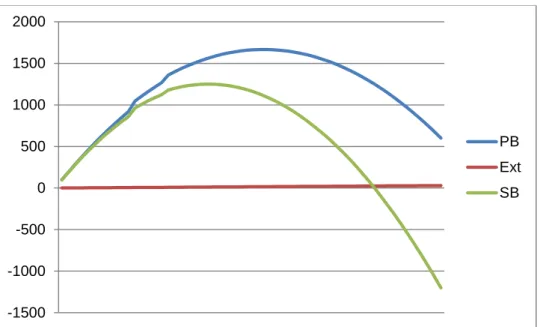
The graph below – based on Makowski (2001) – shows the profit, social benefit and
externality related to the production [See the Appendix for the numerical simulation]. Note
that private benefit, or profit, peaks at 100/3 while social benefit peaks at 20. If bank does not
take this fact into consideration it produces an amount of services that maximizes its private
benefit that is higher than the amount of services that maximizes the social benefit of its
oper-ation. As pointed out this smaller production related to the maximization of the social benefit
may be obtained through the application of a Pigovian taxation on the price of the bank
ser-vice.
Figure 1: Private Benefit (PB), Social Benefit (SB) and Externality (Ext)
-1500 -1000 -500 0 500 1000 1500 2000 PB Ext SBIn this vein the Pigovian taxation makes banks take into account the harmful
externali-ty that would result from their increased production. Without the Pigovian taxation banks only
care about their private benefit of their actions, not about any negative spillover effects that
spring from their actions. In this vein the creation of a proper environment of cooperation
between financial institutions and authorities depends on finding a satisfactory solution to the
risk of criminal liability for financial institutions that carry out a suspicious transaction.
4. Concluding Remarks
In this paper we claim that the Basle principle ‘know your customer’ is in fact a Pigovian
taxation since it requires that banks choose a smaller production. In order to avoid the
exter-nality due to the operation of financial institutions a Pigovian taxation or other mechanism
that implies in reducing the number of the banking accounts may be introduced in order to
make banks to choose the production that maximizes the social benefit and not only their
pri-vate benefit.
While the Pigovian approach is helpful in highlighting the differences between the social
and private benefits of bank operations it is not the best approach to deal with law and
eco-nomic issues. The first and most evident reason is that the taxation would need to discriminate
between banks that cooperate and not cooperate with competent authorities and this kind of
taxation is forbidden by law. Besides, in countries that face credit rationing as pointed out by
Stiglitz and Weiss (1981) any additional barrier to the regular working of banks may be
viewed as an additional barrier against economic growth.
The paper also shows that, theoretically, the best approach to combat money laundering
would be a Coasian one in which the risen of a market in which the externality would be
commercialized would the best solution. However, this approach cannot be implemented due
to some characteristics of the money laundering. First, it is a derived offence in which is
diffi-cult to establish who is the victim. This fact makes almost impossible the creation of a market
in which the victims and would negotiate the property rights. In this context,
although the
Pigovian approach does not produce a first best solution, when the matter is money
launder-ing combat it is still the best feasible solution. Hence, the paper acknowledges that a Pigovian
approach although affected by some difficulties is shown to be the best practice to cope with
prevention of money laundering.
5. References
Araujo (2008). Assessing the Efficiency of the Anti-Money Laundering Regulation: An
Incentive based Approach. Journal of Money Laundering Control. 11(1), pp.67 – 75.
Coase, Ronald H. (1960). The Problem of Social Cost. Journal of Law and Economics, 3
pp.1-44.
Makowski, L. (2001). Monopoly and Competition from an Appropropriation Perspective.
Unpublished manuscript.
Mansfield (1980). Microeconomics: Theory and Applications. New York. W W Norton.
Masciandaro (1999). Money Laundering: The Economics of Regulation. European Journal
of Law and Economics, 7 pp.225 – 240.
Parisi, F. (1999). Coase Theorem and Transaction Cost Economics in the Law. In: Elgar
Companion to Law and Economics, 7-39, J.G. Backhaus ed., 1999.
Ping, H. (2005). The Suspicious Transaction Reporting System. Journal of Money
Laun-dering Control 8:3, pp.252 – 259.
Schneider, F. and Windischbauer, U. (2008). Money laundering: some facts. European
Journal of Law and Economics 26, pp.387–404
Stessens, G. (2000). Money Laundering: A New International Law Enforcement Model.
Cambridge University Press.
Stiglitz, J. and Weiss, A. (1981). Credit Rationing in Markets with Imperfect Information.
American Economic Review 71(3), pp.393 – 410.
Appendix Numerical simulation:
y PB(y) Ext(y) SB(y)
1 98,5 0,5 98 2 194 1 192 3 286,5 1,5 282 4 376 2 368 5 462,5 2,5 450 6 546 3 528 7 626,5 3,5 602 8 704 4 672 9 778,5 4,5 738 10 850 5 800 11 918,5 5,5 858 13 1046,5 6,5 962 14 1106 7 1008 15 1162,5 7,5 1050 16 1216 8 1088 17 1266,5 8,5 1122 19 1358,5 9,5 1178 20 1400 10 1200 21 1438,5 10,5 1218 22 1474 11 1232 23 1506,5 11,5 1242 24 1536 12 1248 25 1562,5 12,5 1250 26 1586 13 1248 27 1606,5 13,5 1242 28 1624 14 1232 29 1638,5 14,5 1218 30 1650 15 1200 31 1658,5 15,5 1178 32 1664 16 1152 33 1666,5 16,5 1122 34 1666 17 1088 35 1662,5 17,5 1050 36 1656 18 1008 37 1646,5 18,5 962 38 1634 19 912 39 1618,5 19,5 858 40 1600 20 800 41 1578,5 20,5 738 42 1554 21 672
43 1526,5 21,5 602 44 1496 22 528 45 1462,5 22,5 450 46 1426 23 368 47 1386,5 23,5 282 48 1344 24 192 49 1298,5 24,5 98 50 1250 25 0 51 1198,5 25,5 -102 52 1144 26 -208 53 1086,5 26,5 -318 54 1026 27 -432 55 962,5 27,5 -550 56 896 28 -672 57 826,5 28,5 -798 58 754 29 -928 59 678,5 29,5 -1062 60 600 30 -1200