46 Polímeros: Ciência e Tecnologia, vol. 17, nº 1, p. 46-50, 2007
.
/
2
-!
3
%
-
4
/
$
/
3
MIR Analysis
José Irineu S. de Oliveira Divisão de Química, IAE, CTA Instituto Tecnológico de Aeronáutica
Milton F. Diniz
Divisão de Química, IAE, CTA
Aparecida M. Kawamoto Divisão de Química, IAE, CTA
Fraunhofer Institut Chemische Technologie, ICT, Germany
Rita C. L. Dutra
Instituto Tecnológico de Aeronáutica
Thomas Keicher
Fraunhofer Institut Chemische Technologie, Germany
Abstract:Azide polymers samples were analyzed by FT-MIR in order to develop a quantitative methodology to determine the C, H and N content in energetic polymers used in propellants. The elemental analysis data were used as reference. The FT-MIR results show a good agreement with CHN analysis. A good linear relationship was obtained suggesting that the methodology developed in the CTA laboratory can be used for quality control of these energetic polymers.
Keywords: FT-IR, energetic binders, mid-IR region (MIR), C, H, N, O content.
Introduction
The elastomeric binder of a composite system like pro-pellants plays an important role in dispersing and immo-bilizing the fuel material and oxidizer. The materials used in the binder normally burn with lower energy than does the fuel material itself. Therefore the binder imposes limits on the energy content that can be recovered from the fuel material. In order to minimize this limitation some ener-getic binders can be used since they can release much more energy when they are burned together with the fuel mate-rial[1]. The energetic binders are the ones that have in their structure chemicals groups with high energy content such as azide, nitrate, difluroamine, nitro and nitroamine, etc.
A formulation using this energetic binder system can result in a propellant with better performance[2]. They are the so called modern solid propellants[3] and are expected to give higher burning rate and specific impulse when used for rockets.
One[4] of the aims of the join project between CTA/IAE – Chemistry Division, Department of Analysis (Brazil) and ICT (Energetic Materials group) is to synthesize some en-ergetic binders that can have several applications including the use in propellants. The following compounds, 3-Azi-domethyl-3-methyl oxetane (AMMO), 3,3-Bis-azidome-thyl oxetane (BAMO), 3-Bromome3,3-Bis-azidome-thyl-3-me3,3-Bis-azidome-thyl oxetane
(BrMMO), Poly-AMMO, Poly-BAMO and Poly-BrMMO, have been characterized by several methods including MIR spectroscopy[5,6].
To establish the relation between structure and proper-ties of a composite solid propellants is important to know the structure of the elastomeric binder that has been used in the system. Therefore this study[7] has concentrated in the characterization in a wide spectral band of infrared, NIR/ MIR/FIR, of all thermoplastic elastomers (TPE’s) that has been synthesized at ICT, which will therefore, allows the identification of analytical bands for future quantitative and kinetic studies of these compounds.
A quantitative analytical method using MIR has been developed at CTA/IAE (Chemistry Division-analytical department) for CHN determination of the TPE’s that has been synthesized at ICT (poly AMMO, poly BAMO and copolymers of poly AMMO/BAMO). The CHN elemental analysis has been used as reference.
Experimental
The TPE’s samples used in this study, as mentioned be-fore have been synthesized at ICT (AK 81 Poly BAMO; AK 97 Poly BAMO; AK 96 Poly AMMO; AK 101 Poly AMMO; AK 98 Poly AMMO/BAMO; AK 120 Poly AMMO/BAMO;
AK 109 Poly AMMO/BAMO) following a method that has already been described in the literature[4].
The MIR spectra have been acquired at CTA using FT-IR spectrometer SPECTRUM 2000 PERKIN ELMER, in the region of 4000 to 400 cm-1, gain 1, resolution of 4 cm-1 and 40 scans. The samples were analyzed by the KBr pellet tech-nique (0.8:400 mg). Due to the uncertainty inherent to this technique, each sample has been analysed ten times in order to reach higher accuracy in the results.
For the quantitative analysis of the compounds using MIR, the values of the stretching frequencies at 2100 cm-1 (QaN3) have been related to the ones corresponding to C-O group at 1100 cm-1. The baseline points at 2358 cm-1 and 1779 cm-1 were established for the calculations of the absorb-ance values of the N3 groups at 2100 cm-1 and the baseline points at 1779 cm-1 and 841 cm-1 established for calculations of the absorbance values of C-O absorption at 1100 cm-1. The values of the relative absorbance A2100/A1100 represent an av-erage value (P) of 10 measurements of each sample.
For the calibration curve, the CHN values measured at ICT[8] for the compounds, have been used as reference.
Results and Discussion
The chemical structure of the compounds and their start-ing materials that have been used in this work are presented in Table 1.
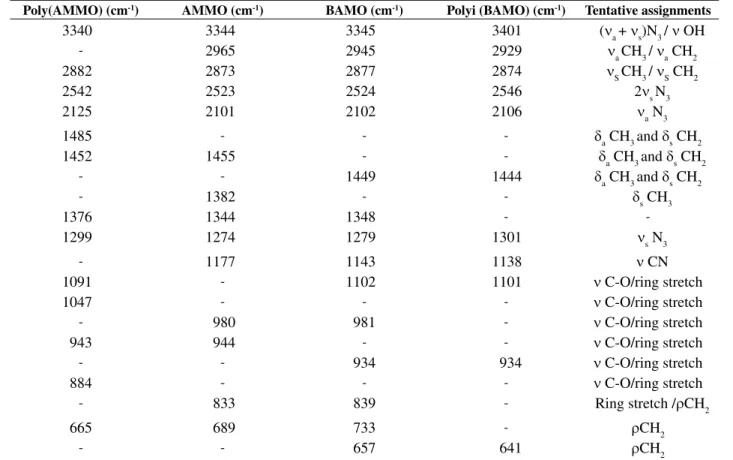
The frequencies and assignments of AMMO; BAMO; PolyAMMO and PolyBAMO are compiled in Table 2 and the spectra shown in Figures 1 to 3.
MIR analysis of AMMO and BAMO
As it has been mentioned in previous paper[7], the main difference between AMMO and BAMO chemical structures is the methyl group at AMMO and one additional azide group at BAMO, which can be visualized at the IR spectra (Figure 1). The assignments of the bands are in Table 3. The peak at 1382 cm-1 (G
s CH3) is attributed to CH3 group and the peaks at 2100 cm-1 (Q
aN3), 2500 cm -1 ( 2 Q
sN3), 1250 cm -1
Table 1. Monomers and polymers studied in this work.
Monomer Polymer
AMMO
O N3
N3
O *
O
n
N3
O
*
n
BAMO
O N3
N3
N3
O *
O
n
N3
N3 O
*
N3 n
Poly-AMMO
/BAMO
N3 O
O n
N3
O
n
N3
O
n N3
H2C N
N C
C
O
CN
N
C O
N3 O O
N3
CH2
n
Poly-BAMO
Poly-AMMO Poly-BAMO
O H H
O O
H O
H
Figure 1. IR spectra of a) AMMO; and b) BAMO.
6500.0 6000 5000 4000 3000 2000 1500 1000 500 250.0
cm-1
(a)
48 Polímeros: Ciência e Tecnologia, vol. 17, nº 1, p. 46-50, 2007
Table 2. Mid IR frequencies (4000-400 cm-1) of the energetic binder[3-5].
Poly(AMMO) (cm-1) AMMO (cm-1) BAMO (cm-1) Polyi (BAMO) (cm-1) Tentative assignments
3340 3344 3345 3401 (Qa+Qs)N3/Q OH
- 2965 2945 2929 QaCH3/Qa CH2
2882 2873 2877 2874 QSCH3/QS CH2
2542 2523 2524 2546 2QsN3
2125 2101 2102 2106 Qa N3
1485 - - - G
a CH3andGs CH2
1452 1455 - - G
a CH3andGs CH2
- - 1449 1444 Ga CH3andGs CH2
- 1382 - - G
s CH3
1376 1344 1348 -
-1299 1274 1279 1301 Qs N3
- 1177 1143 1138 Q CN
1091 - 1102 1101 Q C-O/ring stretch
1047 - - - Q C-O/ring stretch
- 980 981 - Q C-O/ring stretch
943 944 - - Q C-O/ring stretch
- - 934 934 Q C-O/ring stretch
884 - - - Q C-O/ring stretch
- 833 839 - Ring stretch /UCH
2
665 689 733 - UCH2
- - 657 641 UCH2
Q – stretching; Qa– asymmetrical stretching; Qs– symmetrical stretching; Ga – in plane asymmetric bending; Gs – in plane symmetric bending; U – rocking vibration; and w – wagging.
6500.0 6000 5000 4000 3000 2000 1500 1000 500 250.0
cm-1
(a)
(b)
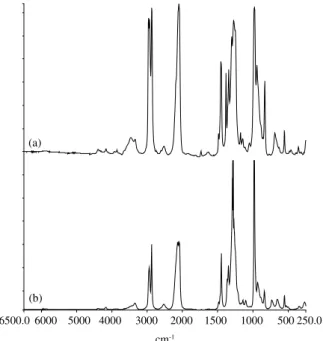
Figure 2. IR spectra of a) AMMO; and b) PolyAMMO.
(QsN3, or Q C-N) are attributed to azide group. It can also be observed that for BAMO the vibrational mode for N3 broad-ens and/or increase in the intbroad-ensity, which can be attributed to the presence of two azide groups in the compound.
MIR analysis of AMMO and PolyAMMO
The main change observed in IR spectroscopy due to the polymerization of AMMO is the opening of the oxetane ring with the formation of the C-O bond. In the spectra of the poly-mer one can notice the absence of the band related to the ring at 980 cm-1 (ring stretching) and the appearance of the new bands typical of C-O (1000-1100 cm-1 - QC-O), and OH (3340 cm-1 -
QOH) attributed to the end groups of the polymer (Figure 2). The broadening of the bands at the C-O group region (aliphatic ether) is due to the repetition of the units in the polymer (Figure 2).
MIR analysis of BAMO and PolyBAMO
The main changes observed in IR spectrum due to the po-lymerization of BAMO are basically the ones that have been observed for AMMO (ring opening and C-O formation) and shown in Figure 3.
Measurement of CHNO of the PolyAMMO and polyBAMO throught MIR technique
The relative absorbance A2100/A1100 and the CHN content (measured at the analytical department of ICT)[8] for all
sev-en samples of polyAMMO and polyBAMO, are pressev-ented in Table 3. The standard deviation VP, of the average value of the absorbance is calculated according to the equation[9]:
Table 3. MIR data of the energetic binders with different CHN contents.
Sample %[C] %[H] %[N] %[O] %[N]/
%[C]
%[N]/ %[O]
Absorbance A2100/A1100
Standard deviate VP
Relative deviate (%)
AK 81 Poly (BAMO) 36.30 5.03 45.30 13.40 1.25 3.38 3.992 0.203 5.09
AK 97 Poly (BAMO) 36.38 4.77 43.56 15.29 1.20 2.85 3.858 0.071 1.84
AK 96 Poly (AMMO) 47.87 7.38 27.33 17.42 0.57 1.57 2.370 0.055 2.32
AK 101 Poly (AMMO) 46.74 7.16 27.85 18.25 0.60 1.53 2.616 0.016 0.61
AK 98 Poly (AMMO)/BAMO 41.88 5.73 39.30 13.09 0.94 3.00 3.403 0.033 0.97
AK 120 Poly (AMMO)/BAMO 43.65 6.34 32.33 17.68 0.74 1.83 2.781 0.032 1.15
AK 109 Poly (AMMO)/BAMO 44.41 6.23 32.96 16.40 0.74 2.01 2.776 0.032 1.15
V is the standard deviation and n the number of measure-ments.
V is represented by:
V = KR. R (2)
KR is the coeficient for the calculation of the standard devia-tion in a range of values and R is the difference between the higher and lower value
R = Xn – X1 (3)
The relative error for each sample has been determined according to the following equation:
Relative Error (%) = (VP/P)x 100 (4) Figure 4 shows the analytical or calibration curve A2100/ A1100vs. %N of the energetic binders. A good linear relation-ship was obtained (R = 0.990) and is represented by the fol-lowing equation:
y = 0.034 + 0.087x (5)
Where: y is the average value of the absorbance A2100/A1100 andx is the %N value.
6500.0 6000 5000 4000 3000 2000 1500 1000 500 250.0
cm-1
(a)
(b)
Figure 3. IR spectra of a) BAMO and b) Poly BAMO.
0 10 20 30 40 50
Abs
(A
azide
/A
C-O
)
N (%) 5
4
3
2
1
0
Figura 4. Values of absorbance (A2100/A1100) vs. %N by elemental analysis.
The curves of A2100/A1100 vs. %N/C and A2100/A1100 vs. %N/O have been also built to establish correlation with the content of C and O.
Figure 5 shows the calibration curve A2100/A1100 vs. %N/C for the energetic binders. A good linear relation was obtained (R = 0.993) and is represented by the following equation:
y = 1.131 + 2.297x (6)
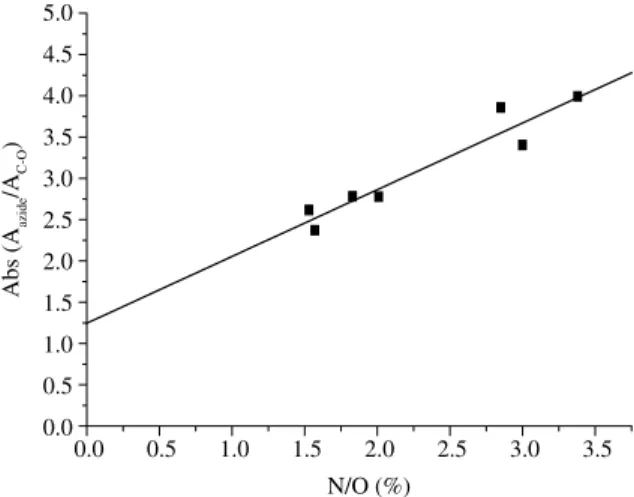
Figure 6 shows A2100/A1100 vs. %N/O. A good linear rela-tion was also obtained (R = 0.954). The following equarela-tion represents the curve:
y = 1.245 + 0.809x (7)
The average relative error inherent to the MIR method is equal to 1.48%, which is inside the precision of IR methods in general (d 2%), mentioned in the Literature[9].
50 Polímeros: Ciência e Tecnologia, vol. 17, nº 1, p. 46-50, 2007
Measurement of CHNO for sample AK 113 using MIR methodology
Sample AK 113 (Poly AMMO) was used as test sample for the method as it had an unknown CHNO content. It was used to verify the accuracy of the method.
The A2100/A1100 measured value was 2.564 (VP = 0.015 and relative deviation = 0.59%). The %C, %N and %O in the sample were measured using the three (Equations 5, 6 and 7) calibration curves. From the equations the following values were determined: %N = 29.08, %C = 46.60% O = 17.84 and %H = 6.48. These values are in a good agreement with the CHNO obtained from other similar samples of PolyAMMO as can be seen in Table 3.
Considering that CHN analysis has the same precision of IR, that IR is a technique available in the majority of analyti-cal laboratories and the accuracy of the results obtained, the methodology developed can be a simple and quick alterna-tive for the quality control of energetic binders.
0.0 0.2 0.4 0.6 0.8 1.0 1.2 1.4
Abs (A
azide
/A
C-O
)
N/C (%) 5
4
3
2
1
0
Figura 5. Values of absorbance (A2100/A1100) vs. %N/C by elemental analysis.
Figura 6. Values of absorbance (A2100/A1100) vs. %N/O by elemental analysis.
0.0 0.5 1.0 1.5 2.0 2.5 3.0 3.5
Abs (A
azide
/A
C-O
)
N/O (%) 5.0
4.5
4.0
3.5
3.0
2.5
2.0
1.5
1.0
0.5
0.0
Conclusion
The use of IR spectroscopy in the MIR region for characterization and quantification of the amount of CHN in energetic binders, showed to be a good alternative to elemen-tal analysis. The new method is simple, quick and precise enough to be used in the quality control of those compounds in industry.
References
1. Wardle,R. B.;Braithwite,P. C.;Haaland,A. C.;Hatwell,J. A.;Hendrickson,R. R.;Lot,V.;Wallace,I. A.;Zisette,C. B. - High Energy Oxetane/HNIW Gun Propellants, 27th Int.Annual Conference of ICT, Karlsruhe, Ger-many, June 25-28, p.52/1(1996).
2. Oyumi, Y; Brill, T. B. – Combustion and Flame. Ther-mal decomposition of energetic materials 12. Infrared Spectral and Rapid Thermolysis Studies of Azide – con-taining monomers and polymers, 65, p.127-135 (1986). 3. Kubota, N. - Survey of Solid Propellant Combus-tion, 22nd Int. Annual Conference of ICT, Karlsruhe, Germany, July 2-5, p.40/1 (1991)
4. Kawamoto, A. M., Keicher T., Krause H., Saboia Holanda, J. A. - “Synthesis and Characterization of Energetic Oxetane-Oxirane Polymers for use in Ther-moplastic Elastomer Binder Systems”, 36th Interna-tional Annual Conference of ICT& 32th InternaInterna-tional Pyrotecnics Seminar, p.195 (2005).
5. Smith, A.L. Applied Infrared Spectroscopy, John Wi-ley & Sons, New York (1979).
6. Lieber, E.; Rao. C.N.R.; Thomas, A.E.; Oftedahl, E.; Minnis, R.; Nambury, C.V.N - “Infrared spectra of acid azides, carbamyl azides and other azido deriva-tives. Anomalous splittings of the N3 stretching bands”, 19, p.1135-1144 (1963).
7. Oliveira, J.I.S, Diniz, M.F., Kawamoto, A.M., Dutra, R.C.L., Keicher, T. Characterization MIR/NIR/FIR of Energetic Binders used in Solid Propellants. PEP in press.
8. CHN analysis of AMMO, PolyAMMO, BAMO and PolyBAMO done at the analytical laboratory of ICT using CHN analyser Agiland 1100 serie.
9. Hórak, M.; Vitek, A. “Interpretation and processing of vibrational spectra”. New York, NY: John Wiley & Sons, p.414 (1978).
Enviado: 27/03/06 Reenviado: 18/07/06
![Table 3. MIR data of the energetic binders with different CHN contents. Sample %[C] %[H] %[N] %[O] %[N]/ %[C] %[N]/%[O] AbsorbanceA 2100 /A 1100 Standarddeviate V P Relative deviate (%) AK 81 Poly (BAMO) 36.30 5.03 45.30 13.40 1.25 3.38 3.992 0.203 5.09](https://thumb-eu.123doks.com/thumbv2/123dok_br/18867468.419215/4.892.78.450.165.715/energetic-binders-different-contents-sample-absorbancea-standarddeviate-relative.webp)