ABSTRACT: Olive (Olea europaea L. subsp. europaea var. europaea) is one of the oldest fruit tree in the Mediterranean basin, and is cultivated for oil and canned fruit. Part of this interest is driven by the economic importance of olive oil which is increasing throughout the world due to its beneficial effect to human health. In Tunisia, olive has great socio-economic importance, with more than 60 millions olive trees cultivated for olive oil production including a wide range of cultivars which are widely extended from the north to the south regions of the country for its high economic value. Here, we applied microsatellites (SSRs) molecular markers to assess the genetic variability of the most important Tunisian olive cultivars. In total, the 10 simple sequence repeats (SSR) loci revealed 73 alleles with a mean number of 07 alleles per locus were detected. The polymorphism index content (PIC) values were high (0.72) ranging from 0.86 at GAPU 103 to 0.56 at EMO 90. The analysis of the dendrogram showed six main separate groups. Keywords: Olea europaea, genetic diversity, microsatellite, genetic relationships Received August 18, 2011
Accepted September 05, 2012
1Olive Tree Institute, Rue de l’Aéroport, B.P 1087 − 3000-Sfax – Tunisia.
2Università Degli Studi Di Palermo − Dipartimento Culture Arboree – 90128 – Palermo − Italia.
*Corresponding author <[email protected]> Edited by: Antonio Costa de Oliveira
Genetic similarity among Tunisian cultivated olive estimated through SSR markers
Sofiane Abdelhamid1*, Naziha Grati-kamoun1, Francesco Marra2, Tiziano Caruso2
Introduction
Tunisia is the fourth largest producer of olive oil country in the world and oil exports represent 40 % of the overall value of agronomic exports and 5.5 % of aggregate exports, making it the fifth largest source of foreign currency earnings for the country.
Olive (Olea europaea L. subsp. europaea var. eu-ropaea) is grown by almost two out of three farmers in the country. The crop is spread over areas from the northern to the southern regions, where a wide range of edaphoclimatic conditions prevail, from lower semi-arid to semi-arid conditions and generally receiving less than 250 mm of rain-fall (IOOC, 2003). The main variety cultivated is ‘Chemleli’ in the south and the centre of the country and “Chetoui” in the north. These two va-These two va-rieties account for 95 % of the total olive tree orchards and contribute more than 90 % of the national produc-tion of olive oil. ‘Chemleli’ alone covers 60 % of the olive-growing surface. The recent boom in demand for olive oil around the world requires Tunisian producers to improve fruit and oil quality to maintain their com-petitiveness on the international oil market and to meet consumer demands.
The distribution of Olea varieties in the Mediter-ranean basin gave rise to a very complex and highly ar-ticulated structure of olive culture which was marked by the existence of a considerable number of differ-ent olive cultivars (Bartolini et al., 2005). The great number of existing varieties led to the need of a pow-erful method of genetic analysis for the development of conservation management strategies for the genetic resources and for the protection of the commercial va-rieties quality label. In addition, there is the problem arising from the existence of homonyms and synonyms (Poljuha et al., 2008). This makes cultivar identification very difficult and complex.
The identification of olive tree cultivars has been traditionally carried out by morphological mark-orphological
mark-ers (Trigui and Msallem, 2002; Hannachi et al., 2007) and by biochemical markers that are allelic variants of proteins based on iso-enzymes and alloenzyme mark-ers. The necessity to target olive cultivar identification led researchers to undertake new studies of varietal identification based on genetic markers such as DNA.
In order to exploit genetic diversity for targeted olive cultivar improvements, several Tunisian research teams have used PCR-based markers for basic and ap-plied research to assess the genetic diversity of Tuni-sian olive cultivars. These markers types include RAPD (Zitoun et al., 2008), AFLP (Grati-Kamoun et al., 2006; Taamalli et al., 2006), SSR (Taamalli et al., 2007; Han-nachi et al., 2008; Rekik et al., 2008) and SNP (Rekik et al., 2010).
In this study, we have made an attempt to system-ically test the suitability of microsatellites for Tunisian cultivar identification and genetic similarity studies.
Materials and Methods
Plant material and DNA extraction
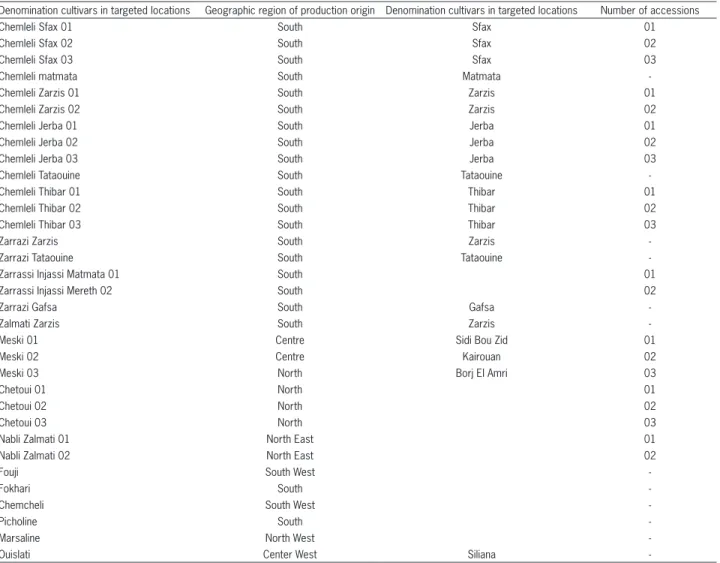
Molecular analysis was performed on 33 trees be-longing to 12 Tunisian cultivars collected from groves located in various agroecological areas of Tunisia which are characterised by very high oil content in their fruits. More than one accession per cultivar was included in some cases such as the cultivar ‘Chemleli’, ‘Zarrazi’, ‘Meski’, ‘Chetoui’ and ‘Nabli Zalmati’. The cultivar analysed and their origins are reported in Table 1.
Total genomic DNA was isolated from young leaves according to the protocol of Doyle and Doyle (1990). DNA so prepared was further purified and resuspended in Tris-EDTA of pH 8.0. The quality of the DNA was as-sessed by agarose gel electrophoresis and the quantity by measuring optical density at 260 and 280nm.
SSR markers
decade towards the identification of olive cultivars us-ing molecular markers. At present SSR are the markers of choice for cultivar identification (Alba et al., 2009; Muzzalupo et al., 2010).
Ten microsatellite primers labelled with one of two fluorescent dyes 6-FAM or HEX (Sigma) (Table 2). ssrOeUA-DCA 3, ssrOeUA-ssrOeUA-DCA 7, ssrOeUA-ssrOeUA-DCA 9, ssrOeUA-ssrOeUA-DCA 14, ssrOeUA-DCA 16, ssrOeUA-DCA 17, ssrOeUA-DCA 18 (Sefc et al., 2010), ssrOeUA-EMO 90 (De la Rosa et al., 2002), ssrOeUA-GAPU 101 and ssrOeUA-GAPU 103 (Car-riero et al., 2002).
Amplification reactions were carried out in final volumes of 10 µL using a thermal cycler (PE Applied Biosystems). The reaction contained 1X PCR buffer, 0.75 mM MgCl2, 2.5 mM dNTP, 10 µM of forward and reverse primers, 0.5 units µL−1 Taq DNA polymerase
(Gotaq, Promega) and 50 ng µL−1 template DNA.
PCR amplification was completed at the following profile with one cycle of 94 °C of initial denaturation for 3 min, followed by 35 cycles of 94 ºC for 20 s, 60 ºC for 20 s and 72 ºC for 30 s, and 72 ºC for 30 s followed
by a final extension for 20 min at 72 ºC. The amplified products were tested on 1.2 % agarose gel to check for the amplification of the PCR products.
PCR product (0.5 µL) was mixed with a 12 µL of deionised formamide and 0.5 µL Gene Scan 500 (LIZ) size standard marker. The resulting mixture was heated for 2 min at 95 °C and then quickly cooled on ice. Each sample was loaded and run on an ABI-310 automated DNA sequencer (Applied Biosystems, USA). Allele siz-ing of electrophoretic data was done ussiz-ing Genotyper 3.1 software (Applied Biosystems, USA).
Data analysis
SSR fragments data were scored using Genescan and Genotyper softwares. The expected heterozygosity (He) of each microsatellite was calculated according to the formula He = 1- ∑(pi)2 (Nei, 1979) using the GDA
program (Weir, 1996). Polymorphic information content (PIC) values was calculated according to the formula 1-
∑(pi)2 - ∑∑ 2 (pi)2 (p j)
2 using the CERVUS v.2 software
(Marshall et al., 1998).
Table 1 – Studied accessions of olive genotypes and their origin.
Denomination cultivars in targeted locations Geographic region of production origin Denomination cultivars in targeted locations Number of accessions
Chemleli Sfax 01 South Sfax 01
Chemleli Sfax 02 South Sfax 02
Chemleli Sfax 03 South Sfax 03
Chemleli matmata South Matmata
-Chemleli Zarzis 01 South Zarzis 01
Chemleli Zarzis 02 South Zarzis 02
Chemleli Jerba 01 South Jerba 01
Chemleli Jerba 02 South Jerba 02
Chemleli Jerba 03 South Jerba 03
Chemleli Tataouine South Tataouine
-Chemleli Thibar 01 South Thibar 01
Chemleli Thibar 02 South Thibar 02
Chemleli Thibar 03 South Thibar 03
Zarrazi Zarzis South Zarzis
-Zarrazi Tataouine South Tataouine
-Zarrassi Injassi Matmata 01 South 01
Zarrassi Injassi Mereth 02 South 02
Zarrazi Gafsa South Gafsa
-Zalmati Zarzis South Zarzis
-Meski 01 Centre Sidi Bou Zid 01
Meski 02 Centre Kairouan 02
Meski 03 North Borj El Amri 03
Chetoui 01 North 01
Chetoui 02 North 02
Chetoui 03 North 03
Nabli Zalmati 01 North East 01
Nabli Zalmati 02 North East 02
Fouji South West
-Fokhari South
-Chemcheli South West
-Picholine South
-Marsaline North West
-Genetic relationships among accessions were calculated on the basis of a similarity matrix analysis according to Jaccard’s coefficient (Sneath and Sokal, 1973). A dendrogram was generated based on the un-weighted pair group method with arithmetic mean (UPGMA) cluster analysis and grouping using NTSYS software ver. 2.11a (Rohlf, 1998).
Results
SSR polymorphism and alleles detected
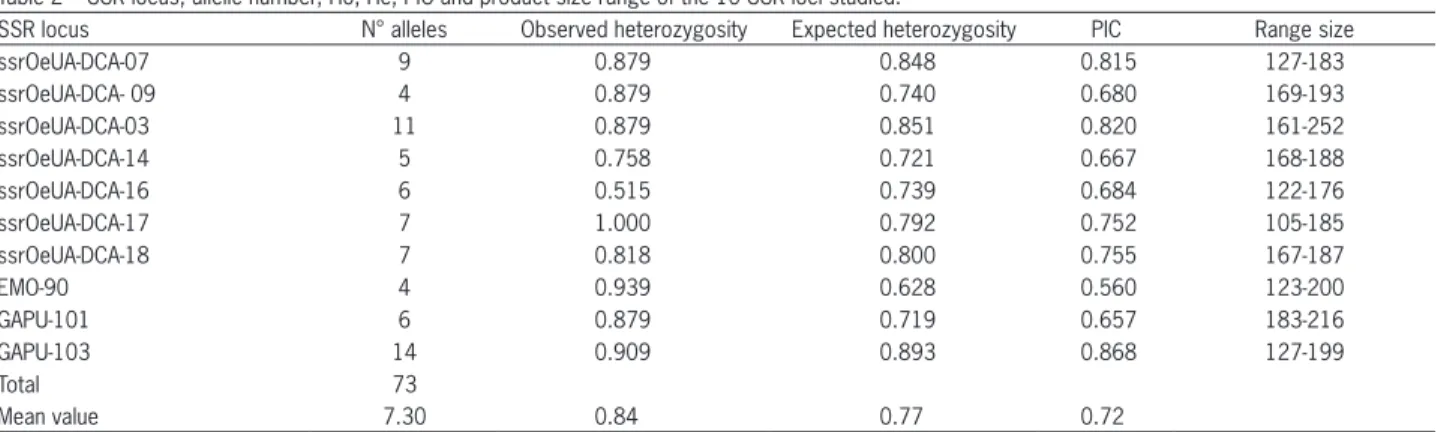
The SSR method used in this study was able to uniquely fingerprint each of the 33 cultivated olive ac-cessions. All SSR loci amplified consistently a 73 total number of amplified alleles with an average number of 7 alleles per locus. DCA 09 and EMO 90 showed the lowest number of alleles (4) whereas GAPU 103 presented the highest number of alleles (14). Alleles sizes vary among the ten loci, differences between the longest and shortest allele ranged from 20 to 91 bp (Table 2). Genetic variability was wide as indicated by the very high values of observed heterozygosity that ranged between 1.00 at locus ssrOeUA-DCA17 and 0.51 at ssrOeUA-DCA16, with a mean value of 0.84. The PIC values were high (0.72) ranging from 0.86 at GAPU 103 to 0.56 at EMO 90.
Cultivar identification
Among accessions, the average number of unique alleles per locus was 2.1 depending on the locus, be-tween one (markers ssrOeUA-DCA14, ssrOeUA-DCA16 and GAPU 101) and eight unique alleles for GAPU 103. The identification key for the studied accessions is shown in Table 3. Specific allele profiles at locus GAPU 103 were first assigned to six varieties (‘Meski’, ‘Chem-leli’, ‘Chetoui’, ‘Chemchali’, ‘Fokhari’ and ‘Nabli Zal-mati’). Specific allele profiles at locus ssrOeUA-DCA07 were assigned to four varieties (‘Ouislati’, ‘Meski’, ‘Zarrazi’ and ‘Chemleli’). These cultivars ‘Ouislati’, ‘Meski’ and ‘Zarrazi’ were differentiated by ssrOeUA-DCA03 while differences at a single locus were found among varieties.
Genetic relationships and differentiation among olive cultivars
Affinities among cultivars and accessions are shown in the obtained dendrogram (Figure 1), form-ing six groups by cuttform-ing the dendrogram at a Genetic Similarity (GS) value of 0.35. In the first group, most accessions were of ‘Chemleli’ variety from the north and the south of Tunisia included only one accession of ‘Zalmati’ from Zarzis. The second main group included ‘Zarrazi’ olive variety from different geographic ori-gin from the south of Tunisia. The others groups were formed by ‘Meski, ‘Chetoui’, ‘Nabli Zalmati’ and ‘Ou-islati’ while the other included ‘Fouji’, ‘Fokhari’ and ‘Chemcheli’ and the latest was constructed by ‘Picho-line’ and ‘Marsa‘Picho-line’.
Discussion
Based on a combination of scores for individual plants, all accessions can be distinguished using the ten markers employed here. However, not all individual plants can always be identified, as some varieties are mixtures of genotypes. Nevertheless, the value of the olive genotyping lies not only in shaping the contin-ued use of microsatellite data in olive research but also
Table 2 –SSR locus, allelic number, Ho, He, PIC and product size range of the 10 SSR loci studied.
SSR locus N° alleles Observed heterozygosity Expected heterozygosity PIC Range size
ssrOeUA-DCA-07 9 0.879 0.848 0.815 127-183
ssrOeUA-DCA- 09 4 0.879 0.740 0.680 169-193
ssrOeUA-DCA-03 11 0.879 0.851 0.820 161-252
ssrOeUA-DCA-14 5 0.758 0.721 0.667 168-188
ssrOeUA-DCA-16 6 0.515 0.739 0.684 122-176
ssrOeUA-DCA-17 7 1.000 0.792 0.752 105-185
ssrOeUA-DCA-18 7 0.818 0.800 0.755 167-187
EMO-90 4 0.939 0.628 0.560 123-200
GAPU-101 6 0.879 0.719 0.657 183-216
GAPU-103 14 0.909 0.893 0.868 127-199
Total 73
Mean value 7.30 0.84 0.77 0.72
in the realm of evolution and domestication of natural and wild olive (Rubio de Casas et al., 2006; Besnard et al., 2008; Belaj et al., 2010; Erre et al., 2010). The olive is not only an economically important species for Mediterranean basin countries where it represents the most important oil-producing crop but also as a model species to initiate conservation programmes that need to integrate genetic variability, diversity, cultural and economic aspects. The olive oil has value as a model therapy of a spectrum of human diseases (cardiovascu-lar disease, obesity) and considered as source of foreign currency earnings for Mediterranean countries.
In this study, we have made an attempt to charac-terize Tunisian olive using nuclear microsatellites and to identify individuals that would represent suitable progenitors for a breeding programme to increase the quality of olive oil (Casagrande et al., 2009). The analy-ses of our marker data revealed that the Tunisian germ-plasm contains substantial diversity, which could sup-port the national programme’s breeding objectives as well as allow participation in international programmes aiming at olive improvement and conservation.
The microsatellite markers used in this study were polymorphic and demonstrated their utility in discriminating between Tunisian olive accessions. Our present study is largely in accordance and comparable with previous studies (Baldoni et al., 2009; Bracci et al., 2009; Muzzalupo et al., 2010) using SSRs as genetic analysis method to assess the genetic variability of Ital-ian olive cultivars, including some minor exceptions. In our analysis, the total number of alleles amplified was 73 alleles with an average number of 7 alleles per locus (Table 2). This is comparable to the 2-7 alleles found by Soleri et al. (2010) with a total of 62 alleles identified for fourteen microsatellite markers in a set of American olive trees. The values of heterozygosity found at each locus was comparable with those reported in several studies, performed by SSR markers, such as on Moroc-can olive germplasm (Khadari et al., 2007; Charafi et al., 2008).
PIC values for the landraces were quite high (Table 2), in accordance with many previous studies (Taamalli et al., 2008), showing that these accessions are a good source of diversity and the ten loci used are suitable for mapping (Poljuha et al., 2008). The ten primer pairs produced simple banding patterns,
show-ing a low degree of differential amplification and easy scorability. They were used for genotyping and will therefore be useful to identify olive varieties and to perform genetic studies what is of particular interest to conduct programme breeding and conservation. It was possible to choose only seven loci (ssrOeUA-DCA03, ssrOeUA-DCA07, ssrOeUA-DCA14, ssrOeUA-DCA16, ssrOeUA-DCA 17, GAPU 101 and GAPU 103) for rapid identification (Table 3).
Results concerning cultivar identification suggest that genotypic and genetic polymorphism were origi-nated from different geographic areas. Tunisian olive groves are essentially dominated by two olive oil variet-ies: ‘Chetoui’ in the north and ‘Chemleli’ in the center and south of the country. Furthermore, those two variet-ies have been the most multiplied by olive growers (Gra- (Gra-ti-Kamoun et al., 2006). Indeed, ‘Chemleli’ was widely cultivated (two-third of total olive area) and is vigorous and well adapted to arid regions (Trigui, 1996).
Allelic differences have been reported in olive using SSR (Cipriani et al., 2002). Undoubtedly, olive (Olea europaea L.) is an ancient crop cultivated since the Roman period, and there may have been occurred some somatic mutations in long-lived trees (Khadari et al., 2007). This is in agreement with the complex-ity of the history of olive domestication. Smulders et al. (2010) thought it may be related to the multi-allelic nature of SSR loci that is considered to derive princi-pally from errors occurring due to slipped-strand mis-pairing during DNA replication, via retrotransposition events, otherwise to interhelical junctions forming dur-ing chromosome alignment, unequal crossdur-ing over, or gene conversion.
The results obtained by microsatellite DNA anal-ysis revealed a clear separation of most Tunisian olive cultivars and showed a significant degree of inter-varie-tal genetic diversity. A dendrogram was made using the pairwise genetic distances between accessions to visu-alise the genetic similarity between accessions (Figure 1). A high range of similarity was found among accesses ranging from 0.15 to 1. For instance, six main groups were observed. In the first group, most accessions were of ‘Chemleli’ variety from the north and the south of Tunisia included only one accession of ‘Zalmati’ from Zarzis. The second main group included ‘Zarrazi’ olive variety from different geographic origin from the south
Table 3 – Distinct SSR private alleles among Tunisian varieties.
ssrOeUA-DCA-07 ssrOeUA-DCA-03 ssrOeUA-DCA-14 ssrOeUA-DCA-16 ssrOeUA-DCA-17 GAPU-101 GAPU-103
Ouislati 153 243 - - - 193
-Meski 173 193-183 - - - - 147
Zarrazi 177 161 - - - -
-Chemleli 179 - - 130 - - 153-171
Chetoui - - 186 - - - 133-169
Picholine - - - - 177 -
-Chemchali - - - - 169 - 183
Fokhari - - - 175
of Tunisia. The others groups were formed by ‘Meski, ‘Chetoui’, ‘Nabli Zalmati’ and ‘Ouislati’ while the other included ‘Fouji’, ‘Fokhari’ and ‘Chemcheli’ and the lat-est was constructed by ‘Picholine’ and ‘Marsaline’.
The high utility of SSR markers in providing va-rieties clustering is in overall accordance with previ-ous studies carried out on a large number of Tunisian olive cultivars (Rekik et al., 2008; Taamalli et al., 2006). There is no clear structuring of the variability relative to the end use of olive cultivars. In fact, ‘Meski’ acces-sions form a distinct single group and were not clus-tered with ‘Picholine’ and ‘Marsaline’ that are the most important Tunisian table cultivars used for canning and have a high average fruit weight (6 g). This result is con-sistent with previous findings indicating that cultivated olive cultivars were characterised by the same origin from the wild population of the Eastern Mediterranean and was spread to the Western part through cultivar dispersal by humans (Besnard et al., 2002).
The developed set of markers demonstrated its performance in discriminating ‘Chemleli’ and ‘Zalmati’ accession from different regions of Tunisia and is clus-tered in a uniform group that shared many of the pheno-typic characteristics. This study has shown that, among Tunisian varieties, the ‘Chemleli’ accessions are the most important targets for preservation based on its contribu-tion to diversity and particularly those from southern Tunisia appear to represent important reservoirs of ge-netic diversity and have been considered as a polyclonal cultivar (Trigui, 1996). It is possible that this variety pro-vides evidence for the movement and exchange of olive cultivars through different regions and is a mixture of closely related genotypes (Charafi et al., 2008).
As a conclusion, microsatellite markers used in this study may be used for establishing a molecular da-for establishing a molecular da-establishing a molecular da-tabase for Tunisian olive identification and to construct a molecular catalogue that can compare the molecular pattern of cultivars as well as to avoid redundant ge-netic entities to make a reference collection.
References
Alba, V.; Montemurro, C.; Sabetta, W.; pasqualone, A.; Blanco, A. 2009. SSR-based identification key of cultivars of Olea europaea L. diffused in Southern-Italy. Scientia Horticulturae 123: 11–16.
Baldoni, L.; Cultrera, N.G.; Mariotti, R.; Ricciolini, C.; Arcioni, S.; Vendramin, G.G.; Buonamici, A.; Porceddu, A.; Sarri, V.; Ojeda, M.A.; Trujillo, I.; Rallo, L.; Belaj, A.;
Perri, E.; Salimonti, A.; Muzzalupo, I.; Casagrande, A.; Lain, O.; Messina, R.; Testolin, R. 2009. A consensus list of microsatellite markers for olive genotyping. Molecular Breeding 24: 213– 231. DOI: http://dx.doi.org/10.1007/s11032-009-9285-8. Bartolini, G.; Prevost, G.; Messeri, C.; Carignani, G. 2005.
Olive germplasm: cultivars and word-wide collections. FAO/ Plant Production and Protection Division, Rome. Available at: http://www.apps3.fao.org/wiews/olive/oliv.jsp [Accessed Dec. 28, 2008]
Besnard, G.; Khadari, B.; Baradat, P.; Berville, A. 2002. Olea europaea (Oleaceae) phylogeography based on chloroplast DNA polymorphism. Theoretical and Applied Genetics 104: 1353–1361.
Besnard, G.; Garcia-Verdugo, C.; Rubio de Casas, R.; Treier, U.A.; Galland, N.; Vargas, P. 2008. Polyploidy in the olive complex (Olea europaea): evidence from flow cytometry and nuclear microsatellite analyses. Annals of Botany 101: 25–30.
Bracci, T.; Sebastiani, L.; Busconi, M.; Fogher, C.; Belaj, A.; Trujillo, I. 2009. SSR markers reveal the uniqueness of olive cultivars from the Italian region of Liguria. Scientia Horticulturae 122: 209–215.
Carriero, F.; Fontanazza, G.; Cellini, F.; Giorio, G. 2002. Identification of simple sequence repeats (SSRs) in olive (Olea europaea L.). Theoretical and Applied Genetics 104: 301–307.
Casagrande, A.; Lain, O.; Messina, R.; Testolin, R. 2009. A consensus list of microsatellite markers for olive genotyping. Molecular Breeding 24: 213–231. DOI: http://dx.doi. org/10.1007/s11032-009-9285-8.
Charafi, J.; El Meziane, A.; Moukhli, A.; Boulouha, B.; El Modafar, C.; Khadari, B. 2008. Menara gardens: a Moroccan olive germplasm collection identified by a SSR locus-based genetic study. Genetic Resources and Crop Evolution 55: 893–900.
Cipriani, G.; Marrazzo, M.T.; Marconi, R.; Cimato, A.; Testolin, R. 2002. Microsatellite markers isolated in olive (Olea europaea L.) are suitable for individual fingerprinting and reveal polymorphism within ancient cultivars. Theoretical and Applied Genetics 104: 223–228.
De la Rosa, R.; James, C.M.; Tobutt, K.R. 2002. Isolation and characterization of polymorphic microsatellites in olive (Olea europaea L.) and their transferability to other genera in the Oleaceae. Molecular Ecology Notes 2: 265–267.
Doyle, J.J.; Doyle, J.L. 1990. Isolation of plant DNA from fresh tissue. Focus 12: 13– 15.
Erre, P.; Chessa, I.; Muñoz-Diez, C.; Belaj, A.; Rallo, L.; Trujillo, I. 2010. Genetic diversity and relationships between wild and cultivated olives (Olea europaea L.) in Sardinia as assessed by SSR. Genetic Resources and Crop Evolution 57: 41–54. Grati-kamoun, N.; Lamy Mahmoud, F.; Rebaï, A.; Gargouri, A.;
Panaud, O.; Saar, A. 2006. Genetic diversity of Tunisian olive tree (Olea europaea L.) cultivars assessed by AFLP markers. Genetic Resources and Crop Evolution 53: 265–275.
Hannachi, H.; Msallem, M.; Ben Elhadj, S.; El Gazzah, M. 2007. Influence of geographical site on the agronomic and technological potential of the olive tree (Olea europaea L.) in Tunisia. Comptes Rendus Biologies 330: 135–142 (in French, with abstract in English).
Hannachi, H.; Breton, C.; Msallem, M.; Ben Elhadj, S.; El Gazzah, M.; Bervillé, A. 2008. Differences between native and introduced olive cultivars as revealed by morphology of drupes; oil composition and SSR polymorphisms: A case study in Tunisia. Scientia Horticulturae 116: 280–290.
Khadari, B.; Charafi, J.; Moukhli, A.; Ater, M. 2007. Substantial genetic diversity in cultivated Moroccan olive despite a single major cultivar: a paradoxical situation evidenced by the use of SSR loci. Tree Genetics & Genomes 4: 213–221. DOI: http:// dx.doi.org/10.1007/s11295-007-0102-4.
Marshall, T.C.; Slate, J.; Kruuk, L.; Pemberton, J.M. 1998. Statistical confidence for likelihood-based paternity inference in natural populations. Molecular Ecology 7: 639–655. Muzzalupo, I.; Chiappetta, A.; Benincasa, C.; Perri, E. 2010.
Intra-cultivar variability of three major olive cultivars grown in different areas of central-southern Italy and studied using microsatellite markers. Scientia Horticulturae 126: 324–329. Nei, M.; Li, W.H. 1979. Mathematical model for studying genetic
variation in terms of endonucleases. Proceedings of the National Academy Sciences of the United States of America 76: 5269–5273.
Poljuha, D.; Sladonja, B.; Šetic, E.; Milotic, A.; Bandelj, D.; Jakse, J.; Javornik, B. 2008. DNA fingerprinting of olive varieties in Istria (Croatia) by microsatellite markers. Scientia Horticulturae 115: 223–230.
Rekik, I.; Salimonti, A.; Grati-kamoun, N.; Muzzalupo, I.; Lepais, O.; Gerber, S.; Perri, E.; Rebai, A. 2008. Characterization and identification of Tunisian olive tree varieties by microsatellite markers. HortScience 43: 1371–1376.
Rekik hakim, I.; Grati- kammoun, N.; Makhloufi, E.; Rebaï, A. 2010. Discovery and potential of SNP markers in characterization of Tunisian olive germplasm. Diversity 2: 17–27. DOI: http://dx.doi.org/10.3390/d2010017.
Rohlf, M. 1998. NTSYS-pc. Numerical Taxonomy and Multivariate Analysis System: Version 2.02. Exeter Software, Setauket, NY, USA.
Rubio De Casas, R.; Besnard, G.; Schönswetter, P.; Balaguer, L.; Vargas, P. 2006. Extensive gene flow blurs phylogeographic but not phylogenetic signal in Olea europaea L. Theoretical and Applied Genetics 113: 575–583.
Sefc, K.M.; Lopes, M.S.; Mendonça, D.; Rodrigues dos Santos, M.; Laimer Sesli, M.; Yeğenoğlu, E.D. 2010. Determination of the genetic relationships between wild olive (Olea europaea oleaster) varieties grown in the Aegean region. Genetics and Molecular Research 9: 884–890.
Smulders, M.J.M.; Esselink, G.D.; Everaert, I.; De Riek, J.; Vosman, B. 2010. Characterisation of sugar beet (Beta vulgaris L. ssp. vulgaris) varieties using microsatellite markers. BMC Genetics 11: 41. DOI: http://dx.doi.org/10.1186/1471-2156-11-41.
Sneath, P.H.A.; Sokal, R.R. 1973. Numerical Taxonomy: The Principles and Practice of Numerical Classification. W.H. Freeman, San Francisco, USA.
Soleri, D.; Koehmstedt, A.; Aradhya, M.K.; Polito, V.; Pinney, K. 2010. Comparing the historic olive trees (Olea europaea L.) of Santa Cruz Island with contemporaneous trees in the Santa Barbara; CA area: a case study of diversity and structure in an introduced agricultural species conserved in situ. Genetic Resources and Crop Evolution 57: 973–984. DOI: http://dx.doi. org/10.1007/s10722-010-9537-9.
Taamalli, W.; Geuna, F.; Banfi, R.; Bassi, D.; Daoud, D.; Zarrouk, M. 2006. Agronomic and molecular analyses for the characterisation of accessions in Tunisian olive germplasm collections. Electronic Journal of Biotechnology 9: 467–481. Taamalli, W.; Geuna, F.; Banfi, R.; Bassi, D.; Daoud, D.; Zarrouk,
M. 2008. SSR marker based DNA fingerprinting of Tunisian olive (Olea europaea L.) varieties. Journal of Agronomy 7: 176– 181.
Taamalli, W.; Geuna, F.; Banfi, R.; Bassi, D.; Daoud, D.; Zarrouk, M. 2007. Using microsatellite markers to characterize the main Tunisian olive cultivars Chemlali and Chetoui. Journal of Horticultural Science and Biotechnology 82: 25–28.
Trigui, A. 1996. Quantitative and qualitative improvement of oil production in Tunisia: necessity and prospect for identification and genetic improvement of the olive tree. Olivae 61: 34–40 (in French).
Trigui, A.; Msallem, M. 2002. Olive trees in Tunisia. In: Catalogue of native varieties & local types; varietal identification & morpho-pomological characterization of Tunisian olive genetic resource. vol.1. Ministère de l’Agriculture, IRESA, Institut de l’Olivier, Tunis, Tunisie (in French).
Weir, B.S. 1996. Genetic Data Analysis II. Sinauer, Sunderland, MA, USA.