Orthodontic treatment need for Brazilian
schoolchildren: A study using the Dental Aesthetic Index
Anderson Barbosa de Almeida1, Isabel Cristina Gonçalves Leite2
How to cite this article: Almeida AB, Leite ICG. Orthodontic treatment need for Brazilian schoolchildren: A study using the Dental Aesthetic Index. Dental Press J Orthod. 2013 Jan-Feb; 18(1):103-9.
Submitted: June 01 2010 - Revised and accepted: June 30, 2011
Contact address: Anderson Barbosa de Almeida Av. Barão do Rio Branco, 2555/601 – Centro – Brazil CEP: 36010-011 – Juiz de Fora/MG
E-mail: [email protected] » The authors report no commercial, proprietary or inancial interest in the
prod-ucts or companies described in this article.
1 MSc in Public Health, UFJF.
2 PhD in Public Health, National School of Public Health.
Objective:To determine the normative orthodontic treatment need among 12-year-old Brazilian schoolchildren, in the munici-pality of Juiz de Fora, Minas Gerais, Brazil, and compare with the need as perceived by the children themselves and their parents or caregivers, assessing putative associated sociodemographic factors. Methods: Four hundred and ity one children without a previous history of orthodontic treatment were randomly selected from a population of 7,993 schoolchildren regularly attending the public and private educational sectors of the municipality of Juiz de Fora, Minas Gerais, Brazil. Results: The prevalence of normative orthodontic treatment need in 12-year-old children, assessed with the Dental Aesthetic Index (DAI) was 65.6% (n = 155). The need perceived by the caregivers was 85.6%, and by the children was 83.8%. Only the perception by the caregivers maintained a signiicant correlation with the normative need of treatment when adjusted to the parents’ schooling and economical level (p = 0.023). Conclusions: There is a high prevalence (65.6%) of malocclusion requiring orthodontic treatment in 12-year-old Brazilian schoolchildren. The most prevalent malocclusions in the study were: Crowding, Class II molar relationship and in-creased overjet. There was no signiicant correlation between the Index of Orthodontic Treatment Need – Aesthetic Component (IOTN-AC) related to dental aesthetic perception and the normative treatment need assessed with the DAI.
Keywords: Malocclusion. Prevalence. Health services needs and demand.
Objetivo:determinar a necessidade normativa de tratamento ortodôntico em escolares brasileiros de 12 anos de idade, no município de Juiz de Fora, Minas Gerais, e compará-la à necessidade percebida pelos responsáveis e crianças da amostra, avaliando potenciais fatores sociodemográicos associados. Métodos: quatrocentos e cinquenta e uma crianças, sem história de tratamento ortodôntico, foram selecionadas, aleatoriamente, de uma população de 7.993 escolares matriculados na rede de ensino pública e particular da cidade de Juiz de Fora. Resultados: a prevalência da necessidade normativa de tratamento ortodôntico em crianças de 12 anos de idade, utilizando o Índice de Estética Dentária (DAI), foi de 65,6% (n = 155). A percepção da necessidade pelos responsáveis foi de 85,6% e pelas crianças foi de 83,8%. No entanto, somente a percepção dos responsáveis teve uma correlação signiicativa com a necessidade normativa (p = 0,023). Conclusões: existe uma alta prevalência (65,6%) de má oclusão com necessidade de tratamento ortodôntico em escolares brasileiros de 12 anos de idade. As más oclusões mais prevalentes no estudo foram apinhamento, relação molar de Classe II e sobressaliência maxilar. Não houve uma correlação signiicativa entre a percepção da estética dentária por meio do IOTN-AC (Index of Orthodontic Treatment Need) e a necessidade de tratamento normativo avaliada por meio do DAI.
INTRODUCTION
Malocclusions are the third priority among oral health problems, coming right after caries and
peri-odontal disease.29 Although the gradual reduction of
caries rates has led to new expectations concerning the public health strategies targeting malocclusion, the high demand for orthodontic treatment remains a challenge, mainly due to the scarcity of financial
resources, affecting developing countries.10 Rational
planning of health actions aiming orthodontic care demands epidemiologic data, and priority should be
given to those with greater severity.11,27
Among the several methods and indices
devel-oped with this purpose,11,23 the Index of Orthodontic
Treatment Need (IOTN) and Dental Aesthetic In-dex (DAI) have been more frequently used. Although no single assessment instrument has reached
consen-sus, the importance of epidemiologic studies
assess-ing orthodontic treatment need through normative
criteria has found literature support.10
In Brazil, in particular, there are few epidemio-logic studies on the issue. This is partly due to the fact that public health dental services still do not ef-fectively include orthodontic treatment in their stra-tegic actions. This study thus aimed to assess the nor-mative orthodontic treatment need (using the DAI) in 12-year-old schoolchildren of the municipality of Juiz de Fora, Minas Gerais, Brazil, and compare with the need as perceived by the children themselves and their caregivers, identifying putative associated so-ciodemographic factors.
MATERIAL AND METHODS
Study sample
Four hundred and fifty one children were select-ed from a population of 7,993 schoolchildren regu-larly attending the public and private educational sectors of Juiz de Fora, a middle-sized city in the state of Minas Gerais, in Southeastern Brazil. The stratified random sample was represented, at the first stage, by a sample of selected schools, out of a uni-verse of 150 schools in the municipality. In order to assure sample representativeness, the distribution of the children in proportion to the population in both sectors was established through data from sampling calculation. Likewise, in order to assure similar par-ticipation odds for each child, a random raffling of
the individuals was performed.14 Sample size was
calculated based on demographic data from SB
Bra-sil 2003,4 taking into account the representativeness
for a 58.14% estimated malocclusion prevalence rate at the age of 12 years, with 95% confidence interval and 5% standard error.
The following exclusion criteria were deined: Pre-vious orthodontic treatment or craniofacial malforma-tions or syndromes with dentofacial manifestamalforma-tions.
The study was approved by the Institutional Ethics Committee (number 414/2008).
Data collection
Data were collected by means of a clinical oral examination and 2 questionnaires, one sent to the caregivers and the other applied to the children af-ter clinical assessment. The questionnaires aimed to categorize the economical status of the study popu-lation and identify the treatment need as perceived by the children and their caregivers. The categoriza-tion system used provided 8 possible classificacategoriza-tions, which were further grouped under 5 categories: A,
B, C, D, and E.2 Treatment need, as perceived by the
children and their caregivers was assessed through a direct question, with 3 possible answers: High need, little need and no need.
The normative criteria used to assess malocclu-sion prevalence and orthodontic treatment need were
those from the Dental Aesthetic Index (DAI),11,28
complemented by the Index of Orthodontic Treat-ment Need-Aesthetic Component (IOTN-AC).
The DAI is a normative instrument which is wide-ly used in epidemiological studies to assess
orthodon-tic treatment need.4 This index assesses, in a single
treatment need within levels of malocclusion sever-ity. Eligibility to public-funded health programs can
thus be finely tuned to match available resources.11
The clinical dental examinations were performed in the school, by a single orthodontist, with a helper responsible for registering the data, and in compli-ance with all biosafety guidelines. The examiner’s re-liability was checked in a pilot study of 15 children, examined twice within a 2-week interval period, and assessed with the Kappa statistics. Mean intraobserver and interobserver agreements were 96% and 91.3%, respectively. Ater the examination, each child was questioned about their own perception of orthodontic treatment need, the IOTN-AC being then applied.
The IOTN-AC consists of a 10-point scale, illus-trated with a series of numbered photographs, organized according to their attractiveness. Opinions are allocated more according to the aesthetic impact of each devia-tion than by speciic morphological similarities, thus re-lecting the psychosocial component of the orthodontic
treatment need.23 The results were divided in 3 groups,
according to the treatment need: No need (1-4),
bor-derline cases (5-7) and deined need (8-10).9
Furthermore, other sociodemographic variables, such as gender, skin color and caregivers’ schooling, were obtained.
Data analysis
The SPSS program, version 8.0, including rate dis-tribution and association tests, was used for statistical analysis. The prevalence of malocclusion and the nor-mative orthodontic treatment need were compared, through the chi-square test and association measure (odds ratio – OR), with the variables: Gender, skin color, caregivers’ schooling, type of school, and orth-odontic treatment need as perceived by the children and
their caregivers, besides isolated occlusal features. The
statistically signiicant variables (p < 0.20) were then in-serted into a logistic regression model, being kept in the model if they remained signiicant (p < 0.05).
RESULTS
Four hundred and ity one schoolchildren aged 12 years were enrolled in the study, being 215 (47.7%) males and 236 (52.3%) females, without any previ-ous orthodontic treatment. With respect to skin col-or, 299 (66.3%) were white and 152 (33.7%) non-white.
Regarding the economic categorization and care-givers’ perception of treatment need, 373 caregivers (82.7%) adequately answered the questionnaire. Be-longed to class A 8.6% of the children (n = 32), 32.2% (n = 120) to class B, 45.2% (n = 169) to class C, 13.7% (n = 51) to class D, and 0.3% (n = 1) to class E (Table 1).
Orthodontic treatment need according to the nor-mative criteria from the DAI and IOTN-AC, and the need as perceived by the children and caregivers are shown in Table 2.
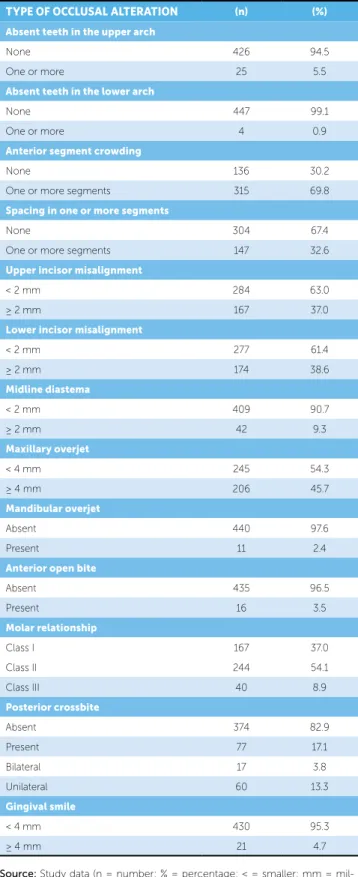
The absolute and relative rates of isolated malocclu-sion indings are shown in Table 3.
Orthodontic treatment need rates, as perceived by
the children and as perceived by their caregivers, were
both higher than the normative values (p < 0.001), be-ing 83.8% (n = 378) and 85.6% (n = 320), respectively. Normative need (DAI) was significantly (p < 0.001) higher than the IOTN-AC. Nevertheless, both had a strong statistical association (p = 0.002; OR=2.8; CI= 1.3 - 5.7). With the exception of posterior cross-bite, anterior cross-bite, absence of teeth in the lower arch and spacing in one or more segments, all the other occlusal alterations had a sta-tistically significant association (p < 0.01 for anterior open bite, and p < 0.001 for all the others) compared to the normative orthodontic treatment need.
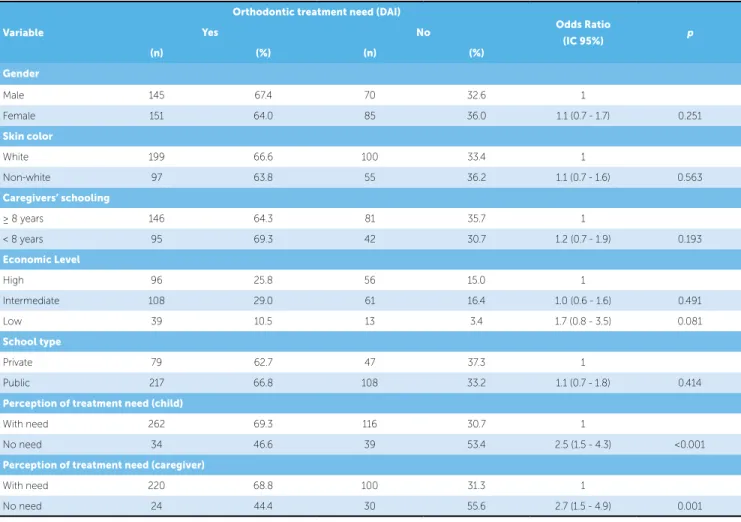
Bivariate analysis showed a signiicant statistical as-sociation between normative orthodontic treatment need and the variables: Treatment need as perceived by the child (p < 0.001) and their caregivers (p < 0.001). Bi-ological indicators, such as gender (p = 0.251) and skin color (p = 0.563), and social indicators, such as caregiv-ers’ schooling (p = 0.193), type of school (p = 0.414), and economic level (p = 0.081) were not associated with orthodontic treatment normative need (Table 4).
Multiple logistic regression analysis with the statisti-cally signiicant variables (p < 0.20) showed that only treatment need as perceived by the caregivers remained signiicantly associated with normative treatment need, when adjusted to the caregivers’ schooling and econom-ic level (p = 0.023).
DISCUSSION
Normative orthodontic treatment need was ob-served in 296 (65.6%) study subjects, a igure similar
to the ones reported by other researchers.1,18 Lower15,24
SAMPLE
CHARACTERIZATION
ABSOLUTE FREQUENCY (n)
RELATIVE FREQUENCY (%) Gender
Male 215 47.7
Female 236 52.3
Skin color
White 299 66.3
Non-white 152 33.7
Economic level
High 152 40.8
Intermediate 169 45.2
Low 52 14.0
Type of school
Private 126 27.9
Municipal 162 35.9
State 153 33.9
Federal 10 2.2
Table 1 - Sample characterization as for gender, skin color, economic level and type of school.
Table 3 - Absolute and relative frequencies of occlusal alterations observed in 12-year-old schoolchildren of the municipality of Juiz de Fora, MG, Brazil.
Source: Study data (n = number; % = percentage).
Table 2 - Normative orthodontic treatment need and need as perceived by 12-year-old schoolchildren and their caregivers, in the municipality of Juiz de Fora, MG, Brazil
Source: Study data (n = number; % = percentage; DAI = Dental Aesthetic Index; IOTN-AC = Index of Orthodontic Treatment Need – Aesthetic Com-ponent).
ORTHODONTIC TREATMENT NEED
ABSOLUTE FREQUENCY (n)
RELATIVE FREQUENCY (%) Normative need (DAI) 296 65.6
No need or slight need 155 34.4
Elective treatment 148 32.8
Highly desirable treatment 86 19.1
Obligatory treatment 62 13.7
Normative need
(IOTN-AC) 89 19.7
No need 362 80.3
Borderline cases 57 12.6
Deined need 32 7.1
Children’s perception 378 83.8
Caregivers’ perception 320 85.6
TYPE OF OCCLUSAL ALTERATION (n) (%)
Absent teeth in the upper arch
None 426 94.5
One or more 25 5.5
Absent teeth in the lower arch
None 447 99.1
One or more 4 0.9
Anterior segment crowding
None 136 30.2
One or more segments 315 69.8
Spacing in one or more segments
None 304 67.4
One or more segments 147 32.6
Upper incisor misalignment
< 2 mm 284 63.0
≥ 2 mm 167 37.0
Lower incisor misalignment
< 2 mm 277 61.4
≥ 2 mm 174 38.6
Midline diastema
< 2 mm 409 90.7
≥ 2 mm 42 9.3
Maxillary overjet
< 4 mm 245 54.3
≥ 4 mm 206 45.7
Mandibular overjet
Absent 440 97.6
Present 11 2.4
Anterior open bite
Absent 435 96.5
Present 16 3.5
Molar relationship
Class I 167 37.0
Class II 244 54.1
Class III 40 8.9
Posterior crossbite
Absent 374 82.9
Present 77 17.1
Bilateral 17 3.8
Unilateral 60 13.3
Gingival smile
< 4 mm 430 95.3
≥ 4 mm 21 4.7
other Brazilian and international studies. Lopes and
Gangussu15 and Marques et al17,18, who also used the
DAI to assess orthodontic treatment need, reported prevalence rates of 45.76%, 52.3% and 77%, respec-tively. The wide variability of malocclusion prevalence rates is mainly due to the diferent methods and indices used. Furthermore, diferences among the age ranges studied may also have contributed to the variability of the reported results. This notwithstanding, the high prevalence rate of malocclusion leading to orthodontic treatment need is present in all these studies.
Categorization of orthodontic treatment need ac-cording to malocclusion severity is particularly im-portant for the planning of corresponding public
poli-cies.16,28 Even when only severe malocclusions with
highly desirable and obligatory treatment need are considered, there is wide variability among the difer-ent epidemiologic studies. Nevertheless, in most stud-ies1,6,15,18,26 the prevalence rate of orthodontic treatment
need is consistently close to our indings (32.8%). Among the malocclusions found, crowding in one or more segments was the most frequent type, with 69.8% (n = 315) prevalence rate, followed by Class II molar relationship (54.1%) and horizontal maxillary overjet equal to 4 mm or greater, which was observed in 45.7% (n = 206) of the children. Because of the aesthetic relevance of these malocclusions, they have
received high social value,21,22 and an important cause
of demand for orthodontic treatment.13 Although
crowding has been the most frequently reported
Variable
Orthodontic treatment need (DAI)
Odds Ratio
(IC 95%) p
Yes No
(n) (%) (n) (%)
Gender
Male 145 67.4 70 32.6 1
Female 151 64.0 85 36.0 1.1 (0.7 - 1.7) 0.251
Skin color
White 199 66.6 100 33.4 1
Non-white 97 63.8 55 36.2 1.1 (0.7 - 1.6) 0.563
Caregivers’ schooling
≥ 8 years 146 64.3 81 35.7 1
< 8 years 95 69.3 42 30.7 1.2 (0.7 - 1.9) 0.193
Economic Level
High 96 25.8 56 15.0 1
Intermediate 108 29.0 61 16.4 1.0 (0.6 - 1.6) 0.491
Low 39 10.5 13 3.4 1.7 (0.8 - 3.5) 0.081
School type
Private 79 62.7 47 37.3 1
Public 217 66.8 108 33.2 1.1 (0.7 - 1.8) 0.414
Perception of treatment need (child)
With need 262 69.3 116 30.7 1
No need 34 46.6 39 53.4 2.5 (1.5 - 4.3) <0.001
Perception of treatment need (caregiver)
With need 220 68.8 100 31.3 1
No need 24 44.4 30 55.6 2.7 (1.5 - 4.9) 0.001
Table 4 - Distribution of frequency and bivariate analysis. Orthodontic treatment need in scholars 12-years-old from the city of Juiz de Fora, Minas Gerais.
malocclusion,6,20 our rates (69.8%) were higher than
those reported by Dias and Gleiser6(45.5%), Sousa et
al25 (28.3%) and Marques18 (37.8%), among others,
and similar to those reported by Freitas et al7 (69%)
and Lopes and Gangussu15 (65%). A possible
expla-nation could be due to the age range assessed, once several studies investigated wider age ranges, with in-clusion of subjects with mixed dentition. This fact
was observed by Sousa et al,25 who found increased
crowding rates during the transition from deciduous to mixed and permanent dentitions.
The same variability may be observed for the molar relationship and maxillary overjet. While
Lopes and Gangussu15 reported a low prevalence rate
of Class II molar relationship (19.1%) in the 12-15
years age range, Almeida et al1 found a prevalence rate
of 48%, that was closer to our results. The largest dis-crepancy among the study measures, however, was re-lated to maxillary overjet. The 45.7% prevalence rate we found was similar to those reported by Marques
et al18 (37.5%) and Cavalcanti et al5 (48%), although
diferent from those reported by Dias and Gleiser6
(29.7%) and Lopes and Gangussu,15 who found a
prev-alence rate over 90% in their samples.
Normative indices of orthodontic treatment need have been criticized. Besides overestimating the preva-lence of occlusal problems and orthodontic treatment
need,8,20 normative instruments have proved ineicient
to identify social and emotional aspects related to tooth positioning and their impact on malocclusion as
per-ceived by the individual.8,20
Contrary to the tendency towards overestimation of orthodontic treatment need determined by normative indexes, when comparing with social and dental
mea-sures and malocclusion self-perception8,20 in our study,
treatment need perceived both by the children and their
caregivers, was higher than normative treatment need,
in agreement with other studies.12
Different from what was reported elsewhere,9,12
our results showed a wide difference between the rates of treatment need assessed by the IOTN-AC (7.1%) and those assessed by the DAI (65.6%) and the chil-dren’s perception (83.8%), although they remained statistically associated. Such difference between the objective and subjective indices for malocclusion
as-sessment was also reported by Souames et al.24 Dias
and Gleiser6 found an IOTN-AC assessed normative
treatment need of 84.3 % of their study sample, much higher than ours (19.7%), although equivalent to treatment need as perceived by the children (83.8%).
The higher need perceived by the children and their caregivers may reflect increased access to this type of therapy, which aggregates a social and cul-tural value to the orthodontic appliance. Orthodontic treatment may thus be associated with cultural trends
and social status,3 which may subjectively foster an
increased perception of orthodontic treatment need, through and additional effect of the desire to undergo such treatment.
The high rate of malocclusions with orthodontic treatment need and the perception of such need by the children and their caregivers reinforce the importance of including orthodontic treatment in public health policies. Such inclusion assumes adequate resource al-location, better use of human resources and professional creativity, and institutional liaison between public and
private institutions.16
CONCLUSION
From our data and discussion, the following conclu-sions can be made:
» There is a high prevalence rate (65.6%) of maloc-clusions with orthodontic treatment need among 12-year-old schoolchildren in the municipality of Juiz de Fora, MG, Brazil.
» Crowding in one or more segments, Class II mo-lar relationship and a horizontal maxilmo-lary overjet were the malocclusions most frequently found. » Orthodontic treatment need as perceived by the
children and their caregivers was signiicantly higher (p < 0.001) than that suggested by norma-tive criteria.
» Orthodontic treatment need as perceived by the caregivers was signiicantly associated with nor-mative treatment need, when adjusted to parents’ schooling and economic level (p = 0.023). » There were no signiicant diferences concerning
the variables gender, skin color, parents’ school-ing and type of school.
1. Almeida MEC, Vedovello Filho M, Vedovello SAS, Lucatto A, Torrezan AT. Prevalência da má oclusão em escolares da rede estadual do município de Manaus, AM - Brasil. RGO: Rev Gaúch Odontol. 2007;55(4):389-94. 2. Associação Brasileira de Empresas de Pesquisa. Critérios de Classiicação
Econômica. São Paulo: ABEP; 2008.
3. Baldwin DC. Appearance and aesthetics in oral health. Community Dent Oral Epidemiol. 1980;8(6):244-56.
4. Brasil. Relatório SB Brasil, 2003. Condições de saúde bucal da população brasileira 2002-2003. Resultados principais. Brasília: Ministério da Saúde; 2004. 5. Cavalcanti AL, Bezerra PKM, Alencar CRB, Moura C. Prevalência de
Maloclusão em escolares de 6 a 12 anos de idade em Campina Grande, PB, Brasil. Pesq Bras Odontoped Clin Integr. 2008;8(1):99-104.
6. Dias PF, Gleiser R. Orthodontic treatment need in a group of 9-12-year-old Brazilian schoolchildren. Braz Oral Res. 2009;23(2):182-9
7. Freitas MR, Freitas DS, Pinheiro FHS, Freitas, KMS. Prevalência das más oclusões em pacientes inscritos para tratamento ortodôntico na Faculdade de Odontologia de Bauru-USP. Rev Fac Odontologia Bauru. 2002;10(3):164-9.
8. Gherunpong S, Tsakos G, Sheiham A. A socio-dental approach to assessing children’s orthodontic needs. Eur J Orthod. 2006;28(4):393-99.
9. Grzywacz I. The value of the aesthetic component of the Index of Orthodontic Treatment Need in the assessment of subjective orthodontic treatment need. Eur J Orthod. 2003;25(1):57-63.
10. Järvinen S. Indexes for orthodontic treatment need. Am J Orthod Dentofacial Orthop. 2001;120(3):237-9.
11. Jenny J, Cons NC. Comparing and contrasting two orthodontic indices, the index of orthodontic treatment need and the dental aesthetic index. Am J Orthod Dentofacial Orthop. 1996;110(4):410-6.
12. Kerosuo H, Al Enezi S, Kerosuo E, Abdulkarim E. Association between normative and self-perceived orthodontic treatment need among Arab high school students. Am J Orthod Dentofacial Orthop. 2004;125(3):373-8. 13. Kilpelainen PV, Phillips C, Tulloch JF. Anterior tooth position and motivation
for early treatment. Angle Orthod. 1993;63(3):171-4.
14. Levy OS, Lemeshow S. Sampling of populations: methods and applications book description. 4ª ed. New York: John Wiley & Sons; 2008.
15. Lopes LS, Cangussu MCT. Prevalência e severidade das alterações oclusais em escolares de 12 a 15 anos de Salvador - BA, 2004. Rev Ciênc Méd Biol. 2005;4(2):105-12.
16. Maciel SM, Kornis GEM. Equity through the inclusion of orthodontic care in oral health policis: suggestions for relection and debate. Rio de Janeiro: UERJ, IMS; 2006.
REFERENCES
17. Marques CR, Couto GB, Orestes-Cardoso S. Assessment of orthodontic treatment needs in Brazilian schoolchildren according to the Dental Aesthetic Index (DAI). Community Dent Health. 2007;24(3):145-8.
18. Marques LS, Barbosa CC, Ramos-Jorge ML, Pordeus IA, Paiva SM. Prevalência da má oclusão e necessidade de tratamento ortodôntico em escolares de 10 a 14 anos de idade de Belo Horizonte, Minas Gerais, Brasil: enfoque psicossocial. Cad Saúde Pública. 2005;21(4):1099-106.
19. Moura C, Cavalcanti AL. Maloclusões, cárie dentária e percepções de estética e função mastigatória: um estudo de associação. Rev Odonto Ciênc. 2007;22(57):256-62.
20. Peres KG, Traebert ESA, Marcene W. Diferences betweem normative criteria and self-perception in the assessment of malocclusion. J Public Health. 2002;36(2):230-6.
21. Shaw WC. The inluence of childrens dentofacial appearance on their social attractiveness as judged by peers and lay adults. Am J Orthod. 1981;79(4):399-415.
22. Shaw WC. Rees G, Dawe M, Charles CR. The inluence of dentofacial appearance on the social attractiveness of young adults. Am J Orthod Dentofacial Orthop. 1985;87(1):21-6.
23. Shaw WC, Richmond S, OBrien KD. The use of occlusal indices: A European perspective. Am J Orthod Dentofacial Orthop. 1995;107(1):1-10.
24. Souames M, Bassigny F, Zenati N, Riordan PJ, Boy-Lefevre ML. Orthodontic treatment need in French schoolchildren: an epidemiological study using the Index of Orthodontic Treatment Need. Eur J Orthod. 2006;28:605-9. 25. Sousa RLS, Lima RB, Florêncio C Filho, Lima KC, Diógenes AMN. Prevalência
e fatores de risco da mordida aberta anterior na dentadura decídua completa em pré-escoalres na cidade de Natal - RN. Rev Dental Press Ortod Ortop Facial. 2007;12(2):129-38.
26. Suliano AA, Rodrigues MJ, Caldas Júnior AF, Fonte PP, Porto-Carreiro CF. Prevalência de maloclusão e sua associação com alterações funcionais do sistema estomatognático entre escolares. Cad Saúde Pública. 2007;23(8):1913-23.
27. Väkiparta MK, Kerosuo HM, Nyström ME. Orthodontic treatment need from eight to 12 Years of age in an early treatment oriented public health care system: a prospective study. Angle Orthod. 2005;75(3):344-9.
28. World Health Organization-WHO. Oral health surveys: basic methods. 4ª ed. Geneva: ORH/EPID; 1997.