AR
TICLE
1 Departamento de Vigilância de Doenças e Agravos Não Transmissíveis e Promoção da Saúde, Ministério da Saúde. Setor SAFS Quadra (Setor de Administração Federal Sul) Edifício Premium/Torre 1/Bloco F/Sala 16, Zona Cívico-Administrativa. 70070-600 Brasília DF Brasil. mdm.mascarenhas@ gmail.com
Emergency room visits due to external causes and alcohol
consumption – Capitals and the Federal District, Brazil, 2011
Abstract The study objective was to describe the profile and factors related to alcohol consumption among emergency room visits by external caus-es. It is a cross-sectional study with data from the Survey of Violence and Injuries in Emergen-cy between September and October 2011, in 24 state capitals and the Federal District. Statistical analysis were performed for all cases treated in selected services, comparing the characteristics of the victims, according to the statement of alcohol consumption. 33,289 visits to emergency rooms by external causes in the population above 18 years of age were included. The prevalence of self-report-ed statement of alcohol consumption among these services was 14.9% for the 24 capitals and the Fed-eral District, and was significantly higher among visits by violent causes than by accidents. For both accidents and violence the associated causes were victims male, black/brown, less educated, mem-bers of specific populations, occurrences on public roads. The results support global discussions on the importance of establishing policies and legal mea-sures to restrict the consumption of alcohol and ve-hicular direction, control advertising of alcoholic beverages, and laws normalizing the functioning of sales points of alcoholic beverages.
Key words Alcohol, Accidents, Violence, External causes, Emergency medical services
Márcio Dênis Medeiros Mascarenhas 1
Alice Cristina Medeiros das Neves 1
Rosane Aparecida Monteiro 1
Marta Maria Alves da Silva 1
M
ascar
e
nhas MDM Introduction
The harmful use of alcohol is considered one of the most important risk factors affecting the health status of different population groups. According to estimates by the World Health Or-ganization (WHO), this habit is responsible for approximately 2.3 million premature deaths an-nually worldwide. Injuries from external causes (accidents and violence) represent more than one-third of all deaths due to alcohol consump-tion and affect not only the direct consumer but other groups, including pedestrians and cyclists, who can be injured by an intoxicated driver1.
External causes of morbidity are of great im-portance in public health because of their mag-nitude and impact on people’s lives, particularly in developing countries2,3. According to the Pan
American Health Organization (PAHO)4,
exter-nal factors are the main cause of reduced lifespan in two-thirds of the American countries, and traf-fic accidents, homicides, and suicides are among the five leading causes of premature death.
Alcohol consumption has been associated with many different types of injuries from ex-ternal causes, including those related to traffic, falls, burns, sports, labor, and interpersonal and self-inflicted violence. In the Americas, violence and injuries due to traffic deserve attention as a public health problem5.
The first national survey on the patterns of alcohol consumption in the Brazilian popula-tion6 was conducted between 2005 and 2006 and
found that 52% of Brazilians over 18 years of age consumed alcohol at least once a year. This rate was 65% among men and 41% among women. In the group of adults who consumed alcohol, 60% of men and 33% of women consumed ≥ 5 drinks on the occasion of highest consumption in the last year. Of all adult men, 11% consumed alcohol every day, and 28% consumed alcohol 1–4 times a week6. With the implementation of
the telephone-based surveillance of risk and pro-tective factors for chronic diseases system (VIG-ITEL), in which alcohol consumption is one of the research topics, it was possible to evaluate the alcohol consumption pattern in the Brazil-ian adult population. According to Moura and Malta7, VIGITEL data showed that, in 2006, the
habitual consumption of alcoholic beverages reached 38.1% of the study population, and alco-hol abuse reached 16.2% of the population; these rates were higher in men compared with women. Since then, alcohol abuse has increased gradually in both genders.
In 2006, the Ministry of Health established the Brazilian Surveillance System for Violence and Accidents (Sistema de Vigilância de Violên-cias e Acidentes/VIVA). This surveillance system is structured into two components: 1) surveil-lance of the cases of violence and accidents in hospital emergency units, aiming to characterize emergency care for external causes, and 2) sur-veillance of the cases of sexual, domestic and/or other interpersonal violence, which considers the legal requirements for notification of violence against children, adolescents, women, and older adults8.
Injuries from external causes attributed to al-cohol consumption have increased worldwide, a problem that is more obvious in the health care provided in emergency services. The assessment of emergency care constitutes an effective strate-gy to collect relevant information on the correla-tion between alcohol use and external causes and fosters the development of public policies aimed at more effective and large-scale interventions1.
This study aimed to describe the profile and factors associated with alcohol consumption in emergency care for external causes based on data obtained from the VIVA 2011 survey conducted in 24 state capitals and the Federal District.
Methods
This cross-sectional study used data obtained from the VIVA survey, conducted between Sep-tember and November 2011 in 71 urgent and emergency care units from the Unified Health System (Sistema Único de Saúde/SUS) in the Federal District and in 24 Brazilian state capitals, except Manaus, in the state of Amazonas, and São Paulo, in the state of São Paulo, which did not conduct the survey for operational reasons. The inclusion of the selected units has been validated by the local teams according to the following cri-teria: 1) health care units authorized to provide urgent and emergency care services according to the National Register of Health Facilities (Ca-dastro Nacional de Estabelecimentos de Saúde/ CNES); 2) availability of records on the number of hospitalizations due to external causes ob-tained from the Hospital Information System of the Unified Health System (Sistema de Infor-mações Hospitalares/SIH/SUS); and 3) number of health care visits identified in the VIVA sur-veys conducted in 2006, 2007, and 20099-11.
12-e C
ole
tiv
a,
20(4):1037-1046,
2015
hour shifts, totaling 60 work shifts, 30 during the daytime (7:00 a.m. to 6:59 p.m.) and 30 during the nighttime (7:00 p.m. to 6:59 a.m.). The proce-dure adopted for the selection of the work shifts was cluster sampling in a single-stage selection, and the shift was the primary sampling unit. The number of shifts drawn in each establishment was obtained as a function of the minimum sam-ple size (2,000 per capital) and the average num-ber of emergency care visits for external causes during working hours, assuming a coefficient of variation of < 30% and a standard error of < 39-11.
All the victims of external causes who sought care for the first time in the urgent and emer-gency services in the shifts selected by casting lots and who agreed to participate in the study were eligible for the interview. Data were collect-ed using a standardizcollect-ed form applicollect-ed by traincollect-ed personnel. The emergency care visits were divid-ed into two groups according to intentionality: a) accident—defined as “an unintentional and avoidable event that causes physical and emo-tional injuries in domestic or social settings, in-cluding work, school, sports, and leisure”12
(traf-fic accidents, falls, burns, cuts, objects falling on the person, poisoning, suffocation, and drown-ing, among others),and b) violence—defined as “the use of force against a group or community that either results in or can potentially result in injury, death, psychological harm, developmental disability, or deprivation”3 (self-harm, abuse, and
assault).
The self-report of alcohol consumption was obtained using the following question: Did you consume alcohol in the six hours prior to the event [which motivated you to seek this health care ser-vice]? The records of emergency care visits for external cases of patients aged ≥ 18 years were included in the present analysis, considering the following variables:
a) Sociodemographic: gender (male, female), age group (18–29, 30–39, 40–59, ≥ 60 years), eth-nicity/skin color (white, black/brown [mixed], yellow/indigenous), education level (0–8, ≥ 9 years), and specific population groups;
b) Event: place of occurrence (residences, public places, schools, recreational areas, busi-nesses, industry/construction areas, etc.), nature of injury (no physical injury, bruise, cut/lacera-tion/amputation, sprain/dislocation, fracture, trauma, other), body part affected (head/neck, chest/abdomen/pelvis, extremities, multiple or-gans/regions), self-report of alcohol use, type of event (accidents, violence), type of occurrence (assault/abuse, drowning, self-harm, injury
from firearms, traffic accident, poisoning/intox-ication, fall, injury from a sharp object, accident involving animals, suffocation/choking, collision against object/person, sprain, burn, object falling on the person, foreign body, compression be-tween/within objects, other accidents);
c) Emergency visit: means of transportation to the hospital (on foot, private vehicle, SAMU [Serviço de Atendimento Móvel de Urgência (Mobile Emergency Care Service)]/ambulance/ rescue, bus/van, police car, etc.), period of visit (nighttime, daytime), day of visit (Monday to Friday, Saturday and Sunday), and outcome (dis-charge, admission, outpatient referral, evasion, death).
The analyses were performed for the total number of visits to the selected units by com-paring the profile of the victims according to self-report of alcohol consumption. The null hy-pothesis of independence between the qualitative variables was assessed using the chi-square test and a significance level of 5%. The prevalence ra-tios and 95% confidence intervals were estimated using a Poisson regression. The “svy” module in Stata software version 11 (Stata Corp., College Station, TX, United States) was used, which is suitable for obtaining unbiased estimates when data are obtained from complex sampling de-signs.
The VIVA survey 2011 was approved by the National Research Ethics Committee (Comissão Nacional de Ética em Pesquisa–CONEP). Addi-tional information on the sampling design, or-ganization, and operationalization of the survey can be obtained from other publications9-11.
Results
M
ascar
e
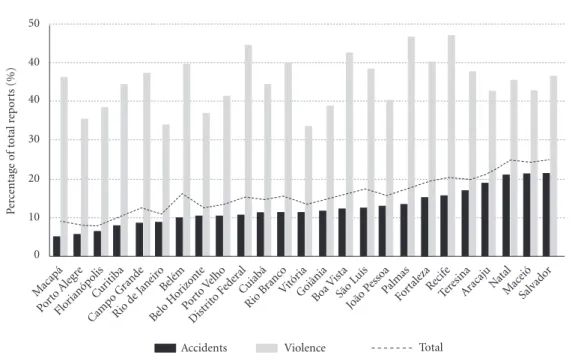
nhas MDM Figure 1 shows the distribution of the prevalence
of self-reported alcohol consumption, according to each municipality and by event type.
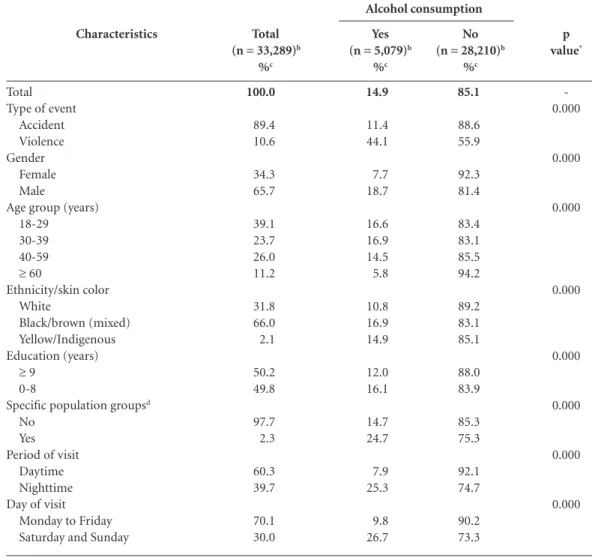
Table 1 shows the distribution of self-report-ed alcohol consumption among the emergency visits for external causes. Alcohol consumption was significantly higher for the visits by victims of violence, primarily among those of male gen-der, among those aged 18-39 years, and among those who declared themselves of black/brown ethnicity. Moreover, alcohol consumption was higher among individuals with less education, for members of specific population groups (vil-lagers, Quilombola communities, homeless), and for emergency visits at night and on weekends.
Table 2 shows the factors associated with al-cohol consumption stratified by type of event (accident or violence). Among the visits for ac-cidents, the prevalence of self-reported alcohol consumption was significantly higher among men, among those who declared themselves of black/brown ethnicity, among those with low education levels, and among members of spe-cific population groups. Alcohol consumption was significantly lower among older people com-pared with younger groups. There was a higher percentage of self-reported alcohol consumption
among patients who experienced injuries in pub-lic places compared with injuries that occurred in residences. Among the visits by victims of vi-olence, self-reported alcohol consumption pre-vailed among men, among those of black/brown and yellow/indigenous ethnicities, among those with lower education levels, and among those from specific population groups. The percentage of self-reported alcohol consumption was higher among patients who experienced events in pub-lic places, recreational areas, and businesses com-pared with events that occurred in residences.
Table 3 presents the characteristics of emer-gency visits for external causes and their asso-ciation with alcohol consumption by type of event. Among the emergency care visits for ac-cidents, the percentage of self-reported alcohol consumption was higher among patients who experienced accidents that affected body seg-ments such as head/neck and multiple organs/ regions. The highest percentage of self-reported alcohol consumption was observed among in-dividuals requiring the use of different means of public transportation to the hospital, among those needing care at night and on weekends, and among those whose visits resulted in hospital-ization, outpatient follow-up, or abandonment.
Figure 1. Distribution of self-reported alcohol consumption among patients who received emergency care
permunicipality - Capitalsa and the Federal District, Brazil, 2011.
Source: MS, SVS, Brazilian Surveillance System for Violence and Accidents (Sistema de Vigilância de Violências e Acidentes-VIVA survey), 2011. a Except Manaus, in the state of Amapá, and São Paulo, in the state of São Paulo.
0 10 20 30 40 40 50
Pe
rc
entag
e o
f t
otal r
ep
or
ts (%)
Macapá Porto
Aleg re
Florianóp olis
Cur itiba
Camp o Grand
e
Rio d e Jane
iro Belém
Belo H orizo
nte
Por to Velho
Dist rito F
eder al Cuiabá
Rio B ranc
o Vitór
ia
Goiânia Boa V ista
São L uís
João P esso
a
Palmas Fortaleza Recif e
Teresina Ara caju Natal
Mace ió
Salvad or
e C
ole
tiv
a,
20(4):1037-1046,
2015
With regard to emergency visits by victims of violence, the percentage of self-reported alcohol consumption was higher among patients whose events affected the head/neck, among individuals requiring the use of different means of transpor-tation to the hospital, including private vehicles and SAMU/ambulance/rescue, and among indi-viduals needing care at night and on weekends. No significant difference was observed in the prevalence of alcohol consumption between the victims of violence according to the outcome of the emergency visit.
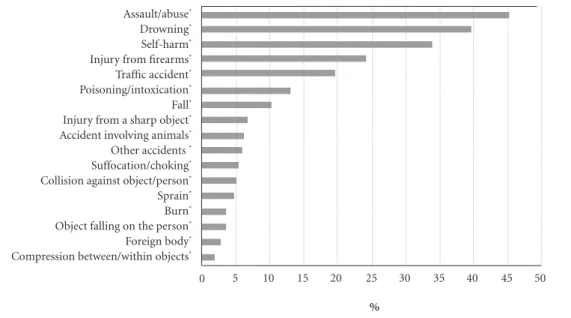
Figure 2 shows the distribution of the prev-alence of self-reported alcohol consumption ac-cording to the type of occurrence, using as
ref-erence the prevalence values obtained for visits due to compression between/within objects. The highest prevalence of self-reported alcohol con-sumption was observed among the victims of aggression/abuse, drowning, self-harm, injury by firearms, traffic accidents, poisoning/intoxica-tion, and falls.
Discussion
Alcohol consumption in emergency visits for ex-ternal causes was self-reported in more than one-tenth of the accidents and in approximately half of the cases of violence, indicating the high
mag-Characteristics
Total Type of event
Accident Violence Gender
Female Male
Age group (years) 18-29 30-39 40-59
≥ 60
Ethnicity/skin color White
Black/brown (mixed) Yellow/Indigenous Education (years)
≥ 9
0-8
Specific population groupsd
No Yes Period of visit
Daytime Nighttime Day of visit
Monday to Friday Saturday and Sunday
Total (n = 33,289)b
%c
100.0
89.4 10.6
34.3 65.7
39.1 23.7 26.0 11.2
31.8 66.0 2.1
50.2 49.8
97.7 2.3
60.3 39.7
70.1 30.0
No (n = 28,210)b
%c
85.1
88.6 55.9
92.3 81.4
83.4 83.1 85.5 94.2
89.2 83.1 85.1
88.0 83.9
85.3 75.3
92.1 74.7
90.2 73.3
Yes (n = 5,079)b
%c
14.9
11.4 44.1
7.7 18.7
16.6 16.9 14.5 5.8
10.8 16.9 14.9
12.0 16.1
14.7 24.7
7.9 25.3
9.8 26.7
p value*
-0.000
0.000
0.000
0.000
0.000
0.000
0.000
0.000
Table 1. Distribution of self-reported alcohol consumption among patients who received emergency care
according to selected characteristics - Capitalsa and the Federal District, Brazil, 2011.
Source: MS, SVS, Brazilian Surveillance System for Violence and Accidents (Sistema de Vigilância de Violências e Acidentes-VIVA survey), 2011. a Except Manaus, in the state of Amapá, and São Paulo, in the state of São Paulo; b Absolute number of observations; c Weighted percentage; d Includes gypsies, Quilombolas, villagers, and homeless people. * Pearson chi-square test.
M
ascar
e
nhas MDM
nitude of the problem. Considering the num-ber of accidents and cases of violence, alcohol consumption was associated with the following characteristics: male gender, black/brown ethnic-ity, lower education level, belonging to specific population groups, occurrence of the event in public places, and emergency visits at night and on weekends.
Alcohol consumption is an adapted behavior encouraged in most cultures and communities and is associated with celebrations, festivities, and religious ceremonies, among other cultur-al manifestations13. The WHO estimates that
approximately 770,000 deaths occur annually (1.5% of all deaths worldwide) due to the use of alcohol, at an annual cost of approximately
0.5%–2.7% of the gross domestic product (GDP) in different countries13,14.
Excessive alcohol consumption is an im-portant public health problem that directly af-fects morbidity and mortality. There are sever-al patterns of sever-alcohol consumption, including chronic consumption, that can cause harm and dependence and can result in mental, liver, and cardiovascular diseases, along with cancer and other complications13-15. A regular usage pattern
involves the consumption of excessive amounts of alcohol in a short period of time, a practice known in the literature as “binge drinking”. The term is used worldwide to define “heavy episodic drinking”16. The problems arising from the
epi-sodic and acute use of alcohol are also
import-Characteristics
Gender Female Male
Age group (years) 18-29 30-39 40-59
≥ 60
Ethnicity/skin color White
Black/brown (mixed) Yellow/Indigenous Education (years)
≥ 9
0-8
Specific population groupsd
No Yes
Place of occurrence
Residencee
Public places Recreational areas
Businesses Schools
Industry/construction areas Other
Table 2. Prevalence (%) of self-reported alcohol consumption among patients who received emergency care
according to sociodemographic characteristics and location of the event, stratified by type of occurrence-Capitalsa and the Federal District, Brazil, 2011.
Source: MS, SVS, Brazilian Surveillance System for Violence and Accidents (Sistema de Vigilância de Violências e Acidentes-VIVA survey), 2011. a Except Manaus, in the state of Amapá, and São Paulo, in the state of São Paulo; b Absolute number of observations; c Weighted percentage; d Includes gypsies, Quilombolas, villagers, and homeless people; e Includes residences and collective housing. PR: prevalence ratio; 95% CI: 95% confidence interval. Statistically significant differences (p < 0.05) are in bold.
%c
5.7 14.6
12.7 12.8 11.6 4.5
8.4 13.0 10.9
9.6 12.1
11.3 17.2
7.4 18.5 8.9 4.5 1.7 1.2 9.2
Accidents Alcohol consumption
(n = 3,434)b
PR (95% CI)
1.00
2.57 (2.26-2.91)
1.00 1.00 (0.91-1.11) 0.91 (0.83-1.01)
0.35 (0.29-0.42)
1.00
1.54 (1.35-1.76)
1.29 (0.97-1.71)
1.00
1.26 (1.16-1.37)
1.00
1.52 (1.22-1.88)
1.00
2.51 (2.27-2.78)
1.21 (0.98-1.50)
0.61 (0.48-0.77)
0.23 (0.04-1.41)
0.16 (0.10-0.27)
1.25 (0.96-1.63)
%c
28.8 50.3
43.3 46.5 44.7 34.9
36.4 46.5 52.5
37.3 46.8
43.6 57.4
32.6 46.3 46.7 66.8 5.1 9.5 36.6
Violence Alcohol consumption
(n = 1,645)b
PR (95% CI)
1.00
1.75 (1.51-2.02)
1.00 1.07 (0.97-1.19) 1.03 (0.92-1.16) 0.81 (0.61-1.06)
1.00
1.28 (1.11-1.46) 1.44 (1.10-1.89)
1.00
1.26 (1.14-1.38)
1.00
1.32 (1.06-1.64)
1.00
1.42 (1.26-1.59) 1.43 (1.08-1.91) 2.05 (1.82-2.30) 0.16 (0.04-0.65)
e C
ole
tiv
a,
20(4):1037-1046,
2015
Characteristics
Body segment affected Extremities
Thorax/abdomen/pelvis Head/neck
Multiple organs/regions
Means of transportation to the hospital Bus/van (public transport)
On foot Private vehicle
SAMU/Ambulance/Rescue Police car
Other Period of visit
Daytime Nighttime Day of visit
Monday to Friday Saturday and Sunday Outcome
Hospital discharge Hospital admission Outpatient referral Evasion
Death
Table 3. Prevalence (%) of self-reported alcohol consumption among patients who received emergency care
according to the characteristics of the emergency visit, stratified by type of occurrence-Capitalsa and the Federal
District, Brazil, 2011.
%c
8.8 8.9 19.1 19.8
4.9 9.4 8.8 20.4 14.9 10.0
6.5 19.8
7.3 21.7
9.8 18.4 13.6 17.4 14.6
Accidents Alcohol consumption
(n = 3,434)b
PR (95% CI)
1.00 1.01 (0.87-1.18)
2.17 (1.98-2.38) 2.25 (1.99-2.55)
1.00
1.92 (1.48-2.49) 1.81 (1.51-2.17) 4.18 (3.43-5.10) 3.05 (2.01-4.60) 2.05 (1.46-2.88)
1.00
3.04 (2.72-3.39)
1.00
2.96 (2.58-3.41)
1.00
1.88 (1.67-2.11) 1.38 (1.14-1.68) 1.78 (1.32-2.38) 1.49 (0.67-3.35)
%c
40.4 42.1 50.6 40.3
32.0 39.9 42.3 51.7 37.5 35.3
29.8 51.2
35.8 55.4
42.3 46.9 46.5 48.6 33.0
Violence Alcohol consumption
(n = 1,645)b
PR (95% CI)
1.00 1.04 (0.89-1.21)
1.25 (1.12-1.39)
1.00 (0.85-1.17)
1.00 1.25 (0.92-1.70)
1.32 (1.07-1.63) 1.62 (1.31-2.01)
1.17 (0.90-1.52) 1.10 (0.72-1.70)
1.00
1.72 (1.53-1.93)
1.00
1.55 (1.41-1.70)
1.00 1.11 (0.99-1.23) 1.10 (0.94-1.29) 1.15 (0.85-1.55) 0.78 (0.37-1.65)
Source: MS, SVS, Brazilian Surveillance System for Violence and Accidents (Sistema de Vigilância de Violências e Acidentes-VIVA survey), 2011. a Except Manaus, in the state of Amapá, and São Paulo, in the state of São Paulo; b Absolute number of observations; c Weighted Percentage. PR: prevalence ratio; 95% CI: 95% confidence interval. Statistically significant differences (p < 0.05) are in bold.
ant risk factors for violence (assault, homicide, suicide), traffic accidents, and work-related acci-dents, among others15,17.
The presence of alcohol in the bloodstream causes several neuromotor changes, depending on the concentration. Even at low doses (0.3 dg/L, or 1 drink), alcohol can result in decreased attention, misperception of speed, euphoria, and difficulty discerning distinct luminance differ-ences. Higher concentrations progressively im-pair decision-making by interfering with reflexes and normal behavior and can lead to intoxica-tion, drowsiness, and even alcoholic coma18.
The results of the current study corroborate the association between alcohol consumption and external causes, including accidents and vi-olence, as has been widely reported in the liter-ature1-3,13,14. Among the many problems resulting
from alcohol use, motor vehicle accidents
involv-ing cars, motorcycles, and trucks occupy a prom-inent place. In the United States, for every 10 car accidents, 1.5 involves alcohol consumption. Drunk driving is one of the main consequences of the inappropriate use of alcohol and increases the risk of traffic accidents18.
Previous WHO studies have reported even higher rates: up to 20% of deaths from traffic accidents have been associated with high blood alcohol levels in high-income countries, and 33%-69% of deaths have been associated with alcohol use in low- and medium-income coun-tries19. Previous studies conducted in São Paulo
have shown that 42.5% of homicide victims who were subjected to toxicology tests had consumed alcohol20. In Curitiba, state of Paraná, 50.2% of
con-M
ascar
e
nhas MDM
ducted in Diadema, in the state of São Paulo, in-dicated a significant decrease in the number of violent deaths after restricting the sale of alcohol-ic beverages and closing the bars earlier at night22.
The sociodemographic characteristics de-scribed herein related to alcohol consumption and external causes (male gender, young age, low socioeconomic level, and low education level) have also been reported in national and interna-tional studies13,14,19.
External factors are important causes of morbidity and mortality among young men and strongly contribute to the reduction in life expectancy among men23. Occurrences among
low-income and less-educated groups have also been described in other studies, confirming the social inequity and inequality of this outcome. Accordingly, low-income populations live in the suburbs, which have less public safety, increased population density, and increased vulnerabili-ty19,23.
The increased occurrence of events on week-ends and at night is also compatible with results from the literature, possibly because it is the most common time for gatherings, parties, and celebrations, which can lead to increased alcohol consumption and risk of occurrences19.
One the limitations of the study involved sample representativeness because the study in-cluded public urgent/emergency care services from 24 state capitals and the Federal District, which precluded making inferences about the entire Brazilian population. In addition, the study was conducted in a single month, which precluded the analysis of the seasonality of these events. Even with these limitations, emergency care in general was provided in public services because they are better equipped to provide care for external causes, and these results were consis-tent with those reported in the literature1,3,5,13,17.
In addition, VIVA data fill an important gap by providing information on violence- and acci-dent-related emergency visits and have support-ed violence prevention policies in Brazil.
The results presented herein reinforce the global discussions on the importance of estab-lishing policies and legal measures to restrict alcohol consumption and motor vehicle driv-ing, to limit advertisements on alcohol, and to create laws to regulate the operation of liquor stores14,24-26. Considering these findings,
preven-tive measures should target population segments consisting primarily of men, individuals of black/ brown ethnicity, those with less education, those
5 10 15 20 25 30 35 40 45 50
Figure 2. Distribution of self-reported alcohol consumption among patients who received emergency care per
type of occurrence-Capitalsa and the Federal District, Brazil, 2011.
Source: MS, SVS, Brazilian Surveillance System for Violence and Accidents (Sistema de Vigilância de Violências e Acidentes-VIVA survey), 2011. a Except Manaus, in the state of Amapá, and São Paulo, in the state of São Paulo. *p < 0.05 (Pearson chi-square test), using as a reference the percentage of self-reported alcohol consumption among patients who received emergency care for compression between/within objects.
Assault/abuse* Drowning* Self-harm* Injury from firearms* Traffic accident* Poisoning/intoxication* Fall* Injury from a sharp object* Accident involving animals* Other accidents * Suffocation/choking* Collision against object/person* Sprain* Burn* Object falling on the person* Foreign body* Compression between/within objects*
0
e C
ole
tiv
a,
20(4):1037-1046,
2015
living in vulnerable situations (villagers, Qui-lombola communities, homeless), motor vehicle drivers, and participants of festive events—par-ticularly on weekends.
Other measures are noteworthy, such as the launch of the Plan to Combat Chronic Non-Com-municable Diseases (Plano de Enfrentamento de Doenças Crônicas Não Transmissíveis)25,26
in 2011,which established goals for the decrease of alcohol consumption and indicated the best strategies to decrease alcohol consumption as recommended by the WHO27: a) strengthen the
implementation of pricing policies and raise tax-es on products derived from tobacco and alcohol to decrease consumption; b) support the inten-sification of surveillance measures associated with the sale of alcoholic beverages to minors (< 18 years); c) strengthen educational measures of the School Health Program (Programa Saúde na Escola/PSE) to prevent and limit tobacco use and alcohol abuse; and d) support local initiatives to control the sale of alcohol, establishing limited pe-riods for sale in bars and similar places.
Other important public policy measures in-volved bans on drinking and driving (Prohibition Law No. 11705/200828; New Prohibition Law No.
12.760/201229), which resulted in decreased
alco-hol consumption after the publication of laws on alcohol use and responsible driving30,31. The debate
involving government, legislatures, health profes-sionals, education profesprofes-sionals, society, families, and young people is essential to improve public
policies and regulatory frameworks related to al-cohol consumption.
More recently, other initiatives have included the Road Safety Program, known in Brazil as ‘Pro-grama Vida no Trânsito’, a partnership involving the Ministry of Health, National Traffic Depart-ment (DepartaDepart-mento Nacional de Trânsito–De-natran), Ministry of Justice, PAHO, WHO, and Bloomberg Foundation, among other partners working in conjunction to promote the decrease in the number of traffic accidents, in addition to the 2011-2020 Road Safety Plan32.
Conclusion
The VIVA survey highlights the importance of the correlation between alcohol consumption and external causes, particularly cases of violence/ assault, half of which are associated with alcohol consumption. The survey allowed the identifica-tion of events not previously identified by the SIH/ SUS system or by the mortality information sys-tem (Sissys-tema de Informação de Mortalidade/SIM) and combined all visits to urgency/emergency care units, including less severe cases. Therefore, the VIVA survey has supported local planning to the extent that managers and local teams understand the reality of these services and the circumstances underlying these events and can thus provide more effective strategies for the prevention of external causes and the promotion of health.
Collaborators
M
ascar
e
nhas MDM
World Health Organization (WHO). Beber e dirigir: manual de segurança no trânsito para profissionais de trânsito e saúde. Genebra: WHO; 2007.
Gazal-Carvalho C, Carlini-Cotrim B, Silva OA, Sauaia N. Prevalência de alcoolemia em vítimas de causas ex-ternas admitidas em centro urbano de atenção ao trau-ma. Rev Saude Publica 2002; 36(1):47-54.
Freitas EAM, Mendes ID, Oliveira LCM. Ingestão alco-ólica em vítimas de causas externas atendidas em um hospital geral universitário. Rev Saude Publica 2008; 42(5):813-821.
Duailibi S, Ponicki W, Pinsky I, Laranjeira R, Raw M. The effect of restricting opening hours on alcohol re-lated violence. Am J Public Health 2007; 97(12):2276-2280.
Brasil. Ministério da Saúde (MS). Saúde Brasil 2012: uma análise da situação de saúde e dos 40 anos do Pro-grama Nacional de Imunizações. Brasília: MS; 2013. McMillan GP, Lapham S. Effectiveness of bans and laws in reducing traffic deaths: legalized sunday packaged alcohol sales and alcohol-related traffic crashes and crash fatalities in New Mexico.Am J Public Health. 2006; 96:1944-1948.
Brasil. Ministério da Saúde (MS). Plano de ações estra-tégicas para o enfrentamento das doenças crônicas não transmissíveis (DCNT) no Brasil, 2011-2022. Brasília: MS; 2011. [acessado 2012 jun 17]. Disponível em: http://portal.saude.gov.br/portal/saude/profissional/ area.cfm?id_area=1818
Malta DC, Morais Neto OL, Silva Junior JB. Apresenta-ção do plano de ações estratégicas para o enfrentamen-to das doenças crônicas não transmissíveis no Brasil, 2011 a 2022. Epidemiol Serv Saúde 2011; 20(4):425-438. World Health Organization (WHO). Global status report on non-communicable diseases 2010. Geneva: WHO; 2011.
Brasil. Lei n. 11.705, de 19 de junho de 2008. Dispõe sobre o consumo de bebida alcoólica por condutor de veículo automotor, e dá outras providências. Diário Oficial da União 2008; 20 jun.
Brasil. Lei n. 12.760, de 20 de dezembro de 2012. Altera a Lei no 9.503, de 23 de setembro de 1997, que institui o Código de Trânsito Brasileiro. Diário Oficial da União 2012; 21 dez.
Moura EC, Malta DC, Morais Neto OL, Penna GO, Temporão JG. Direção de veículos motorizados após consumo abusivo de bebidas alcoólicas, Brasil, 2006 a 2009. Rev Saude Publica 2011; 43(Supl.):891-894. Malta DC, Bernal RTI, Silva MMA, Claro RM, Silva Júnior JB, Reis AAC. Consumo de bebidas alcoólicas e direção de veículos, balanço da lei seca – Brasil, 2007 a 2013. Rev Saude Publica 2014; 48(4):692-966. Morais Neto OL, Silva MMA, Lima CM, Malta DC, Silva Júnior JB. Projeto Vida no Trânsito: avaliação das ações em cinco capitais brasileiras, 2011-2012. Epide-miol Serv Saúde 2013; 22(3):373-382.
Article submitted 09/24/2013 Approved 10/09/2014
Final version submitted 10/11/2014 19.
20.
21.
22.
23.
24.
25.
26.
27.
28.
29.
30.
31.
32. References
World Health Organization (WHO). Alcohol and inju-ries: emergency departments studies in an international perspective. Geneva: WHO; 2009.
World Health Organization (WHO). Guidelines for conducting community surveys on injuries and violence. Geneva: WHO; 2004.
World Health Organization (WHO). World report on violence and health. Geneva: WHO; 2002. Pan American Health Organization (PAHO). Preven-tion of alcohol-related injuries in the Americas: from evi-dence to policy action. Washington: PAHO; 2013. Fraade-Blanar L, Concha-Eastman A, Baker T. Injury in the Americas: the relative burden and chalenge. Rev Panam Salud Publica 2007; 22(4):254-259.
Laranjeira R, organizador. I Levantamento nacional so-bre os padrões de consume de álcool na população brasi-leira. Brasília: SEAND; 2007.
Moura EC, Malta DC. Consumo de bebidas alcoólicas na população adulta brasileira: características socio-demográficas e tendência. Rev Bras Epidemiol 2011; 14(Supl. 1):61-70.
Gawryszewski VP, Silva MMA, Malta DC, Mascarenhas MDM, Costa VC, Matos SG, Moraes Neto OL, Montei-ro RA, Gazal-Carvalho C, Magalhães ML. A pMontei-roposta da rede de serviços sentinela como estratégia de vigi-lância de violências e acidentes. Cien Saude Colet 2006; 11(Supl.):1269-1278.
Brasil. Ministério da Saúde (MS). Viva: vigilância de violências e acidentes, 2006 e 2007. Brasília: MS; 2009. Brasil. Ministério da Saúde (MS). Viva: vigilância de violências e acidentes, 2008 e 2009. Brasília: MS; 2010. Brasil. Ministério da Saúde (MS). Viva: Vigilância de Violências e Acidentes, 2009, 2010 e 2011. Brasília: MS; 2013.
Brasil. Ministério da Saúde (MS). Portaria nº 737, de 16 de maio de 2001. Institui a política nacional de redução da morbimortalidade por acidentes e violências. Diário Oficial da União 2001; 18 mai.
World Health Organization (WHO). International gui-de for monitoring alcohol consumption and related harm. Geneva: WHO; 2002.
World Health Organization (WHO). Strategies to re-duce the harmful use of alcohol. Geneva: WHO; 2008. [acessado 2013 abr 10]. Disponível em: http://apps. who.int/gb/ebwha/pdf_files/A61/A61_13-en.pdf Mascarenhas MDM, Malta DC, Silva MMA, Gazal-Carvalho C, Monteiro RA, Morais Neto OL. Consumo de álcool entre vítimas de acidentes e violências atendi-das em serviços de emergência no Brasil, 2006 e 2007. Cien Saude Colet 2009; 14(5):1789-1796.
Brasil. Ministério da Saúde (MS). Vigitel 2012: Vigilân-cia de fatores de risco e proteção para doenças crônicas por inquérito telefônico. Brasília: MS; 2013.
Barros MBA, León LM, Oliveira HB, Dalgalarrondo P, Botega NJ. Perfil do consumo de bebidas alcoólicas: di-ferenças sociais e demográficas no Município de Cam-pinas, Estado de São Paulo, Brasil, 2003. Epidemiol Serv Saúde 2008;17(4):259-270.
National Highway Traffic Safety Administration. A re-view of the literature on the effects of low doses of alcohol on driving-related skills. [acessado 2008 jan 22]. Dispo-nível em:http://www.nhtsa.dot.gov
1.
2.
3. 4.
5.
6.
7.
8.
9. 10. 11.
12.
13.
14.
15.
16.
17.