Original Research
Intraperitoneal bevacizumab for control of malignant
ascites due to advanced-stage gastrointestinal cancers: A
multicentre double-blind, placebo-controlled phase II
study
e
AIO SUP-0108
K. Jordan
a,*
, T. Luetkens
b,c, C. Gog
d, B. Killing
e, D. Arnold
f,
A. Hinke
g, M. Stahl
h, W. Freier
i, J. Ru¨ssel
a, D. Atanackovic
b,c,
S. Hegewisch-Becker
ja
Department of Hematology and Oncology, Martin-Luther-University of Halle-Wittenberg, Germany
b
Oncology/Hematology/Stem Cell Transplantation, University Medical Center Hamburg-Eppendorf, Hamburg, Germany
c
Hematology and Hematologic Malignancies, University of Utah/Huntsman Cancer Institute, Salt Lake City, UT, USA
dDepartment of Surgery, Johann Wolfgang Goethe University, Frankfurt, Germany eClinic for Hematology/Oncology and Palliative Medicine, Wetzlar, Germany fInstituto CUF de Oncologia (ICO) Lisboa, CUF Cancer Center, Lisbon, Portugal gWiSP Research Institute, Langenfeld, Germany
hDepartment of Medical Oncology, Kliniken Essen-Mitte, Essen, Germany iOncology Practice, Hildesheim, Germany
jHOPE
ePractice for Oncology, Hamburg, Germany
Received 11 November 2015; received in revised form 22 April 2016; accepted 4 May 2016
KEYWORDS
Malignant ascites; Gastrointestinal cancer;
Bevacizumab; Intraperitoneal administration
Abstract Purpose:Malignant ascites is debilitating for patients with advanced cancer. As shown previously, tumour cell production of vascular endothelial growth factor might be a major cause of the formation of malignant ascites. Intraperitoneal bevacizumab could there-fore be an option for symptom control in refractory ascites.
Patients and methods:Patients with advanced gastrointestinal cancer and malignant ascites who had undergone paracentesis at least twice within the past 4 weeks were randomly assigned in a 2:1 ratio to intraperitoneal bevacizumab (400 mg absolute) or placebo after paracentesis. During the 8-week treatment period, a minimum interval of 14 d was kept between the appli-cations of the study drug. Primary end-point was paracentesis-free survival (ParFS).
Results:Fifty-three patients (median age 63 years) were randomised. Forty-nine patients received at least one study drug application and qualified for the main analysis. The
*Corresponding author: Department of Hematology and Oncology, University of Halle-Wittenberg, Ernst-Grube-Str. 40, 06120 Halle, Germany. Tel.:þ49 0345 557 2019.
E-mail address:[email protected](K. Jordan).
http://dx.doi.org/10.1016/j.ejca.2016.05.004
0959-8049/ª2016 Elsevier Ltd. All rights reserved.
Available online atwww.sciencedirect.com
ScienceDirect
proportion of patients with at least one common toxicity criteria grade IIIeV event was similar with 20/33 (61%) on bevacizumab and 11/16 (69%) on placebo. Median ParFS was 14 d (95% confidence interval [CI]: 11e17) in the bevacizumab arm and 10.5 d (95% CI: 7
e21) on placebo (hazard ratio 0.74, 95% CI: 0.40e1.37; P Z 0.16). The longest
paracentesis-free period was 19 d on bevacizumab (range 6e66 d) and 17.5 d in the placebo arm (range 4e42) (PZ0.85). Median overall survival was 64 d (95% CI: 45e103) on beva-cizumab compared to 31.5 d (95% CI: 20e117) on placebo (PZ0.31).
Conclusion:Intraperitoneal bevacizumab was well tolerated. Overall, treatment did not result in a significantly better symptom control of malignant ascites. However, patients defined by specific immune characteristics may benefit.
ª2016 Elsevier Ltd. All rights reserved.
1. Introduction
Despite major prognostic improvements in the palliative treatment of patients with gastrointestinal cancer, symptomatic malignant ascites, which occurs in up to 15% of these patients, remains a challenge in optimal symptom management [1]. Fluid accumulation causes severe impairing symptoms [2]. Its elimination is a foremost goal and generally improves the patient’s quality of life, or even may prolong survival[3]. Diuretic therapy is effective in the beginning. Alternative options such as intraperitoneal chemotherapy or targeted ther-apies need further investigation.
With progressive disease, the fluid recurrence usually accelerates, requiring more frequent paracenteses. Stringently designed, randomised trials in this area are rare. Except for catumaxomab, a trispecific monoclonal antibody prolonging puncture-free periods[4], there is a general lack of evidence on efficacy [2,5,6]. However, catumaxomab is at present not generally available anymore.
Besides mechanical obstruction and hormonal effects, cytokine release seems to play a major role in the pathophysiology of malignant ascites [1,6]. Recently translational research as well as clinical results from small case series have suggested a potential role of the vascular endothelial growth factor (VEGF) in the development process of malignant ascites[1,7].
The rationale of this placebo-controlled randomised phase II study was to assess, whether the intraperitoneal administration of the monoclonal anti-VEGF antibody bevacizumab is able to impact on development of ma-lignant ascites in order to improve symptom control in patients with advanced gastrointestinal cancer.
2. Patients and methods
2.1. Study design
This multicentre, placebo-controlled, double-blind rand-omised phase II study was carried out according to the
Declaration of Helsinki and Good Clinical Practice Guidelines and was approved by the appointed Ethical Committee of each participating site. Written informed consent was obtained from all patients before study participation. Registration: ClinicalTrials.gov NCT012 00121.
2.2. Patient population
Patients aged 18 years with histologically confirmed gastrointestinal cancer, with ascites were eligible. Ma-lignant ascites had to be diagnosed either cytologically, or as an exudate with total protein >30 g/L clinically
suggestive for malignant origin, or morphologically as peritoneal carcinosis by imaging. Ascites had to be clinically assessed to be non-responsive to both con-ventional systemic treatment of the underlying disease, and to diuretics, demanding at least two previous par-acenteses within 4 weeks prior to enrolment were required. Further inclusion criteria were Eastern Cooperative Oncology Group performance score3, a life expectancy of at least 12 weeks, and no severe ab-normalities with respect to haematology, clinical chem-istry and urinalysis parameters. Major exclusion criteria were bacterial peritonitis, haemorrhagic ascites, initia-tion of new treatment with other antineoplastic agents as already applied before inclusion (continuation of ongoing treatment which did not result in sufficient as-cites control was permitted), parallel treatment with bevacizumab intravenous (i.v.), and standard contrain-dications preventing bevacizumab treatment.
2.3. Treatment plan and assessments
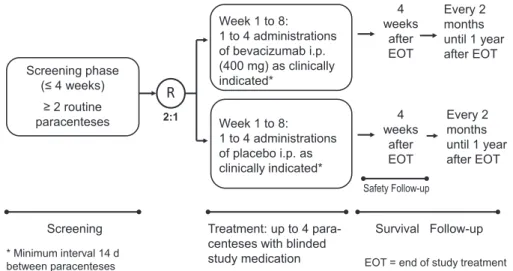
Bevacizumab and placebo medication were manufac-tured centrally, securing blind allocation to the study patients following a concealed, computer-generated randomisation list, in a 2:1 ratio.
period started with the application of the first para-centesis with study medication. The indication for the following paracenteses was assessed by the treating physician as needed for symptom control. With those, up to four intraperitoneal administrations of bev-acizumab (400 mg absolute dose in 100 ml NaCl 0.9%) or placebo with a minimum interval of 14 d following subsequent paracenteses, during a maximum period of 8 weeks were administered, after placement of an intra-peritoneal catheter and removal of the maximum vol-ume of ascites for symptom relief. In case of unacceptable toxicity, treatment was prematurely dis-continued. The following assessments were performed before or after each study paracentesis and 4 weeks thereafter: volume of ascites drained, performance sta-tus, physical examination, body weight, quality of life using the Functional Assessment of Chronic Illness Therapy-Ascites Index (FACIT-AI) questionnaire [8], supportive procedures, urinalysis, haematology, clinical chemistry, activated partial thromboplastintime (aPTT), international normalized ratio (INR), and adverse events. Further puncture-free and overall survival (OS) follow-up took place every 2 months for 1 year.
2.4. End-points and statistical aspects
The first primary end-point was paracentesis-free sur-vival (ParFS), i.e. the time from randomisation to either the second on-study paracentesis or to death, whichever occurred first. Based on results by Heiss et al. [4] the median ParFS in the untreated control group was ex-pected to be approximately 14 d. In order to detect a doubling of this interval to a median of 28 d by bev-acizumab (hazard ratio [HR]: 0.5), a total number of 60 evaluable patients (40 in the experimental group, 20 in the control group, according to the 2:1 randomisation) with their event observed was required with a one-sided type I error of 5% and a power of 80%. In order to allow
for non-evaluable cases or drop-outs, a total of 72 pa-tients were planned to be randomised. A second primary end-point (‘best response’) was defined as the longest paracentesis-free period within the 12-week main observation period.
Secondary study end-points included: number of paracenteses during the 12-week observation period; quality of life; changes in performance status; OS, defined as the time from randomisation until death; rates of adverse events graded according to NCI com-mon toxicity criteria (CTC) V. 3.0. Time-to-event data were analysed by the KaplaneMeier method and
compared using the log-rank test[9]. Other continuous data were compared using the Wilcoxon-Mann-Whitney test. Within-group comparisons between different time points or periods, were performed with the Wilcoxon signed rank test. All tests except for the primary end-points were considered explorative and are two-sided.
2.5. Luminex analysis
Ascites samples were collected from patients at the time of baseline paracentesis and after a median of 2 weeks (range 1e3 weeks) after administration of the first dose
of the study drug with the second routine paracentesis. Samples were centrifuged at 1000 g for 10 min and frozen at a minimum of 20
C until further use. Luminex analyses were performed according to the manufacturer’s instructions by EMD Millipore.
3. Results
3.1. Patient population and screening paracenteses
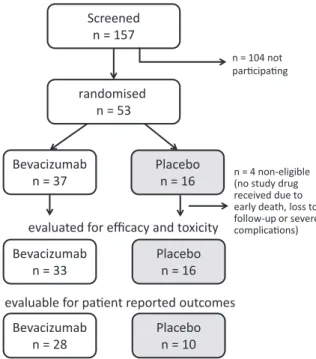
Between June 2010 and July 2013, a total of 157 patients had been screened and 53 patients from 14 institutions in Germany were randomised (Fig. 2). Due to the un-expectedly low rate of patients eventually fulfilling the
Week 1 to 8:
1 to 4 administrations of bevacizumab i.p. (400 mg) as clinically indicated*
Week 1 to 8:
1 to 4 administrations of placebo i.p. as clinically indicated* Screening phase
(≤ 4 weeks) ≥ 2 routine paracenteses
Every 2 months until 1 year after EOT 4
weeks after EOT
Screening
Safety Follow-up
Survival Follow-up Treatment: up to 4
para-centeses with blinded study medication
4 weeks
after EOT
Every 2 months until 1 year after EOT 2:1
R
* Minimum interval 14 d
between paracenteses EOT = end of study treatment
eligibility criteria for randomisation, the study had to be closed for recruitment prematurely. The most frequent reason for non-inclusion was a deterioration of the general condition during screening, followed by failure to gain informed consent, and a too low frequency of paracentesis. Baseline demographic and clinical char-acteristics are described inTable 1. The majority of the
patients had pancreatic cancer. Inevitably, due to the small patient numbers, some imbalances are present between the groups, but paracentesis history parameters were rather equally distributed.
3.2. Treatment exposure
Of the 208 recorded paracenteses during the observation period 55% were followed by the administration of study medication. Twenty percent of the patients received the maximum number of four applications, with rather equal increments of the study population receiving one (bevacizumab/placebo: 30/38%, respec-tively), two (21/25%), three (30/12%) or four applica-tions (18/25%). Premature termination was mainly caused by death (overall: 43%; bevacizumab: 39%, pla-cebo: 50%). Other reasons included withdrawal of con-sent (n Z 1), patient’s request (n Z 2), investigator’s
decision (nZ3), or switching to a non-protocol ascites
treatment (nZ1).
3.3. Efficacy
The median numbers of interventional paracenteses during the study period were 4 (range: 1e17) and 3
(range: 1e8) for bevacizumab or placebo, respectively.
ParFS curves as the primary efficacy criterion are shown inFig. 3A, based on observed events in all of the 49 evaluable patients. There was no major difference between the bevacizumab and the control group with
Screened n = 157
randomised n = 53
Bevacizumab n = 37
Placebo n = 16
evaluated for efficacy and toxicity
evaluable for pa ent reported outcomes Bevacizumab
n = 33
Placebo n = 16
Bevacizumab n = 28
Placebo n = 10
n = 104 not par cipa ng
n = 4 non-eligible (no study drug received due to early death, loss to follow-up or severe complica ons)
Fig. 2. Overview of patient disposition.
Table 1
Baseline characteristics and screening paracenteses.
Category Study arm
Bevacizumab (nZ33) Placebo (nZ16)
Age, median (range) [years] 62 (35e81) 65.5 (46e75)
Gender, female [n (%)] 15 (45) 4 (25)
Cancer type [n (%)]
Cholangiocellular 1 (3) 3 (19)
Colorectal 5 (15) 1 (6)
Gastric 9 (27) 1 (6)
Hepatocellular 1 (3) e
Pancreatic 17 (52) 10 (62)
Unknown primary (Adeno-Ca) e 1 (6)
Time since initial diagnosis of cancer, median [months] 9.9 12.1 Time since initial diagnosis of disseminated disease, median [months] 9.1 11.9
Number of previous antineoplastic regimens, median 2 2
Performance status [n (%)] (missing in three patients)
ECOG 0e1 15 (45) 4 (25)
ECOG 2 12 (36) 9 (56)
ECOG 3 5 (15) 1 (6)
Paracenteses during screening period (4 weeks):
Number, median (range) 2 (1a
e10) 2 (1ae4)
Average interval between paracenteses, median (range) [d] 8 (1.1e17) 8 (3.5e16.3)
Maximum interval between paracenteses, median (range) [d] 10 (2e27) 11.5 (6e27)
Average ascites volume of last two paracenteses, median 3550 3250
ECOG, Eastern Cooperative Oncology Group.
a
ParFS medians of 14.0 d (95% confidence interval [CI]: 11e17 d) and 10.5 d (7e21 d). The HR amounts to 0.74
(95% CI: 0.40e1.37,PZ0.16). Thus, the CI does not
exclude the prospectively anticipated target effect size of HRZ0.5. The ParFS result was clearly dominated
by paracentesis events, as in only eight patients (16%) death occurred first before a second on-study para-centesis. Likewise, the second primary efficacy end-point, ‘best response’, did not show any major benefit in the bevacizumab group, with a mean maximum period without paracentesis of 22.9 d in the bevacizumab arm (median: 19, range: 6e66 d) versus 18.7 d in the placebo
arm (median: 17.5, range 4e42 d; PZ0.85).
In respect to OS the KaplaneMeier estimates suggest
a moderate trend in favour of bevacizumab (HR: 0.73,
95% CI: 0.40e1.37), without reaching statistical
signifi-cance (PZ0.31,Fig. 3B).
3.4. Effect of intraperitoneal bevacizumab treatment on ascites cytokine/chemokine levels
Using Luminex technology, 13 soluble factors were analysed in ascites samples from 22 patients of whom pre- and post-treatment samples were available (Fig. 4A). Overall, no significant changes in cytokine/ chemokine levels were detected. However, in the group treated with bevacizumab we observed 8/16 patients with at least 75% reduced ascites VEGF levels compared to 0/6 patients in the placebo group. Within the patient group treated with bevacizumab we further observed a
0 5 10 15 20 25 30 35 40 45 50
days 0.0
0.2 0.4 0.6 0.8 1.0
rate w
ithout
ev
ent
Paracentesis-free survival by study arm
Logrank test: p = 0.16 (one-sided)
Bevacizumab: n = 33, 33 events, median = 14 days Placebo: n = 16, 16 events, median = 10.5 days
A
0 20 40 60 80 100 120 140 160 180 200
days 0.0
0.2 0.4 0.6 0.8 1.0
survival
rate
Overall survival by study arm
Logrank test: p = 0.31
Bevacizumab: n = 33, 30 events, median = 64 days Placebo: n = 16, 16 events, median = 31.5 days
B
slightly prolonged median ParFS (Fig. 4B) in those pa-tients experiencing at least a 75% reduction in ascites VEGF levels after treatment, compared to patients with more stable VEGF levels.
3.5. Safety
Due to the end-stage cancer status of all patients, a plethora of adverse events were recorded with ques-tionable relation to the study medication. The overall frequency of events of CTC severity grades IIIeV was
not higher under bevacizumab (61%) than in the placebo arm (69%). No case of hypertension was reported in either treatment arm. One serious thromboembolic event was reported in both arms (bevacizumab: 3%; placebo: 6%). Gastrointestinal symptoms occurred more
often in the bevacizumab group, with nausea reported in 45% versus 31%, and vomiting in 36% versus 0%. Almost all of the recorded deaths were caused by pro-gressive tumour disease (96%).
3.6. Patient reported outcomes and supportive procedures
According to the specifications of the FACIT-AI, a summary score was calculated from the 13 items, ranging from 0 (worst) to 52 (best). Assessment of quality of life was inevitably compromised by the major loss process in this highly palliative situation. While 78% of the forms were available at randomisation, the questionnaires for week 8 were available in only 24% of the patients. At baseline, i.e. before the first on-study paracentesis, the total population showed a relevant
Reduced VEGF, n = 8, events = 8, median = 14 days Stable VEGF, n = 8, events = 8, median = 11 days
A
B
deterioration of health status due to ascites, with a median score of 31 with a rather low variability (inter-quartile range: 27e36). All pairwise comparisons of the
FACIT-AI between study weeks 0, 2 and 4 did not indicate any significant difference (allPvalues>0.3), in
both arms as well as in the total population.
4. Discussion
This study is the first to test, in a randomised blinded design, the potential benefit of intraperitoneal adminis-tration of bevacizumab, in order to evaluate this approach as a treatment option for symptom control in the difficult treatment situation of advanced recurrent ascites.
Bevacizumab was chosen as it is known that VEGF plays a decisive roleenot only in angiogenesis but also
in the pathophysiology of malignant ascites, by aug-menting the permeability of microvasculature and of the peritoneal membrane [7,10,11]. In animal models, the expression level in cancer cells was markedly associated with the production of ascites, while VEGF injections increased the permeability of pre-existing small vessels lining the peritoneum. Following promising data on peritoneal influx blocking and impressive ascites re-missions inin vivo models[7], a number of clinical case series provided beneficial results for bevacizumab, especially when given intraperitoneal (i.p.), in patients with ascites secondary to a variety of solid tumours, predominantly ovarian cancer. However, the sample sizes were rather small, ranging from 1e9 patients[7,12].
For the largest series, published in abstract form, El-Shami et al. reported resolution or at least distinctly delayed reaccumulation of ascites in all of the nine pa-tients enrolled, after only one i.p. application of 5 mg/kg bevacizumab[13].
Those results stimulated the prospective and controlled evaluation of i.p. administration in our trial. One hypothesis was that i.p. application should build up the highest concentration of the study drug within the body compartment where malignant ascites is promoted by VEGF secretion. Secondly, it is assumed that i.p. agents are readily absorbed by the peritoneal tumour tissue. Thirdly, this route was likewise successfully used in most pre-clinical animal models[7,14]
The overall median ParFS, based on observed events in all patients, was 13 d for the whole study population (95% CI: 10e15 d). This is in accordance
with the assumed median of 14 d, which formed the basis for the statistical design calculation of the trial. Nevertheless, our observations could not confirm the benefits suggested by the pilot studies, both with respect to the time to the next recurrence event nor to the duration of the subsequent paracentesis. Likewise, no major differences between bevacizumab and pla-cebo could be detected in the secondary clinical or patient-reported outcomes. However, it might be of
interest that we did observe a trend towards an improved event-free survival in those patients evidencing a substantial decrease in VEGF levels in their malignant ascites following bevacizumab treat-ment. A recently published abstract on a retrospective series of 34 patients, without control group, with as-cites secondary to gynaecological or gastrointestinal cancers, suggested some prolongation of ParFS in exsudative but not transudative types of ascites[15].
The poor median survival of about 1e2 months in
our overall population is quite in agreement with the results from other similar patient series, i.e. with the gastric cancer control group, experiencing recurrent punctures, in the randomised catumaxomab trial [4], and with the 3 months counted from first detection of ascites in gastrointestinal cancer patients by Ayantunde et al.[5].
In our study, the far advanced stage of ascites, in combination with the short remaining lifetime, possibly associated to the predominance of pancreatic cancer in our cohort (55%, compared to only 7% in the catu-maxomab study), may have prevented the detection of a meaningful efficacy of the tested agent. Alternatively, the chosen i.p. treatment could be suboptimal in this setting[16]. Meanwhile, more promising results became available from controlled studies on the effect of VEGF-targeting therapies in ovarian cancer. In a randomised study with 55 patients with ascites, i.v. aflibercept, an inhibitor of both VEGF and placental growth factor proved to be superior compared to placebo for the time to repeat paracentesis but with an increased risk of in-testinal perforations [17]. The large randomised AUR-ELIA and GOG 0218 studies on i.v. bevacizumab (which enrolled also patients without ascites) show beneficial progression-free and OS effects in the sub-groups with ascites[18,19]. However, in ovarian cancer, the amount of ascites is comparatively small, especially in the first-line setting, in which the ascites is often detected (and removed) during surgery. In addition, bevacizumab was given in combination with newly-introduced chemotherapy.
A general drawback is the lack of standard defini-tions of end-points in this disease setting, and their subjectivity and variability between investigators. Un-fortunately, the number of samples available for extended translational analysis was limited. Neverthe-less, there is some hint of a correlation of reduced ascites VEGF level development in the bevacizumab group, and slightly prolonged ParFS.
Funding
This work was sponsored by AIO-Studien-gGmbH (AIO grant number: AIO SUP 801), and supported by an unconditional grant from Roche Pharma AG, Ger-many (grant number: ML22294).
Conflict of interest statement
The authors have following conflict of interests to disclose:
KJ: Consulting or advisory role (Merck, MSD and Helsinn, Tesaro).
T.K.: Nothing to disclose. CG: Nothing to disclose.
BK: Research funding (Roche, Novartis), travel cost reimbursement (Teva, Lilly, Roche, Boehringer Ingelheim).
DArnold: Consulting or advisory role (Roche, Fre-senius Biotech, Merck Serono, Bayer Healthcare, Amgen).
AH: Honoraria (Roche).
MS: Honoraria (Amgen, Celgene), consulting or advisory role (MSD), travel cost reimbursement (Amgen).
WF: Nothing to disclose.
JR: Consulting or advisory role (Roche), speakers’ bureau (Sanofi Aventis).
DAtanackovic: Speakers’ bureau (Celgene, Onyx, Millennium).
SHB: Consulting or advisory role (Roche).
Acknowledgement
The authors acknowledge and thank Anja Klein (GSO, Hamburg) for the support in monitoring and management of the study data.
References
[1] Smith EM, Jayson GC. The current and future management of malignant ascites. Clin Oncol 2003;15:59e72.
[2] Walton L, Nottingham JM. Palliation of malignant ascites. J Surg Educ 2007;64:4e9.
[3] Rosenberg SM. Palliation of malignant ascites. Gastroenterol Clin North Am 2006;35:189e99.
[4] Heiss MM, Murawa P, Koralewski P, Kutarska E, Kolesnik OO, Ivanchenko VV, et al. The trifunctional antibody catumaxomab for the treatment of malignant ascites due to epithelial cancer:
results of a prospective randomized phase II/III trial. Int J Cancer 2010;127:2209e21.
[5] Ayantunde AA, Parsons SL. Pattern and prognostic factors in patients with malignant ascites: a retrospective study. Ann Oncol 2007;18:945e9.
[6] Becker G, Galandi D, Blum HE. Malignant ascites: systematic review and guideline for treatment. Eur J Cancer 2006;42:589e97.
[7] Kobold S, Hegewisch-Becker S, Oechsle K, Jordan K, Bokemeyer C, Atanackovic D. Intraperitoneal VEGF inhibition using bevacizumab: a potential approach for the symptomatic treatment of malignant ascites? Oncologist 2009;14:1242e51.
[8] Cella D, Neubauer N, Thomas J, Kutner J, Seiden MV. The FACIT-AI, a new tool for assessing symptoms associated with malignant ascites. Gynecol Oncol 2013;128:187e90.
[9] Peto R, Peto J. Asymptotically efficient rank invariation test procedures (with discussion). J R Stat Soc A 1972;135:185e206.
[10] Nagy JA, Herzberg KT, Dvorak JM, Dvorak HF. Pathogenesis of malignant ascites formation: initiating events that lead to fluid accumulation. Cancer Res 1993;53:2631e43.
[11] Kipps E, Tan DSP, Kaye SB. Meeting the challenge of ascites in ovarian cancer: new avenues for therapy and research. Nat Rev Cancer 2013;13:273e82.
[12] Fushida S, Oyama K, Kinoshita J, Yagi Y, Okamoto K, Tajima H, et al. VEGF is a target molecule for peritoneal metastasis and malignant ascites in gastric cancer: prognostic significance of VEGF in ascites and efficacy of anti-VEGF monoclonal antibody. Onco Targets Ther 2013;6:1445e51.
[13] El-Shami K, Elsaid A, El-Kerm Y. Open-label safety and efficacy pilot trial of intraperitoneal bevacizumab as palliative treatment in refractory malignant ascites. J Clin Oncol 2007;25(Suppl.): 9043.
[14] Imaizumi T, Aoyagi K, Miyagi M, Shirouzu K, Dreyer C, Faivre SJ, Raymond E. Suppressive effect of bevacizumab on peritoneal dissemination from gastric cancer in a peritoneal metastasis model. Surg Today 2010;40:851e7.
[15] Mateescu C, Becq A, Bouattour M, Dreyer C, Faivre SJ, Raymond E, et al. Bevacizumab administered intraperitoneally as palliative treatment of malignant refractory ascites. J Clin Oncol 2014;32(Suppl.):e20617.
[16] Woopen H, Sehouli J. Current and future options in the treatment of malignant ascites in ovarian cancer. Anticancer Res 2009;29: 3353e60.
[17] Gotlieb WH, Amant F, Advani S, Goswami C, Hirte H, Provencher D, et al. Intravenous aflibercept for treatment of recurrent symptomatic malignant ascites in patients with advanced ovarian cancer: a phase 2, randomised, double-blind, placebo-controlled study. Lancet Oncol 2012;13:154e62.
[18] Pujade-Lauraine E, Hilpert F, Weber B, Reuss A, Poveda A, Kristensen G, et al. Bevacizumab combined with chemotherapy for platinum-resistant recurrent ovarian cancer: the AURELIA open-label randomized phase III trial. J Clin Oncol 2014;32: 1302e8.