Comparison of effects of finger kazoo and tube
phonation techniques in women with normal voice
Comparação dos efeitos do
finger kazoo
e da fonação em tubo
em mulheres com voz normal
Carla Aparecida Cielo1, Joziane Padilha de Moraes Lima1, Mara Keli Christmann2
ABSTRACT
Purpose: To compare the voice before and after the finger kazoo and
phonation into a glass tube immersed in water in women without vocal complaints or laryngeal affections. Methods: Forty-six women
partici-pated of the group that performed the finger kazoo and 12 of the group performed the phonation into a glass tube immersed in water. It was collected the vowel /a:/, before and after the techniques, for acoustic analysis through the Multi-Dimensional Voice Program Advanced and the Real Time Spectrogram; and auditory perceptual with RASATI scale. The techniques were performed on three series of the 15 repetitions, with 30 seconds of rest between them. Results: In comparison, phonation into a glass tube immersed in water showed significant improvement: definition of the first formant, subharmonic presence, smoothed pitch perturbation, variation of f0 and voice turbulence index; and the finger kazoo showed a significant reduction in the standard deviation of f0. The auditory perceptual analysis had no significant difference between groups. Conclusion: In comparison, phonation into a glass tube immer-sed in water provided more noticeable improvement in acoustic vocal aspects related to resonance, noise and stability than the finger kazoo.
Keywords: Voice; Voice quality; Voice training; Larynx; Speech acoustic
RESUMO
Objetivo: Comparar voz antes e após a execução do finger kazoo e de
fonação em tubo de vidro imerso em água, em mulheres sem queixas vocais e com laringes sem alterações. Métodos: Participaram 46
mu-lheres no grupo que realizou a técnica finger kazoo e 12, no grupo que realizou a técnica de fonação em tubo de vidro imerso em água. Cole-tou-se a vogal /a:/, antes e imediatamente após a realização das técnicas, para análises acústicas, por meio do Multi-Dimensional Voice Program Advanced e do Real Time Spectrogram,epara análise perceptivo-audi-tiva, com a escala RASATI. As técnicas foram realizadas em três séries de 15 repetições, com repouso de 30 segundos entre elas. Resultados:
Quando comparados os métodos, a fonação em tubo de vidro imerso em água mostrou melhora significativa da definição do primeiro formante, da presença de sub-harmônicos, do quociente de perturbação do pitch
suavizado, da variação da frequência fundamental (f0) e do índice de turbulência da voz. O finger kazoo apresentou redução significativa do
desvio padrão da f0. Na análise perceptivo-auditiva, não houve diferença significativa entre os grupos. Conclusão: A fonação em tubo de vidro
imerso em água proporcionou melhora mais perceptível nos aspectos vocais acústicos relacionados à ressonância, ruído e estabilidade, do que o finger kazoo.
Descritores: Voz; Qualidade da voz; Treinamento da voz; Laringe; Acústica da fala
Research developed at Post-Graduation Program in Human Communication Disorders, Universidade Federal de Santa Maria – UFSM – Santa Maria (RS), Brazil. (1) Hearing, Speech and Language Department, Post-Graduation Program in Human Communication Disorders, Universidade Federal de Santa Maria – UFSM – Santa Maria (RS), Brazil.
(2) Hearing, Speech and Language Department, Associação Educacional Luterana Bom Jesus – IELUSC – Joinville (SC), Brazil.
Funding: Coordenação de Aperfeiçoamento de Pessoal de Nível Superior (CAPES), Fundação de Amparo à Pesquisa do Estado do Rio Grande do Sul (FAPERGS).
Conflict of interest: No
Authors’ contribution: CAC, project preparation and correction, guidance in data collection and analysis, manuscript writing and correction; JPML and MKC, project preparation, data collection, analysis and tabulation, and manuscript writing.
Corresponding autor: Mara Keli Christmann. E-mail: [email protected]
INTRODUCTION
In vocal production, the vocal source and filter alter acoustic impedance, because of changes in physiological configurations of the vocal tract. So, both levels interfere with each other(1,2,3,4).
In phonotherapy, the increase of vocal tract impedance may occur in case of constriction or stretching. Constriction and discrete stretching occur in vocal exercises related to anterior constriction with semi-occluded lips, such as the finger kazoo (FK) technique. Higher artificial stretching may happen throu-gh phonation into resonance tubes with different lengths and diameter, such as phonation into glass tube immersed in water (FTVIA)(1,2,5,6,7,8,9,10,11,12,13,14,15).
Literature mentions several effects produced by training with these exercises with semi-occluded vocal tract (ESOVT). Among the effects, there are: reduction of phonatory pressure and of glottic airflow, increase of harmonic energy, changes in glottic aerial pulse way and in oscillatory characteristics of vocal folds, increment of sound pressure, and increase of vocal tract vibrations perception(2,14,15,16). Another study
verifies decrease in the first formant (F1) frequency. It would cause easier phonation, because of reduction of phonation threshold pressure and decrease of transglottic airflow, pro-ducing a voice full of harmonics. The ESOVT are used in therapy and improvement of speaking and sung voice, and also in cases of functional dysphonia (hyper and hypofunc-tional), organic (recurrent laryngeal nerve paralysis) and organofunctional(8,11).
FK is produced with narrow vocal tract constriction, lips semi-occlusion and airflow block with the index finger vertically positioned in front of the lips(2,9). It is practiced
with extended pharynx, relaxed tongue and mandible and protruding and rounding lips, by prolonging a voiced blowing, similar to the /u/ vowel. It generates a secondary sound, be-cause of the contact between the airflow and the index finger, such as beetles’ sounds, requiring proper air support to be maintained(2,9). In FTVIA for hyperfunctional cases, the tube
distal extremity should be immersed 2 cm into an acrylic recipient with water and, in the proximal extremity(10,17), as
well as FK, it should be emitted voiced blowing with the /u/ vowel(2,9).
Although both techniques are classified as ESOVT, the performance of each technique and the mechanisms of vocal tract semi-occlusion are different. Thus, it seems not to be correct to generalize their effectiveness. As literature is still precarious about such techniques(1,2,9,10,14,15,17,18) and there is
only one study(2) which compares the techniques, it is important
to verify their effects and to compare them, to provide more accurate indication to patients.
In relation to FK, previous studies investigated the immedia-te effects of its performance in women with normal voice(2,9,19,20).
Three of them performed investigation through three series of 15 repetitions(9,19,20). The first one evidenced significant increase
of fundamental frequency, improve of amplitude variation (AV) and degree of subharmonics (DSH)(9). The second one,
presen-ted significant increase of modal sound pressure level(19). The
last one, through spectrographic acoustic analysis, presented significant improvement of second, third and fourth formants, as well as of high frequencies. It presented also significant improvement of the definition of the second and third formants and of the harmonics, as well as gains in tracing regularity. In some aspects, they were maintained five minutes after the end of the exercised performance(20).
In relation to the comparison with ESOVT, a pioneer study compared the FK effects with the technique of phonation into tubes of lower diameter, showing that both methods improved vocal self-perception and reduction of fundamental frequency, but the perceptive-auditory evaluation indicated positive effects only in phonation into tubes(2).
The number of published articles about phonation into tubes has increased, and it may be verified that this technique pro-vides positive results in several aspects related to voice(7,9,14,15).
A research investigated the immediate effect of a sequence of four exercises with phonation into tube (22.8 cm length and 3 mm diameter), performed with the following variations: usual pitch and loudness and with a melody into the tube. It was found significant difference in the parameters Cepstrum, Jitter, Shimmer and harmonics-to-noise ratio (HNR), between the
moments before and after exercises. There was also prevalence of positive vocal sensations(7).
The immediate FTVIA effects were also researched with 25 dysphonic teachers, who performed the technique in a series of 10 repetitions, with immerse tube of 2 cm. Most of them mentioned sensation of better phonatory comfort and improve-ment of vocal quality, after performing the technique. In the perceptive-auditory vocal analysis, there was improvement of vocal instability in the samples of counting numbers, as well as reduction of sub harmonics, of noise in high frequencies and of f0(14).
The technique effectiveness was studied with 42 elderly subjects, both genders, who performed the following emis-sions into the tube: prolonged /b/, /u/ vowel, ‘jjjuu’, ‘jjjiibbuu’, ‘jjiibbiiuu’ and the melody of the song ‘happy birthday’. It was used glass tubes from 8 mm to 9 mm of diameter and from 25 cm to 26 cm of length, immersed 5 cm into water. The therapy, lasting one hour, was performed once a week, for six weeks. There was significant improvement in all parameters of the vocal perceptive-auditory GRBASI scale, with exception of soprosity. In the vocal self-perception, most subjects reported decrease of complaints and symptoms and, in spirometry, there was significant increase of values(15).
METHODS
This is an observational, cross-sectional, analytical, con-temporary and quantitative research, approved by the Ethics Committee from Universidade Federal de Santa Maria
(UFSM), Brazil, (number 016945/2010-76). All participants were informed about the study and signed the Free and Clarified Consent Term. The target population consisted of adult women, who participated in lectures about vocal health, from cam-paigns of Voice Day. They were invited, in case of interest, to evaluation in a Speech, Language and Hearing Sciences school clinic and, subsequently, to perform the evaluation and voice improvement.
To select the subjects, the following inclusion criteria were established: consent term signature; to be a female; aged from 18 to 40 years old (excluding, so, the period of voice changes in adolescence and hormonal alterations which occur with women, mainly after they are 40 years old, as well as laryngeal and vocal changes caused by aging process(21,22)); absence of
la-ryngeal affections, according to otorhinolaryngological (ORL) evaluation and vocal complaints(9,20,21,22,23).
The exclusion criteria were: report of neurological, psychia-tric, gastric chronic, respiratory chronic, endocrinological diseases or other systemic diseases, which could alter vocal performance or understanding of orders during the evalua-tions(9,10,20,21,22,23); flu or respiratory allergies in the data collection
day(9,10,20,22); vocal complaints, which could signalize organic and/
or functional vocal dysfunction(20,21); history of laryngeal surgery
and/or any surgical procedure of head or neck(10); hormonal
alterations caused by pregnancy or menstrual or pre-menstrual period, in the collection day, as they might alter vocal parame-ters; to be a smoker or alcoholic, because these are risk factors to develop laryngeal affections(9,10,20,22); to be a subject who has
already performed previous Speech, Language and Hearing and/ or ORL treatment, excluding the possibility of presenting any vocal disorder or conditioning by training phono therapeutic techniques; knowledge about the used vocal techniques; hearing alterations, not to undermine self-monitoring of voice; presence of stomatognathic system alterations, which could interfere with the technique performance, or with voice evaluation(9,10,20,22).
For all the volunteers, it was applied a questionnaire, with information related to the mentioned criteria. It was performed ORL evaluation with laryngoscopy, in order to discard laryngeal affections, as well as evaluation of the stomatognathic system and audiometric screening (frequencies of 500, 1000, 2000 and 4000 Hz in 25 dB). The subjects who presented alterations in any of the evaluated aspects were excluded from the research and they were referred to more complete evaluations.
Both study groups (FTVIA and FK) were selected from two different research projects. One of them aims at verifying the FTVIA effects, and the other, the FK effects. Both researches occurred in different moments, but with identical methodo-logy of data collection (with difference only in the chosen
technique). For this reason, they presented different sizes, with different subjects in each group, with no necessity of matching the numbers, because both groups were independent(24).
For the FK data collection, there were 56 volunteers. Ten of them were excluded, one because of menstrual period, one who is a singer, one because she presents vocal folds edema, one because she demonstrated microweb, one with vocal fur-row, one with vocal nodules, one with hearing loss, and three of them did not attend all the evaluations, resulting a group of 46 women (GFK).
For the FTVIA technique collection, there were 16 volun-teers. Four of them were excluded because they presented la-ryngeal affections, one was excluded because of pre-menstrual period and one was a smoker, resulting in a group of 12 women (GFTVIA).
The volunteers of both groups were blinded in relation to the purposes of the initial researches and the data collection started in acoustically treated environment, with noise level lower than 50 dB, measured through sound pressure gauge (Instrutherm®, Dec- 480)(9,10,19,20,22). They remained in
orthos-tatic position and they emitted the vowel /a:/ in usual pitch and loudness for, at least, four seconds. The vocal emissions were recorded through digital recorder by Zoom®, model H4n
(stereo microphone, unidirectional, 96 kHz, 16 bits, 50% of the entrance signal recording level), at an angle of 90º from the mouth(24) and distance of 4 cm from the microphone to the
mouth(9,10,19,20,22). The same emission was collected immediately
after the performance of each technique.
The GFK participants were instructed to produce voiced blowing, emitting the /o:/ sound in usual loudness and pitch, without inflating the cheeks, with tongue in low position and relaxed, and the index finger in vertical position, touching the lips, without pressing them, such as in the gesture to ask for silence. During this production, it should occur a secondary friction sound, corresponding to the airflow in contact with the index finger(2,9,19,20).
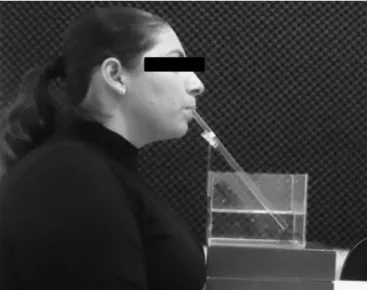
To perform the FTVUA, the recipient size was standardized (12 cm width, 12 cm depth, 15 cm length), filled with water up to 9 cm height. In order to maintain the participants’ correct posture, the recipient was adjusted (elevated) according to each participant’s height, so the tube could be in the lips level and they did not need to bend forward during the technique perfor-mance(14). A holder was adapted, also, from the glass tube to
the water recipient, so the angle between the tube and the chin remained the same for all the participants, during the technique performance. The tube remained fixed to the support, with the distal tip submerged 2cm from the surface(1,10) and previously
marked on the tube, according to Figure 1.
The GFTVIA subjects were instructed to put the proximal extremity of the tube (glass tube, 27 cm length, 1 mm thickness and 9 mm diameter)(5,10,12,20,21) between the lips and to produce
Each emission of both techniques was performed up to the expiration end, without increasing muscular contraction of the shoulder girdle and of the suprahyoid region and in usual pitch and loudness. These aspects were visually monitored by the researchers, during data collection, as well as the perfor-mance of the technique, in correct and standardized way, for all volunteers(9,10,20).
The techniques were performed in three series of 15 re-petitions and, between each series, there was passive rest of 30 s, when the volunteers remained in the same position, in silence(9,10,20,25). Along the time of technique performance, the
women could ingest up to 250 ml of water(9,10,19,20), without
intervening in the results, because systemic hydration takes some hours to reach the larynx(9,10,19,20).
For the voice acoustic analysis, it was omitted the vocal attack of the /a:/ production and, from this moment, the time of 3.5 s was considered as pattern for the analysis window, discarding the rest(2,9,10,19,20).
The voices were analyzed through the program
Multi-Dimensional Voice Program Advanced (MDVPA), by Kay
PENTAX®, with sample index of 44 kHz and 16 bits, extracting
several measures, grouped according to the analyzed phenom-enon: fundamental frequency measures: f0; f0 high (fhi); f0 low (flo); f0 standard deviation (STD); frequency perturbation measures: absolute jitter (Jita); Jitter percent (Jitt); relative av-erage perturbation (RAP); pitch perturbation quotient (PPQ); smoothed pitch perturbation quotient (sPPQ); coefficient of f0 variation (vf0); measures of amplitude variation: dB shimmer (ShdB); shimmer percentual (Shim); amplitude perturbation quotient (APQ); smoothed amplitude perturbation quotient (sAPQ); Amplitude Coefficient of Variation (vAm); noise measures; noise-to-harmonics ratio (NHR); voice turbulence index (VTI); soft phonation index (SPI); voice breaks measures: degree of voice breaks (DVB); number of voice breaks (NVB); measures of unvoiced segments: number of unvoiced segments (NUV); degree of unvoiced segments (DUV); measures of
subharmonic segments: degree of subharmonic segments (DSH); number of subharmonic segments (NSH)(9,10,22).
It was also performed the perceptive-auditory analysis, through the RASATI scale, based on the production of the vowel /a:/. The judges of each group received the randomized voices on a CD and they were guided to listen to the recordings through headsets, as many times as they needed, in silent environment.
For the spectography, it was used the program Real Time Spectrogram by Kay PENTAX®, in broadband filter: 100 points
(646 Hz) and in narrowband filter: 1024 points (63.09 Hz), with sampling rate of 11 kHz and 16 bits(9,10,20,22).
In the analysis of the broadband filter (EBL), it was con-sidered the following aspects: darkening of the formants F1, F2, F3, F4 tracing; darkening of the high frequencies tracing; darkening of the tracing of all spectography; presence of noise in all vocal spectography, as well as in the high frequencies; definition of tracings F1, F2, F3 and F4; tracing regularity(9,10,20).
In the analysis of the narrowband filter (EBE), the follow-ing aspects were considered: darkenfollow-ing of high frequencies tracing; darkening of tracing of all vocal spectography; pres-ence of noise in all the vocal spectography, as well as in the high frequencies; definitions of the harmonic tracing; tracing regularity(9,10,20).
The spectrographic analysis was performed by three speech, hearing and language therapists for each group of techniques, using specific protocol(9,10,20). The EBL and the EBE were
pre-sented to the judges in pairs (before and after the performance of the techniques). Thus, the evaluation was performed com-paring the first and the second spectrography(4,20). All the pairs
were randomized and, then, it was performed the reliability calculation through the Kappa coefficient(20).
All the judges who participated in the study were blinded in relation to the purposes and methodology of the study and all of them presented experience of, at least, five years in the area of voice(9,10,20,22). The results were tabulated and were treated
through the Mann-Whitney U test, to compare the effects of both techniques. The statistical analysis of the reliability among evaluators was performed through the Kappa coefficient.
RESULTS
For the perceptive-auditory evaluation, the reliability among evaluators resulted in 0.20 for the GFK and 0.31 for the GFTVIA and, in the spectrographic evaluation, the relia-bility among evaluators was 0.2 in the GFK and 0.35 in the GFTVIA(10,18).
DISCUSSION
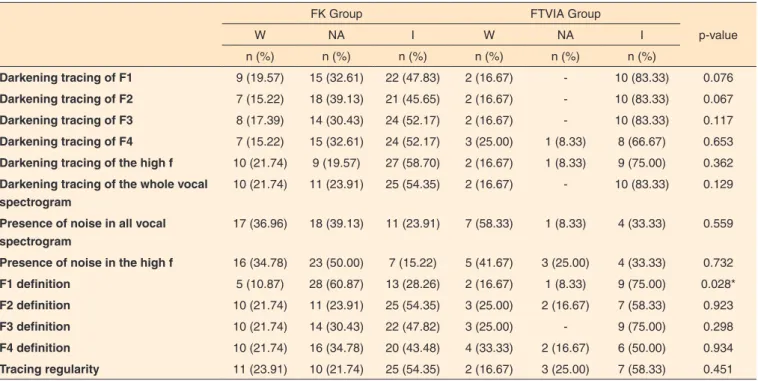
In relation to the results of the research, there was higher F1 definition in the GFTVIA (Table 1). As the ‘Fs’ are more directly related to the vocal filter, these results suggest that the FTVIA causes more modifications in this region, when compared with
Table 1. Comparison of the broadband spectogram between the groups finger kazoo and phonation into glass tube immersed in water
FK Group FTVIA Group
p-value
W NA I W NA I
n (%) n (%) n (%) n (%) n (%) n (%)
Darkening tracing of F1 9 (19.57) 15 (32.61) 22 (47.83) 2 (16.67) - 10 (83.33) 0.076
Darkening tracing of F2 7 (15.22) 18 (39.13) 21 (45.65) 2 (16.67) - 10 (83.33) 0.067
Darkening tracing of F3 8 (17.39) 14 (30.43) 24 (52.17) 2 (16.67) - 10 (83.33) 0.117
Darkening tracing of F4 7 (15.22) 15 (32.61) 24 (52.17) 3 (25.00) 1 (8.33) 8 (66.67) 0.653
Darkening tracing of the high f 10 (21.74) 9 (19.57) 27 (58.70) 2 (16.67) 1 (8.33) 9 (75.00) 0.362
Darkening tracing of the whole vocal spectrogram
10 (21.74) 11 (23.91) 25 (54.35) 2 (16.67) - 10 (83.33) 0.129
Presence of noise in all vocal spectrogram
17 (36.96) 18 (39.13) 11 (23.91) 7 (58.33) 1 (8.33) 4 (33.33) 0.559
Presence of noise in the high f 16 (34.78) 23 (50.00) 7 (15.22) 5 (41.67) 3 (25.00) 4 (33.33) 0.732
F1 definition 5 (10.87) 28 (60.87) 13 (28.26) 2 (16.67) 1 (8.33) 9 (75.00) 0.028*
F2 definition 10 (21.74) 11 (23.91) 25 (54.35) 3 (25.00) 2 (16.67) 7 (58.33) 0.923
F3 definition 10 (21.74) 14 (30.43) 22 (47.82) 3 (25.00) - 9 (75.00) 0.298
F4 definition 10 (21.74) 16 (34.78) 20 (43.48) 4 (33.33) 2 (16.67) 6 (50.00) 0.934
Tracing regularity 11 (23.91) 10 (21.74) 25 (54.35) 2 (16.67) 3 (25.00) 7 (58.33) 0.451
*Significant values with higher scores in the FTVIA group (p<0.05) – Mann-Whitney’s U test
Subtitle: FK = finger kazoo; FTVIA = phonation into glass tubes immersed in water; W = worsening; NA = no alterations; I = improvements; f = frequency
Table 2. Comparison of narrowband spectrogram between the finger kazoo group and phonation into tubes immersed in water
FK Group FTVIA Group
p-value
W NA I W NA I
n (%) n (%) n (%) n (%) n (%) n (%)
Darkening tracing of the high f 9 (19.57) 13 (28.26) 24 (52.17) 2 (16.67) 4 (33.33) 6 (50.00) 0.983
Darkening tracing of the whole vocal spectrogram
8 (17.39) 17 (36.96) 21 (45.65) 2 (16.67) - 10 (83.33) 0.064
Presence of noise among the harmonics 15 (32.61) 24 (52.17) 7 (15.22) 7 (58.33) 3 (25.00) 2 (16.67) 0.228
Presence of noise in the high f 15 (32.61) 25 (54.35) 6 (13.04) 5 (41.67) 5 (41.67) 2 (16.67) 0.750
Substitution of harmonics by noise in all vocal spectrogram
7 (15.22) 22 (47.83) 17 (36.96) 5 (41.67) - 7 (58.33) 0.106
Substitution of harmonics by noise in the high f
4 (8.70) 25 (54.35) 17 (36.96) 6 (50.00) - 6 (50.00) 0.298
Harmonics definition 12 (26.09) 9 (19.57) 25 (54.35) 2 (16.67) - 10 (83.33) 0.118
Tracing regularity 9 (19.57) 14 (30.43) 23 (50.00) 2 (16.67) 3 (25.00) 7 (58.33) 0.635
Number of harmonics 15 (32.61) 9 (19.57) 22 (47.83) 3 (25.00) - 9 (75.00) 0.190
Presence of subharmonics 2 (4.35) 40 (86.96) 4 (8.70) - 8 (66.67) 4 (33.33) 0.005*
*Significant values with higher scores in the FTVIA group (p<0.05) – Mann-Whitney’s U test
Subtitle: FK = finger kazoo; FTVIA = phonation into glass tubes immersed in water; W = worsening; NA = no alterations; I = improvements; f = frequency
the FK technique. Literature shows that F1 is related to mouth opening and tongue height in the oral cavity, and, in general, the formants are regions of amplitude increase of some groups of harmonics, associated with vocal resonance(21,23).
In two case studies which used phonation into glass tube and computed tomography to verify vocal tract changes, it was observed elevation of the velum and of the tongue posterior region, during and after technique performance. Besides, the
technique increased the vocal tract space and expanded the transversal areas of the oropharynx and of the oral cavity, after the performance(12,18). One of the studies(18) found, as acoustic
evaluation result, increase of sound pressure in the singer’s for-mant region after the technique, evidencing that the technique provides changes in the ‘Fs’
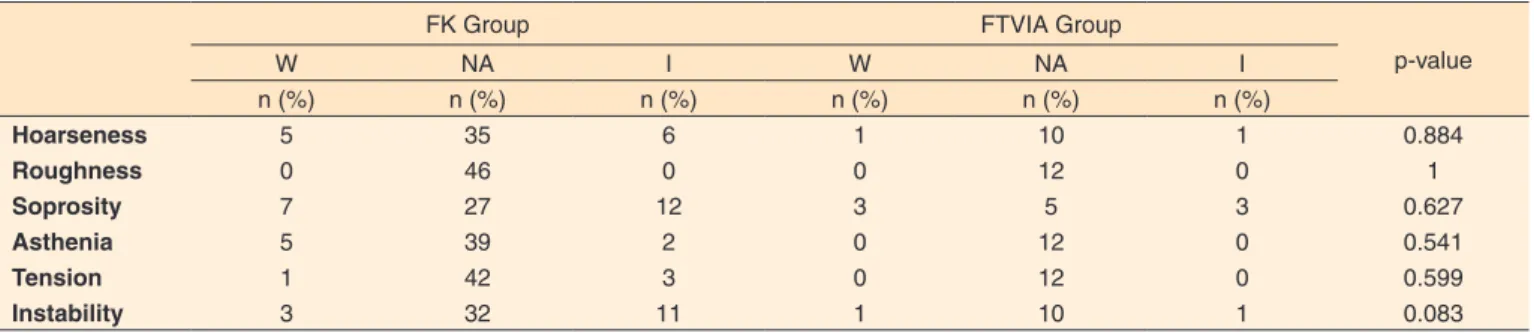
Table 3. Comparison of the perceptive-auditory vocal evaluation (RASATI) between the groups finger kazoo and phonation into tubes immersed in water
FK Group FTVIA Group
p-value
W NA I W NA I
n (%) n (%) n (%) n (%) n (%) n (%)
Hoarseness 5 35 6 1 10 1 0.884
Roughness 0 46 0 0 12 0 1
Soprosity 7 27 12 3 5 3 0.627
Asthenia 5 39 2 0 12 0 0.541
Tension 1 42 3 0 12 0 0.599
Instability 3 32 11 1 10 1 0.083
Mann-Whitney’s U test (p<0.05)
Subtitle: FK = finger kazoo; FTVIA = phonation into glass tubes immersed in water; W = worsening; NA = no alterations; I = improvements
Table 4. Comparison of the vocal acoustic analysis with glottic source (MDVPA) between the groups finger kazoo and phonation into tubes im-mersed in water
FK Group FTVIA Group
p-value Average of total gain (before
and after technique) n
Average of total gain (before and after technique) n
f0 7.325 46 2.793 12 0.318
Fhi 8.291 46 -3.534 12 0.0653
fl0 2.466 46 6.960 12 0.672
STD -42.295 46 -1.271 12 0.039*
Jita 3.189 46 -11.479 12 0.172
Jitt 0.101 46 -0.263 12 0.124
RAP 0.058 46 -0.158 12 0.124
PPQ 0.074 46 -0.146 12 0.111
sPPQ 0.101 46 -0.302 12 0.028**
vf0 0.308 46 -0.656 12 0.023**
ShdB -0.032 46 -0.032 12 0.946
Shim -0.351 46 -0.342 12 0.938
APQ -0.273 46 -0.272 12 0.672
SAPQ -0.499 46 -397.212 12 0.551
vAm -1.61 46 -2.202 12 0.908
NHR -0.007 46 -0.027 12 0.089
VTI 0.667 46 -0.011 12 0.036**
SPI 0.733 46 -2.117 12 0.077
DVB 0 46 -0.086 12 0.050
DSH -0.353 46 -0.285 12 0.345
DUV 0.115 46 -0.467 12 0.342
NVB 0 46 -0.083 12 0.050
NSH -0.456 46 -0.333 12 0.308
NUV 0.152 46 -0.583 12 0.356
Mann-Whitney’s U test (p<0.05)
*Significant values with higher scores in the FK group ** Significant values with higher scores in the FTVIA group
Subtitle: FK = finger kazoo; FTVIA = phonation into glass tube immersed in water; f0 = fundamental frequency; Fhi = high f0; flo = low f0; STD = f0 standard deviation; Jita = absolute Jitter; Jitt = percentual or relative Jitter; RAP = relative average perturbation of the frequency; PPQ = pitch perturbation quotient; sPPQ = smoothed pitch perturbation quotient; vf0 = fundamental frequency variation; ShdB = absolute Shimmer or in dB; Shim = percentual or relative Shimmer; APQ = amplitude perturba-tion quotient; sAPQ = smoothed amplitude perturbaperturba-tion quotient; vAm = amplitude variaperturba-tion coefficient; NHR = noise-to-harmonics ratio; SPI = soft phonaperturba-tion index; VTI = voice turbulation index; DVB = degree of voice breaks; NUV = number of unvoiced segments; DUV = degree of unvoiced segments; NVB = number of vocal breaks; NSH = number of subharmonic segments; DSH = degree of subharmonics segments
subjects, of both groups, did not present alterations. Generally speaking, the GFTVIA evidenced more parameters with im-provements than the GFK (Table 2). A study(16) with FTVIA
performed with teachers demonstrated reduction of instabili-ty, in subharmonics and noise of high frequencies, after the
study, agrees with literature, showing that both used ESOVTs favor the vibration of the vocal folds, providing more periodi-city, justifying the findings(1,2,9,10,19,20).
However, using EBE, a research(20) with FK did not present
difference in relation to the parameter subharmonic, after the technique. The same was observed in another study(10) with
FTVIA, in which it was not evidenced significant differences regarding subharmonic presence, after the technique perfor-mance. Such fact highlights the importance of performing more studies using these techniques and with different populations, because the investigations findings presented discrepancies and, thus, it is still not possible to claim which are the exact changes caused by the techniques.
In relation to the vocal perceptive-auditory aspects, the FTVIA research evidenced significant soprosity improvement(10),
while another recent study(15), performed with elderly people
evidenced improvement in most parameters of the GRBASI scale, except soprosity. The global degree of alteration presented significant improvements. Another finding of this research, using the same technique, performed in three series of 10 repetitions in teachers with behavioral dysphonia, was the significant improve-ment of the general degree of disphonia, in 60% of the subjects(14).
A study(20) with FK presented decrease of vocal instability,
immediately after the performance of the technique, maintai-ning the result after five minutes of rest. It suggests that FK generates higher stability. In this study, one group did not de-monstrate higher perceptive-auditory changes than the other one (Table 3), possibly because both techniques are ESOVTs, which improve the vocal folds vibration, providing higher periodicity and stability, with decrease of aperiodic energy(1,2,9,10,20).
The results of both researches(9,10), which emphasized
perceptive-auditory improvements after FK and FTVIA, in-dividually, confirm the fact that both techniques, which are ESOVTs, generate perceptive-auditory vocal improvements and, for this reason, there was no significant difference between them, in the present study. On the other hand, a study showed differences in the perceptive-auditory evaluation between FK and phonation into tubes with lower diameter, in women wi-thout vocal complaints. It evidences improvement only after the performance of phonation into tubes. The techniques were performed for only one minute, twice in each participant, with interval of five minutes between them, always in the following order: FK, phonation into straw, phonation into straw and FK(2).
Possibly, the absence of improvement after FK is related to the time of technique performance.
In the present study, there was significant difference in the f0 standard deviation (STD), between the GFK and the GFTVIA (Table 4), with higher reduction of this measure after the FK technique, demonstrating higher stability. It agrees with the perceptive-auditory improvement found for FK, in another investigation(9).
Other measures analyzed by the Multi Dimension Voice Program Advanced (MDVPA), such as smoothed pitch
perturbation quotient (sPPQ), f0 variation (vf0) and voice turbulence index (VTI) presented significant reduction in the GFTVIA, when compared with the GFK (Table 4). These re-sults agree with the only similar study which compared FK and phonation into tube, but the tube was not immersed into water and it had lower diameter. It found similar acoustic results(2).
In an investigation(5) which compared phonation into tubes
with different sizes and bilabial fricative production, the re-sults showed that the relationship between the activities of the thyroarythenoid and crico-arytenoid muscles, using a 30 cm tube, was significantly higher during and after the exercise. It suggests that the activity of the thyroarythenoid increases, as the intraoral pressure raises, a result of the vocal tract semi--occlusion. It may explain the fact that most the improvements of this research happened with the GFTVIA, reinforcing the results of another study(11), in which it was performed
electro-glottography – high speed images of the vocal folds – with a rigid endoscope (high speed) and air pressure average during the performance of the technique phonation into plastic tubes (2 cm of diameter and 30, 60 and 100 cm of length), with three subjects who performed the technique in the three tubes.
With the longest tube, there was higher f0 reduction, the time of glottic cycle closed phase was lower, the subglottic pressure was higher and the amplitude of the electroglottogra-phic (EGG) signal was lower, when compared with the shorter tube. It suggests that longer tubes require more effort and more activities of the expiratory muscles.
In the present study, the FTVIA presented improvements in more aspects than the FK technique. However, there is the necessity of more studies, because some results from literature still differ between the studied groups.
CONCLUSION
In the comparison of both techniques, the FTVIA provided more intense improvements of vocal aspects related to resonan-ce, presence of noise and stability, than the FK technique. The FTVIA evidenced significant improvement in the definition of the first formant, in the presence of subharmonics, in the smoothed pitch perturbation quotient, in the variation of the fundamental frequency and in the voice turbulence index. The FK technique demonstrated significant reduction in the standard deviation of the fundamental frequency.
REFERENCES
1. Simberg S, Laine A. The resonance tube method in voice therapy: description and practical implementations. Logoped Phoniatr Vocol. 2007;32(4):165-70. http://dx.doi.org/10.1080/14015430701207790 2. Sampaio M, Oliveira G, Behlau M. Investigação de efeitos
3. Laukkanen AM, Horáček J, Krupa P, Švec J. The effect of phonation into a straw on the vocal tract adjustments and formant frequencies. A preliminary MRI study on a single subject completed with acoustic results. Biomed Signal Process and Control. 2011;7(1):50-7. http:// dx.doi.org/10.1016/j.bspc.2011.02.004
4. Siracusa MGP, Oliveira G, Madazio G, Behlau M. Efeito imediato do exercício de sopro sonorizado na voz do idoso. J Soc Bras Fonoaudiol. 2011;23(1):27-31. http://dx.doi.org/10.1590/S2179-64912011000100008
5. Laukkanen AM, TitzeIR, Hoffman HH, Finnegan E. Effects of a semioccluded vocal tract on laryngeal muscle activity and glottal adduction in a single female subject. Folia Phoniatr Logop. 2008;60(6):298-311. http://dx.doi.org/10.1159/000170080
6. Gaskill CS, Erickson ML. The effect of a voiced lip trill on estimated glottal closed quotient. J Voice. 2008;22(6):634-43. http://dx.doi. org/10.1016/j.jvoice.2007.03.012
7. Guzmán M, Higueras D, Fincheira C, Muñoz D, Guajardo C. Efectos acústicos inmediatos de una secuenciade ejercicios vocales con tubos de ressonância. Rev CEFAC. 2012;14(3):471-80. http://dx.doi. org/10.1590/S1516-18462011005000127
8. Guzmán M, Callejas C, Castro C, García-Campo P, Lavanderos D, Valladeres MJ et al. Efecto terapéutico de los ejercicios con tracto vocal semiocluido en pacientes con disfonía músculo tensional tipo I. Rev Logop Fonoaudiol Aud. 2012; 20(1):1-8. http://dx.doi. org/10.1016/j.rlfa.2012.05.004
9. Christmann MK. Modificações vocais produzidas pelo Finger Kazoo [dissertação]. Santa Maria, RS: Universidade Federal de Santa Maria; 2012.
10. Lima JPM. Modificações vocais e laríngeas imediatas em mulheres após a técnica de fonação em tubo de vidro imerso em água [dissertação]. Santa Maria, RS: Universidade Federal de Santa Maria; 2013.
11. Laukkanen AM, Pulakka H, Alku P, Vilkman E, Hertegård S, Lindestad P et al. High-speed registration of phonation-related glottal area variation during artificial lengthening of the vocal tract. Logop Phoniatr Vocol. 2007;32(4):157-64. http://dx.doi. org/10.1080/14015430701547013
12. Vampola T, LaukkanenAM, Horácek J, SvecJG. Vocal tract changes caused by phonation into a tube: a case study using computer tomography and finite-element modeling. J Acoust Soc Am. 2011;129(1):310-5. http://dx.doi.org/10.1121/1.3506347
13. Gaskill CS, Quinney DM. The effect of resonance tubes on glottal contact quotient with and without task instruction: a comparison of trained and untrained voices. J Voice. 2011;26(3):e79-93. http:// dx.doi.org/10.1016/j.jvoice.2011.03.003
14. Paes SM, Zambon F, Yamasaki R, Simberg S, Behlau M. Immediate effects of the finnish resonance tube method on behavioral dysphonia. J Voice. 2013;27(6):717-22. http://dx.doi.org/10.1016/j. jvoice.2013.04.007
15. Santos SB, Rodrigues SR, Gadenz CD, Anhaia TC, Spagnol E, Cassol M. Verificação da eficácia do uso de tubos de ressônancia na terapia vocal com indivíduos idosos. Audiol Commun Res. 2014;19(1):81-7. http://dx.doi.org/10.1590/S2317-64312014000100014
16. Maia MEO, Maia MO, Gama ACC, Behlau M. Efeitos imediatos do exercício vocal sopro e som agudo. J Soc Bras Fonoaudiol. 2012;24(1):1-6. http://dx.doi.org/10.1590/S2179-64912012000100003
17. S o v i j ä r v i A . D i e b e s t i m m u n g d e r stimmkategorienmittelsresonanzröhren. In: Proceedings of the fifth International Congress of phonetic sciences; 1964 Aug 16-2; Münster. New York: Karger. p. 532-5.
18. Guzman M, Laukkanen AM, Krupa P, SvecJHJ, Geneid AG. Vocal tract and glottal gunction during and after vocal exercising with resonance tube and straw. J Voice. 2013;27(4):523.e19-34. http:// dx.doi.org/10.1016/j.jvoice.2013.02.007
19. Cielo CA, Frigo LF, Christmann MK. Pressão sonora e tempo máximo de fonação após a técnica de Finger Kazoo. Rev
CEFAC. 2013;15(4):994-1000. http://dx.doi.org/10.1590/S1516-18462013000400029
20. Cielo CA, Christmann MK. Finger kazoo: modificações vocais acústicas espectrográficas e autoavaliação vocal. Rev CEFAC. 2014;16(4):1239-54. http://dx.doi.org/10.1590/1982-021620145513 21. Pinho SMR. Fundamentos em fonoaudiologia: tratando os distúrbios
de voz. Rio de Janeiro: Guanabara Koogan; 2003.
22. Schwarz K, Cielo CA. Modificações laríngeas e vocais produzidas pela técnica de vibração sonorizada de língua. Pro Fono. 2009;21(2):161-6. http://dx.doi.org/10.1590/S0104-56872009000200013
23. Behlau M. Voz: o livro do especialista. Rio de Janeiro: Revinter; 2008.
24. Chernobelsky SI. The treatment and results of voice therapy amongst professional classical singers with vocal fold nodules. Logoped Phoniatr Vocol. 2007;32(4):178-84. http://dx.doi. org/10.1080/14015430600852043
25. Saxon KG, Schneider C. M. Vocal exercise physiology. San Diego: Singular; 1995.