Disponible en castellano/Disponível em língua portuguesa SciELO Brasil www.scielo.br/rlae 1 M.Sc. in Mental Health, Doctoral Student, e-mail: [email protected]; 2 Ph.D. in Science: Psychology, Psychologist at the Foundation for Support to Teaching,
Research and Care at the Hospital das Clinicas; 3 Ph.D., Professor, e- mail: [email protected]. University of São Paulo at Ribeirão Preto Medical School, Brazil
VERBAL CONTENTS EXPRESSED BY MOTHERS OF PRETERM INFANTS WITH CLINICAL
EMOTIONAL SYMPTOMS
Luciana Leonetti Correia1 Ana Emília Vita Carvalho2
Maria Beatriz Martins Linhares3
Correia LL, Carvalho AEV, Linhares MBM. Verbal contents expressed by mothers of preterm infants with clinical emotional symptoms. Rev Latino-am Enfermagem 2008 janeiro-fevereiro; 16(1):64-70.
The aim of the present study was to characterize verbal contents expressed by preterm neonates’ mothers during psychological support intervention. The sample was composed by 20 mothers of pre-term and very low birthweight neonates, hospitalized in NICU, allocated into two groups: 10 mothers with emotional clinical symptoms (MECS) and 10 mothers with no symptoms (MNECS), assessed by the Beck Depression Inventory and the State-Trait Anxiety Inventory. The verbal behavior expressed by mothers in the psychological support group was recorded, transcribed and categorized. The results show that three verbal categories were more frequent: negative feelings or reactions, followed by positive feelings or reactions and communication with the health staff. The comparison between groups reveals that MECS presented more expressions in the first category in comparison to MNECS. The identification of the feelings and reactions of pre-term neonates’ mothers and emotional clinical symptoms should be included for appropriate intervention in developmental care in NICU.
DESCRIPTORS: verbal behavior; infant premature; anxiety; depression; intensive care units
CONTENIDO VERBAL EXPRESADO POR LAS MADRES DE BEBÉS PREMATUROS CON
SÍNTOMAS EMOCIONALES CLÍNICOS
El objetivo de este estudio fue caracterizar los contenidos verbales maternos expresados durante una intervención de apoyo psicológico. La muestra estaba compuesta por 20 madres de recién nacidos prematuramente, con un peso abajo de lo normal, internados en una UTI Neonatal; la muestra estaba constituida por 10 madres con indicadores clínicos emocionales (MCIE) y 10 madres sin estos indicadores (MSIE); las expresiones fueron evaluadas por medio de los Inventarios de Depresión de Beck y de Ansiedad Trazo/Estado. Las expresiones verbalizadas por las madres en el grupo de apoyo fueron gravadas, transcritas y clasificadas en categorías. Los resultados mostraron que las categorías sobre los sentimientos o reacciones maternas con connotación negativa o connotación positiva y la comunicación con el equipo de salud fueron las más frecuentes. Comparando los grupos, el Grupo MCIE verbalizó más expresiones referentes a la primera categoría que el Grupo MSIE. La identificación de los sentimientos y reacciones de las madres de neonatos prematuros y de los síntomas emocionales clínicos deben ser incluidas para realizar una adecuada intervención en el desarrollo individualizado del bebé en una UTIN.
DESCRIPTORES: conducta verbal; prematuro; ansiedad; depresión; unidades de terapia intensiva
CONTEÚDOS VERBAIS EXPRESSOS POR MÃES DE BEBÊS PREMATUROS COM SINTOMAS
EMOCIONAIS CLÍNICOS
O objetivo do estudo foi caracterizar os conteúdos verbais maternos expressos durante intervenção de apoio psicológico. A amostra foi composta por 20 mães de neonatos pré-termo com muito baixo peso, internados em UTI Neonatal, distribuída em 10 mães com indicadores clínicos emocionais (MCIE) e 10 mães sem estes indicadores (MSIE), avaliadas pelos Inventários de Depressão de Beck e de Ansiedade Traço-Estado. As verbalizações maternas expressas no grupo de apoio foram gravadas, transcritas e categorizadas. Os resultados mostraram que as categorias sobre sentimentos ou reações maternas com conotação negativa ou conotação positiva e comunicação com a equipe de saúde foram as mais freqüentes. Na comparação entre os grupos, o Grupo MCIE verbalizou mais expressões referentes à primeira categoria quando comparado ao Grupo MSIE. A identificação dos sentimentos e reações de mães de neonatos pré-termo e dos sintomas emocionais clínicos deve ser incluída para adequada intervenção em cuidado desenvolvimental em UTIN.
INTRODUCTION
T
he birth of a pre-term infant with extremely low weight represents a “psychological crisis” in thefamily. Especially for the mother, this is an
unpredictable situation, which causes stress and
feelings of impotence and increases the incidence of
anxiety and depression symptoms(1-3). Studies
assessing maternal anxiety and depression showed
that these symptoms occur simultaneously, which
represent potential risk factors for the infant’s
development and the mother-infant relationship(2-3).
In order to minimize the impact of immediate
and adverse consequences for the relation between
the mother and the preterm infant hospitalized at the
Neonatal Intensive Care Unit (NICU) some changes
in neonatal care practice are proposed(3-4). The
“Individualized Developmental Care Approach
Centered on families of extremely low-weight preterm
infants” has marked a new age in interdisciplinary
work at NICUs(4-5).
The psychological support group may
represent a setting to facilitate feelings and guide
reflections, in which support and protection are offered
to the mother so that she can develop better conditions
to face the infant’s hospitalization period at the NICU(6).
Studies were carried out to assess the topics of the
contents of maternal verbalizations while participating
in psychological support groups for mothers of infants
hospitalized at NICUs(7). However, in this respect, the
analysis of the content of infants’ mothers
verbalizations has not considered mental health
aspects.
This study aimed to characterize the verbal
contents of preterm infants’ mothers, expressed
during a psychological intervention context, comparing
two groups of mothers who are different with respect
to clinical emotional indicators.
METHOD
Participants
The sample consisted of 20 mothers of
preterm infants, with birth weight equal to or lower
than 1,500 grams, who participated in the
“Psychological Support Program for mothers of
preterm infants hospitalized at the Neonatal Intensive
Care Unit” from June 2001 to February 2003, promoted
by the Psychological Pediatrics Service of the
University of São Paulo at Ribeirão Preto Medical
School Hospital das Clínicas (HCFMRP- USP), along
with the Neonatology Service. From an initial sample
of twenty-seven mothers, seven were excluded; one
due to the baby’s death and six due to psychiatric
disorders (before and after the infant’s birth). The
study was approved by the Neonatology and
Obstetrics and Gynecology Departments and by the
Research Ethics Committee at the HCFMRP- USP.
Instruments and materials
The following instruments and materials were
used for selecting the participants and for data
collection: a) SCID Non - Patient - Structured Clinical
Interview for DSM - III - R(8); b) State-Trait Anxiety
Inventory -STAI with translation and Brazilian
adaptation(9). In the state-anxiety subscale, the
mothers had to answer items about their infant’s birth.
The STAI scores were transformed into percentiles
and the percentile ≥ 75 was adopted as the cut-off
percentile for discriminating state-trait anxiety clinical
indicators of anxiety; c) Beck’s Depression Inventory
(BDI) with translation and Brazilian adaptation(10). The
cut-off score used to identify the clinical depression
indicators was the score above 20(11); d) “Precious
Reminders for Mommy -Booklet for psychological
support of preterm infants’ mothers”(12); e) Medical
chart of infants from HCFMRP- USP; f) Interview guide
for socio-demographic data collection of mothers and
infants(13); g) Recorder, cassette tape and batteries.
PROCEDURE
Data collection
Participant selection: The psychologist
(second author) individually applied the Structured
Clinical Interview for DSM III R / SCID Non
-Patient, without diagnostic purposes, in order to
exclude mothers who presented psychiatric history.
After confirming the inclusion criteria, the “Free and
Informed Consent Term” was signed.
Group formation, according to clinical emotion
symptoms: the psychological assessment was
performed in order to identify two groups of mothers,
different in terms of clinical emotion indicators, which
ten mothers without emotional indicators (M-NE). For
the formation of both groups of mothers, the first
author used the Trait-State Anxiety Inventory- STAI
and Beck’s Depression Inventory - BDI. The clinical
level mentioned in instruments and materials was
adopted.
Data collection: the data were obtained during
psychological intervention sessions with mothers of
premature babies, which aimed to offer psychological
support and guide the mothers during babies’
hospitalization at the NICU. This procedure is
performed weekly at the NICU, weekly, with the
support of a psychologist (second author). The data
that will be assessed in the present study consist of
maternal verbal reports obtained during 16
psychological group intervention sessions, in which
the “Precious Reminders for Mommy -Booklet for
psychological support of preterm infants’ mothers”
was used(12). The booklet is organized in chapters that
present the course of events that frequently involve
parents of preterm hospitalized babies, which are:
The impact of preterm birth; Visiting at NICU; How
can I have contact with my baby?; News on the baby
hospitalized at NICU; How to breastfeed my baby
hospitalized at NICU; Discharge. Each chapter is
introduced by extracts of mothers’ brief reports
regarding the topics addressed in the chapters. The
procedure regarding the use of “Precious Reminders
for Mommy” is described in Carvalho(13). After the
participant mothers’ previous agreement, these
sessions were audio-recorded for later literal
transcription by a second psychologist (first author),
who was “blind” regarding the characteristics and the
results of the mothers’ psychological assessments.
The sessions lasted approximately 60 minutes. Thus,
in total, 960 minutes of recording were used for
assessment.
Informations about the infant’s health history:
information was collected through documentary
analysis of medical records, with a view to identifying
the following variables of the infant’s neonatal risk:
birth weight (grams), gestational age (weeks) and
hospitalization time at NICU (days).
Data analysis
Preparing data analysis: the audio recordings
were literally transcribed for later assessment of the
maternal verbalization topic content. These
transcriptions were performed by the second author
and were later submitted to the psychologist in charge
of carrying out the sessions (first author), so that
possible transcription flaws were corrected.
Elaborating the system of categories for
assessing the verbal content: the content of the
transcribed verbalizations was assessed through a
quantitative and interpretative system(14). The
elaboration of this system of categories for assessing
verbal content is described in Correia(15). The
feasibility index between two independent coders of
the category system of the mothers’s verbal content
was established. The coders were expertise in
systematic observation of human behavior. The
feasibility index obtained between two coders was
85%. Then, the category system and subcategories
for assessing the mothers’ verbal content was adjusted
to clarify disagreements between assessors and
applied to all data of the study sample. The system
categories and subcategories of the mother’s verbal
content assessment are presented next.
I - Feelings / mother’s reactions with positive meaning: love or pride for the baby; happiness to see, visit and take care of the baby;
wish for the baby’s survival; adaptation, acceptance,
overcoming, hope or tranquility facing the baby’s
premature condition; need or wish to establish contact,
approach or touch the baby; wish for breastfeeding,
wish for discharge and taking care of the baby after
that; attention to the baby; II - Feelings / mother’s reactions with negative meaning: II.1 - Negative reactions: Fear of approaching, of harming or
establishing contact with the baby; discomfort,
anxiety, apprehension, nervousness, scarsity or
insecurity; alarm, shock, surprise, panic, fearfulness
or grief; cry or sadness; rejection, insurrection, denial
or detachment from her preterm baby; impatience
or restlessness; II.2 - Doubts and comments on the birth condition and health state of the preterm baby;
III- Feelings/ mother’s reactions with oscillation or ambivalent meaning; IV -Mother’s feelings of guilt: Guilt given by another; free of guilt; self-attribution of guilt; V - Mother’s expectations regarding baby’s birth condition and health team: V.1 - Expectations regarding baby’s birth condition: Expectations regarding baby’s
health state; relative expectation regarding “normal”
weight; relative expectation regarding “normal” size;
relative expectation regarding full-term birth; relative
expectation regarding baby’s gender. V.2
perceptions regarding development, evolution and baby’s health: Positive or Negative; VII -Mother’s conceptions about prematurity: Unable to perform mother role; mother’s indifference;
mother’s dependence regarding the infant; infant’s
dependence regarding the mother; VIII
-Comparisons with other babies and mothers:
Positive or Negative; IX - Communication and
mother’s relationship with health team: Omitted communication; provided communication; active
search for information; fear or shame of asking about
the baby; help or care from the health team; team’s
prohibition to see or visit the baby; opposition or
insecurity regarding health team; X - Mentioning religious faith; XI - Descriptions of mother-baby relationship; XII- Identification with material used in intervention program:
Identification or non identification; XIII - Friends and relatives’ incentive and support; XIV -Comparisons with the father; XV - Comparison with other siblings.
Data analysis: first, a descriptive statistical
analysis was performed, with the use of frequency,
percentage, proportion and median, according to the
data. Quantitative descriptive analysis of topic verbal
categories was performed in terms of frequency and
percentage of mother’s verbal contents. The frequency
of each category or subcategory corresponded to the
number of times they were expressed by the mothers.
The percentage of each category was calculated by
dividing the total frequency of mother’s verbalizations
by the total frequency of mother’s verbalizations
expressed in the set of intervention sessions. The
percentage of each subcategory was calculated by
dividing the frequency of verbalizations of the
subcategory by the total frequency of verbalizations
of the corresponding category. Later, the mothers
were identified regarding emotional clinical indicators
and the mother’s verbal contents found in E and
M-NE were assessed, respectively. The comparison
between groups (M-E vs M-NE) aimed to characterize
and identify possible differences between the groups
regarding the feelings, thoughts and the mother’s
verbally expressed reactions. The continuous variables
were treated with Mann Whitney’s non parametric test
and, for the discrete variables, the Chi-square test or
Fisher’s exact test was used. The relations among
the infant’s neonatal variables were assessed (birth
weight, clinical risk index for babies - CRIB - and
baby’s NICU hospitalization period). In both groups,
Spearman’s correlation was used. For statistical data
treatment, the Statistical Package for Social Sciences
(SPSS) for Windows version 12.0 was used. The
significance level adopted for this study was 5%.
RESULTS
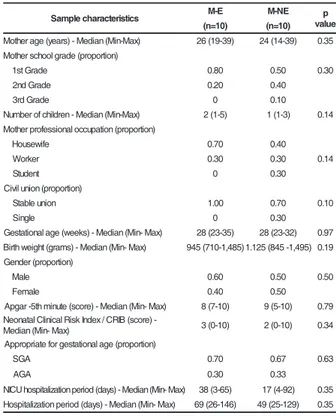
Table 1 - Demographic characteristics of mothers and
infants from M-E and M-NE groups
E: Mothers with emotional indicators of anxiety and/or depression; M-NE: Mothers without emotional indicators of anxiety and/or depression. SGA: small for gestational age; AGA: adequate for gestational age.
Table 1 shows that there were no differences
between groups regarding the mother’s and infants’
neonatal characteristics. Focusing on maternal
variables, in both groups, most mothers were young,
had few kids, lived in a stable civil union, had finished
elementary school and did not work. In both groups,
infants had a median gestational age of 28 weeks
and the median birth weight value was around 1,000
grams. Both groups presented a high median score
on the Apgar index and the neonatal index, measured
by CRIB, was equal to or three points lower than the
median, indicating moderate clinical neonatal status
for the infants. The Apgar and CRIB scores presented
a wide range, suggesting infants’ individual variation
regarding these aspects. Most of the infants in both
groups are classified as “small for gestational age”,
i.e., had birth weight lower than expected for
s c i t s i r e t c a r a h c e l p m a
S M-E M-NE vaplue )
0 1 = n
( (n=10)
) x a M -n i M ( n a i d e M -) s r a e y ( e g a r e h t o
M 26(19-39) 24(14-39) 0.35 ) n o it r o p o r p ( e d a r g l o o h c s r e h t o M e d a r G t s
1 0.80 0.50 0.30
e d a r G d n
2 0.20 0.40
e d a r G d r
3 0 0.10
) x a M -n i M ( n a i d e M -n e r d li h c f o r e b m u
N 2(1-5) 1(1-3) 0.14
) n o it r o p o r p ( n o it a p u c c o l a n o i s s e f o r p r e h t o M e fi w e s u o
H 0.70 0.40
r e k r o
W 0.30 0.30 0.14
t n e d u t
S 0 0.30
) n o it r o p o r p ( n o i n u li v i C n o i n u e l b a t
S 1.00 0.70 0.10
e l g n i
S 0 0.30
) x a M -n i M ( n a i d e M -) s k e e w ( e g a l a n o it a t s e
G 28(23-35) 28(23-32) 0.97 ) x a M -n i M ( n a i d e M -) s m a r g ( t h g i e w h t r i
B 945(710-1,485)1.125(845-1,495) 0.19 ) n o it r o p o r p ( r e d n e G e l a
M 0.60 0.50 0.50
e l a m e
F 0.40 0.50
) x a M -n i M ( n a i d e M -) e r o c s ( e t u n i m h t 5 -r a g p
A 8(7-10) 9(5-10) 0.79
-) e r o c s ( B I R C / x e d n I k s i R l a c i n il C l a t a n o e N ) x a M -n i M ( n a i d e
M 3(0-10) 2(0-10) 0.34
) n o it r o p o r p ( e g a l a n o it a t s e g r o f e t a i r p o r p p A A G
S 0.70 0.67 0.63
A G
A 0.30 0.33
) x a M -n i M ( n a i d e M -) s y a d ( d o ir e p n o it a z il a ti p s o h U C I
N 38(3-65) 17(4-92) 0.35
) x a M -n i M ( n a i d e M -) s y a d ( d o i r e p n o it a z il a ti p s o
gestational age. The NICU period and the infant’s total
period presented similar median values, with a wide range in both groups.
Complementing data from Table 1, in both
groups, a significant positive correlation was observed
between the infant’s NICU hospitalization period and the CRIB index; the higher the neonatal clinical risk,
the longer the NICU period (r= 0.74 [p≤ 0.02]; r=0.87
[p≤ 0.002], respectively. Otherwise, a significant
negative correlation between NICU hospitalization
period and birth weight was found; the lower the birth weight, the longer the hospitalization period (r= -0.72
[p≤ 0.01]; r=-0.69 [p≤ 0.02], respectively).
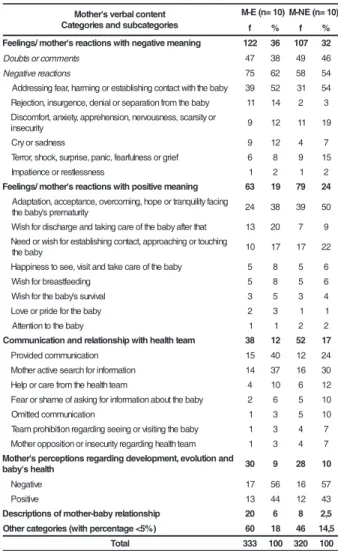
Table 2 - Mother’s verbal content categories and subcategories - M-E and M-NE groups- in terms of
frequency (f) and percentage (%)
verbalizations about Feelings or mother’s reactions
with negative meaning, it is observed that the Negative
Reactions subcategory was more verbalized than
Doubts and Comments, in both groups. Focusing on
Negative Reactions, the verbalizations about fear of
approaching, of harming or of establishing contact
with the baby were the most distinguished in both
groups. The M-E Group verbalized more about
rejection, insurrection, denial or baby’s separation
than the M-NE Group. Regarding maternal
verbalizations about Feelings/ mother’s reactions with
positive connotations, it is observed that mothers from
M-E showed a higher tendency of verbalizing less than
M-NE mothers about adaptation, acceptance,
overcoming, hope or tranquility facing the baby’s
premature condition and the need or maternal wish
for establishing contact, approaching or touching the
baby. However, M-E mothers expressed more the wish
of discharge and taking care of the baby after that
when compared to M-NE mothers. It is observed that,
in the category of Communication and the mother’s
relationship with health team category, mothers from
the M-E group verbalized more than M-NE about
expressions related to the mother’s active search for
information about the infant.
DISCUSSION
In the present study, the mother’s of
pre-term infants hospitalized in NICU reported
predominantly about feelings or reactions with
negative meaning, independently of the presence of
clinical symptoms of anxiety or depression. Otherwise,
the mothers with emotional clinical indicators showed
a tendency of expressing feelings or mother’s reactions
with negative meaning when compared to mothers
that did not present such indicators; the mother
presented a tendency of verbalizing more on
expressions of feeling or reactions with positive
meaning and about the communication and
relationship with the health team, when compared to
M-E mothers. Possibly, the presence of the mother’s
clinical emotional indicators of anxiety and depression
may have stimulated a greater occurrence of
verbalizations about feelings and reactions with
negative meaning. These verbalizations, however, are
expected due to the impact the preterm birth and
early NICU infant hospitalization represent for mothers
within this context(3). t n e t n o c l a b r e v s ' r e h t o M s e i r o g e t a c b u s d n a s e i r o g e t a C ) 0 1 = n ( E
-M M-NE(n=10)
f % f %
g n i n a e m e v i t a g e n h t i w s n o i t c a e r s ' r e h t o m / s g n i l e e
F 122 36 107 32
s t n e m m o c r o s t b u o
D 47 38 49 46
s n o it c a e r e v it a g e
N 75 62 58 54
y b a b e h t h ti w t c a t n o c g n i h s il b a t s e r o g n i m r a h ,r a e f g n i s s e r d d
A 39 52 31 54
y b a b e h t m o r f n o it a r a p e s r o l a i n e d , e c n e g r u s n i , n o it c e j e
R 11 14 2 3
r o y ti s r a c s , s s e n s u o v r e n , n o i s n e h e r p p a , y t e i x n a ,t r o f m o c s i D y ti r u c e s n
i 9 12 11 19
s s e n d a s r o y r
C 9 12 4 7
f e i r g r o s s e n l u f r a e f , c i n a p , e s i r p r u s , k c o h s ,r o r r e
T 6 8 9 15
s s e n s s e lt s e r r o e c n e it a p m
I 1 2 1 2
g n i n a e m e v i t i s o p h t i w s n o i t c a e r s ' r e h t o m / s g n i l e e
F 63 19 79 24
g n i c a f y ti li u q n a r t r o e p o h , g n i m o c r e v o , e c n a t p e c c a , n o it a t p a d A y ti r u t a m e r p s ' y b a b e h
t 24 38 39 50
t a h t r e tf a y b a b e h t f o e r a c g n i k a t d n a e g r a h c s i d r o f h s i
W 13 20 7 9
g n i h c u o t r o g n i h c a o r p p a ,t c a t n o c g n i h s il b a t s e r o f h s i w r o d e e N y b a b e h
t 10 17 17 22
y b a b e h t f o e r a c e k a t d n a ti s i v , e e s o t s s e n i p p a
H 5 8 5 6
g n i d e e ft s a e r b r o f h s i
W 5 8 5 6
l a v i v r u s s ' y b a b e h t r o f h s i
W 3 5 3 4
y b a b e h t r o f e d i r p r o e v o
L 2 3 1 1
y b a b e h t o t n o it n e tt
A 1 1 2 2
m a e t h t l a e h h t i w p i h s n o i t a l e r d n a n o i t a c i n u m m o
C 38 12 52 17
n o it a c i n u m m o c d e d i v o r
P 15 40 12 24
n o it a m r o f n i r o f h c r a e s e v it c a r e h t o
M 14 37 16 30
m a e t h tl a e h e h t m o r f e r a c r o p l e
H 4 10 6 12
y b a b e h t t u o b a n o it a m r o f n i r o f g n i k s a f o e m a h s r o r a e
F 2 6 5 10
n o it a c i n u m m o c d e tt i m
O 1 3 5 10
y b a b e h t g n it i s i v r o g n i e e s g n i d r a g e r n o it i b i h o r p m a e
T 1 3 4 7
m a e t h tl a e h g n i d r a g e r y ti r u c e s n i r o n o it i s o p p o r e h t o
M 1 3 4 7
d n a n o i t u l o v e , t n e m p o l e v e d g n i d r a g e r s n o i t p e c r e p s ' r e h t o M h t l a e h s ' y b a
b 30 9 28 10
e v it a g e
N 17 56 16 57
e v it i s o
P 13 44 12 43
p i h s n o i t a l e r y b a b -r e h t o m f o s n o i t p i r c s e
D 20 6 8 2,5
) % 5 < e g a t n e c r e p h t i w ( s e i r o g e t a c r e h t
O 60 18 46 14,5
l a t o
T 333 100 320 100
Table 2 shows that the three most frequent
categories in both groups, from the most to the least
frequent, were: Feelings or mother reactions with
negative meaning, Feelings or mother reactions with
positive meaning and Communication and mother’s
Although it seems to be paradoxical those
mothers of both groups have verbalized about feelings and negative and positive feelings and
reactions, these data suggest that mothers of premature infants may experience ambiguous
feelings. The behavior of persons in a psychological crisis comprehends oscillations and ambivalences of
feelings and reactions, triggered by unexpected situations, like preterm birth and the infants’ early
hospitalization at the NICU(1). In order to restructure the mother’s emotional equilibrium and minimize the
unfavorable consequences of the presence of the
mother’s emotional indicators, it is relevant to supply psychological support to mothers, in the neonatal
period. Support and protection are offered to the mother, so that she can develop better conditions to
cope with the infant’s NICU hospitalization(5). Then, it can contribute to a significant reduction of the
mother’s clinical symptoms of anxiety and
depression(2).
The mother’s verbal reports suggest that
preterm birth and early NICU infant’s hospitalization are variables that may compromise mother and family
emotional equilibrium, corroborating with previous studies(3;5); however, negative mother verbalizations
related to birth and infant’s hospitalization showed a tendency of occurring more in mothers with emotional
clinical symptoms of anxiety or depression than in mothers who did not present them.
The present study offers the advantage of being
accomplished in an applied natural setting, which grants “ecological validity” to the obtained results, i.e., the
analysis of the verbalized mother’s reports preceded a context of immediate experience to the premature infant
birth and his/her hospitalization at NICU. However, its results are representative of a small sample selected
at a university hospital, which demands care when generalizing the findings to other mother samples.
Finally, the advance in maternal verbalization analysis about the infants’ prematurity may improve
the understanding of the mother’s psychological
universe, who are the primary and long-term caregivers of these vulnerable infants.
FINAL COMMENTS
The investigation about mothers’ emotional
indicators is relevant for clinical practice. During hospitalization, the clinical care focus is the premature
infant and his/her clinical evolution. Yet, as actions that depend on the mother to promote well being and infant’s
health are introduced, such as breastfeeding, visits, skin-to-skin contact and Kangaroo Care Method, the
knowledge of thoughts, feelings and maternal beliefs helps to guide adequate implementation of intervention
strategies that facilitate developmental and individualized
care of the infant.
REFERENCES
1. Maldonado MT. Psicologia da gravidez: parto e puerpério. 14ª ed. São Paulo (SP): Saraiva; 1997.
2. Preyde M, Ardal F. Effectiveness of a parent “buddy” program for mothers of very preterm infants in a neonatal intensive care unit. CMAJ 2003; 168(8):969- 73.
3. Linhares MBM, Carvalho AEV, Correia LL, Gaspardo CM, Padovani FHP. Psicologia pediátrica em neonatologia de alto risco: promoção precoce do desenvolvimento de bebês prematuros. In: Crepaldi MA, Linhares MBM, Perosa GB, organizadoras. Temas em Psicologia Pediátrica. São Paulo (SP): Casa do Psicólogo; 2006. p. 109- 46.
4. Als H. Towards a synactive theory of development: promise for the assessment of infant individuality. Infant Ment Health J 1982; 3:229- 43.
5. Buarque V, Lima MC, Scott RP, Vasconcelos MG. The influence of support groups on the family of risk newborns and on neonatal unit workers. J Pediatr 2006; 82:295-301. 6. Scochi CGS, Kokuday MLP, Riul MJS, Rossanez LSS, Fonseca LMM, Leite AM. Incentivando o vínculo mãe-filho em situação de prematuridade: as intervenções de enfrentamento no Hospital das Clínicas de Ribeirão Preto. Rev Latino-am Enfermagem 2003 julho-agosto; 11(4):539-43.
7. Aylward GP. Methodological issues in outcomes studies of at-risk infants. J Pediatr Psychol 2002; 27(10):37-45. 8. Spitzer RL, Williams JB, Gibbon M, First MB. Instruction manual for the structured clinical interview for DSM III - R (SCID, 5/11/89 Revision). New York: Biometrics Research Department. New York State Psychiatric Institute; 1989. 9. Biaggio AMB, Natalício L, Spielberger CD. Desenvolvimento da forma experimental em português do In ventário de Ansiedade Traço-Estado (IDATE) de Spielberger. Arquiv Bras Psicol Aplicada 1979; 29(3):31-44.
10. Cunha JA. Manual da versão em português das Escalas Beck. São Paulo: Casa do Psicólogo; 2001.
11. Kendall PC, Smith TW, Donnell C, Ronank K. Cognitive specificity in emotional distress. J Pers Soc Psychol 1987; 53(4):734-42.
13. Carvalho AEV. Indicadores emocionais maternos e intervenção psicológica durante hospitalização do bebê pré-termo em UTI Neonatal. [tese]. Ribeirão Preto (SP): Faculdade de Filosofia, Ciências e Letras de Ribeirão Preto/USP; 2005. 14. Biasoli-Alves ZMM A pesquisa em psicologia- análise de métodos e estratégias na construção de um conhecimento que se pretende científico. In: Romanelli G, Biasoli-Alves ZMM, organizadores. Diálogos metodógicos sobre prática de pesquisa. Ribeirão Preto (SP): Legis Summa; 1998. p. 135-57. 15. Correia LL. Conteúdos verbais de mães de bebês pré-termo internados em UTI Neonatal, diferenciadas quanto a indicadores clínicos emocionais de ansiedade e depressão. [Dissertação]. Ribeirão Preto (SP): Faculdade de Medicina/ USP; 2005.