A semi-structured interview for psychological autopsy in
suicide cases
Entrevista semi-estruturada para autópsia psicológica em casos de
suicídio
Blanca Guevara Werlanga and Neury José Botegab
aPostgraduate course in Psychology of the School of Psychology of the Catholic University of the State of Rio Grande do Sul (PUCRS), Porto Alegre, RS, Brazil. bDepartment of Medical Psychology and Psychiatry of the School of Medical Sciences of the State University of Campinas (UNICAMP). Campinas, SP, Brazil
*Article based on the doctorate thesis ‘Proposal of a Semi-structured Interview for Psychological Autopsy in suicide cases’, by Blanca Guevara Werlang, Postgraduate Course in Medical Sciences, Area of Mental Health of the School of Medical Sciences of the State University of Campinas (UNICAMP).
The author Blanca Guevara Werlang was supported by Coordenação de Aperfeiçoamento de Nível Superior (Capes). None conflitc of interest.
Received on 5/10/2001. Approved on 10/6/2003.
Objective: To investigate the applicability and the interrater reliability of a Semi-Structured Interview for
psychological autopsy in cases of suicide.
Method: The Semi-Structured Interview for Psychological Autopsy (SSIPA) proposed in this paper consists of
four modules which evaluate key-topics associated to suicide. In order to evaluate the instrument’s applicability, a sample formed by 42 subjects related to 21 suicide cases was used. The interviews were tape-recorded first and then transcribed. The related material as well as the police inquiry data were presented to four judges. Evaluation of information has been performed with the help of a four-module formulary for decision making: precipitants and/ or stressors, motivation, lethality, and intentionality. Data processing, whenever possible, has been accomplished using kappa statistics. When kappa statistic was not applicable, concordance percentage has been used.
Results: The SSIPA is applicable because it provides information containing a significant degree of agreement
between evaluators, found in one hundred and twenty measurements of judgements made by four judges. There has been significant statistical agreement between the judges in three modules (precipitants and/or stressors, motivation, and intentionality) of the model for decision, except in one step of each module, which did not interfere in the final agreement on the present evaluation. In the lethality evaluation module, there has been a 100% agreement between judges. The judgement made by the raters on the four modules have allowed to reach a final agreement regarding the death mode as suicide.
Conclusion: The results of this study show that it is possible to use a semi-structured instrument for psychological
autopsy in cases of suicide, when the interviewees are relatives who accepted to provide information.
Psychological autopsy. Semi-structured interview. Suicide.
Objetivo: Desenvolver uma entrevista semi-estruturada para autópsia psicológica de casos de suicídio e avaliar
a confiabilidade entre avaliadores desse instrumento.
Método: A Entrevista Semi-estruturada para Autópsia Psicológica (ESAP) é constituída por 69 itens distribuídos
em quatro módulos para avaliação dos temas-chave associados ao suicídio: precipitadores e/ou estressores, moti-vação, letalidade e intencionalidade. Para avaliar a sua aplicabilidade foi utilizada uma amostra de 42 sujeitos, relacionados a 21 casos de suicídio. As entrevistas realizadas foram gravadas em áudio e posteriormente transcri-tas. O material correspondente e os dados do inquérito policial foram avaliados pela entrevistadora, por uma auxiliar de pesquisa e dois juízes, sempre de modo independente. A avaliação das informações foi realizada com o auxílio de um formulário para a tomada de decisão. A análise dos dados foi feita através da estatística kappa.
Resultados: A ESAP é aplicável, porque fornece informações que permitem um grau marcante de
concordân-cia entre avaliadores, verificado nos quatro módulos do instrumento. Em três módulos, houve concordânconcordân-cia entre os avaliadores, em grau estatisticamente significante em todos os passos, exceto em um em cada módulo. Isso, entretanto, não comprometeu a concordância final sobre a avaliação de precipitadores e/ou estressores, motivação e intencionalidade. No módulo relativo à avaliação da letalidade, houve 100% de concordância. Os julgamentos dos quatro avaliadores, nos quatro módulos, permitiu chegar à concordância final quanto ao modo
Abstract
Keywords
Introduction
Methodological difficulties often prevent the unequivocal de-termination of the death mode, discriminating between those occurring due to suicide from those with other origin. There-fore, in most of the cases, the death certification depends much more on the authorities’ point of view about objective data re-lated to the obit than on a psychological approach. However, according to the literature, it is possible to understand the sui-cide by means of retrospective exams. This kind of assessment has allowed the identification of direct and indirect clues related to the lethal behavior which was to occur, clarifying the inten-tion and the role of the deceased regarding his/her own death. Using the method called as ‘psychological autopsy’, an expres-sion created by Edwin Shneidman in the end of the ‘50s,1-4 the psychological aspects of a specific death can be understood. (Appendix) This resource has helped medical examiners and criminal and civil law professionals and can also contribute for the identification of risk factors and sociodemographic corre-lates of suicide.5-16
There are four basic questions to be answered in the psycho-logical autopsy: What?, Why?, From what? and How has the subject died? And there are, respectively, four constructs un-derlying the psychological autopsy’s strategy: precipitants and/ or stressors, motivation, lethality and intentionality. Precipi-tants and/or stressors are immediate facts or circumstances that would trigger the last push for suicide. Motivation can be un-derstood identifying the psychological reasons to die, rooted, in life time, in the subject’s conduct, thought, life stile and per-sonality. The degree of lethality is measured by the chosen method and its consequences. The assessment of the degree of lucidity in the planning, preparation and objectivation of the self-destructive action establishes the subject’s intent.
Several scientific studies and publications highlight that psy-chological autopsy in suicide cases has shown useful as an in-strument for clinical assessment and research. However, in our society this is a still scarcely divulged method and we may remind that it is a complex and multidimensional assessment strategy, to which scholars provide very general orientations, schemes of areas to be explored, but, up to the moment, with-out a structured instrument for data collection.1-4,10,12,16-27 Lack-ing this kind of instrument, the psychological autopsy can be considered as a subjective, unreliable resource, that leaves the professional insecure and without a reasonable degree of cer-tainty to emit conclusions.
de morte sendo suicídio.
Conclusão: Os resultados demonstraram que é possível usar, com boa fidedignidade, um instrumento
semi-estruturado para autópsia psicológica, em casos de suicídio, quando os informantes são familiares dispostos a prestar informações.
Autópsia psicológica. Entrevista semi-estruturada. Suicídio.
Descritores
Undoubtedly, the main factor responsible for the doubtful precision of the collected data is the retrospective nature of the psychological autopsy. In the absence of the studied object, the victim, both the informant and the interviewer are potentially vulnerable to biases, as both presuppose that the investigated subject has committed suicide. Therefore, the quantity and quality of data provided by the informant can be influenced by, for example, religious reasons, to maintain the person’s repu-tation after his/her death, to prevent the cancellation of the life insurance of the deceased, for the feelings of sadness of the interviewed, for his/her degree of kinship with the deceased, for the supposedly-existent degree of psychopathology for a subject to choose suicide, etc. As for interviewers, they may have specific expectations about the types of most probable disorders in a victim of suicide, may adhere to specific events due to the need of finding explanations of how the death oc-curred, may have difficulties to deal with discrepancies be-tween informants, may be more or less competent due to their training and experience, etc.
Considering that the psychological autopsy aims to reach an understanding on the facts, the issues related to reliability and validity become very problematic. Thus, in order to assess the reliability of the obtained information, many studies propose the performing of a second interview, with other informant, or a second interview with the same informant, but conducted by other technician (precision), or, else, of other interview with the same informant and technician, after a time interval (sta-bility). All those situations are not always possible to happen and, in some cases, produce embarrassment and tension. On the other hand, a way of validating the obtained data is com-paring them with the information reported in the personal, medical, police, school and other document records.3,4,28
high-lighted, establishing the estimation of interrater reliability by means of assessment of information by different judges.3
Therefore, considering that literature about the methodologi-cal aspects regarding strategies to perform the psychologimethodologi-cal autopsy for suicide cases is scarce, the objective of this study was to develop a semi-structured interview for the psychologi-cal autopsy, whose data would allow to verify the presence of a reasonable degree of agreement between evaluators.
Method
Subjects
The sample was composed by 42 subjects (informants: fam-ily members, friends and/or acquaintances) related to 21 cases of suicide consecutively selected from August 1998 to January 2000, in the death records of the Medical Examiner Office with an existing inquiry in one of the police stations of the Greater Porto Alegre. The selection of suicide cases followed inclu-sion criteria (registration of death by suicide, obit of the case occurred up to six weeks before, existence of data about the identification and registration of the last address of the victim; existence of data about the identification and registration of the last address of family members, friends and/or acquaintan-ces; accessibility to two informants about the case or to one, when it would be the only possible; informed consent of par-ticipants) and exclusion criteria (last address of informants out of the urban area of the Greater Porto Alegre; informants whose spoken language was not Portuguese, or were prevented, by other reason, of adequate communication; informants not found up to 30 weeks after the subject’s suicide, reported as a case; or not interviewed after up to 32 weeks).
Instrument
Starting with a review of the literature in the period from 1987 to 2000, in computer-based databases, it was possible to specify and render operative guiding criteria for a psychologi-cal autopsy as well as to define the basic items for the semi-structured interview.10-12,14,17,18,21,29 Therefore, the Semi-Struc-tured Interview for Psychological Autopsy (SSIPA) is com-posed by four modules: Precipitants and/or stressors, Motiva-tion, Lethality and Intentionality (Appendix). The option for these four modules, decided by the authors, as well as the or-ganization of each module, tried to follow, besides what was found in the literature, a logical sequence of clinical reasoning. Using closed, open and/or echo questions30 (the echo repeats the part of the answer of the interviewee that one wants him/ her to elaborate) we sought to cover key-themes associated to suicide.
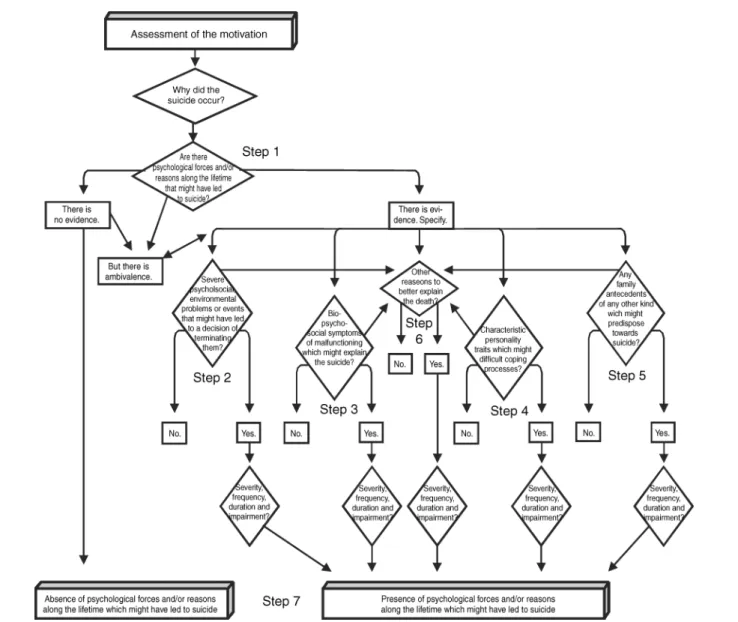
In the first module (assessment of precipitants and/or stres-sors), besides the initial answer (what happened before the death and what could have any relation with this fact?) there are two more items, composed by closed answers with alternatives de-fined in two options: yes and no. In the second module (assess-ment of motivation), after the general question (Why has sui-cide happened or what were the reasons for wishing to die?), there are more 32 items with dicotomic alternatives (yes - no),
organized in four sections (psychosocial, environmental issues or those related to non-daily facts; symptoms of malfunction-ing; personality traits; facts associated to family history).
In the third module (assessment of lethality), after the intro-ductory question (From what has the subject died?), there are more five items, of which three are multiple-choice ones and two request specification about the death method. In the fourth module (assessment of intentionality), besides the initial ques-tion (How has the fact ended occurring?), there are more 26 closed questions (with dicotomic alternatives), composing two sections: evidence of intention or desire of dying and planning for the death.
Surely, the fundamental requisition for the organization of the SSIPA was its support on scientific grounds to help the operationalization of the variables to be investigated. This sci-entific basis, as the regulating core of this semi-structured in-terview, is based on Edwin Shneidman’s theoretical model of suicide as a self-inflicted, intentional human terminating act,31,32 stemming from an unbearable psychic pain, generated by frus-trated psychological needs.14,31-33 Moreover, in the formulation of the questions of the four modules, the investigating catego-ries proposed by Shneidman,18,34 Ebert,1 Spellman & Heyne27 and Litman10-12 were taken into account, as well as some items suggested from part of the content of the Adolescent Psychia-try Diagnostic Form,35 from the Beck Schuyler and Herman Intentionality Scale36 and from the psychosocial and environ-mental issues, Axis IV of the Multiaxial Evaluation of the Di-agnostic and Statistical Manual of Mental Disorders.37
A previous version of the SSIPA was analyzed in four cases (pilot study), before the main study. From this point onwards, we were able to certify that the terms and expressions used were adequate and understood without great difficulties and there was no need to reformulate or add new items; the duration of the interview was, in average, nearly one hour and fifty-five min-utes. Besides this aspect, the pilot study allowed the refinement of the research strategies to be applied in the main study.
We have also developed a Decision-Making Form (DMF) with instructions for evaluators to analyze the information obtained in the four modules of the interview. We reached the probability of occurrence or not of suicide, following a decision scheme similar to the process of an algorithm, which represents the clini-cal reasoning (see example in Figure). Using this process evalu-ators follow different steps in each module (Table 1) which will be considered as key-points in the interrater agreement measure. The last step in each module has the final decision regarding that module. Yet, in the final part of the DMF, there is a summary of the four modules, aiming to facilitate the obtainment of a final opinion about the case. This opinion would have a qualitative character in order to facilitate the option for a substantially nega-tive alternanega-tive for suicide or for one of the posinega-tive alternanega-tives (some hypothesis, very suggestive or highly suspicious) to de-terminate the probability of suicide.
Procedures and data analysis
the police station where the occurrence of the fact was informed, we sent a letter to the future informants by regular mail, within up to 30 days after the death. Whenever possible, one week after that we made a phone-call to obtain the informed con-sent. In case of acceptation we defined day, time and place for the interview. Interviews were tape-recorded and afterwards transcribed.
In the following step, basic data related to the identification, examination and the registration of the interview (tape transcrip-tion) were independently assessed using the DMF. This assess-ment was performed by the interviewer (who has a 24-year clini-cal experience and is Specialist in Psychologiclini-cal Diagnosis, MD, Ph.D. in the area of Mental Health) and by the research assistant (student of the last year in the course of Psychology, who had concluded the disciplines and training in Clinical Psychology and was specially trained to follow up the interview and to ana-lyze its data) who had been present to the interviews. Data were also submitted to two judges (one psychologist, with 25 years of clinical experience, Ph.D. in Clinical Psychology and one
occu-pational therapist, with 5 years of experience in multidisciplinary attention in neuropsychiatric ambulatory, M.Sc. in Mental Health, master thesis on suicide) who had also performed independent assessments about each case.
The agreement level was assessed using the kappa statistics. We used the statistical program STATA.38 Comparisons were made between the interviewer and the research assistant (I-A), the interviewer and the first judge (I-J1), the interviewer and the second judge (I-J2), between the first and the second judge (J1-J2) and between the interviewer, the first judge and the second judge (I-J1-J2). When we could not use the kappa sta-tistics we examined the agreement percentage.
The agreement measure (kappa statistics) was interpreted ac-cording to what was suggested by Landis and Koch, in the STATA manual:38
Results
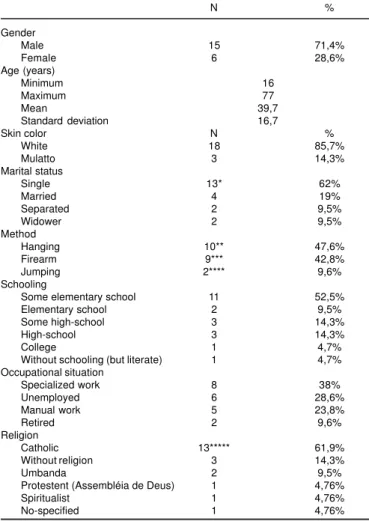
Some characteristics of suicide cases are displayed in Table 1. In an eighteen-month period we obtained from the Medical
Examiner Office 399 records of death for suicide in 16 cities in the Greater Porto Alegre. According to the distance between the cities and the time spent at each place, we could examine and register data of police inquiries of 104 cases, distributed among 28 police stations in six cities. Of these 104 cases, let-ters to family members of 66 deceased subjects were mailed and 38 cases were eliminated as their police inquiries were not closed. Of the 66 letters sent and the subsequent phone-calls, in 28.8% of cases there was no acceptation to participate in the study, in 39.4% of the cases it was not possible to find the possible informant (letter returned by the post office, wrong phone number, not answered phone-call, no call-back after a message was left), and in 31.8% (21 cases of suicide) of the cases informants accepted to participate in the study.
For the 21 cases under study we were able to interview 42 people who accepted to participate in one or two interviews, totaling 25 interviews. The number of informants per view varied (minimum of 1, maximum of 5) and most of inter-views (21), due to the informants’ choice, was performed at their domicile, and, predominantly, only one informant had par-ticipated. The duration of the interviews varied from 53 min-utes to 1 hour and 50 minmin-utes.
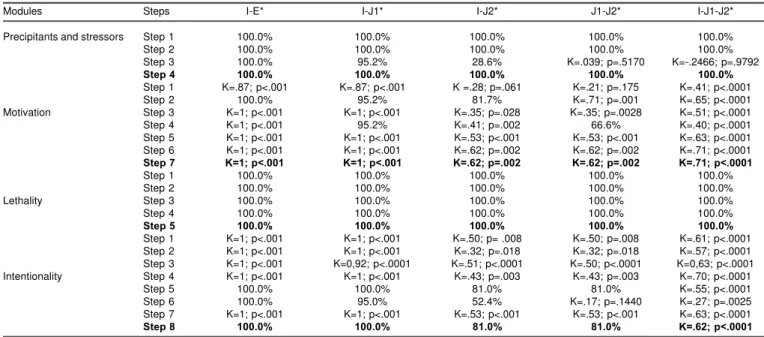
The results of the agreement measure, at each step of the four modules of the SSIPA, can be seen in Table 2.
We may state that there is a remarkable interrater agreement in each of the of the SSIPA modules for cases of suicide. In three modules of the decision scheme, there was a statistically significant concordance between judges, in all steps, except for one step in each module. However, this has not compro-mised the final concordance about the assessment of precipi-tants and/or stressors (step 4), motivation (step 7) and inten-tionality (step 8). In the module related to the assessment of lethality, there was 100% of agreement between judges.
Discussion
It is interesting to observe that many of the demographic char-acteristics of the cases of suicide are similar to that of data found in the literature, mainly regarding the variables gender, skin color and age. In the state of Rio Grande do Sul and in the metropolitan area of the Greater Porto Alegre, the most used method for suicide was by hanging, followed by firearms and fall from high places.39 This same order was observed in the studied cases. The fact that we found the same general charac-teristics of people who commit suicide, even this being a small sample, was noteworthy.
The participants in this study (mourning survivors, herein called informants) characterize a peculiar situation, due to the fact that the data were indirectly obtained (information from third parts), and that informants were undergoing mourning processes. Al-though bereavement is, as a rule, a normal psychological pro-cess, the death of a beloved one by suicide is not experienced as a ‘common’ and/or ‘regular’ fact. In that case, as points out the literature, the elaboration of the mourning seems to be more pain-ful and traumatic. This emotional involvement not always al-lows these survivors to be readily available to a requisition to provide information about the unfortunate deed.
Those interviews have demonstrated, corroborating data from the literature, that the impact of suicide can be diversified, de-pending on the degree of the existing relationship and links.40 Due to this fact, it seems that the choice of the place for the interview was the result of psychological reasons. We may pre-suppose that, specifically for this study’s cases, this choice was related to the need of a family and supporting environment. Similarly, the duration of the interview seemed to be related to how more or less easily they communicate painful issues.
Due to these aspects, in this study it has not seemed impor-tant to us to strictly establish neither the number of informants, nor the number of interviews to be performed. However, there was no need of a sample bigger than 20 cases of suicide, as the main objective was neither to assure generalizations nor to test hypotheses about the psychological autopsy, but to verify if there was or not interrater agreement regarding the informa-tion obtained in the interview. It is also important to remind that the SSIPA is not provided with elements to differentiate suicide from homicide or accident. If this were the objective we would need to improve the interview and to develop a new study about interrater reliability.
We may remind that we have worked with relatives who ac-cepted to provide information. Besides being this a limitation for any population survey (to work with those who accepted to
Table 1 - Summary of demographic characteristics of suicide cases. (N=21)
N %
Gender
Male 15 71,4%
Female 6 28,6%
Age (years)
Minimum 16
Maximum 77
Mean 39,7
Standard deviation 16,7
Skin color N %
White 18 85,7%
Mulatto 3 14,3%
Marital status
Single 13* 62%
Married 4 19%
Separated 2 9,5%
Widower 2 9,5%
Method
Hanging 10** 47,6%
Firearm 9*** 42,8%
Jumping 2**** 9,6%
Schooling
Some elementary school 11 52,5%
Elementary school 2 9,5%
Some high-school 3 14,3%
High-school 3 14,3%
College 1 4,7%
Without schooling (but literate) 1 4,7% Occupational situation
Specialized work 8 38%
Unemployed 6 28,6%
Manual work 5 23,8%
Retired 2 9,6%
Religion
Catholic 13***** 61,9%
Without religion 3 14,3%
Umbanda 2 9,5%
Protestent (Assembléia de Deus) 1 4,76%
Spiritualist 1 4,76%
No-specified 1 4,76%
participate), in fact, we should not presuppose that similar lev-els of agreement would be achieved if the participation were obligatory, as could happen, for example, in a police investiga-tion about a suspicious death.
Considering the lack of data about the methodological aspects regarding the strategies for the accomplishment of psychological autopsy in cases of suicide, it seems to us that the results achieved in this study can be considered as a relevant scientific contribu-tion. This statement is justified as, although there has been much criticism about the dangers of subjective retrospective evaluations, as far as it is known in the literature, there has been no attempt to measure the degree of interrater agreement regarding the infor-mation provided by an original instrument such as the one pro-posed here for the accomplishment of psychological autopsies.
In this study, the degree of agreement was inferred from 120 measurements of judgements in four different situations, com-paring assessments of different judges. Of note, in 61 mea-surements where it was possible to use the kappa statistics, the results, as a rule, were statistically significant (except for less than 9.0% of the cases).
We may remind that for the kappa calculation we take into account the possibility that part of the agreement occurred by chance. In 59 measurements we could not calculate the kappa,
due to the lack of variability in some of the judges’ assess-ments (in 47 of these measureassess-ments there was 100% of agree-ment between judges). Situations with degree of agreeagree-ment lower than 80.0% occurred in only 5.0% of the measurements. Besides, although there were partial divergences in some steps, it is noteworthy the fact that they have not compromised the final concordance about the assessment of precipitants and/or stressors, motivation and intentionality.
By means of the remarkable agreement verified in each of the four modules, we can presuppose that the protocol of the semi-structured interview for data collection allowed evalua-tors to extract sufficient information in order to judge the key-issues represented by questions: What?, Why?, From what? and How has the subject died? In other words, the protocol of the interview provided elements for the assessment of the four inherent constructs of the psychological autopsy.
Conclusion
The results of this study showed that we were able to de-velop and apply, with high interrater reliability, a semi-struc-tured interview to be used in psychological autopsy, in sui-cide cases, when the informants are family members willing to give the information.
*I = interviewer; A = research assistant; J1 = first judge; J2 = second judge.
Table 2 - Summary of results of the concordance measure at each of the composing steps in the four modules of the SSIPA.
Modules Steps I-E* I-J1* I-J2* J1-J2* I-J1-J2*
Precipitants and stressors Step 1 100.0% 100.0% 100.0% 100.0% 100.0%
Step 2 100.0% 100.0% 100.0% 100.0% 100.0%
Step 3 100.0% 95.2% 28.6% K=.039; p=.5170 K=-.2466; p=.9792
Step 4 100.0% 100.0% 100.0% 100.0% 100.0%
Step 1 K=.87; p<.001 K=.87; p<.001 K =.28; p=.061 K=.21; p=.175 K=.41; p<.0001
Step 2 100.0% 95.2% 81.7% K=.71; p=.001 K=.65; p<.0001
Motivation Step 3 K=1; p<.001 K=1; p<.001 K=.35; p=.028 K=.35; p=.0028 K=.51; p<.0001
Step 4 K=1; p<.001 95.2% K=.41; p=.002 66.6% K=.40; p<.0001
Step 5 K=1; p<.001 K=1; p<.001 K=.53; p<.001 K=.53; p<.001 K=.63; p<.0001 Step 6 K=1; p<.001 K=1; p<.001 K=.62; p=.002 K=.62; p=.002 K=.71; p<.0001
Step 7 K=1; p<.001 K=1; p<.001 K=.62; p=.002 K=.62; p=.002 K=.71; p<.0001
Step 1 100.0% 100.0% 100.0% 100.0% 100.0%
Step 2 100.0% 100.0% 100.0% 100.0% 100.0%
Lethality Step 3 100.0% 100.0% 100.0% 100.0% 100.0%
Step 4 100.0% 100.0% 100.0% 100.0% 100.0%
Step 5 100.0% 100.0% 100.0% 100.0% 100.0%
Step 1 K=1; p<.001 K=1; p<.001 K=.50; p= .008 K=.50; p=.008 K=.61; p<.0001 Step 2 K=1; p<.001 K=1; p<.001 K=.32; p=.018 K=.32; p=.018 K=.57; p<.0001 Step 3 K=1; p<.001 K=0,92; p<.0001 K=.51; p<.0001 K=.50; p<.0001 K=0,63; p<.0001 Intentionality Step 4 K=1; p<.001 K=1; p<.001 K=.43; p=.003 K=.43; p=.003 K=.70; p<.0001
Step 5 100.0% 100.0% 81.0% 81.0% K=.55; p<.0001
Step 6 100.0% 95.0% 52.4% K=.17; p=.1440 K=.27; p=.0025
Step 7 K=1; p<.001 K=1; p<.001 K=.53; p<.001 K=.53; p<.001 K=.63; p<.0001
Step 8 100.0% 100.0% 81.0% 81.0% K=.62; p<.0001
References
1. Ebert B. Guide to conducting a psychological autopsy. In: Anchor KN, editor. The handbook of medical psychotherapy cost: effective strategies in mental health. Lewiston: Hohrefe & Huber; 1991. p. 249-56. 2. Gould MS, Shaffer D, Fisher P, Kleinman M, Morishima A. The clinical
prediction of adolescent suicide. In: Maris RW, Berman AL, Maltsberger JT, Yufit RI, editors. Assessment and prediction of suicide. New York: The Guilford Press; 1992. p. 130-43.
3. Clarck DC, Horton-Deutsch SL. Assessment in absentia: the value of the Psychological Autopsy Method for studying antecedents of suicide and predicting future suicides. In: Maris RW, Berman AL, Maltsberger JT, Yufit RI, editors. Assessment and prediction of suicide. New York: The Guilford Press; 1992. p. 144-82.
24. Shneidman ES. Clues to suicide, reconsidered. Suicide Life-Threat Behav 1994;24:395-97.
25. Kelly TM, Mann JJ. Validity of DSM-III-R diagnosis by psychological autopsy: a comparison with clinician ante-mortem diagnosis. Acta Psychiatr Scand 1996;94:337-43.
26. Sometsä E, Heikkinen M, Henriksson M, Marttunen M, Aro H, Lönnqvist J. Differences between urban and rural suicides. Acta Psychiatr Scand 1997;95:297-305.
27. Spellman A, Heyne B. Suicide? Accident? Predictable? Avoidable? The Psychological Autopsy in jail suicides. Psychiatr Q 1989;60:173-83. 28. Beskow J, Runeson B, Åsgård U. Psychological Autopsies: methods and
ethics. Suicide Life-Threat Behav 1990;20:307-323.
29. Mayo DJ. What is being predicts? Definitions of “suicide”. In: Maris, RW, Berman AL, Maltsberger JT, Yufit RI, editors. Assessment and prediction of suicide. New York: The Guilford Press; 1992. p. 88-101.
30. Othmer E, Othmer SC. A entrevista clínica, usando DSM-III-R. São Pau-lo: Manole; 1992.
31. Shneidman ES. Definition of suicide. New Jersey: Aronson; 1994. 32. Shneidman ES. Suicide. In: Freedman, AM, Kaplan, HI Sadock, BJ, editors.
Comprehensive textbook of psychiatry - II. Baltimore: The Williams & Wilkins, 1975. p. 1774-1785.
33. Shneidman ES. A conspectus of the suicidal scenario. In: Maris RW, Berman AL, Maltsberger JT, Yufit RI, editors. Assessment and prediction of suicide. New York: The Guilford Press; 1992. p. 50-64.
34. Shneidman ES. Suicide, lethality and the psychological autopsy. In: Shneidman ES, Ortega M. Aspects of depression. Boston: Little, Brown; 1969. p. 225-49.
35. Wilson, MR. A proposed diagnostic classification for adolescent psychiatric cases. In: Feinstein SC, Giovacchini, PL, Miller AA. Adolescent psychiatry.
New York: Basic Books; 1971. p. 275-95.
36. Beck, AT, Schuyler, D, Herman, I. Development of suicidal intents scales. In: Beck AT, Resnick HI, Lettiari DJ, editors. The prediction of suicide. Philadelphia: Charles Press; 1974. p. 45-56.
37. American Psychiatric Association. Manual diagnóstico e estatístico de transtornos mentais: DSM-IV. Porto Alegre: Artes Médicas; 1995. 38. STATA: statistics, graphics, data management. Computing Resource Center.
Santa Monica, CA Copyright; 1992. v. 2.
39. Departamento Médico Legal (DML). Estatísticas dos óbitos. Porto Ale-gre: Controle de Perícias; 2000. (inédito)
40. World Health Organization (WHO). Preventing suicide: how to start a survivor’s group. Genebre: Department of Mental Health; 2000.
Correspondence:
Blanca Guevara Werlang
Faculdade de Psicologia – PUC-RS Av. Ipiranga, 6681, Prédio 11, 9º andar 90610-001 Porto Alegre, RS, Brazil E-mail: [email protected]
5. Curphey TJ. El especialista en ciencias sociales en la configuración médi-co legal de la muerte por suicidio. In: Farberow NL, Shneidman ES, orgs. ¡Necesito ayuda! Un estudio sobre el suicidio y su prevención. México: La Prensa Médica Mexicana; 1969. p. 128-35.
6. Shneidman ES, Farberow L, Litman RE. El Centro de Prevención del Suicidio. In: Farberow NL, Shneidman ES, orgs. ¡Necesito ayuda! Un estudio sobre el suicidio y su prevención. México: La Prensa Médica Mexicana; 1969. p. 6-19.
7. Shneidman ES, Farberow L. Investigaciones sobre muertes dudosamente suicidas. In: Farberow NL, Shneidman ES, orgs. ¡Necesito ayuda! Un estudio sobre el suicidio y su prevención. México: La Prensa Médica Mexicana; 1969. p. 136-47.
8. Selkin J, Loya F. Issues in the Psychological Autopsy of a controversial public figure. Prof Psychol 1979;10:87-93.
9. Cline JS, Willcox JR. Defense of a suicide case. In Nolan JL, editor. The suicide case: investigation and trial of insurance claims. Chicago: Tort and insurance practice section American Bar Association; 1988. p. 13-31. 10. Litman RE. Mental disorders and suicidal intention. Suicide Life-Threat
Behav 1987;17:85-92.
11. Litman RE. Psychological autopsies, mental illness and intention in suici-de. In: Nolan JL. The suicide case: investigation and trial of insurance claims. Chicago: Tort and insurance practice section American Bar Association; 1988. p. 69-82.
12. Litman RE. Psychological Autopsies. J Forensic Issues 1989;34:638-46. 13. Selkin J. Psychological autopsy: scientific psychohistory or clinical
intuition? Am Psychol 1994;1:74-5.
14. Shneidman ES. Perturbation and lethality: a psychological approach to assessment and intervention. In: Jacobs DG, editor. The Harvard Medical School guide to suicide assessment and intervention. San Francisco: Jossey-Bass; 1999. p. 83-97.
15. Annon JS. The Psychological autopsy. Am J For Psychol 1995;13:39-48. 16. Jacobs D, Klein-Benhein M. The Psychological autopsy: a useful tool for determining proximate causation in suicide cases. Bull Am Acad Psychiatry & Law 1995;23:165-82.
17. Shneidman ES. Suicide, lethality and the psychological autopsy. In: Shneidman ES, Ortega M. Aspects of depression. Boston: Little, Brown; 1969. p. 225-49.
18. Shneidman ES. The Psychological Autopsy. Suicide and Life-Threat Behav 1981;11:325-40.
19. Shafii M, Carrigan S, Whittinghill JR, Derrick A. Psychological autopsy of completed suicide in children and adolescents. Am J Psychiatry 1985;149:1061-64.
20. Beskow J, Runeson B, Åsgård U. Ethical aspects of psychological autopsy. Acta Psychiatr Scand 1991;84:482-7.
21. Young TJ. Procedures and problems in conducting a psychological autopsy. International J Offender Ther & Comp Crim 1992;36:43-52.
22. Brent DA, Perper JA, Moritz G, Allman CJ, Roth C, Schweers J, et al. The validity of diagnosis obtained through the psychological autopsy procedure in adolescent suicide victims: use of family history. Acta Psychiatr Scand 1993;87:118-22.
First Module - Precipitants and stressors
Step 1: Is there any immediate event with possible relation with the fact?
Step 2: Has the reaction of the deceased showed that the event has caused affective involvement or frustration that was sufficiently stressing to cause behavioral modifications that could have led to suicide? Specify, please.
Step 3: Would there be other events that have also influenced in the decision of committing suicide?
Step 4: Final decision
Second module - Motivation
Step 1: Are there psychological forces and/or reasons (in life time) for desiring to die?
Step 2: Are there psychosocial, environmental issues or events that are severe enough to be the target of a decision to finish with them? Step 3: Are there symptoms of bio-psycho-social malfunctioning which would explain the action?
Step 4: Are there characteristic personality traits that may consti-tute a pattern of an existential non-confrontation?
Step 5: Are there familial or other antecedents that use to be con-sidered as predisposing to a suicidal act?
Step 6: Would there be other reasons which better explain the fact? Step 7: Final decision
Third Module - Lethality
Step 1: Has a lethal method been used?
Step 2: Are there signs suggesting that the method has been possi-bly self-inflicted?
Step 3: Would there have been knowledge and/or capability of assessing the degree of lethality of the used method?
Step 4: Was the method accessible or would it be easy to obtain it? Step 5: Final decision
Fourth Module - Intentionality
Step 1: Is there evidence that the deceased would have performed a direct and conscious role to accomplish his/her own death? Step 2: Has the deceased shown in the interpersonal acts, verbal and/or behavioral signs that could denounce the purpose and the intent of committing suicide as a solution for his/her problems? Step 3: Is there in the life style any involvement with activities that would be dangerous or harmful to health and could demon-strate desires or intention of dying?
Step 4: Has he/she given recommendations, performed arrange-ments, distributed objects, made wills, written letters or notes or had other behaviors suggesting a possible suicide?
Step 5: Has he/she chosen place, time, day and method suggesting the objectivation of a self-destructing act as the only available option?
Step 6: Is it possible to justify the self-destructing action by an unsustainable situation and/or altruism?
Step 7: Would there be other evidence that explained better the possibility of existing an intentionality?
Step 8: Final decision
Primeiro Módulo - Precipitadores e estressores
Passo 1: Existe(m) evento(s) imediato(s) com possível relação com o fato?
Passo2: A reação do falecido demonstra que o(s) evento(s) causou(aram) mobilização afetiva ou frustração suficientemente estressante para causar modificações no comportamento, poden-do ter levapoden-do ao suicídio? Especifique.
Passo 3: Será que não há outros eventos que também influencia-ram na decisão de suicídio?
Passo 4: Decisão final
Segundo Módulo - Motivação
Passo 1: Há forças e/ou razões psicológicas (ao longo da vida) para que quisesse morrer?
Passo 2: Há problemas psicossociais, ambientais ou eventos que são graves o bastante para poderem ser alvo de uma decisão de terminar com eles?
Passo 3: Há sintomas de mau funcionamento bio-psico-social que explicariam a ação?
Passo 4: Há traços característicos de personalidade que podem se constituir em padrões para um não enfrentamento existencial? Passo 5: Há antecedentes familiares ou outros que costumam ser considerados predisponentes de um ato suicida?
Passo 6: Haverá outras razões que melhor expliquem o fato? Passo 7: Decisão final
Terceiro Módulo - Letalidade
Passo 1: Foi utilizado um método letal?
Passo 2: Há indícios sugestivos de que o método possivelmente foi auto-infligido?
Passo 3: Haveria conhecimento e/ou capacidade de avaliar o grau de letalidade do método?
Passo 4: O método estava acessível ou seria fácil de consegui-lo? Passo 5: Decisão final
Quarto Módulo - Intencionalidade
Passo 1: Existem evidências de que o falecido teria desempenha-do um papel direto e consciente para efetivar a sua própria morte? Passo 2: Demonstra nos atos interpessoais, pistas verbais e/ou comportamentais que poderiam denunciar o propósito e a inten-ção de suicidar-se como a soluinten-ção para os problemas?
Passo 3: No estilo de vida há envolvimento com atividades peri-gosas e/ou nocivas à saúde que poderiam demonstrar desejos ou intenção de morrer?
Passo 4: Fez recomendações, tomou providências, distribuiu ob-jetos, fez testamentos, escreveu cartas ou bilhetes ou teve outros comportamentos sugestivos de um possível suicídio?
Passo 5: Escolheu lugar, horário, dia e método sugestivo de objetivação do ato autodestrutivo como única opção disponível? Passo 6: É possível justificar a ação autodestrutiva por uma situa-ção insustentável e/ou por altruísmo?
Passo 7: Haveria outra(s) evidência(s) que melhor explique(m) a possibilidade de haver uma intencionalidade?
Passo 8: Decisão final
Appendix
Semi-structured interview for psychological autopsy (SSIPA)