ABSTRACT
BACKGROUND AND OBJECTIVES: he literature men-tions several factors inluencing chronic pain onset or mainte-nance; however, it is known that such aspects cannot be general-ized and universalgeneral-ized because studies state that socio-cultural diferences interfere with pain perception. his study aimed at characterizing patients’ perception of their pain and associated sufering as from the projective tool Portrait of Pain.
METHODS: his is an exploratory study with 150 patients with diferent chronic pains. hey were evaluated as from socio-demographic variables related to pain and beliefs with regard to pain/sufering and proposed treatment (application of the Por-trait of Pain). Information obtained from the PorPor-trait of Pain was analyzed by the content analysis method. A single meeting was scheduled with mean duration of 60 minutes.
RESULTS: he study was made up of 64% of females, mean age of 52.5 years, 46% were married and 46% had not completed high school. Mean pain duration was 6 years (58%). Drawings were grouped in 8 categories (scenes, monsters, objects, geometric shapes, irregular shapes and scribbles, whole human body, parts of the body and miscellaneous), evidencing that half of the subjects associated current sufering to other events with emotional impact and 87% expected to improve as from passive strategies.
CONCLUSION:here are few reports on the use of projective tools to evaluate and manage chronic pain. Results suggest that this resource could help characterizing the meaning of pain in
Chronic pain portrait: pain perception through the eyes of sufferers*
Retrato de dores crônicas: percepção da dor através do olhar dos sofredores
Adrianna Loduca1,2, Barbara Maria Müller2, Roberta Amaral2, Andrea Cristina Matheus da Silveira Souza2,4, Alessandra Focosi1,2,
Claudio Samuelian2, Lin Tchia Yeng2,3, Marcia Batista1
*Received from Catholic University of São Paulo, São Paulo, SP, Brazil.
1. Catholic University of São Paulo, School of Human and Health Sciences, Psychology Course, São Paulo, SP, Brazil.
2. School of Medicine University of São Paulo, Clinicas Hospital, Pain Group, São Paulo, SP, Brazil.
3. School of Medicine University of São Paulo, Clinicas Hospital, Pain Group, Department of Physiatry, São Paulo, SP, Brazil.
4. Institute of Infectology Emílio Ribas, Rehabilitation Department, São Paulo, SP, Brazil.
Submitted in November 25, 2013.
Accepted for publication in February 19, 2014. Conlict of interests: none.
Correspondence to: Adrianna Loduca
Avenida Arnolfo Azevedo, 70 – Pacaembu 01236-030 São Paulo, SP, Brasil. E-mail: [email protected]
© Sociedade Brasileira para o Estudo da Dor
patients’ lives and favor adhesion to proposed treatment. Further studies should come up to deepen the theme.
Keywords:Chronic pain, Evaluation of impact on health, Pro-jective tool, Psychological evaluation.
RESUMO
JUSTIFICATIVA E OBJETIVOS: A literatura enumera vários fatores que inluenciam na eclosão ou manutenção da dor crôni-ca; entretanto, sabe-se que esses aspectos não podem ser general-izados e universalgeneral-izados, pois estudos airmam que as diferenças socioculturais interferem na percepção do quadro álgico. Este es-tudo teve como objetivo caracterizar a percepção que o paciente tem sobre sua dor e seu sofrimento associado a partir do recurso projetivo Retrato da Dor.
MÉTODOS: Trata-se de um estudo exploratório realizado com 150 pacientes com dor crônica de diversas etiologias. Eles foram avaliados a partir de variáveis sociodemográicas, relacionadas a dor e de crenças em relação a dor/sofrimento e ao tratamento proposto (aplicação do Retrato da Dor). As informações obtidas no Retrato da Dor foram analisadas segundo o método de análise de conteúdo. Foi realizado um único encontro com duração mé-dia de 60 minutos.
RESULTADOS: A pesquisa foi composta por 64% de mulheres, com idade média de 52,5 anos, 46% eram casados e 46% tinham o 2º grau incompleto. O tempo médio de convívio com a dor foi de 6 anos (58%). Os desenhos foram agrupados em 8 categorias (cenas, monstros, objetos, formas geométricas, formas irregulares e rabiscos, corpo humano inteiro, partes do corpo e miscelânea), evidenciando-se que a metade dos sujeitos associava o sofrimento atual a outros eventos de impacto emocional, assim como 87% aguardava melhorar a partir de estratégias passivas.
CONCLUSÃO: Há poucos relatos do uso de instrumentos projeti-vos na avaliação e tratamento de dor crônica. Os resultados sugerem que esse recurso pode ajudar na caracterização do sentido da dor na vida do paciente e favorecer a adesão ao tratamento proposto. Novos estudos devem surgir para maior aprofundamento do tema.
Descritores: Avaliação do impacto na saúde, Avaliação psi-cológica, Dor crônica, Instrumento projetivo.
INTROCDUTION
Chronic pain impacts life in diferent physical, psychological and social aspects, which are sometimes diicult to adjust and
impair several areas of patients’ lives1-10. hese impacts result
in uncertainties, fears, concerns and feeling of incapacity11-13,
so persistence of pain globally impairs suferers’ lives. When pain persists, in spite of therapeutic eforts, health pro-fessionals share with suferers and their relatives the feeling of frustration, especially due to the fact of being unable to has-ten healing. he athas-tention should be turned to helping them adjusting to the resulting incapacity and to drug adverse ef-fects14,15 which, when excessively used and for a long time,
may decrease endorphin production by the body (pain block-ers), thus increasing pain perception16. In this sense,
under-standing how patients interpret the impact of pain on their lives is a critical tool for the efectiveness of the treatment proposed by the multi or interdisciplinary team.
Specialized literature has studies explaining that culture may potentially interfere with pain, both from patients and pro-fessionals point of view, in diferent aspects of daily life. Each meaning is fruit of the inluence of ideologies on health, qual-ity of life and socioeconomic status17,18. It is noticed that the
expression of sufering is made up by the sum of physical, emotional and social factors, so it cannot be translated just by quantifying pain frequency and intensity19. In addition,
diferences among ethnic and cultural groups evidence difer-ences in language and meaning related to symptoms, open-ing space for the need to develop and validate local question-naires20,21.
Professionals working for Brazilian Pain Centers have tried to validate international tools, but have also identiied, as ferred by international literature, the need to develop new re-sources to meet work demands of our teams and of the reality of the Brazilian population. Within this perspective, a study was carried out in 199812, which has developed a projective
tool called Portrait of Pain.
By that time, it was noticed that patients with the same pain diagnosis would not necessarily attribute the same mean-ing to their pain, which has encouraged the development of a tool were patients were asked to draw their physical dis-comfort, and in the sequence, questions were asked to help understanding the meaning of pain in the lives of patients. Since 2000, as from this study12, a group of investigators is
adopting the Portrait of Pain as a reference tool for psycho-logical evaluation of patients admitted to the Pain Group, IOT, HCFMUSP.
While in Brazil, reports and meanings given by patients to their pain were valued, approximately in 2008, a movement appeared called PainSTORY, developed by European coun-tries which were concerned with paying attention to the report and graphic expression of patients’ pain. he investigation, counting on the collaboration of approximately 13 European countries, has gather data from 294 patients, throughout one year, and aimed at observing the impact of chronic pain on patients’ lives. PainSTORY results have shown that pain had diferent meanings in patients’ lives, reinforcing the impor-tance of valuing individual reports and the richness of using other forms of pain expression, such as graphic production22.
In 2010, a group of psychologists, in partnership with a
pharmaceutical company, has developed a Portraits of Pain Handbook aiming at showing to health professionals that the meaning of pain for each patient was not restricted to clini-cal diagnosis. Our study was started by that time and now is being closed with the analysis of 150 Portraits of Pain under diferent aspects.
here are few reports in the international literature about the use of projective tools in psychological studies about chronic pain evaluation and management. Among those found, pro-jective tools already existing in the area of Psychology were used, such as MMPI (Minnesota Multiphasic Personality In-ventory), Rorchasch, hematic Apperception Test (TAT) and Human Figure Drawing (HFD)23,24.
here is a gap with regard to the development of projective tools to help the evaluation of chronic pain patients. hese evidences show the need for further resources to be used in the pain area to allow patients to express their distress in a freer and more creative way. Projective techniques require in-dividuals to use characteristics of their personality, needs and life experiences to interpret ambiguous stimulations, which decreases the action of defense mechanisms and allows the access to contents not accessible by collaborator’s awareness25.
his study aimed at characterizing patients’ perception of their pain and associated distress, by applying the Portrait of Pain projective tool.
METHODS
This is an exploratory study26 carried out with 150 patients
with chronic pain of different etiologies indicated by the Pain Group, Institute of Orthopedics and Traumatology, Clinicas Hospital, School of Medicine, University of São Paulo, through a partnership established with the Catholic University of São Paulo. All patients starting treatment in the ambulatory between January 2010 and July 2013 were invited to participate. Exclusion criteria were presence of significant cognitive deficit and/or severe psychiatric disor-ders, in addition to refusal to participate in the investiga-tion.
Investigation was focused on three groups of variables: so-ciodemographic (gender, age, marital status), pain-related (duration, pain numerical scale) and beliefs with regard to pain and to the multidisciplinary approach (application of Portrait of Pain). here has been only one interview with mean duration of 60 minutes.
Information obtained from the Portrait of Pain was analyzed according to the content analysis method27. Initially, a
Description of material
Pain numerical scale (NS): identiies the sensory quality of painful experience28. Patients are asked to classify their pain
intensity according to a series of numbers varying from zero to 10 (or zero to 100) being that zero means “no pain” and 10 “the maximum possible pain”.
Portrait of Pain: projective tool11,12,29 aiming at identifying
patients’ perception of their pain and associated distress. Pa-tients are asked to imagine that their pain has a shape and then they are asked to draw it on a piece of paper. Colored pencils, graphite pencil and colored hydrographic pens are ofered for the drawing. Patients are reminded that there is no right or wrong. After the drawing, an interview is carried out by means of seven questions aiming at broadening de under-standing of pain.
his study was approved by the Ethics Committee, Catholic University of São Paulo, under n. 118/2005.
RESULTS
here has been predominance of females (64%) and mean age was 52.5 years, prevailing the group from 31 to 55 years of age (61% of participants), 46% were married and 46% had incomplete high school. With regard to time living with pain, most (58%) had mean of six years and pain intensity was around 7.75.
Portraits analysis allowed drawings to be grouped in eight cat-egories: scenes, monsters, objects, geometric shapes, irregular shapes and scribbles, whole human body, parts of the body and miscellaneous. In addition to graphic representations, it is noticed the predominance of some colors. Most patients uses few colors prevailing black and gray (70%) and when there are diferent colors, most common were red, brown and yellow complementing black and gray; the presence of colors such as green and blue was scarce.
With regard to the interview, names given by participants to their pain were distributed in three groups: physical, emotional and mixed. Few participants (4%) have referred just emotional aspects (hope, dread, fear, concern, yearn-ing). Most, approximately 67%, have called pain by adjec-tives and nouns including both physical discomfort and unpleasant emotions (snake, vicious pain, rollercoaster, boomerang) and 29% have stressed sensory aspects (throb-bing, beating, jumping, burning). As to pain age, 44% of patients gave to drawing ages corresponding to the time they were living with pain, while 30% gave ages above the time of its onset. When mentioning living with pain, pre-dominant answer (44.8%) was that it was bad (terrible, horrible or lousy).
With regard to beliefs about what could improve discomfort, 85% mentioned passive approaches, that is, they considered that just external interventions with drugs or health profes-sionals’ assistance, especially the physician, could revert the situation:
• 40%: only physicians and drugs could relieve their pain;
• 19%: interdisciplinary team or proposed treatment could
change the situation, but patient did not believe that could contribute to such process;
• 17% did not believe than someone or something could treat pain;
• 9%; have attributed to God the only possibility of reaching the “miracle of healing”.
When asked whether pain could be associated to other situa-tions as bad as or worse than living with pain:
• 50% have related to other events of emotional impact, es-pecially situations of mourning and losses: 66% death of be-loved ones and 22% problems with loving relationships (be-trayals and separations);
• 24% have mentioned events of physical impact: remem-brance of other pains or acute and chronic diseases;
• 17% have stated that this was the worst event ever happened to their lives.
DISCUSSION
he prevalence of females reinforces Brazilian literature data on the frequency of pain among this population10, and mean
age is in line with other Brazilian studies11,14, showing that the
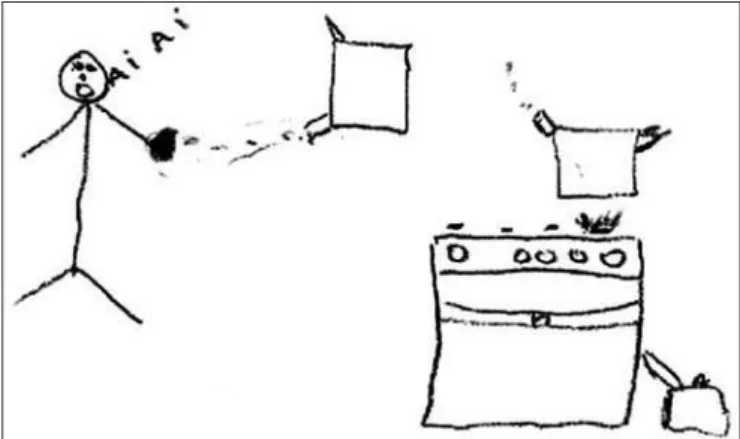
highest incidence of pain occurs in the productive popula-tion, thus signiicantly intefering with labor situation. Further discussing identiied drawing categories, we give be-low illustrations which albe-low characterizing each category: SCENES: Patients making analogies with situations close to current sufering. he drawing of a 36 years old female with pelvic pain (NS=7) is a good illustration. She referred that her pelvic pain could be compared to burning with boiling water (Figure 1), being that heat and burning sensations are pain descriptors commonly found in the literature30.
Figure 1. Example of scene
MONSTERS: representations (Figure 2) which scare, por-traying the torture caused by pain in daily life. A 74 years old male with low back pain stated living with his pain for 40 years (NS=7). He said that it was very bad, it was evil, sadism. He also mentioned that he felt he was ighting against his own body what illustrates the pattern of rejection with regard to pain12, being this a moment when patients measure forces to
Figure 2. Example of monster
OBJECTS: drawings of objects or igures expressing physical malaise and evidencing sensory pain aspects (something that irradiates, pulses, weighs or burns). Figure 3 was drawn by a 31 years old male with myofascial pain syndrome (NS=9) who referred that his pain gave him the sensation of being stabbed.
Figure 3. Example of object
GEOMETRIC SHAPES: among them, circular shapes were the most commonly drawn, which may indicate emphasis on the sensation of weight or remaining in a vicious cycle: pain-stress-pain. Figure 4 was drawn by a 36 years old female with com-plex regional pain syndrome (NS=8). She reported that her pain could improve if people would believe it is real, she felt herself alone and discredited. It is noticed in this case that the heavi-est weight was related to lack of credibility and support from relatives and from the closest social media which, in turn, has expanded her sufering to beyond physical discomfort. Although
reports like this are common in the clinical practice, there are authors who discuss the impact of chronic pain on the family, however without considering patients’ sensation of discredit.
Figure 4. Example of geometric shape
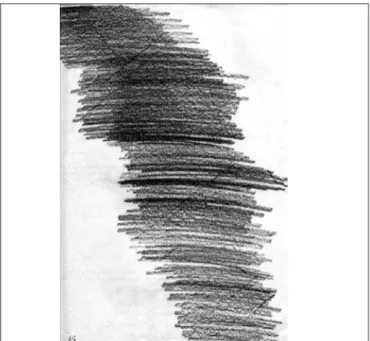
IRREGULAR SHAPES AND SCRIBBLES: these are more primitive drawings (regressed) which show motor discharge, probably impulsivity and/or anger. his is the case of igure 5, drawn by a 29 years old female with cervicogenic headache (NS=4), who referred having drawn a blot to express the bad sensation caused by pain, that is, possibly the strong tracing evidences discharge of anger and frustration32. Others have
drawn waves as if they wished to represent sensory stimula-tion circuit, explaining that they are trying to cope with the problem in a rational way, not allowing much space for emo-tions. It is noticed that drawings may illustrate the discharge of strong emotions or represent sensory pain aspects.
WHOLE BODY: self-portraits or representations of body scheme showing that pain affects them completely although, very often, this pain is affecting just one or some parts of the body. Figure 6 is a drawing of a 25 years old female with immobility syndrome (NS=10). Both patient’s drawing and report made clear that pain affected her whole body in a very severe way, as if her identity would have been taken by pain, which evidences the chaotic pattern of living with pain, where there is little or no differentiation between My-self and Pain12.
Figure 6. Example of whole body
PARTS OF THE BODY: drawings of parts of the body that ache, revealing that the focus of interest of the pa-tient is turned to uncomfortable regions, as stressed in fig-ure 7, drawn by a 40 years old female with phantom pain
(NS=7). Here one can notice the need to help the patient to broaden her body perception, thus being able to use the potential of parts of the body which were not affected by pain, as well as preventing the use of body compensa-tion schemes to impair other body areas. The pattern of dependence when living with pain prevails when patient’s interests are oriented by pain12.
MISCELLANEOUS: subjects who made drafts that could not be grouped in any identiied category were allocated to this group.
As to drawing colors, black and gray, or colors associated by patients with pain intensity have prevailed. Few participants have used colors they liked and when they used them they made clear their efort to neutralize the discomfort with some stimuli which would give a sensation of well-being. Although there is a psychological study33 about the use of colors on
drawings, the meaning attributed to this variable was not considered in this study.
With regard to the interview it has been observed that most names given to pain characterized both physical discomfort and unpleasant emotions patients felt with regard to pain; this reinforces IASP deinition of pain which highlights the importance of pain being treated from the biopsychosocial perspective34. As to age given to the time they were living with
pain, it calls the attention that patients have given ages older than the pain onset, which shows the trend to perpetuate suf-fering and the need to help them leave the position of victims. With regard to beliefs35 about what could improve pain,
passive approaches have prevailed showing the need for psycho-educative programs to further involve patients with the proposed treatment, broadening the understanding of the problem and the learning of how can they help the ef-fectiveness of the proposed treatment, strengthening coping resources and sense of eicacy36.
When asked whether they would associate their pain with other situations as bad as or worse than living with pain, half the participants have referred other events of emotional im-pact, especially mourning, which reinforces the importance of psychological assistance to this population to prevent psy-chological variables to help the maintenance or worsening of pain or to impair adhesion to proposed pain treatment. Psy-chology is broadening its space in the area of health in multi and interdisciplinary teams due to the known eicacy of its interventions and to the multidimensional character of the illness process37.
Our results have shown that the application of the Portrait of Pain helps patients express their sufering beyond physi-cal sufering, trying to understand it within the biography of each patient31. his tool minimizes individual rationalization
mechanisms, allowing the collection of important informa-tion and also the recogniinforma-tion of the inluence of psychological factors on pain perception30. Sometimes, the interview
mobi-lizes patients’ emotions and makes them perceive or recognize the demand for psychological assistance12,30.
CONCLUSION
here are few reports in the international literature on the use of projective tools by psychological studies about chronic pain evaluation and treatment, and results found in the analy-sis have shown the diiculty to generalize information, that is, they reinforce the subjective and peculiar character of each patient’s experience.
It is also important to recognize that, although the multidis-ciplinary approach is the best treatment indicated for chronic pain, patients still look for immediate solutions. hey long for invasive procedures or drugs that may place them in a pas-sive role with regard to well-being recovery.
his study has shown that emotional aspects play important role in the way individuals interpret and use their own re-sources to deal with pain, so their report should not be over-looked. Report analysis should be considered an element to be taken into consideration by health professionals in chronic pain centers to evaluate patients for further deinition of ther-apeutic approaches. Other studies should be carried out to broaden and deepen evidences of our investigation.
REFERENCES
1. Bates MS, Edwards WT, Anderson KO. Ethnocultural inluences on variation in chro-nic pain perception. Pain. 1993;52(1):101-12.
2. Wall PD, Melzack R, (editors). Textbook of pain. 4th ed. Edinburgh: Churchill
Livin-gstone; 1999. 1504p.
3. Jakobsson U, Klevsgård R, Westergren A, Hallberg IR. Old people in pain: a compa-rative study. J Pain Symptom Manage. 2003;26(1):625-36.
4. Keefe FJ, Rumble ME, Scipio CD, Giordano LA, Perri LM. Psychological aspects of persistent pain: current state of the science. J Pain. 2004;5(4):195-211.
5. Linton SJ. A review of psychological risk factors in back and neck pain. Spine. 2000;25(9):1148-56.
6. McBeth J, Macfarlane GJ, Hunt IM, Silman AJ. Risk factors for persistent chronic widespread pain: a community-based study. Rheumatology. 2001;40(1):95-101.
7. Manek NJ, MacGregor AJ. Epidemiology of back disorders: prevalence, risk factors, and prognosis. Curr Opin Rheumatol. 2005;17(2):134-40.
8. Buer N, Linton SJ. Fear-avoidance beliefs and catastrophizing: occurrence and risk factor in back pain and ADL in the general population. Pain. 2002;99(3):485-91.
9. Menzel NN. Psychosocial factors in musculoskeletal disorders. Crit Care Nurs Clin North Am. 2007;19(2):145-53.
10. Kreling MC, da Cruz DA, Pimenta CA. [Prevalence of chronic pain in adult workers]. Rev Bras Enferm. 2006;59(4):509-13. Portuguese.
11. Yeng LT, Teixeira MJ. Tratamento multidisciplinar dos doentes com dor crônica. Rev Prática Hosp. 2004;35:28-32.
12. Loduca A, Samuelian C. Avaliação psicológica: do convívio com dores crônicas à adesão ao tratamento na clínica de dor. In: Alves Neto O, Cost CM, Siqueira JTT,
Teixeira MJ, (editores). Dor, princípios e prática. 1ª ed. Porto Alegre, Artmed; 2009. 382-97p.
13. Szumita RP, Szumita PM, Just N. Understanding and managing patients with chronic pain. Oral Maxillofac Surg Clin North Am. 2010;22(4):481-94.
14. Ferreira KA, Siqueira SR, Teixeira MJ. Características demográicas, da dor e do tra-tamento dos pacientes atendidos em centro multidisciplinar de dor. Cad Saúde Colet. 2008;16(3):449-70.
15. Turk DC. Biopsychosocial perspective on chronic pain. In: Gatchel RJ, Turk DC, (editors). Psychological approaches to pain management: a practitioner’s handbook. New York: Guilfold; 1996. 3-32p.
16. Wells C, Nown G. In pain? A self-help guide for chronic pain suferers, London: Optima Book; 1993. 1-50p.
17. Campbell LC, Andrews N, Scipio C, Flores B, Feliu MH, Keefe FJ. Pain coping in Latino populations. J Pain. 2009;10(10):1012-9.
18. Shavers VL, Bakos A, Sheppard VB. Race, ethnicity, and pain among the U.S. adult population. J Health Care Poor Underserved. 2010;21(1):177-220.
19. McWhinney IR. An introduction to family medicine. New York, Oxford: Oxford University Press; 1981. 219p.
20. Goldman J, Conrad DF, Ley C, Halperin D, de la Luz Sanchez M, Villacor-ta R, et al. Validation of a Spanish language dyspepsia questionnaire. Dig Dis Sci 2002;47(3):624-40.
21. Urnes J, Johannessen T, Farup PG, Lydersen S, Petersen H. Digestive symptoms and their psychosocial impact: validation of a questionnaire. Scand J Gastroenterol. 2006;41(9):1019-27.
22. O’Brien T, Breivik H. he impact of chronic pain--European patients’ perspective over 12 months. Scand J Pain. 2012;3(1):23-9.
23. Villemor-Amaral AE, Pasqualini-Casado L. A cientiicidade das técnicas projetivas em debate. Psico USF. 2006;11(2):185-93.
24. Panek PE, Skowronski JJ, Wagner EE. Diferences on the projective hand test among chronic pain patients reporting three diferent pain experiences. J Pers Assess. 2002;79(2):235-42.
25. Nunes MF, Okino ET, Noce MA, Jardim-Maran ML. Interesses proissionais: perspec-tivas teóricas e instrumentos de avaliação. Aval Psicol. 2008;7(3):403-14.
26. Triviños ANS. Introdução à pesquisa em ciências sociais: a pesquisa qualitativa em educação. São Paulo: Atlas; 1987. 175p.
27. Bardin L. Análise de conteúdo. 3ª ed. Lisboa: Edições; 2004. 70p.
28. Melzack R, Katz J. he McGill pain questionnaire: appraisal and current status. In: Turk DC, Melzack R. Handbook of pain assessment. 2nd ed. New York: Guilford;
2001. 35-52p.
29. Loduca A, Samuelian C. Avaliação psicológica do doente com dor. In: Teixeira MJ, Braum JL, Yeng LT, Marquez JO (editores). Dor-contexto interdisciplinar, Curitiba: Editora Maio; 2002. 191-204p.
30. Lin CP, Kupper AE, Gammaitoni AR, Galer BS, Jensen MP. Frequency of chronic pain descriptors: implications for assessment of pain quality. Eur J Pain. 2011;15(6):628-33. 31. West C, Usher K, Foster K, Stewart L. Chronic pain and the family: the experience of
the partners of people living with chronic pain. J Clin Nurs. 2012;21(23-24):3352-60.
32. Hammer EF. A Técnica Projetiva do Desenho da Casa-Árvore-Pessoa: interpretação do conteúdo. In: Hammer EF. (Org.). Aplicações clínicas dos desenhos projetivos. São Paulo: Casa do Psicólogo; 1991.
33. Van Klock OL. Interpretação psicológica de desenhos: três estudos. São Paulo: Pionei-ra; 1968. 179p.
34. Classiication of chronic pain: Descriptions of chronic pain syndromes and deinitions of pain terms. Seattle (WA): IASP Press; 1994.
35. McCracken LM, Carson JW, Eccleston C, Keefe FJ. Acceptance and change in the context of chronic pain. Pain. 2004;109(1-2):4-7.
36. Asghari A, Nicholas MK. Pain self-eicacy beliefs and pain behaviour: a prospec-tive study. Pain. 2001;94(1):85-100.