CASE REPORT
Subarachnoid neurolytic blockade in patient with refractory cancer pain.
Case report*
Bloqueio neurolítico subaracnoideo em paciente com dor oncológica refratária. Relato de caso
José Osvaldo Barbosa Neto1, Ângela Maria Sousa2, Silvia Maria Machado Tahamtani2, Hazem Adel Ashmawi3 *Received from the Cancer Institute of the State of São Paulo. Clinicas Hospital, School of Medicine, University of São Paulo. São Paulo, SP.
ABSTRACT
BACKGROUND AND OBJECTIVES: he use of subarach-noid neurolytic blockade to control pain has decreased in recent years due to the introduction of new techniques, but it is still important to control refractory cancer pain. his study aimed at presenting a case of cancer pain where this technique was used to control pain.
CASE REPORT: Male patient, 45 years old, with locally advanced
anal canal scamous cell carcinoma and ulcerated lesion in perineal region with enterovesical istula and local infection. Patient had severe pain with numerical verbal scale (NVS) = 10 and was being pharmacologically treated with high opioid doses and adjuvants without good response. Subarachnoid neurolytic blockade was induced with 5% phenol with signiicant pain relief; 20 minutes ater the procedure patient has referred 80% relief. Improvement has remained for 21 days when patient died due to infectious com-plications.
CONCLUSION: his case has illustrated the use of subarachnoid blockade with 5% phenol to control cancer pain. he conclusion is that for selected cases, where life expectation is limited, this tech-nique may be successfully used.
Keywords: Analgesia, Cancer pain, Neurolytic blockade.
RESUMO
JUSTIFICATIVA E OBJETIVOS: O uso de bloqueio neu-rolítico subaracnoideo no controle de dor tem diminuído nos úl-timos anos devido à introdução de novas técnicas, mas ainda tem importância no controle de dor oncológica refratária. O objetivo deste estudo foi apresentar um caso de dor oncológica, em que esta técnica foi utilizada para controle da dor.
RELATO DO CASO: Paciente do sexo masculino, 45 anos, diag-nosticado com carcinoma espinocelular de canal anal localmente avançado e lesão ulcerada em região perineal com presença de fístula retovesical e infecção local. O paciente apresentava dor in-tensa com escala verbal numérica (EVN) =10 e recebia tratamento farmacológico com doses altas de opioide e adjuvantes sem boa res-posta. Foi realizado bloqueio neurolítico subaracnoideo com fenol a 5% e após realização do bloqueio houve melhora signiicativa do quadro doloroso, tendo paciente referindo alívio de 80% após 20 minutos do procedimento. A melhora permaneceu até o 21º dia após bloqueio quando o paciente foi a óbito devido complicações infecciosas.
CONCLUSÃO: O caso ilustrou o uso do bloqueio subaracnoideo com fenol a 5% para controle de dor oncológica. Conclui-se que para casos selecionados, onde a expectativa de vida é limitada, esta técnica pode ser empregada com sucesso.
Descritores: Analgesia, Bloqueio neurolítico, Dor oncológica.
INTRODUCTION
Pain is a prevalent symptom among cancer patients and still remains a fac-tor generating major morbidity for patients and their families. In a broad review of the last 40 years, general pain prevalence among these patients was 53%, and from 58% to 69% in patients with advanced disease1.
Cancer pain management is currently oriented by the World Health Organization’s analgesic ladder and is able to efectively manage 80% to 90% of patients with drug therapy. However, 10% to 20% of can-cer patients do not adequately respond to drugs and beneit from interventional pain therapy2,3.
Subarachnoid neurolytic blockade is an efective interventional technique used to control cancer pain. Its use has decreased in recent years due to the introduction of new interventional therapy modali-ties, but this technique is still important to control refractory cancer pain4.
1. Anesthesiologist of the Cancer Institute of the State of São Paulo, Clinicas Hospital, School of Medicine, University of São Paulo (HC-FMUSP). São Paulo, SP, Brazil. 2. Anesthesiologist, Doctor by the School of Medicine, University of São Paulo (FMUSP); Supervisor of the Pain Control Team of the Cancer Institute of the State of São Paulo, Clini-cas Hospital, School of Medicine, University of São Paulo (HC-FMUSP). São Paulo, SP, Brazil.
3. Physician, Free Professor by the School of Medicine, University of São Paulo (FMUSP); Supervisor of the pain control Team, Anesthesiology Division, Clinicas Hospital, School of Medicine, University of São Paulo (HC-FMUSP). São Paulo, SP, Brazil.
Submitted in October 02, 2012.
Accepted for publication in February 27, 2013. Correspondence to:
José Osvaldo Barbosa Neto, M.D. Av. Dr. Enéas de Carvalho Aguiar, 255 - 8o A
Serviço de Anestesia - Prédio dos Ambulatórios 05403-000 São Paulo, SP.
E-mail: [email protected]
76
cSociedade Brasileira para o Estudo da Dorhis study aimed at reporting a case of cancer pain refractory to drug therapy where this technique was used to control pain.
CASE REPORT
Male patient, 45 years old, with locally advanced anal canal scamous cell carcinoma who was referred to the Pain Management Center of the institution for evaluation of diicult to control pain.
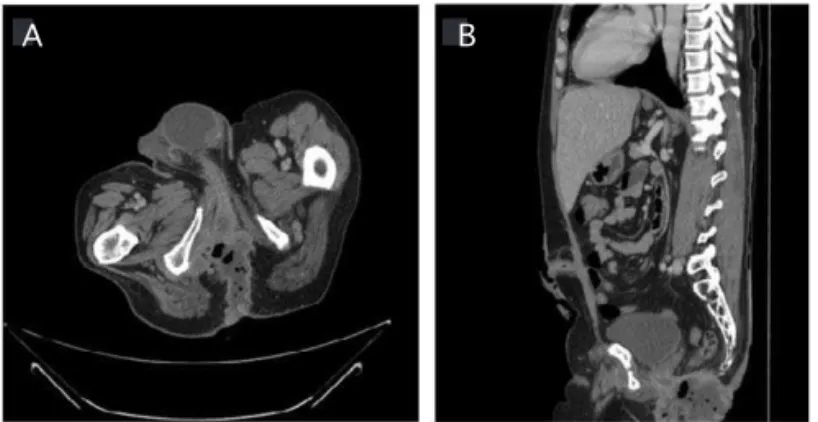
Patient had ulcerated lesion in perineal region with presence of reto-vesical istula and local infection, in addition to signs of skin infec-tion on right thigh.
CT images illustrate the extension of the lesion (Figure 1).
he surgical team considered the tumor inoperable and several che-motherapy and radiation therapy cycles had not been successful to control the lesion. Ultimately, we decided for protective colostomy and referral to exclusive palliative care.
Patient reported severe pain in perineal region, with numerical verbal scale (NVS) = 10, continuous, burning and stabbing. Patient also re-ferred incidental, spontaneous and disabling pain. He had diiculty to walk and to remain sat down, so he would spend most of the time standing up. He took up to 300 mg morphine to obtain pain relief. His normal prescription was transdermal fentanyl (250 μg/h), res-cue morphine (120 mg) up to every four hours, dipirone (2 g) every 6 hours, amitriptyline (75 mg) at night, diclofenac (50 mg) every eight hours, and gabapentin (900 mg/d). However, in spite of such high analgesic doses, he remained with severe pain.
Due to refraction to drug therapy and ater signing the free and in-formed consent term, patient was submitted to subarachnoid neuro-lytic blockade with 5% phenol, in a total of 2 mL, in L5-S1 interspace in the sitting position.
Pain has signiicantly improved ater blockade, with 80% relief 20 minutes ater the procedure, with NVS = 1-2 most of the time,
which has led to rescue drugs withdrawal and to less severe crises of incidental pain (NVS = 6).
Improvement remained until the 21st day ater blockade when
pa-tient died due to infectious complications of right leg cellulites.
DISCUSSION
Pain is feared by cancer patients and up to 20% of them are not adequately managed. he use of timely interventional therapy may provide a dramatic decrease in opioid consumption and decrease morbidity caused by pain to this group of patients5. Our case has
illustrated the use of subarachnoid blockade with 5% phenol to con-trol perineal pain refractory to drug therapy with high opioid doses associated to adjuvants.
Among the advantages of this technique, there is a good cost/beneit ratio for the patient with less follow up visits as compared to other techniques6. Major associated risks are short duration of analgesia
and the possibility of developing lower limbs weakness and sphinc-ter dysfunction6.
In our case, patient had already been submitted to colostomy which made irrelevant the risk for sphincter dysfunction. Since patient had already major ambulation limitations, the beneit of pain relief would overcome the risk for permanent motor block.
Since the efect of this block lasts no more than six months, patients indicated for such therapy should have limited life expectation and untreatable and well localized disease7.
Most common chemicals are 50%-100% alcohol and 7%-12% phe-nol. We decided for phenol, which is a hyperbaric solution with re-gard to CSF. Using this agent’s property it is possible to limit the appearance of side efects by concentrating the agent on sacral ibers and leaving the patient in the sitting position for a prolonged time (saddle block). In addition, phenol induces a higher intensity blockade with less risk for chemical neuritis5.
he conclusion was that, for selected cases where life expectancy is limited, this technique may be successfully used to rapidly control cancer pain.
REFERENCES
1. van den Beuken-van Everdingen MH, de Rijke JM, Kessels AG, et al. Prevalence of pain in patients with cancer: a systematic review of the past 40 years. Ann Oncol. 2007;18(9):1437-49.
2. Burton AW, Hamid B. Current challenges in cancer pain management: does the WHO ladder approach still have relevance? Expert Rev Anticancer her. 2007;7(11):1501-2. 3. Miguel R. Interventional treatment of cancer pain: the fourth step in the World Health
Organization analgesic ladder? Cancer Control. 2000;7(2):149-56.
4. Sloan PA. he evolving role of interventional pain management in oncology. J Support Oncol. 2004;2(6):491-503.
5. Watanabe A, Yamakage M. Intrathecal neurolytic block in a patient with refractory cancer pain. J Anesth. 2011;25(4):603-5.
6. Chambers WA. Nerve blocks in palliative care. Br J Anaesth. 2008;101(1):95-100. 7. Gerbershagen HU. Neurolysis. Subarachnoid neurolytic blockade. Acta Anaesthesiol
Belg. 1981;32(1):45-57.
77
Barbosa Neto, Sousa, Tahantami et al.
A: axial slice showing infected lesion with gaseous content in perineal region. B: coronal slice showing infected lesion in perineal region and ex-tending to the skin.
Figure 1 – CT of abdomen and pelvis.
A B
157
Subarachnoid neurolytic blockade in patient with refractory cancer pain.
Case report
Bloqueio neurolítico subaracnoideo em paciente com dor oncológica refratária. Relato de caso
José Osvaldo Barbosa Neto, Ângela Maria Sousa, Silvia Maria Machado Tahantami, Hazem Adel Ashmawi
Rev Dor. 2013;14(1):76-7
he correct spelling of Dr. Silvia is Silvia Maria Machado Tahamtani.
Regards,
José Osvaldo Barbosa Neto