ABSTRACT
BACKGROUND AND OBJECTIVES: Studies carried out worldwide have shown that the incidence of dental pain is one reason leading people to look for dental services and that it impairs quality of life. his study aimed at observing the prevalence of dental pain, pain-related absenteeism and pos-sible associations with sociodemographic characteristics. METHODS:his was an analytical, observational and trans-versal study using a randomized sample of 312 public servants obtained from a universe of 994 employees of the City Hall of Marataízes, ES. A structured script with 27 items was used for data collection, which was carried out between May and June 2009, by three qualiied servants. Chi-square and Fisher Exact tests were used to compare dental pain percentages and absenteeism to sociodemographic factors.
RESULTS: he prevalence of dental pain among employees was 57.0%, with higher prevalence among those with socio-economic condition C/D/E (OR= 1.560). From those re-porting dental pain, 17.8% have missed work, with higher prevalence of those of socioeconomic condition C/D/E (OR= 3.816) and with incomplete high school (OR= 2.298). CONCLUSION: High dental pain prevalence was observed and enough to produce absenteeism, with higher frequency among workers of less favored economic classes and with low-er education level.
Keywords:Absenteeism, Dental pain, Worker’s health.
Association between dental pain and absenteeism among public workers
from Southeastern Brazil*
Associação entre dor de dente e absenteísmo em funcionários públicos do sudeste do Brasil
Maria Helena Monteiro de Barros Miotto1, Wadson José Gonçalves Lima2, Ludmilla Awad Barcellos3
*Received from Federal Univesrity of Espírito Santo, Vila Velha, ES, Brazil.
1. Federal University of Espírito Santo, Vitória, ES, Brazil. 2. Brazilian Association of Dentistry, Vitória, ES, Brazil. 3. Vila Velha Universtiy, Vila Velha, ES, Brazil.
Submitted in May 23, 2014.
Accepted for publication in August 21, 2014. Conlict of interests: none.
Correspondence to:
Maria Helena Monteiro de Barros Miotto Av. Marechal Campos 1468 – Maruípe 29040-091 Vitória, ES, Brasil. E-mail: [email protected]
© Sociedade Brasileira para o Estudo da Dor
RESUMO
JUSTIFICATIVA E OBJETIVOS: Pesquisas realizadas em todo o mundo demonstram que a ocorrência de dor de dente é uma das razões que levam as pessoas a procurar o serviço odontológico, comprometendo a qualidade de vida. O obje-tivo deste estudo foi veriicar a prevalência da dor dentária, absenteísmo motivado pela dor e possíveis associações com características sociodemográicas.
MÉTODOS: Estudo analítico, observacional, transversal utilizou uma amostra aleatória de 312 servidores obtida de um universo de 994 funcionários da Prefeitura do município de Marataízes, ES. Foi utilizado um roteiro estruturado com 27 itens para a coleta de dados, realizada entre maio e junho de 2009, por três servidoras treinadas. Para comparação dos percentuais de dor dentária e absenteísmo com os fatores so-ciodemográicos foram utilizados os testes Qui-quadrado e Exato de Fisher.
RESULTADOS: A prevalência de dor dentária entre os fun-cionários foi de 57,0%, com maior prevalência naqueles com condição socioeconômica C/D/E (OR=1,560). Dos que sen-tiram dor dentária, 17,8% faltaram ao trabalho, com maior prevalência para os de condição socioeconômica C/D/E (OR=3,816) e com escolaridade até o ensino médio incom-pleto (OR= 2,298).
CONCLUSÃO: Alta prevalência de dor de dente foi ob-servada e suiciente para produzir absenteísmo, com maior frequência em trabalhadores inseridos nas classes econômicas menos favorecidas e com menor escolaridade.
Descritores: Absenteísmo, Odontalgia, Saúde do trabalhador.
INTRODUCTION
Epidemiological studies show that pain is the primary reason for looking for health services and is one of the major causes of human sufering, impairing quality of life (QL) and psy-chosocial and economic status1.
Dental pain is one of the most common pains afecting hu-mankind. It is responsible for a large number of work losses. Absences from work due to health problems relect incapacity to perform labor activities2.
Absenteeism caused by oral problems is poorly studied in Bra-zil. here are no updated data on the number of lost working days due to dental pain, in national, state and municipal
els. here is also no information about the burden brought by such absences, such as the psychosocial impact for workers. here are two types of absenteeism: type 1 is characterized by absence from work; type 2 is characterized by physical pres-ence with individuals working with pain3.
Dental problems may produce pain, discomfort and generate signs and symptoms, which go from decreased attention to work, to absence, in addition to social behaviors of isolation. his fact reairms the need for and the importance of dentists (D) participating in multidisciplinary teams3.
he compartmentalization which sees the mouth separated from the body is outdated. It is impossible to talk about in-tegral workers’ health attention without inserting Dentistry actions, which should be carried out within Occupational Health Medical Control Programs (OHMCP) by duly quali-ied Ds to deal with the speciicity of oral health and work re-lationship5. he proposal of legislative bill 422/2007 is based on this understanding and tries to contribute to close the ex-isting gap, promoting the expansion of the number of actions aimed at preventing and assisting occupational diseases, with incorporation of Labor Dentistry actions. his is the only way for companies to comply with their social duty of promoting integral health assistance to their workers6.
Oral problems may directly impact professional performance. Because labor health promotion programs have a limited number of speciic actions for oral health, there is the need to implement an oral health promotion protocol within compa-nies. he implementation of such program would avoid ab-senteeism and decrease in productivity. Workers’ oral health teams should orient their actions to promote health7.
his study aimed at measuring the frequency of dental pain in the last six months, and the possible occurrence of absen-teeism caused by toothache and associations with sociode-mographic variables of employees of the local government of Marataízes, ES.
METHODS
his is a transversal study with representative sample of local government workers of a resort to the South of the State, 200 km far from the capital. Parameters used for sample calcula-tion were: expected prevalence of 35% - results found in stud-ies carried out in the region – conidence level of 95%, error of 5% and n=994. Calculation has resulted in a sample of 260 employees plus 52 more individuals, considering a possible loss of up to 20%. he study has used a randomized sample of 312 employees. hose in maternal or medical leave were excluded from the study.
Data were collected by means of a validated questionnaire with 27 items regarding sociodemographic characteristics, need for total or partial prosthesis, dentition status (presence or total absence of teeth), dental pain, absenteeism, and type of service used for treatment.
Scripts were used as standardized interviews and were ap-plied by three trained interviewers, non-participant public servants, assuring cultural, economic and social equivalence
with respondents, between May and June 2009.
Chi-square and Fisher Exact tests were used to check possible associations. Signiicance level was 5%. Odds Ratio (OR) and respective Conidence Intervals were calculated to check as-sociation power. Research was carried out according to ethical principles and was approved by the Research Ethics Commit-tee, Federal University of Espirito Santo in March 24, 2009, protocol 023/09. All participants have signed the Free and Informed Consent Term.
RESULTS
Final sample was made up of 286 employees, above the origi-nal calculation (n=252). here has been predominance of fe-males (64%), young individuals, 65% below 40 years of age, and 61.2% were married. With regard to education level, most (74.1%) have reported complete high school or above; income has not followed education level; 46.1% have reported family income of up to two minimum wages and 60.8% have reported belonging to socioeconomic condition C (Table 1).
Table 1. Sociodemographic data of civil servants. Marataízes/ES
Characteristics n %
Gender
Male 103 36.0
Female 183 64.0
Age group (years)
18 – 30 63 22.0
31 – 40 123 43.0
41 – 50 80 28.0
51 or above 20 7.0
Marital status
Single 59 20.6
Married 175 61.2
Cohabitating 32 11.2
Divorced 20 7.0
Education level
Incomplete elementary school 39 13.6
Complete elementary school 21 7.4
Incomplete high school 14 4.9
Complete high school 95 33.2
Incomplete college 41 14.3
Complete college 76 26.6
Family income
Less than 1 minimum wage 7 2.4
1 to 2 minimum wages 125 43.7
3 to 5 minimum wages 127 44.4
6 to 10 minimum wages 21 7.3
Above 10 minimum wages 6 2.2
Socioeconomic condition
A 10 3.5
B 79 27.6
C 174 60.8
D 18 6.3
E 5 1.8
With regard to dentition, 84 (29.4%) have reported no tooth loss, 201 (70.3%) have reported at least one tooth loss and one employee (0.3%) has reported being edentulous.
From participants reporting tooth loss, 119 (58.9%) had lost posterior teeth, 14 (6.9%) anterior teeth and 69 (34.2%) pos-terior and anpos-terior teeth. As to the reported need for remov-able partial prosthesis (RPP), 191 participants (66.8%) have answered they did not need, 84 (29.4%) have reported need and 11 (3.8%) have refused to answer.
With regard to reported need for total prosthesis, 253 (88.5%) have answered they did not need, 25 (8.7%) have perceived the need and 8 (2.8%) have refused to answer (Table 2). Prevalence of toothache was 57%, considered high and enough to lead to the use of dental services in 39.9% of these employees. he use of public dental services (47.7%) was very close to that recorded for private services (44.6%). he num-ber of employees (6.2%) looking for a fake professional was surprising (Table 2).
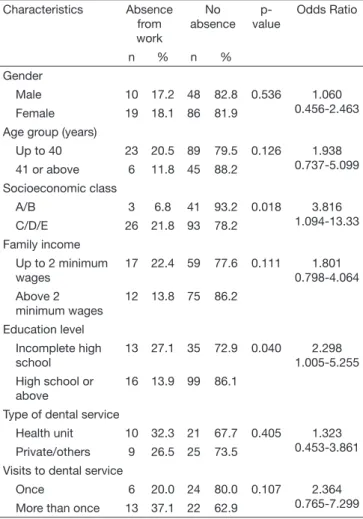
he prevalence of reported absenteeism caused by toothache was 17.8%, generating loss of up to one working day for 93.2%. With regard to productivity, 27% of employees with toothache have reported that it has interfered with labor ac-tivities (Table 3).
With regard to variables gender, age group, socioeconomic condition (SEC), family income and education level, results have shown no statistically signiicant association with the
prevalence of toothache. When testing variable SEC, p value (0.054) was very close to nominal limit, showing potentially signiicant result (Table 4).
Prevalence of absenteeism was higher among employees of socioeconomic classes C/D/E (OR= 3.816, CI 95% = 1.094;13.333), that is, the chance of classes C/D/E individu-als missing work due to toothache was 3.816 times higher as compared to that of classes A and B.
Workers with education level up to incomplete high school had 2.298 times more chance of missing work due to tooth-ache (OR= 2.298, CI 95% = 1.005;5.255), as compared to those with higher level education (Table 5).
Table 4. Data on dental pain and sociodemographic characteristics of civil servants. Marataízes/ES
Characteristics Pain No pain p-
value
Odds Ratio
n % n %
Gender
Male 58 56.3 45 43.7 0.479 1.044
0.641-1.700
Female 105 57.4 78 42.6
Age group (years)
Up to 40 112 60.2 74 39.8 0.085 1.454
0.891-2.373
41 or above 51 51.0 49 49.0
Socioeconomic class
A/B 44 49.4 45 50.6 0.054 1.560
0.942-2.583
C/D/E 119 60.4 78 39.6
Family income
Up to 2 minimum wages
76 57.6 56 42.4 0.474 1.045
0.653-1.672
Above 2 minimum wages
87 56.5 67 43.5
Education level
Incomplete high school
48 64.9 26 35.1 0.073 1.557
0.900-2.695
Complete high school or above
115 54.2 97 45.8
Table 3. Absenteeism data of civil servants. Marataízes/ES
Characteristics n %
Absence from work due to pain
Yes 29 17.8
No 134 82.2
Absence from work
One shift 16 55.3
One day 11 37.9
Two to three days 2 6.8
Productivity at work with toothache
Paid no attention to tasks 9 6.7
Postponed tasks to next Day 8 6.0
Failed to carry out tasks 10 7.5
Has not justiied 107 79.9
Table 2. Data on dental pain of civil servants. Marataízes/ES
Characteristics n %
Pain
Yes 163 57.0
No 123 43.0
Looked for dental assistance
Yes 65 39.9
No 98 60.1
Type of service
Health unit 31 47.7
Fake professional 4 6.2
Private 29 44.6
Other 1 1.5
Number of visits to dental service
Once 30 46.2
Twice 18 27.6
Three times or more 17 26.2
Reason for not using the serviced
Fear 3 3.1
Felt no need 46 46.9
Was not allowed 9 9.2
Lack of money 12 12.2
Could not schedule visit 3 3.1
Other reason 1 1.0
DISCUSSION
Dental pain prevalence among participants of this study was 57.0% and was considered high; however, it was similar to other results found in Espírito Santo, of 43% among employ-ees of the local government of Venda Nova do Imigrante8 and of 46.7% among employees of a food company in Linhares9. International studies have also found similar results10, of 51.9% among Australian employees11, and of 43.6% among employees of two Malaysian industries. Some Brazilian stud-ies have shown lower prevalence: 33.7% among students aged from 12 to 13 years in Florianópolis-SC12; 28% among met-allurgical and mechanical employees in Xanxerê-SC13; 20.7% among employees of the Municipal Urban Cleaning Depart-ment of Porto Alegre-RS14.
Such comparisons are impaired by variations among age groups, observation intervals (last two weeks, six months or even 12 months), and diferent regions within Brazil and worldwide. It is important to stress that methodological as-pects of future epidemiological studies on the subject should be standardized to provide more reliable comparisons15. In our study, toothache was not associated to gender, being in agreement with other studies16,17. here are reports showing
that males have higher chance of having dental pain18,19. Classes C/D/E workers had 56% more chance of experienc-ing toothache as compared to those of more privileged classes. Extensive literature has shown a higher prevalence of tooth decay and its consequences in more destituted classes. Worst indices worldwide are found in regions of social deprivation. Social status is the fundamental cause of the disease, because it mediates the access to society resources and this determines the access to all points of the causal chain of the health/dis-ease process20. Most studies on oral health social determinants associate social class, socioeconomic class, income and educa-tion level to oral health condieduca-tions21.
Our study has not found statistically signiicant diference in family income and the prevalence of dental pain, being in disagreement with studies showing that low income families were more susceptible to dental pain12,17,18,22,23. A possible ex-planation to this inding is that, in our study, Brazilian salary inequality was not reproduced, having salary proximity at the cutof point for the analysis of the variable.
Absenteeism due to dental pain in our study was 17.8%, very close to results found in Espírito Santo and Brazil15,19. his study has shown that 20.0% of employees with toothache have reported loss of productivity during their labor activities due to poor attention or mistakes when carrying out tasks. his is important not only due to decreased productivity, but also to the increased risk of labor accidents. Gemeli24 has in-vestigated labor accidents and has found that in 11.0% of cases, respondents have reported dental pain on the day of the accident suggesting possible interference of dental pain on workers’ attention and concentration.
Brazil is a champion in labor accident statistics. It is always important to remind that such statistics relect accidents re-corded by Social Security. It estimated that in Brazil there is still a high rate of underreporting of accidents25.
Our study has observed that 39.9% of participants with den-tal pain have looked for denden-tal services. Most widely used type of service was public service (47.7%), followed by pri-vate service (40%). Since sample is made up of municipal employees, this could, in a way, have motivated the use of public oral health services. But even with large part (46%) reporting family income of up to two minimum wages, a large percentage has used the private system. Studies are needed to understand oral health values and beliefs and the existence of barriers which may afect the use of public services. Studies are also needed to understand the fact that 6.2% of workers have looked for a fake professional, although being employees of a local government of the Southeastern Region where den-tal services are available and which, according to the Brazilian Constitution26, should assure access to all citizens, especially in urgent cases27.
he use of oral health services is determined by several vari-ables with diferent prediction power28. Several studies have shown perception of need as the characteristic with highest explanation power for the search for dental assistance. Dental pain is not always enough to motivate a visit to the dental service29.
Table 5. Data on absenteeism due to toothache of employees of the local government of Marataízes/ES, 2009
Characteristics Absence
from work
No absence
p- value
Odds Ratio
n % n %
Gender
Male 10 17.2 48 82.8 0.536 1.060
0.456-2.463
Female 19 18.1 86 81.9
Age group (years)
Up to 40 23 20.5 89 79.5 0.126 1.938
0.737-5.099
41 or above 6 11.8 45 88.2
Socioeconomic class
A/B 3 6.8 41 93.2 0.018 3.816
1.094-13.33
C/D/E 26 21.8 93 78.2
Family income
Up to 2 minimum wages
17 22.4 59 77.6 0.111 1.801
0.798-4.064
Above 2 minimum wages
12 13.8 75 86.2
Education level
Incomplete high school
13 27.1 35 72.9 0.040 2.298
1.005-5.255
High school or above
16 13.9 99 86.1
Type of dental service
Health unit 10 32.3 21 67.7 0.405 1.323
0.453-3.861
Private/others 9 26.5 25 73.5
Visits to dental service
Once 6 20.0 24 80.0 0.107 2.364
0.765-7.299
From workers reporting toothache in the last six months and not having looked for oral health services, 46.9% have not perceived the need and 12.0% failed to do it due to lack of money, which may suggest a lack of third shift dental assis-tance in the public service or not having been waived for treat-ment. he high prevalence of pain and absenteeism found in this study justiies the implementation of actions, going from the creation of health public service third shift to the inser-tion of Ds in the company8.
One cannot discard the possibility of self-medication, very popular and concerning procedure in Brazil for being inade-quately and abusively done and, most of the times, with drugs subject to medical prescription30. Self-medication is also very popular in other countries. With poorly-structured health system, going to the pharmacy is the irst option to solve a health-related problem. Simpler and more commonly used drugs, such as analgesics, are available in pharmacies and even in supermarkets, may be purchased without medical prescrip-tion and are the most widely used as self-medicaprescrip-tion31,32. Our study has found that employees with socioeconomic con-dition C/D/E had almost four times more chance of missing work due to dental pain, as compared to classes A/B. Men-tioned Brazilian studies have not considered this variable; international studies use a diferent tool to classify subjects according to social status, thus making comparisons diicult. Our results have shown that employees with lower educa-tion level had 2.3 times more chance of missing work due to toothache. hese results are similar and comparable to other studies8,18,33.
CONCLUSION
Our study has observed high prevalence of toothache gen-erating absenteeism, with higher frequency among workers from less privileged economic classes and with lower educa-tion levels.
Strategies directed to health promotion and to better access to dental services certainly will be able to decrease observed frequencies.
REFERENCES
1. Brasil. Ministério da Saúde. Portaria nº 19/GM. Brasília, 3 jan. 2002. Disponível em: http://dtr2001.saude.gov.br/sas/Portarias/Port2005/GM/GM-19.htm. Acessado em: 10 de novembro de 2009.
2. Yano SR, Santana VS. Faltas ao trabalho por problemas de saúde na indústria. Cad Saude Publica. 2012;28(5):945-54.
3. Aguiar GA, Oliveira JR. Absenteísmo: suas principais causas e consequências em uma empresa no ramo de saúde. Rev Ciências Gerenciais. 2009;8(18):95-113.
4. Sheiham A. Oral health, general health and quality of life. Bull World Health Organ. 2005;83(9):644.
5. Brasil. Câmara dos Deputados. Comissão de Trabalho, de Administração e Serviço Público, Brasília. Projeto de Lei, PL nº 957/2003. Disponível em: http://www.camara.
gov.br. Acessado em: 02 de setembro de 2008.
6. Brasil. Câmara dos Deputados. Comissão de Desenvolvimento Econômico, Indústria e Comércio. Brasília. Projeto de Lei, PL n.º 422/2007. Disponível em: http://www. camara.gov.br. Acessado em: 02 de setembro de 2008.
7. Medeiros UV, Abreu CM. Protocolo de promoção de saúde bucal em empresas. Rev Bras Odontol. 2006;63 (1/2):29-32.
8. Miotto MH, Silotti JC, Barcellos LA. Dor dentária como motivo de absenteísmo em uma população de trabalhadores. Cien Saude Colet. 2012;17(5):1355-63. 9. Miotto MH, Barcellos LA, Lopes ZV. Dor de dente como preditor de absenteísmo
em trabalhadores de uma indústria de sucos da Região Sudeste do Brasil. Cienc Saúde Colet. 2013;18(11):3183-90.
10. Sanders AE, Spencer AJ. Job characteristics and the subjective oral health of Australian workers. Aust N Z J Public Health. 2004;28(3):259-66.
11. Jaafar N, Razak IA, Zain RB. he impact of oral and facial pain in an industrial popu-lation. Ann Acad Med Singapore. 1989;18(5):553-5.
12. Nomura LH, Bastos, JL, Peres MA. Prevalência de dor de dente e associação com cárie e condições socioeconômicas em escolares, sul do Brasil, 2002. Braz Oral Res. 2004;18(2):134-40.
13. Lacerda JT, Traebert J, Zambenedetti ML. Dor orofacial e absenteísmo em trabalha-dores da indústria metalúrgica e mecânica. Saúde Soc. 2008;17(4):182-91. 14. Gomes AS, Abegg C. O impacto odontológico no desempenho diário dos
trabalha-dores do departamento municipal de limpeza urbana de Porto Alegre, Rio Grande do Sul, Brasil.Cad Saúde Pública. 2007;23(7):1707-14.
15. Nardi A, Michel-Crosato M, Biazevic MG, Cosato E, Pizzatto E, Queluz DP. Rela-tionship between orofacial pain and absenteeism among workers in Southern Brasil. Braz J Oral Sci. 2009;8(1):50-4.
16. Locker D, Grushka M. he Impact dental and facial pain. J Dent Res. 1987;66(9):1414-7.
17. Pau AK, Croucher R, Marcenes W. Prevalence estimates and associated factors for dental pain: a review. Oral Health Prev Dent. 2003;1(3):209-20.
18. Alexandre GC, Nadanovsky P, Lopes CS, Faerstein E. Prevalência e fatores associados à ocorrência da dor de dente que impediu a realização de tarefas habituais em uma população de funcionários públicos no Rio de Janeiro, Brasil. Cad Saúde Pública. 2006;22(5):1073-8.
19. Nardi A, Michel-Crosato E, Biazevic MGH. Dores dental e facial em trabalhadores do sul do Brasil, 2003. Rev Odontol UNESP. 2006;35(1):81-7.
20. Graham H. Social determinants and their unequal distribution: clarifying policy un-derstandings. Milbank Q. 2004;82(1):101-24.
21. Newton JT, Bower EJ. he social determinants of oral health: new approaches to conceptualizing and researching complex causal networks. Community Dent Oral Epidemiol. 2005;33(1):25-34
22. Bastos JL, Nomura LH, Peres MA. Dor de dente e sua relação com condições sócio--econômicas e cárie dentária em adultos jovens do sexo masculino no Sul do Brasil. Cad Saúde Pública. 2005;21(5):1416-23.
23. Goes PSA, Sheiham A, Watt RG, Hardy R. he prevalence and severity of dental pain in Brazilian 14-15 years old schoolchildren. Community Dental Health. 2007; 24: 217-24, 2007.
24. Gemeli TR. Aplicação e análise de metodologia investigatória de causalidade entre morbidez odontológica e acidentes de trabalho. Disponível em: http://www.saude. sc.gov.br. Acesso em: 20 de fevereiro de 2009].
25. Binder MCP, Almeida IM. Acidentes de trabalho: acaso ou descaso. In: Mendes R, (editor). Patologia do trabalho. São Paulo: Atheneu; 2005. 769-810p.
26. Brasil. Constituição [da] República Federativa do Brasil. Brasília: Senado Federal; 1988.
27. Brasil. Ministério da Saúde. Diretrizes da Política Nacional de Saúde Bucal. 2004. Disponível em: http//www.saude.ms.gov.br. Acesso em 13 de junho de 2010. 28. Baldani MH, Brito WH, Lawder JA, Mendes YB, da Silva F de F, Antunes JL.
Deter-minantes individuais da utilização de serviços odontológicos por adultos e idosos de baixa renda. Rev Bras Epidemiol. 2010;13(1):150-62.
29. Reisine ST. Dental disease and work loss. J Dent Res. 1984;63(9):1158-61. 30. Mastroianni P de C, Lucchetta RC, Sarra J dos R, Galduróz JC. Estoque doméstico e
uso de medicamentos em uma população cadastrada na estratégia saúde da família no Brasil. Rev Panam Salud Publica. 2011;29(5):358-64.
31. Loyola Filho AI, Uchoa E, Guerra HL, Firmo JO, Lima-Costa MF. Prevalência e fatores associados à automedicação: resultados do projeto Bambuí. Rev Saúde Pública. 2002;36(1):55-62.
32. Schmid B, Bernal R, Silva NN. Automedicação em adultos de baixa renda do municí-pio de São Paulo. Rev Saude Publica. 2010;44(6):1039-45.