Risk behavior for the Human Immunodeiciency Virus
among motel clients
Helisamara Mota Guedes
1Luciana Oliveira Costa Cabral
2Maria Verônica de Barros Costa
2Alex Ferreira dos Reis
3Simone Gomes Pereira
2Fernanda Oliveira-Ferreira
4This study aimed to verify risk behavior for infection with the Human Immunodeiciency Virus
in people who attended motels. This is a cross-sectional study conducted in two motels in
two municipalities in the state of Minas Gerais, Brazil, with a sample of 308 randomly selected
individuals, aged between 18 and 60 years. Bivariate (chi-square and t test for independent
samples) and multivariate (logistic regression) statistical tests were performed. A total of 45.8%
of the participants reported not having used a condom during the last vaginal sexual intercourse,
48.4% did not use a condom during the last oral sex, while 26.3% reported not having used
a condom in the last anal intercourse. Having a steady partner was the strongest predictor of
not using condoms. Probable beliefs regarding loyalty involved in a stable relationship may be
contributing to the failure to use condoms during intercourse, increasing the risk of HIV infection.
Descriptors: HIV; Sexual Behavior; Condoms; Sexuality.
1 Doctoral Student, Universidade Federal de Minas Gerais, Brazil. Assistant Professor, Departamento de Enfermagem, Universidade
Federal dos Vales do Jequitinhonha e Mucuri, Brazil.
2 Undergraduate students in Nursing, Centro Universitário do Leste de Minas Gerais, Brazil.
3 Undergraduate student in Nursing, Centro Universitário do Leste de Minas Gerais, Brazil. Scholarship holder from Programa de
Iniciação Cientíica PIC Unileste.
4 PhD, Adjunct Professor, Departamento de Ciências Básicas, Universidade Federal dos Vales do Jequitinhonha e Mucuri, Brazil.
Corresponding Author: Helisamara Mota Guedes Rua da Glória, 187 Centro
CEP: 39100-000, Diamantina, MG, Brasil E-mail: [email protected]
Rev. Latino-Am. Enfermagem
2012 May.-June;20(3):536-42
www.eerp.usp.br/rlae
Comportamentos de risco frente ao vírus da imunodeiciência humana entre frequentadores de motéis
Este estudo teve por objetivo veriicar comportamentos de risco referentes à infecção pelo vírus da imunodeiciência humana (HIV) em pessoas que frequentaram motéis. Trata-se de estudo transversal, realizado em dois motéis de dois municípios do interior de Minas Gerais, com amostra de 308 indivíduos, seguindo cálculo amostral, selecionados aleatoriamente, com idade entre 18 e 60 anos. Foram realizados testes estatísticos bivariados (qui-quadrado e teste t para amostras independentes) e multivariados (regressão logística). Dentre os
participantes, 45,8% relataram não ter usado preservativo na última relação sexual vaginal,
48,4% não utilizaram preservativo na última relação sexual oral, enquanto 26,3% airmaram não ter usado na última relação anal. Ter um parceiro ixo foi o maior preditor do não uso do preservativo. Prováveis crenças de idelidade, envolvidas em um relacionamento estável,
podem estar contribuindo para o não uso do preservativo nas relações, aumentando o risco
de infecção pelo HIV.
Descritores: HIV; Comportamento Sexual; Preservativos; Sexualidade.
Las conductas de riesgo al virus de inmunodeiciencia humana entre usuarios de moteles
Este estudio tuvo como objetivo determinar las conductas de riesgo al virus de inmunodeiciencia humana en personas que asistieron moteles. Estudio transversal
realizado en dos moteles en dos municipios de Minas Gerais con una muestra de 308
personas. Bivariado se realizaron pruebas estadísticas (Jue-cuadrado y t para muestras independientes) y multivariado (regresión logística). La mayoría (42,5%) tenían entre 18 y 25 años y el 45,8% no había utilizado preservativo en sus últimas relaciones sexuales
vaginales, 48,4% no usó condón para sexo oral, mientras que 26,3 % reportó no haber
utilizado el su última relación anal. Tener una pareja estable fue el mejor predictor para no
usarse condones. Llegamos a la conclusión de que la lealtad tiende a estar involucrada en
una relación estable puede estar contribuyendo a la no utilización de preservativos en las
relaciones, aumentando la vulnerabilidad.
Descriptores: VIH; Conducta sexual; Condones; Sexualidad.
Introduction
The concerns emerging in the early 1990’s due to
the large number of people infected with the human
immunodeficiency virus (HIV) raised questions for
society regarding sexual practices, with the intention
of better comprehending the relationship between
these practices and HIV infection. In Brazil, the epidemiological profile of HIV and of the acquired immunodeficiency syndrome (AIDS) present important
regional differences and diverse effects in society, with
variations regarding gender, race, social class and
intellectual level(1). From 1980 to June 2011, 608,230
AIDS cases were reported in Brazil, and between 2000 and 2010 there was a decline in HIV incidence rates in the Southeast from 24.5 to 17.6 cases per 100,000
inhabitants. However, there was an increase in incidence
rates for the other regions, with an increase from 27.1
cases/100,000 inhabitants to 28.8/100,000 in the
southern region; an increase from 7.0 cases/100,000 to 20.6/100,000 in the northern region; 13.9/100,000 to 15.7/100,000 in the central-west; and 7.1/100,000
to 12.6/100,000 in the north east(2).
In a study conducted in the ive regions of Brazil,
13.2% of male interviewees reported having had
relationships with more than ive casual sexual partners
in the year preceding the study. Among the women, this
percentage was lower (4.1%). A total of 36.9% of the
men and 17% of the women reported sexual initiation
Rev. Latino-Am. Enfermagem 2012 May.-June;20(3):536-42.
538
of the male interviewees reported using condoms in their
relationships, while only 16.4% of the women reported
condoms use(3).
A study with 200 participants who were married or
in a stable relationship showed that, despite knowing the
ways to prevent STD/AIDS, the participants presented
risk behavior, justifying this behavior due to their trust
in the steady partner. Of the respondents, 95% knew
about condoms as a form of prevention, however, only
14% reported their use in the last 12 months, and
9% of the population surveyed had an extramarital
relation without using condoms(4). Similar data on the use of condoms in casual relationships have been
published by the Ministry of Health, indicating that the
number of individuals who had sexual relations with
more than five casual partners increased from 4% in
2004 to 9.3% in 2008. In these casual relationships
the frequency of condom use decreased from 51.6%
in 2004 to 46.5% in 2008. Another fact to be
emphasized is the practice of extramarital relations,
with 7.1 million people who live in stable relationships
reporting having had extramarital relations, and 63%
of these individuals reporting not having adopted the
use of condoms in all their casual relationships(5). The behavior exhibited by heterosexual couples with
respect to the practice of safe sex and awareness has
been an obstacle to prevent the spread of HIV/AIDS,
since there is still a perception that a relationship
grounded in love, complicity, respect, loyalty and trust
ensures that men and women are protected from the
risk of infection(4).
A national study on the knowledge of the population
between 15 and 64 years of age regarding HIV infection showed that 96.6% agreed with the statement that the use of condoms is the best way to avoid HIV infection and 95.7% agree that a person can be infected during
sexual intercourse without a condom(3). However, knowledge itself does not guarantee its apprehension
and incorporation into the behavior(6). Given the above, it is necessary to carry out differentiated work in places
that are frequented by heterosexual and homosexual
couples, with the aim of developing health education
programs. The majority of studies involving the theme of
prevention of HIV and other STDs have been developed
with convenience samples of specific populations,
such as homosexuals(7-8), Latin American immigrants
living in the USA(9) and Chinese married women(10).
No studies were found in the literature that used a sample of people frequenting motels. Considering that
this institution attracts a diverse public with respect
to sexual orientation, age, gender, marital status, and
other features, it is important to investigate the factors
related to the use of condoms in sexual intercourse of
this diverse and heterogeneous population. The aim of
this investigation is to know the risk factors to which
the population is exposed, which will, in turn, allow the
planning of preventive actions.
Knowing the characteristics related to risk behavior
concerning STD infection may contribute to the planning
of actions and strategies to be implemented, with
educational programs directed toward the environments
that are mostly sought for the practice of sexual relations.
Considering these aspects, the general aim of this study was to verify risk behavior for HIV infection in people who
attended motels of two municipalities of Minas Gerais,
Brazil.
Method
This is a cross-sectional study conducted in two
motels in two municipalities (Timóteo and Coronel Fabriciano) in Minas Gerais, Brazil, located in the Vale do Aço region, between March and July 2009. The Metropolitan Region of the Vale do Aço, also known as the Steelmaker Region, is located in the east of the
state of Minas Gerais, southeastern Brazil. It has the
11th largest GDP in Brazil. Timóteo has a population
of 81,243 people estimated by the 2010 Census and
its HDI is 0.831, which is considered high in relation
to the state of Minas Gerais. Coronel Fabriciano had an estimated population of 103,694 inhabitants in 2010, with a HDI 0.789, considered average in relation to
the state of Minas Gerais(11). The study was conducted with the people present in the motels, between March
and July 2009. The selection of the times for the
development of the study occurred randomly, with data
collection occurring on each day of the week, including
weekends, in three shifts - morning, afternoon and
night - thus avoiding selection bias. It was requested
that the participant answered the questionnaire only
once in case the person was present at the motel
on other days and had already answered the data
collection instrument at another time.
The delivery of the questionnaires took place in a
way that ensured the conidentiality and privacy of the
participants, with the explanation about the research
and the invitation to participate in the study made by
telephone, at the time that the motel clients were calling
the reception requesting the bill. The study questionnaire
was left in the room of the client with the bill, which
guaranteed the conidentiality of the participation. The
estimated time spent completing the questionnaire was
calculated to be around 03 minutes and the respondents
allow ive minutes for the clients to leave the site after
paying the bill. Thus, there was no inconvenience to the
institution and/or the client.
On average, 300 couples attended each
participating motel weekly. For the statistical calculation
of the sample size an unknown proportion of the use of
condoms in the population was considered (estimated
proportion of 50%) since no similar study was found
that investigated the proportion of condom use in motel
clients. A significance level of 95% and a 6% margin of
error were considered, resulting in a minimum sample
of 267 individuals to be studied. To compensate for
eventual losses, 15% was added to the calculation,
resulting in a final sample size of 307 individuals. The
participants of the study were 308 individuals (154
participants in each municipality, 51.6% female), aged
between 18 and 60 years, who were present in the
participating motels during the data collection.
A questionnaire containing 16 objective questions
was used as the instrument. The questionnaire focused
on the last sexual encounter that took place at the
motel on the day of data collection and requested that
only one person who was in the room responded to the
instrument. The questions were related to the use of
condoms during vaginal, oral and anal intercourse, the
length of the relationship with the other person in the
room, if they had a steady partner, and if they drank
alcohol or shared drugs during the last intercourse,
among other issues. There was the option “did not do”
for the questionnaire items.
The data were analyzed with the “Statistical Package for the Social Sciences” (SPSS) version
17.0 program. Initially, descriptive analyzes were
performed. Subsequently, bivariate statistical analyzes
were performed (chi-square and t test for independent
samples) in order to verify the association between the
independent variables (age, length of relationship, use
of alcohol and drugs, number of partners, if they had
a steady partner) and the dependent variable condom
use. The level of significance adopted was p<0.05. In
order to determine which variables were predictors of
condom use behavior, multivariate logistic regression
analysis was performed.
The study was previously approved by the Research
Ethics Committee (REC) of Unileste-MG, under protocol number 2112508. Conidentiality and anonymity were guaranteed, and in no way were the participants identiied. It should be noted that the REC dispensed with the use of the Terms of Free Prior Informed Consent (TFPIC) for this study, due to the consideration that by signing the TFPIC the participants would be identiied, which would cause
embarrassment for them.
Results
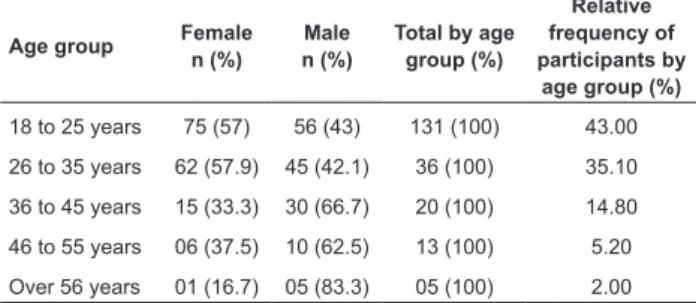
Among the participants, 42.5% were aged
between 18 and 25 years. There were significant
differences with respect to the distribution frequency
of the genders in each age group (X2=13.59;
p<0.009), with the frequency of female participants
decreasing with increasing age. There was an increase
in the frequency of male participants from 35 years of
age, as shown in Table 1.
Analyzing the risk behavior for STD infection, it was
found that 45.8% of the participants reported not having
used a condom during the last vaginal sexual intercourse,
48.4% did not use a condom during the last oral sex,
while 26.3% reported not having used a condom during
the last anal intercourse.
The mean age of first sexual intercourse was 16.86
years (sd=2.91). There were no significant differences
with regard to mean age at first intercourse, and
condom use (t=1.15; df=1; p=0.249). Analyzing the
data of condom use with the sharing of drugs, it was
found that among participants who claimed to have
shared drugs during the last sexual relation, 47.8%
reported having used a condom during the last vaginal
intercourse. Conversely, 51.6% of the motel clients
who claimed not to have shared drugs reported using a
condom during the last vaginal intercourse (X2=9.01; Table 1 - Distribution of the participants by gender and age
Age group Female
n (%)
Male n (%)
Total by age group (%)
Relative frequency of participants by
age group (%)
18 to 25 years 75 (57) 56 (43) 131 (100) 43.00
26 to 35 years 62 (57.9) 45 (42.1) 36 (100) 35.10
36 to 45 years 15 (33.3) 30 (66.7) 20 (100) 14.80
46 to 55 years 06 (37.5) 10 (62.5) 13 (100) 5.20
Over 56 years 01 (16.7) 05 (83.3) 05 (100) 2.00
Table 2 - Frequency of the use of condoms during vaginal,
oral and anal intercourse, among those who said they had
practiced these sexual relations
Sexual intercourse
Condom used?
Yes (%) No (%)
Vaginal 51.3 45.8
Oral 10.7 48.4
Rev. Latino-Am. Enfermagem 2012 May.-June;20(3):536-42.
540
df=1; p=0.01), revealing significant differences in
condom use between drug users and non-users, for this
sample. Regarding the use of alcohol, no association
was found between alcohol consumption and condom
use. Among the participants who reported having used
a condom during the last vaginal intercourse, 48.1%
reported having consumed alcohol, while among
those who did not use condoms, 51.9% had not
consumed alcohol (X2=0.182; df=1; p=0.201). There were significant differences in condom use between
participants who reported having a steady partner
and participants who reported not having a steady
partner at the time. The frequency of condom use was
higher among participants who did not have a steady
partner, as shown in Table 3. Comparing the amount
of partners over the past six months with the use of
condoms, it was observed that among the participants
who had intercourse with five or more partners, 63.2%
reported not having used a condom during the last
vaginal intercourse. Among those who reported having
had intercourse with only one partner in the last six
months, 49.7% reported not having used a condom
during the last intercourse. Thus, there was no
significant association between the number of partners
and the use of condoms (X2=3.21; df=1; p=0.07), as shown in Table 3.
condom, with these differences reaching statistical
significance (X2=8.28; df=1; p=0.01). There were no significant differences in condom use between
the different age groups, considering the last vaginal
intercourse (X2=2.53; df=1; p=0.638). A total of 53.5% of the participants aged between 18 and 25
years reported having used a condom during the last
vaginal intercourse, while 83.5% of the participants
aged over 56 years reported having used a condom
during the last vaginal intercourse. There was no
association between condom use and the length of
the relationship, as shown in Table 4. It is noteworthy
that 33.3% of the participants who reported knowing
the person they had intercourse with for just one day
did not use condoms and 53.3% of the people who
reported being in a relationship with the partner for
less than a month also did not use a condom.
In order to determine which factors would
best explain the use of condoms, a multivariate
logistic regression model was constructed using the
independent variables: age, number of partners in
the last six months, steady partner, drug use, alcohol
use, difficulty in proposing condom use and length of
relationship, and the dependent variable condom use
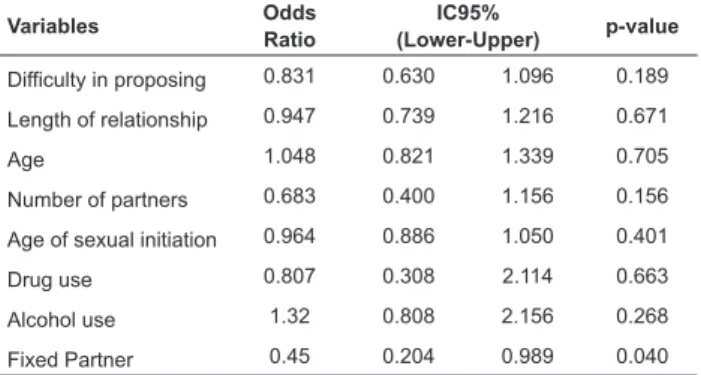
during last vaginal sexual intercourse. Table 5 presents
the results of the logistic regression analysis. Table 3 - Relationship between condom use, having or not
having a steady partner and number of sexual partners in
the previous 6 months
Variables
Used condom during
the last intercourse Total X2 df p
Yes n (%) No n (%)
Steady Partner
Yes 109 (50.9) 113 (49.1) 222 (100)
4.84 1
No 49 (63.6) 28 (36.4) 77 (100) 0.02
Number of Partners in the previous 6 months
One 95 (50.3) 94 (49.7) 189 (100)
5.21 2 0.07
Two to four 56 (61.5) 35 (38.5) 91 (100)
Five or more 07 (36.8) 12 (63.2) 19 (100)
Table 4 - Association between the length of the relationship
maintained with the person who was with them in the
motel and condom use
Length of relationship
Used condom in
the last intercourse Total % X2 df p
Yes n (%) No (%)
1 day 14 (66.7) 07 (33.3) 21 (100)
4.57 4 0.333
2 days to 1 month 14 (46.7) 16 (53.3) 30 (100)
2 months to 1 year 53 (42.4) 39 (57.6) 92 (100)
13 months to 3 year 39 (53.4) 34 (46.6) 73 (100)
Over 4 years 38 (45.8) 45 (54.2) 83 (100)
It was investigated whether there were
differences in condom use between the heterosexuals
and homosexuals. With regard to condom use during
the last oral sex, there were no significant differences
between heterosexuals and homosexuals (X2=2.67;
df=1; p=0.262). Considering the use of condom during
the last anal intercourse, 35.3% of the participants
that said they had homosexual intercourse did not use
condoms, while 26.2% of the participants who had
heterosexual intercourse reported not having used a
Table 5 - Multivariate logistic regression analysis to
investigate the predictors of condom use
Variables Odds
Ratio
IC95%
(Lower-Upper) p-value
Difficulty in proposing 0.831 0.630 1.096 0.189
Length of relationship 0.947 0.739 1.216 0.671
Age 1.048 0.821 1.339 0.705
Number of partners 0.683 0.400 1.156 0.156
Age of sexual initiation 0.964 0.886 1.050 0.401
Drug use 0.807 0.308 2.114 0.663
Alcohol use 1.32 0.808 2.156 0.268
The results of multivariate logistic regression
indicated that, in the constructed model, the variable that
signiicantly predicted the use of condoms during vaginal
intercourse was to have a steady partner. An alternative
interpretation of the odds ratio is the transformation of this
value in terms of percentage effects, using the formula =
Percentage effect on the probability of occurrence of the
event = (OR-1) x 100(10). Therefore, the analysis of the results of the steady partner variable = (0.45-1) x 100=
- 55%, indicating that the fact that the participant has a
steady partner reduced by 55% the likelihood of using a
condoms, compared with those without a steady partner,
considering that the other independent variables of the
model are constant.
Discussion
The data revealed that no association was found
between age at the initiation of intercourse, and condom
use, indicating that the mean age of initiation of sexual
activity did not differ between participants who used
and those who did not use condoms. With respect to the
sharing of drugs, it was observed that the frequency of
condom use was signiicantly lower among participants
who reported having shared drugs during the last
intercourse. Contrary to literature data which indicate
that alcohol consumption increases vulnerability to sexual
intercourse without condoms(3,12), in the present study no association was found between alcohol use and condom
use. No association was encountered between condom use
and the length of the relationship. However, one aspect to
be highlighted is the high frequency of non-condom use
in casual relationships with partners known for less than
a month, behavior that increases vulnerability to infection
by HIV and other STDs.
The logistic regression analysis revealed that,
considering all the risk factors together, the factor that
most contributed to the failure to use condoms was
having a steady partner. This data is in agreement with
the literature showing that conidence in a stable partner
contributes to not using condoms(3,6,9). A study performed with Mexican immigrants residing in the United States
revealed the belief that a request for condom use by
married women indicates mistrust and a lack of love
for the partner. Thus, these women believe that having
sex without a condom is proof of trust in the marriage,
behavior that exposes them to a greater risk of HIV
infection(9).
A study developed with HIV seropositive mothers
revealed that trust and loyalty are the main reasons why
the person does not require the use of condoms, and
therefore, facilitators of the denial of the risk. Therefore,
a prolonged relationship contributes to the woman
presenting the feeling that she is immune to HIV and the
trust in the partner contributes to the wives disregard of
the previous life of her husband(6).
There are also cultural issues that must be considered.
In societies where there are inequities in terms of gender,
where the woman has a submissive role in relation to the
man, condom use is even less frequent(13). The low self-esteem of women and the lack of autonomy and economic
dependence limit the ability of women to communicate
with their partner and negotiate condom use. In marriage,
gender roles and social stereotypes are present in all
aspects of the quotidian life. The cultural aspects that
encourage men to have more than one sexual partner
should also be highlighted, as this behavior is not tolerated
in women(14). Considering that in the present study the fact of having a steady partner was the main factor explaining
the failure to use condoms, this situation increases the
risk of the woman contracting STD/HIV.
Further analysis of the results of this study revealed
that there were married participants who were in the
motel with a partner who they had known for just one day,
and that a condom was not used during the last sexual
intercourse. These data will be explored in a future work
and they strengthen the hypothesis of vulnerability of
married women to HIV infection. One study investigated
the factors related to sexual intercourse without condoms
among male participants(7). The results indicated that the main factors associated with not using condoms were
related to issues of sexual satisfaction, adventure and
intimacy. Thus, the researchers argued that the campaigns
regarding HIV prevention only slightly address the libidinal
aspects, which are psychological elements central to the
adherence to the use of condoms, and should be included
in the campaigns for condom use.
Conclusion
The results of this study revealed that approximately
half of the participants did not use a condom during the
last vaginal intercourse or oral sex. The main determinant
variable for not using condoms was the fact of having
a steady partner. This data provides support to think
about the need for effective campaigns involving issues
that permeate the belief of the population, such as the
stereotype of security and trust in stable relationships.
References
Rev. Latino-Am. Enfermagem 2012 May.-June;20(3):536-42.
542
2. Ministério da Saúde. Aids no Brasil [Internet]. Brasília: Ministério da Saúde; 2012 [acesso 06 mar 2012]. Disponível em: http://www.aids.gov.br/pagina/
aids-no-brasil.
3. Ministério da Saúde (BR). Pesquisa de Conhecimentos, Atitudes e Práticas da População Brasileira de 15 a 64 anos de idade. [Internet]. Brasília (Brasil): Programa Nacional de DST e Aids; 2009.[acesso 18 jun 2008]. Disponível em: http://www.aids.gov.br/sites/default/iles/anexos/ publicacao/2009/40352/pcap_2008_f_pdf_13227.pdf 4.Maia C, Guilhem D, Freitas D. Vulnerabilidade ao HIV/
aids de pessoas heterossexuais casadas ou em união
estável.Rev Saúde Pública.2008;42(2):242-8.
5. Ministério da Saúde (BR). Comportamento sexual e uso do preservativo na população brasileira. [Internet]. Brasília: PCAP; 2008. [acesso 20 ago 2009]. Disponível em: http://www.aids.gov.br/portalaids_services/data/ documents/storedDocuments/%7BB8EF5DAF-23AE- 4891-AD36-1903553A3174%7D/%7BFB7ECC9A-CDF1-440E-AF64-53CE1C5BAE6B%7D/PCAP-BR%20CNAIDS. ppt#451,9, Comportamento sexual e uso do preservativo
na população brasileira.
6. Neves LAS, Gir E. Crenças das mães soropositivas ao HIV acerca da transmissão vertical da doença. Rev. Latino-Am. Enfermagem.set-out 2006;14(5):140-7.
7. Carballo-Diéguez A, Ventuneac A, Dowsett GW, Balan I, Bauermeister J, Remien RH, et al. Sexual Pleasure and Intimacy Among Men Who Engage in “Bareback Sex”. AIDS and Beh. 2011;15, Suppl 1:S57-65.
8. Mora C, Monteiro S. Vulnerability to STIs/HIV:
sociability and the life trajectories of young women who
have sex with women in Rio de Janeiro. Culture Health Sexual.2010;12(1):115-24.
9. Hirsch JS, Higgins JBA, Bentley ME, Nathanson CA The Social Constructions of Sexuality: Marital Inidelity and Sexually Transmitted Disease-HIV Risk in a Mexican Migrant Community. Am J Public Health.
2002;92(8):1227-37.
10. Hong H, Qin QR, Li LH, Ji GP, Ye DQ. Condom use
among married women at risk for sexually transmitted
infections and HIV in rural China. Int J GynecolObstetrics. 2009;106:262–5.
11. Instituto Brasileiro de Geograia e Estatística [Internet]. Censo Demográico 2010. [acesso 15 jun 2011]. Disponível em http://www.ibge.gov.br/cidadesat/
topwindow.htm?1.
12. Cardoso LRD, Malbergi A, Figueredo TFB. O consumo de álcool como fator de risco para a transmissão das DSTs/ HIV/Aids.Rev PsiqClín. 2008:5(supl 1):70-5.
13. Jacubowski N. Marriage is not a safe place: Heterosexual marriage and HIV-related vulnerability in Indonesia.Culture, Health Sexual.2008;10(1):87-97.
14. Wang BO, Li X, Stanton B, Fang X, Liang G, Liu H, et al. Gender Differences in HIV-Related Perceptions, Sexual Risk Behaviors, and History of Sexually Transmitted Diseases Among Chinese Migrants Visiting Public Sexually Transmitted Disease Clinics. AIDS Patient Care and STDs. 2007;21(1):57-68.
Received: Sep. 26th 2011