EVALUATION OF COGNITIVE AND SOCIAL-AFFECTIVE
DEVELOPMENT OF CHILDREN WITH HEARING LOSS
Avaliação do desenvolvimento cognitivo e afetivo-social
de crianças com perda auditiva
Maria de Lourdes M. Tabaquim (1), Camila G.A. Nardi (2), Juliana B. Ferrari (3), Cibelle N. Moretti (4), Midori O. Yamada (5), Maria Cecília Bevilacqua (6)
(1) Department of Speech Pathology, FOB/USP and Graduate Program in Rehabilitation Sciences, HRAC-USP, Bauru, SP, Brazil.
(2) Program in Health: Syndromes and Craniofacial Anomalies of the Hospital for Rehabilitation of Craniofacial Anomalies, HRAC-USP, Bauru, SP, Brazil.
(3) Program in Health: Syndromes and Craniofacial Anomalies of the Hospital for Rehabilitation of Craniofacial Anomalies, HRAC-USP, Bauru, SP, Brazil.
(4) Program in Health: Syndromes and Craniofacial Anomalies of the Hospital for Rehabilitation of Craniofacial Anomalies, HRAC-USP, Bauru, SP, Brazil.
(5) Audiological Research Center-HRAC/USP, Bauru, SP, Brazil.
(6) Department of Speech Pathology, FOB/USP, Bauru, SP, Brazil.
Conlict of interest: non-existent
newborns at high risk led to the increased rate of survival with growing interest of health professionals in identifying risk factors of child development 5-7.
Hearing disorder in childhood can cause various effects in communication and a number of secondary consequences, such as cognitive-perceptual, emotional, social, educational and intel-lectual changes, being considered a striking factor, especially in the irst years of life8-11. In this sense,
it severally restricts children’s ability to develop spoken language, since this is the period in which occurs the maturation of the auditory system.
Language plays a critical role in the perceptual organization, receipt and structuring of information, learning and social interactions of human being. The American Speech-Language-Hearing Association believes hearing loss accounts for 60% of commu-nication disorders.
A child with hearing loss, unable to communicate properly, understand and be understood might ABSTRACT
Purpose: the objective of this study was to evaluate the level of cognitive, affective and social development of children diagnosed with hearing loss. Method: the study included 50 children diagnosed with hearing loss, with a mean age of 16.1 months, both genders. We applied a semi-structured interview with parents for the life history of the child, Scale Development and Behavioral Assessment Scale Reaction Baby Retraction. Results: the study identiied 80% of children with
bilateral profound hearing loss. Quotient of normal development occurred in 76% of the sample and the most affected functions were language and personal-social. The affective and interactional levels adjustment were characterized by the alarm reactions for personal problems and social interaction.
Conclusion: the dephased verbal and nonverbal competences showed implications on cognitive development, suggesting the hearing loss condition and associated risk factors, with limited situational
communicative exchanges that promote the development of adaptive skills and increased the
self-esteem on the relationships.
KEYWORDS: Child Development; Hearing Loss; Cognition; Behavior
INTRODUCTION
become isolated, withdrawn and have dificulty in affective and social interaction12-15.
Regardless of the type of gap or severity of hearing loss, resources of development should be identiied early, since resulting changes can interfere with the cognitive and psychosocial aspects16,17.
In general, global development evaluation proce-dures are performed through standardized tests and speciic protocols, being extremely useful to understand motor, language, psychosocial and adaptive impacts17. The development scales relect
the major gains in the course of ages and identify signs of evolution, considering the history of life and the systematic direct observation of behavior as reference.
The Behavioral Development Scale proposed by Gesell and Amatruda18 has been used to monitor
the development of children at risk. The evaluation of the overall development of children with senso-rineural hearing impairment enables to identify
eficient performances of preserved compensatory
functional areas, reducing potential false diagnoses.
Since the irst day of life children learn how to
master different mental and emotional functions through the loving presence and peacefulness of their parents given their rocking arms, affection, smiles, soft voice and whispering songs that teach frustration and uneasiness have an end and are followed by a reward.
Thus, babies act motivated by their needs and distresses. Early in their emotional development, the
way children get rid of unpleasant experiences they
cannot avoid is through motor discharge and body activities. By assigning a meaning to hunger, thirst, pain, joy, anger, sadness, or their multiple emotional
experiences, children develop the representation
and symbolization of the world, of shared things and emotions, using verbal and nonverbal language.
In assessing children’s behavior at early stages of development, the symptoms observed concerns,
most of the time, eminently relex actions, important
for the detection of major neurological disorders. Equally important, the affective and emotional aspects often impact the interactive and linguistic pattern of the affected individual, indicating risk to potential adaptive skill19. Given the dificulties to diagnose speciic psychiatric disorders in early
ages, Brazelton20 and Guedeney21 used the concept
of withdrawal response as a precursor of psychiatric conditions, as an indication of normal regulation of
loss through the Behavioral Development Scale and the Alarm Distress Baby Scale.
METHOD
This is a descriptive study on the characteristics of children with hearing loss and the relation among cognitive-affective-social variables.
A total of 50 children participated in this study, 31 male and 19 female, mean age 16.1 months, diagnosed with different degrees of hearing loss enrolled in the evaluation program for cochlear implant surgery at the Hospital for Rehabilitation of Craniofacial Anomalies – USP. The Behavioral Development Scale by Gesell and Amatruda18 and
the Alarm Distress Baby Scale19,20 were applied. A
semi-structured interview with parents for the history of life of the child was conducted.
The observations obtained using the Behavioral Development Scale by Gesell and Amatruda18
were supplemented with information obtained from parents. We assessed the child’s development in ive areas of behavior: 1) adaptive behavior: we observed the child’s skill as regards organization of stimuli, perception of relations, decomposition and reintegration of the whole with the parts; 2) gross motor behavior: we evaluated postural responses, balance of the head, and posture at standing, sitting and walking; 3) ine motor behavior: we observed the ability to use hands and ingers to manipulate objects, 4) language behavior: we observed facial expressions, gestural and postural movements, vocalizations, words, phrases or sentences, including imitation and understanding of communi-cation with others, 5) personal-social behavior: we observed personal responses of the child in their social environment, considering the rules and varia-tions of individual education.
The scale describes that the Developmental Quotient (DQ) of a child with average results is 100. Values between 85 and 68 are considered borderline and would have implications in terms of monitoring. Values below 68 indicate signiicant delay in one or more areas of development18.
total score results from the arithmetic sum of the scores obtained20.
Prior to data collection, the ethical procedures for research were adopted, and the project was approved by CEP/HRAC-USP – Protocol No. 099/2008.
A comparison of results between the scales used in this study considered the ive ields of devel-opment and the sum of these, using the nonpara-metric Kruskal-Wallis test. The measures of position (minimum value, 1st and 3rd quartiles, median,
maximum value) were considered and the value of the test with related descriptive level (“valor-p”). Signiicance level was 5%.
RESULTS
The history of life led to the identiication of bilateral profound hearing loss in 80% of the sample, 17% mild and 3% moderate. Considering the etiology, 42% of children had congenital factors, 70% had multifactorial conditions related to idiopathic, neuropathic, infectious (meningitis and
cytomegalovirus) components and ototoxic drugs. Results showed 42% of cases in which hearing loss was due to congenital factors.
Gestational age ranged between 6 and 10 months (26.1% preterm and 2.1% post-term) and 32% were SGA (small for gestational age).
In this study, 76% of the cases had global devel-opment, namely the Developmental Quotient (DQ), rated in the normal range, but 20% slightly lagged, 2% moderate and 2% severe.
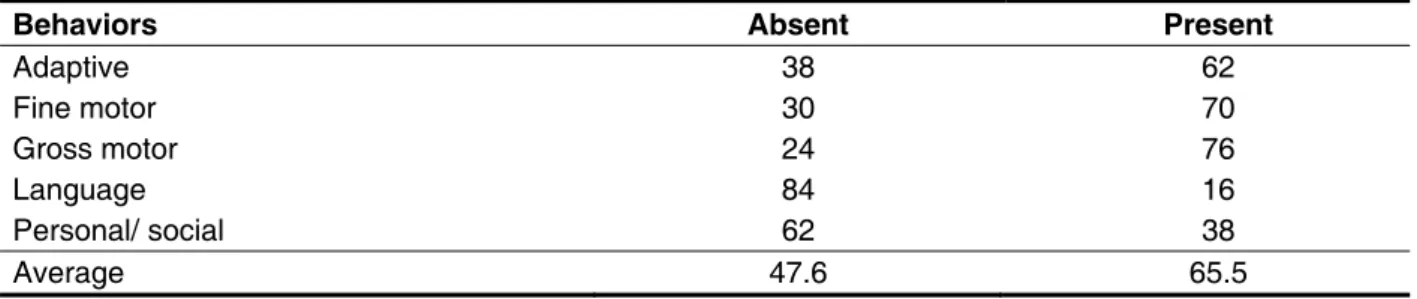
When comparing DQ with risk factors, there was no statistical signiicance (nonparametric Kruskal-Wallis test). However, analyzing the descriptive factors of development, gaps were found in language and personal-social areas. In the language area, 84% had lower performance in verbal and non-verbal tasks related to understanding and expression. As regards personal-social behavior, 62% of subjects had low gain (absent). Broad or global (gross) motor skills were the best performances in the group studied (TABLE 1).
In this study, the mean age was 16.1 months (TABLE 2).
Behaviors Absent Present
Adaptive 38 62
Fine motor 30 70
Gross motor 24 76
Language 84 16
Personal/ social 62 38
Average 47.6 65.5
Table 1 – Representation of development acquisitions
Variables N Average Standard
deviation Min. Median Max. P-value
Age (months) 50 16,1 7,7 3,0 14,0 35,0 0,23
DQ 50 86,7 14,6 24,6 90,0 104,6 0,38
DA 50 13,6 6,2 2,6 13,8 27,0 0,16
Table 2 – Representation of age, developmental quotient and age
The developmental age (DA) appeared incon-sistent with chronological age, with an average of 13.6 months. The developmental quotient (DQ) with a score of 86.7 represented appropriately based index of global development. Thus, although the group had changes in the level of acquisitions (DA), it is in the middle range at this level. The discrepancy between the developmental age and the developmental quotient can be understood by the gap identiied in 24% of the sample, shown in Table 1.
When comparing DQ with Adaptive, Gross Motor, Fine Motor, Language and Social Behaviors, signiicant results were identiied, with p<0.05 (TABLE 3).
The quality indicators of emotional-affective inter-action, veriied by the Alarm Distress Baby Scale,
showed signiicant results, reported under “doubt as to the pathological nature”. According to the scale, the higher the number of absent behaviors, the better the behavior observed in the levels of affective and interactional adjustment (TABLE 4).
Although the item “doubt as to the pathological
nature” shows statistical signiicance, 84% of subjects had satisfactory answers, indicating the absence of comorbidities speciic to the relationship, identiied by the index of regulation for the interaction.
When comparing the level of withdrawal with DQ, the observed behavior relative to “Eye Contact” under doubtful nature was statistically signiicant (p=0.042), indicating that subjects with this aspect of doubt had increased risks for the diagnosis of relational problems.
Adaptive p Gross Motor p Fine Motor p Language p Personal/
social p
0 and 1-2 0.97 0 and 1-2 0.01* < 0 and 1-2 0.29 0 and 1-2 0.02* 0 and 1-2 <0.01* 0 and 3-4 0.04* 0 and 3-4 0.35 0 and 5-6 < 0.01* 0 and 3-4 0.75 0 and 3-4 0.01*
0 and 5 <0.01* 0 and 5-6 0.12 1-2 and 5-6 0.61 0 and 5 0.03* 0 and 5-6 <0.01* 1-2 and 3-4 0.01* 1-2 and 3-4 0.87 - - 1-2 and 3-4 0.89 1-2 and 3-4 0.49
1-2 and 5 <0.01* 1-2 and 5-6 0.99 - - 1-2 and 5 0.88 1-2 and 5-6 0.17 3-4 and 5 0.33 3-4 and 5-6 0.72 - - 3-4 and 5 0.86 3-4 and 5-6 0.36 Table 3 – Multiple comparisons of the developmental quotient, tested by age, according to adaptive, gross motor, ine motor, language and personal-social behaviors
Nonparametric statistical test Behrens-Fisher-Test, where p<0.05 indicates signiicant difference on the comparison of results.
Observed behavior Absent (%)
Doubts as to pathological nature (%)
More discrete pathological
sign (%)
Apparent to all (%)
Intense (%)
Facial expression 74 26 0 0 0
Eye contact 82 18 0 0 0
General Level of Activity
88 10 2 0 0
Self-stimulation Gestures
94 2 4 0 0
Vocalization 75 26 0 2 0
DISCUSSION
The idiopathic or unknown etiology of congenital hearing loss prevails over the other causes, which shows the need to routinely carry out genetic studies in order to obtain a real proile of the prevalence of congenital hearing loss causes 3,4.
Children born prematurely and underweight are at risk for developmental delay and neurological disorders due to the immaturity of their nervous system. However, not only the somatic factors determine the baby at risk, but also the environ-mental factors, which may cause deicits in the motor, sensory, mental and emotional aspects 3-8.
The low gain, characterized by the absence of personal and social behavior, represented limited acquisition patterns related to the social culture and inluenced by the environment. Thus, commu-nication dificulties of children with hearing loss suggest a high likelihood of reduced interactions with parents.
Broad or global (gross) motor skills were the best performances in the group studied. Even deaf, a baby usually has typically normal motor development at the expected level, considering their age, in assessments that adopt scales of child development6,7, as well as the results obtained in
this study.
Whereas hearing loss during early development (0-2 years) may strongly interfere with normal communication skills, compromise language acqui-sition and hinder psychosocial relationships, the child that cannot understand the context and make themselves understood may get frustrated and become withdrawn, and this represents a risk factor for behavioral and cognitive disorders.
The quality of the affective and emotional interac-tions observed in this study showed high indicators of “doubt” that constitute the alarm response, often observed in children with relationship issues, being hearing loss condition, presumably, the risk factor for such manifestations18.
In addition to language skills, the use of visual systems in communication can facilitate the devel-opment of skills related to affective and emotional interactions15,18 in children with hearing loss.
Therefore, reporting “eye contact” as doubtful nature, found in this study, is a suggestive risk factor for the acquisition of communicative skills.
CONCLUSION
The study showed that complications caused by multiple factors were signiicant to the development, such as prematurity and SGA, which represented important risk factors for development losses in 20% of the sample (10 subjects).
In assessing development, the most signiicant gaps occurred in activities related to language under-standing and expression, both verbal and nonverbal. Losses were also identiied in the relational skills of the personal and social behavior. As regards optimi-zation of resources, motor skills were the most preserved functions of the development.
Whereas hearing loss in the overall development of the child, especially in the early stages, the normal intelligence pattern (DQ preserved) does not ensure the same level of cognitive functions, causing losses in the developmental age (DA).
The levels of affective and interactional adjustment observed in this study featured alarm responses to problems related to personal and social interaction, suggesting implications on the condition of children with hearing loss, circum-stantially limited to communicative exchanges that promote self-concept and strengthen self-esteem.
REFERENCES
1. Meyer C, Witte J, Hildmann A, Hennecke KH, Schunck KU, Maul K et al. Neonatal screening for hearing disorders in infants at risk: incidence, risk, factors and follow-up. Pediatrics 1999;104:900-4. 2. Pupo, Altair Cadrobbi, Balieiro, Clay Rienzo, Figueiredo, Renata de Souza Lima. Estudo retrospectivo de crianças e jovens com deiciência auditiva: caracterização das etiologias e quadro audiológico. Rev. CEFAC. 2008;10(1):84-9.
3. Muniz L et al. Conhecimento de ginecologistas e pediatras de hospitais públicos do Recife a respeito dos fatores de risco para surdez. Braz. j. otorhinolaryngol. (Impr.). 2010;76(4):510-6.
4. Cruz MS, Oliveira LR, Carandina L, Lima MPC, Cesar CLG, Barris MBA et al . Prevalência de deiciência auditiva referida e causas atribuídas: um estudo de base populacional. Cad. Saúde Pública. 2009;25(5):1123-31.
5. Lichtig I, Monteiro MIV, Couto FMB, De Haro MSC, De Campos FAC, Vaz YO et al. Avaliação do comportamento auditivo e neuropsicomotor em lactentes de baixo peso ao nascimento. Rev. Assoc. Med. Bras.2001;47(1):52-8. ISSN 0104-4230. 6. Bredariol ACP. Estimulação psicomotora com bebês de risco. In: Ferreira C, Thompson R,
8. Bordin MBM, Linhares MBM, Jorge SM. Aspectos cognitivos e comportamentais na média meninice de crianças nascidas pré-termo e com muito baixo peso. Psic.: Teor. e Pesq. 2001;17(1):49-57. 9. Freitas M, Kernkraut AM, Guerrero SMA, Akopian STG, Murakami SH, Madaschi V, Rueg D, Almeida CI, Deutsch AD. Acompanhamento de crianças prematuras com alto risco para alterações do crescimento e desenvolvimento: Uma abordagem multiproissional. Einstein. 2010;8(2 Pt 1):180-6. 10. Leybaert J, D’hondt M. Neurolinguistic development in deaf children: the effect of early language experience. International Journal of Audiology.2003;42(1-Suppl 1):34-40
11. Gatto C, Tochetto TM. Deiciência auditiva infantil: implicações e soluções. Rev. CEFAC.2007;9(1):110-5.
12. Simão R, De Conto J, Fujinaga C. Concepções de Gestantes sobre a Perda Auditiva. Revista Salus. 2010;2(1):23-35.
13. Hage SRV, Joaquim RSS, Carvalho KG. Diagnóstico de crianças com alterações especíicas de linguagem por meio de escala de desenvolvimento. Arq. Neuropsiquiatria. 2004;62(3-A):649-53.
14. Tiensoli LO, Goulart LMHF, Resende LM, Colosimo EA. Triagem auditiva em hospital público de Belo Horizonte, Minas Gerais, Brasil: deiciência RESUMO
Objetivo: avaliar o nível de desenvolvimento cognitivo e afetivo-social de crianças com diagnóstico de deiciência auditiva. Método: participaram do estudo 50 crianças com diagnóstico de deiciência auditiva, com idade média de 16,1 meses, de ambos os gêneros. Empregou-se a entrevista semi--estruturada com os pais para a obtenção da história de vida da criança, a Escala de Desenvolvimento Comportamental e a Escala de Avaliação da Reação de Retração do Bebê. Resultado: o estudo identiicou 80% das crianças com perda auditiva profunda bilateral. O Quociente de Desenvolvimento na normalidade ocorreu em 76% da amostra, sendo as funções da linguagem e pessoal-social, as mais prejudicadas. Os níveis de ajustamento afetivo e interacional foram caracterizados pelas rea-ções de alarme para problemas de interação pessoal-social. Conclusão: as competências defasadas de habilidades verbais e não-verbais mostraram implicações no desenvolvimento cognitivo, sugesti-vas da condição da criança com perda auditiva e dos fatores de risco associados, com limitação cir-cunstancial a trocas comunicativas que promovem o desenvolvimento de competências adaptativas e o fortalecimento da auto-estima para as relações.
16. Tabaquim, MLM e Ciasca, SM AEvaluation of the global development of children with chronic infantile non-progressive encephalopaty. Salusvita. 2000;19(2):127-38.
17. Amaral, ACT, Tabaquim, MLM e Lamônica, DAC Avaliação das habilidades cognitivas, da comunicação e neuromotoras de crianças com risco de alterações do desenvolvimento. Rev Bras Educ Esp. 2005;11(2):185-200.
18. Borges CF, Lopes RFF, Lopes EJ. Estudo das habilidades de memória e raciocínio simbólico e não-simbólico de crianças e adolescentes surdas por meio da bateria padrão do Universal Nonverbal Intelligence Test. Rev. bras. educ. espec. 2010;16(1):83-94.
19. Gesell A, Amatruda CS. Diagnóstico do desenvolvimento: Avaliação e tratamento do desenvolvimento neuropsicológico do lactente e na criança pequena – o normal e o patológico. São Paulo: Atheneu, 1990.
20. Assumpção JRFP, Assumpção TM. Avaliação da reação de retração no bebê com doenças pediátricas. Arq. Neuropsiquiatr. 2002;60(4):971-3. 21. Guedeney A, Charron J, Delour M. La construction et la validation d’une échelle de retrait relationnel du jeune enfant: voir ensemble pour intervenir plus tôt. De la pédiatrie à la pédopsychiatrie. Perspectives Psy. 2000;39(3):179-84.
Received on: November 04, 2011 Accepted on: February 04, 2012
Mailing Address:
Maria de Lourdes Merighi Tabaquim Rua Bandeirantes, 9-60 Aptº 61 Bauru – SP
CEP: 17015-012