SUMMARY
BACKGROUND AND OBJECTIVES: Failure or delay
to diagnose brain death leads to needless occupa-tion of a hospital bed, emooccupa-tional and i nancial losses, and unavailability of organs for transplants. The in-tensive care physician plays an essential role in this diagnosis. This study intended to evaluate intensi-vists’ knowledge concerning brain death.
METHODS: Cross-sectional study in 15 intensive care units (ICU) in eight hospitals in the city of Porto Alegre, Brazil.
RESULTS: Two hundred forty-six intensivists were interviewed in a consecutive sample between April and December 2005. The prevalence of lack of kno-wledge regarding the concept was of 17%. Twenty per cent of the interviewees ignored the legal need for complementary coni rmatory tests for their diag-nosis. Forty-seven per cent considered themselves
Evaluation of Intensivists’ Knowledge
on Brain Death*
Avaliação do Conhecimento de Intensivistas sobre Morte Encefálica
Alaor Ernst Schein1, Paulo Roberto Antonacci Carvalho2, Taís Sica da Rocha1,
Renata Rostirola Guedes3, Laura Moschetti4, João Caron La Salvia5, Pedro Caron La Salvia6
1. Pediatric Intensivist.
2. Professor of the Universidade Federal do Rio Grande do Sul. 3. Resident Physician in Pediatrics.
4. Resident Physician in Surgery. 5. Resident Physician in Orthopedics. 6. Graduated of Medicine.
*Received from the Faculdade de Medicina da Universidade Federal do Rio Grande do Sul, Porto Alegre, RS
Submitted on February 12, 2008 Accepted for publication on May 7, 2008 Address for correspondence
Alaor Ernst Schein, M.D.
Hospital da Criança Santo Antônio Rua Independência, 155
90035-074 Porto Alegre, RS Phone/Fax: (51) 3214-8758 E-mail: [email protected]
©Associação de Medicina Intensiva Brasileira, 2008
as having the highest level of assurance to explain the concept to a patient’s family members. Twenty-nine per cent erroneously determined the legal time of death for brain dead patients. Pediatric intensi-vists had less knowledge about the concept, when compared to intensivists for adults (p < 0.001). CONCLUSIONS: Current knowledge of brain death is insufi cient in Brazil, among the health care pro-fessionals who most often i nd patients in this situ-ation. Education on the subject is needed to avoid unnecessary expenses, reduce family suffering and increase the offer of organs for transplant.
Key Words: Attitude, Death, ICU, Transplantation.
RESUMO
JUSTIFICATIVA E OBJETIVOS: A falha ou atraso no diagnóstico de morte encefálica resulta na ocupa-ção desnecessária de um leito hospitalar, em perdas emocionais e i nanceiras e na indisponibilidade de órgãos para transplante. O médico intensivista tem fundamental papel nesse diagnóstico. O objetivo deste estudo foi avaliar o conhecimento sobre morte encefálica entre os intensivistas.
MÉTODO: Estudo transversal em 15 unidades de te-rapia intensiva (UTI) em oito hospitais da cidade de Porto Alegre, Brasil.
en-cefálica. Os intensivistas pediátricos tiveram menor conhecimento do conceito em relação aos intensi-vistas de adultos (p < 0,001).
CONCLUSÕES: O atual conhecimento sobre morte
encefálica é insui ciente entre os proi ssionais que mais freqüentemente se deparam com pacientes nessa situação. Há necessidade de educação sobre o tema a i m de evitar gastos desnecessários, dimi-nuir o sofrimento familiar e aumentar a oferta de ór-gãos para transplantes.
Unitermos:Atitude,Morte, Transplante, UTI
INTRODUCTION
The concept of brain death seems to be well establi-shed in most countries of the world, with some va-riation in the diagnostic protocols1,2. Notwithstanding
the broad acceptance of the concept, seemingly doubts persist among many health care professio-nals3,4. Most cases of brain death occur in an
inten-sive care unit (ICU), disclosing the fundamental role played by the intensive medicine specialist in correct diagnosis. Delay or failure at this point results in un-necessary cost, occupation of an ICU bed, additional suffering for the family and unavailability of organs for transplant5,6.
Prevalence of adequate knowledge on the subject among professionals and students in the health area, according to the population under study, ranges from 39% to 88%3,5,7-14. There is clearly a shortage of
stu-dies evaluating knowledge of intensive care specia-lists on the subject.
The purpose of this study was to survey knowled-ge on the concept of brain death among physicians working in ICUs in the municipality of Porto Ale-gre, Rio Grande do Sul, Brazil. This state had the country’s highest rate of donors in brain death with 13.2 donors per million inhabitants per year (pmp/ year) in 2005 whereas in Brazil the rate was of 6.3 pmp/year.
METHODS
After approval by the Ethics Committee for Research in the Hospital das Clínicas of Porto Alegre of the Universidade Federal do Rio Grande do Sul, under number 04-358 a questionnaire was formulated, translated and modii ed from a previous study3. It
wasadministered by means of a personal interview with intensivists from eight hospitals of Porto Alegre
from April to December of 2005. Participants remai-ned anonymous and the hospitals involved remairemai-ned unidentii ed.
Authors, co-authors and supervisors as well as mem-bers of Ethics Committees on research who partici-pated in the evaluation of this study, were excluded. Questions addressed the dei nition of the concept of brain death, the need to carry out a complementary exam for diagnosis, time of death in the brain death patient and the self-appointed assurance in explai-ning the concept of brain death to a patient’s family members.
1) What brain functions must be absent in the person for a declaration of brain death?
a) Irreversible loss of all cortical cerebral functions; b) Irreversible loss of all cortical and brain stem func-tions;
c) Varies according to the law; d) Does not know.
“b” was considered the correct reply.
2) Is there a legal need for a complementary exam to establish the diagnosis of brain death?
a) Yes; b) No.
In Brazil, the law requires a complementary exam for diagnosis of brain death. Therefore “a” was conside-red the correct reply.
3) An adult patient starts the protocol of brain death at 12 o’clock, is submitted to a second clinical exam and the complementary exam at 6; 00 P.M. of the same day. Becomes an organ donator. What is the time of death?
a) Opening of protocol (12 o’clock); b) Closure of protocol (6:00 P.M); c) Time of organ withdrawal.
“b” was considered the correct reply.
4) How do you view your assurance to explain what is brain death to a patient’s family members?
(no assurance) (great assurance)
1 2 3 4 5
Information regarding the main activity performed in the ICU was recorded: if on duty physician, daily rounds, professor or resident; time of work in intensi-ve care and the type of ICU, pediatric or adult.
Statistical Analysis
dispersion tendencies were reported with the mean and the confidence interval of 95% when frequency distribution behaved normally and the median and the first and last and third quartile in the other ca-ses. When comparing both groups in relation to the mean, the Wilcoxon-Man-Whitney U test (WMW) was used, because frequencies did not follow a nor-mal distribution. Efforts to verify association betwe-en two quantitative characteristics were made by means of the Spearman’s (rs), rank correlation coe-fficient, because the variables used violated norma-lity and homocedasticity assumptions When groups were compared in relation to qualitative variables, the Chi-square test for comparisons of proportions (χ2) was used. In tables 2 x 2, the Yates (χ2Y), correc-tion was utilized.
RESULTS
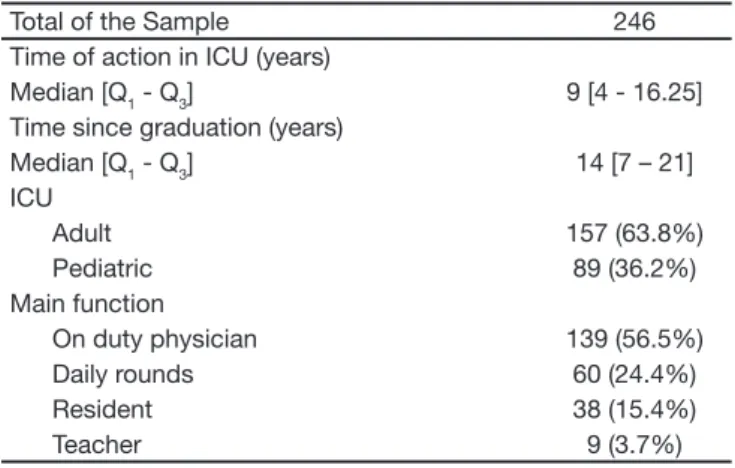
A total of 248 questionnaires was administered; ho-wever two were excluded as incomplete. The proi le of the interviewed intensivists is shown in table 1. Two hundred and forty six professionals were effec-tively interviewed. Sixty four percent worked with adults. The majority (56%) of interviewed intensivists, essentially were on duty physicians.
Table 1 – Overall Data of the State
Total of the Sample 246 Time of action in ICU (years)
Median [Q1 - Q3] 9 [4 - 16.25] Time since graduation (years)
Median [Q1 - Q3] 14 [7 – 21] ICU
Adult 157 (63.8%) Pediatric 89 (36.2%) Main function
On duty physician 139 (56.5%) Daily rounds 60 (24.4%) Resident 38 (15.4%)
Teacher 9 (3.7%)
Q1 - Q3: i rst and third quartiles
Eighty three percent (204/246) of the intensivists cor-rectly dei ned the concept of brain death. Eighty per-cent (198/246) were familiar with the Brazilian legal requirement to perform a complementary exam for diagnosis. Seventy one percent (172/246) correctly es-tablished time of death of the hypothetical patients. Most interviewees (194/246) judged themselves in the two higher levels of assurance to explain what brain
death is to the patient’s family members. None judged themselves as totally insecure on the subject. The le-vel of assurance was not statistically different between those that had the right reply and those that failed the three previous questions. (χ2 p= 0.40; 0.83; 0.19). A small positive correlation was found (rs = 0.191, p = 0.003) between time of experience and level of self-assigned assurance. That is to say, 3.6% of variation in the assurance level is explained by the variation in the time of experience.
When interviewees were separated in two groups (a) intensivists working in pediatric ICU and (b) inten-sivist in adult ICU (Table 2), it was noted that 89% (140/157) of intensivists with adults correctly dei ned brain death, while 72% (64/90) of pediatric intensi-vists did ((χ2Y p < 0.001). Difference in prevalence of the right reply among these groups for question 2 and 3 were not statistically signii cant. Alternative (c) of question 3 was chosen by 31% (49/157) of inten-sivists for adults versus 11% (10/89) of pediatric in-tensivists (χ2Y p < 0.001).
Table 2 – Results According to Intensive Therapy Unit of Ac-tion
ICU
Time of Action
(md) 1
Questions with Correct Replies2
1 2 3
Adult
n = 157 10 years 140 (89.2%) 124 (79.0%) 104 (66.2%) Pediatric
n = 89 8 anos 64 (71.9%) 74 (83.1%) 71 (79.8%) p 0.084 0.001 0.532 0.035
1Wilcoxon-Mann-Whitney U test . 2χ2
Y Pearson’s for comparison of proportions with the Yates correction.
Thirty nine percent (35/89) of pediatric intensivists considered themselves at the highest level of assu-rance to explain the concept of brain death to the patient’s family members. This prevalence was of 52% (81/157) among intensivists for adults ((χ2 p = 0.054).
DISCUSSION
This study endeavored to assess the knowledge on brain death among intensivists in the capital city of the State of Rio Grande do Sul. Supposedly expe-rienced and exemplary on the subject, the highest knowledge regarding organ donation and brain death is expected from these physicians5.Along this line
artii cial and may not rel ect the knowledge and at-titude of physicians when faced with real patients in clinical situations3.
No differences were observed, capable of esta-blishing a relationship between the self-assigned level of assurance and the correlation of replies to the remaining questions. Perhaps if the sample size had been larger, some signii cance could have been obtained, but an exaggerated self-assurance may exist, which is usually is at the root of problems in Medicine.
The high prevalence (24%) of intensivists who be-lieve that the time of organ withdrawal is the time of the donor’s death continues to be surprising. Where it so, the ethical axiom based on withdrawal of vital organs would be violated. That is to say, denying the dead donor rule that brain death means death. This would violate the Brazilian law of organ transplant and possibly risk murder.
The tendency that intensivists for adults feel more assured to explain the matter to the family members of a patient was also observed, together with the greater knowledge on the matter
Perhaps the early dei nitions of brain death that exclu-ded children, may have inl uenced this result? Accep-tance of the concept in children more than 7 days old was established in literature in 1987. In Brazil, a reso-lution of 1991 excluded children with less than 2 years – a prevalent age bracket in pediatric ICU15 – who were
only included as from 1997. Possibly, this information has not yet become the rule in the practice of all pe-diatric intensivists. This difference does not seem to be related to the fact of acting in intensive care before or after Brazilian ruling. When intensivists with over nine years of work in ICU are subtracted from this analysis, the difference remains marginal in the prevalence of correct replies among the two groups. Although proba-bly because of the smaller size of the sample (124), this difference has a p = 0.06 (χ2Y).
A high prevalence of error still remains in the dei ni-tion of the time of donor’s death in brain death. Al-though it seems a prosaic doubt, the statement that legal death takes place at the time of organ withdra-wal, in addition to being incorrect can jeopardize the entire process of organ retrieval.
CONCLUSION
Prevalence found in this studied is a matter of con-cern. Fortunately, the intensivists’ lack of
knowled-ge concerning the obligatory protocol that must be followed does not result in a false-positive diagnosis. That is to say there is apparently no risk of some patients having a diagnosis of brain death without in-deed being dead. However there is the possibility of omitting a diagnosis in patients that meet the criteria, which in addition to other damages brings about the unnecessary occupation of an ICU bed and the failu-re to failu-retrieve organs.
Porto Alegre is the largest city of the Rio Grande do Sul state and where most diagnoses of brain death and transplantations are carried out. Rio Grande do Sul is a Brazilian State that has the highest rate of effective donors in brain death. As such, it may be supposed that results of the other Brazilian states would not easily disclose a higher level than that of the current study, thereby warranting the statement that the level of knowledge on brain death among Brazilian intensivists is still lacking.
The factors responsible for this relatively high pre-valence of lack of knowledge were not analyzed and may be the subject of future research. It is known that brain death diagnosis is criticized in literature. Maybe this criticism inl uenced conduct of intensivists, or is there a blatant lack of knowledge on the subject? Brazilian intensivists are in need of educational im-provements. This required knowledge, in addition to the obvious increase in the number of diagnoses, brought about by more uniform medical procedures, probably will lead to greater well being for society as well as in the specii c case of the family members who are suffering from the demise of a cherished fa-mily member.
A higher prevalence of lack of knowledge of the con-cept was observed, also a tendency towards a lo-wer level of assurance among physicians that act in a pediatric ICU. This justii es additional education for this group.
REFERENCES
01. Wijdicks EF - Brain death worldwide: accepted fact but no global consensus in diagnostic criteria. Neurology, 2002;58:20-25.
02. Wijdicks EF - The diagnosis of brain death. N Engl J Med, 2001;344:1215-1221.
03. Harrison AM, Botkin JR - Can pediatricians dei ne and apply the con-cept of brain death? Pediatrics. 1999;103:e82.
04. Bitencourt AGV, Neves FBCS, Torreão LDA, et al. Avaliação do co-nhecimento de estudantes de medicina sobre morte encefálica. Rev Bras Ter Intensiva, 2007;19:144-150.
05. Schaeffner ES, Windisch W, Freidel K, et al. Knowledge and attitude regarding organ donation among medical students and physicians. Transplantation. 2004;77:1714-1718.
care nurses towards brain death and organ transplantation. J Clin Nurs, 2006;15:574-580.
07. Youngner SJ, Landefeld CS, Coulton CJ, et al. ‘Brain death’ and or-gan retrieval. A cross-sectional survey of knowledge and concepts among health professionals. JAMA, 1989;261:2205-2210.
08. Rachmani R - Physicians’ and nurses’ attitudes and knowledge to-ward brain death. Transplant Proc, 1999;31:1912-1913.
09. Pugliese MR, Degli Esposti D, Venturoli N, et al. Hospital attitude sur-vey on organ donation in the Emilia-Romagna region, Italy. Transpl Int, 2001;14:411-419.
10. Ohwaki K, Yano E, Shirouzu M, et al. Factors associated with attitude and hypothetical behaviour regarding brain death and organ trans-plantation: comparison between medical and other university stu-dents. Clin Transplant, 2006;20:416-422.
11. Nasrollahzadeh D, Siavosh H, Ghods AJ - Intensive care unit
nur-ses’ attitudes and knowledge toward brain death and cadaveric renal transplantation in Iran. Transplant Proc. 2003;35:2545.
12. Evanisko MJ, Beasley CL, Brigham LE, et al. Readiness of critical care physicians and nurses to handle requests for organ donation. Am J Crit Care, 1998;7:4-12.
13. Bogh L, Madsen M - Attitudes, knowledge, and proi ciency in relation to organ donation: a questionnaire-based analysis in donor hospitals in northern Denmark. Transplant Proc, 2005;37:3256-3257.
14. Akgun HS, Bilgin N, Tokalak I, et al. Organ donation: a cross-sectional survey of the knowledge and personal views of Turkish health care professionals. Transplant Proc, 2003;35:1273-1275.