Copyright © 2015 Revista Latino-Americana de Enfermagem This is an Open Access article distributed under the terms of the Creative Commons Attribution Non-Commercial License (CC BY-NC).
This license lets others distribute, remix, tweak, and build upon your work non-commercially, and although their new works must also acknowledge you and be non-commercial, they don’t have to license their derivative works on the same terms.
Corresponding Author: Vânia Medianeira Flores Costa
Universidade Federal de Santa Maria. Centro de Ciências Sociais e Hu-manas
Av. Roraima, 1000 Bairro: Camobi
CEP: 97105-900, Santa Maria, RS, Brasil E-mail: [email protected]
1 Paper extracted from master’s thesis “Commitment and Entrenchment with nurses career: an analysis of taes in public and private hospital institutions”, presented to Universidade Federal de Santa Maria, Santa Maria, RS, Brazil.
2 MSc, Professor, Universidade Federal de Santa Maria, Santa Maria, RS, Brazil. 3 PhD, Professor, Universidade Federal de Santa Maria, Santa Maria, RS, Brazil.
4 Doctoral student, Universidade Federal de Santa Maria, Santa Maria, RS, Brazil. Administrative assistant, Universidade Federal de Santa Maria, Santa Maria, RS, Brazil.
5 Master’s student, Universidade Federal de Santa Maria, Santa Maria, RS, Brazil. Scholarship holder from Coordenação de Aperfeiçoamento de Pessoal de Nível Superior (CAPES), Brazil.
6 Undergraduate student in Administration, Universidade Federal de Santa Maria, Santa Maria, RS, Brazil. Scholarship holder from Fundo de Incentivo a Pesquisa da Universidade Federal de Santa Maria (FIPE-UFSM), Brazil.
Levels of career commitment and career entrenchment of nurses from
public and private hospitals
1Mauren Pimentel Lima
2Vânia Medianeira Flores Costa
3Luis Felipe Dias Lopes
3Laércio André Gassen Balsan
4Andressa Schaurich dos Santos
5Gean Carlos Tomazzoni
6Objective: to determine the prevalence of the types of relations to career – commitment and
entrenchment – of nurses from public and private hospitals. Methods: field survey with a
quantitative approach. A total of 237 nurses participated in the survey through a questionnaire
with 43 questions about sociodemographic data, occupation, and relation to career. Descriptive
statistics, frequency analysis, and Mann-Whitney U test were used for data analysis. Results:
nurses from public and private hospitals have a high level of career commitment and a median
level of career entrenchment. Conclusions: nurses have a stronger relation of affection and
identification to career than a relation of stagnation, maintained primarily due to investments,
followed by emotional costs and lack of alternatives. This fact is associated with individuals
continuing in nursing and having a strong commitment to activities.
Descriptors: Nursing; Hospitals; Employment.
Rev. Latino-Am. Enfermagem
2015 Nov.-Dec.;23(6):1033-40
DOI: 10.1590/0104-1169.0211.2646
www.eerp.usp.br/rlae
Rev. Latino-Am. Enfermagem 2015 Nov.-Dec.;23(6):1033-40.
Introduction
Workers committed to the career make it essential
for their life(1). On the other hand, factors such as
labor market instability and agitation bring effects that
can negatively impact on professional career growth
and stability, resulting in another form of relation,
denominated occupational entrenchment(2).
Commitment and entrenchment to the career
are characterized by divergent behavioral attitudes,
causing signiicant personal, organizational, and social
impacts(3-4). Committed individuals remain in the
career due to emotional feelings that generate strong
identiication with the profession, feeling motivated in
their work because of the feeling of having chosen the
right profession; while entrenched individuals remain in
the career due to necessity or lack of alternatives.
The formation of relations to the career –
commitment and entrenchment – arise from the
motivation of professionals(5). Therefore, it is important
to understand the relation of nurses to hospitals,
since they are responsible for the management and
coordination of activities directed to patient care. In
addition, hospital environments and health institutions
are rich in management experiences and practices;
however, studies developed by researchers analyzing
these approaches are scarce(6) .
Thus, based on these considerations, we outlined
the general objective of the study: to determine
the prevalence of the types of relations to career –
commitment and entrenchment – of nurses from public
and private hospitals. And, as speciic objectives: i) to
determine the level of the nurses’ relation to career
and how this occurs in each type of hospital (public or
private); and ii) to compare the relations to career of
nurses from public and private hospitals.
Relation to career: commitment and entrenchment
Early studies applied to career commitment were
dominated by the one-dimensional model(7), also known
as occupational, which aims to measure the strong
emotional involvement of individuals with their occupation
through their identiication, positive feelings about the
career and desire to continue in the chosen occupation.
Hence, occupational commitment is deined as “one’s
attitude regarding one’s vocation or profession” and, also,
an “attitude in relation to an occupation or ield”(7).
However, in the mid-1990s, a new career
commitment model was created, denominated
multidimensional model(8), consisting of a scale
composed of three dimensions (identity, insight or career
planning, and resilience). In this same line of thought,
career commitment is conceptualized as “a motivation
to work in a chosen profession”(8).
Career entrenchment is deined as a professional’s
tendency to continue in the same occupation, due to
investments in the career, emotional costs to be lost
in the event of a change of occupation, and limited
awareness of alternative ways out of the professional
ield(3,9). The individual is entrenched concerning these conditions and tends to adopt a static, defensive
position, as the meaning of the word suggests(5).
This immobility, present in the individual’s behavior,
is triggered both by psychological and economic
aspects, making career change dificult to be carried out. Thus, differently from the deinition of career
commitment, the relation of entrenchment is not
formed, exclusively, by psychological dimensions(3),
because it seeks to establish a relation that is
different from commitment, which, traditionally, is
more studied(10).
The nurse from hospitals
Among the professions in health, nursing is
responsible for the management of units, involving
provision, supply, maintenance and control of material
and human resources for the operation of the service,
along with care management, establishing diagnosis,
planning, execution and evaluation of care, which
includes delegating activities, supervising, and leading
the staff(11).
This professional, as a leader of staff and hospitals,
is a reference to the others in the group(12). Therefore,
hospitals now have a business representation and
nursing is inluenced by this new hospital context, modifying the nurse’s proile, adopting an attitude of critical, relective, creative and conident leader in
Method
This is a descriptive ield survey with a
quantitative approach conducted in the regions of
Santa Maria and Santa Cruz do Sul, in the state of
Rio Grande do Sul (RS), Brazil. Four hospitals were
selected: one public hospital and three private
hospitals. Ease of access and authorization from
managers of these institutions were decisive in the
choice. A total of 156 nurses from public hospitals
and 81 nurses from private hospitals participated in
the survey, totaling 237 professionals.
The study was approved by the Research Ethics
Committee of the Federal University of Santa Maria,
under registration number 74045. After approval, data
collection was initiated, which was carried out between
September and October 2012. As survey instrument, we
used a questionnaire with closed questions, consisting
of two parts: the irst part had eight questions about
age, gender, marital status, income, education, children,
and type of institution (public or private); the second
part comprised the items that assess the individual’s
relation to career (career commitment, occupational
commitment, and career entrenchment).
To measure the variable career commitment, we
applied the scale proposed by Carson and Bedeian(8),
composed of three dimensions (identity, planning, and
resilience) and 12 items. Examples of items: “My type
of profession has great personal meaning to me”; “I do
not often think about my personal development in this
profession”; and “Due to the problems I experience in
this profession, I sometimes wonder if it is worthwhile”.
To measure occupational commitment, we used the
one-dimensional scale proposed by Blau(7), consisting
of seven items. Examples of items: “If I could choose
a different profession, that paid the same, I probably
would choose it”; “I clearly wish to make my career
in my chosen profession”; and “I feel disappointed for
having chosen my profession”.
Finally, to measure career entrenchment, we applied
the scale developed by Carson, Carson and Bedeian(3),
structured in three dimensions (career investments,
emotional costs, and limitedness of alternatives),
consisting of 12 items. Examples of items concerning
career entrenchment: “If I left my profession, I would
feel without reasonable alternatives”; “Leaving my
profession would cause little emotional disturbance
to my life”; “Because of my experience and training,
there are attractive alternatives available to me in other
professions”.
Therefore, the second part of the questionnaire
totaled 31 items. The questions evaluating the relations
were measured by Likert-type scale of ive points, ranging
from “totally disagree” to “totally agree”. We point out
that the scales of occupational commitment(4,9-10,13),
career commitment, and career entrenchment(2,4,13),
used in this study to measure the relation to career,
were all validated in Brazil.
Data were analyzed quantitatively with the
aid of Microsoft Excel, SPSS - version 18, and SAS
- version 9.1. Initially, descriptive (central tendency
and dispersion) and exploratory analyses were
conducted to investigate accuracy of data entry;
distribution of omissions; and sample size and
description. Subsequently, we used Cronbach’s alpha
internal consistency indicator to verify the reliability
of the measures of the theoretical constructs used
in the questionnaire. Cronbach’s alphas obtained in
this study for the scales of relation to career were:
occupational commitment α=0.70; career commitment
α=0.70; and career entrenchment α=0.69. It is noteworthy, therefore, that the Cronbach’s alpha
coeficient obtained for all variables approached
0.7, considered a good indicator of reliability by the
literature. Importantly, both scales have validation
in international and national contexts by researchers
from Psychology, Administration, and related ields.
Then, mean and standard deviation were calculated
to determine the levels of the relations established by
the nurses. To determine the levels of the constructs,
we deined three categories: high (mean from 66.67% to 100%), medium (mean from 33.33% to 66.67%), and low (mean from 0% to 33.33%), thus determining
the level of relations established by the nurses to their
careers. Finally, to determine the differences between
the levels of relations of the groups of nurses from
public and private hospitals, the Mann-Whitney test was
Rev. Latino-Am. Enfermagem 2015 Nov.-Dec.;23(6):1033-40.
Results
Regarding the sample proile, most individuals (65.82%) work at public institutions. Participants mean age was 30–39 years (37.13%), with younger nurses in the age group of 20–29 years (15.19%) and the older over 50 years (19.83%).
Concerning gender, most professionals were
female (89.36%). Regarding marital status, most participants were married (69.96%) and had children (65.11%), with an average of two children (42.95%).
As for occupational data, most professionals have
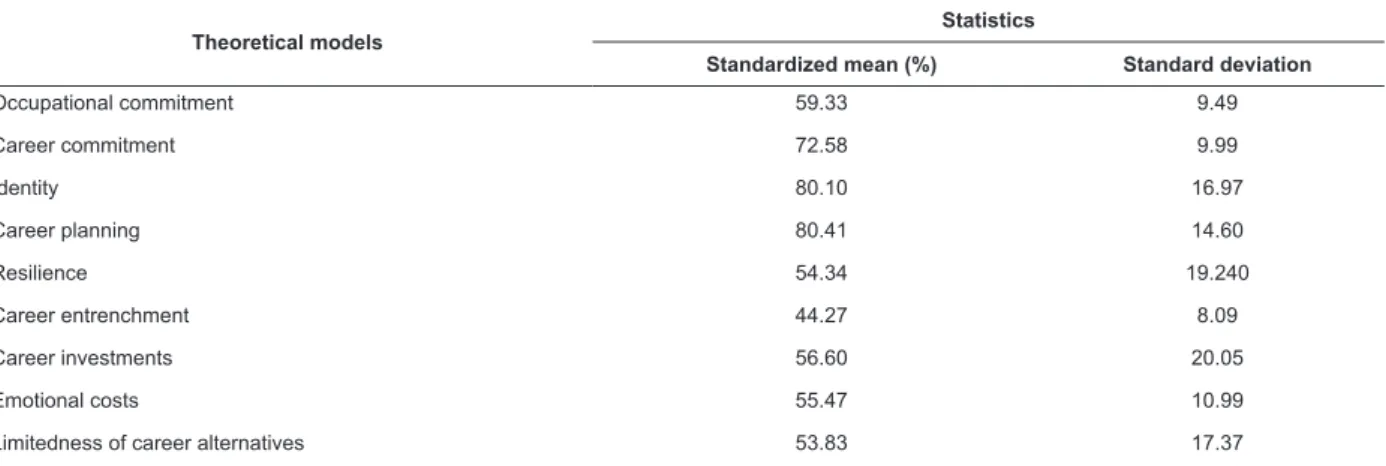
Table 1 - General statistics for the constructs and standardized dimensions. Santa Maria and Santa Cruz do Sul, state
of Rio Grande do Sul, Brazil, 2012
Theoretical models
Statistics
Standardized mean (%) Standard deviation
Occupational commitment 59.33 9.49
Career commitment 72.58 9.99
Identity 80.10 16.97
Career planning 80.41 14.60
Resilience 54.34 19.240
Career entrenchment 44.27 8.09
Career investments 56.60 20.05
Emotional costs 55.47 10.99
Limitedness of career alternatives 53.83 17.37
a specialization degree (70.98%), career of up to 10 years (38.98%) and earn between 6 and 10 Brazilian minimum wages (52.63%).
To identify the nurses’ level of relation to career,
we standardized the results of the means obtained
for each construct in order to classify the level of
the relations (commitment and entrenchment) into
low, medium, and high (procedure explained in the
method section). For this purpose, the overall means
and standard deviation obtained for each construct
and respective dimensions were analyzed, as shown
in Table 1.
Concerning the irst theoretical model, for occupational commitment, the mean value was 59.33%, classiied as a medium-level relation. Regarding career
commitment, the theoretical model had the highest
mean (=72.58%), characterizing it as the relation of
the highest level. For the dimensions of this relation, the
highest means were for planning (=80.41%), followed
by identity (=80.10%) and resilience (=54.34%)
regarding the career, which, however, had a medium
level.
As for career entrenchment, the mean (=44.27%)
revealed a medium level for the relation, with dimensions
investments (=56.60%), emotional costs (=55.47%)
and limitedness of alternatives (=53.83%) having the
same behavior. Standard deviations were low, indicating
that there was no signiicant variability among the answers
of the participants. This fact reinforces the positive
evaluation by the participants regarding the theoretical
models used.
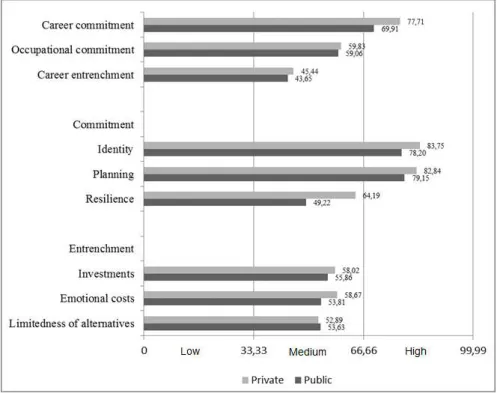
As for the determination of the levels of the nurses’
relation to the career according to type of hospital,
means for each construct by type of institution are
shown in Figure 1.
The irst construct (career commitment) was the
theoretical model with the highest means, for nurses of
both public (=69.91%), and private hospital (=77.71%).
The dimensions of this relation had higher means for
private hospitals than for public hospitals. For private
hospitals, the dimension with the highest mean was
identity (=83.75%), followed by planning (=82.84%)
and resilience (=64.19%). For public hospitals, the means
obtained for the dimensions of commitment were also
higher for the dimension identity (=78.20%), followed by
With regard to occupational commitment, we
veriied that the mean for the nurses from private
hospitals (=59.83%) was higher than the mean for
nurses from public hospitals (=59.06%). However, a
medium classiication was observed for both regarding
the level of occupational commitment.
Concerning career entrenchment, mean was
slightly higher for private hospitals (=45.44%)
compared to public hospitals (=43.65%). This
construct showed a medium level of relation for both
types of hospitals. This behavior of the level of relation
remained in its dimensions; however, means were
slightly higher for private hospitals, except for the
dimension limitedness of alternatives, slightly higher
for the public sector.
Thus, to compare the relations to career –
commitment and entrenchment – of the nurses
from public and private hospitals, the Mann-Whitney
test was conducted to determine the differences
of means. Importantly, values with p<0.05 were
considered signiicant.
Based on the data presented in Table 2, considering
the theoretical models surveyed, only career
commitment and its dimensions planning and resilience,
in addition to the dimension emotional costs from career
entrenchment showed statistically signiicant differences
(p<0.05). As for the remaining theoretical models, such
differences (p>0.05) were not observed, indicating that,
regardless of the type of hospital, the difference found
for mean possibly occurred due to sampling error.
Figure 1 - Standardized mean and classiication of the level of the constructs and
dimensions by type of hospital
Table 2 - Descriptive statistics of the constructs and respective dimensions for nurses from public and private
hospitals. Santa Maria and Santa Cruz do Sul, state of Rio Grande do Sul, Brazil, 2012
Theoretical models
Statistics
p-value
Public Private
Mean Standard
deviation Mean
Standard deviation
Occupational commitment 3.02 0.45 3.07 0.42 0.6196
Career commitment 3.40 0.36 3.71 0.38 0.0001*
Identity 3.55 0.46 3.59 0.49 0.2379
Rev. Latino-Am. Enfermagem 2015 Nov.-Dec.;23(6):1033-40.
Discussion
In this study, career commitment and career
entrenchment were median, differently from other
studies(4,10,13), whose mean values for occupational
commitment showed a high level of relation.
Results for career commitment level and mean and
identity dimension were high, corroborating the values
found in another study(13). Considering the means found
for the dimensions that are part of the construct career
commitment, it is emphasized that the high level of
career commitment among nurses does not necessarily
imply high levels of resilience. A similar result was found
in a survey applied to professors of higher education
institutions(4,10). The study found that, when the mean of
the dimension resilience is not a signiicant value, it is
assumed that the high level of commitment is not related
to the ability to be resilient, i.e., to face adversities found
in the profession in order to continue in it(4,10), according
to the indings obtained in the present study.
As for career entrenchment, a similar survey(13)
also obtained median level for the three dimensions that
form this relation. However, in this study, the dimension
investments was the highest in relation to means,
contrary to the author’s indings, whose highest mean
was obtained for the dimension emotional costs(13).
In general, it is observed that the indings obtained showed much more signiicant levels for
career commitment compared to career entrenchment,
which is similar to other surveys concerning the
subject(4,10,13). This fact reinforces that the nurses
surveyed have a stronger relation of identiication to
their career than a relation of stagnation, maintained
primarily due to investments, followed by emotional
costs and lack of alternatives.
Regarding the nurses’ level of relation to career
according to type of hospital, in summary, in both
types of institutions, public and private, means for the
dimensions commitment, identity, and planning were
classiied as high level and resilience as median level.
A similar study assumed that high levels of career
identity and planning, since they are subjective aspects
of this relation, would best deine the commitment of
these professionals(13). Thus, the high level of career
planning may indicate that the nurses devise strategies,
objectives, plans, and goals, aspects considered by the
author as responsible for professional development.
Considering the indings about the dimensions
that constitute career commitment, we point out that
the professionals from the private context have more
signiicant levels for the dimensions career identity and
career resilience, while nurses from the public context
plan the nursing career more. Thus, it is veriied that
professionals from private hospitals show to be better at
overcoming the adversities of the occupational context,
given the instability of the institution’s employment
contracts. On the other hand, public hospitals have
professionals who plan the career more, due to higher
possibilities of growth. These indings are corroborated
by a survey conducted with professors from higher
education institutions(4,10), which observes that the
public context has signiicant differences from the
private context, referring to career conditions. Public
institutions provide professionals with a stable career
and the possibility of continuous training, which does
not occur in the private sector(4,10).
As for occupational commitment, the indings show
that there is emotional attachment to the occupation,
producing good feelings to continue in the career and
seek professional growth. In the speciic case, it was
found that nurses from public hospitals have higher levels
of occupational commitment compared to professionals
of private hospitals. These results are similar to those
of the study that applied the occupational commitment
scale(7) to professors of higher education institutions, Table 2 - (continuation)
Theoretical models
Statistics
p-value
Public Private
Mean Standard
deviation Mean
Standard deviation
Career planning 4.03 0.63 4.22 0.69 0.0092*
Resilience 2.60 0.87 3.34 0.96 0.0001*
Career entrenchment 2.81 0.50 2.92 0.51 0.2535
Career investments 2.94 0.94 3.02 0.96 0.5570
Emotional costs 2.85 0.31 3.08 0.30 0.0001*
Limitedness of alternatives 2.80 0.82 2.76 0.39 0.6294
verifying that professors from public institutions had a
higher level of commitment to the profession compared
to professors from private universities(4,10).
Regarding career entrenchment, information
obtained in the results indicates that large investments
in the career tend to cause medium levels of career
entrenchment to the studied nurses. Therefore, nurses
participating in the study tend to remain stagnant
mainly because of the investments in the career rather
than because of affective losses and emotional impacts
that a change can cause. Regarding the dimensions
that are part of career entrenchment, the result found
in another study was contrary to the result found in
this study(13).
Thus, we emphasize that the values obtained in
the results indicate that nurses from private hospital
are more committed than nurses from public hospitals.
These indings are consistent with the view that the
public service brings returns to traditional careers,
i.e., those characterized by stability and possibilities of
retirement due to length of service(14). Thus, apparently,
this lower level of career commitment among nurses
from public hospitals may have occurred because of the
guarantees provided by positions of such nature(14).
As for the dimensions that are part of career
commitment, we observed that nurses from private
hospitals have more career planning compared to
nurses from the public hospitals. This higher level
of planning among nurses from private hospitals
may result from conditions provided by the type of
institution they work for. Regarding career resilience,
nurses from private hospitals are more resilient
compared to nurses from public hospitals, indicating
that these professionals more easily adapt to the
adversities in the occupational context.
Another statistical difference identiied among the
nurses from public and private hospitals was related to
emotional costs, a dimension of career entrenchment. It
was evident that nurses from private hospitals estimate
the emotional costs, affective impacts, and repercussions
on social and family life more than professionals from
public hospitals. In addition, there is great homogeneity
in the group studied as for the standard deviation found
for the constructs and dimensions of the theoretical
models applied in this study.
Conclusion
Career commitment was the predominant relation
among the nurses of the study. Nurses have a stronger
relation of affection and identiication to career than a
relation of stagnation, maintained due to investments,
emotional costs, and lack of alternatives. This relation of
commitment is associated with individuals continuing in
nursing and having a strong commitment to activities,
indicating that nurses continue in the career because of
identiication with the profession.
As for career entrenchment, the dimension
investment is highlighted. This data indicates that,
when leaving the career, the nurse takes into account
the investment in training, as well as the efforts in the
exercise of nursing.
Concerning limitations of the research, we highlight
the study ield being restricted to four hospitals and the
absence of evaluations with co-workers and immediate
supervisors, which may have caused overestimation and
underestimation biases to the answers of the subjects.
In addition, we point out the dificulty of comparing the indings to other studies on the same topic, researches
focusing on the study of organizational behavior in health
and nursing institutions. Thus, expanded, regional and
national samples are suggested for future studies so
results can be generalized.
References
1. Blau G. Testing for a four-dimensional structure
of occupational commitment. J Occup Org Psychol.
2003;76(4):469-88.
2. Magalhães MO. Propriedades psicométricas da versão
brasileira da Escala de entrincheiramento na carreira.
Psico-USF. 2008;13(1):13-9. doi:
10.1590/S1413-82712008000100003
3. Carson KD, Carson PP, Bedeian AG. Development and
construct validation of a career entrenchment measure.
J Occup Org Psychol. 1995;68:301-20. doi: 10.1111/
j.2044-8325.1995.tb00589.x
4. Rowe DEO, Bastos AVB, Pinho APM. Múltiplos
comprometimentos com o trabalho e suas influências
no desempenho: um estudo entre professores do ensino
superior no Brasil. Org Soc. 2013;20(66):501-21. doi:
10.1590/S1984-92302013000300008
5. Carson KD, Carson PP, Phillips JS, Roe CW. A career
entrenchment model: theoretical development and
empirical outcomes. J Career Develop.
1996;22(4):273-86. doi: 10.1007/BF02259996
6. Borba GS, Kliemann Neto FJ. Gestão hospitalar:
identificação das práticas de aprendizagem existentes
em hospitais. Saúde Soc. 2008;7(1):44-60. doi:
Rev. Latino-Am. Enfermagem 2015 Nov.-Dec.;23(6):1033-40.
7. Blau GJ. The measurement and prediction of career
commitment. J Occup Psychol. 1985;58(4):277-88. doi:
10.1111/j.2044-8325.1985.tb00201.x
8. Carson KD, Bedeian AG. Career commitment:
Construction of a measure and examination of
its psychometric properties. J Vocational Beh.
1994;44(3):237-62. doi: 10.1006/jvbe.1994.1017
9. Scheible ACF, Bastos AVB, Rodrigues ACA.
Comprometimento e entrincheiramento na carreira:
integrar ou reconstruir os construtos? Uma exploração
das relações à luz do desempenho. Rev Admin.
2013;48(3):530-43. doi: 10.5700/rausp1104
10. Rowe DEO, Bastos AVB, Pinho APM. Comprometimento
e entrincheiramento na carreira: Um estudo de suas
influências no esforço instrucional do docente de ensino
superior. Ver Admin Empresas. 2011;15(6):973-92. doi:
10.1590/S1415-65552011000600002
11. Greco RM. Ensinando a administração em
enfermagem através da educação em saúde. Rev
Bras Enferm. 2004;57(4):504-7. doi:
10.1590/S0034-71672004000400026
12. Amestoy SC, Backes VMS, Trindade LL. Canever
BP. Produção científica sobre liderança no contexto da
enfermagem. Rev Esc Enferm USP. 2012;46(1):227-33.
doi: 10.1590/S0080-62342012000100030.
13. Andrade RS, Fernandes SRP, Bastos AVB.
Bem-estar subjetivo e comprometimento com a carreira:
examinando suas relações entre professores de ensino
superior. Rev Psicol. 2013,4(2):47-60.
14. Chanlat JF. Quais carreiras e para qual sociedade?
Rev Admin Empresas. 1995;35(6):67-75. doi: 10.1590/
S0034-75901996000100003
Received: June 16th 2014