DOI: 10.1590/0104-1169.3067.2359 www.eerp.usp.br/rlae
Copyright © 2013 Revista Latino-Americana de Enfermagem
This is an Open Access article distributed under the terms of the Creative Commons Attribution Non-Commercial License (CC BY-NC).
This license lets others distribute, remix, tweak, and build upon your work non-commercially, and although their new works must also acknowledge you and be non-commercial, they don’t have to license their derivative works on the same terms.
Corresponding Author: Elucir Gir
Universidade de São Paulo. Escola de Enfermagem de Ribeirão Preto Departamento de Enfermagem Geral e Especializada
Av. Bandeirantes, 3900 Bairro: Monte Alegre
CEP: 14040-902, Ribeirão Preto, SP, Brasil E-mail: [email protected]
Lilian Andreia Fleck Reinato
2Daiana Patrícia Marchetti Pio
3Letícia Pimenta Lopes
4Fernanda Maria Vieira Pereira
3Ana Elisa Ricci Lopes
2Elucir Gir
51 Paper extracted from master’s thesis “Staphylococcus aureus colonization in individuals with HIV/AIDS hospitalized in a teaching hospital in the city of Ribeirão Preto, state of São Paulo”, presented to Escola de Enfermagem de Ribeirão Preto, Universidade de São Paulo, WHO Collaborating Centre for Nursing Research Development, Ribeirão Preto, SP, Brazil.
2 Master’s student, Escola de Enfermagem de Ribeirão Preto, Universidade de São Paulo, WHO Collaborating Centre for Nursing Research Development, Ribeirão Preto, SP, Brazil.
3 Doctoral student, Programa Interunidades de Pós-graduação em Enfermagem, Escola de Enfermagem, Universidade de São Paulo, São Paulo, SP, Brasil and Escola de Enfermagem de Ribeirão Preto, Universidade de São Paulo, WHO Collaborating Centre for Nursing Research Development, Ribeirão Preto, SP, Brazil.
4 Doctoral student, Escola de Enfermagem de Ribeirão Preto, Universidade de São Paulo, WHO Collaborating Centre for Nursing Research Development, Ribeirão Preto, SP, Brazil.
5 PhD, Full Professor, Escola de Enfermagem de Ribeirão Preto, Universidade de São Paulo, WHO Collaborating Centre for Nursing Research Development, Ribeirão Preto, SP, Brazil.
Objective: to evaluate the prevalence of nasal colonization with Staphylococcus aureus in
individuals with HIV/AIDS under inpatient treatment in a teaching hospital in the state of São
Paulo (Brazil). Method: a cross-sectional study undertaken in two units specialized in attending
people living with HIV/AIDS, in the period August 2011 – July 2012. Socio-demographic and
clinical data was collected through individual interviews and from the medical records; samples
of nasal secretion were collected with Stuart swabs on the first day of inpatient treatment.
Ethical aspects were respected. Result: of the 229 individuals with HIV/AIDS hospitalized in this
period, 169 participated in the study, with Staphylococcus aureus being identified in the culture
tests of 46 (27.2%) of the individuals, resistance to oxacillin being evidenced in 10 (21.8%)
participants. Conclusion: the results of the research indicate that the prevalence of colonization
with Staphylococcus aureus in individuals with HIV/AIDS in the specialized units was considered
relevant, possibly contributing to future investigations and, moreover, to the implementation of
measures to prevent and control this pathogen in this population.
Descriptors: Staphylococcus aureus; Methicillin-Resistant Staphylococcus aureus; Acquired
Immunodeficiency Syndrome; Nursing; Clinical Nursing Research.
Nasal colonization with
Staphylococcus aureus
in individuals with HIV/
Rev. Latino-Am. Enfermagem 2013 Nov.-Dec.;21(6):1235-9.
Introduction
Staphylococcus aureus is a gram-positive bacteria which colonizes the skin and has a preference for the
anterior nares, with this colonization’s prevalence
varying, depending on the population studied. It has a
mean of 37.2% in the general population, and a rate of
up to 35.5% in the nasal sites of patients with Human
Immunodeiciency Virus (HIV)(1-2).
Staphylococcus aureus’s resistance to methicillin
(MRSA) was irst described in Europe in 1961, as a
nosocomial pathogenic agent(3).
For researching Staphylococcus aureus and,
principally, MRSA, the sites of the greatest interest are
the nasal mucosa and the skin, due to their characteristic
of being naturally colonized.
The colonization of individuals with HIV/AIDS by
pathogenic micro-organisms has been associated with
higher risk of morbidity and mortality, principally when
related to Staphylococcus aureus. Researchers found a
rate of 76.7% of colonization with this bacteria in this
population, indicating prolonged hospitalization (over 10
days) as a risk factor for resistance to methicillin(4).
The prevalence of nasal colonization with
Staphylococcus aureus varies depending on the population studied. The recent use of antibiotics and
inpatient treatment in the last year have been found as
independent predictors for nasal MRSA colonization in
HIV-positive patients treated as outpatients(5).
In individuals living with HIV/AIDS,
immunosuppression and the constant use of
antimicrobials can viabilize colonization with
multi-resistant bacteria and the occurrence of infections.
This manuscript’s relevance is explained by the fact
that publications on the issue of Staphylococcus aureus
in people living with HIV/AIDS were not found in Nursing
periodicals in Brazil.
Objective
To evaluate the prevalence of nasal colonization
with Staphylococcus aureus in individuals with HIV/AIDS
receiving inpatient treatment in a teaching hospital in
the state of São Paulo (Brazil).
Method
The present study is quantitative and
cross-sectional and was undertaken in two units which are
specialized in attending individuals with HIV/AIDS in a
large* teaching hospital in the state of São Paulo.
This research project was considered and approved
by the Research Ethics Committee of the Ribeirão Preto
School of Nursing (Protocol n° 1304/2011 EERP-USP).
The inclusion criteria established were: to be
aged over 18 years old; to be aware of the diagnosis
of infection with HIV/AIDS; to be clinically well enough
to understand the guidance and to take the decision to
participate or not. Individuals with HIV/AIDS using any
ventilatory equipment which would make consenting or
data collection impossible were excluded, as were those
who were inpatients before the data collection period.
On the irst day of inpatient treatment, (the irst
24 hours) the individual was invited to participate and
received information referent to the study objective
and the research’s ethical precepts; once the individual
had understood and accepted to participate, he or she
signed the Terms of Free and Informed Consent.
Socio-demographic and clinical data was collected
through individual interviews and by accessing the
medical records; the biological material was collected
respecting the recommended bio-security measures, in
the period August 2011 – July 2012. The nasal secretion
was obtained using Stuart swabs, these being rubbed
lightly in the left and right anterior nares.
The material collected was seeded and the isolation
and the phenotypic identiication of Staphylococcus aureus were carried out by an automatized method,
using Vitek® system cards (BioMérieux™). Susceptibility
to antimicrobials was tested using the AST-P585 card
(BioMérieux™).
The data was organized in Microsoft Ofice and
Mac Excel 2011 spreadsheets and then exported to
the Statistical Package for the Social Science program,
version 17.0. The distribution of the frequencies (mean
and median) and the subsequent descriptive statistics of
the data were undertaken.
Results
Of the 229 individuals approached in the period,
169 (73.8%) participated in the research; these were
individuals with HIV/AIDS receiving inpatient treatment
during the data collection period, who met the inclusion
criteria; 57.4% were male, their ages varied between
19 and 72 years, with a mean of 42 years, and 39.6%
of them were in the age range between 40 and 49 years
old. White ethnicity was predominant, corresponding
to 63.9% of the participants. In relation to education,
45.0% of the interviewees had completed primary
school, and only 3.6% stated that they had completed
higher education.
The microbial analysis of the material resulted in
123 (72.8%) non-colonized individuals and 46 who were
colonized with Staphylococcus aureus in the nostrils,
which corresponds to a prevalence of 27.2%. Among
those who were colonized, 36 (78.3%) presented
Staphylococcus aureus which was sensitive to oxacillin, these being denominated MSSA, and 10 (21.7%) were
resistant to oxacillin, these known as MRSA.
Nasal colonization with Staphylococcus aureus was
observed more in male individuals with HIV/AIDS, with
Table 1 - Distribution of the individuals with HIV/AIDS receiving inpatient treatment in two units of a teaching hospital
(N=169) by socio-demographic variables and nasal colonization with Staphylococcus aureus, sensitive to (MSSA),
and resistant to, oxacillin (MRSA). Ribeirão Preto, SP, Brazil, 2011-2012
52.8% MSSA and 90.0% MRSA, the predominant age
range being 30 to 39 years old, with 36.1% MSSA and
60.0% MRSA being evidenced in this age range. The level
of education prevalent among the individuals with HIV/
AIDS who were colonized in the nostrils with MSSA was
equally distributed in the following categories: primary
education incomplete and primary education complete,
each with 36.1%; among those colonized in the nostrils
with MRSA, there was predominance in the category
‘primary education complete’, 60% of the participants
having this phenotype.
Table 1 presents the individuals with HIV/AIDS
by the variables: sex, age, ethnicity, education, and
classiication regarding colonization or non-colonization
with MSSA or MRSA.
Variables Non-colonized (n=123)
Colonized (n=46)
MSSA (n=36) MRSA (n=10)
f % f % f %
Sex
Male 69 56.1 19 52.8 9 90.0
Female 54 43.9 17 47.2 1 10.0
Age range
19 to 29 11 8.9 6 16.7 1 10.0
30 to 39 32 26.0 13 36.1 6 60.0
40 to 49 54 43.9 12 33.3 1 10.0
50 to 59 20 16.3 2 5.6 1 10.0
≥60 6 4.9 3 8.3 1 10.0
Education
Illiterate 8 6.5 2 5.6 1 10.0
Primary - incomplete 29 23.6 13 36.1 3 30.0
Primary - complete 57 46.3 13 36.1 6 60.0
Secondary - complete 24 19.5 7 19.4 0 0.0
Higher Ed. - complete 5 4.1 1 2.8 0 0.0
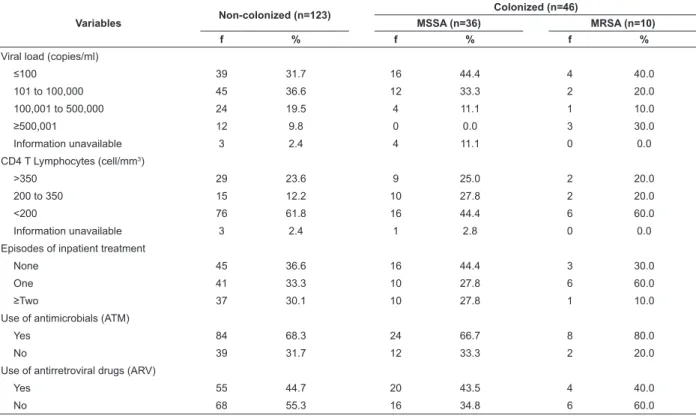
In relation to the viral load of the HIV, MSSA was
isolated in 16 (44.4%) of the individuals with HIV/AIDS
who had counts below 100 copies/ml, while MRSA was
identiied in 4 (40.0%) of the individuals in the same
range of viral load count. In relation to the determination
of CD4+ T lymphocytes, among those colonized with
MSSA and MRSA, there was a predominance of the range
below 200 cells/mm³ in 16 (44.4%) and 6 (60.0%)
individuals, respectively.
Regarding the number of episodes of inpatient
treatment in the previous six months, it was observed
that 44.4% of the individuals with HIV/AIDS colonized
with MSSA, and 30.0% of the individuals with HIV/
AIDS colonized with MRSA, had not received inpatient
treatment in the period. Among the participants with
MRSA, 60.0% mentioned one episode of inpatient
treatment in the previous six month period. The
use of antimicrobials was observed in 66.7% of the
individuals with HIV/AIDS with MSSA, and in 80.0% of
the individuals with HIV/AIDS with MRSA, evidencing
the predominance of the use of antimicrobials in those
colonized with Staphylococcus aureus.
The use of antiretroviral drugs was identiied in
43.5% of the individuals colonized with MSSA, not
being observed in 60.0% of those individuals colonized
with MRSA.
Table 2 brings together the characterization of
Rev. Latino-Am. Enfermagem 2013 Nov.-Dec.;21(6):1235-9.
or MRSA, by the variables of viral load, CD4+ T cell
count, number of episodes of inpatient treatment in the
Table 2 - Distribution of the individuals with HIV/AIDS receiving inpatient treatment in two units of a teaching hospital
(N=169) by the variables of the disease, treatment, hospitalization and colonization with Staphylococcus aureus,
sensitive to oxacillin (MSSA) and resistant to oxacillin (MRSA). Ribeirão Preto, SP, Brazil, 2011-2012
previous six months, use of antimicrobials, and use of
antiretroviral drugs.
Variables Non-colonized (n=123)
Colonized (n=46)
MSSA (n=36) MRSA (n=10)
f % f % f %
Viral load (copies/ml)
≤100 39 31.7 16 44.4 4 40.0
101 to 100,000 45 36.6 12 33.3 2 20.0
100,001 to 500,000 24 19.5 4 11.1 1 10.0
≥500,001 12 9.8 0 0.0 3 30.0
Information unavailable 3 2.4 4 11.1 0 0.0
CD4 T Lymphocytes (cell/mm3)
>350 29 23.6 9 25.0 2 20.0
200 to 350 15 12.2 10 27.8 2 20.0
<200 76 61.8 16 44.4 6 60.0
Information unavailable 3 2.4 1 2.8 0 0.0
Episodes of inpatient treatment
None 45 36.6 16 44.4 3 30.0
One 41 33.3 10 27.8 6 60.0
≥Two 37 30.1 10 27.8 1 10.0
Use of antimicrobials (ATM)
Yes 84 68.3 24 66.7 8 80.0
No 39 31.7 12 33.3 2 20.0
Use of antirretroviral drugs (ARV)
Yes 55 44.7 20 43.5 4 40.0
No 68 55.3 16 34.8 6 60.0
Discussion
Of the samples collected from the nostrils of 169
(73.8%) individuals with HIV/AIDS receiving inpatient
treatment in a large teaching hospital, 46 (27.2%) were
positive for Staphylococcus aureus, of whom 36 (78.3%)
were identiied as MSSA and 10 (21.7%), as MRSA.
The male sex was more frequent in the population
studied, both in those individuals who were colonized
and among those who were not. The predominant age
range was from 30 to 39 years of age among those
colonized with Staphylococcus aureus. The predominant
level of schooling was completed primary school.
A similar, retrospective, study, with individuals
with HIV/AIDS, undertaken to identify risk factors for
colonization or infection with MRSA, obtained results
showing that 63.0% of the participants were male and
that the mean age was 41 years old (22 to 60 years old).
Nasal colonization in individuals with HIV/AIDS was
identiied more in those who had a low viral load (≤100
copies/ml), CD4+ T lymphocytes count <200 cells/mm3,
those with a history of at least one episode of inpatient
treatment in the previous six months, and who were using
antimicrobials. Only MRSA was identiied with greater
frequency among the individuals who were not using
antiretroviral drugs, as, in the MSSA evidence, the majority
of the participants were using antiretroviral drugs.
Previous research had identiied a rate of 34%
of nasal colonization with Staphylococcus aureus in
individuals with HIV, emphasizing being a nasal carrier,
having a vascular catheter, a low CD4+ T lymphocyte
count and neutropenia as important risk factors for
infections related to this pathogen(7).
Research conducted among individuals with HIV
found that 83.3% of the nasal carriers of Staphylococcus
aureus were patients with CD4 T lymphocytes <200 cells/
mm3, while among those who had a CD4 T cell count
above 300 cells/mm3, MRSA was not isolated(4).
Inpatient treatment, the previous use of
antimicrobials, skin/soft tissue infection or being
HIV-positive may all be considered as risk factors for patients
who presented colonization with MRSA(8).
Some risk factors for MRSA infection are indicated
for individuals living with HIV, the following being
highlighted: the immunosuppressed condition, and
Received: Dec. 18th 2012
Accepted: Aug. 21st 2013
behaviors, such as high-risk sexual practices and the
use of illicit drugs(9).
The use of antimicrobials has also been documented
as a risk factor for colonization with Staphylococcus
aureus in individuals with HIV(10).
The use of antiretroviral drugs and the prophylactic
use of Trimethoprim/sulfamethoxazole (TMP/SMX) are
included among probable protective factors against
colonization with Staphylococcus aureus among
individuals with HIV(6,10-11).
Some measures for the prevention and control
of MRSA can be instituted, such as the investigation
of patients who are suspected of being colonized or
infected with MRSA, as well as this patient’s restriction in
the hospital environment (private room and bathroom);
the investigation of body sites with swabs (nasal site,
the genital region), and the use of personal protective
equipment for the health professionals when in direct
contact with the suspected cases, followed by the
treatment and decolonization of patients and health
professionals identiied as colonized(12).
One study undertaken with health professionals
emphasizes the need to implement strategies which
cover public policies directed at programs for the control
of this pathogen in the hospital setting, promoting broad
discussions on this topic(13).
Conclusion
The concern with identifying colonization with
Staphylococcus aureus in the population which lives with HIV/AIDS is growing, in view of the need for
interventions for controlling the spread of this pathogen,
minimizing correlated future infections.
In spite of being a bacteria irst isolated in human
beings over four decades ago, Staphylococcus aureus
commonly causes the infection of skin and soft tissues,
among others, both in people receiving inpatient
treatment and those living in the community.
It is necessary for there to be joint action from
professionals and government bodies linked to health, so
as to improve policies of control related to antimicrobial
resistance and to multi-drug-resistant micro-organisms.
References
1. Casewell MW, Hill RLR. The carrier state:
Methicillin-resistant Staphylococcus aureus. J Antimicrob
Chemother. 1986;18(Suppl A):1-12.
2. Kluytmans J, Belkum A, Verbrugh H. Nasal carriage
of Staphylococcus aureus: epidemiology, underlying
mechanisms, and associated risks. Clin Microbiol Rev.
1997;10(3):505-20.
3. Jevons MP. Celbenin – resistant staphylococci. Br Med
J. 1961;1(5219):124-5.
4. Chacko J, Kuruvila M, Bhat GK. Factors affecting the
nasal carriage of methicillin-resistant Staphylococcus
aureus in human immunodeficiency virus-infected
patients. Indian J Med Microbiol. 2009;27(2):146-8.
5. Villacian JS, Barkham T, Earnest A, Paton NI.
Prevalence of and risk factors for nasal colonization with
Staphylococcus aureus among Human Immunodeficiency
Virus-positive outpatients in Singapore. Infect Control
Hosp Epidemiol. 2004;25(5):438-40.
6. Ramsetty SK, Stuart LL, Blake RT, Parsons CH, Salgado
CD. Risks for methicillin-resistant Staphylococcus
aureus colonization or infection among patients with HIV
infection. HIV Medicine. 2010;11(6):389-94.
7. Nguyen MH, Kauffman CA, Goodman RP, Squier C,
Arbeit RD, Singh N, et al. Nasal carriage of and infection
with Staphylococcus aureus in HIV-infected patients.
Ann Intern Med. 1999;130(3):221-5.
8. Hidron AI, Kourbatova EV, Halvosa JS, Terrell
BJ, McDougal LK, Tenover FC, et al. Risk factors for
colonization with methicillin-resistant Staphylococcus
aureus (MRSA) in patients admitted toa n urban
hospital: emergence of community-associated MRSA
nasal carriage. Clin Infect Dis. 2005;41(2):159-66.
9. Shadyab AH, Crum-Cianflone, NF. Methicillin-resistant
Staphylococcus aureus (MRSA) infections among
HIV-infected persons in the era of highly active antirretroviral
therapy: a review of the literature. HIV Medicine.
2012;13(6):319-32.
10. Yehia BR, Fleishman JA, Wilson L, Hicks PL,
Gborkorquellie TT, Gebo KA. Incidence of and risk
factors for bacteraemia in HIV-infected adults in the
era of highly active antiretroviral therapy. HIV Medicine.
2011;12(9):535-43.
11. Hidron AI, Moanna A, Rimland D. The rise and fall of
methicillin-resistant Staphylococcus aureus infections in
HIV patients. AIDS. 2011;25(7):1001-3.
12. Cruz EDA, Pimenta FC, Andresen BM, Gir E. Lessons
to learn with the methicillin-resistant Staphylococcus
aureus control in Norway. Braz J Infect Dis.
2011;15(6):591-3.
13. Moura JP, Pimenta FC, Hayashida M, Cruz EDA, Canini
SRMS, Gir E. Colonization of nursing professional by
Staphylococcus aureus. Rev. Latino-Am. Enfermagem.