I
ntroductIonIt is well established that estradiol (E2) plays an important role in the genesis and progression of breast cancer1,2,3. Almost 70% of breast cancer occurs in postmenopausal women and approxi-mately 75% are estrogen dependent showing that aromatase is very important for carcinogenesis in these women4,5.
Estrogen metabolism is mediated by a number of enzymes. Aromatase is a cytochrome P-450 family coded by the CYP19 gene that catalyses the conversion of androstenedione into oestrone (E1) and testosterone into E2 through hydroxylation, oxidation and removes the C-19 carbon and aromatization
of the steroid A ring 6,7. This estrogen synthesis, which is the main form of estrogen production in postmenopausal women, can occur in peripheral tissues, but is found mainly in the local mammary tissue 7.
A large number of studies have shown that local production of estrogen in breast cancer tissue is higher than in normal breast counterparts due to the presence of very high levels of aromatase 8 - 12.
An essential process in forming distant metastases is degra-dation of the extracellular matrix (ECM) allowing tumor cells to invade local tissue, intravasate and extravasate blood vessels and form new metastatic colonies. This process is primarily
*Correspondência:
Rua: Cesário Motta Jr. 112- Vila Buarque
São Paulo, SP CEP: 012210-020 Phone/ Fax (+55 11) - 32224254
Summary
objectIve. This study intends to verify the expression levels and correlation of aromatase, matrix
metalloproteinase 2 (MMP-2), matrix metalloproteinase 9 (MMP-9) and CD44 in ductal carcinoma in
situ (DCIS) and iniltrating ductal carcinoma (IDC) when both are found in the same breast. Methods. One hundred and ten cases were evaluated by tissue microarray (TMA) and
immunohisto-chemically screened with anti-aromatase polyclonal antibodies, anti-MMP-2 monoclonal antibodies, anti-MMP-9 policlonal antibodies and anti-CD44 monoclonal antibodies.
results. Aromatase was expressed in IDC and DCIS in 63 (57.3%) and 60 (67%) of the cases
respectively; MMP-2 was similarly expressed in IDC and DCIS in 15 (13.60%) cases; MMP-9 was positively expressed in IDC and DCIS in 83 (75.50%) and 82 (74.50%) cases, respectively; CD44 was positively expressed in IDC and DCIS in 49 (44.50%) and 48 (42.60%) of the cases, respectively; all of them were highly correlated (p<0,001). The correlation analysis found positive, statistically
signiicant correlation, in IDC between aromatase and MMP-2 (p<0.001) and between aromatase
and MMP-9 (p=0.034). Positive correlation between aromatase and MMP-2 (p<0.001) and between MMP-9 and CD44 (p=0.030) were found in DCIS.
conclusIon. These results allow us to conclude that aromatase through local estrogen synthesis in breast tissue plays an important role in breast carcinogenesis, mainly inluencing MMP-2 and MMP-9
which are important participants in tumor cell invasion and dependence of their connection to CD44 for action.
Key words: Aromatase. Matrix metalloproteinase 2. Matrix metalloproteinase 9. Antigens CD44. Carcinoma ductal breast.
the
InteractIon
between
aroMatase
,
MetalloproteInase
2
,
9
and
cd
44
In
breast
cancer
FábIo bagnolI1*, vIlMar Marquesde olIveIra2, MarIa antonIeta longo galvãoda sIlva3, gIulIana cássIa Morrone taroMaru4, josé FrancIsco rInaldI5, tsutoMu aokI6
Study conducted at Santa Casa de Misericórdia de São Paulo, São Paulo, SP
1. Especialista - Médico Segundo Assistente do Departamento de Obstetrícia e Ginecologia da Santa Casa de Misericórdia de São Paulo, São Paulo, SP 2. Doutor em Medicina - Professor Doutor Assistente da Faculdade de Ciências Médicas da Santa Casa de São Paulo e Chefe da Clínica de Mastologia do
Departamento de Obstetrícia e Ginecologia da Santa Casa de Misericórdia de São Paulo, São Paulo, SP
3. Doutora em Medicina - Professora Doutora Assistente da Faculdade de Ciências Médicas da Santa Casa de São Paulo e do Departamento de Ciências Patológicas da Santa Casa de Misericórdia de São Paulo, São Paulo, SP
4. Mestre em Medicina - Médica Segundo Assistente do Departamento de Obstetrícia e Ginecologia da Santa Casa de Misericórdia de São Paulo, São Paulo, SP 5. Doutor em Medicina - Professor Doutor Assistente da Faculdade de Ciências Médicas da Santa Casa de São Paulo e do Departamento de Obstetrícia e Ginecologia
da Santa Casa de Misericórdia de São Paulo, São Paulo, SP
inluenced by activity of tumor secreted proteinases 13,14. Metalloproteinases (MMPs) are the largest class of proteinases in the human genome 15. MMPs are proteolytic enzymes that can degrade the structural elements of the ECM and release cell-bound inactive precursor forms of growth factors, degrade cell-cell and cell-ECM adhesion molecules and activate others MMPs 16. The main MMPs involved in breast cancer are metallo-proteinase-2 (MMP-2) and metalloproteinase 9 (MMP-9) that have the capacity to degradate type IV collagen which is present on basal membrane and has the function of separating epithelial cells from adjacent stromal 17,18. The high expression of MMP-2 and MMP-9 in tumors is associated with elevated numbers of distant metastases and poor prognosis 19,20.
Di et al. (2005) 21, through PCR analysis of breast cancer tissues, found a positive correlation between aromatase, MMP-2, and MMP-9 (p<0.01). Lu et al. (2007) 22 demonstrated a positive correlation between aromatase, MMP-2, and MMP-9 in breast cancer tissues positive for hormonal receptors (p<0.05). CD44 is a broadly distributed transmembrane glycopro-tein that plays a critical role in a variety of cellular behaviors, including adhesion, migration, invasion and survival. CD44 mediates cell-cell and cell-matrix interactions a primarily through its affinity for hyaluronic acid (HA), a glycosamino-glycan constituent of extracellular matrices, but also potentially through its affinity for other ligands 23. Okamoto et al. (2002) 24 showed increased levels of soluble CD44 in plasma from patients with some tumors, reflecting the increase in proteolytic activity and matrix remodeling that is associated with tumor growth and metastasis. Abraham et al. (2005) 25 found a relation between breast cancer cells that express CD44 and a greater incidence of metastasis.
Some studies have shown that CD44 glycoprotein acts as a docking site for MMP-9 on the cell surface and demonstrated that CD44 and cross-linking leads to an enhanced level and relocation of MMP-9 in human breast tumor cells accompanied by increased tumor invasion and metastasis 26 - 28.
Objective
This study intends to verify the expression levels and correlation of aromatase, MMP-2, MMP-9 and CD44 in ductal carcinoma in situ (DCIS) and iniltrating ductal carcinoma (IDC) when both are found in the same breast.
M
ethodsPatients
We selected one hundred and ten patients surgically treated for breast cancer from the Mastology Clinic of the Obstetrics and Gynecology Department of Santa Casa Hospital between August
2002 and January 2008. Only patients with iniltrating ductal
carcinoma and ductal carcinoma in situ in the same surgical specimen were included. This was a cross sectional study approved by the Ethics Committee.
Histopathology and Tissue microarray Immunohistochemistry
After study of macroscopic specimens, selected fragments were dehydrated in ethanol, cleared by xylene and embedded
in parafin for preparation of the blocks. The blocks were cut
by using a microtome calibrated for 4 mm thick slabs. The
histological sections were stained with hematoxylin and eosin (HE) and read using a light microscope.
DCIS was classiied according to presence or absence of
comedonecrosis in comedocarcinomas and non-comedocarci-nomas. Criteria proposed by Dabbs et al. (1993) 29 and Elston and Ellis (1991) 30 were used for classiication of DCIS and IDC using nuclear and histological grades, respectively.
Cases with IDC and adjacent DCIS were selected for prepa-ration of the tissue microarray (TMA). Two regions from each histological type were selected for composing the microarray, thus, each case was represented by four areas, two from DCIS and two from IDC from the same patient, comprising a total of 440 regions for analysis.
The expression of aromatase, MMP-2, MMP-9, and CD44
was evaluated by immunohistochemistry analyses using speciic
antibodies detected by use of the chromogenic substrate diaminobenzidine. The sections were counter stained with Harris hematoxylin, followed by dehydration and mounting in Entellan with cover slips. The primary antibodies used in immu-nohistochemistry reactions were: rabbit polyclonal antibody anti-aromatase (MCA2077 Serotec Inc.), mouse monoclonal antibody anti-MMP-2 (Mob312 DBS), rabbit polyclonal antibody anti-MMP-9 (A0150 Dako) and mouse monoclonal antibody anti-CD44 (M7082 Dako) in the dilutions 1/70, 1/150, 1/600 and 1/200, respectively.
Evaluation of aromatase, mmP-2, mmP-9 and CD44 - ex-pression.
Expressions of aromatase, MMP-2, MMP-9 were evaluated with scores, by two independent examiners.
We used the same criteria employed by Oliveira et al. (2006) 31 for analysis of aromatase: score 0: no stained cells observed; score 1: cytoplasm and cell membrane stained diffusely and weakly (it should have at least 10% of stained cells with strong intensity); score 2: cytoplasm granular staining of the cell membrane and moderate to strong in 10-90% of cells; score 3: more than 90% of cells stained with strong intensity.
To classify the immunohistochemical expression of MMP-2, MMP-9 and CD44 we used the same criteria used by Ellis et al. (2006) 31: score 0 and 1: less than 10% cells stained, score 2: less than 30% of cells weakly stained or strong incomplete staining, score 3: more than 30% of cells strongly and comple-tely stained.
We used the same criteria as Ristimäki et al. (2002) 33 and Oliveira et al. (2006)31 to classify the immunohistochemical expression as positive or negative, considering 0 and 1 as nega-tive and 2 or 3 as posinega-tive.
Statistical analysis
r
esultsThe aim of our study was to assess the correlation between aromatase, MMP-2, MMP-9 and CD44 levels in ductal carcinoma in situ and iniltrating ductal carcinoma when both are present in the same surgical specimen. Moreover, an analysis was made to verify if there was any relation between the expression of these biomarkers and age (younger or older than 50 years), tumor size (less than or equal to 2 cm or more than 2 cm), histological grade, nuclear grade, axillary lymph node and hormonal status. Age at diagnosis ranged from 26 to 90 years with a mean age of 56.4 years, with a standard deviation of 12.81, and median of 55 years.
Evaluation of aromatase expression
One hundred and ten cases were evaluated by immunohisto-chemistry with scores attributed from zero to three, according to the intensity and number of stained cells. Aromatase expression was positive in 63 cases (57.3%) in DCIS and positive in 67 cases (60%) in IDC showing a high correlation (p < 0.001)
(Table 1). There was no statistically signiicant difference when
the expression of aromatase with histological grade, nuclear grade, age, axillary lymph node status and hormonal status was analyzed.
Immunoreactivity to mmP-2, mmP-9 and CD44
MMP-2 expression was positive in 15 IDC and DCIS cases (13.60%); MMP-9 was positive in 83 IDC cases (75.5%) and 82 DCIS cases (74.5%); CD44 was positive in 49 IDC cases (44.5%) and 48 DCIS cases (43.6%). When performing statis-tical analysis a high correlation was found between the three
biomarker expressions in IDC and DCIS (p <0.001). As in
the analysis of aromatase, there was no statistically signiicant
difference when the expression of these biomarkers with histolo-gical grade, nuclear grade, age, axillary lymph node status and hormonal status was analyzed. (Table 1)
Correlation between the expression of aromatase, mmP-2, mmP-9 and CD44
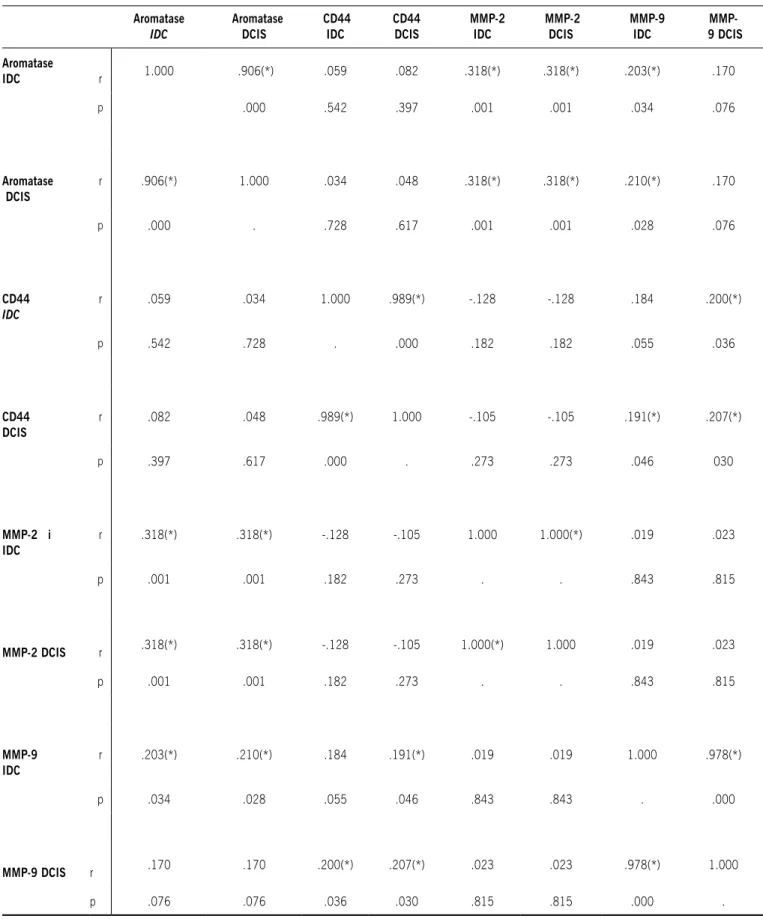
When only IDC regions were considered, a statistically
signiicant positive correlation was found between aromatase
and MMP-2 (p=0.01) and between aromatase and MMP-9 (p=0,034). When only the DCIS was evaluated the statistical
analysis showed a statistically signiicant positive correlation
between aromatase and MMP-2 (p=0.001) and between MMP-9 and CD44 (p=0.03). (Table 2)
There was no statistically signiicant correlation when the
expression of aromatase, MMP-2, MMP-9 and CD44 with histo-logical grade, nuclear grade, age, axillary lymph node status and hormonal status was analyzed.
d
IscussIonThe estrogen function in all phases of breast carcinogenesis is well established. It is found in women of reproductive age and also in post-menopausal1,3. The great difference between these two phases of life is that in postmenopausal women extra-ovarian aromatase plays a fundamental role in the estrogen synthesis (7,12).
The peripheral conversion of androgens to estrogens occurs in the adipose tissue, muscle, skin and also in the breast tissue
itself and especially in the latter, signiicant enhancement of
conversion due to higher levels of aromatase expression is asso-ciated with malignant changes 10,35,36.
In our study we detected aromatase expression, by immu-nohistochemistry, in 57.3% of IDC cases and in 60% of DCIS
cases showing a signiicant correlation (p<0.01). These results
agree with the theory that high aromatase expression in tumor epithelium favors tumor formation, especially when aromatase expression is more frequent in DCIS than IDC disclosing the fundamental role of this enzyme in the initial phases of carcino-genesis. Others authors found similar results37,31,35.
The high expression of aromatase in our study corroborates
the inding of Bulun et al. (2004)11, where in normal breast tissue, promoter I.4 acts while promoters I.3 and II act minimally.
In breast cancer tissues they veriied the action of promoter I.4
whereas 1.3 and II were extremely higher, and the action of promoter I.7, resulted in high estrogen concentration.
In relation to the nuclear grade our results are similar to those found by Hudelist et al. (2008)12 ,who evaluated 96 samples of DCIS, and 104 samples of DCIS and IDC in the same samples.
They found that in DCIS there was no statistically signiicant
difference in aromatase expression between high, moderate and low grade tumors. However Silva et al. (1989)38, differently, found higher aromatase expression in nuclear grade III (p=0.03).
Some studies have evaluated prognosis of patients that present higher aromatase expression; Silva et al. (1989)38 showed that higher aromatase expression correlates with lower disease free survival (p<0.05). Eppenberger et al. (2001)39 found that women with high aromatase expression in breast cancer have increased
Table 1 - Immunohistochemical expression of aromatase, mmP-2, mmP-9 and CD44 in Invasive ductal carcinoma (IDC) and Ductal
carcinoma in situ (DCIS) on 110 cases
Biomarker absolute number (%)
Aromatase
idc 63 (57.3%)
dcis 67 (60%)
MMP-2
Idc 15 (13.60%)
dcis 15 (13.60%)
MMP-9
idc 83 (75.50%)
dcis 82 (74.50%)
CD44
Idc 49 (44.50%)
dcis 48 (42.60%)
Table 2 - Correlation between the expression of aromatase, mmP-2, mmP-9 and CD44 in 110 IDC and DCIS cases
aromatase
IDC
aromatase DCIS
CD44 IDC
CD44 DCIS
mmP-2 IDC
mmP-2 DCIS
mmP-9 IDC
mmP- 9 DCIS
aromatase
IDC r 1.000 .906(*) .059 .082 .318(*) .318(*) .203(*) .170
p .000 .542 .397 .001 .001 .034 .076
aromatase DCIS
r .906(*) 1.000 .034 .048 .318(*) .318(*) .210(*) .170
p .000 . .728 .617 .001 .001 .028 .076
CD44
IDC
r .059 .034 1.000 .989(*) -.128 -.128 .184 .200(*)
p .542 .728 . .000 .182 .182 .055 .036
CD44 DCIS
r .082 .048 .989(*) 1.000 -.105 -.105 .191(*) .207(*)
p .397 .617 .000 . .273 .273 .046 030
mmP-2 i IDC
r .318(*) .318(*) -.128 -.105 1.000 1.000(*) .019 .023
p .001 .001 .182 .273 . . .843 .815
mmP-2 DCIS r .318(*) .318(*) -.128 -.105 1.000(*) 1.000 .019 .023
p .001 .001 .182 .273 . . .843 .815
mmP-9 IDC
r .203(*) .210(*) .184 .191(*) .019 .019 1.000 .978(*)
p .034 .028 .055 .046 .843 .843 . .000
mmP-9 DCIS r .170 .170 .200(*) .207(*) .023 .023 .978(*) 1.000
p .076 .076 .036 .030 .815 .815 .000 .
risk of relapse and death (p<0.05). Lu et al. (2007)22 in the
univariate survival analysis showed that aromatase is signiicantly
and positively associated with decreased overall survival (OS) (p= 0.04) in the estrogen receptor (ER) and/or progesterone receptor (PR), positive patients (10 year OS 100% for the aromatase-negative group compared with 85.1% for the aromatase-positive group). However, in the multivariate survival analysis, we did
not ind this association to be signiicant (p> 0.05). In the ER and PR negative cases, there were no signiicant OS differences
between aromatase negative and aromatase positive patients in
either univariate or multivariate analysis (p> 0.05).
For local invasion to occur the basal membrane must be disrupted. MMPs are proteolytic enzymes which can degrade the structural elements of the extracellular matrix. This isplays an important role in invasion by extracellular matrix remodelling, liberating and activating growth factors, and cytokines, thereby facilitating tumor invasion 40,16. Studies have shown that in many types of cancer the MMPs expression are elevated and associated with poor prognosis 41,19,42. In breast cancer MMP-2 and MMP-9 are the main MMPs related with this type of cancer 19.
In our study MMP-2 expression was positive in 13.6% of IDC and in DCIS cases with perfect positive correlation (cc = 1). MMP-9 was positive in 75.5% in IDC and in 74.5% in
DCIS with statistically signiicant correlation (p<0.01). Di et al.
(2005)21 and Lu et al. (2007)22 using polyclonal antibodies for immunohistochemistry analyzed only IDC and found positive values similar to ours (72.3% and 62.7% respectively). When evaluating MMP-2 they found higher values of positivity (68.7% and 58.6% respectively). Kohrmann et al. (2009) 43 evaluated normal breast tissues and IDC specimens and found higher expression of MMP-2 and MMP-9 in the tumors.
When we evaluated only IDC we found a statistically
signiicant positive correlation between aromatase and MMP-2
(p=0.001) and between aromatase and MMP-9 (p=0.034). Similar results were obtained by Di et al. (2005) and Lu et al. (2007) with p<0.001 21,22.
These results and others that show positive correlation between aromatase and MMP-2 and aromatase and MMP-9 increase the possibility that aromatase can elevate the invasion capacity of tumor cells by increasing the activity of MMP-2 and MMP-9. It is possible that with a higher expression of aromatase, there is a higher activity and action of MMPs for degrading the extracellular matrix and favoring disease progression.
When we evaluated only DCIS we found a statistically signiicant
positive correlation between aromatase and MMP-2 and MMP-9 and CD44 (p=0.030). The positive correlation between aromatase and
MMP-2 in DCIS conirms the tendency that neoplasia, which shows
aromatase expression, has higher invasion potential.
A melanoma study by Yu and Stamenkovic (2000) 44 and a prostate study by Desai et al. (2007) 26 showed a fundamental connection between CD44 and MMP-9, as the latter acts in degrading the basal membrane and initiates local invasion. Ours results showing a positive correlation between MMP-9 and CD44
(p=0.030) corroborate indings by these authors and Peng et al.
(2007) 28 who observed MMP-9 and CD44 correlation in breast cancer cells. These results are an indication that CD44 acts as a docking site for MMP-9 and that formation of the CD44/MMP-9 complex on the cellular surface probably is necessary for MMP-9 action.
c
onclusIonAfter analysis of our results we can conclude that aromatase from local breast tissue estrogen synthesis play an important
role in breast carcinogenesis, inluencing mainly MMP-2 and
MMP-9 which are important participants in tumor invasion and their probable dependence of their conection with CD44 to act. These results allow us to consider that use of aromatase inhi-bitors (AI) acts in the prevention and treatment of breast cancer not just because of reduction in blood and local concentration of estrogen but also because of the action on important pathways for tumor progression where the CD44/MMP-9 complex plays a fundamental role. It is possible that use of some substances which inhibit MMPs isolated or associated with AI, may be a promising target for researchers of breast cancer treatment.
Conlict of interest: none
r
esuMoa Interaçãoentre aroMatase, MetalloproteInase 2, 9e cd44 nocâncerdeMaMa
ObjetivO. O objetivo desse estudo é verificar as expressões e correlações da aromatase, metalloproteinase 2 da matriz (MMP2), metalloproteinase 9 da matriz (MMP-9) e CD44 no
carcinoma ductal in situ (CDIS) e carcinoma ductal infiltrativo
(CDI) quando ambos estão presentes simultaneamente na mesma mama.
MétOdOs. Foram avaliados 110 casos pelo método de tissue microarray (TMA) e através da utilização de anticorpos policlonais antiaromatase, anticorpos monoclonais anti-MMP-2, anticorpos policlonais anti-MMP-9 e anticorpos monoclonais anti-CD44.
ResultadOs. A aromatase estava expressa de forma positiva no CDI e CDIS em 63 (57,3%) e 60 (67%) casos, respecti-vamente. A expressão de MMP-2 estava expressa de forma positiva em 15 (13,6%) casos tanto no CDI, quanto no CDIS. A expressão da MMP-9 estava expressa de forma positiva em 83 (75,5%) e 82 (74,5%) casos de CDI e CDIS, respectivamente. A expressão de CD44 estava expressa de forma positiva em 49 (44,5%) e 48 (42,6%) casos de CDI e CDIS, respectiva-mente. Todos eles apresentando alta correlação (p<0,001). Na avaliação de correlação foi encontrada correlação positiva estatisticamente significante no CDI entre aromatase e MMP-2 (p<0,01) e entre aromatase e MMP-9 (p=0,034). Nos casos de CDIS houve correlação positiva estatisticamente significante entre aromatase e MMP-2 (p<0,001) e entre CD44 e MMP-9 (p=0,030).
COnClusãO. Após analisarmos os resultados de nosso estudo, podemos concluir que a aromatase, através da síntese de estrogênio local no tecido mamário, desempenha importante papel na carcinogênese mamária, principalmente influenciando a atuação da MMP-2 e da MMP-9, grandes responsáveis pela invasão celular tumoral que, por sua vez, provavelmente dependem de sua ligação a CD44 para poder desempenhar suas
funções. [Rev Assoc Med Bras 2010; 56(4): 472-7]
Unitermos: Aromatase. Metaloproteinase 2 da matriz.
r
eFerences1. Henderson IC, Canellos GP. Cancer of the breast: the past decade. N Engl J Med. 1990;302:17-30.
2. Pasqualini JR, Chetrite GS. Recent insight on the control of enzymes involved in estrogen formation and transformation in human breast cancer. J Steroid Biochem Mol Biol. 2005;93:221-36.
3. Russo J, Russo IH. The role of estrogen in the initiation of breast cancer. J Steroid Biochem Mol Biol. 2006;102:89-96.
4. American Cancer Society. Breast cancer facts & igures 2007-2008. Atlanta: American Cancer Society, Inc. Available from: http://www.cancer.gov. 5. Russo J, Hasan Lareef M, Balogh G, Guo S, Russo IH. Oestrogen and its
metabolites are carcinogenic agents in human breast epithelial cells. J Steroid Biochem Mol Biol. 2003;87:1-25.
6. Simpson ER. Sources of estrogen and their importance. J Steroid Biochem Mol Biol. 2003;86:225-30.
7. Subramanian A, Salhab M, Mokbel K. Oestrogen producing enzymes and mammary carcinogenesis: a review. Breast Cancer Res Treat. 2008;111:191-202.
8. Chetrite GS, Cortes-Prieto J, Philippe JC, Wright F, Pasqualini JR. Comparison of estrogen concentrations, estrone sulfatase and aromatase activities in normal, and in cancerous, human breast tissues. J Steroid Biochem Mol Biol. 2000;72:23-7.
9. Prichard RS, Hill AD, Dijkstra B, McDermott EW, OHiggins NJ. The prevention of breast cancer. Br J Surg. 2003;90:772-83.
10. Suzuki T, Miki Y, Nakamura Y, Moriya T, Ito K, Ohuchi N, et al. Sex steroid-producing enzymes in human breast cancer. Endocr Relat Cancer. 2005;12:701-20.
11. Bulun SE, Takayama K, Suzuki T, Sasano H, Yilmaz B, Sebastian S. Orga-nization of the human aromatase p450 (CYP19) gene. Semin Reprod Med 2004;22:5-9.
12. Hudelist G, WülWng P, Kersting C, Burger H, Mattsson B, Czerwenka K, et al. Expression of aromatase and estrogen sulfotransferase in preinvasive and invasive breast câncer. J Cancer Res Clin Oncol. 2008;134:67-73. 13. Nagase H, Visse R, Murphy G. Structure and function of matrix
metalloprotein-ases and TIMPs. Cardiovasc Res. 2006;69:562-73.
14. Page-McCaw A, Ewald AJ, Werb Z. Matrix metalloproteinases and the regulation of tissue remodelling. Nat Rev Mol Cell Biol. 2007;8:211-33.
15. Puente XS, López-Otín C. A genomic analysis of rat proteases and protease inhibitors. Genome Res. 2004;14:609-22.
16. Sternlicht MD, Werb Z. How matrix metalloproteinases regulate cell behavior. Annu Rev Cell Dev Biol. 2001;17:463-516.
17. Iwasaki M, Nishikawa A, Fujimoto T, Akutagawa N, Manase K, Endo T, et al. Anti-invasive effect of MMI-166 new selective matrix metalloproteinase inhibitor, in cervical carcinoma cell lines. Gynecol Oncol. 2002;85:103-7. 18. Kato Y, Yamashita T, Ishikawa M. Relationship between expression of matrix
metalloproteinase-2 and matrix metalloproteinase-9 and invasion ability of cervical cancer cells. Oncol Rep. 2002;9:565-9.
19. Li HC, Cao DC, Liu Y, Hou YF, Wu J, Lu JS. Prognostic value of matrix metal-loproteinases (MMP-2 and MMP-9) in patients with lymph node-negative breast carcinoma. Breast Cancer Res Treat. 2004;88:75-85.
20. Vizoso FJ, González LO, Corte MD, Rodríguez JC, Vasquez J, Lamelas ML, et al. Study of matrix metalloproteinases and their inhibitors in breast cancer. Br J Cancer. 2007;96:903-11.
21. Di GH, Lu JS, Song CG, Li HC, Shen ZZ, Shao ZM. Over expression of aromatase protein is highly related to MMPs levels in human breast carcinomas. J Exp Clin Cancer Res. 2005;24:601-7.
22. Lu J, Li H, Cao D, Di G, Wu J, Sheng K, et al. Clinical signiicance of aromatase protein expression in axillary node negative breast cancer. J Cancer Res Clin Oncol. 2007;133:401-9.
23. Cichy J, Puré E.The liberation of CD44. J Cell Biol. 2003;161:839-43. 24. Okamoto I, Tsuiki H, Kenyon LC, Goldwin AK, Emlet DR, Holgado-Madruga M,
et al. Proteolytic cleavage of the CD44 adhesion molecule in multiple human tumors. Am J Pathol. 2002;160:441-7.
25. Abraham BK, Fritz P, McClellan M, Hauptvogel P, Athelogou M, Brauch H. Prevalence of CD44 /CD24-/low cells in breast cancer may not be associated
with clinical outcome but may favor distant metastasis. Clin Cancer Res. 2005;11:1154-9.
26. Desai B, Rogers MJ, Chellaiah MA. Mechanisms of osteopontin and CD44 as metastatic principles in prostate cancer cells. Mol Cancer. 2007;6:18. 27. Samanna V, Ma T, Mak TW, Rogers M, Chellaiah MA. Actin polymerization
modulates CD44 surface expression, MMP-9 activation, and osteoclast func-tion. J Cell Physiol. 2007;213:710-20.
28. Peng ST, Su CH, Kuo CC, Shaw CF, Wang HS. CD44 crosslinking-mediated matrix metalloproteinase-9 relocation in breast tumor cells leads to enhanced metastasis.Int J Oncol. 2007;31:1119-26.
29. Dabbs DJ. Ductal carcinoma of breast: nuclear grade as a predictor of S-phase fraction. Hum Pathol. 1993;24:652-6.
30. Elston CW, Ellis IO. Pathological prognostic factors in breast cancer. I. The value of histological grade in breast cancer: experience from a large study with long-term follow-up. Histopathology. 1991;19:403-10.
31. Oliveira VM, Piato S, Silva MA. Correlation of cyclooxygenase-2 and aroma-tase immunohistochemical expression in invasive ductal carcinoma, ductal carcinoma in situ, and adjacent normal epithelium. Breast Cancer Res Treat. 2006;95:235-41.
32. Ellis MJ, Tao Y, Young O, White S, Proia AD, Murray J, Renshaw L, et al. Estrogen-independent proliferation is present in estrogen-receptor HER2-positive primary breast cancer after neoadjuvant letrozole. J Clin Oncol. 2006;24:3019-25.
33. Ristimäki A, Sivula A, Lundin J. Prognostic signiicance of elevated cyclooxy-genase-2 expression in breast cancer. Cancer Res. 2002;62:632-5. 34. Bernard R. Fundamentals of biostatistics. 2nd ed. Boston: Buxbury Press; 1986.
35. Shibuya R, Suzuki T, Miki Y, Yoshida K, Moriya T, Ono K, et al. Intratumoral concentration of sex steroids and expression of sex steroid-producing enzymes in ductal carcinoma in situ of human breast. Endocr Relat Cancer. 2008;15:113-24.
36. Oliveira VM, Ribeiro LS, Rossi LM, Silva MA, Aldrigui JM, Bagnoli F, et al. Aromatase expression in invasive and in situ ductal carcinoma present in the same breast. Rev Assoc Med Bras. 2009 ;55:651-5.
37. Díaz-Cruz ES, Shapiro CL, Brueggemeier RW. Cyclooxygenase inhibitors suppress aromatase expression and activity in breast cancer cells. J Clin Endocrinol Metab. 2005;90:2563-70.
38. Silva MC, Rowlands MG, Dowsett M, Gusterson B, Mckinna JA, Fryatt I, et al. Intratumoral aromatase as a prognostic factor in human breast carcinoma. Cancer Res. 1989;49:2588-91.
39. Eppenberger-Castori S, Kueng W, Benz C, Caduff R, Varga Z, Bannwarrt F, et al. Prognostic and predictive signiicance of ErbB-2 breast tumor levels measured by enzyme immunoassay. J Clin Oncol. 2001;19:645-56.
40. Ellerbroek SM, Stack MS. Membrane associated matrix metalloproteinases in metastasis. Bioessays. 1999;21:940-9.
41. Curran S, Dundas SR, Buxton J, Leeman MF, Ramsay R, Murray GI. Matrix metal-loproteinase/tissue inhibitors of matrix metalloproteinase phenotype identiies poor prognosis colorectal cancers. Clin Cancer Res. 2004;10:8229-34. 42. Pellikainen JM, Ropponen KM, Kataja VV, Kellokoski JK, Eskelinen MJ, Kosma
VM. Expression of matrix metalloproteinase (MMP)-2 and MMP-9 in breast cancer with a special reference to activator protein-2, HER2, and prognosis. Clin Cancer Res. 2004;10:7621-8.
43. Köhrmann A, Kammerer U, Kapp M, Dietl J, Anacker J. Expression of matrix metalloproteinases (MMPs) in primary human breast cancer and breast cancer cell lines: new indings and review of the literature. BMC Cancer. 2009;16:188.
44. Yu Q, Stamenkovic I. Cell surface-localized matrix metalloproteinase-9 proteo-lytically activates TGF-beta and promotes tumor invasion and angiogenesis. Genes Dev. 2000;14:163-76.