SUMMARY
Objective: To describe pregnancies with conjoined twins according to the request for legal termination of pregnancy. Methods: Retrospective review of pregnancies with con joined twins, with no possibility of extrauterine survival or postnatal surgical separation, observed at a tertiary teaching hospital, between 1998 and 2010. Results: Amongst 30 cases seen during the study period, six (20.0%) couples decided to continue with the pregnancy, termination of pregnancy was not requested due to advanced gestational age (> 25weeks) in 5 cases (16.7%). Legal authorization to terminate the pregnancy was re quested in 19 (63.3%) cases: permission was granted in 12 (63.2%), denied in ive (26.3%) and information was missing in two (10.5%) cases. A successful vaginal delivery was performed in 83.3% of the cases undergoing termination of pregnancy and a cesarean section was performed in all the remaining cases (p < 0.01). Conclusion: In pregnancies with conjoined twins and without fetal prognosis, legal termination of the pregnancy is an alternative. Moreover, a successful vaginal delivery can be performed in most cases before the third trimester, further reducing maternal risks and parental sufering.
Keywords: Twins conjoined; legal abortion; ultrasonography prenatal; pregnancy com plications; pregnancy multiple.
Study conducted at the Department of Obstetrics and Gynecology of Faculdade de Medicina da Universidade de São Paulo, Universidade de São Paulo, São Paulo, SP
Submitted on: 11/15/2010
Approved on: 01/23/2011
Correspondence to:
Roseli Mieko Yamamoto Nomura Av. Dr. Enéas de Carvalho Aguiar
255, 10º andar CEP: 05403-000 São Paulo – SP [email protected]
Conlict of interests: None.
Conjoined twins and legal authorization for abortion
ROSELI MIEKO YAMAMOTO NOMURA1, MARIADE LOURDES BRIZOT2, ADOLFO WENJAW LIAO3, WAGNER RODRIGUES HERNANDEZ2, MARCELO ZUGAIB4
1 Lecturer (Tenured Professor) in Obstetrics; Associated Professor at the Department of Obstetrics and Gynecology of Faculdade de Medicina da Universidade de São Paulo, São Paulo, SP 2 Assistant Physician at the Obstetrics Clinic of Hospital das Clínicas da Faculdade de Medicina da Universidade de São Paulo, São Paulo, SP
INTRODUCTION
In the last decades, technological advances in Reproductive Medicine have been associated with the increase in multiple pregnancies, as well as the complications associated with this event and among them, the occurrence of fetal abnor malities. Among the fetal development abnormalities, the most severe one is the development of conjoined or Siamese twins, with an estimated incidence of 1:50,000 to 1:200,000 gestations13.
Conjoined twins are classiied according to the most prominent site of connection, together with the term pagus, which indicates fusion: thoracopagus (thoracic union); om phalopagus (abdominal union); parapagus (extensive lateral union); pygopagus (sacral union); ischiopagus (lower abdo men and pelvis union); cephalopagus (head and encephalon union); craniopagus (cranial union) and rachipagus (verte bral column union)4.
he ultrasonographic diagnosis can be carried out from the 12th week of gestation5 and the early detection is crucial for planning the conduct in the pregnancy, as well as for fam ily counseling6. Survival in cases submitted to surgical sepa ration depends on the degree of organ sharing between the fetuses and associated malformations. In this context, cardi ac unions are the conditions associated with worse progno sis7,8. Many conjoined twins, without perspective of postnatal surgical separation, die within a few hours ater birth9.
In Brazil, the legal permission for abortion includes only the situations where the pregnancy was the result of rape or when there is risk of death for the mother. In cases of lethal fetal malformation, such as anencephaly, the couple can ap ply for legal permission to terminate the pregnancy. As it is a rare event, few reference centers have cases of conjoined twins whose parents applied for legal authorization to ter minate the pregnancy.
he Judicial System is also rarely called upon to decide on these cases of such elevated complexity. In cases where fetal survival has been considered impossible, the abortion has been authorized, which abbreviates the mother’s suf fering and minimizes the risk of complications during the pregnancy and birth.
When there is extensive vital organsharing, in which the postnatal separation is not possible and when that is the parent’s wish, the legal authorization for the abortion has been requested. he objective of the present article was to describe cases of conjoined twins in whom the postnatal surgical separation was not possible due to severe organ sharing and extrauterine survival was considered impos sible, describing the cases according to the request or not for legal authorization to terminate the pregnancy.
METHODS
Cases of multiple pregnancies with a diagnosis of conjoined twins followed by the Service of Multiple Pregnancy of a university hospital, from June 1998 to June 2010 were ret
rospectively analyzed. he study was approved by the Eth ics Committee in Research of the institution, protocol # 0212/10.
he following inclusion criteria were adopted: diagnosis of twin pregnancy with conjoined twins at the irst assess ment in this service; conclusive assessment of postnatal sur gical separation or survival and followup at the institution. he data were collected from the medical iles and hospital birth registers.
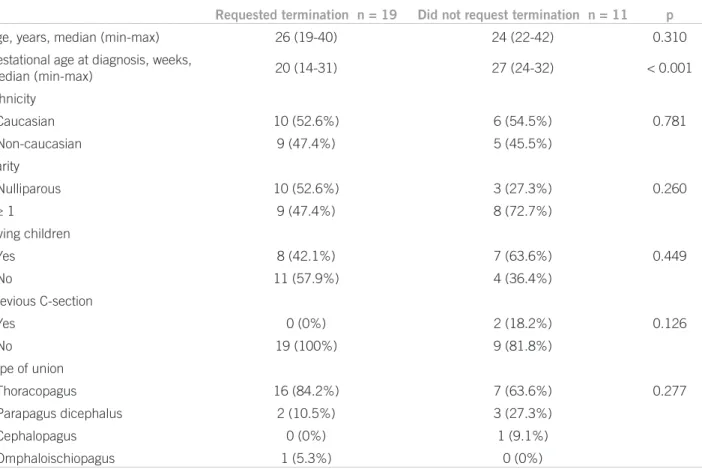
A total of 37 cases of pregnancies with conjoined twins were identiied. One case had a diagnosis of fetal death at the irst ultrasonographic assessment and was not included in the analysis. In six cases there was a prognosis of possible postnatal surgical separation and were not included in the analysis, either. he present study analyzed the data from 30 pregnancies with a diagnosis of conjoined twins in whom postnatal surgical separation or survival was considered impossible. he data concerning the characteristics of this population are shown in Table 1.
he pregnant women were evaluated for more than one ultrasonographist from the Fetal Medicine team, to characterize the site of twin union and evaluate the exten sion of organsharing. he presence of other associated malformations was also investigated and a specialized fetal echocardiography was performed to determine prognosis and the possibility of surgical separation when the fetuses shared the heart.
he following data were investigated: gestational age at diagnosis, prognosis related to fetal lethality, legal authori zation or not to terminate the pregnancy, type of delivery, birth complications, product of conception weight, gesta tional age and the following demographic variables: ma ternal age, marital status, parity, number of living children and prior cesarean section (Csection). he weight of the conjoined twins was measured in the birth room.
he following criteria were adopted for requesting legal authorization to terminate the pregnancy: lethality of the fetal malformation and fetal union; lack of prognosis for postnatal surgical separation; gestational age < 25 weeks and no contraindication for vaginal delivery. In cases of gestational age > 25 weeks, or when the couple did not want to terminate the gestation, the pregnancy was fol lowed until its resolution.
In these cases, the parents received multidisciplinary assistance on ofers of support measures to guarantee the basic comforts to the twins ater the birth.
In cases where the couple chose to request legal autho rization to terminate the pregnancy, the ultrasonography and echocardiography reports were provided, which in cluded details of the examination indings and prognostic report on the fetuses.
diagnostic and prognostic indings and psychological as sessment. he report was signed by two doctors from the Fetal Medicine team that participated in the assessment. Copies of literature articles on the fetal condition, support ing the lethal condition of the case, were added to the re port. he pregnant woman/couple was advised to present the legal authorization request to terminate the pregnancy at a Court of Justice in the city/town where they lived. Af ter the judge’s decision, the patient returned to the service to follow the decision.
he prognosis of lethality was characterized by ex tensive union of vital organs (heart and liver), with com plex cardiac malformation. Once the legal authorization was granted to terminate the pregnancy, fetal death was induced, followed by vaginal delivery. Cervix prepara tion and birth induction were initiated on the same day ater fetal death was induced, when the ultrasonographic assessment showed that the largest diameter of the con joined parts and the fused cephalic poles would not be an impediment to birth.
he results were analyzed using the sotware Statistica for Windows (release 4.3, Statsot, Inc., 1993). he vari ables were analyzed descriptively, by calculating medians, minimum and maximum values, absolute and relative fre quencies. he categorical and semiquantitative data were assessed by the Chisquare test or Fisher’s Exact test, when
indicated. Continuous variables were analyzed by Mann Whitney U test. he level of signiicance was set at p < 0.05.
RESULTS
A total of 30 cases of multiple gestations with conjoined twins were assessed, with a prognosis of impossible post natal surgical separation or survival. Of the 25 cases to whom the possibility of requesting legal authorization to terminate the pregnancy was ofered, 76% chose to ter minate and 24% (six cases) chose to maintain the preg nancy. he characteristics of the gestations in the cases that requested or not legal authorization to terminate the pregnancy are shown in Table 1. In ive cases with gesta tional age > 25 weeks at the diagnosis of conjoined twin pregnancy, the termination was not discussed. Of the 19 cases for which the legal authorization to terminate the pregnancy was requested, 12 (63.2%) requests were granted by the judge and the abortion was authorized, ive (26.3%) requests were denied and two (10.5%) did not return to our service and were lost to followup. he characteristics of the 17 cases for which the legal decision to terminate or not was known are shown in Table 2. In the group that chose to terminate the pregnancy, vaginal delivery occurred in 83.3%, but in the group for which the legal authorization was denied, a Csection was per formed in 100% of the cases (p < 0.01).
Table 1 – Maternal characteristics in cases of conjoined twins and type of fetal union according to the request or not of legal authorization for pregnancy termination
Requested termination n = 19 Did not request termination n = 11 p
Age, years, median (min-max) 26 (19-40) 24 (22-42) 0.310
Gestational age at diagnosis, weeks,
median (min-max) 20 (14-31) 27 (24-32) < 0.001
Ethnicity
Caucasian 10 (52.6%) 6 (54.5%) 0.781
Non-caucasian 9 (47.4%) 5 (45.5%)
Parity
Nulliparous 10 (52.6%) 3 (27.3%) 0.260
≥ 1 9 (47.4%) 8 (72.7%)
Living children
Yes 8 (42.1%) 7 (63.6%) 0.449
No 11 (57.9%) 4 (36.4%)
Previous C-section
Yes 0 (0%) 2 (18.2%) 0.126
No 19 (100%) 9 (81.8%)
Type of union
Thoracopagus 16 (84.2%) 7 (63.6%) 0.277
Parapagus dicephalus 2 (10.5%) 3 (27.3%)
Cephalopagus 0 (0%) 1 (9.1%)
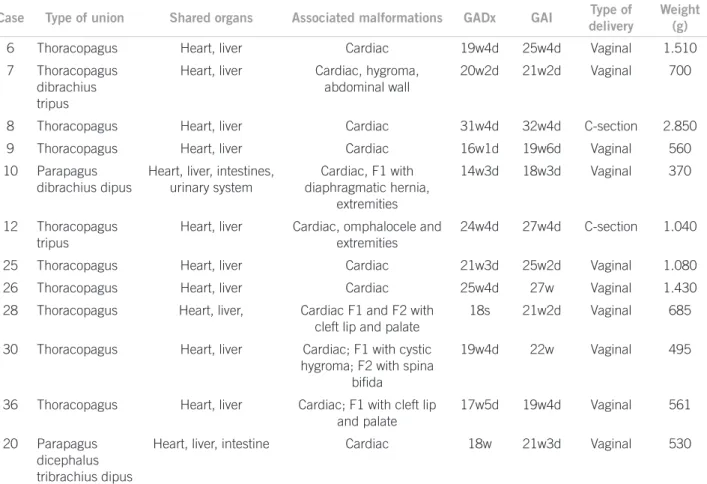
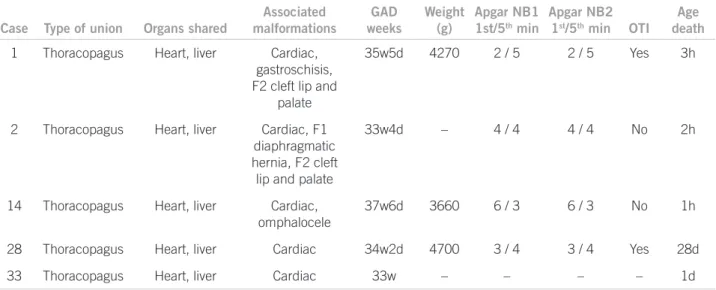
Table 3 shows the description of the cases for which the legal authorization to terminate the pregnancy was granted. he ive cases that were denied authorization are shown in Table 4. hree cases had other associated mal formations, in addition to the cardiac ones. As for the cardiac union, all cases had atrial and ventricular union and in four cases the twins died within the irst three hours ater birth and in one case, on the 28th day ater the birth.
DISCUSSION
Although there have been many publications on con joined twins, few have analyzed the characteristics of the cases in which the pregnancy was terminated. In coun tries where abortion is legal, couples are free to choose this option. However, in Brazil, as the presence of fetal anomalies incompatible with extrauterine survival is not among the situations established by the Law as the ones that allow the termination of pregnancy (when the preg
Table 2 – Characteristics of the diagnoses and birth data in cases of conjoined twins according to the legal authorization or not to interrupt the pregnancy
Authorized n = 12 Non-authorized n = 5 p value
GA at diagnosis, weeks, median (min-max) 20 (14-32) 24 (22-26) 0.050
Type of union
Thoracopagus 10 (83.3%) 5 (100%) 1.00
Parapagus dicephalus 2 (16.7%) 0 (0%)
GA at abortion/delivery. weeks. median (min-max) 22 (19-33) 34 (33-38) 0.002
Type of birth
Vaginal 10 (83.3%) 0 (0%) 0.003
C-Section 2 (16.7%) 5 (100%)
Weight of twins. g. median (min-max) 693 (370-2850) 4270 (3660-4700) 0.009
GA, gestational age.
Table 3 – Clinical description of cases of conjoined twins in which the mother received legal authorization to terminate the pregnancy
Case Type of union Shared organs Associated malformations GADx GAI Type of
delivery
Weight (g)
6 Thoracopagus Heart, liver Cardiac 19w4d 25w4d Vaginal 1.510
7 Thoracopagus
dibrachius tripus
Heart, liver Cardiac, hygroma,
abdominal wall
20w2d 21w2d Vaginal 700
8 Thoracopagus Heart, liver Cardiac 31w4d 32w4d C-section 2.850
9 Thoracopagus Heart, liver Cardiac 16w1d 19w6d Vaginal 560
10 Parapagus
dibrachius dipus
Heart, liver, intestines, urinary system
Cardiac, F1 with diaphragmatic hernia,
extremities
14w3d 18w3d Vaginal 370
12 Thoracopagus
tripus
Heart, liver Cardiac, omphalocele and
extremities
24w4d 27w4d C-section 1.040
25 Thoracopagus Heart, liver Cardiac 21w3d 25w2d Vaginal 1.080
26 Thoracopagus Heart, liver Cardiac 25w4d 27w Vaginal 1.430
28 Thoracopagus Heart, liver, Cardiac F1 and F2 with
cleft lip and palate
18s 21w2d Vaginal 685
30 Thoracopagus Heart, liver Cardiac; F1 with cystic
hygroma; F2 with spina biida
19w4d 22w Vaginal 495
36 Thoracopagus Heart, liver Cardiac; F1 with cleft lip
and palate
17w5d 19w4d Vaginal 561
20 Parapagus
dicephalus tribrachius dipus
Heart, liver, intestine Cardiac 18w 21w3d Vaginal 530
nancy was the result of rape or when there is risk of death for the mother), couples who decide to interrupt the pregnancy must request legal authorization to undergo the procedure, prolonging parental sufering and anxiety.
he present study demonstrated that, when the malfor mation lethality was conirmed, 76% of the couples chose to request legal authorization to terminate the pregnancy. Of the cases for which the authorization was requested, 63% obtained a favorable decision and the abortion was authorized. he median gestational age at pregnancy in terruption was 22 weeks. he mean interval to obtain the legal authorization was approximately three weeks in the 12 cases that had a favorable decision. In cases where the Justice System denied authorization to terminate the pregnancy, the delivery was carried out by Csection and all twins died, four cases on the same day of the birth and one case on the 28th day ater the birth.
Pregnancy termination in cases of conjoined twins and no possibility of extrauterine survival aims at mini mizing the maternal risks associated with the diicul ties posed by the birth of conjoined fetuses, which are invariably delivered by Csection when they reach the third gestational trimester, as well as the risks inherent to the maintenance of a twin pregnancy. he abortion per formed up to the second trimester allows a vaginal birth, reducing the risk of maternal complications and without submitting the woman to a procedure that can damage her uterus and her reproductive health, mainly when the uterine incision is in a corporal (vertical) portion. Once submitted to a corporal Csection, the subsequent births will mandatorily occur by Csection, as the risk of uter ine rupture is wellknown in pregnant women with a pre vious history of corporal Csection.
he Court of Justice of the State of São Paulo, in a decision regarding the authorization to terminate a pregnancy with conjoined twins, airms: “his Court of Justice has decided that, considering the impossibility of extra-uterine survival, the abortion shall be permitted, with the objective of abbreviating maternal sufering, out of deference to their grief, their health and dignity” (Legal authorization # 990.09 1002879 Santos – 6th Court of Justice Judge Marco Antonio 21.05.09).
he impossibility to perform the postnatal surgical separation of conjoined twins is determined by the severity and complexity of cardiac union and in cases that can result in unacceptable severe deformities. his situation includes thoracopagus twins with complex cardiac union and the cephalopagus or craniopagus, when the surgical separation can result in neurological sequelae10,11. hroughout 12 years, 37 twin pregnancies with conjoined twins were diagnosed in this institution. hat is a relevant series of cases, when compared to the ones described in the literature1217. In a epi demiological study carried out in Spain2, the authors analyzed the incidence of conjoined twins in two periods (1980 to 1985 and 1986 to 2006) and reported a decrease in the incidence of conjoined twin births ater the abortion legalization.
he median gestational age at the irst ultrasonograph ic assessment was relatively late in the second trimester, 24 weeks, when compared with two series in the USA pub lished in 199018 and 200214, in which the mean gestational ages were 18.5 and 19.8 weeks and in which 64.3% and 21.4% of the cases the pregnancy was terminated in the irst weeks of the second trimester.
In a literature review of cases of conjoined twins diag nosed below the 15th week, Pajkrt and Jauniaux19 found 50 published cases, of which 41 (82%) decided to terminate the pregnancy.
Table 4 – Clinical description of cases of conjoined twins in which the mother was denied legal authorization for interrupting the pregnancy
Case Type of union Organs shared
Associated malformations
GAD weeks
Weight (g)
Apgar NB1
1st/5th min
Apgar NB2
1st/5th min OTI
Age death
1 Thoracopagus Heart, liver Cardiac,
gastroschisis, F2 cleft lip and
palate
35w5d 4270 2 / 5 2 / 5 Yes 3h
2 Thoracopagus Heart, liver Cardiac, F1
diaphragmatic hernia, F2 cleft lip and palate
33w4d – 4 / 4 4 / 4 No 2h
14 Thoracopagus Heart, liver Cardiac,
omphalocele
37w6d 3660 6 / 3 6 / 3 No 1h
28 Thoracopagus Heart, liver Cardiac 34w2d 4700 3 / 4 3 / 4 Yes 28d
33 Thoracopagus Heart, liver Cardiac 33w – – – – 1d
he more frequent indication for routine ultrasonog raphy in the irst trimester of pregnancy in several coun tries provides an early diagnosis of fetal abnormalities. he correct diagnosis, before the viability, allows the parents to choose to request or not legal authorization for preg nancy termination, and, consequently, minimizes mater nal morbidity, as the pregnancy interruption at an earlier gestational age has fewer risks. In this study, in the cases in which the authorization was granted and the abortion was performed, the necropsy assessment conirmed the ind ings described in the prenatal assessment and all cases in which the pregnancy was maintained resulted in neonatal death without surgical separation.
In the present study, the request for legal authoriza tion for pregnancy termination followed the recommen dations of the Regional Council of Medicine of the State of São Paulo (Conselho Regional de Medicina do Estado de São Paulo)20. he gestational age at the time of pregnancy termination is clinically important, as the earlier the abor tion is performed, the lower the maternal risks are. Vagi nal delivery is successful due to the lexibility of sot tissue connecting the fetuses and due to the smaller total volume of fetuses.
Although the literature has many reports on conjoined twins, addressing several medical, ethical and legal as pects, maternal complications are seldom described and detailed. In a review of cases performed by Harper et al.21, comprehending published cases of omphalopagus in three hundred years, the authors found a description of dystocia in 36% of them and a stillbirth rate of 19%. Rode et al.16 de scribed a 40year experience with cases of conjoined twins and reported one maternal death during delivery. In the series described by Al Rabeeah12 birth canal trauma is re ported in two of ive cases that underwent vaginal delivery. Conjoined twins attract many ethical and legal argu ments2225. With the advances in Medicine, several di agnostic evaluations allow detailed assessments of their anatomical features. he ethical and medical challenges appear when the twins share vital organs, such as the heart and liver, preventing postnatal surgical separation or ex trauterine survival. his vital organsharing can accom pany fetal losses, neonatal death and early deterioration of one twin.
In practice, in cases of conjoined gestations where ex trauterine survival is not possible, the physicians must in form the parents clearly, respecting their opinions, their cultural factors and religious beliefs. he decision must be made by the parents, ater being counseled by the medi cal team, considering the best interest of the pregnant woman’s health. From the prenatal diagnosis, during the pregnancy followup, the parents must discuss and plan with the medical team the possible measures to be ad opted. Conidentiality must be guaranteed by all involved and public and media sensationalism must be avoided at
all costs23,25. he approach in each case must be coherent with the decisions made jointly and the parents must be encouraged to seek religious counseling, if they wish so. Moreover, the parents must be assured that they have total control over the decision process regarding the conducts to be adopted.
Conjoined twin pregnancy represents a highseverity diagnosis, as in many cases the shared organs and the ex tension of fetal union result in characteristics that prevent postnatal surgical separation or extrauterine survival.
he choice to terminate the pregnancy can be attained by requesting legal authorization for the abortion. Once the request is granted in the second trimester of pregnan cy, vaginal delivery is the usual procedure, decreasing the risks to the pregnant woman’s health and minimizing pa rental sufering.
REFERENCES
1. Castilla EE, LopezCamelo JS, Orioli IM, Sánchez O, Paz JE. he epidemiology of conjoined twins in Latin America. Acta Genet Med Gemellol. 1988;37:1118.
2. MartínezFrías ML, Bermejo E, Mendioroz J, RodríguezPinilla E, Blanco M, Egüés J et al. Epidemiological and clinical analysis of a consecutive series of conjoined twins in Spain. J Pediatr Surg. 2009;44:81120.
3. Spencer R. heoretical and analytical embryology of conjoined twins: part I: embryogenesis. Clin Anat. 2000;13:3653.
4. McHugh K, Kiely EM, Spitz L. Imaging of conjoined twins. Pediatr Radiol. 2006;36:899910.
5. Wenstrom KD, Syrop CH, Hammitt DG, Van Voorhis BJ. Increased risk of monochorionic twinning associated with assisted reproduc tion. Fertil Steril. 1993;60:5104.
6. Taner MZ, Kurdoglu M, Taskiran C, Kurdoglu Z, Himmetoglu O, Balci S. Early prenatal diagnosis of conjoined twins at 7 weeks and 6 days gestation with twodimensional Doppler ultrasound: a case report. Cases J. 2009;2:8330.
7. Andrews RE, McMahon CJ, Yates RW, Cullen S, de Leval MR, Kiely
EM et al. Echocardiographic assessment of conjoined twins. Heart
2006;92:3827.
8. Zhang YQ, Wu LP, Wu LJ, Chen GZ, Sun K, Zhang ZF et al. Echo cardiographic assessment of conjoined twins with congenital heart disease in Shanghai. Echocardiography 2009;26:6918.
9. Groner JI, Teske DW, Teich S. Dicephalus dipus dibrachius: an un usual case of conjoined twins. J Pediatr Surg. 1996;31:1698700. 10. Spitz L, Kiely EM. Experience in the management of conjoined
twins. Br J Surg. 2002;89:118892.
11. Spitz L. Conjoined twins. Prenat Diagn. 2005;25:8149.
12. Al Rabeeah A. Conjoined twinspast, present, and future. J Pediatr Surg. 2006;41:10004.
13. Berezowski AT, Duarte G, Rodrigues R, Carvalho Cavalli R, Santos RO, Andrade Vicente YA et al. Gêmeos conjugados: experiência de um hospital terciário do sudeste do Brasil. Rev Bras Ginecol Obstet. 2010;32:615.
14. Mackenzie TC, Crombleholme TM, Johnson MP, Schnaufer L, Flake AW, Hedrick HL et al. he natural history of prenatally diagnosed conjoined twins. J Pediatr Surg. 2002;37:3039.
15. ONeill JA Jr, Holcomb GW 3rd, Schnaufer L, Templeton JM Jr, Bish op HC, Ross AJ 3rd et al. Surgical experience with thirteen conjoined twins. Ann Surg. 1988;208:299312.
16. Rode H, Fieggen AG, Brown RA, Cywes S, Davies MR, Hewitson
JP et al. Four decades of conjoined twins at Red Cross Childrens
Hospitallessons learned. S Afr Med J. 2006;96:93140.
18. Barth RA, Filly RA, Goldberg JD, Moore P, Silverman NH. Con joined twins: prenatal diagnosis and assessment of associated mal formations. Radiology 1990;177:2017.
19. Pajkrt E, Jauniaux E. Firsttrimester diagnosis of conjoined twins. Prenat Diagn. 2005;25:8206.
20. Conselho Regional de Medicina do Estado de São Paulo. Ética em ginecologia e obstetrícia. 3ª ed. São Paulo: Conselho Regional de Medicina do Estado de São Paulo; 2004.
21. Harper RG, Kenigsberg K, Sia CG, Horn D, Stern D, Bongiovi V. Xiphopagus conjoined twins: a 300year review of the obstetric, morphopathologic, neonatal, and surgical parameters. Am J Obstet Gynecol. 1980;137:61729.
22. Atkinson L. Ethics and conjoined twins. Childs Nerv Syst. 2004;20:5047.
23. Bratton MQ, Chetwynd SB. One into two will not go: conceptualis ing conjoined twins. J Med Ethics. 2004;30:27985.
24. Rafensperger J. A philosophical approach to conjoined twins. Pedi atr Surg Int. 1997;12:24955.