PEDIATRIC TEST OF SPEECH INTELLIGIBILITY
WITH IPSILATERAL COMPETITIVE MESSAGE:
NARRATIVE REVIEW ABOUT ITS APPLICABILITY
Teste de identificação de sentenças sintéticas
com mensagem competitiva ipsilateral pediátrico:
revisão narrativa sobre a sua aplicabilidade
Fernanda Freitas Vellozo(1), Valdete Alves Valentins dos Santos Filha(2), Maristela Julio Costa(2),
Eliara Pinto Vieira Biaggio(2), Michele Vargas Garcia(2)
(1) Universidade Federal de Santa Maria (UFSM), Santa
Maria, RS, Brasil.
(2) Departamento de Fonoaudiologia da Universidade Federal
de Santa Maria (UFSM), Santa Maria, RS, Brasil.
Conlict of interest: non-existent
learning diiculties, however, the peripheral hearing, may be within the normal ranges2.
These skills are needed in order for information processing, among them: the detection of sound, location, attention, selective attention, igure-ground, binaural integration and separation, closure, recog
-nition, discrimination, association, comprehension
and memorization3.
The evaluation of the auditory processing (AP) is used as a super-injunction subjective measure hearing ability that enables greater understanding of the communication function and it is useful in quantifying the hearing impairment resulting from functional deicits in the auditory system4.
To evaluate the AP, international literature recom
-mends the inclusion of auditory discrimination test, dichotic of binaural interaction, temporal auditory processing and low redundancy in monaural set of assessments of central auditory processing5.
INTRODUCTION
Auditory processing is deined by perception at the central level of the sonorous stimuli picked up by the peripheral auditory system, with subjective responses, that is, the ability of the nervous system has to use the information that comes by hearing1. Diagnostic and therapeutic techniques have presented evolution enabling greater precision in identifying the Auditory Processing Disorder (APD).
The APD can be deined as a complex and hetero
-geneous group of changes in auditory processing, commonly associated with a number of hearing and
ABSTRACT
Auditory Processing is the capacity of the nervous system has to use the information that comes by hearing. The auditory skills are necessary so that there information processing. Behavioral tests are used to evaluate auditory processing disorders such as Pediatric Test of Speech Intelligibility with Ipsilateral Competitive Message (PSI/MCI), which assesses the ability of igure-ground for verbal sounds. It is about a narrative review that aims to identify the applicability of PSI test, in the last ten years. A search of the database: Lilacs, PubMed, Medline, IBCS and SciELO, was used as descriptors: auditory perception, hearing tests, auditory perceptual disorders, hearing, comprehension, combined with the word PSI. Have been found 52 items, being selected, read in their entirety and analyzed only eight articles. It was observed a large variability in their application, proving to be an important assessment tool in diferent populations and age groups.
The sources which were used for this survey are national and international scientiic literature published in the last 10 years (2004-2014). The sources were selected for research in electronic databases in the system of the Latin American Literature on Health Sciences (Lilacs), National Center for Biotechnology Information, U.S. National Library of Medicine (PubMed and Medline), Information Behavior in Everyday Contexts (IBECS)
and Scientiic Eletronic Library Online (SciELO).
The descriptors used for the location of the articles were: auditory perception, hearing tests, disorder of auditory perception, hearing, understanding with their corresponding to the English language
(Auditory perception, Hearing Tests, auditory perceptual disorders, hearing e comprehension),
through structured vocabulary Health Sciences Descriptors (DeCS), prepared by the Virtual Health Library - Medicine®. In addition to descriptors, in all studies was added as a word, PSI stands for greater iltering.
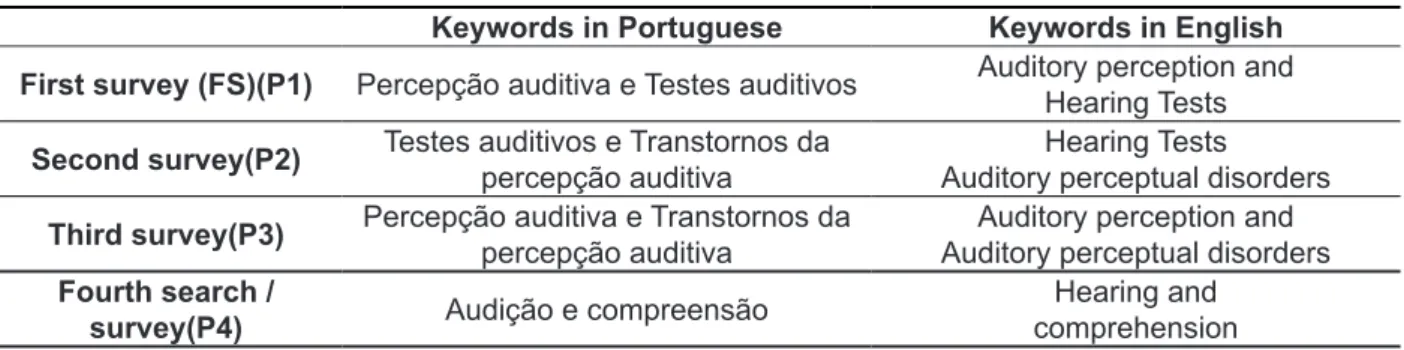
In the irst study (P1) descriptors were combined: hearing tests, hearing the word perception and PSI; the second survey (P2) were combined: disorder of auditory perception, hearing tests and PSI; the third survey (P3) was combined: auditory perception, auditory perception disorder and the word PSI. A fourth survey was conducted (P4) with descriptors: listening and understanding, along with the word PSI.
As selection criteria were used scientiic articles published in the last ten years in Portuguese and / or English, indicating the use of PSI in its methodology. The selection resulted from the prior reading of titles and abstracts in databases, which showed research conducted with PSI Test.
The initial search found 52 articles, of which eight were selected. 44 articles were excluded, 31 of them because they are duplicated in two or more databases, nine for not having the full text available and 4 in which the researchers did not use the PSI test methodology were excluded.
The eight articles that met the selection criteria were analyzed and read in full.
Table 1 shows the search strategies used for
literature.
These tests measure the ability to distinguish similar features in stimuli that difer in frequency, intensity and duration; the ability to integrate or separate the diferent auditory stimuli presented in each ear simultaneously; evaluating the binaural processes (Diotic) which depend on intensity diference of time and sound; the ability to analyze acoustic events as a function of time and the discrimination of modiied speech stimuli by ear5.
To assess the ability of igure-ground for verbal sounds, from the low redundancy tests, there is the Synthetic Sentence Identiication Test with Ipsilateral Competitive Message (SSI) and its version for children, Synthetic Sentence Identiication Test with Message competitive Ipsilateral Pediatric (PSI). The aim of these (tests) is to provide information about the physiological auditory mechanism of verbal sound recognition in dichotic listening monotic and, with the recommendation for adults and the elderly SSI (once it requires reading ability) and children PSI (with igures)6.
This ability is the primary message ID in the presence of competitive sounds and the ability to realize it is very important in the execution of daily activities such as conversation in a noisy environment and the learning of a school subject,
eg6.
There is a need to understand the searches which have been realized through PSI test, since it is a pediatric testing and often have the need to use it in adults or older people with diiculty reading, for example. So, in this context, a narrative review of the publications being carried out with the PSI might be useful for the interpretation of the knowledge produced in the area. It could help the development of future research, especially in the aspect of adaptation of the test igures PSI, thinking in adults and the elderly.
Thus, the aim of this study was to perform a descriptive review of the PSI auditory processing test, identifying its applicability in the scientiic community over the last ten years.
METHODS
subject in a population of 22 children diagnosed with phonological disorder, aged 5 and 7 years and both genders. The authors observed that all children had 100% success in the PSI, but in other tests used showed changes in temporal organization skills and igure-ground as well, lagged sensory memory, pointing out that such alterations can compromise the acquisition of these traits described10.
The importance of auditory processing issues related to the speech of children and the PSI test was demonstrated in two studies described above, indicating such a test as an important assessment
tool.
The PSI was also used to verify the performance of 27 children from seven to 11 years with isolated cleft palate in auditory processing tests. As regards the PSI / SSI with ipsilateral competitive message, both the average values and the minimum values, they showed bilaterally well below that expected for all signal-to-noise ratios evaluated, showing diiculty in performing this task monotic through of selective attention. However, when the test was carried out with dichotic task the children performed better than monotic11.
Another survey, covering patients with unilateral congenital aural atresia evaluated the possible beneit of binaural hearing in two distinct periods: before and one month after repair surgery. In this article was used the test - Hearing in Noise Test -
HINT or its version for children HINTC-C to assess speech recognition with and without competitive noise, comparing such results with PSI assessment performed in a previous study population with the same characteristics12.
In another study, the authors evaluated 20 aphasic subjects with mild comprehension disorder, in order to verify the performance igure-ground tasks and selective attention to verbal sounds in competing message listener. The subjects had diiculties in understanding, statistically signiicant, in situations of ipsilateral competitive message, the 0 dB and -10 dB situations and also in contralateral
LITERATURE REVIEW
Figure 1 depicts the results of the search in databases, cataloging the titles with their authors,
journal and year.
Analysis of selected studies
Few studies in the compiled literature used the PSI test in the last ten years, which would it the criteria of this review with a visa period, descriptors and searchable databases. However, the analysis thereof indicates an application of variability in diferent samples. The articles analyzed showed similarity in relation to their goals, methods and indings, but in diferent populations.
Among the studies found, the PSI was one of the tests used for verifying the maturation of auditory processing in students with ages eight, nine and ten, with and without learning diiculties in order to check the response improves with increasing age in auditory processing skills. The response of improvement in both groups was observed, noting that the children group with learning diiculties presented a lower performance in all the tests applied to the three age groups, suggesting delayed maturation of auditory processing skills7.
In another study, we compared 30 children aged between four and seven years old, born preterm and full-term, pointed up delay on some auditory processing, noting it worse performance in preterm children than children born at term8.
Other authors, who studied the relationship between auditory processing and the acquisition of normal and disordered speech in 44 children between ive and seven years, found that children with speech deviant had lower results than those with normal speech in all tests, including the PSI, concluding that the auditory processing can interfere in speech development9.
The relationship between auditory skills and combinations of traits present in the speech of children with phonological disorders was a research
Table 1 – Descriptors used to search the databases in this study
Keywords in Portuguese Keywords in English
First survey (FS)(P1) Percepção auditiva e Testes auditivos Auditory perception andHearing Tests
Second survey(P2) Testes auditivos e Transtornos da
percepção auditiva Auditory perceptual disordersHearing Tests
Third survey(P3) Percepção auditiva e Transtornos da percepção auditiva Auditory perceptual disordersAuditory perception and
Fourth search /
survey(P4) Audição e compreensão
Title Author Journal Year 1. O processamento auditivo e a
combinação de traços distintivos na aquisição de fala em crianças com desvios fonológicos. Auditory processing and combination of distinctive features in speech acquisition in children with phonological
disorders
2. Avaliação do processamento auditivo em crianças nascidas pré-termo.
3. Auditory processing in children with normal and disordered speech. Processamento auditivo em crianças com fala normal e desviante.
4. Understanding speech in noise after correction of congenital unilateral aural atresia: efects of age the emergence of binaural squelch but not in use of head-shadow.
5.Crianças com issura isolada de palato: desempenho nos testes de processamento
auditivo.
6. Compreensão de fala em situação de mensagem competitiva em afásicos.
7. Maturação do processamento auditivo em crianças com e sem diiculdades escolares
8. Processamento auditivo em idosos: estudo da interação por meio de testes com estímulo verbais e não-verbais
Quintas VG, Attoni TM, Keske-Soares M, Mezzomo CL.
Gallo J, Dias K.Z, Pereira L.D, Azevedo M,
Sousa EC.
Quintas VG, Attoni, TM, Keske-Soares M, Mezzomo C L.
Lincoln G, Bradley K, Erika C.
Boscariol M,André K D,Feniman M R.
Ortiz KZ, Peroni CV.
Neves IF, Schochat E.
Pinheiro MMC, Pereira L D.
Rev Soc Bras
Fonoaudiol
J Soc Bras Fonoaudiol
Braz. j. otorhinolaryngol
Braz J Otorhinolaryngol.
Int J Pediatr Otorhinolaryngol.
Rev. CEFAC
Pró-Fono R. Atual. Cient
Braz J Otorhinolaryngol
2011
2011
2010
2009
2009
2008
2005
2004
Figure 1 – Included papers references in Literature Review
competitive messages in the relation- 40 dB evident diiculties in understanding verbal stimuli in such tasks13.
The PSI was applied to 110 elderly subjects, aged 60 to 85 years, in order to characterize the aspect of the interaction of verbal and non-verbal in elderly patients with and without hearing loss. The authors observed that the test of sound localization and the PSI showed a signiicant dependence on the degree of hearing loss. These results might contribute in order to elucidate how the brain injury, the efects of age and consequently the loss of auditory perceptual skills can interfere with understanding information
in day-to-day, where various messages that occur competitively14.
The last two studies mentioned above, relatively recent, demonstrate the possibility of applying the PSI in adults. Despite being a test developed for children, the PSI may be used in adults with language disorders, elderly and illiterate with visual diiculties to be unit to perform the SSI. So, the need for adaptation of this evaluation tool for an adult version may be a new facet that must be considered for future research.
We conclude that in the past decade few studies have been performed with the PSI and a descriptive review lies researchers on research that should be conducted. For adult and elderly population, with inability to perform SSI, an adaptation in the PSI igures can contribute to higher test applicability in identifying the skill of background igure for verbal
sounds.
CONCLUSION
We conclude that in the past decade few studies have been performed with the PSI and a descriptive review lies researchers on research that should be conducted. For adult and elderly population, with inability to perform SSI, an adaptation in the PSI igures can contribute to higher test applicability in identifying the skill of background igure for verbal
sounds.
the best choice of the tests to be applied in diferent subjects.
In most of the literature studies the PSI test was applied in its population, originally children, but was also applied in aphasic adults and seniors.
It could be seen with this study the possibility of holding a descriptive review with the PSI test and observe its application in a population of variability, addressing diferent aspects such as the evaluation of the PA maturation and speech development processes and their traits in children, as well as language disorders in adults and elderly, as they have changes that hinder the performance of other tests for such evaluation (SSI). The PSI has
proven to be an important evaluation tool auditory
processing in diferent populations and age groups because their results were altered in children with learning diiculties in premature infants, in children with deviant talks with cleft palate in aphasic and
elderly.
RESUMO
O Processamento auditivo é a capacidade que o sistema nervoso tem para usar a informação que chega pela audição. As habilidades auditivas são necessárias para que haja o processamento das informações. Testes comportamentais são utilizados para avaliar desordens do processamento audi
-tivo, como o Teste de Identiicação de Sentenças Sintéticas com Mensagem Competitiva Ipsilateral Pediátrico (PSI), que avalia a habilidade de igura-fundo para sons verbais. Trata-se de uma revisão narrativa que objetiva identiicar a aplicabilidade do teste PSI, nos últimos dez anos. Uma busca nas
bases de dados: Lilacs, PubMed, Medline, IBCS e SciELO foi realizada, utilizando-se como descrito
-res: percepção auditiva, testes auditivos, transtorno da percepção auditiva ,audição, compreensão, combinados com a palavra PSI. Foram encontrados 52 artigos, sendo selecionados, lidos na íntegra e analisados, apenas, oito artigos. Pôde-se observar grande variabilidade em sua aplicação, demons
-trando ser uma eicaz ferramenta de avaliação do processamento auditivo em diferentes populações e faixas etárias.
DESCRITORES: Percepção Auditiva; Testes Auditivos; Transtornos da Percepção Auditiva; Audição; Compreensão
REFERENCES
1.Yalçinkaya F, Muluk, NB, Sahin S. Efects of listening ability on speaking, writing and reading skills of children who were suspected of auditory processing diiculty. Int J Pediatr Otorhinolaryngol.
2009;73(8):1137–42.
2.Chermak GD, Musiek E. Auditory training: principles and approachesfor remediating and managing auditory processing disorders. Semin Hear. 2002;23(4):297-308.
3.Azevedo MF, Pereira LD. Terapia para desordem do Processamento Auditivo Central em Crianças. In: Pereira LD, Schochat E. Processamento auditivo central: Manual de avaliação. São Paulo: Lovise,
1997. p.69-77.
de fala em crianças com desvios fonológicos. Auditory processing and combination of distinctive features in speech acquisition in children with phonological disorders. Rev Soc Bras Fonoaudiol.
2011;16(2):167-73.
11. Boscariol M, André KD,Feniman M R.Crianças com issura isolada de palato: desempenho nos testes de processamento auditivo.Braz J Otorhinolaryngol. 2009;75(2):213-20.
12. Lincoln G, Bradley K, Erika C. Understanding speech in noise after correction of congenital unilateral aural atresia:Efects of age in the emergence of binaural squelch but not in use of head-shadow. Int J Pediatr Otorhinolaryngol.
2009;73(9):1281-7.
13. Ortiz KZ, Peroni CV. Compreensã o de fala em situação de mensagem competitiva em afásicos.
Rev CEFAC. 2008;10(2):226-32.
14. Pinheiro MMC, Pereira LD. Processamento auditivo em idosos: estudo da interação por meio de testes com estímulo verbais e não-verbais. Braz J Otorhinolaryngol. 2004;70(2):209-14.
5. American Speechand Language hearing Association. Central auditory processing Disorders [ technical Report ]. 2005.
6. Pereira LD, Schochat E. Testes auditivos comportamentais para avaliação do processamento auditivo central. Ed Pró Fono; 2011.
7. Neves I F, Schochat E. Maturação do processamento auditivo em crianças com e sem diiculdades escolares. Pró-Fono R Atual Cient.
2005;17(3):311-20.
8. Gallo J, Dias KZ, Pereira LD, Azevedo M, Sousa EC. Avaliação do processamento auditivo em crianças nascidas pré-termo. J Soc Bras Fonoaudiol.
2011;23(2):95-101.
9. Quintas VG, Attoni TM, Keske-Soares M, Mezzomo CL. Auditory processing in children with normal and disordered speech. Processamento auditivo em crianças com fala normal e desviante. Braz. j. otorhinolaryngol. 2010;76 (6):718-22. 10. Quintas VG, Attoni TM, Keske-Soares M, Mezzomo CL. O processamento auditivo e a combinação de traços distintivos na aquisição
Received on: February 10, 2015 Accepted on: July 06, 2015
Mailing address:
Fernanda Freitas Vellozo
Rua Marisa Franco Rosa, nº 07, quadra 32, Bairro Tancredo Neves
Santa Maria – RS – Brasil
CEP: 97032-320